Free Email Lead Sources in 2026: What Actually Works
Free email lead sources look identical until you send. Here's what free tiers, scrapers, and directories actually deliver in 2026 — bounce rates, hidden limits, and when paying beats free.
TL;DR
- A "free email lead" is only worth something if it's deliverable. Most free sources hand you addresses that bounce at 20-40%, which costs you domain reputation you can't buy back.
- The three honest free channels in 2026 are vendor free tiers (25-50 credits/month), public data you collect yourself (site footers, press pages, LinkedIn exports), and directory scraping — each with a different failure mode.
- Free tiers from real vendors beat scrapers because the address is verified before you get it. Tomba's free tier gives 25 searches/month; Hunter gives 25; Findymail gives none.
- The break-even point is roughly 300-500 contacts/month. Below that, stack free tiers. Above it, a $49/mo plan is cheaper than the deliverability damage.
- Never send to a free-sourced list without running it through an email verifier first. That single step is the difference between a 2% and a 30% bounce rate.
What Is a Free Email Lead, Exactly?#
A free email lead is a business contact — name, company, work email — that you obtained without paying per record. That's the whole definition, and it hides an enormous quality range.
Think of it like tap water versus bottled. Both are water. One arrives pre-tested against a standard; the other might be fine, or might have picked up something on the way through the pipe. You can't tell by looking, only by drinking. Email addresses work the same way: sarah.chen@acme.com looks identical whether it came from a verified provider or from a regex run over a company's careers page. The difference only shows up in your bounce report, three days after you sent 2,000 emails.
Free email leads come from four structurally different places, and each has its own predictable weakness:
- Vendor free tiers — Tomba, Hunter, Snov.io and others give a monthly credit allowance. The data is verified before delivery, so quality matches their paid tier exactly. The constraint is volume, not accuracy.
- Self-collected public data — contact pages, press releases, conference speaker lists, GitHub commit histories, podcast show notes. Genuinely free and often highly targeted, but slow and inconsistently formatted.
- Pattern guessing — you know the company uses
first.last@domain.com, so you generate the rest. Costs nothing, but produces unverified guesses. An email permutator makes this fast; it does not make it accurate. - Scraped directories and lists — Crunchbase exports, forum member lists, "free B2B lead list" downloads. Highest volume, lowest quality, and frequently the same recycled data circulating for years.
The mistake most teams make is treating these as interchangeable because the price is identical. They aren't. Source 1 and source 4 differ in deliverability by an order of magnitude.
How Do Free Email Lead Sources Actually Compare?#
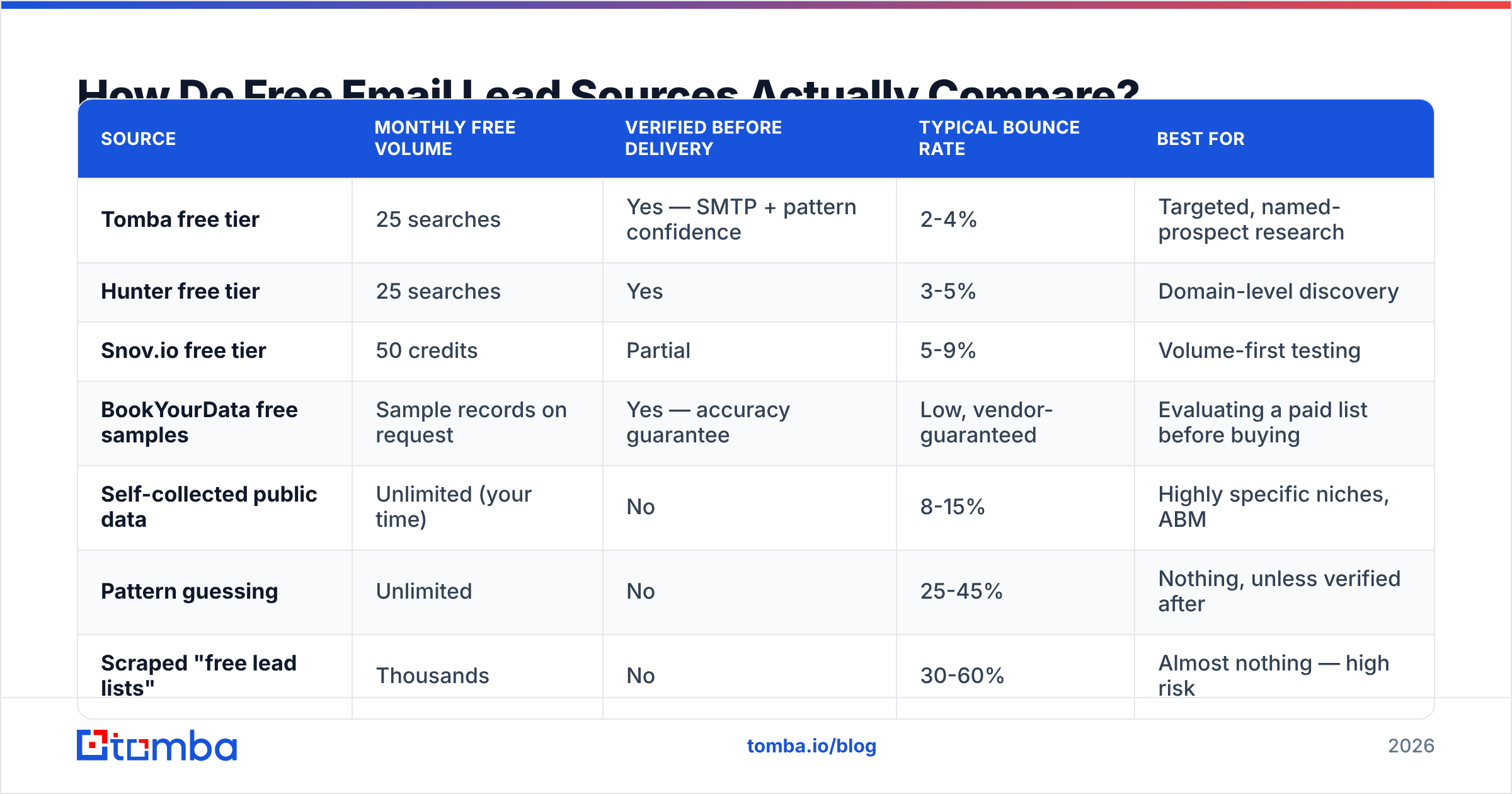
Here's the honest layout. Volumes reflect publicly listed free-tier allowances as of early 2026; check the vendor page before you build a process on them, since free tiers change more often than paid ones.
| Source | Monthly free volume | Verified before delivery | Typical bounce rate | Best for |
|---|---|---|---|---|
| Tomba free tier | 25 searches | Yes — SMTP + pattern confidence | 2-4% | Targeted, named-prospect research |
| Hunter free tier | 25 searches | Yes | 3-5% | Domain-level discovery |
| Snov.io free tier | 50 credits | Partial | 5-9% | Volume-first testing |
| BookYourData free samples | Sample records on request | Yes — accuracy guarantee | Low, vendor-guaranteed | Evaluating a paid list before buying |
| Self-collected public data | Unlimited (your time) | No | 8-15% | Highly specific niches, ABM |
| Pattern guessing | Unlimited | No | 25-45% | Nothing, unless verified after |
| Scraped "free lead lists" | Thousands | No | 30-60% | Almost nothing — high risk |
Two rows deserve a note. BookYourData is a genuinely different model: rather than a recurring free credit drip, they'll provide sample records so you can test accuracy before committing to a paid list — a fair approach if you're evaluating bulk data and want evidence rather than a claim. And pattern guessing is the most misunderstood row: it's not bad, it's incomplete. A guessed address that then passes verification is a good lead. A guessed address you send blind is a coin flip weighted against you.

Why Do Free Lead Lists Bounce So Much?#
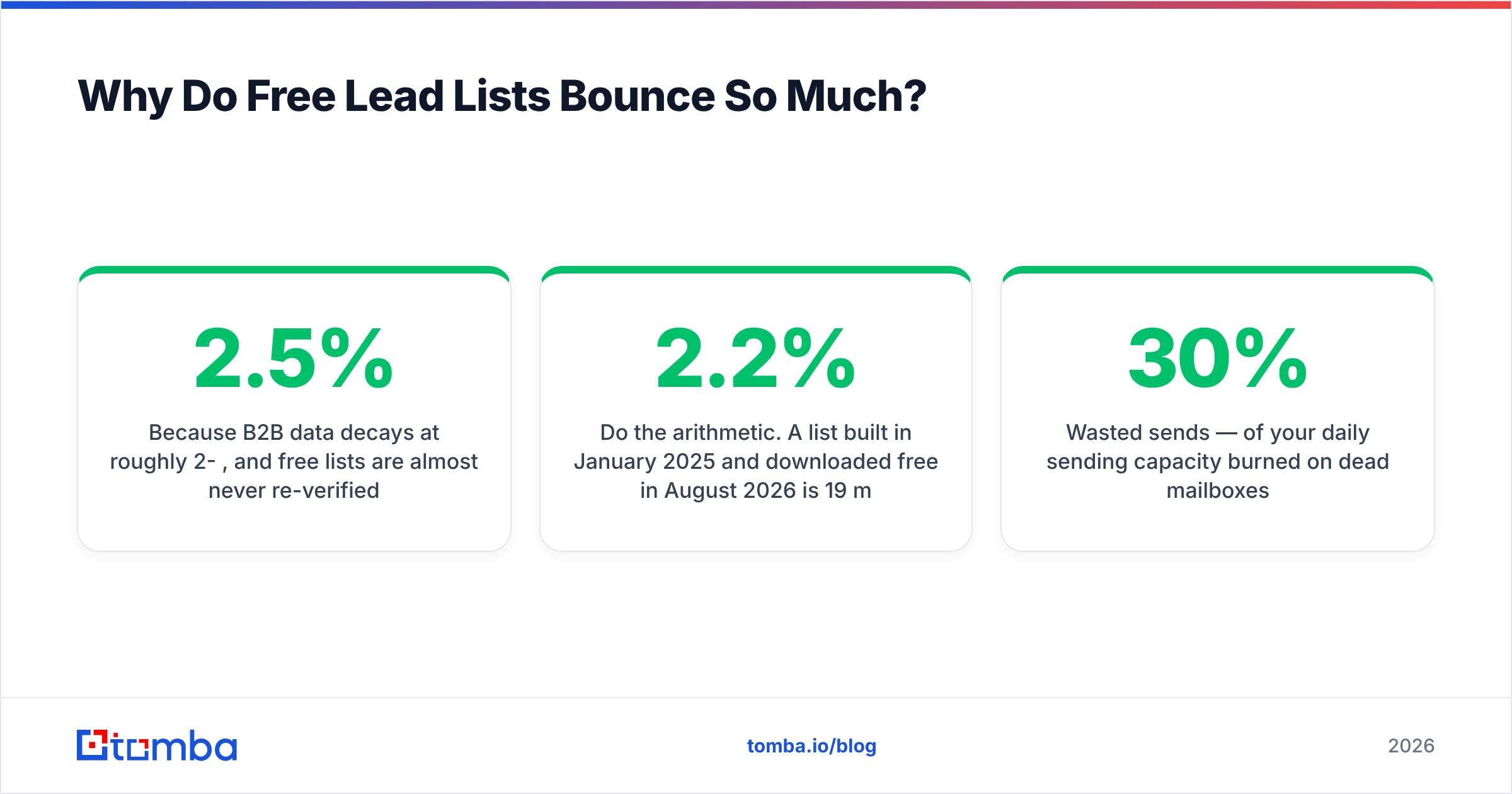
Because B2B data decays at roughly 2-2.5% per month, and free lists are almost never re-verified.
Do the arithmetic. A list built in January 2025 and downloaded free in August 2026 is 19 months old. At 2.2% monthly decay, about 34% of those addresses are already dead — people changed jobs, companies rebranded domains, the mailbox got deprovisioned. Nobody paid to refresh it because nobody was charging for it. That's not a vendor being dishonest; it's the economics of free.
Then there's the second-order cost. Mailbox providers score you on how many invalid recipients you hit. Google and Microsoft both tightened bulk-sender enforcement through 2024-2025, and Google's published bulk sender guidelines now put a hard spam-complaint ceiling on senders. Cross a bounce threshold and your sender reputation drops for every campaign afterward — including the good lists.
So the true cost of a free list isn't zero. It's:
- Wasted sends — 30% of your daily sending capacity burned on dead mailboxes
- Reputation damage — measured in weeks of degraded inbox placement
- Domain risk — in the worst case, a burned sending domain you have to replace
- Spam trap exposure — recycled traps sit in old lists specifically to catch this behavior
Free data that costs you a domain is the most expensive data you'll ever use.
How Do You Get Free Email Leads That Actually Land?#
Stack the free tiers, collect your own public data deliberately, and verify everything before it enters your sequencer. Concretely:
1. Run domain-first, not name-first. Pick 20 target accounts, then use a domain search to pull every discoverable address at each. You spend one credit per domain instead of one per person, which multiplies a 25-credit free tier into potentially hundreds of contacts. This is the single highest-leverage move on a free plan and almost nobody does it.
2. Harvest the places your competitors ignore. Conference speaker pages, podcast guest archives, and open-source contributor lists give you name + company + role for free, and they self-select for people who talk publicly about your problem space. Feed those names into a finder rather than guessing.
3. Use author bylines. If you sell to marketers, every industry blog is a free lead list with job titles attached. An author finder turns a byline into a contact without burning your general search credits.
4. Mine your own traffic. People already on your site are the warmest free leads you own. Website visitor reveal identifies the companies behind anonymous traffic, so you're prospecting into accounts that already showed intent.
5. Verify before every send, without exception. Even verified-at-source data ages. Run the batch through a bulk verify pass the week you send, not the month you collected. Catch-all domains need their own handling — a catch-all verifier tells you whether an accept-all server is masking a dead mailbox.
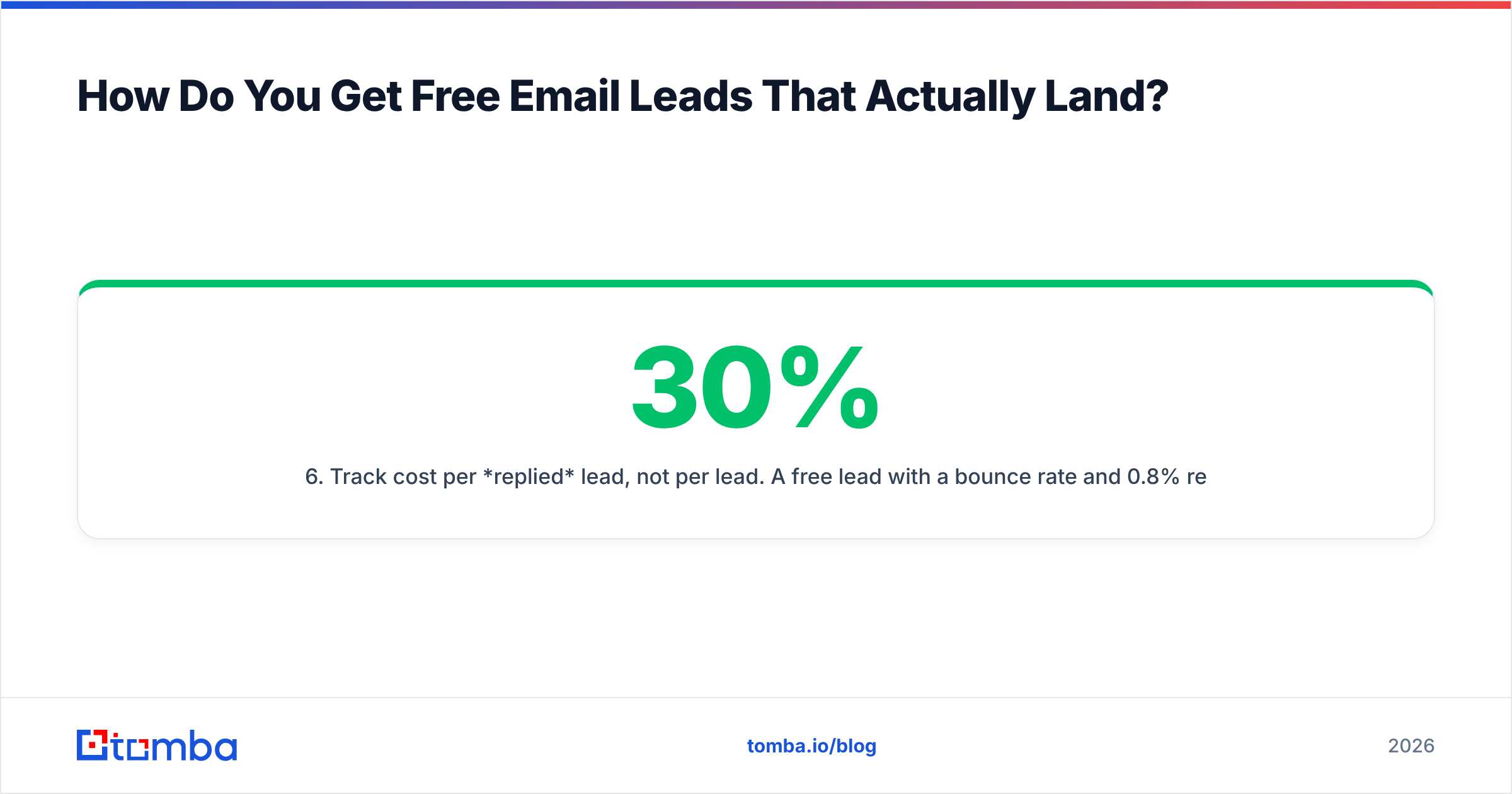
6. Track cost per replied lead, not per lead. A free lead with a 30% bounce rate and 0.8% reply rate is more expensive per conversation than a $0.04 verified record. Measure the metric that pays you.
When Should You Stop Using Free and Start Paying?#
At roughly 300-500 verified contacts per month, or the moment a bounce spike touches your inbox placement — whichever comes first.
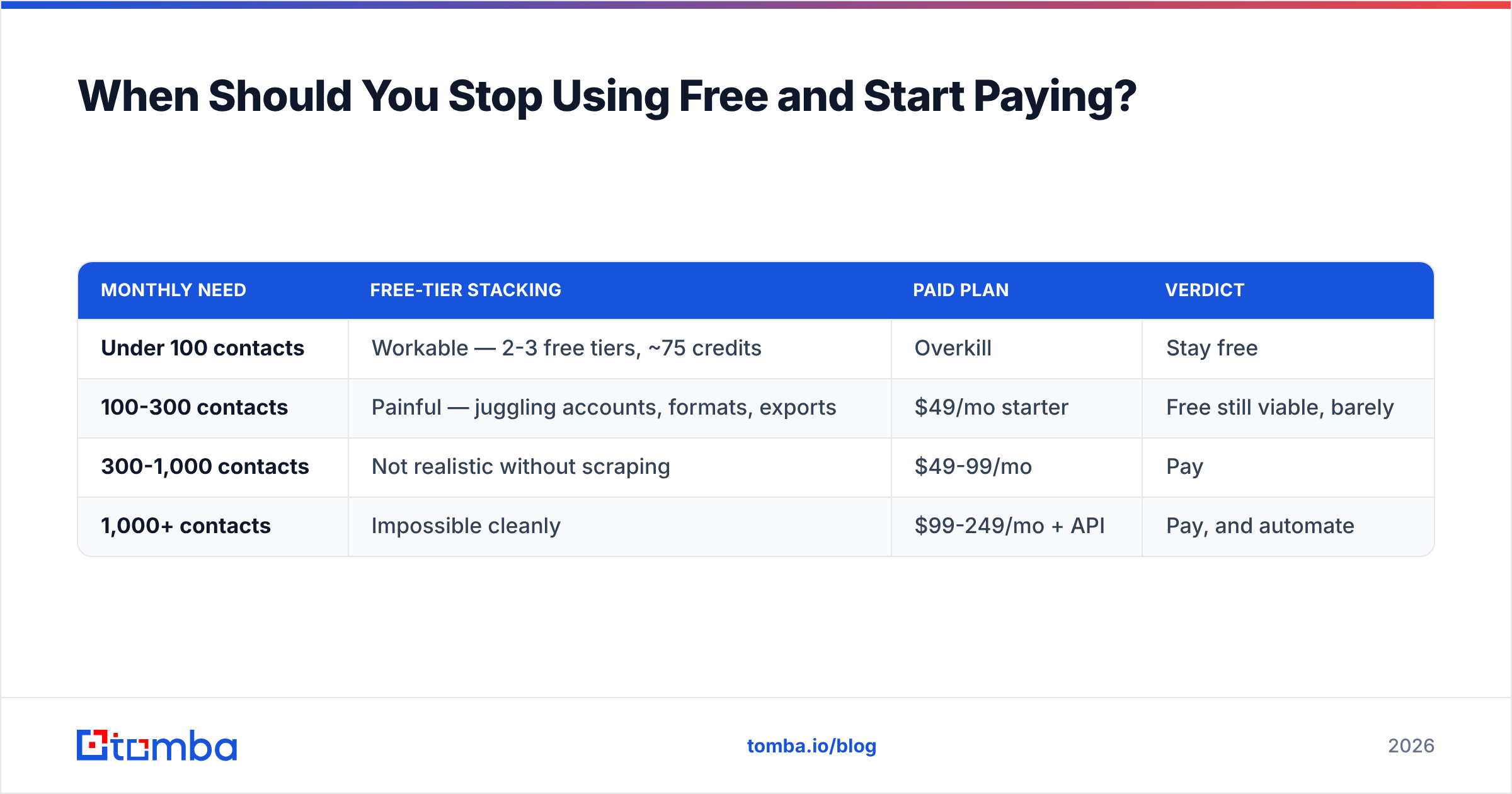
Here's the break-even in plain numbers:
| Monthly need | Free-tier stacking | Paid plan | Verdict |
|---|---|---|---|
| Under 100 contacts | Workable — 2-3 free tiers, ~75 credits | Overkill | Stay free |
| 100-300 contacts | Painful — juggling accounts, formats, exports | $49/mo starter | Free still viable, barely |
| 300-1,000 contacts | Not realistic without scraping | $49-99/mo | Pay |
| 1,000+ contacts | Impossible cleanly | $99-249/mo + API | Pay, and automate |
For reference, Tomba pricing starts with a free tier at 25 searches/month, then Starter at $49/mo, Growth at $99/mo, and Pro at $249/mo, with Enterprise custom. The relevant comparison isn't $49 versus $0 — it's $49 versus the hours you spend stitching three free accounts together plus the deliverability risk you absorb.
There's also a hidden operational cost in staying free too long: no API. Free tiers are UI-only or heavily rate-limited, which means every lead is hand-copied. The moment you want enrichment inside your CRM, a Sheets formula, or a nightly job, you need programmatic access. That's usually the real trigger to upgrade, not raw volume.
What Should You Never Do With Free Email Leads?#
Three hard rules, all learned expensively by somebody else.
Never buy a "free" list that asks for your email first. If a site trades a 10,000-contact CSV for your address, you're not the customer — you're the next entry in someone else's list. That data is also being handed to everyone else in your market simultaneously, so your prospects have seen four identical pitches this week.
Never send from your primary domain. Even careful free-sourcing carries higher variance than paid data. Use a dedicated sending domain, warm it properly, and keep your main domain's email deliverability insulated. Check your DNS with an SPF checker before the first send.
Never ignore consent law because the data was free. Under GDPR, the source of a contact doesn't change your obligations — legitimate interest still requires a documented assessment, and the ICO's direct marketing guidance applies whether you paid for the record or scraped it. "It was publicly available" is not a legal basis. Review the rules for your target geography before you build a list, not after a complaint. Peer reviews on G2 are a reasonable sanity check on whether a vendor takes compliance seriously.
What Does a Realistic Free Workflow Look Like?#
Say you're a two-person startup targeting 40 mid-market SaaS companies this quarter. No budget yet.
Week 1 — build the account list. Pull 40 companies from public sources: G2 category pages, funding announcements, your own site analytics. Cost: your time.
Week 2 — map the domains. Run all 40 through a free-tier domain search. At 25 free credits you cover 25 domains this month, 15 next month. You'll surface roles, patterns, and often 5-20 addresses per domain. This is where free tiers massively outperform per-contact credits.
Week 3 — fill the gaps. For the specific people the domain search missed, use the company email pattern you now know, generate candidates with an email permutator, and verify each one. Discard anything that doesn't come back valid. Do not "send anyway to see."
Week 4 — verify and send. Re-verify the full list the day before launch. Segment catch-all domains into a separate, lower-volume send. Start at 20-30 emails/day per mailbox and ramp.
That workflow produces 150-400 usable contacts a quarter on zero spend. It also shows you exactly where the ceiling is — and when you hit it, the upgrade decision makes itself.
The Bottom Line#
Free email leads are real and usable, but only when "free" describes the price and not the quality control. Verified free-tier data with a domain-first workflow will beat a 10,000-row scraped CSV on every metric that matters: reply rate, bounce rate, and the reputation of the domain you send from.
Start with the Tomba Email Finder free tier — 25 searches a month, verified before they reach you, with the same accuracy engine behind the paid plans. Run it domain-first, verify before you send, and only upgrade when the volume genuinely outgrows what free can carry. That's how free email leads turn into booked meetings instead of bounce reports.
Related guides#
Ready to find emails that actually work?
Join 150,000+ professionals who stopped guessing and started sending. Free credits on signup — no credit card required.
Get the Tomba newsletter
Practical outbound tactics and product updates — once every two weeks.
About the author