Free Email Outreach Tool: What You Actually Get in 2026
Free outreach tiers are real, but they hide limits that break campaigns at scale. Here's what each free plan actually gives you, where the ceilings hit, and when paying beats stitching free tools together.
TL;DR
- A free email outreach tool is real and usable, but almost every free tier caps you at one of three chokepoints: contacts stored, emails sent per day, or verification credits.
- The most common free stack in 2026 is a free finder (25–50 lookups/mo), a free sending tool (200–500 emails/mo), and a free warmup or deliverability checker. It works up to roughly 100 prospects a month.
- Free sending plans rarely include real deliverability infrastructure — no inbox rotation, no bounce suppression, no reputation monitoring. That is where free campaigns quietly die.
- The honest break-even: once you send more than ~300 targeted emails per month, paid tiers ($49–$99/mo) cost less than the deals you lose to bounces and spam placement.
- Start free to validate your offer and ICP. Upgrade the data layer first, the sending layer second.
What is a free email outreach tool?#
A free email outreach tool is any software that lets you find, verify, or send cold emails without paying — either through a permanently free tier, a limited free plan, or a trial that converts.
The category is muddier than the name suggests. "Outreach" spans four separate jobs, and no free plan covers all four well:
- Finding contacts — turning a company domain or a name into a work email address. Free tiers here are metered in lookups or credits.
- Verifying deliverability — checking whether that address actually accepts mail before you send. Usually metered separately from finding.
- Sending and sequencing — the actual sending engine, follow-ups, reply detection, and scheduling. Free plans cap daily sends and connected mailboxes.
- Warming and monitoring — building sender reputation and watching for spam placement. Almost never free at any meaningful volume.
When someone says they use a free email outreach tool, they usually mean one piece of that chain plus Gmail for the rest. That works — right up until it doesn't.

What do free plans actually give you in 2026?#
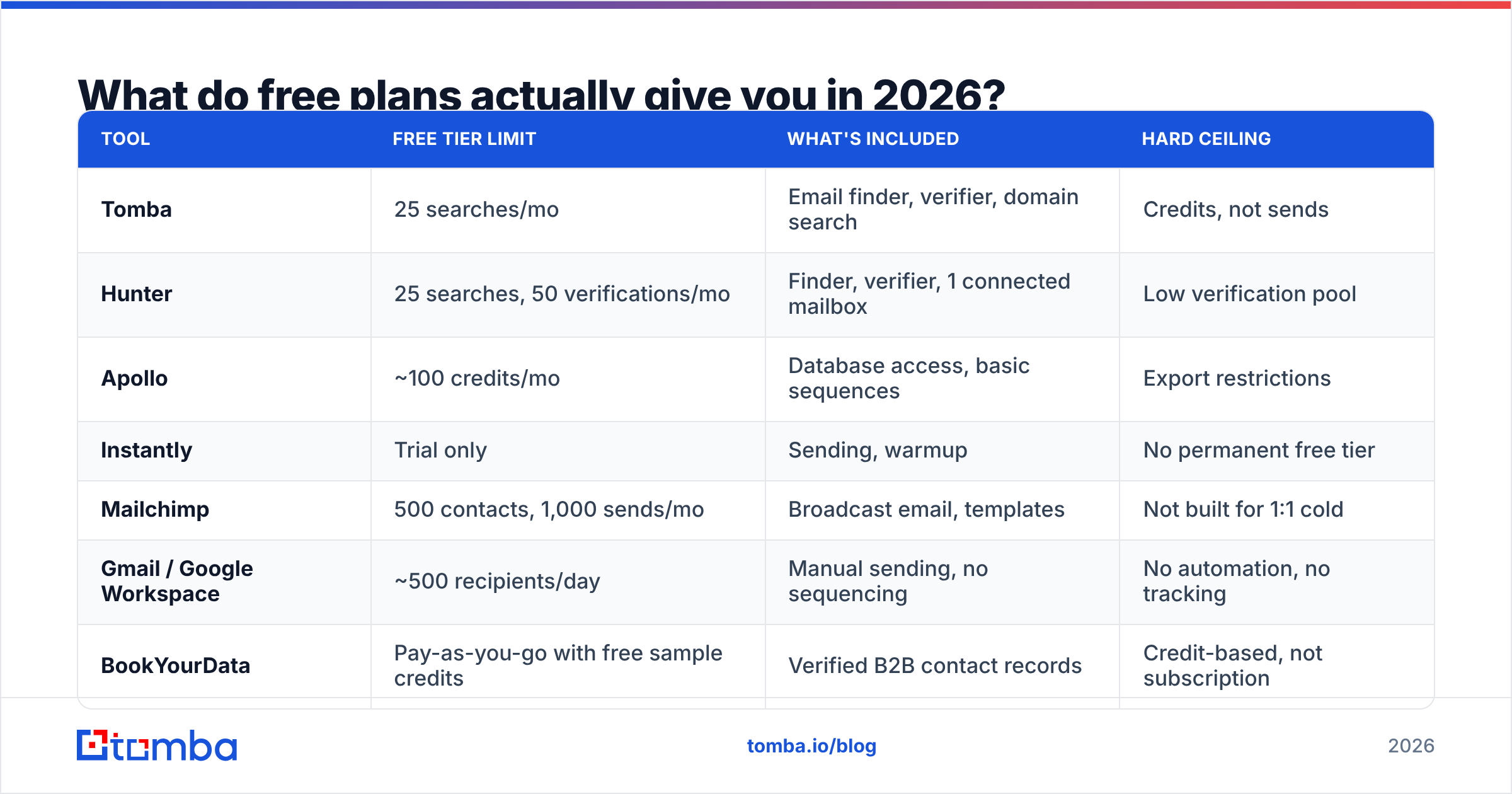
Here is what the free tiers of widely used tools include, based on their published plan pages. Numbers change; check the vendor before you commit.
| Tool | Free tier limit | What's included | Hard ceiling |
|---|---|---|---|
| Tomba | 25 searches/mo | Email finder, verifier, domain search | Credits, not sends |
| Hunter | 25 searches, 50 verifications/mo | Finder, verifier, 1 connected mailbox | Low verification pool |
| Apollo | ~100 credits/mo | Database access, basic sequences | Export restrictions |
| Instantly | Trial only | Sending, warmup | No permanent free tier |
| Mailchimp | 500 contacts, 1,000 sends/mo | Broadcast email, templates | Not built for 1:1 cold |
| Gmail / Google Workspace | ~500 recipients/day | Manual sending, no sequencing | No automation, no tracking |
| BookYourData | Pay-as-you-go with free sample credits | Verified B2B contact records | Credit-based, not subscription |
Two things jump out. First, the finders are generous with searching and stingy with verification — which is backwards from what a cold campaign needs, because an unverified send is worse than no send. Second, the sending tools have largely abandoned permanent free tiers in favor of 14-day trials. If you see a "free forever" sending plan in 2026, read what it costs you in branding, deliverability, or mailbox limits.
BookYourData sits in a different lane worth noting: instead of a monthly subscription with a free ceiling, it sells verified contact records on a credit basis with sample credits up front. If your problem is data quality on a small, specific list rather than ongoing send volume, that model can be cheaper than any subscription tier — free or paid.
Which free stack should you build?#
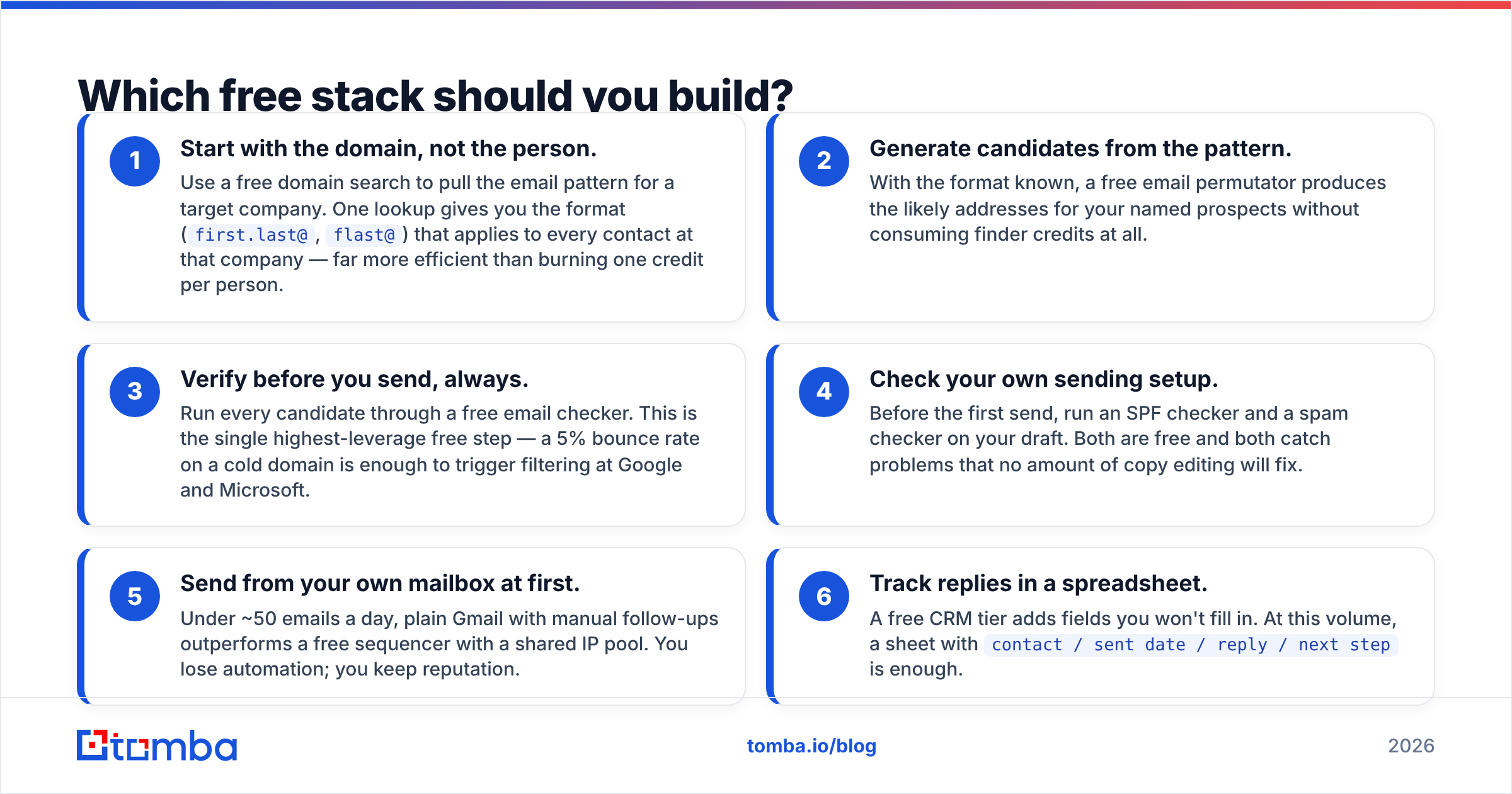
If you are going to run outreach on zero budget, build the chain deliberately instead of picking whatever ranks first. The order matters because each stage feeds the next.
- Start with the domain, not the person. Use a free domain search to pull the email pattern for a target company. One lookup gives you the format (
first.last@,flast@) that applies to every contact at that company — far more efficient than burning one credit per person. - Generate candidates from the pattern. With the format known, a free email permutator produces the likely addresses for your named prospects without consuming finder credits at all.
- Verify before you send, always. Run every candidate through a free email checker. This is the single highest-leverage free step — a 5% bounce rate on a cold domain is enough to trigger filtering at Google and Microsoft.
- Check your own sending setup. Before the first send, run an SPF checker and a spam checker on your draft. Both are free and both catch problems that no amount of copy editing will fix.
- Send from your own mailbox at first. Under ~50 emails a day, plain Gmail with manual follow-ups outperforms a free sequencer with a shared IP pool. You lose automation; you keep reputation.
- Track replies in a spreadsheet. A free CRM tier adds fields you won't fill in. At this volume, a sheet with
contact / sent date / reply / next stepis enough.
That stack costs nothing and handles roughly 80–120 prospects per month. Past that, step 1 and step 3 start rationing you.
Where does free actually break?#
Free tiers don't fail at the moment you exceed the limit. They fail earlier, in ways that don't show up in the dashboard.
Verification credits run out before finder credits. Most free plans give you more lookups than verifications. So people find 50 addresses, verify 20, and send to all 50. The 30 unverified ones include the catch-all domains, the role accounts (info@, sales@), and the departed employees. That's your bounce rate.
Catch-all domains are invisible on free plans. A catch-all server accepts every address at the domain, so a basic verifier returns "valid" for asdfgh@company.com. Distinguishing a real mailbox from a catch-all requires deeper checks that free tiers generally don't run. A catch-all verifier exists precisely because standard verification returns a false green here.
Shared sending infrastructure carries other people's reputation. Free and cheap sending tiers often route through pooled IPs. Your carefully written email inherits the sender reputation of everyone else on that pool. According to Google's Postmaster Tools documentation, domain and IP reputation are evaluated independently — and you control neither on a shared pool.
No suppression list means repeat sends. Free plans rarely deduplicate across campaigns. Emailing the same prospect twice from two lists is the fastest way to earn a spam complaint, and complaint rate is the metric that matters most to mailbox providers.
Export limits lock your data in. Several free database tiers let you see contacts but not export them. You end up doing manual copy-paste, which caps your real throughput far below the stated credit limit.
Is a free email outreach tool good enough for a small team?#
Yes — for validation. No — for a revenue channel you depend on.
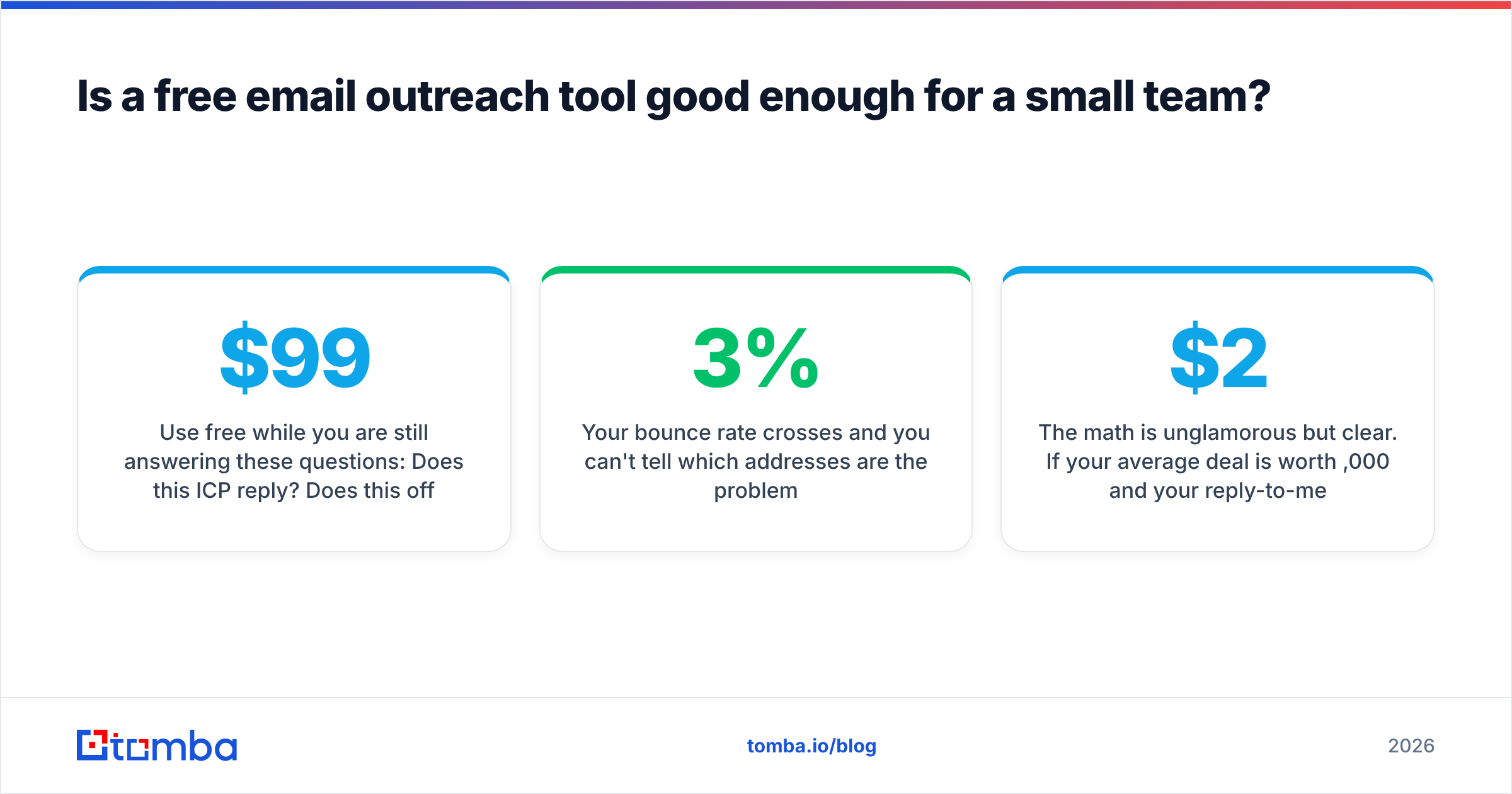
Use free while you are still answering these questions: Does this ICP reply? Does this offer land? Which subject line gets opened? Those answers need 50–100 sends, not 5,000. Free tiers are genuinely well-suited to that phase, and burning $99/mo to learn your positioning is wrong is a waste.
Switch to paid when any of these become true:
- You send more than 300 targeted emails per month.
- Your bounce rate crosses 3% and you can't tell which addresses are the problem.
- You are managing more than one sending mailbox or domain.
- Someone other than you needs access to the same contact list.
- You want the data inside your CRM automatically rather than via CSV.
The math is unglamorous but clear. If your average deal is worth $2,000 and your reply-to-meeting rate is 20%, a single extra meeting per quarter covers a year of a $49/mo plan. The failure mode of free isn't the monthly bill — it's the campaign that lands in spam and never tells you.
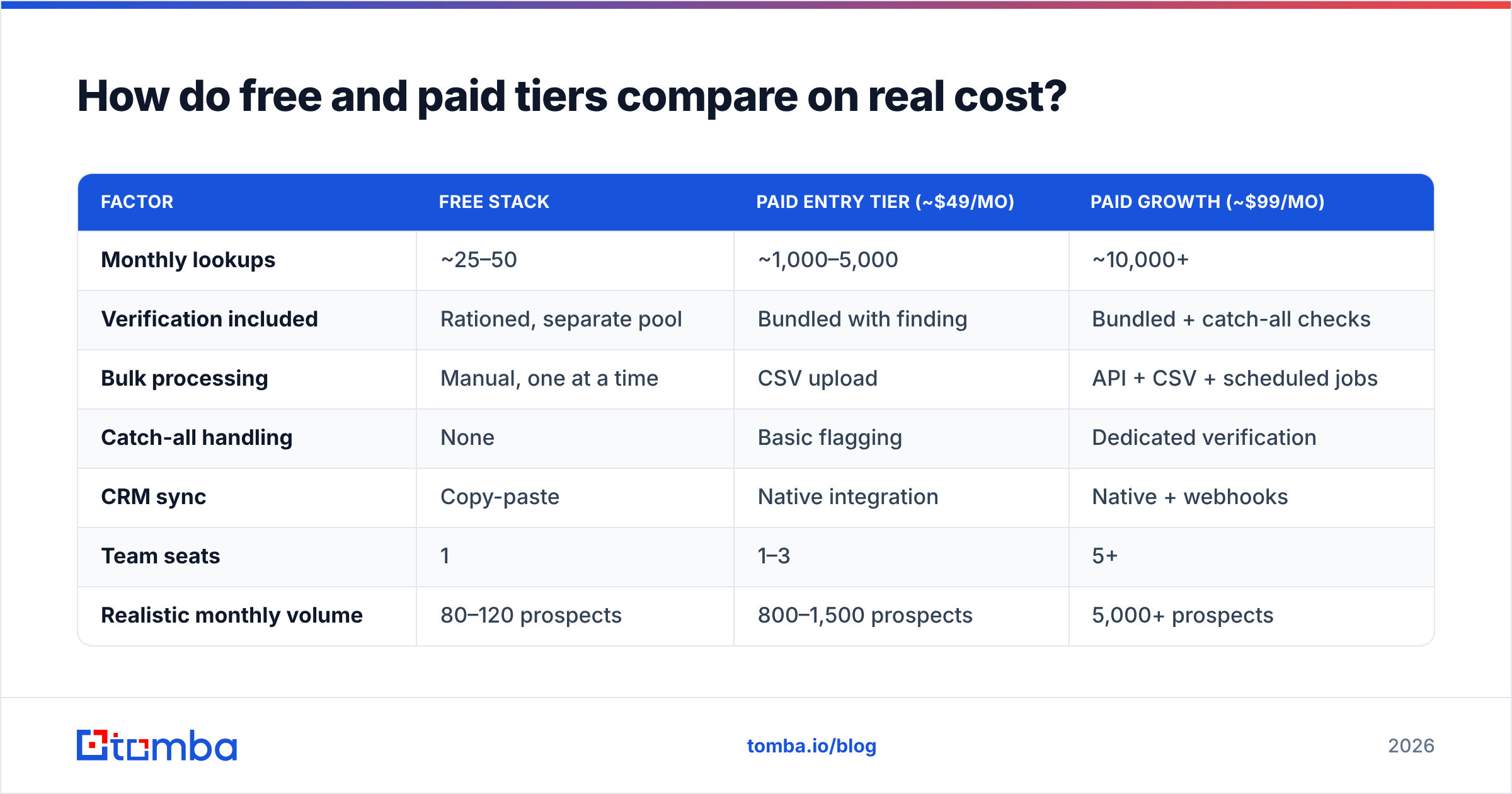
How do free and paid tiers compare on real cost?#
| Factor | Free stack | Paid entry tier (~$49/mo) | Paid growth (~$99/mo) |
|---|---|---|---|
| Monthly lookups | ~25–50 | ~1,000–5,000 | ~10,000+ |
| Verification included | Rationed, separate pool | Bundled with finding | Bundled + catch-all checks |
| Bulk processing | Manual, one at a time | CSV upload | API + CSV + scheduled jobs |
| Catch-all handling | None | Basic flagging | Dedicated verification |
| CRM sync | Copy-paste | Native integration | Native + webhooks |
| Team seats | 1 | 1–3 | 5+ |
| Realistic monthly volume | 80–120 prospects | 800–1,500 prospects | 5,000+ prospects |
| Hidden cost | Your time + bounce damage | None material | None material |
Note the last row. Free is never actually free — you pay in hours of manual lookup and in deliverability damage that persists after you upgrade. A domain that got filtered during your free-tier experiments doesn't reset when your credit card clears.
For reference on how the finder tools compare on the accuracy dimension specifically, Tomba's data sources page documents where records originate, and independent user reviews on G2 are a reasonable cross-check on vendor-published accuracy claims.

What should you upgrade first — data or sending?#
Upgrade the data layer first. Here's why, in plain terms: a great sequencing tool sending to bad addresses produces bounces. A basic mailbox sending to verified addresses produces replies. The email address is upstream of everything.
Concretely, the upgrade order that wastes the least money:
- First — verification and finding. Move off rationed free credits. A paid email verifier with catch-all handling eliminates the largest single source of bounces. This is where Tomba's pricing starts at $49/mo for the Starter tier, with a Free plan at 25 searches/month if you want to test the accuracy on your own list before committing.
- Second — bulk and API access. Once verification is solid, the bottleneck becomes throughput. Bulk processing and the Tomba API remove the manual step so your list-building scales past what one person can type.
- Third — sending infrastructure. Now pay for dedicated sending: your own domains, inbox rotation, warmup. Instantly, Smartlead, and lemlist all compete here; none of them fix bad data, which is why this is third and not first.
- Fourth — enrichment and intent. Firmographics, technographics, contact enrichment. Genuinely useful, genuinely not urgent until the first three are working.
Teams that invert this order — buying a $150/mo sequencer while still scraping addresses by hand — end up with an expensive tool sending unverified mail. The tool logs it as "sent." The prospect never sees it.
What are the honest limits of every free plan?#
Three limits are structural and no vendor will remove them:
Free plans don't include support. When your campaign gets filtered and you need to know whether it's SPF, DKIM, content, or reputation, free tier support is documentation. That diagnosis takes a paid customer an hour and a free user a week.
Free plans don't include liability. Data accuracy guarantees, GDPR processing agreements, and SOC 2 documentation are paid-tier features across the industry. If you are doing outreach into the EU or into regulated buyers, the free tier is a compliance gap, not just a volume cap.
Free plans are the vendor's acquisition channel. The limits are set precisely where they'll hurt enough to convert you. That's not a criticism — it's a functional business model — but it means the free ceiling is calibrated to your pain, not to your workflow. Plan for it rather than being surprised by it.
How do you get the most out of a free tier before upgrading?#
- Batch by company, not by person. One domain search yields a pattern that covers every contact at that company. This is a 10x multiplier on your free credits.
- Verify in one session at the end. Don't verify as you go; you'll waste credits on prospects you later disqualify. Build the full list, qualify it, then verify only the survivors.
- Never email role addresses.
info@,contact@, andsales@burn credits and generate complaints. Filter them out before verification. - Use the free tools that aren't metered. Permutators, SPF checkers, spam-score checkers, and subject line testers generally don't consume credits. Lean on them heavily.
- Track your bounce rate manually. If you're on a free stack, nobody is watching this for you. A weekly count of bounced sends divided by total sends is enough to catch a problem before your domain reputation suffers.
Where does that leave you?#
A free email outreach tool is the right starting point and the wrong ending point. Use free tiers to prove that your offer works on a hundred prospects. The moment it does, the free ceiling becomes the most expensive thing in your pipeline — measured in bounced sends, spam placement, and hours spent doing by hand what a $49/mo plan does in a batch.
If your bottleneck right now is finding and verifying the addresses rather than sending them, start with the Tomba Email Finder. The free plan gives you 25 searches a month — enough to run the pattern-first workflow above on a real target list and see the accuracy on companies you actually care about, before you spend anything. When you outgrow it, the Starter tier at $49/mo covers the bulk verification and catch-all checks that the free stack simply can't do.
Related guides#
Ready to find emails that actually work?
Join 150,000+ professionals who stopped guessing and started sending. Free credits on signup — no credit card required.
Get the Tomba newsletter
Practical outbound tactics and product updates — once every two weeks.
About the author