Free Email Verification: What You Actually Get in 2026
Free email verification tiers are real, useful, and quietly limited. Here is what the free plans actually check, where they break down on catch-all and role domains, and the volume where paying starts to cost less than bouncing.
TL;DR
- Free email verification is real and useful, but almost every free tier caps you between 25 and 250 checks per month and strips out the expensive checks (catch-all resolution, role detection, deep SMTP handshakes).
- Syntax and MX checks cost providers almost nothing, so they are always free. SMTP probing and catch-all intelligence cost money, so they are almost always gated.
- A single-email checker in a browser tab is fine for verifying one prospect. It is the wrong tool the moment you have a 5,000-row CSV.
- The break-even is simpler than vendors admit: if bouncing 4% of a 10,000-send campaign would cost you domain reputation, a $49/mo plan is cheaper than the recovery.
- Tomba's free tier gives you 25 searches a month, and the free email checker runs unlimited one-off validations without an account.
What does "free email verification" actually mean?#
It means one of three very different things, and vendors deliberately blur them.
One: a no-account web form where you paste a single address and get a verdict. This is genuinely free and genuinely unlimited at most providers, including Tomba's free email checker. It is also slow — one address at a time, no API, no export.
Two: a free tier inside a paid product. You get an account, an API key, and a credit allowance that resets monthly. Typical range is 25 to 250 verifications. Tomba's free tier sits at 25 searches per month; ZeroBounce hands out 100; several list-cleaning tools give 100 on signup only, not monthly.
Three: an open-source or DIY script that does syntax parsing plus an MX lookup. This costs nothing but your time, and it catches maybe 60% of what a commercial verifier catches. It cannot tell you whether sales@ is a role account, whether the domain is a catch-all, or whether the mailbox is a spam trap.
When someone says "I use free email verification," they usually mean type one, and they usually have not tried to scale it past forty addresses.
How does email verification actually work under the hood?#
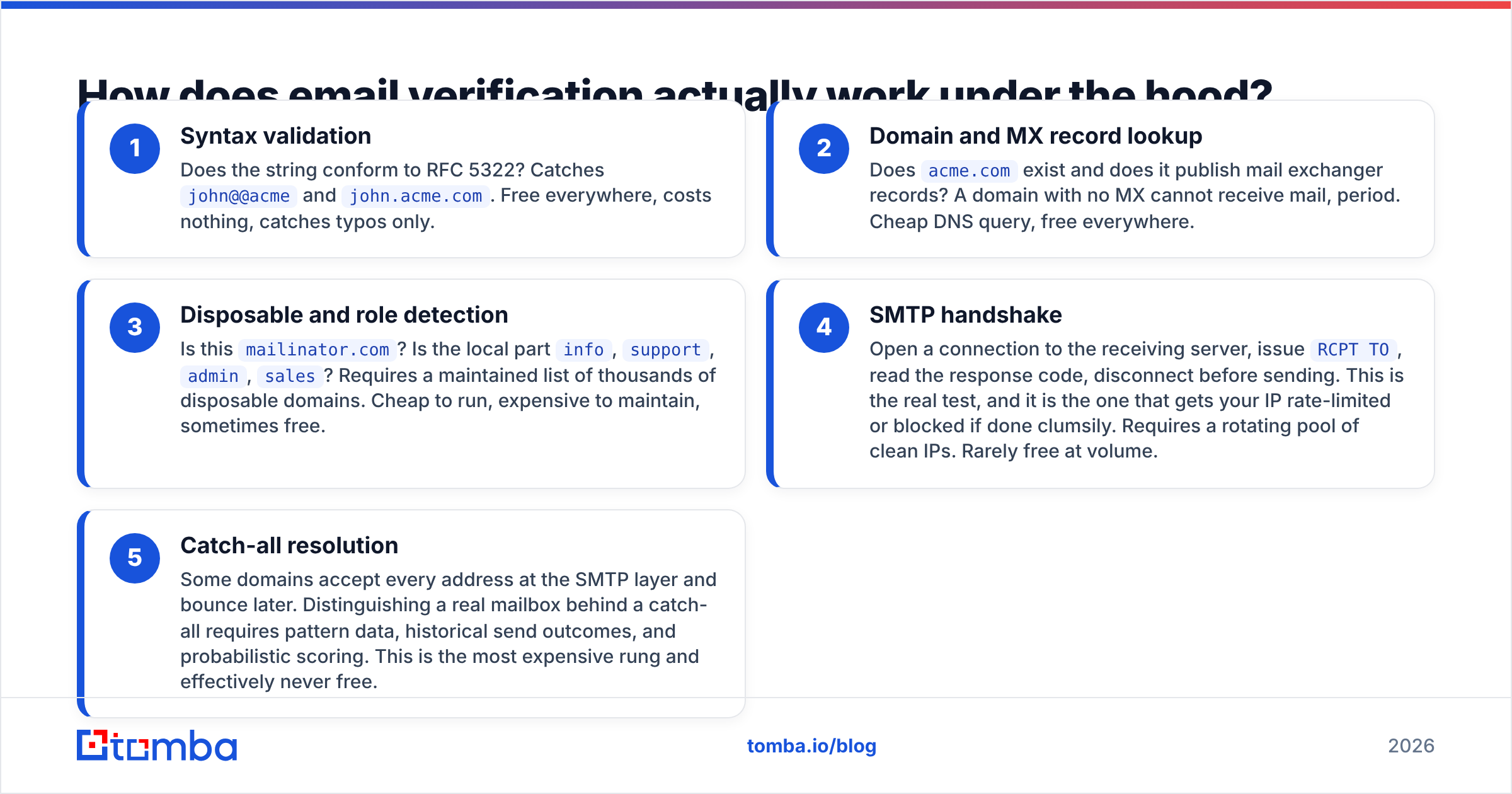
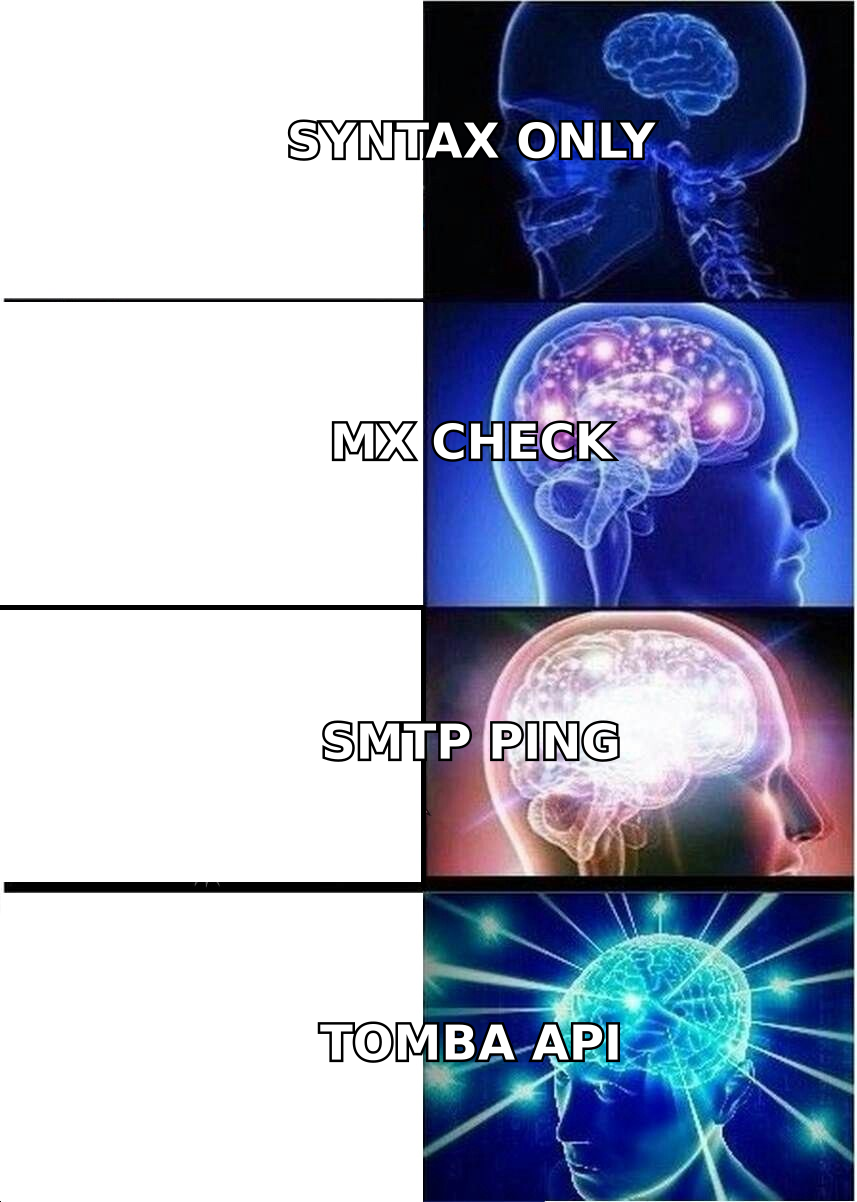
Verification runs as a ladder. Each rung costs the provider more, which is exactly why free tiers stop partway up.
- Syntax validation — Does the string conform to RFC 5322? Catches
john@@acmeandjohn.acme.com. Free everywhere, costs nothing, catches typos only. - Domain and MX record lookup — Does
acme.comexist and does it publish mail exchanger records? A domain with no MX cannot receive mail, period. Cheap DNS query, free everywhere. - Disposable and role detection — Is this
mailinator.com? Is the local partinfo,support,admin,sales? Requires a maintained list of thousands of disposable domains. Cheap to run, expensive to maintain, sometimes free. - SMTP handshake — Open a connection to the receiving server, issue
RCPT TO, read the response code, disconnect before sending. This is the real test, and it is the one that gets your IP rate-limited or blocked if done clumsily. Requires a rotating pool of clean IPs. Rarely free at volume. - Catch-all resolution — Some domains accept every address at the SMTP layer and bounce later. Distinguishing a real mailbox behind a catch-all requires pattern data, historical send outcomes, and probabilistic scoring. This is the most expensive rung and effectively never free.
The SMTP protocol was never designed as a lookup service, which is why rung four is fragile. Big providers — Google Workspace, Microsoft 365 — deliberately return ambiguous codes to stop exactly this kind of probing. That ambiguity is where cheap verifiers quietly guess and expensive verifiers do statistical work.

Where do free tiers break down first?#
Three places, in this order.
Volume, obviously. 100 credits disappears in one afternoon of prospecting. If you export a conference attendee list, you have 800 rows before you have had coffee.
Catch-all domains. Roughly 15-20% of B2B domains are configured as catch-all, and the share is higher among enterprises with legacy mail routing. A free verifier returns "unknown" or "risky" and hands the decision back to you. That is not a verdict, it is a shrug. A catch-all verifier is a paid feature at essentially every vendor because it is the only rung that requires proprietary data rather than protocol calls.
API access. Free tiers frequently include the credits but not the endpoint. You can verify in the dashboard; you cannot verify from your enrichment pipeline. If your workflow is "webhook fires when a form is submitted, verify before it enters the CRM," a dashboard-only free tier is worthless to you.
There is a fourth, subtler failure: staleness. B2B email data decays at roughly 22-30% annually as people change jobs. A verification result from March is not a verification result in August. Free tiers rarely include re-verification, so your "clean" list rots on schedule.
What do the free tiers actually include?#
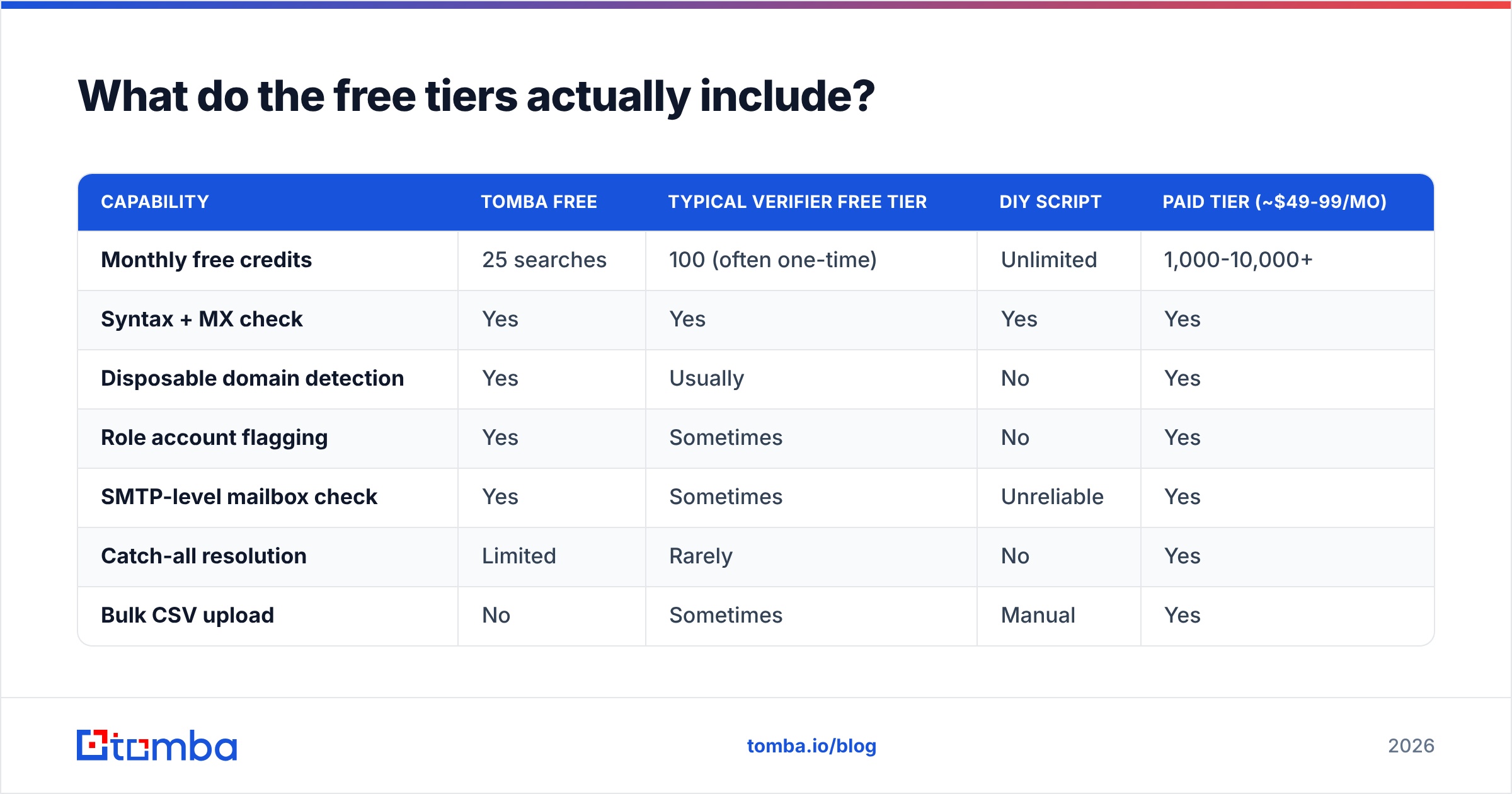
Here is the honest comparison. Figures are the publicly listed free allowances as of early 2026 — always confirm on the vendor's own pricing page before committing, since free tiers change more often than paid ones.
| Capability | Tomba Free | Typical verifier free tier | DIY script | Paid tier (~$49-99/mo) |
|---|---|---|---|---|
| Monthly free credits | 25 searches | 100 (often one-time) | Unlimited | 1,000-10,000+ |
| Syntax + MX check | Yes | Yes | Yes | Yes |
| Disposable domain detection | Yes | Usually | No | Yes |
| Role account flagging | Yes | Sometimes | No | Yes |
| SMTP-level mailbox check | Yes | Sometimes | Unreliable | Yes |
| Catch-all resolution | Limited | Rarely | No | Yes |
| Bulk CSV upload | No | Sometimes | Manual | Yes |
| API access | Limited | Often excluded | N/A | Yes |
| Confidence score | Yes | Varies | No | Yes |
| Cost | $0 | $0 | $0 + engineering | $49-$249/mo |
The pattern is consistent across the category: rungs 1-3 of the ladder are free, rungs 4-5 are the product. Anyone offering unlimited free SMTP verification is either rate-limiting you invisibly, returning cached results, or selling your query data.

Is free email verification accurate enough for cold outreach?#
For a handful of addresses, yes. For a campaign, no — and the reason is asymmetric risk.
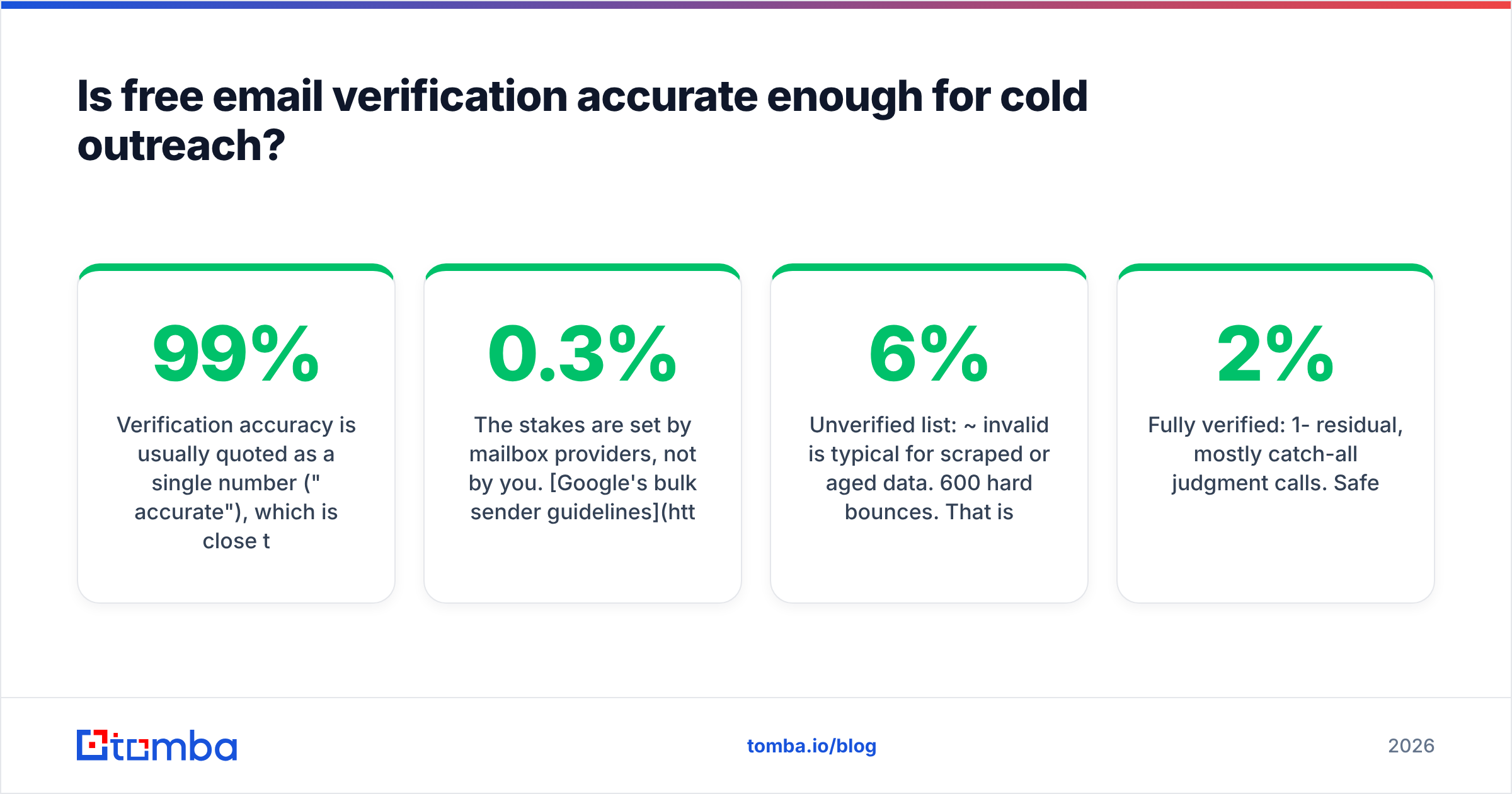
Verification accuracy is usually quoted as a single number ("99% accurate"), which is close to meaningless without knowing the denominator. A verifier that marks 30% of your list "unknown" and is 99% accurate on the remaining 70% is worse than one that resolves 92% of the list at 96% accuracy. Ask for coverage and precision separately, or run your own test: take 200 addresses you can independently confirm, split them across two tools, and count.
The stakes are set by mailbox providers, not by you. Google's bulk sender guidelines put the spam-complaint threshold at 0.3% and expect authenticated, low-bounce sending. Cross a 4-5% hard-bounce rate consistently and your sender reputation degrades across every mailbox on the domain — including the one your AEs use for replies. Recovering takes weeks of reduced volume and warmup.
Run the arithmetic on a 10,000-address campaign:
- Unverified list: ~6% invalid is typical for scraped or aged data. 600 hard bounces. That is comfortably above the danger line.
- Free-tier verified (partial): you cleaned the 100 addresses your credits covered. Effective bounce rate barely moves.
- Fully verified: 1-2% residual, mostly catch-all judgment calls. Safe.
The paid plan costs $49. The reputation repair costs a month of pipeline. This is not a close call at volume — it is only a close call below roughly 500 sends a month, which is exactly the range where free tiers work fine.
When is a free tier genuinely the right answer?#
More often than vendors want you to believe. Use free verification when:
- You are verifying one address before a high-stakes email. You found a VP's address, you are sending one carefully written note. A single-check tool is the correct tool. Zero reason to pay.
- You are validating a form submission manually. Low volume, human in the loop, no API needed.
- You are evaluating vendors. Run the same 25 known-good and 25 known-bad addresses through three free tiers. This is the only benchmark that reflects your data — vendor-published accuracy claims are measured on vendor-chosen samples.
- Your total monthly outbound is under a few hundred emails. Founder-led sales, niche ABM lists, recruiting for one role. Stack a free tier with a careful email permutator workflow and you will be fine.
- You are cleaning a small legacy list once. A one-time 100-credit allowance covers a one-time job.
The moment any of those turn recurring or exceed a few hundred rows a month, the free tier stops being frugal and starts being a bottleneck disguised as a saving.
How do the paid options compare once you outgrow free?#
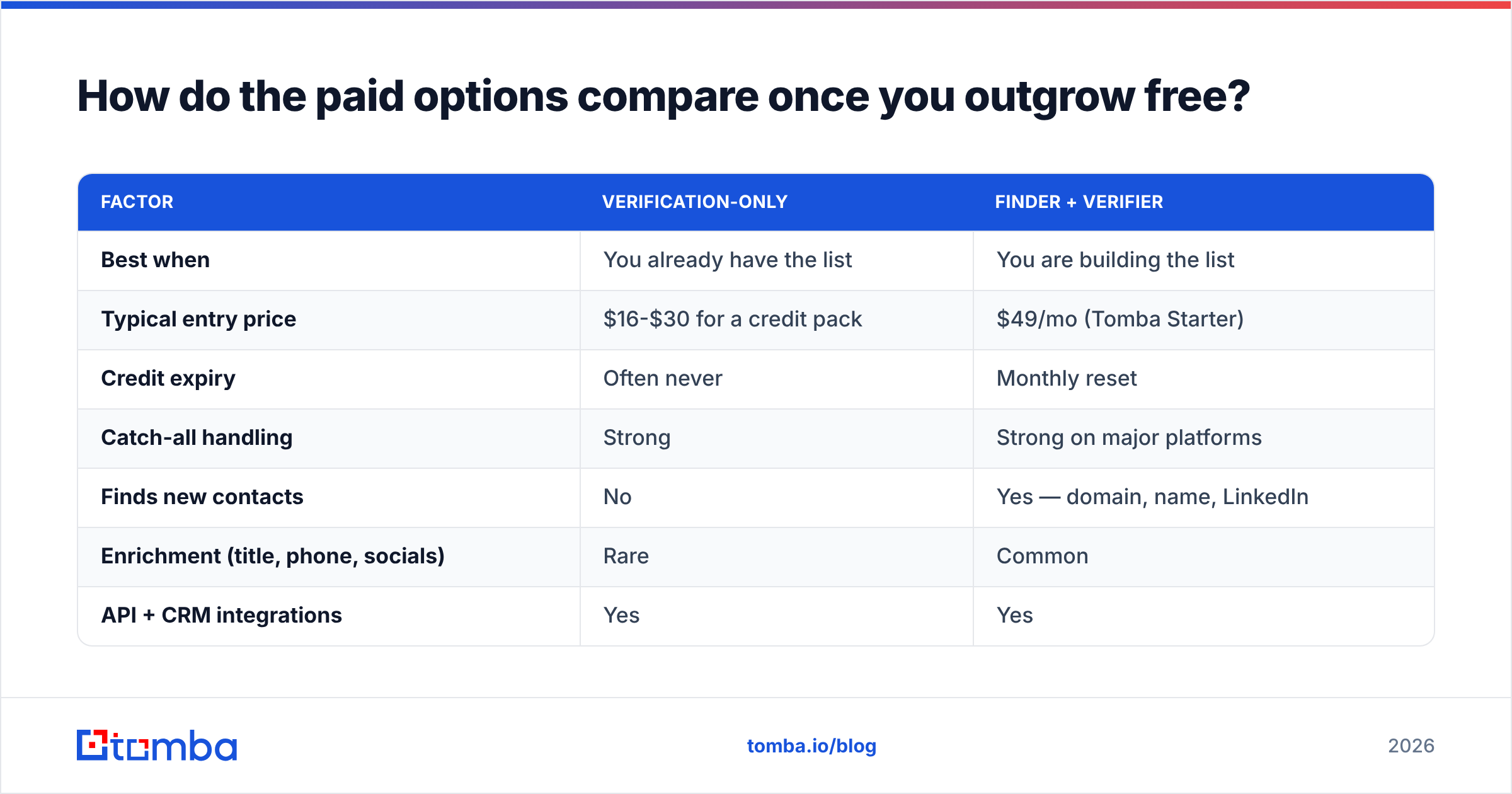
Two shapes of product exist, and picking the wrong shape wastes more money than picking the wrong vendor.
Verification-only tools (ZeroBounce, Bouncer, DeBounce, Clearout) take a list you already have and clean it. Usually priced per credit, often with credits that never expire. Excellent if your lead source is a CRM export, a webinar registration list, or a database you already license — providers like BookYourData sell verified B2B lists that pair naturally with a verification layer for periodic re-checks.
Finder-plus-verifier platforms (Tomba, Hunter, Findymail) find the address and validate it in one pass. Priced per search, monthly. Better if you are building lists from scratch, because verifying an address you had to guess is a two-step process you would otherwise pay two vendors for.
| Factor | Verification-only | Finder + verifier |
|---|---|---|
| Best when | You already have the list | You are building the list |
| Typical entry price | $16-$30 for a credit pack | $49/mo (Tomba Starter) |
| Credit expiry | Often never | Monthly reset |
| Catch-all handling | Strong | Strong on major platforms |
| Finds new contacts | No | Yes — domain, name, LinkedIn |
| Enrichment (title, phone, socials) | Rare | Common |
| API + CRM integrations | Yes | Yes |
| Overkill risk | High if you have no list | High if you only need cleaning |
Tomba pricing runs Free (25 searches/mo), Starter $49/mo, Growth $99/mo, Pro $249/mo, and custom Enterprise — with the email verifier bundled alongside domain search, catch-all checks, phone finding, and enrichment rather than sold as a separate SKU. That bundling is the practical argument for a combined platform: one credit pool, one API, one place to debug when a lookup returns something odd.
Whichever shape you pick, check independent reviews on G2's email verification category before you commit. Support responsiveness and refund policy on unused credits vary far more between vendors than accuracy does.

What should you check before trusting any verifier's numbers?#
Five questions that separate marketing from measurement:
- What percentage of a real B2B list comes back "unknown"? Above 20% and the tool is offloading its hard cases onto you.
- How are catch-all domains scored? "Risky" is not an answer. A confidence score with a documented methodology is.
- Are results cached, and for how long? Cached results are fast and cheap but stale. Ask for the TTL.
- Do unused credits roll over? Monthly-reset plans punish uneven prospecting cycles.
- Is there an API on the plan you are buying, or only on the tier above? This is the single most common upsell trap in the category.
Ask a vendor these in a sales call and watch which ones get a straight number. That is your real signal.
The bottom line#
Free email verification is not a trick — it is a real, functional product with an honest ceiling. Below a few hundred checks a month, use it without guilt. Above that, the free tier is not saving you money, it is deferring a bounce-rate bill that lands on your sending domain.
If you are building lists rather than just cleaning them, start with the Tomba Email Finder. Twenty-five searches a month on the free tier is enough to test it against your own known-good contacts before you spend anything, and the verification, catch-all checks, and enrichment run on the same credit pool when you scale up. Test it on your data, not on a vendor's demo list — that is the only benchmark that matters.
Related guides#
Ready to find emails that actually work?
Join 150,000+ professionals who stopped guessing and started sending. Free credits on signup — no credit card required.
Get the Tomba newsletter
Practical outbound tactics and product updates — once every two weeks.
About the author