Free Trial Follow Up Email: 9 Templates That Convert Users
Most trial follow-up sequences stop at "just checking in" and die by day 3. Here's the day-by-day cadence, the behavioural triggers that decide what to send, and nine templates you can paste in today.
TL;DR
- A free trial follow up email only works when it's tied to what the user did in the product, not to how many days have passed since signup.
- The highest-converting cadence is 9 touches across a 14-day trial: activation, value proof, objection handling, and two post-expiry recoveries.
- "Just checking in" is the single worst-performing subject line pattern in trial sequences — replace it with a specific observation about their account.
- Roughly 40-60% of self-serve signups use a personal or aliased address, so your best-fit accounts need a work email appended before sales can act on them.
- Measure trial-to-paid by cohort and by email, not by open rate. Opens tell you nothing about whether someone finished setup.
What is a free trial follow up email?#
A free trial follow up email is any message you send between the moment someone signs up for a trial and the moment they either pay or churn. That window is short — usually 7, 14, or 30 days — and it's the only period where a prospect is actively touching your product with intent.
Think of it like a gym induction. Someone paid for a month, walked in once, and never came back. The gym that emails "Here's the 20-minute beginner circuit, three machines, no queue at 7am" retains them. The gym that emails "Just checking in on your fitness journey!" does not. Same customer, same product, radically different outcome — the difference is specificity.
Technically, trial follow-ups sit in the activation layer of a product-led growth motion. They're triggered by product events (invite sent, integration connected, first report generated) rather than by a marketing calendar. That distinction is what separates a sequence that converts 18% of trials from one that converts 4%.
Why do most free trial follow-up sequences fail?#
Four failure modes account for nearly everything that goes wrong:
- They're time-based, not behaviour-based. Sending "How's your trial going?" on day 3 to a user who already imported 4,000 contacts is insulting. Sending it to a user who never logged in twice is useless. Same email, two wrong audiences.
- They ask for a call before delivering a win. A demo request on day 1 converts at a fraction of the same request sent after the user hits their first activation event.
- They stop at expiry. The two emails sent after a trial ends — the expiry notice and the 7-day-later recovery — routinely account for a third of total trial-to-paid conversions, and most teams skip them entirely.
- They go to a dead inbox. Signups use
gmail.comaddresses, throwaway aliases, or a sharedteam@mailbox nobody reads. Your sequence is technically "sent" and functionally invisible.
That last point is the one nobody instruments. If 25% of your trial list bounces or lands in an unmonitored inbox, your conversion rate isn't a copy problem — it's a data problem, and no amount of subject-line testing fixes it. Run new signups through an email verifier before the sequence starts and you'll see the real denominator.
What does a 14-day trial follow-up cadence look like?#
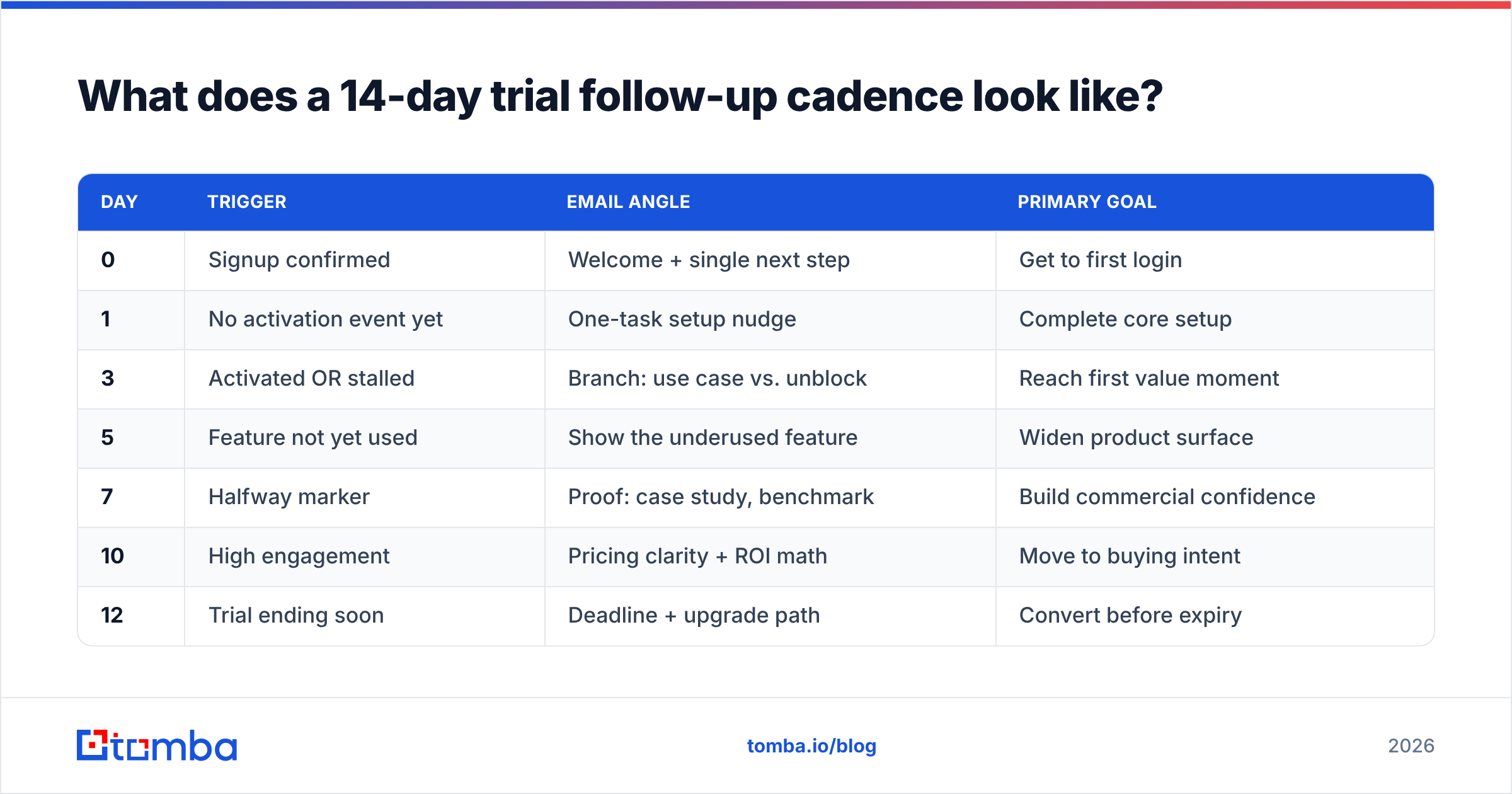
Here's the structure that holds up across most B2B SaaS trials. Adjust the day numbers proportionally for 7-day or 30-day trials — the order matters more than the calendar.
| Day | Trigger | Email angle | Primary goal |
|---|---|---|---|
| 0 | Signup confirmed | Welcome + single next step | Get to first login |
| 1 | No activation event yet | One-task setup nudge | Complete core setup |
| 3 | Activated OR stalled | Branch: use case vs. unblock | Reach first value moment |
| 5 | Feature not yet used | Show the underused feature | Widen product surface |
| 7 | Halfway marker | Proof: case study, benchmark | Build commercial confidence |
| 10 | High engagement | Pricing clarity + ROI math | Move to buying intent |
| 12 | Trial ending soon | Deadline + upgrade path | Convert before expiry |
| 14 | Trial expired | What you lose, one-click restart | Recover fence-sitters |
| 21 | 7 days post-expiry | Win-back with new angle or offer | Recover the tail |
Nine emails sounds aggressive until you realise a 14-day trial gives you 14 chances and you're using nine of them, each triggered by something the user actually did. Compare that to a five-email drip that fires regardless of behaviour and reads identically to every other SaaS trial the prospect is running that month.
Which email should you send at each stage?#
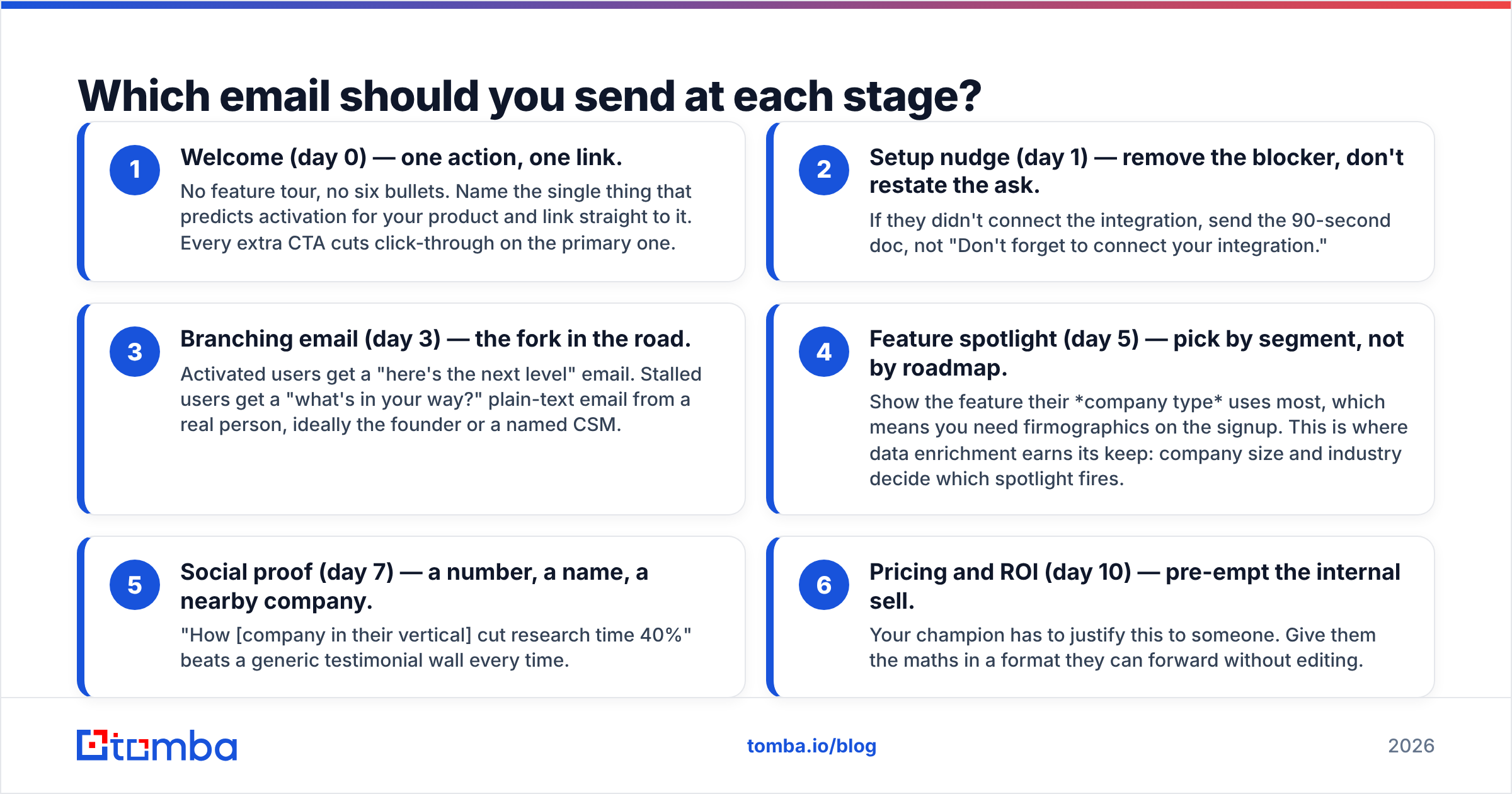
Use these as the decision rules behind each send:
- Welcome (day 0) — one action, one link. No feature tour, no six bullets. Name the single thing that predicts activation for your product and link straight to it. Every extra CTA cuts click-through on the primary one.
- Setup nudge (day 1) — remove the blocker, don't restate the ask. If they didn't connect the integration, send the 90-second doc, not "Don't forget to connect your integration."
- Branching email (day 3) — the fork in the road. Activated users get a "here's the next level" email. Stalled users get a "what's in your way?" plain-text email from a real person, ideally the founder or a named CSM.
- Feature spotlight (day 5) — pick by segment, not by roadmap. Show the feature their company type uses most, which means you need firmographics on the signup. This is where data enrichment earns its keep: company size and industry decide which spotlight fires.
- Social proof (day 7) — a number, a name, a nearby company. "How [company in their vertical] cut research time 40%" beats a generic testimonial wall every time.
- Pricing and ROI (day 10) — pre-empt the internal sell. Your champion has to justify this to someone. Give them the maths in a format they can forward without editing.
Then the closing block: the expiry warning, the expiry notice, and the win-back. These three are the least creative and the highest-yielding emails in the entire sequence.
What should each free trial follow up email actually say?#
Templates, kept deliberately short. Long trial emails do not get read.
Day 1 — setup nudge
Subject: Your [Product] account is 2 minutes from useful
Hi {{first_name}},
You created an account yesterday but haven't connected {{integration}} yet — that's the step that turns the dashboard from empty to useful.
Here's the 90-second walkthrough: [link]
If something broke, reply and tell me where. I'll fix it or fix the docs.
— {{sender}}
Day 3 — stalled branch
Subject: Did {{product}} not fit what you needed?
Hi {{first_name}},
You signed up on {{date}} and haven't been back. That usually means one of three things: wrong tool, wrong timing, or the setup was heavier than expected.
Which one? One word is a fine reply.
Day 7 — proof
Subject: {{similar_company}} tried the same thing you're testing
Hi {{first_name}},
You've been running {{feature}} this week. {{similar_company}}, roughly your size, used the same workflow to cut {{metric}} by {{number}}%.
Two-minute breakdown here: [link]. Worth twenty minutes on Thursday to map it to your setup?
Day 12 — expiry warning
Subject: Your trial ends {{day}} — here's what stops working
Hi {{first_name}},
On {{date}} you lose {{specific_thing_they_built}}. Your data stays put for 30 days, but the workflows pause.
Upgrade in one click: [link]. If pricing is the sticking point, reply and tell me the number you were expecting.
Day 21 — win-back
Subject: Different angle on {{problem}}
Hi {{first_name}},
You trialled us in {{month}} and passed. Since then we shipped {{change}}, which addresses the thing most trials stall on.
Want a fresh 14 days with the new version? No card. [link]
Notice what's missing: exclamation marks, "I hope this email finds you well," and any sentence that could be sent to a different person unchanged. If you want a starting library to adapt, the email templates collection covers adjacent outbound formats you can lift structure from.
How do trial follow-up approaches compare?#
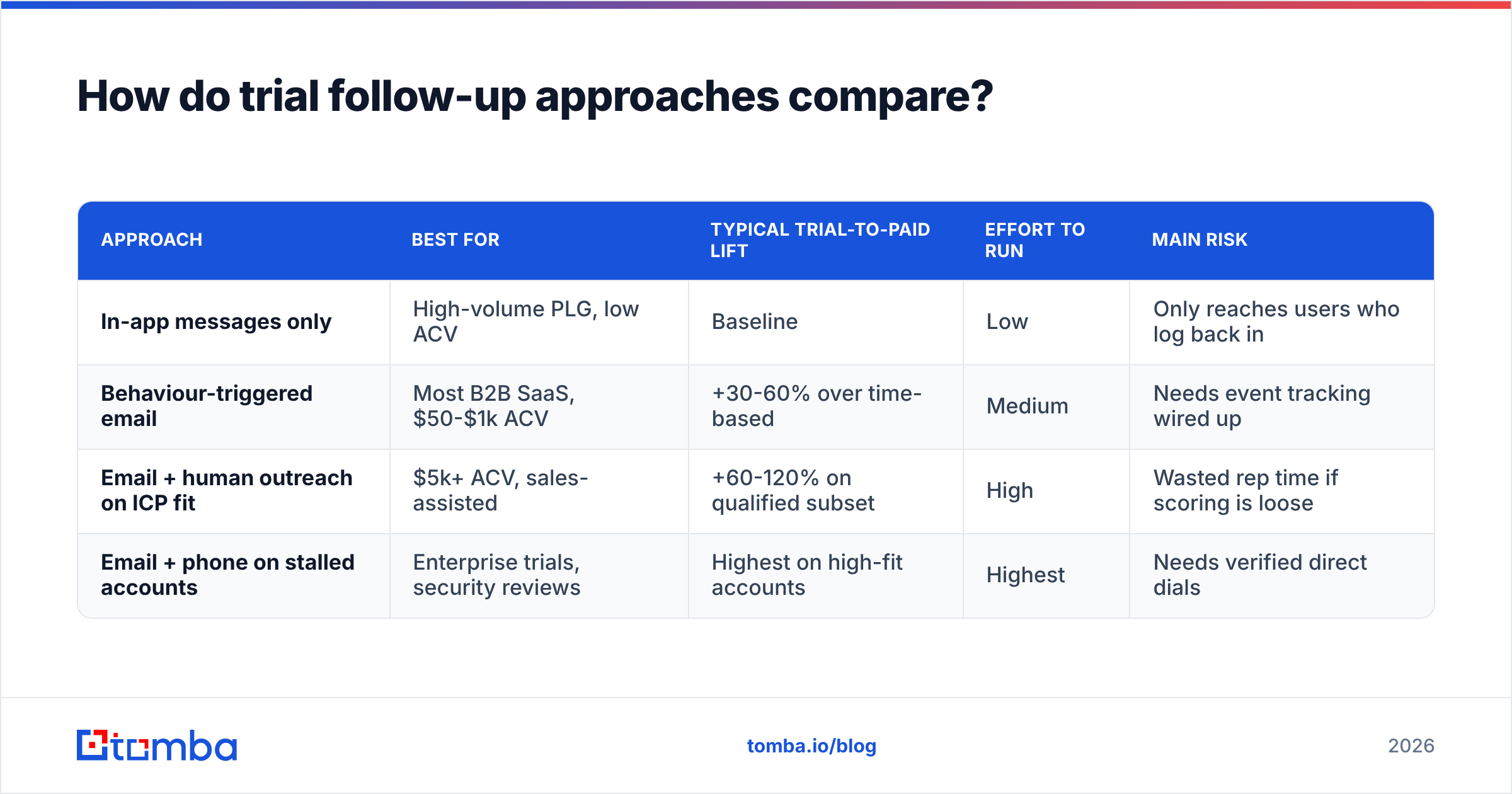
Not every team should run the same motion. Here's how the four common approaches stack up:
| Approach | Best for | Typical trial-to-paid lift | Effort to run | Main risk |
|---|---|---|---|---|
| In-app messages only | High-volume PLG, low ACV | Baseline | Low | Only reaches users who log back in |
| Behaviour-triggered email | Most B2B SaaS, $50-$1k ACV | +30-60% over time-based | Medium | Needs event tracking wired up |
| Email + human outreach on ICP fit | $5k+ ACV, sales-assisted | +60-120% on qualified subset | High | Wasted rep time if scoring is loose |
| Email + phone on stalled accounts | Enterprise trials, security reviews | Highest on high-fit accounts | Highest | Needs verified direct dials |
The pattern across every benchmark set: hybrid motions win on ACV, pure automation wins on cost per conversion. Vendor comparison sites like G2 and the sales research published on HubSpot's blog tell the same story — the question isn't automation versus human, it's which accounts deserve the human.
If you're layering calls onto stalled high-fit trials, you need direct numbers, not switchboards. A phone finder closes that gap for accounts your scoring flags as worth the call.
How do you reach trial users who signed up with a personal email?#
This is the quiet killer in self-serve funnels. Someone from a 400-person company signs up with jordan.k.designs@gmail.com, evaluates the product, likes it, and then goes quiet — because the buying conversation happens on their work account, in a thread you were never part of.
Three fixes, in order of effort:
- Ask for the work domain at signup. A single optional field ("company website") lets you enrich everything else later without adding friction to the form.
- Reverse-resolve the person. A reverse email lookup can map a personal address back to a name and employer, which then gives you a domain to work from.
- Find the work address from the domain. Once you have a name and a company domain, an email finder returns the corporate address with a confidence score, so your sequence lands in the inbox that actually signs the invoice.

The same logic applies to multi-threading. Trials rarely convert on one person's opinion — someone in finance, security, or ops gets a say. Running a domain search on the trial account's company gives you the other names on the buying committee before the trial expires, rather than after.
What metrics tell you a trial sequence is working?#
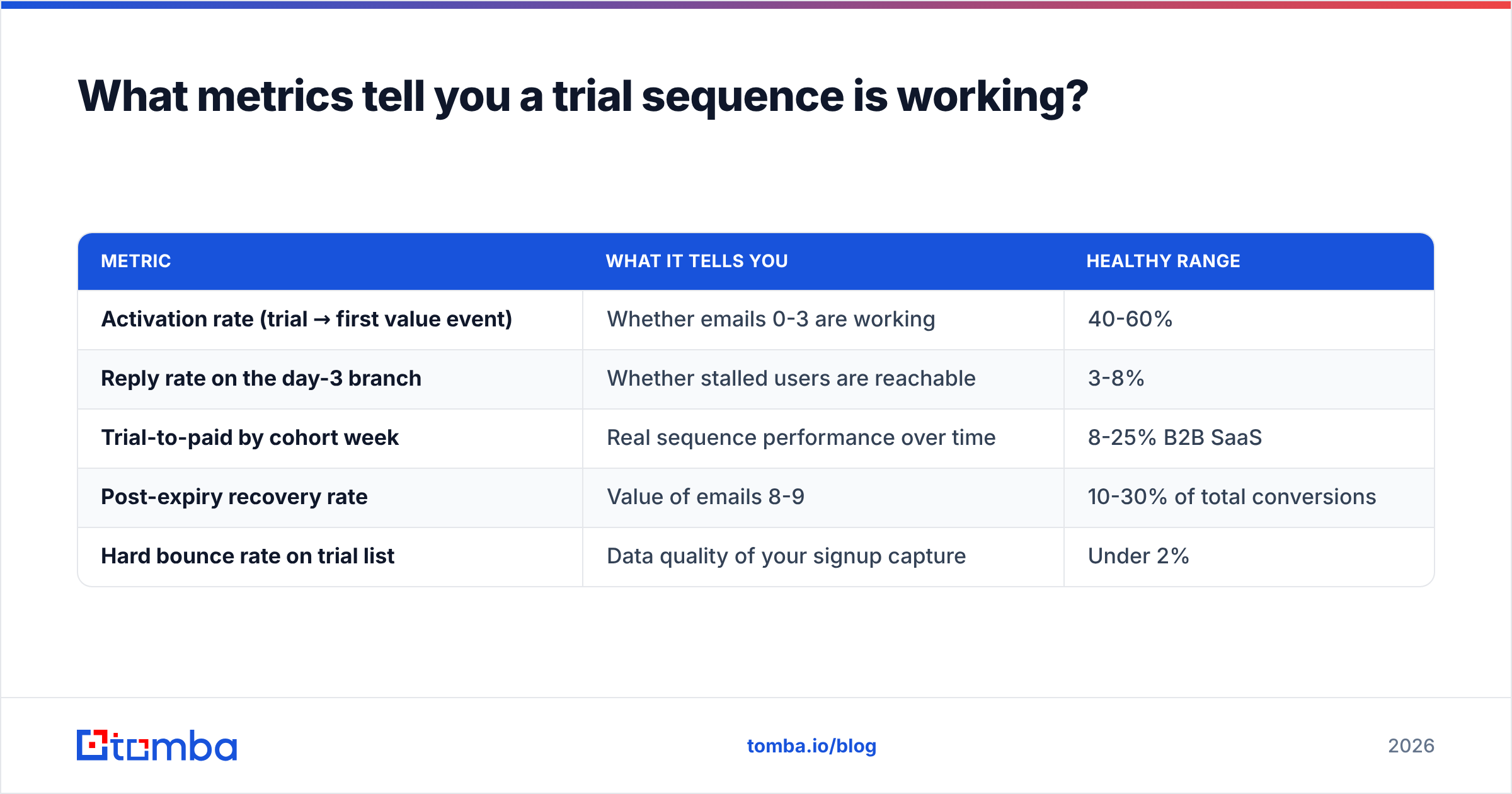
Open rate is the wrong instrument. It's inflated by privacy proxies and it doesn't correlate with revenue. Track these instead:
| Metric | What it tells you | Healthy range |
|---|---|---|
| Activation rate (trial → first value event) | Whether emails 0-3 are working | 40-60% |
| Reply rate on the day-3 branch | Whether stalled users are reachable | 3-8% |
| Trial-to-paid by cohort week | Real sequence performance over time | 8-25% B2B SaaS |
| Post-expiry recovery rate | Value of emails 8-9 | 10-30% of total conversions |
| Hard bounce rate on trial list | Data quality of your signup capture | Under 2% |
That last row is the diagnostic most teams skip. If your bounce rate on trial signups is above 3%, fix the list before you touch the copy — you're optimising a message that never arrives. High bounce rates also compound into sender reputation damage, which quietly suppresses delivery for every other email your product sends, including password resets.
What are the most common mistakes to avoid?#
- Sending from
noreply@. Trial emails should be replyable. Half the value of the day-3 branch is the replies you get. - Batching the expiry email. It must fire on their expiry date, in their timezone, or the deadline reads as fake.
- Offering a discount too early. Discounting on day 7 teaches every future prospect to wait. Hold it for the day-21 win-back, if at all.
- Treating all trials equally. A one-person consultancy and a 2,000-seat enterprise should not get the same nine emails. Segment on firmographics at signup.
- No exit ramp. Every email needs a one-click unsubscribe from the trial sequence specifically — not from all mail. Forcing an all-or-nothing choice costs you future customers.
How should you build this without a big RevOps team?#
Start with three emails, not nine: welcome, day-3 branch, and expiry notice. Those three cover the largest drop-off points. Instrument one product event as your activation trigger. Then add the win-back at day 21, because it's the cheapest incremental conversion you'll ever buy.
Once the skeleton runs, spend your next block of effort on data quality rather than copy. Deduplicate signups, verify addresses at capture, and append work emails and firmographics so segmentation becomes possible. Everything downstream — branching, ICP scoring, deciding which stalled trial deserves a phone call — depends on knowing who signed up.
Ready to stop guessing who's behind your trial signups? The Tomba Email Finder turns a name and a company domain into a verified work email with a confidence score, so your trial follow-up sequence reaches the person who can actually approve the purchase — not an abandoned personal inbox. Start on the free tier with 25 searches a month, or check Tomba pricing for the Starter plan at $49/mo when you're ready to run it across your whole signup flow.
Related guides#
Ready to find emails that actually work?
Join 150,000+ professionals who stopped guessing and started sending. Free credits on signup — no credit card required.
Get the Tomba newsletter
Practical outbound tactics and product updates — once every two weeks.
About the author