Freight Broker Cold Email Template: 7 Scripts That Book Loads
Seven freight broker cold email templates built for shippers who ignore capacity pitches — plus the lane research, contact data, and follow-up cadence that decide whether any of them get a reply.
TL;DR
- A freight broker cold email template only works when it names a specific lane, mode, or seasonal pain — "we have capacity" is the fastest way to get deleted.
- Shippers reply to logistics managers' language: dwell time, tender rejection, detention, on-time pickup. Not "partnership opportunities."
- Your contact data matters more than your copy. A perfect script sent to
info@never reaches the traffic manager who actually tenders freight. - Seven templates below cover cold intro, lane-specific, seasonal surge, carrier-failure recovery, referral, reconnect, and break-up.
- Expect 3-8% reply rates on a tight list of 200 shippers, not 0.5% on a scraped list of 5,000.
Why do most freight broker cold emails get ignored?#
Because they all say the same three things: we're a licensed broker, we have carrier capacity, let's talk about your freight.
A logistics manager at a mid-market manufacturer gets somewhere between five and thirty of those a week. They are functionally identical, which means they carry zero information. The manager doesn't have to read your email to know what it says — the subject line already told them.
A freight broker cold email template that works inverts this. It leads with something only someone who studied that shipper could know: the lane they run out of Laredo, the fact that their DC in Columbus went live in Q1, the produce season that hits their receiving dock every June. The capacity pitch comes second, if at all.
The other half of the problem is deliverability and targeting. According to HubSpot's sales research, the overwhelming majority of cold outreach fails at the list level, not the copy level. If you're emailing a general inbox, an outdated contact, or a role that has no say in carrier selection, no subject line saves you.
Fix that in this order:
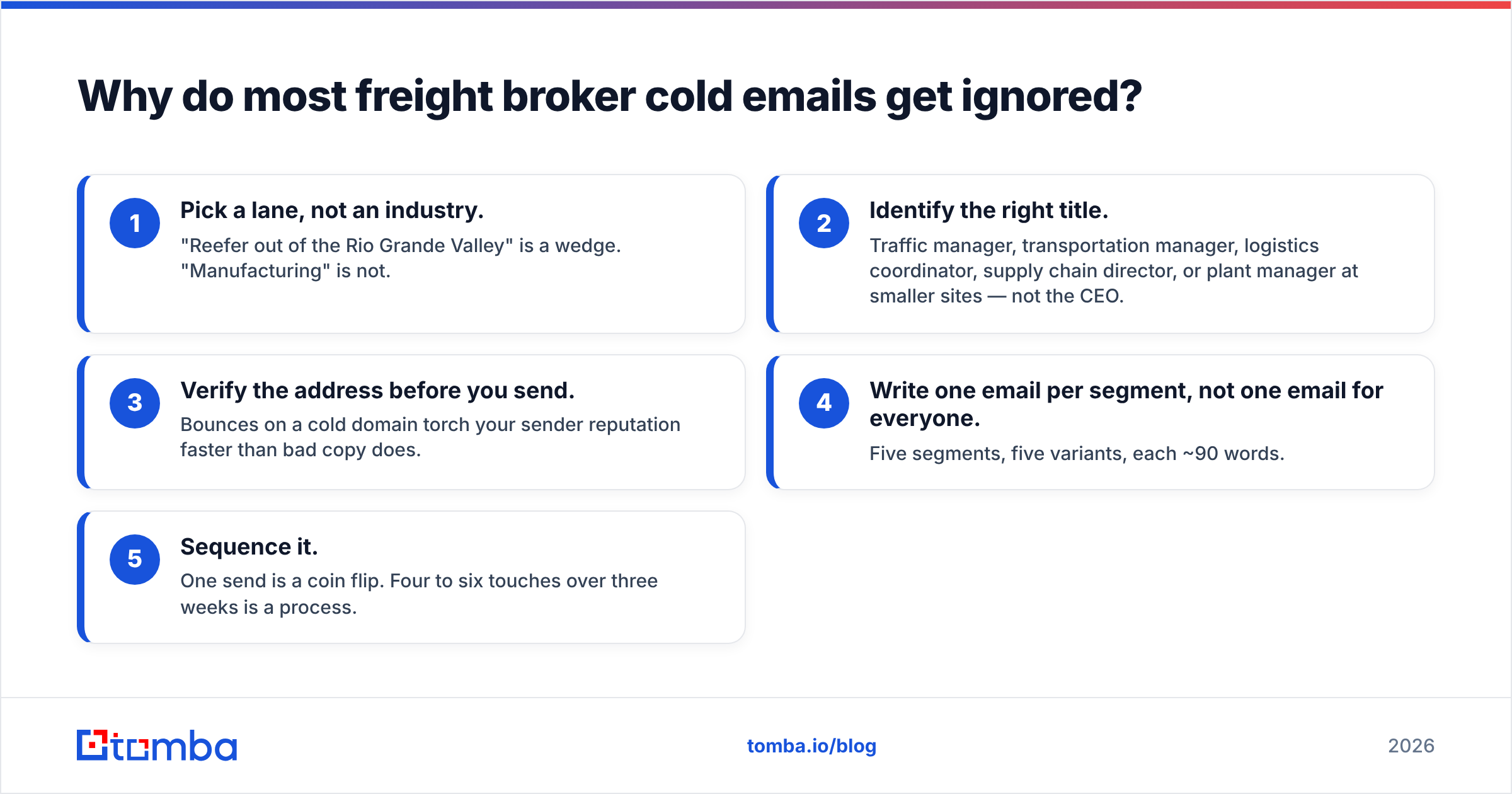
- Pick a lane, not an industry. "Reefer out of the Rio Grande Valley" is a wedge. "Manufacturing" is not.
- Identify the right title. Traffic manager, transportation manager, logistics coordinator, supply chain director, or plant manager at smaller sites — not the CEO.
- Verify the address before you send. Bounces on a cold domain torch your sender reputation faster than bad copy does.
- Write one email per segment, not one email for everyone. Five segments, five variants, each ~90 words.
- Sequence it. One send is a coin flip. Four to six touches over three weeks is a process.
What makes a freight broker cold email different from generic B2B outreach?#
Three things: the buyer already has incumbents, the value is operational rather than strategic, and timing beats persuasion.
Every shipper worth emailing already has a routing guide. You are not replacing it with one email — you're trying to become the person they call when a carrier falls off a load at 4pm on a Friday. That reframes the ask. You're not selling a "logistics partnership," you're asking for a spot quote on one lane.
Operational value means concrete numbers. Tender acceptance, dwell, detention hours, cost per mile on a specific origin-destination pair. Freight buyers live in DAT rate data and their own TMS reports. Talk in those units and you sound like a peer. Talk about "synergies" and you sound like a bot.
Timing beats persuasion because freight demand is lumpy. The shipper who ignored you in April is desperate in June when produce season eats every reefer in the region. Which is why the follow-up sequence — and re-touching quarterly — outperforms clever copywriting almost every time.
What are the best freight broker cold email templates?#
Seven scripts below. Each one is short on purpose: under 120 words, one ask, no attachments, no logos, plain text.
Template 1 — The lane-specific cold open#
Subject: Laredo → Chicago reefer
Hi {{FirstName}},
I noticed {{Company}} moves temp-controlled freight out of the Rio Grande Valley toward the Midwest. We cover Laredo → Chicago reefer weekly and currently have two trucks repositioning empty on that lane every Tuesday.
If your routing guide is tight on that lane right now, I can send a spot quote today — no commitment, just a number to benchmark against.
Worth a look?
{{YourName}}
{{Company}} | MC #{{MCNumber}}
Why it works: names the lane, names the mode, gives a reason the capacity exists (repositioning empties), and asks for something small.
Template 2 — The capacity-gap email#
Subject: covering your overflow, not your routing guide
Hi {{FirstName}},
Not asking you to change your primary carriers. Most of the shippers we work with in {{Industry}} keep their routing guide exactly as-is and use us for the 8-12% of loads that fall through.
We run {{Region}} dry van and flatbed with same-day coverage on tenders under 300 miles.
If you have a load this week your primaries rejected, send it over and see what happens.
{{YourName}}
Why it works: it lowers the perceived switching cost to zero and targets the one job the incumbent is failing at.
Template 3 — The seasonal surge email#
Subject: before {{Season}} hits your dock
Hi {{FirstName}},
Every year around {{Month}}, reefer capacity out of {{Origin}} tightens and spot rates jump 20-40% over contract. If {{Company}} is shipping through that window, locking coverage in {{PriorMonth}} usually costs less than scrambling in {{Month}}.
We're building capacity commitments for that period now. Want me to put together a lane-by-lane number for your top three origins?
{{YourName}}
Why it works: it creates a deadline the shipper already believes in, because they've lived it.
Template 4 — The carrier-failure recovery email#
Subject: if a carrier falls off a load
Hi {{FirstName}},
Quick and specific: when a carrier no-shows on a pickup, who do you call?
We keep a bench of {{Number}} vetted carriers on {{Region}} lanes specifically for that scenario. Average time from call to covered tender last quarter was under 90 minutes.
No pitch here — just want to be in your phone before the day you need it. Can I send over our carrier compliance sheet and dispatch line?
{{YourName}}
Why it works: it asks to be a contingency, which is a much easier "yes" than asking to be a vendor.
Template 5 — The referral / warm-adjacent email#
Subject: {{ReferrerName}} suggested I reach out
Hi {{FirstName}},
{{ReferrerName}} at {{ReferrerCompany}} mentioned you handle inbound freight for the {{City}} DC. We move their {{Mode}} volume on the {{Lane}} lane — mostly drop trailer, ~{{Number}} loads a month.
Happy to send the same setup your way if that lane overlaps with yours. Do you want the details, or should I check back after {{Quarter}} planning?
{{YourName}}
Only send this if the referral is real. Fabricating one is a fast way to get blacklisted in a small industry.
Template 6 — The reconnect email#
Subject: revisiting {{Lane}}
Hi {{FirstName}},
We spoke in {{Month}} about {{Lane}} — you were locked into a contract rate at the time. That cycle should be up soon.
Rates on that lane have moved about {{Percent}} since we talked. If you're re-bidding, I'd like a shot at the RFP. If not, I'll check back next cycle.
Either way is fine — just let me know which.
{{YourName}}
Template 7 — The break-up email#
Subject: closing the loop
Hi {{FirstName}},
I've sent a few notes about {{Lane}} coverage and haven't heard back, which usually means it's not a priority right now. Totally fair.
I'll stop emailing. If capacity gets tight on {{Lane}} this year, my number's below and I'll answer.
{{YourName}}
Break-up emails reliably pull replies — sometimes a "sorry, been slammed, send me a quote." Send it as touch five or six, never as touch two.
Which freight broker cold email template should you use when?#
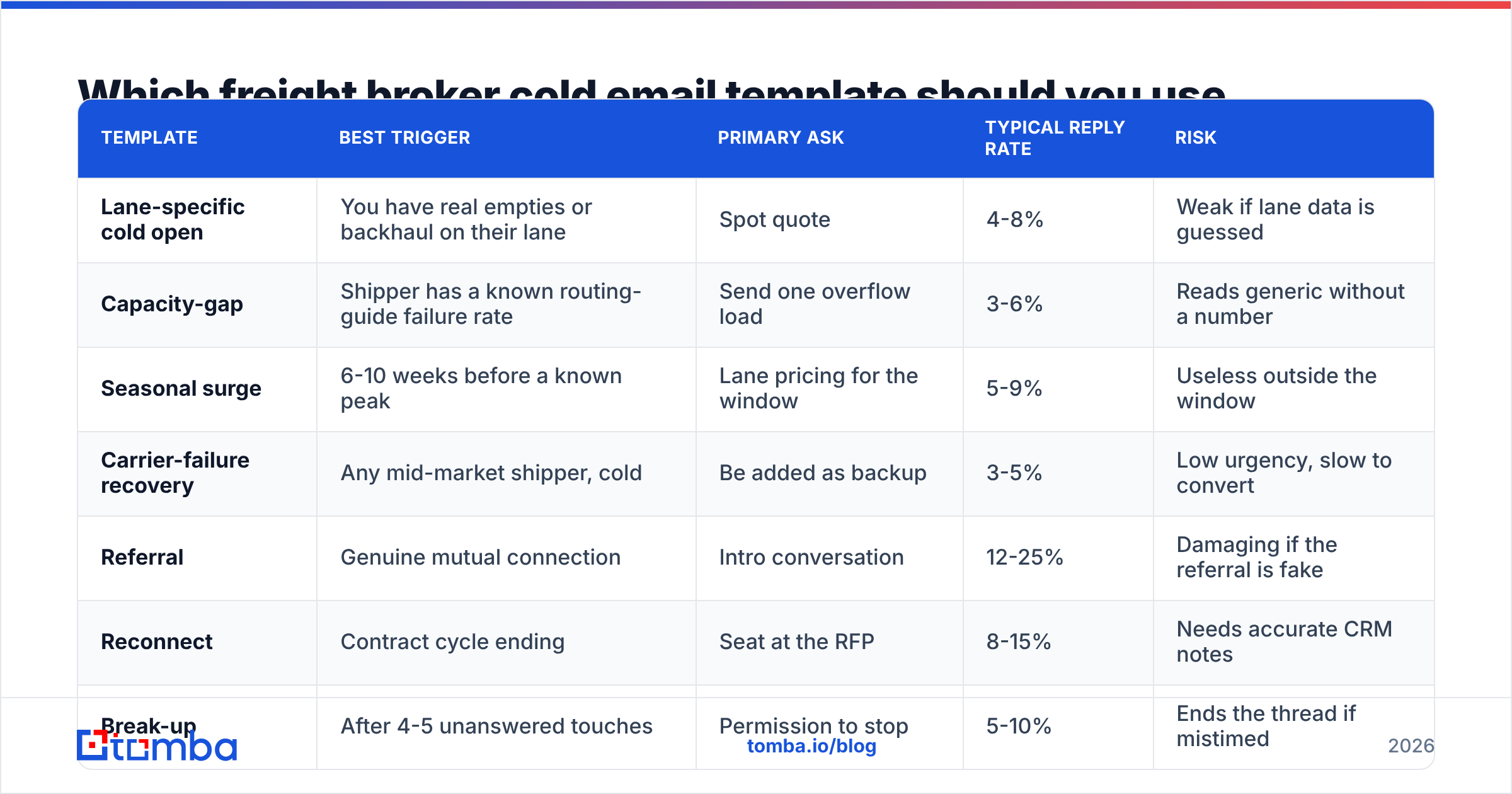
| Template | Best trigger | Primary ask | Typical reply rate | Risk |
|---|---|---|---|---|
| Lane-specific cold open | You have real empties or backhaul on their lane | Spot quote | 4-8% | Weak if lane data is guessed |
| Capacity-gap | Shipper has a known routing-guide failure rate | Send one overflow load | 3-6% | Reads generic without a number |
| Seasonal surge | 6-10 weeks before a known peak | Lane pricing for the window | 5-9% | Useless outside the window |
| Carrier-failure recovery | Any mid-market shipper, cold | Be added as backup | 3-5% | Low urgency, slow to convert |
| Referral | Genuine mutual connection | Intro conversation | 12-25% | Damaging if the referral is fake |
| Reconnect | Contract cycle ending | Seat at the RFP | 8-15% | Needs accurate CRM notes |
| Break-up | After 4-5 unanswered touches | Permission to stop | 5-10% | Ends the thread if mistimed |
Reply-rate ranges assume a verified list under 300 contacts, correct titles, and a warmed sending domain. On a scraped list they collapse by roughly an order of magnitude.
How do you find the right shipper contact to email?#
Start from the facility, not the corporate HQ. The person who tenders freight usually sits at the plant or the DC, and their title is rarely "VP."
A repeatable process:
- Build the shipper list from lane logic. Who ships out of the origins where you already have carrier density? Trade data, customs records, and plain Google Maps searches for DCs in a metro all work.
- Map the org. Look for transportation manager, traffic manager, logistics coordinator, inbound supervisor, and supply chain director. At companies under 200 employees, the ops manager often owns freight.
- Get the address, don't guess it. A domain search returns the verified addresses and the company's email pattern in one pass, which is faster than permutating
first.last@and hoping. - Verify before sending. Run every address through an email verifier. Freight shipper domains churn constantly through acquisitions and site closures, so a list built six months ago is already decaying.
- Enrich for phone. Freight is still a phone industry. Pairing email with a phone finder lets you run email-first, call-second sequences, which convert far better than either channel alone.
Why do freight broker cold emails land in spam?#
Usually one of four causes, in this order of frequency: bounce rate, sending volume ramp, domain authentication, and content.
Bounces are the big one. Send 500 emails to an unverified list, hit a 12% bounce rate, and mailbox providers start filing you as a spammer regardless of what your copy says. Under 2% is the target.
Authentication is table stakes now. Google and Yahoo both enforce SPF, DKIM, and DMARC for bulk senders — the requirements are published in Google's sender guidelines. If you're sending from a broker domain with no DMARC record, fix that before you write another template.
Volume ramp trips up brokers who buy a new domain, wait a week, then blast 300 a day. Ramp over four to six weeks, cap at 30-50 per mailbox per day, and add mailboxes rather than raising per-mailbox volume. Our email warmup calculator gives you a schedule based on your target volume.
Content matters least, but a few things still hurt: attachments on a first touch, image-heavy signatures, tracking pixels on every send, and the words most brokers lead with ("capacity," "rates," "free quote") stacked in a single subject line. Plain text, one link maximum, no attachment until they ask.
What results should a freight broker expect from cold email?#
Benchmarks for a broker running a disciplined program on a verified list:
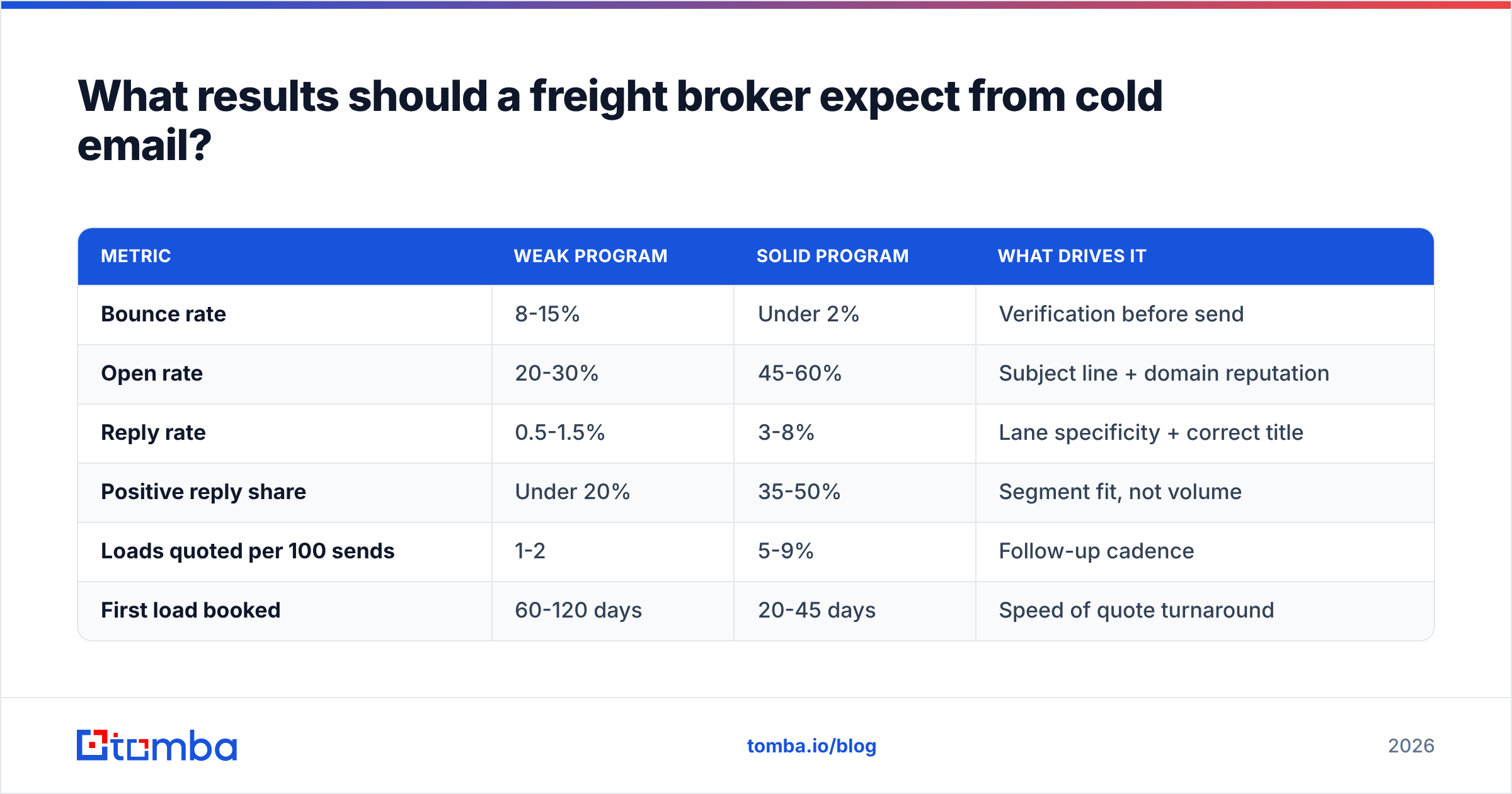
| Metric | Weak program | Solid program | What drives it |
|---|---|---|---|
| Bounce rate | 8-15% | Under 2% | Verification before send |
| Open rate | 20-30% | 45-60% | Subject line + domain reputation |
| Reply rate | 0.5-1.5% | 3-8% | Lane specificity + correct title |
| Positive reply share | Under 20% | 35-50% | Segment fit, not volume |
| Loads quoted per 100 sends | 1-2 | 5-9% | Follow-up cadence |
| First load booked | 60-120 days | 20-45 days | Speed of quote turnaround |
The number brokers underweight is time-to-first-quote. A shipper who asks for a number and gets it in 20 minutes converts at a dramatically different rate than one who gets it the next morning. Your cold email program is only as good as the dispatch response behind it.
Also track by segment, not in aggregate. If reefer shippers reply at 7% and dry van at 1.5%, the answer isn't "improve the email" — it's "send more reefer emails."
How many follow-ups should a freight broker cold email sequence have?#
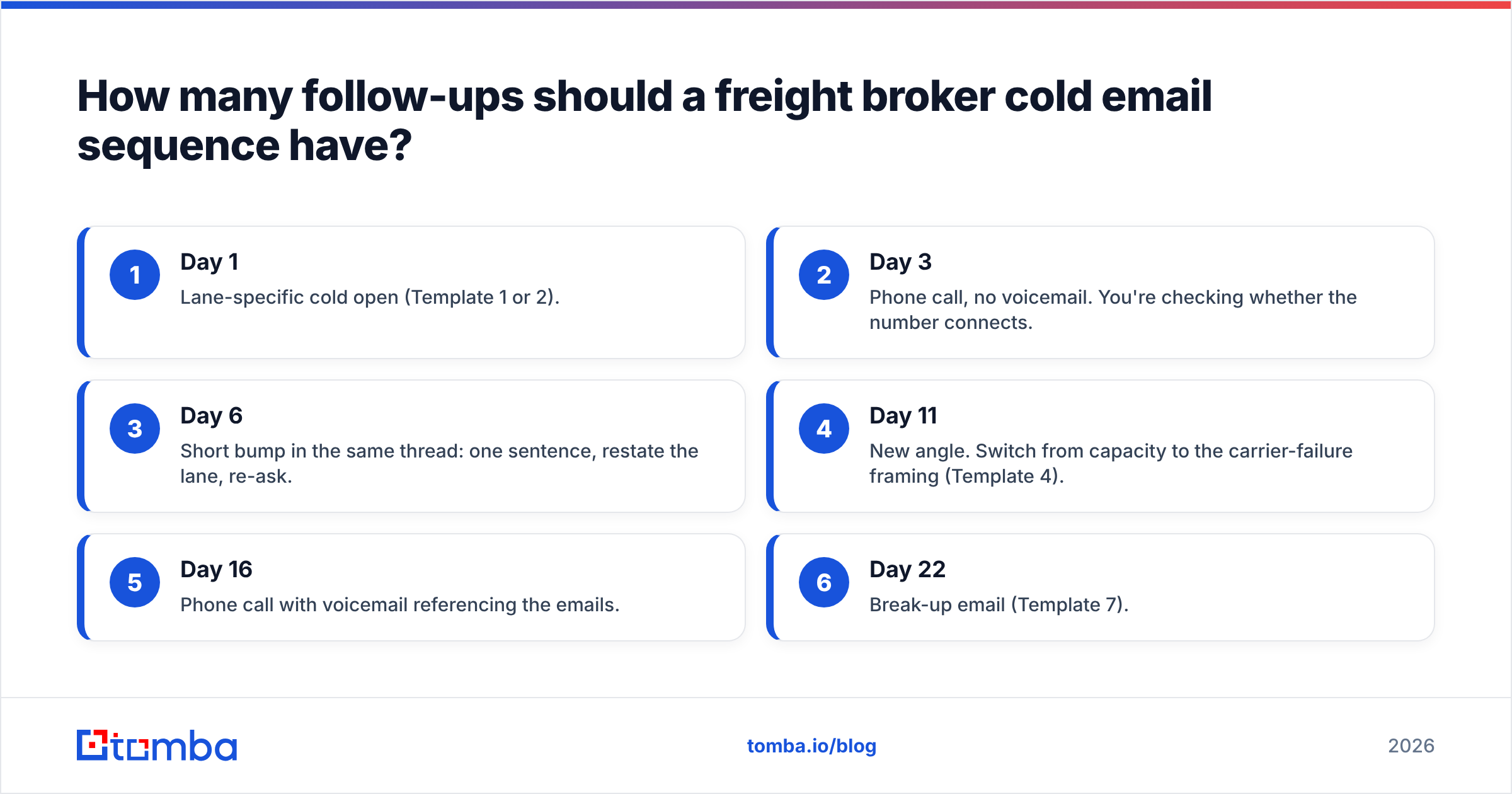
Four to six touches over 18-25 days, mixing email and phone.
A cadence that holds up:
- Day 1 — Lane-specific cold open (Template 1 or 2).
- Day 3 — Phone call, no voicemail. You're checking whether the number connects.
- Day 6 — Short bump in the same thread: one sentence, restate the lane, re-ask.
- Day 11 — New angle. Switch from capacity to the carrier-failure framing (Template 4).
- Day 16 — Phone call with voicemail referencing the emails.
- Day 22 — Break-up email (Template 7).
Then re-enter the contact into a quarterly nurture. Freight is cyclical; the "no" you got in Q2 is often a "send me a number" in Q4. That's why CRM hygiene and periodic data enrichment beat writing yet another template — the contact who ignored you may have changed roles, and the new person has no incumbent loyalty at all.
Ready to build the list behind these templates?#
Templates are the easy part. The hard part is knowing which 200 shippers to send them to and having the verified address for the person who actually tenders the freight.
Start with Tomba's Email Finder: search a shipper's domain, pull verified contacts by title, and export straight into your sequencer or CRM. The free tier gives you 25 searches a month to test the process on a handful of target accounts, and paid plans start at $49/mo when you're ready to scale the list. Check Tomba pricing for the full breakdown — then go send the lane-specific version, not the capacity blast.
Related guides#
Ready to find emails that actually work?
Join 150,000+ professionals who stopped guessing and started sending. Free credits on signup — no credit card required.
Get the Tomba newsletter
Practical outbound tactics and product updates — once every two weeks.
About the author