Freight Broker Follow Up Email: Templates That Book Loads
Shippers ignore first emails, not brokers. Here are the follow-up cadences, timing windows, and templates that actually get freight brokers a reply in 2026.
TL;DR
- Freight brokers lose most shipper deals between touch two and touch five — not on the cold open. The average shipper needs 6–8 contacts before a reply, and most brokers stop at two.
- "Just following up" is the single worst subject line in freight. Replace every follow-up with a new piece of lane, capacity, or rate information.
- Timing beats volume: Tuesday–Thursday, 6:30–8:00 a.m. local to the shipper's dock, aligned to when logistics managers triage overnight tenders.
- Build the sequence around events (rate swings, carrier failures, RFP season, new DC openings), not around calendar intervals.
- Bad contact data kills more freight broker follow-up sequences than bad copy. Verify the logistics manager's address before touch one, not after touch four.
Why do freight broker follow up emails fail so often?#
Because brokers treat follow-up as repetition instead of escalation.
Think of it like calling on a shipper's dock. If you show up Monday and say "any freight today?", then show up Tuesday and say the exact same thing, the dock manager stops looking up. But if Tuesday you say "I've got a reefer deadheading out of Laredo tomorrow at 6 a.m., empty on your lane" — now you're useful. Email works identically. Each touch must carry new information or it burns the relationship.
The math is brutal. Freight is a relationship business with a 9–18 month sales cycle for enterprise shippers, yet most brokerage reps run two-touch sequences. According to HubSpot's sales research, the majority of closed deals require five or more follow-ups, while the majority of reps quit after one or two. In freight, where the incumbent broker has an existing contract and the buyer has zero urgency, that gap is wider.
Three failure modes account for nearly all of it:
- No new information per touch. "Circling back," "bumping this up," and "did you see my last email" are not information. They ask the shipper to do work.
- Wrong contact entirely. You're emailing a plant manager about carrier procurement decisions made by a corporate logistics director three states away.
- Calendar cadence instead of event cadence. Day 3, day 7, day 14 is a spreadsheet habit. Freight buying happens on triggers — a carrier fails, a rate spikes, an RFP window opens.
What does a working freight broker follow up sequence look like?#
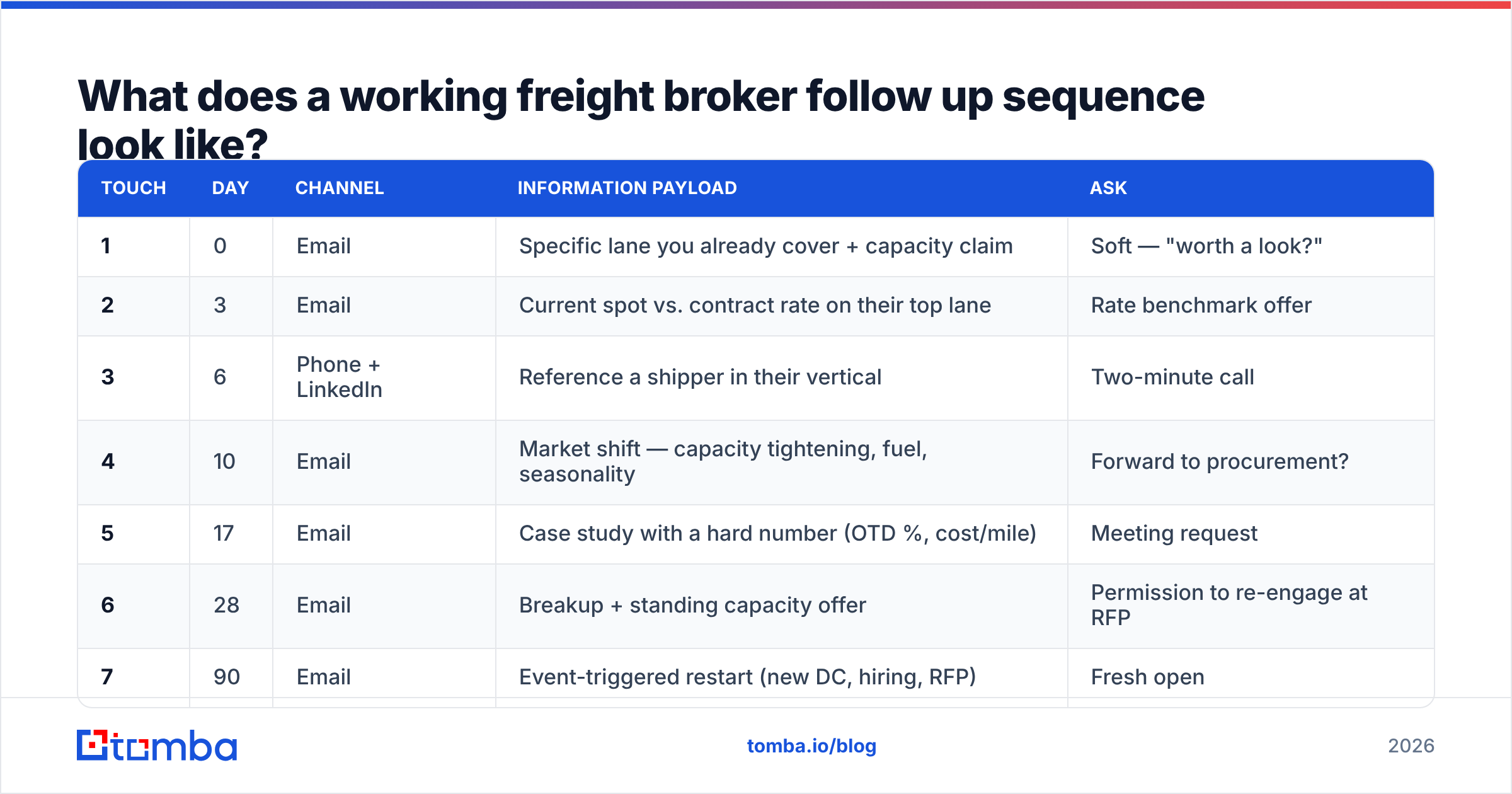
Here's the structure that outperforms generic cadences in transportation sales. Each touch has a distinct job and a distinct information payload.
| Touch | Day | Channel | Information payload | Ask |
|---|---|---|---|---|
| 1 | 0 | Specific lane you already cover + capacity claim | Soft — "worth a look?" | |
| 2 | 3 | Current spot vs. contract rate on their top lane | Rate benchmark offer | |
| 3 | 6 | Phone + LinkedIn | Reference a shipper in their vertical | Two-minute call |
| 4 | 10 | Market shift — capacity tightening, fuel, seasonality | Forward to procurement? | |
| 5 | 17 | Case study with a hard number (OTD %, cost/mile) | Meeting request | |
| 6 | 28 | Breakup + standing capacity offer | Permission to re-engage at RFP | |
| 7 | 90 | Event-triggered restart (new DC, hiring, RFP) | Fresh open |
Notice what's missing: there is no touch whose only content is "following up on my last note." Every row carries something the shipper couldn't get by ignoring you.
The 28-day breakup is not theater. It genuinely closes the loop, and in freight it converts unusually well because logistics buyers appreciate directness. Roughly one in six replies to a well-written brokerage sequence arrives on the breakup email.
When should you send a freight broker follow up email?#
Send when the shipper's operational rhythm makes them receptive, not when your CRM reminder fires.
Logistics and supply chain roles run on a distinct clock. Loads tender overnight, exceptions surface at 6 a.m., and the afternoon is firefighting. That produces a narrow, reliable window.
- Best window: Tuesday–Thursday, 6:30–8:00 a.m. in the shipper's local time zone. Your email sits at the top of the inbox during morning tender triage.
- Second window: Tuesday–Thursday, 1:00–2:00 p.m. — post-lunch, pre-afternoon-crisis.
- Avoid: Monday before 10 a.m. (weekend backlog), Friday after 1 p.m. (weekend coverage planning), and the last two business days of the month for anyone with volume commitments.
- Seasonal timing: Q3 is RFP season for most large shippers with January contract starts. A follow-up in August that references "your upcoming bid cycle" lands very differently than the same note in March.
- Event timing: A carrier service failure, a port disruption, or a sudden spot-rate spike on their lane is worth more than any scheduled touch. Break your cadence for it.
One caveat on time-zone precision: a shipper's corporate HQ time zone often differs from the DC that actually generates the freight. Send against the address where the decision sits, and note which one you used so your reply-rate data stays clean.
What should each follow up email actually say?#
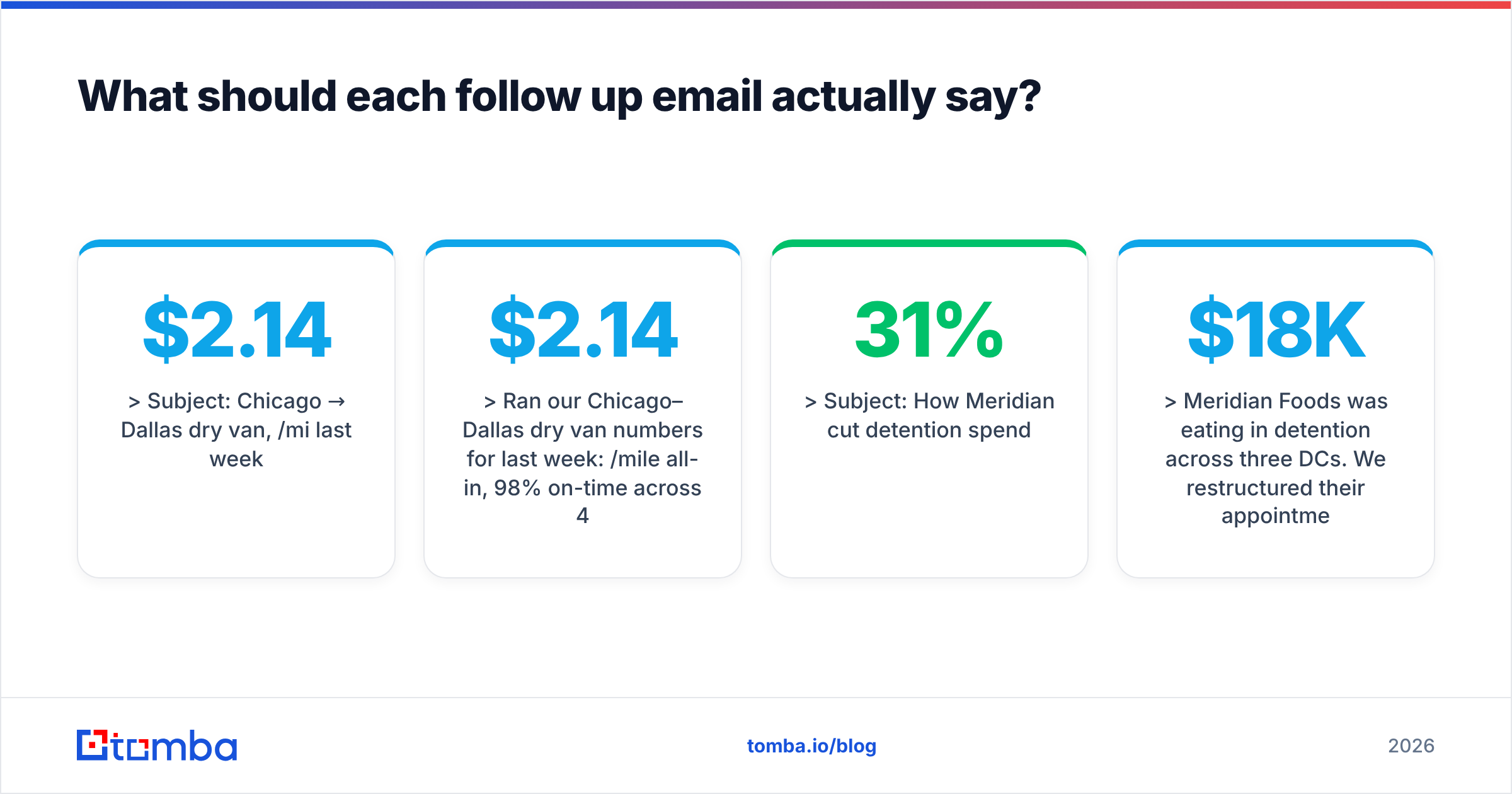
Short. Specific. One ask. Here are four templates mapped to the sequence above.
Touch 2 — the rate benchmark (day 3)
Subject: Chicago → Dallas dry van, $2.14/mi last week
Hi Dana,
Ran our Chicago–Dallas dry van numbers for last week: $2.14/mile all-in, 98% on-time across 41 loads. Most shippers I talk to are paying contract in the $2.30s on that lane right now.
If you're anywhere north of that, I can send the full lane breakdown — no meeting needed, just a PDF.
Worth a look?
Touch 4 — the market shift (day 10)
Subject: Reefer capacity tightening out of the Valley
Hi Dana,
Heads up in case it's useful: reefer capacity out of the Rio Grande Valley started tightening two weeks early this season. We're seeing tender rejections climb on southbound backhauls.
We hold committed capacity with four carriers on that lane. Happy to hold a truck for you if produce volume is part of your Q4 plan.
If procurement handles this, feel free to forward.
Touch 5 — the proof point (day 17)
Subject: How Meridian cut detention spend 31%
Hi Dana,
One specific example, then I'll stop crowding your inbox.
Meridian Foods was eating $18K/month in detention across three DCs. We restructured their appointment windows and moved 60% of their volume to drop-and-hook. Detention spend fell 31% in the first quarter.
Fifteen minutes to see if the same structure fits your network?
Touch 6 — the breakup (day 28)
Subject: Closing your file
Hi Dana,
I'll assume freight procurement isn't a priority right now and stop reaching out.
If that changes — a carrier falls over, or your bid cycle opens — we hold committed capacity on Chicago–Dallas and the Texas triangle. One email and I'll quote same day.
Good luck with Q4.
Each one passes the same test: could the shipper forward this to a colleague and have it make sense without your previous emails? If not, rewrite it.
If you want a faster starting point, our library of cold email templates and the subject line tester will get you to a testable draft in minutes. Just replace every generic noun with a lane, a rate, or a mode.
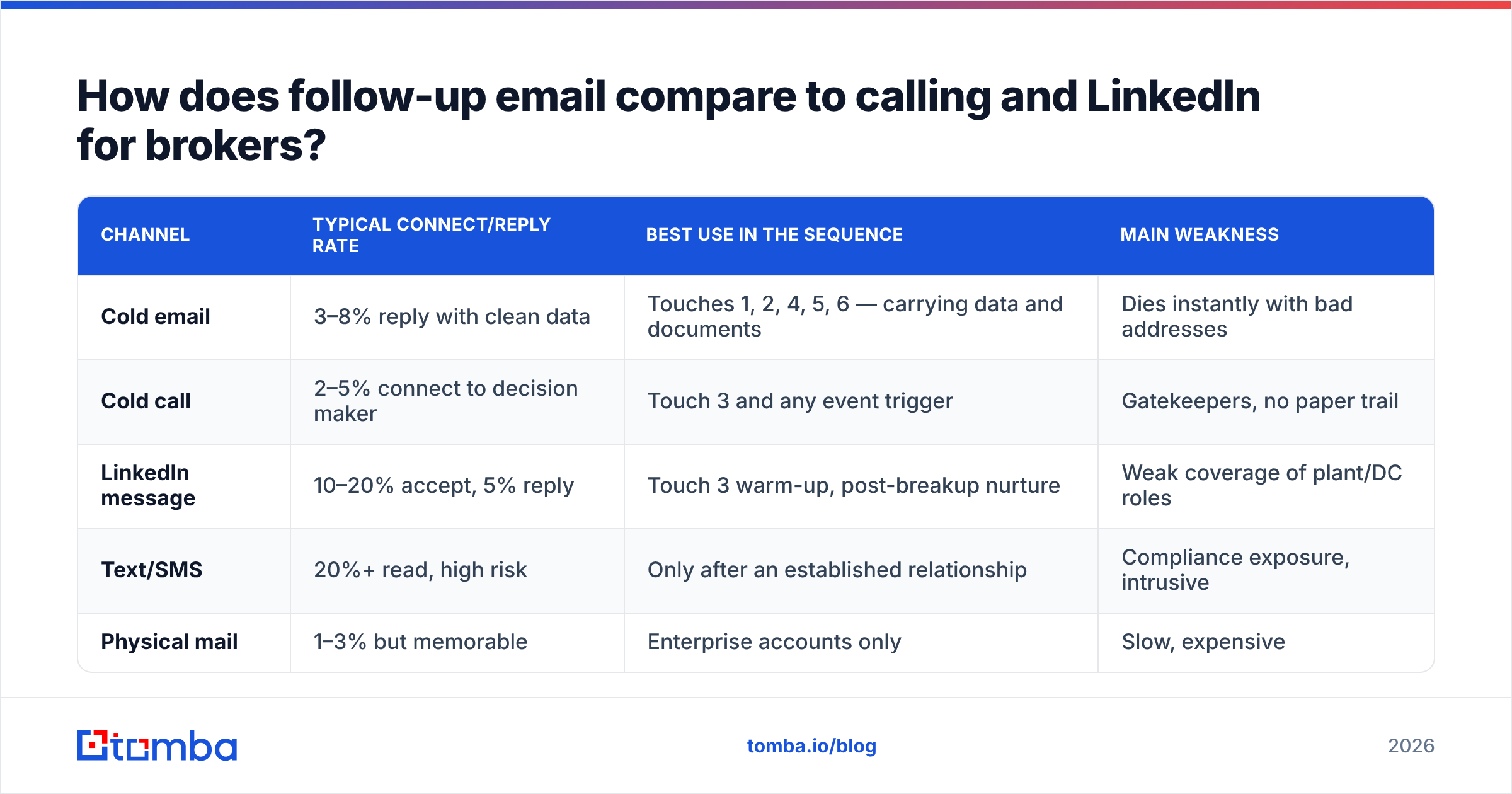
How does follow-up email compare to calling and LinkedIn for brokers?#
None of them wins alone. The comparison matters because most brokerages over-index on the phone and under-invest in the other two.
| Channel | Typical connect/reply rate | Best use in the sequence | Main weakness |
|---|---|---|---|
| Cold email | 3–8% reply with clean data | Touches 1, 2, 4, 5, 6 — carrying data and documents | Dies instantly with bad addresses |
| Cold call | 2–5% connect to decision maker | Touch 3 and any event trigger | Gatekeepers, no paper trail |
| LinkedIn message | 10–20% accept, 5% reply | Touch 3 warm-up, post-breakup nurture | Weak coverage of plant/DC roles |
| Text/SMS | 20%+ read, high risk | Only after an established relationship | Compliance exposure, intrusive |
| Physical mail | 1–3% but memorable | Enterprise accounts only | Slow, expensive |
The pattern that works: email carries the information, the phone creates the moment, LinkedIn keeps you visible between touches. A broker who runs all three against the same 200 shippers will beat a broker who dials 400 numbers.
For the LinkedIn leg, pulling verified work addresses from profiles is faster than guessing — a LinkedIn email extractor turns a saved list of logistics directors into a usable sequence list without manual pattern guessing.
Why does contact data matter more than copy in freight?#
Because transportation has the highest contact churn of almost any B2B vertical, and a bounced email poisons your whole domain.
Logistics managers move constantly. Third-party warehouses change hands. A shipper consolidates three regional DCs into one and half your contact list evaporates. Industry data consistently puts B2B contact decay somewhere between 22% and 30% per year; in freight and 3PL it runs at the top of that range.
That creates two compounding problems:
- Bounces damage sender reputation. A bounce rate over 3% starts affecting inbox placement. Push past 5% and your legitimate follow-ups to good contacts start landing in spam — meaning your best prospects never see touches four through six.
- Wrong-role delivery wastes the sequence. Sending a contract-rate pitch to a dock supervisor gets no reply, and it looks identical in your analytics to a well-targeted email that got ignored. You learn nothing.
Fix this at the front of the process, not the back:
- Verify before touch one. Run the list through an email verifier so you're only spending sequence slots on live mailboxes.
- Target by role, not by company. For mid-market shippers, the buyer is usually a Logistics Manager, Transportation Manager, or Supply Chain Director. For enterprise, add the corporate procurement contact.
- Handle catch-all domains explicitly. Many manufacturers run catch-all servers that accept everything, so standard verification returns "unknown." A catch-all verifier reduces that gray zone before you commit a sequence to it.
- Refresh quarterly. Re-verify any list older than 90 days. In freight, that is not conservative — it's the minimum.
- Track bounces per source. If one data source produces 8% bounces and another produces 1%, stop paying for the first one.
Sender infrastructure matters alongside the data. Authenticate properly, warm new domains, and check your SPF record before you scale volume. Google's bulk sender guidelines spell out the current thresholds — and Gmail enforces them on the same B2B mailboxes your shippers use.
How do you measure whether your follow up sequence works?#
Track four numbers per sequence, not one.
- Deliverability rate — target above 97%. Below that, fix data before touching copy.
- Reply rate by touch number — this is the diagnostic that matters. If touch 1 gets 4% and touches 2–6 get under 1% combined, your follow-ups aren't carrying new information.
- Positive reply share — of all replies, what percent are interested versus "remove me"? Under 40% positive means your targeting is off, not your writing.
- Load-to-sequence ratio — how many sequences produce a first tendered load within 120 days. This is the only number your brokerage owner cares about.
A realistic benchmark for a well-targeted freight brokerage sequence in 2026: 5–7% total reply rate, 45–55% of those positive, and roughly one first load per 40–60 completed sequences. If you're far below that, the diagnostic order is always data, then targeting, then timing, then copy. Most brokers reverse it and spend three weeks rewriting subject lines on a list that's 30% dead.
Peers to compare notes with: vendor-neutral review sites like G2's sales engagement category publish reply-rate ranges by tool and segment, which is a more honest benchmark than any vendor's own case study.
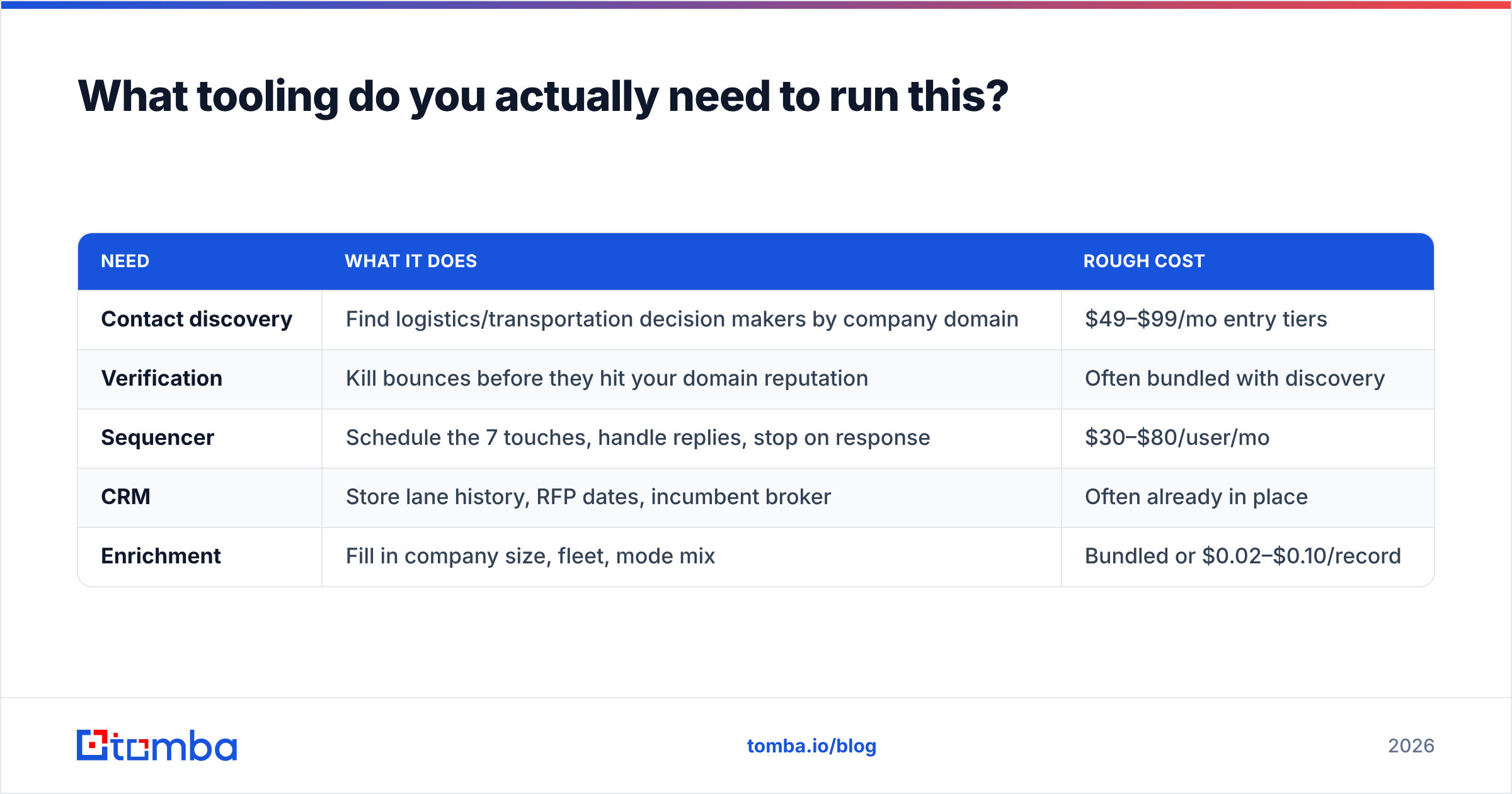
What tooling do you actually need to run this?#
Less than most brokerages buy. The stack has three jobs: find the right contact, verify it, and send the sequence.
| Need | What it does | Rough cost |
|---|---|---|
| Contact discovery | Find logistics/transportation decision makers by company domain | $49–$99/mo entry tiers |
| Verification | Kill bounces before they hit your domain reputation | Often bundled with discovery |
| Sequencer | Schedule the 7 touches, handle replies, stop on response | $30–$80/user/mo |
| CRM | Store lane history, RFP dates, incumbent broker | Often already in place |
| Enrichment | Fill in company size, fleet, mode mix | Bundled or $0.02–$0.10/record |
On the discovery side, Tomba pricing starts free at 25 searches per month, with Starter at $49/mo, Growth at $99/mo, and Pro at $249/mo — verification included rather than sold as a separate line item, which matters when you're re-verifying a churny freight list every quarter. BookYourData is a solid alternative if you'd rather buy a pre-built list of logistics contacts outright than search domain by domain; it's a genuinely different purchase model, and for brokers targeting a fixed vertical it can be the faster path.
Whichever you pick, resist buying a fifth tool. The bottleneck in freight brokerage outbound is almost never software — it's that nobody wrote touch four.
Ready to build a follow-up list that doesn't bounce?#
Your sequence is only as good as the mailbox it lands in. Use the Tomba Email Finder to pull verified addresses for logistics managers, transportation directors, and supply chain leads at the shippers on your target lanes — by company domain, by name, or in bulk. Start free with 25 searches a month, confirm the data quality against a handful of accounts you already know, then scale the sequence once your bounce rate is under 2%.
Write touch four. Verify the list. Send Tuesday at 7 a.m.
Related guides#
Ready to find emails that actually work?
Join 150,000+ professionals who stopped guessing and started sending. Free credits on signup — no credit card required.
Get the Tomba newsletter
Practical outbound tactics and product updates — once every two weeks.
About the author