Frontline Sales Manager: The 2026 Role, Skills & Playbook
The frontline sales manager is the highest-leverage role in B2B revenue — and the most under-supported. Here's what the job actually involves in 2026, the coaching cadence that works, and the tooling that keeps reps selling.
TL;DR
- A frontline sales manager owns 5-10 quota-carrying reps directly — no manager layer beneath them. It is the only role in the org that touches individual deal execution and territory strategy in the same week.
- The job splits roughly 40% coaching, 25% pipeline inspection, 20% hiring and ramping, 15% cross-functional unblocking. When admin work crowds out coaching, attainment drops within two quarters.
- Most companies promote their best rep and hand them a dashboard. That's the single biggest cause of frontline manager failure — selling skill and coaching skill are different muscles.
- The metrics that actually predict a manager's quarter are leading (activity quality, stage-conversion, ramp time), not lagging (bookings, quota attainment).
- Tooling matters less than cadence, but bad data kills both. If reps spend hours hunting contact details, your coaching hours evaporate into list-building.
What is a frontline sales manager?#
A frontline sales manager is the first level of sales leadership — the person who manages individual contributors directly rather than managing other managers. Titles vary: Sales Manager, Team Lead, Regional Sales Manager, SDR Manager, Head of Inside Sales at smaller companies. What defines the role is the reporting line: quota-carrying reps report to them, and they report to a Director or VP.
The distinction matters because the work is structurally different from second-line leadership. A VP of Sales works in aggregates — segments, capacity models, comp plan design, board forecasts. A frontline sales manager works in specifics: this rep, this deal, this call recording, this objection they fumbled on Tuesday.
Here's the analogy that sticks. A VP is the coach designing the season's strategy from the box. The frontline manager is the position coach on the sideline, correcting a player's footwork between plays. Both are necessary. Only one of them can change what happens in the next two minutes.
Gartner's sales leadership research has consistently found that frontline manager effectiveness is one of the strongest predictors of seller quota attainment — stronger than seller experience level or territory quality. That's a big claim, and it's directionally supported by how quickly attainment moves when a strong manager takes over a struggling team versus how slowly it moves when you swap territories around.
What does a frontline sales manager actually do all week?#
The honest answer: far more administrative work than the job description implies, and that's the problem.
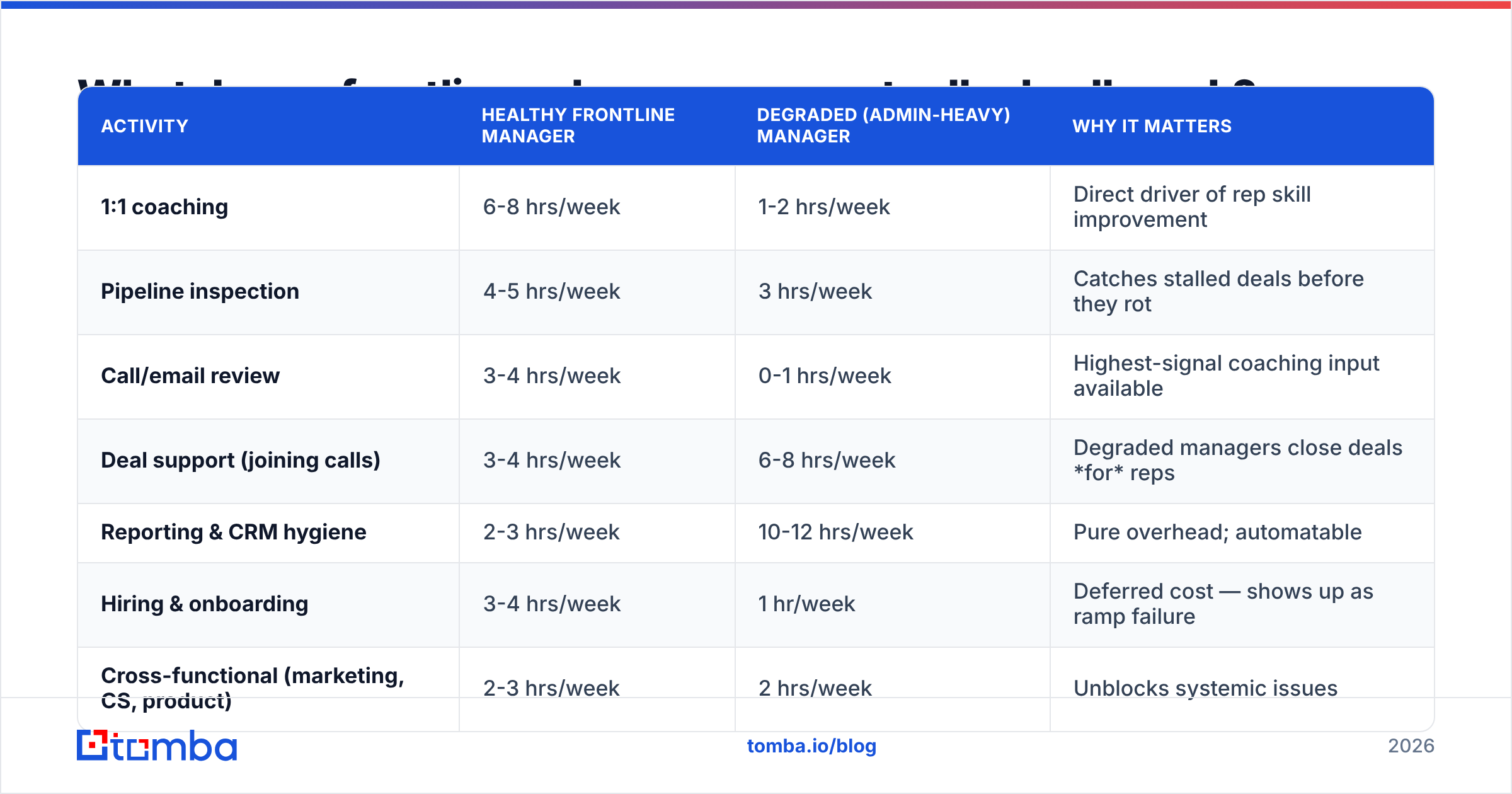
Here's how the week breaks down when the role is functioning well versus when it's degraded into reporting duty.
| Activity | Healthy frontline manager | Degraded (admin-heavy) manager | Why it matters |
|---|---|---|---|
| 1:1 coaching | 6-8 hrs/week | 1-2 hrs/week | Direct driver of rep skill improvement |
| Pipeline inspection | 4-5 hrs/week | 3 hrs/week | Catches stalled deals before they rot |
| Call/email review | 3-4 hrs/week | 0-1 hrs/week | Highest-signal coaching input available |
| Deal support (joining calls) | 3-4 hrs/week | 6-8 hrs/week | Degraded managers close deals for reps |
| Reporting & CRM hygiene | 2-3 hrs/week | 10-12 hrs/week | Pure overhead; automatable |
| Hiring & onboarding | 3-4 hrs/week | 1 hr/week | Deferred cost — shows up as ramp failure |
| Cross-functional (marketing, CS, product) | 2-3 hrs/week | 2 hrs/week | Unblocks systemic issues |
The tell for a degraded manager is the "deal support" row going up while coaching goes down. A manager who joins every late-stage call and personally handles the pricing objection looks heroic on the quarter-end report. They are also guaranteeing that the rep will need them on the next deal, and the one after that.
The five recurring rituals#
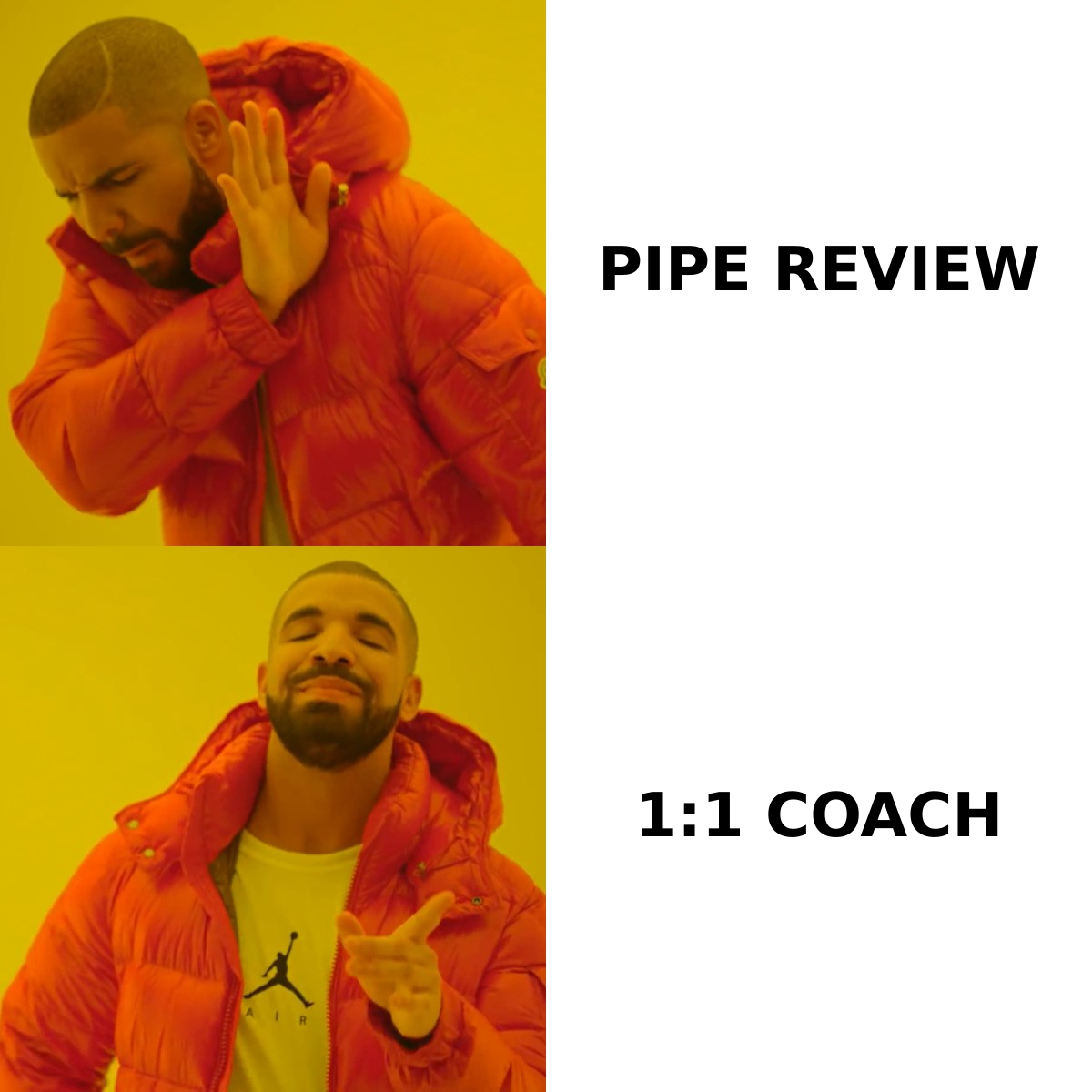
- Weekly 1:1 (45-60 min, non-negotiable). Not a pipeline review with a different name. Split it: 15 minutes on deals, 30 minutes on one skill, 10 minutes on career. If you only ever discuss deals, you're a forecast auditor, not a coach.
- Weekly pipeline inspection (60-90 min, team). Look at stage-to-stage conversion and deal age, not just total pipeline value. A $2M pipeline where 60% of deals haven't moved stages in 30 days is a $600K pipeline wearing a costume.
- Call review block (2-3 hrs, async). Pull two recordings per rep per week. Timestamp one thing they did well and one thing to change. Sending a 90-second Loom beats a 30-minute meeting.
- Monthly territory/account planning. Where is the whitespace? Which accounts have gone quiet? This is where a solid B2B database earns its cost — you cannot plan a territory you can't see.
- Quarterly skills assessment. Score each rep on 5-7 competencies (discovery, multithreading, negotiation, forecasting accuracy, prospecting volume). Track the delta quarter over quarter. Without this, "coaching" is just vibes.
Why do great reps fail as frontline sales managers?#
Because you promoted them for a skill they now have to stop using.
A top rep wins by taking control — of the call, the objection, the close. A frontline sales manager wins by not taking control, and instead building the capability in someone else. Those instincts are in direct conflict. The new manager watches a rep fumble a discovery call, feels the physical urge to jump in, jumps in, and closes the deal. Rep learns nothing. Manager gets praised. Repeat for three quarters, and you have a team of five reps who can't close without their manager on the line.
The three failure patterns worth naming:
- The super-rep. Closes deals for the team. Team attainment looks fine until the manager takes vacation or the team grows past six people. Then it collapses.
- The dashboard manager. Overcorrects into pure inspection. Weekly pipeline meeting becomes an interrogation. Reps learn to sandbag their forecasts, and forecast accuracy — the one thing this manager cares about — gets worse.
- The friend. Was a peer six weeks ago and can't make the switch. Avoids hard conversations about underperformance until the PIP arrives as a surprise. Attrition follows, and it's usually the good reps who leave first because they see the low bar.
The fix is boring and it works: give new frontline managers a structured 90-day ramp of their own, with a manager-of-managers doing weekly skip-level coaching on their coaching. Most companies build a 90-day ramp for reps and zero ramp for the person managing them.
Which metrics should a frontline sales manager actually track?#
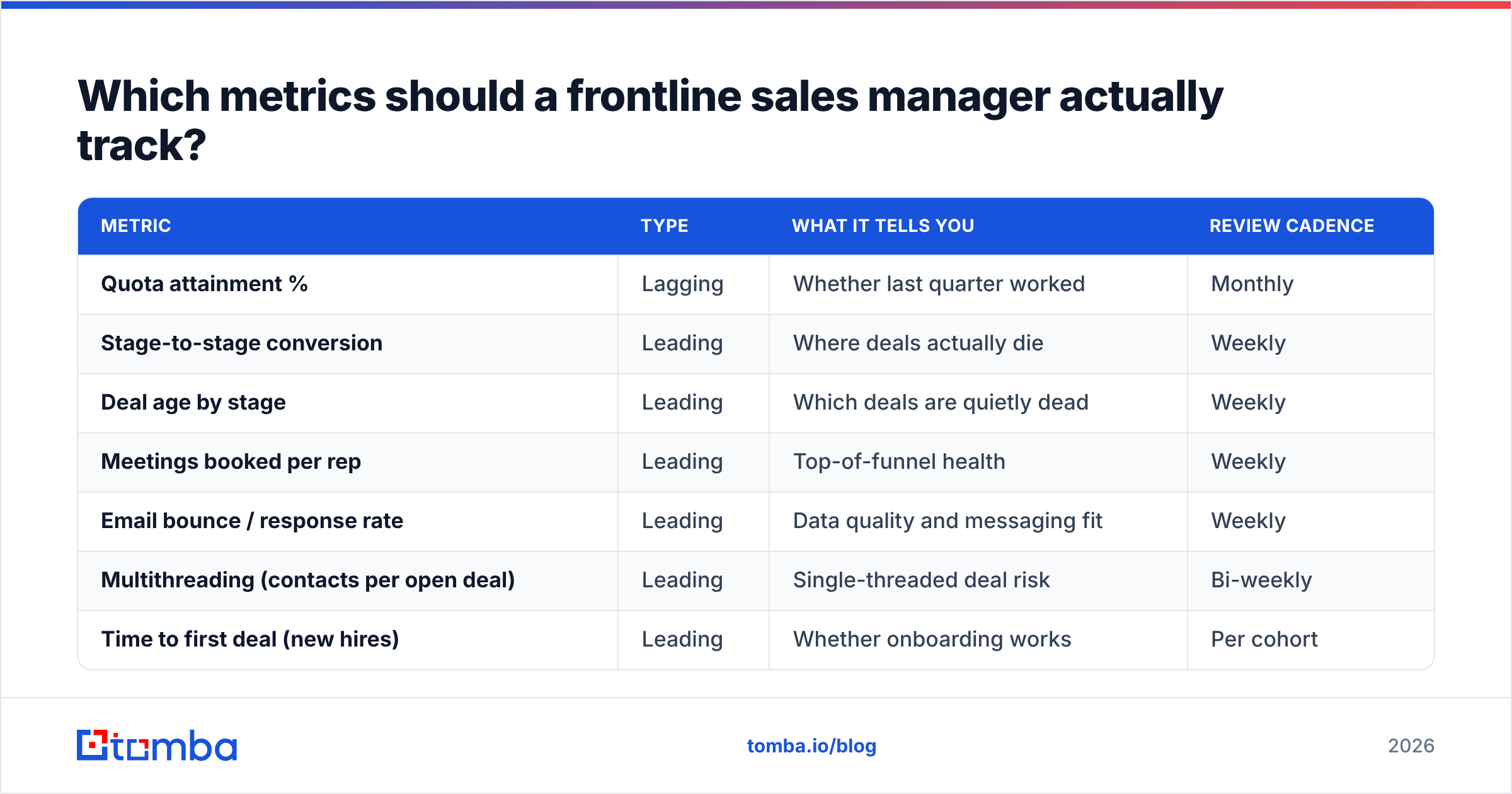
Lagging metrics tell you what happened. Leading metrics tell you what's about to. A frontline manager's job lives almost entirely in the leading column.
| Metric | Type | What it tells you | Review cadence |
|---|---|---|---|
| Quota attainment % | Lagging | Whether last quarter worked | Monthly |
| Stage-to-stage conversion | Leading | Where deals actually die | Weekly |
| Deal age by stage | Leading | Which deals are quietly dead | Weekly |
| Meetings booked per rep | Leading | Top-of-funnel health | Weekly |
| Email bounce / response rate | Leading | Data quality and messaging fit | Weekly |
| Multithreading (contacts per open deal) | Leading | Single-threaded deal risk | Bi-weekly |
| Time to first deal (new hires) | Leading | Whether onboarding works | Per cohort |
| Forecast accuracy per rep | Leading | Who you can trust in the roll-up | Monthly |
| Rep attrition (regretted) | Lagging | Management quality, honestly | Quarterly |
Two of these deserve extra attention.
Multithreading. Count distinct contacts engaged per open opportunity. A deal with one champion and no economic buyer identified is not a real deal — it's a hope with a close date. When you see reps stuck at 1.2 contacts per deal, the coaching move is tactical: help them map the buying committee and get contact details for the CFO and the VP of Ops before the next call. Tools like a domain search turn that from a two-hour research project into a two-minute one.
Bounce rate. If a rep's cold email bounce rate is above 3%, that's not a messaging problem, it's a data problem — and it will torch your sender reputation across the whole team's domain. Frontline managers who ignore bounce rates find out about it three months later when nobody's emails are landing. Run lists through an email verifier before they hit a sequence, and make it a team standard rather than a per-rep preference.
How should a frontline sales manager run coaching?#
Coaching fails when it's generic. "Be more consultative" is not coaching. "On Tuesday's Acme call, at 14:20, you answered their pricing question before you understood their budget process — next time, ask what their approval path looks like first" is coaching.
The structure that holds up across teams:
- One skill per rep per month. Not five. Pick the constraint — the single thing that, if fixed, moves the most pipeline — and work only on it for four weeks.
- Evidence, not opinion. Every coaching point references a specific call, email, or CRM record. This removes the "you're just not seeing my deals" defense and makes the conversation about behavior, not personality.
- Rep does the diagnosis first. Ask "how did that call go?" before you say anything. If the rep can self-diagnose, the fix sticks. If they can't, that's your real finding.
- Practice, not just feedback. Role-play the objection in the 1:1. Uncomfortable for both parties. Also the only part that reliably changes behavior on the next live call.
- Write it down. A shared doc per rep with the current focus skill, the evidence, and the agreed next action. Otherwise every 1:1 restarts from zero.
Salesforce's sales leadership research and HubSpot's annual sales reports both land on the same theme: coaching frequency correlates with attainment far more than coaching duration. Twenty focused minutes weekly beats a two-hour deep dive monthly.
What tools does a frontline sales manager actually need?#
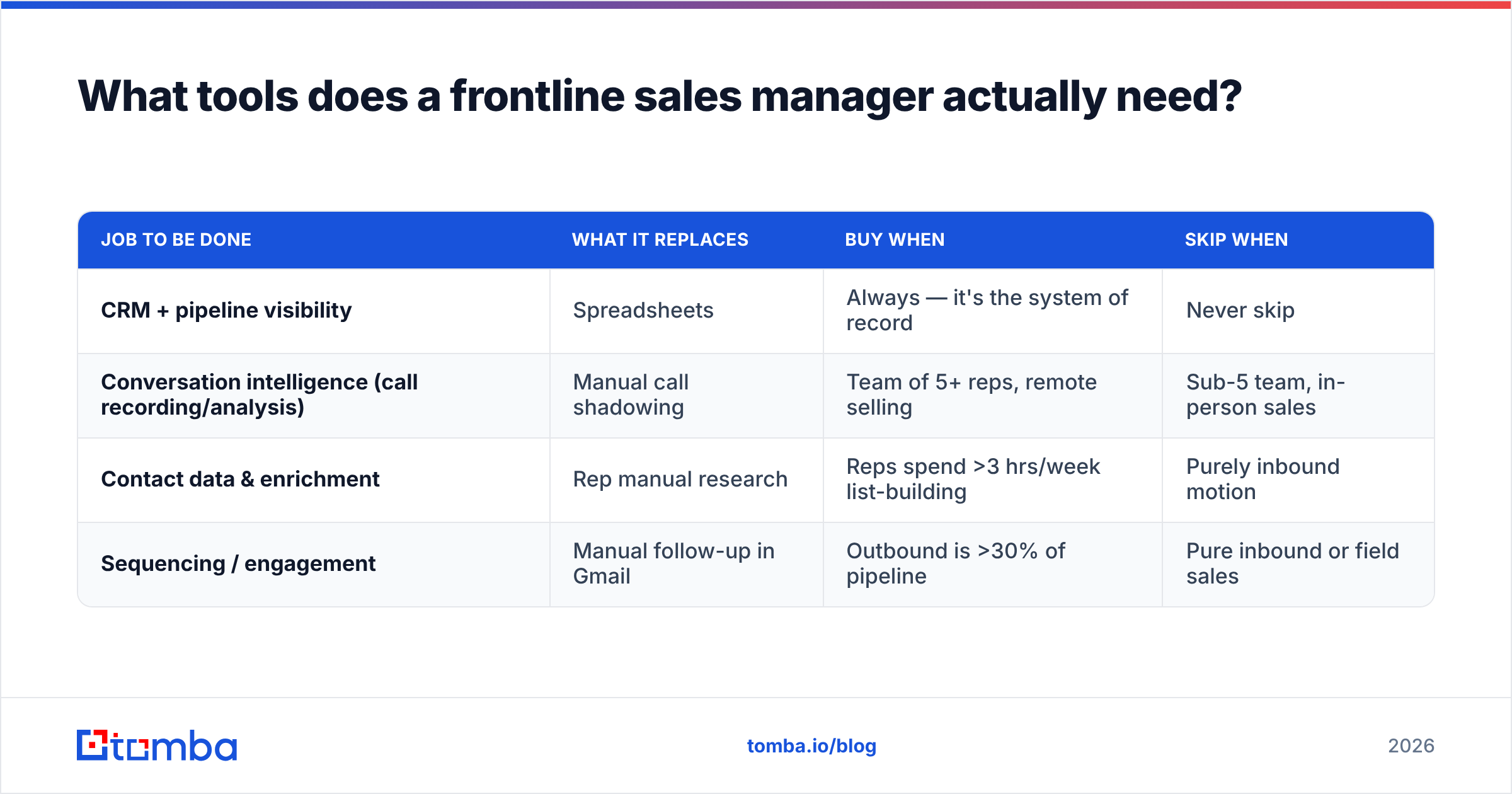
Fewer than the vendor pitches suggest. The stack falls into four jobs, and most teams over-buy in one category while ignoring another.
| Job to be done | What it replaces | Buy when | Skip when |
|---|---|---|---|
| CRM + pipeline visibility | Spreadsheets | Always — it's the system of record | Never skip |
| Conversation intelligence (call recording/analysis) | Manual call shadowing | Team of 5+ reps, remote selling | Sub-5 team, in-person sales |
| Contact data & enrichment | Rep manual research | Reps spend >3 hrs/week list-building | Purely inbound motion |
| Sequencing / engagement | Manual follow-up in Gmail | Outbound is >30% of pipeline | Pure inbound or field sales |
The category frontline managers most often under-invest in is contact data — and it's the one that quietly steals the most coaching hours. If each of your six reps spends four hours a week hunting emails and phone numbers, that's 24 hours of selling capacity gone weekly, and it shows up in your pipeline coverage number as if it were a skill problem.
Practical evaluation notes when you're comparing options:
- Check coverage in your ICP, not overall. A provider with 400M contacts globally may be thin in mid-market German manufacturing. Run 50 known-good test records from your actual territory before you sign anything. G2 and Capterra reviews are useful for support quality but useless for coverage in your specific niche — test it yourself.
- Separate finding from verifying. Finding an address and confirming it's deliverable are different operations with different failure modes. Some vendors bundle them, some don't. Tomba pricing starts free at 25 searches/month, then $49/mo for Starter, $99/mo Growth, and $249/mo Pro — worth noting because per-seat pricing at the frontline manager level adds up fast when you're staffing a six-rep pod. Peers like BookYourData take a different approach with prepaid contact credits, which suits teams doing large one-off list builds rather than continuous enrichment.
- Insist on API or spreadsheet access. Your ops workflows will need bulk operations. A tool that only works as a Chrome extension will bottleneck at the exact moment you scale. Check for Google Sheets and API support before you commit.
- Watch catch-all domains. A meaningful slice of enterprise domains accept all mail, which makes standard verification return "unknown." If your ICP skews enterprise, ask specifically how the vendor handles catch-alls — it's where accuracy claims usually break down.
How do you know if your frontline sales managers are working?#
Four diagnostics, in order of signal strength.
- Rep improvement curve. Take reps who've been on the team 6+ months. Is their quota attainment trending up? If tenured reps plateau, coaching isn't landing regardless of team numbers.
- Ramp time for new hires. A strong frontline manager compresses time-to-first-deal. If your ramp is the same today as it was two years ago with better tools and more content, the enablement isn't reaching the rep through their manager.
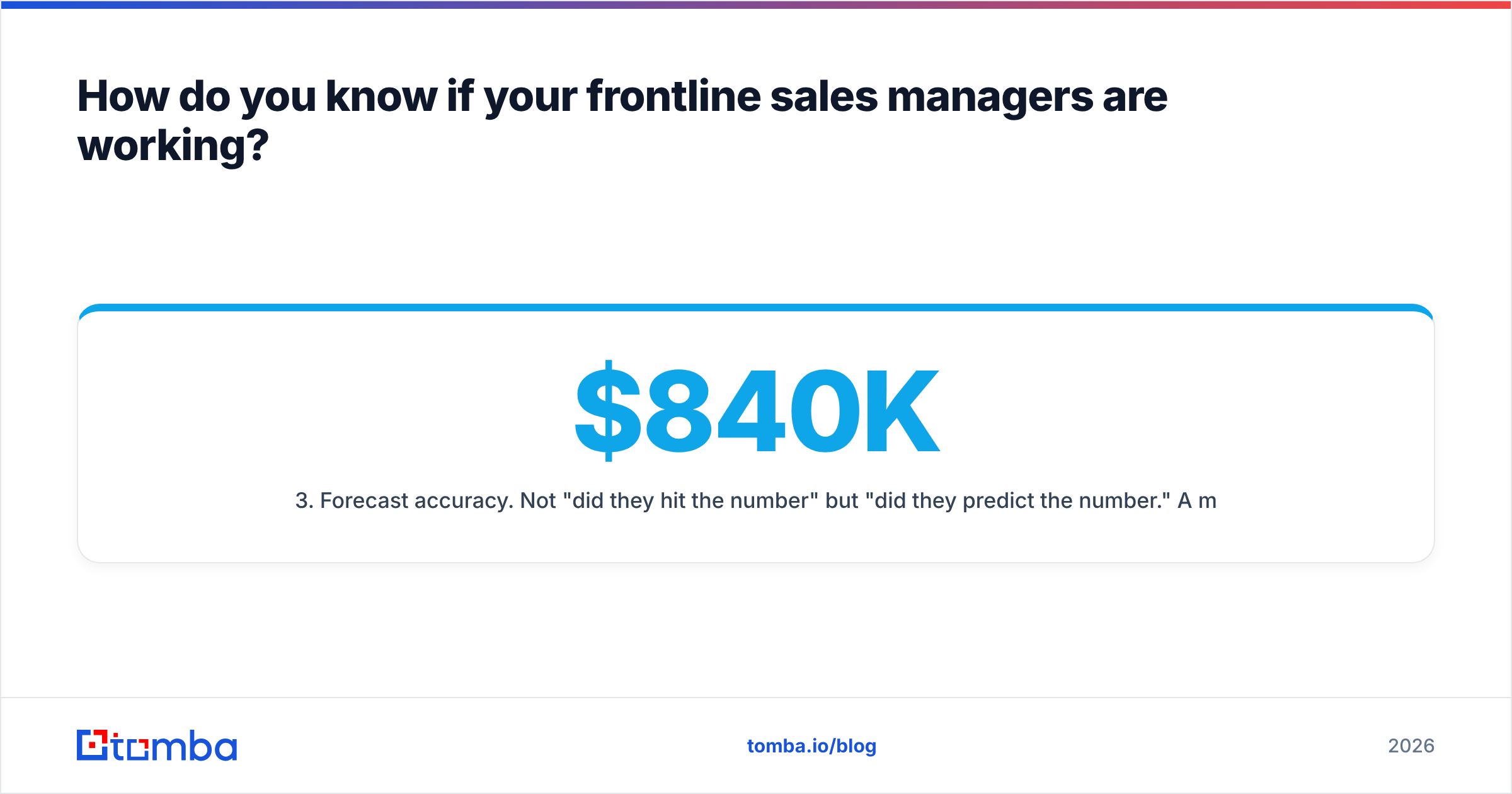
- Forecast accuracy. Not "did they hit the number" but "did they predict the number." A manager who calls $840K and lands $835K is more valuable than one who calls $600K and lands $900K — the second one is a planning liability.
- Regretted attrition. People leave managers. If one pod is losing good reps while comp and territory are equivalent to peers, you have a management problem, not a market problem.
Run these quarterly. Three of the four are visible in your CRM already; you just have to be willing to look at them per-manager rather than per-team.
Get your managers back to coaching#
The frontline sales manager role fails for a mundane reason: the calendar fills with work that shouldn't be on it. Contact research, list cleanup, CRM hygiene, and chasing bad data are all things that expand to consume whatever time you give them — and they crowd out the coaching that actually moves attainment.
Fix the data layer first and the coaching hours reappear on their own. Tomba Email Finder gives your reps verified professional emails by domain, name, or company, with a free tier at 25 searches/month so a single rep can validate the workflow before you roll it out to the pod. Bulk operations, a full API, and Sheets support mean your ops team can handle list-building centrally instead of leaving each rep to reinvent it. Start free, test it against 50 accounts in your actual territory, and see how many hours come back to the coaching column.
Related guides#
Ready to find emails that actually work?
Join 150,000+ professionals who stopped guessing and started sending. Free credits on signup — no credit card required.
Get the Tomba newsletter
Practical outbound tactics and product updates — once every two weeks.
About the author