Full Sales Cycle Explained: Stages, Metrics, and Fixes
A full sales cycle is every step from first touch to closed-won — and most B2B teams can't name where theirs leaks. Here's the stage-by-stage breakdown, the benchmarks that matter, and the fixes that actually shorten it.
TL;DR
- A full sales cycle is every stage from first identifying an account to closed-won and handoff — typically 7 stages in B2B, not the 4 most CRMs ship with.
- The median B2B sales cycle runs 60–90 days; deals over $50k routinely stretch past 6 months. Anything much longer than your segment's median is a process problem, not a market problem.
- Most cycle length is created at the top, not the bottom. Bad contact data and unqualified prospecting add weeks before a rep ever gets a meeting.
- Track stage-level conversion and time-in-stage, not just overall win rate. The stage where deals sit longest is almost never the stage reps complain about.
- Shortening a cycle means removing steps, not moving faster through them. Consolidating tools, pre-verifying contacts, and multithreading early are the three highest-leverage fixes.
What Is a Full Sales Cycle?#
A full sales cycle is the complete, repeatable sequence a deal moves through from the moment you identify an account to the moment revenue is booked and the customer is handed to onboarding. "Full" is the operative word — it includes the prospecting and research work that happens before anyone in your CRM sees an opportunity record, and the post-signature handoff that determines whether the deal sticks.
Think of it like a restaurant kitchen. The dish that arrives at the table is the closed deal. But the cycle started with sourcing ingredients, prepping stations, and writing the menu. If you only measure from "order taken" to "plate served," you'll spend forever optimizing plating while the real delay sits in the supply chain.
That's exactly what happens in B2B. Most teams measure their sales cycle from opportunity creation to close — which conveniently excludes the two to five weeks of list building, contact hunting, and unanswered emails that preceded it. When executives ask "why does it take so long to close," the honest answer usually starts before stage one.
A rep carrying a full-cycle role (sometimes written "full-cycle sales" or "full desk") owns every one of these stages personally: prospect, qualify, demo, propose, negotiate, close, hand off. In a segmented org, an SDR owns the top, an AE owns the middle, and a CS or onboarding team owns the tail. Both models run the same cycle — they just distribute the labor differently.
What Are the Stages of a Full Sales Cycle?#
Seven stages cover almost every B2B motion. Names differ by company; the work doesn't.
- Prospecting and list building — Define the ICP, source accounts, find and verify decision-maker contact data. This is where cycle time is silently created. A list with 30% bad emails means 30% of your outreach capacity produces nothing but bounces.
- Outreach and connection — Multi-channel sequences: email, phone, LinkedIn. The goal is one thing only — a booked conversation. Median B2B cold email reply rates sit in the 1–5% range, so volume and targeting both matter.
- Discovery and qualification — Establish the problem, the cost of inaction, the budget, and the buying process. Skipping this is the single most expensive mistake in the cycle because unqualified deals consume full-cycle effort and then die at procurement.
- Demo or solution presentation — Map your product to the specific pain surfaced in discovery. Generic demos add a round trip; tailored demos compress two meetings into one.
- Proposal and business case — Pricing, scope, ROI model, security questionnaire. In enterprise, this stage is where legal and InfoSec quietly add three weeks nobody planned for.
- Negotiation and closing — Terms, procurement, signature. Discount pressure here is usually a symptom of weak stage 3 work, not a pricing problem.
- Handoff and expansion — Implementation kickoff, success criteria, and the first expansion conversation. Deals that skip a structured handoff churn measurably faster.
The stages are sequential on paper and messy in practice. Buyers loop backward, new stakeholders enter at stage 5 and demand a stage 3 conversation, and champions change jobs. A good process accounts for loops instead of pretending they don't happen.
How Long Should a Full Sales Cycle Take?#
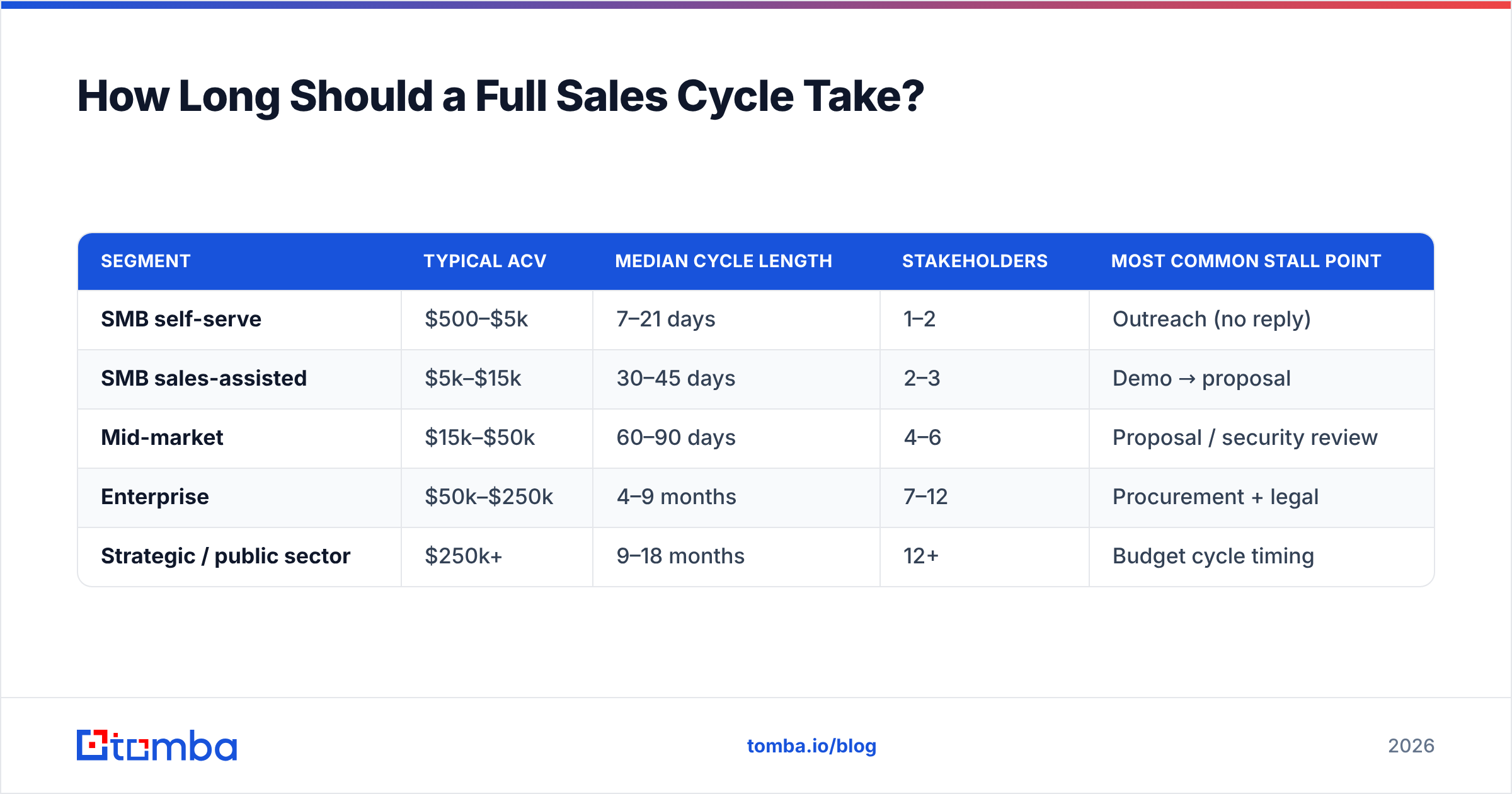
Depends on deal size and who has to sign. Here's what the ranges look like across common B2B segments:
| Segment | Typical ACV | Median cycle length | Stakeholders | Most common stall point |
|---|---|---|---|---|
| SMB self-serve | $500–$5k | 7–21 days | 1–2 | Outreach (no reply) |
| SMB sales-assisted | $5k–$15k | 30–45 days | 2–3 | Demo → proposal |
| Mid-market | $15k–$50k | 60–90 days | 4–6 | Proposal / security review |
| Enterprise | $50k–$250k | 4–9 months | 7–12 | Procurement + legal |
| Strategic / public sector | $250k+ | 9–18 months | 12+ | Budget cycle timing |
Two things to take from this table. First, stakeholder count predicts cycle length better than deal size does — Gartner's research on B2B buying has repeatedly put the typical buying group at six to ten people, each arriving with their own information needs. Second, the stall point moves as you go upmarket. Optimizing your demo when your enterprise deals die in procurement is wasted effort.
Benchmark against your own median before you benchmark against the industry. Pull the last 50 closed-won deals, calculate days from first touch (not opportunity creation) to signature, and take the median rather than the mean — one 400-day whale will wreck your average and hide the real pattern.
Where Does the Full Sales Cycle Actually Leak?#
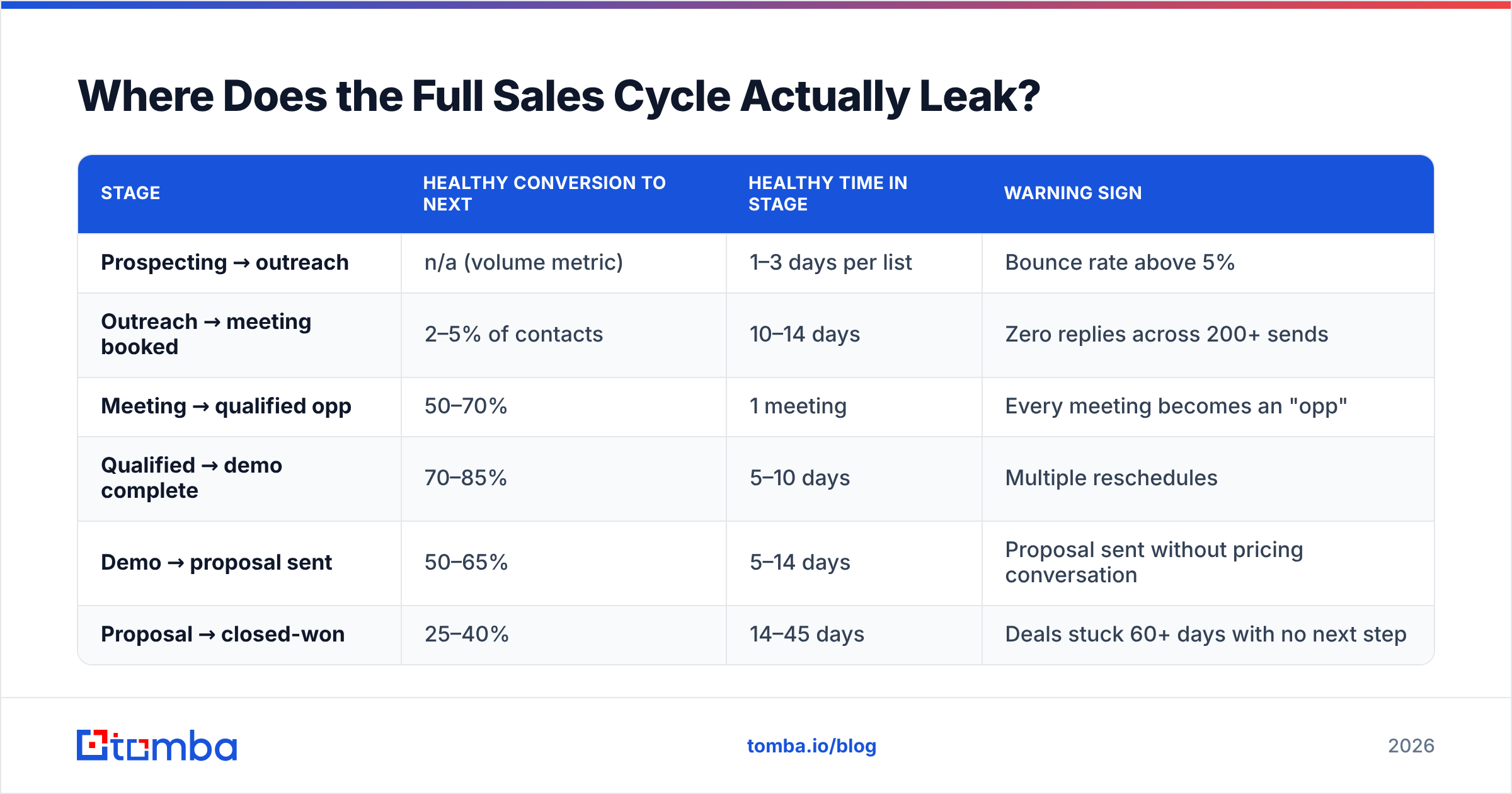
Run the numbers on stage-level conversion and time-in-stage together. A stage with 80% conversion but 30 days of dwell time is a bigger problem than a stage with 40% conversion and 3 days of dwell.
| Stage | Healthy conversion to next | Healthy time in stage | Warning sign |
|---|---|---|---|
| Prospecting → outreach | n/a (volume metric) | 1–3 days per list | Bounce rate above 5% |
| Outreach → meeting booked | 2–5% of contacts | 10–14 days | Zero replies across 200+ sends |
| Meeting → qualified opp | 50–70% | 1 meeting | Every meeting becomes an "opp" |
| Qualified → demo complete | 70–85% | 5–10 days | Multiple reschedules |
| Demo → proposal sent | 50–65% | 5–14 days | Proposal sent without pricing conversation |
| Proposal → closed-won | 25–40% | 14–45 days | Deals stuck 60+ days with no next step |
The first row is the one teams skip and the one that costs the most. If a quarter of your list bounces, you didn't just lose a quarter of your contacts — you damaged your sender reputation, which suppresses inbox placement for the contacts that were valid. One bad list poisons the next three campaigns.
That's why data quality belongs in a sales-cycle conversation and not just a marketing-ops one. Running contacts through an email verifier before a sequence launches costs cents per record and removes an entire class of cycle delay. Same logic for catch-all domains, which most tools mark "unknown" and reps then treat as valid — a dedicated catch-all verifier resolves that ambiguity instead of leaving it to guesswork.
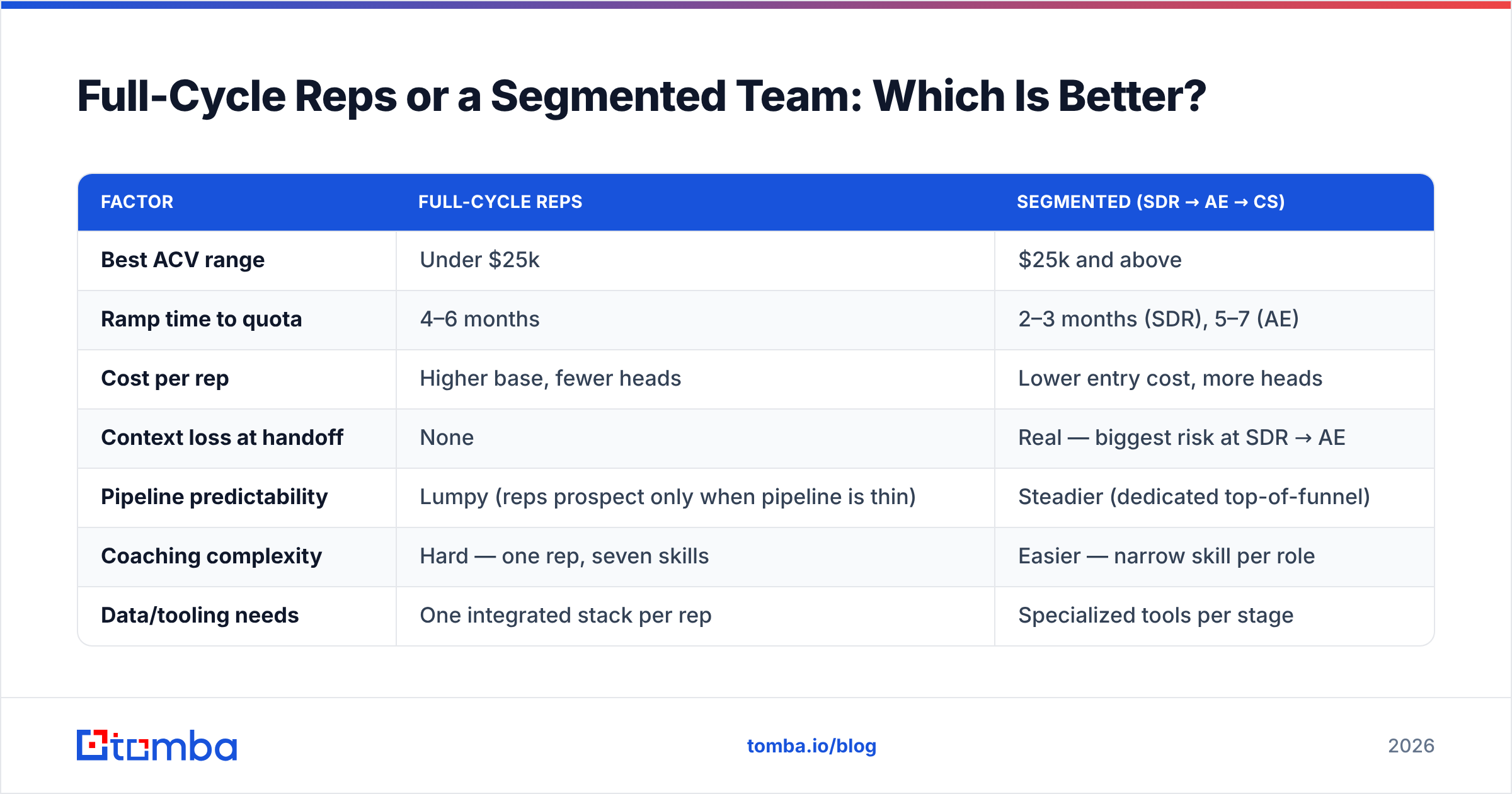
Full-Cycle Reps or a Segmented Team: Which Is Better?#
Neither wins universally. The right answer follows your ACV and your ramp budget.
| Factor | Full-cycle reps | Segmented (SDR → AE → CS) |
|---|---|---|
| Best ACV range | Under $25k | $25k and above |
| Ramp time to quota | 4–6 months | 2–3 months (SDR), 5–7 (AE) |
| Cost per rep | Higher base, fewer heads | Lower entry cost, more heads |
| Context loss at handoff | None | Real — biggest risk at SDR → AE |
| Pipeline predictability | Lumpy (reps prospect only when pipeline is thin) | Steadier (dedicated top-of-funnel) |
| Coaching complexity | Hard — one rep, seven skills | Easier — narrow skill per role |
| Data/tooling needs | One integrated stack per rep | Specialized tools per stage |
| Typical failure mode | Prospecting gets deprioritized | Deals arrive unqualified |
The classic full-cycle failure mode is worth naming plainly: when a rep has both prospecting and closing on their plate, closing always wins the calendar. Pipeline goes lumpy — great quarter, empty quarter, great quarter. If you run full-cycle, you need enforced prospecting blocks and enough automation that list building takes an hour, not a day.
The classic segmented failure mode is context evaporation at handoff. The SDR heard the real pain; the AE reads three bullet points in a CRM field and reopens discovery from scratch, adding a meeting and a week.
How Do You Shorten a Full Sales Cycle?#
Remove steps. Don't just move faster through the ones you have.
1. Fix the data before the sequence, not after. Every bounced email, wrong number, and left-the-company contact is a full outreach cycle spent on nothing. Verify at list build time. Use a domain search to pull every reachable contact at a target account in one pass instead of hunting people individually, then verify the batch before it hits your sequencer.
2. Multithread from the first email, not the third meeting. With six to ten people in a typical buying group, single-threaded deals are cycle-length risk in a trench coat. Identify two or three plausible stakeholders per account up front. When your champion goes quiet — and one of them will — you have a live path instead of a restart.
3. Qualify harder, earlier. Every unqualified deal you advance costs a demo, a proposal, and 30 days of forecast noise. A disqualified prospect in week one is a win. Use a simple gate: named problem, quantified cost, identified budget owner, known decision process. Miss two of four, and it goes back to nurture.
4. Compress the proposal stage with pre-work. Ask about security review, legal review, and procurement thresholds during discovery, not after the proposal is sent. If a SOC 2 questionnaire is coming, start it in week two. This alone routinely takes two to three weeks out of mid-market cycles.
5. Collapse your tool count. Every seat swivel is friction. If reps pull contacts from one tool, verify in another, enrich in a third, and paste into a CRM manually, you've built a 20-minute tax on every account. Pushing verified contacts straight into your CRM through a HubSpot integration or the Tomba API turns that into a background job.
6. Set a next-step rule. No meeting ends without a calendar-confirmed next step. Deals without a scheduled next action are how 45-day cycles become 120-day cycles — no single dramatic stall, just three weeks of "following up" at a time.
What Should You Measure Across the Full Sales Cycle?#
Six metrics, tracked monthly, tell you almost everything:
- Cycle length by segment (median, not mean) — measured from first touch, including prospecting time.
- Stage conversion rates — where deals actually die, versus where reps say they die.
- Time-in-stage — the dwell-time metric most CRMs collect and almost nobody reviews.
- Contact data hit rate — verified deliverable contacts divided by contacts sourced. Below 90% and your top-of-funnel is leaking.
- Win rate by lead source — sources with long cycles and low win rates are worth cutting even if volume looks healthy.
- Meetings per closed-won deal — the cleanest proxy for process efficiency. If it's climbing, discovery is getting weaker.
Peer benchmarks are useful context but bad targets. G2's buyer behavior reporting and vendor benchmark studies are directionally helpful, though methodologies vary enough that your own trailing-12-month data is the more reliable baseline. Track your own trend line first; compare externally second.
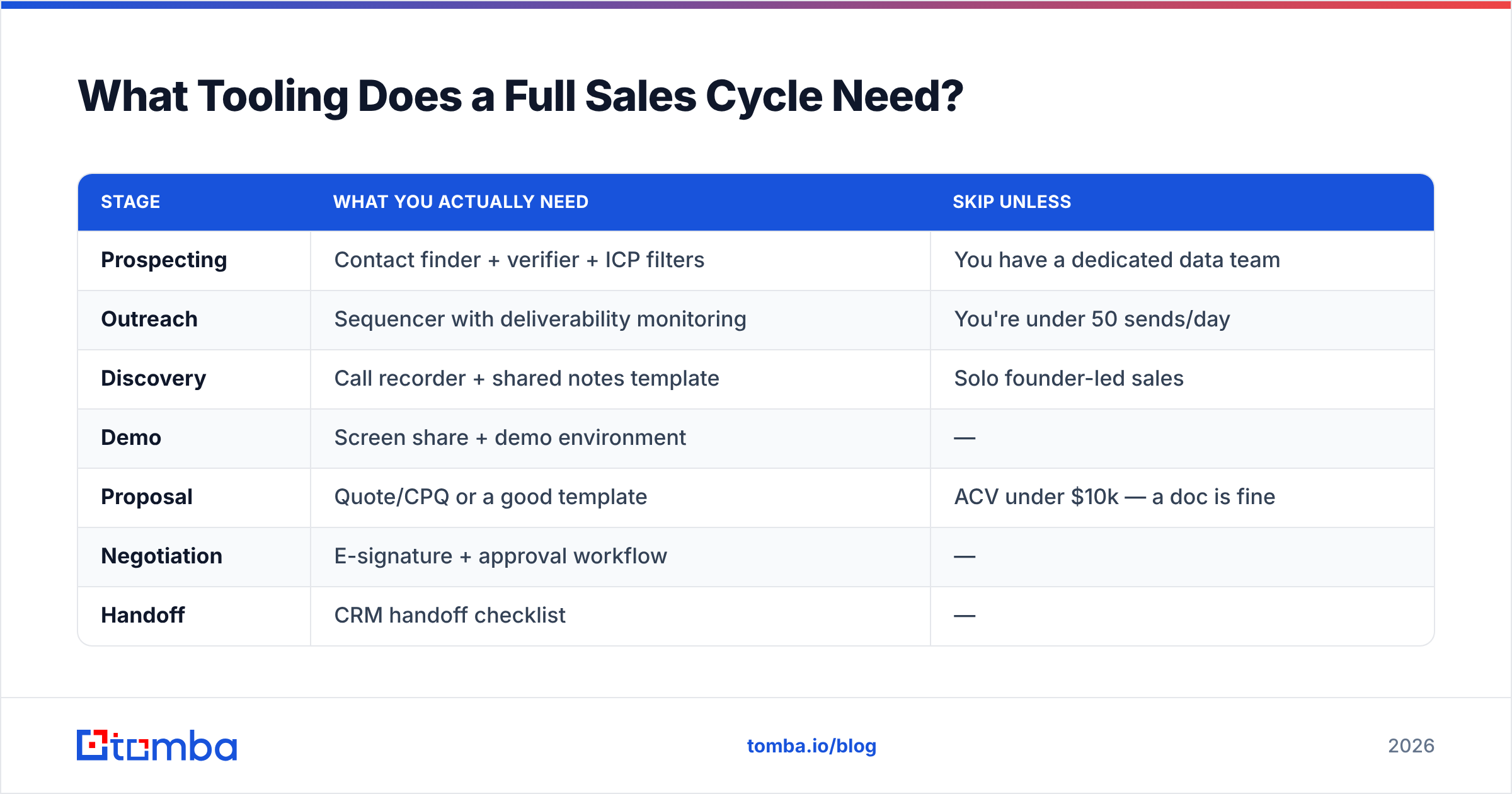
What Tooling Does a Full Sales Cycle Need?#
Fewer tools than most stacks contain. Map tools to stages and cut anything that doesn't own a stage outright:
| Stage | What you actually need | Skip unless |
|---|---|---|
| Prospecting | Contact finder + verifier + ICP filters | You have a dedicated data team |
| Outreach | Sequencer with deliverability monitoring | You're under 50 sends/day |
| Discovery | Call recorder + shared notes template | Solo founder-led sales |
| Demo | Screen share + demo environment | — |
| Proposal | Quote/CPQ or a good template | ACV under $10k — a doc is fine |
| Negotiation | E-signature + approval workflow | — |
| Handoff | CRM handoff checklist | — |
For the prospecting layer specifically, the buying criteria are accuracy, verification depth, and how cleanly data reaches the rest of your stack. Providers like BookYourData take a database-first approach with prebuilt, pay-as-you-go lists — a strong fit when you want volume without a subscription. Tomba sits on the search-and-verify side: find contacts live by domain or name, verify before sending, and push through the API or a Chrome extension rather than exporting CSVs. Both models work; the question is whether your motion is list-driven or account-driven.
On price, Tomba's plans start with a free tier at 25 searches per month, then Starter at $49/mo, Growth at $99/mo, and Pro at $249/mo, with Enterprise custom-quoted. Run the math against your monthly contact volume rather than headline credit counts — cost per verified, deliverable contact is the number that maps to cycle time.
The Bottom Line#
Your full sales cycle is only as fast as its slowest stage, and that stage is usually earlier than you think. Teams obsess over closing technique when the actual delay is 200 contacts that never should have been emailed, a discovery call that skipped the budget question, and a security review nobody flagged until week nine.
Measure from first touch. Track dwell time alongside conversion. Kill unqualified deals fast. And treat contact data as sales-cycle infrastructure, not a marketing line item.
Start where the leverage is highest: build cleaner lists. Tomba Email Finder finds verified professional emails by domain, name, or company, so your sequences reach real inboxes instead of burning sender reputation on bounces. The free tier covers 25 searches a month — enough to test a target account list before you commit a cent.
Related guides#
Ready to find emails that actually work?
Join 150,000+ professionals who stopped guessing and started sending. Free credits on signup — no credit card required.
Get the Tomba newsletter
Practical outbound tactics and product updates — once every two weeks.
About the author