FullCircl vs Apollo.io: Which B2B Data Platform Wins in 2026?
FullCircl sells UK company risk and onboarding intelligence. Apollo.io sells a 275M-contact outbound engine. They barely overlap — and picking the wrong one costs you a year of contract. Here's the honest split.
FullCircl vs Apollo.io looks like a fair fight. It isn't. One tool checks whether a UK company is safe to onboard. The other hands you 275 million contacts to email. Here is the short version before the long one.
TL;DR
- These two tools are not really competitors. FullCircl is a UK/Ireland company-intelligence and regulated-onboarding platform. Apollo.io is a global contact database bolted to a sales engagement engine. Buyers only compare them because both get filed under "B2B data."
- Choose FullCircl if you sell into or onboard UK businesses under compliance pressure. That means insurance brokers, banks, lenders, and fintechs that need Companies House filings, credit signals, and KYC/AML checks in one workflow.
- Choose Apollo.io if you need volume outbound: contact records, filters, sequences, a dialer, and CRM sync, at a per-seat price you can read off the pricing page.
Two more things to settle before you book demos:
- Pricing transparency is the sharpest split. Apollo publishes its tiers. FullCircl is quote-only on annual contracts, so budgeting starts with a sales call.
- Neither is a great pure email-finding layer. If your bottleneck is verified work emails rather than firmographics or compliance, a dedicated email finder is cheaper and more accurate than either platform's per-seat premium.
What is FullCircl, exactly?#
FullCircl is a customer lifecycle intelligence platform built for regulated B2B, mostly UK and Irish. It came out of the 2021 merger of Artesian Solutions (sales trigger alerts) and DueDil (company data). It later added W2's identity and AML checking. Since a 2024 acquisition it sits inside IRIS Software Group. That history explains the product. It is three things stapled together: company data, risk and compliance checking, and sales trigger alerts.
The practical output looks like this. Point FullCircl at a business and it returns registry-grade facts: Companies House filings, directors, shareholdings, group structures, financial health signals, county court judgments, and industry classifications. On top of that sit rules — your rules. They decide whether a prospect is in appetite. They flag when a customer's risk profile changes. They tell you when a new director appointment or filing is worth a call.
Who actually buys it: commercial insurance brokers, business banking teams, alternative lenders, accountancy firms, and fintechs. All of them must onboard companies without tripping over KYC/AML obligations. FullCircl's own site leans hard into "onboard, verify, monitor" language for that reason. You can see the current positioning at fullcircl.com.
What it is not: a global prospecting database. Ask it for 4,000 VP-of-Engineering emails across US SaaS companies and you are using the wrong tool.
What is Apollo.io, exactly?#
Apollo.io is the opposite shape. It is a very large contact and company database — Apollo markets figures in the region of 270M+ contacts and 70M+ companies. Around that database sits an execution layer: sequences, email sending, a dialer, a LinkedIn extension, meeting booking, basic scoring, and CRM sync to HubSpot or Salesforce.
The pitch is consolidation. You skip paying for a database, a sequencer, and a dialer separately. An SMB or mid-market team pays per seat and gets all three. None of the three is best in class. That trade is why Apollo scaled so fast in the SMB segment. It is also the root of most complaints about it. Data accuracy varies by region and seniority. Export credits run out faster than teams expect. Deliverability suffers when everyone sequences the same stale records.
For an outside read on how buyers rate both categories, G2's sales intelligence grid is a reasonable sanity check. Review volume alone tells you Apollo aims at a far broader market than FullCircl.

FullCircl vs Apollo.io: how do they compare head-to-head?#
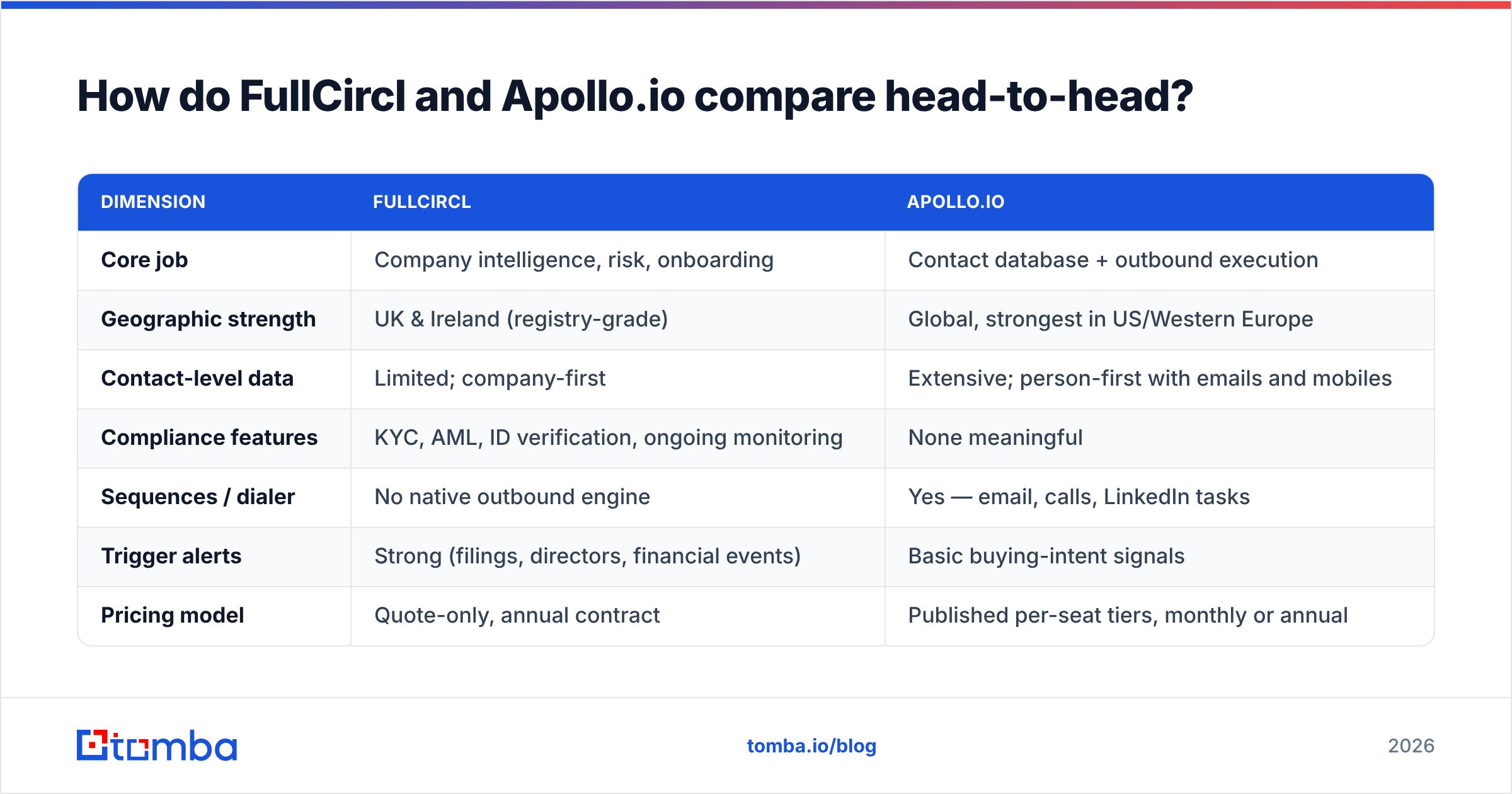
| Dimension | FullCircl | Apollo.io |
|---|---|---|
| Core job | Company intelligence, risk, onboarding | Contact database + outbound execution |
| Geographic strength | UK & Ireland (registry-grade) | Global, strongest in US/Western Europe |
| Contact-level data | Limited; company-first | Extensive; person-first with emails and mobiles |
| Compliance features | KYC, AML, ID verification, ongoing monitoring | None meaningful |
| Sequences / dialer | No native outbound engine | Yes — email, calls, LinkedIn tasks |
| Trigger alerts | Strong (filings, directors, financial events) | Basic buying-intent signals |
| Pricing model | Quote-only, annual contract | Published per-seat tiers, monthly or annual |
| Typical buyer | Insurance, banking, lending, fintech | SMB and mid-market SaaS sales teams |
| Time to first value | Weeks (implementation + rules setup) | Same day |
| Best-fit team size | Compliance-heavy teams of 10–500 | 1–200 reps doing volume outbound |
Read that table twice before you take either demo. In FullCircl vs Apollo.io, almost every row is a genuine either/or. This is not a case of one tool being 15% better. The overlap is thin. Both can tell you a company exists, what it does, and roughly how big it is. Everything past that diverges.
Whose data is actually better?#
Wrong question. Better at what is the question. Here is the honest breakdown:
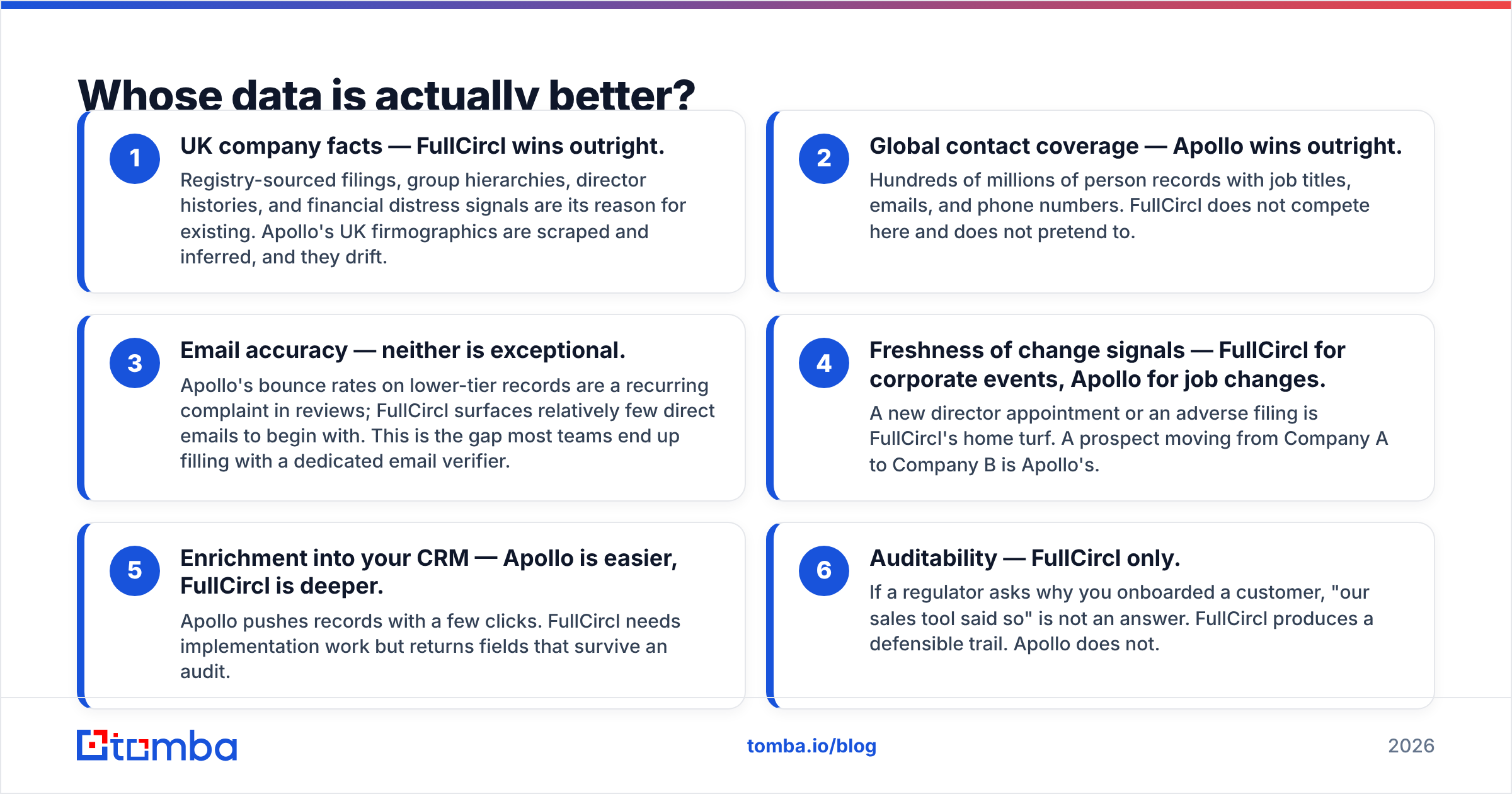
- UK company facts — FullCircl wins outright. Registry-sourced filings, group hierarchies, director histories, and financial distress signals are its reason for existing. Apollo's UK firmographics are scraped and inferred, and they drift.
- Global contact coverage — Apollo wins outright. Hundreds of millions of person records, with job titles, emails, and phone numbers. FullCircl does not compete here and does not pretend to.
- Email accuracy — neither is exceptional. Reviewers flag Apollo bounce rates on lower-tier records again and again. FullCircl surfaces relatively few direct emails to begin with. Most teams fill this gap with a dedicated email verifier.
The operational differences matter just as much:
- Freshness of change signals — FullCircl for corporate events, Apollo for job changes. A new director appointment or an adverse filing is FullCircl's home turf. A prospect moving from Company A to Company B is Apollo's.
- Enrichment into your CRM — Apollo is easier, FullCircl is deeper. Apollo pushes records with a few clicks. FullCircl needs implementation work, but it returns fields that survive an audit.
- Auditability — FullCircl only. If a regulator asks why you onboarded a customer, "our sales tool said so" is not an answer. FullCircl produces a defensible trail. Apollo does not.
What does each one cost in 2026?#
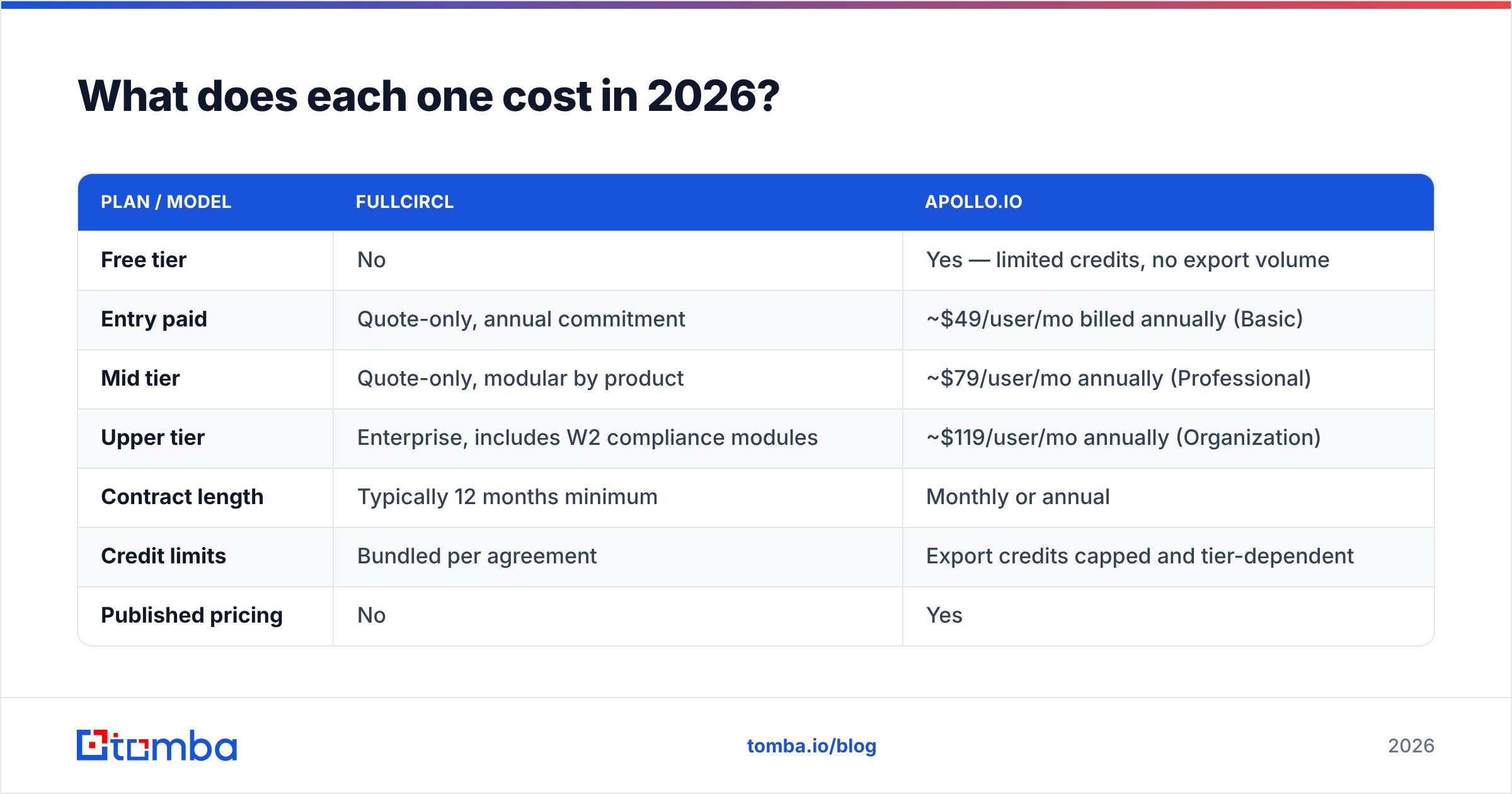
| Plan / model | FullCircl | Apollo.io |
|---|---|---|
| Free tier | No | Yes — limited credits, no export volume |
| Entry paid | Quote-only, annual commitment | ~$49/user/mo billed annually (Basic) |
| Mid tier | Quote-only, modular by product | ~$79/user/mo annually (Professional) |
| Upper tier | Enterprise, includes W2 compliance modules | ~$119/user/mo annually (Organization) |
| Contract length | Typically 12 months minimum | Monthly or annual |
| Credit limits | Bundled per agreement | Export credits capped and tier-dependent |
| Published pricing | No | Yes |
Apollo's numbers move. Check them against the live Apollo.io pricing page before you budget. Monthly billing runs well above the annual figures above. Export credit caps have been revised more than once.
FullCircl has no public price. Expect a discovery call and a scoping exercise. For anything beyond a small team, expect a five-figure annual number, with the compliance modules priced separately. That is normal for regulated-industry software. It also means you cannot run a two-week trial to find out whether it works.

Which one fits regulated onboarding versus outbound prospecting?#
Split it by what breaks when you get it wrong.
If your failure mode is compliance: you onboard a company, and eighteen months later the beneficial owner turns out to be sanctioned. Or the business was already in distress when you extended credit. That failure costs you a fine, a remediation project, and possibly a licence. FullCircl exists to prevent it. Apollo is irrelevant to it.
If your failure mode is pipeline: you have five reps, no meetings booked, and a list built from a webinar attendee export. Apollo puts contacts and sequences in their hands this afternoon. FullCircl's six-week implementation does not help you hit this quarter.
If both are true — say a fintech selling to UK SMEs that must also run high-volume outbound — you are looking at two tools, not one. That is a real budget conversation. The usual resolution is FullCircl for onboarding, plus a lighter, cheaper prospecting stack for the top of funnel. Full Apollo seats for everyone rarely survives the maths.
One more consideration: seat math. Apollo charges per user. A 12-rep team on Professional runs roughly $11,400 a year, billed annually, before credit overages. FullCircl typically prices by product and volume rather than headcount. That flips the economics if you have many light users and few heavy ones.
Where do both platforms fall short?#
Three gaps show up in nearly every evaluation.
Email accuracy at the point of send. Apollo's database is broad but uneven. Bounce complaints cluster around smaller companies, non-English markets, and records that have not been re-verified in a year. FullCircl surfaces companies beautifully and people sparsely. Either way, someone on your team ends up cleaning a list before it goes into a sequence. Unverified sends are the fastest route to wrecking your email deliverability.
Catch-all domains. A large share of enterprise domains accept everything at the SMTP layer. That means "valid" from a generic checker means nothing. Neither platform handles this well. A dedicated catch-all verifier is the only reliable answer.
Cost per usable contact. This is the metric nobody puts on a slide. Say you pay $79 per seat per month, and half your exported records bounce or belong to someone who left. Your real cost per deliverable contact is double the sticker. Run that calculation on a 200-record sample before you renew. It changes buying decisions more often than any feature comparison does.
How do you fill the email gap without buying a third platform?#
You do not need a third seat-priced suite. You need a verification and finding layer that plugs into whatever you already run.
That is the narrow slot Tomba fits. Instead of per-seat licences, Tomba pricing runs on credits: a free tier at 25 searches/month, Starter at $49/mo, Growth at $99/mo, Pro at $249/mo, and custom Enterprise. One admin can run finds and verifications for a whole team, with no licence per rep. That structure is exactly what breaks Apollo's seat math for larger teams.
Three concrete patterns teams use:
- Post-Apollo cleanup. Export from Apollo, run the list through verification, and drop the risky records before they touch a sequence. Cheaper than the deliverability damage.
- Post-FullCircl contact discovery. FullCircl tells you the company is in appetite and who the directors are. A domain search turns that into reachable inboxes with the company's actual email pattern.
- API-first enrichment. If your RevOps team already owns the pipeline, the Tomba API drops verification into your existing enrichment job. No extra UI for someone to forget to log into.
If you are weighing whether to keep paying Apollo seats, the Apollo alternative breakdown covers the swap in more detail than fits here.
FullCircl vs Apollo.io: which should you choose in 2026?#
Choose FullCircl if you operate in UK/Ireland financial services, insurance, or lending. It fits when compliance owns part of your buying decision and you need company data that stands up to an audit. Budget for a real implementation and an annual contract. It is a good product for a narrow, valuable job.
Choose Apollo.io if you run volume outbound and want a database plus sequencing in one seat. It rewards speed over precision. Accept that you will spend time on list hygiene, and that credit limits will bite as you scale.
Choose neither as your data foundation if what you actually need is verified contact details. Both platforms are priced for capabilities you may not use — Apollo for its sequencer, FullCircl for its compliance engine. Both leave the same email-quality gap behind.
The honest summary: this comparison is really a category mismatch. Work out whether your constraint is risk, reach, or reachability. FullCircl solves the first. Apollo solves the second, imperfectly. The third is a separate, much cheaper problem.
Start with the cheapest correct fix. Run a sample of your current list through the Tomba Email Finder on the free tier. Measure how many of your existing records are actually deliverable. Let that number decide how much platform you really need to buy.
Related guides#
Ready to find emails that actually work?
Join 150,000+ professionals who stopped guessing and started sending. Free credits on signup — no credit card required.
Get the Tomba newsletter
Practical outbound tactics and product updates — once every two weeks.
About the author