FullCircl vs OneMoreLead: Which B2B Data Tool Wins in 2026?
FullCircl sells UK company risk intelligence. OneMoreLead sells cheap US contact lists. They barely overlap — and picking the wrong one wastes a year of budget. Here's the honest breakdown.
TL;DR
- FullCircl and OneMoreLead are not really competitors. FullCircl is a UK/Ireland company-intelligence and onboarding platform for regulated industries; OneMoreLead is a low-cost US B2B contact database for list building.
- Choose FullCircl if you sell into UK businesses and need firmographics, financials, credit signals, and KYB/AML checks inside one workflow — expect an annual contract and a sales call.
- Choose OneMoreLead if you need a large, cheap, self-serve pool of US contacts to fuel cold outreach and you can tolerate doing your own verification.
- Neither is a precision email-finding tool. If your bottleneck is "I have the company and the person, I just need a deliverable address," a dedicated finder plus verifier is faster and cheaper than either.
- Budget reality check: FullCircl typically lands in the four-to-five-figure annual range with no public price list; OneMoreLead advertises entry plans in the double-digit monthly range. That gap tells you they're solving different problems.
What is FullCircl and who is it built for?#
FullCircl is a "customer lifecycle intelligence" platform formed from the 2021 merger of Artesian Solutions and DueDil, later expanded through the acquisition of identity-verification provider W2 Global Data. Its centre of gravity is the UK and Ireland: company records sourced from official registries, filed accounts, group structures, directorships, and risk signals, wrapped in tooling for both sales teams and compliance teams.
The typical FullCircl buyer is a bank, insurer, broker, lender, or fintech — an organisation that has to answer two questions about the same company at once: is this a good prospect? and are we allowed to onboard them? That dual use case is the whole product thesis.
What you actually get:
- Company intelligence on UK/IE entities — registry data, financials, corporate hierarchies, directors, and shareholding, refreshed from official sources including Companies House.
- Business information graph — the relationship layer that connects parents, subsidiaries, and people across entities, which is what makes group-level account planning possible.
- Trigger and alert engine — inherited from the Artesian side: news, filings, and change-of-status events that tell a relationship manager when to pick up the phone.
- KYB / AML onboarding — identity, sanctions, PEP, and business verification checks that turn a prospecting record into a compliant customer record.
- CRM embedding — the platform is designed to live inside Salesforce, Dynamics, or HubSpot rather than as a separate tab your reps never open.
Notice what is not on that list: a large pool of verified personal work emails for individual contacts across dozens of countries. FullCircl tells you which company matters and whether you can legally do business with it. It does not exist to hand you 5,000 outbound-ready addresses in Ohio.

What is OneMoreLead and who is it built for?#
OneMoreLead sits at the opposite end of the market. It's a self-serve B2B contact database marketed around a large record count — roughly 46 million US-centric B2B profiles in its public messaging — with filtering by industry, job title, company size, location, and technology, plus CSV export and basic list management.
The pitch is volume for very little money. You sign up, filter, build a list, export, and load it into your sequencer. There's no implementation project, no data-governance workshop, no annual commitment negotiated with procurement.
The trade-off is equally straightforward. Big static databases decay. B2B contact data goes stale at roughly 25–30% per year according to widely cited industry estimates, and low-cost providers rarely re-verify every record before you download it. That means bounce risk lands on you, and bounce risk lands on your domain reputation. If you export 5,000 records and 12% hard bounce, you have not saved money — you've bought a deliverability problem. Run exports through an email verifier before a single send, regardless of which database you pulled them from.
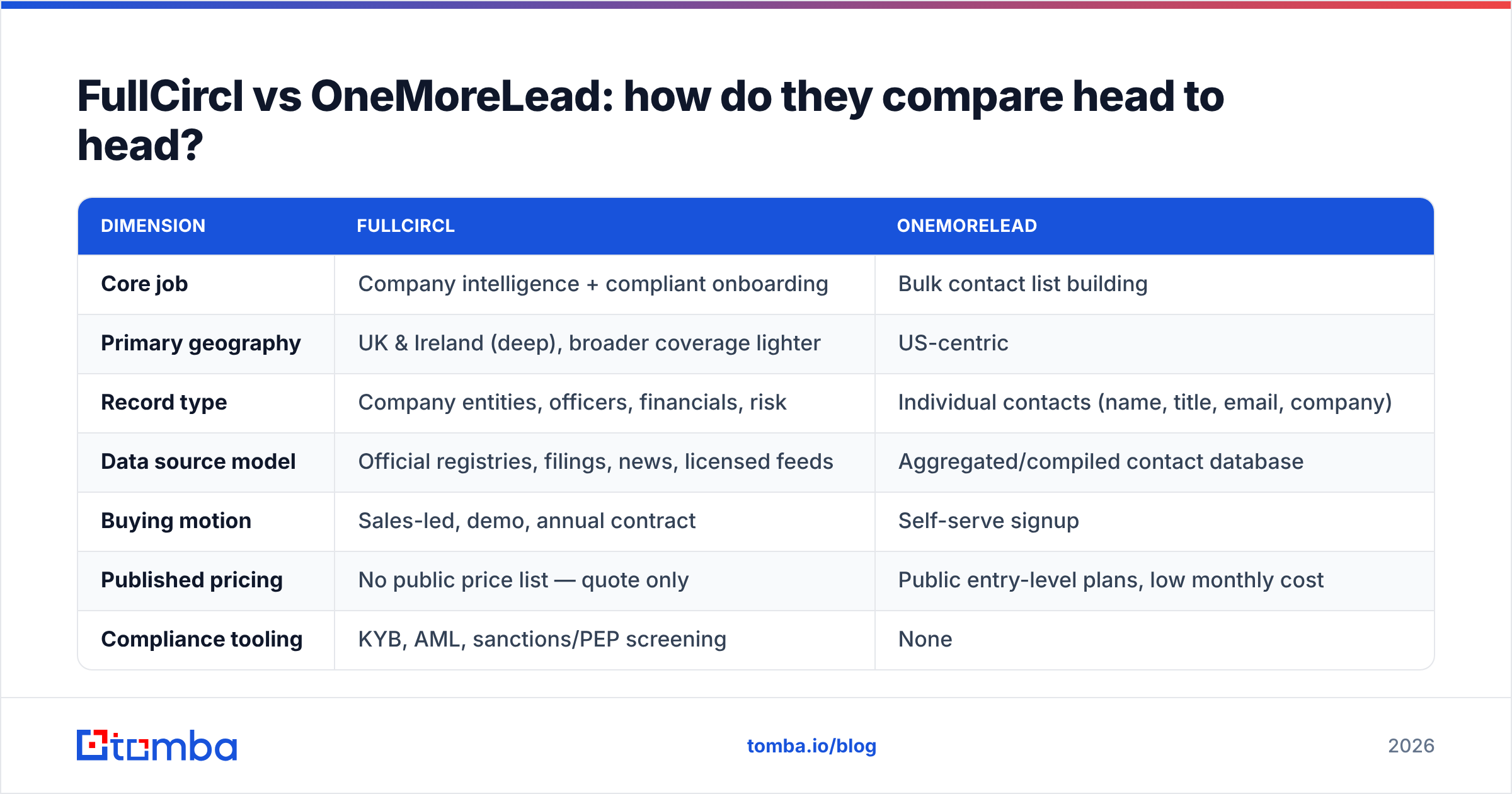
FullCircl vs OneMoreLead: how do they compare head to head?#
| Dimension | FullCircl | OneMoreLead |
|---|---|---|
| Core job | Company intelligence + compliant onboarding | Bulk contact list building |
| Primary geography | UK & Ireland (deep), broader coverage lighter | US-centric |
| Record type | Company entities, officers, financials, risk | Individual contacts (name, title, email, company) |
| Data source model | Official registries, filings, news, licensed feeds | Aggregated/compiled contact database |
| Buying motion | Sales-led, demo, annual contract | Self-serve signup |
| Published pricing | No public price list — quote only | Public entry-level plans, low monthly cost |
| Compliance tooling | KYB, AML, sanctions/PEP screening | None |
| Best-fit team | Financial services, insurance, regulated B2B | SMB outbound, agencies, high-volume SDR teams |
| Weakest point | Cost and scope for a simple prospecting need | Data freshness and verification burden |
Read that table twice before you shortlist either one. Most "FullCircl vs OneMoreLead" searches come from someone who has been handed two very different vendor proposals and is trying to normalise them. You usually can't. The correct answer is often "neither, or one of them plus something else."
Which one has better data accuracy?#
Different definitions of accuracy, so the comparison needs care.
FullCircl's accuracy claim rests on provenance. Its UK company data traces back to statutory sources — filed accounts, registry records, official notices. When it says a company has a specific SIC code, turnover band, or director, that's verifiable against a public record. For entity data, provenance-based accuracy is the gold standard, and it's why regulated buyers accept the price.
OneMoreLead's accuracy claim rests on volume plus periodic cleaning. Compiled contact databases assemble records from many sources and validate in batches. Even conscientious vendors in this tier ship records that were true when collected and are no longer true now — the contact was promoted, the company rebranded, the mailbox was retired.
There's a third accuracy model worth naming, because it's the one most outbound teams actually need: verify at the moment of use. Instead of trusting a static row in a database, you resolve the address in real time against the mail server and pattern evidence when you're about to send. That's the model behind a live email finder and it sidesteps the decay problem entirely — a record checked ten seconds ago cannot be nine months stale.
Practical rule: judge any provider on the bounce rate of a 200-record sample you pull yourself, not on the accuracy percentage in its marketing. Ask both vendors for a trial export, verify it independently, and compare. Vendors who refuse a sample are telling you something.
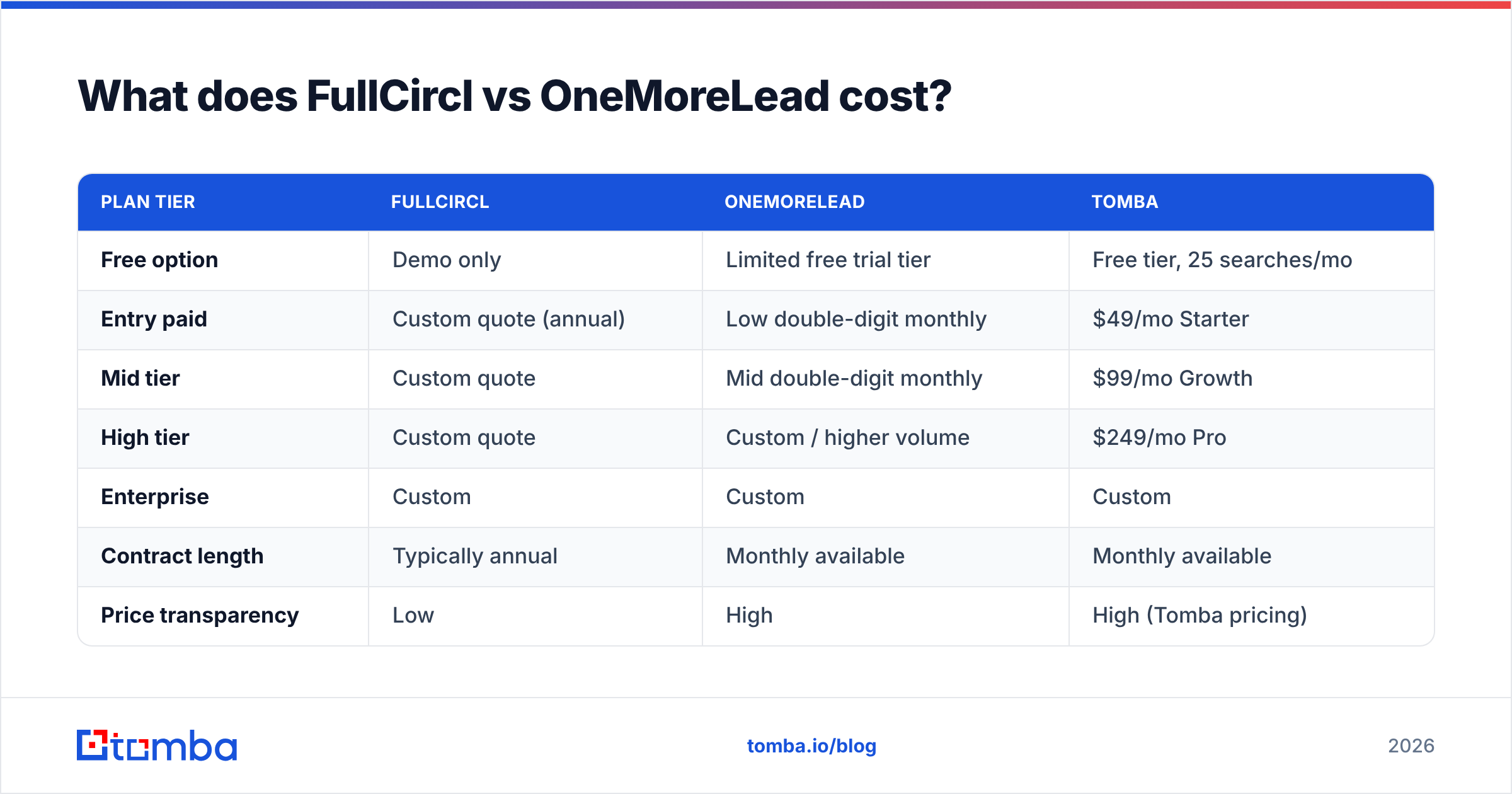
What does FullCircl vs OneMoreLead cost?#
| Plan tier | FullCircl | OneMoreLead | Tomba |
|---|---|---|---|
| Free option | Demo only | Limited free trial tier | Free tier, 25 searches/mo |
| Entry paid | Custom quote (annual) | Low double-digit monthly | $49/mo Starter |
| Mid tier | Custom quote | Mid double-digit monthly | $99/mo Growth |
| High tier | Custom quote | Custom / higher volume | $249/mo Pro |
| Enterprise | Custom | Custom | Custom |
| Contract length | Typically annual | Monthly available | Monthly available |
| Price transparency | Low | High | High (Tomba pricing) |
Two honest caveats. First, FullCircl publishes no rate card, and reported deal sizes vary enormously with modules, seats, and whether onboarding/KYB is included — treat any number you read on a third-party site as a rumour until it's in your quote. Second, low-cost database pricing moves frequently and lifetime-deal promotions distort the picture; check the vendor's own page on the day you buy.
The strategic point survives the caveats. FullCircl is a platform investment justified by risk reduction and relationship-manager productivity. OneMoreLead is a consumable justified by cost per record. If you evaluate one with the other's success metric, you'll reach the wrong conclusion.

When should you choose FullCircl?#
Pick FullCircl when at least three of these are true:
- You sell into UK or Irish companies and firmographic depth on those entities materially changes your targeting.
- You are regulated. If onboarding requires KYB, sanctions screening, or beneficial-ownership checks, buying prospecting and compliance from one vendor collapses a painful handoff.
- Your ACV is high enough to justify per-seat platform pricing. Relationship managers working named accounts, not SDRs blasting 2,000 emails a week.
- You need event-driven triggers, not static lists — you want to know when an account files accounts late, changes directors, or appears in the news.
- Your CRM is the system of record and you want intelligence surfaced inside it.
Where FullCircl disappoints: teams outside the UK who expected global depth, and teams whose actual need was "get me the CFO's email address." It's not built for that, and paying platform pricing to do it is a bad trade.
When should you choose OneMoreLead?#
Pick OneMoreLead when:
- You need US contact volume fast and your motion is high-volume outbound rather than named-account selling.
- Budget is the binding constraint. At entry pricing it costs less than a single hour of an SDR's time.
- You already own a verification step. If every export passes through a verifier and a suppression list before it touches your sequencer, the freshness risk is manageable.
- You want zero procurement friction. Card, signup, export, done.
Where OneMoreLead disappoints: anyone expecting enrichment-grade accuracy, deep firmographics, non-US coverage, or API-first workflows. It's a list source, and it should be evaluated as one.
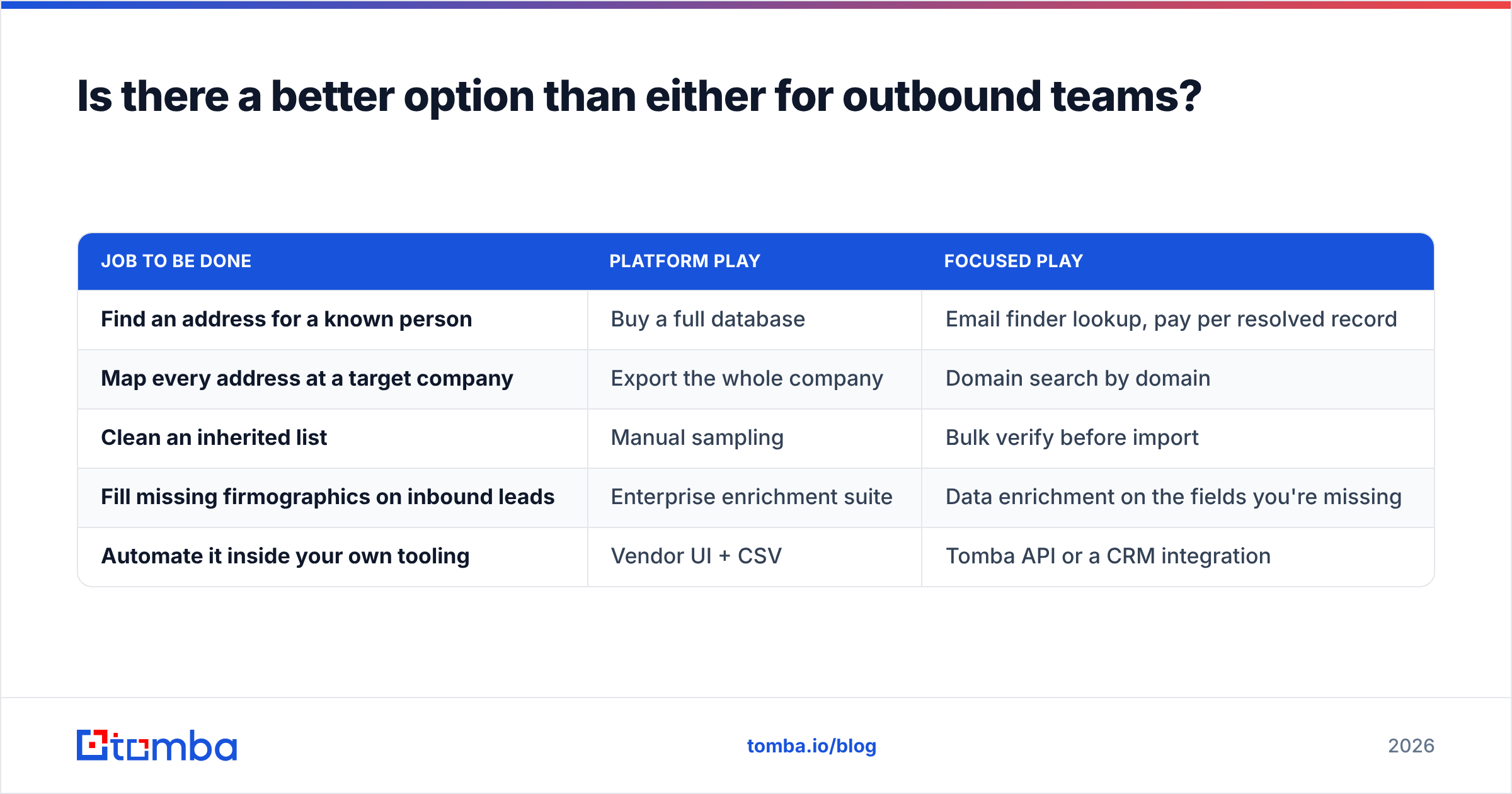
Is there a better option than either for outbound teams?#
For a lot of teams, yes — because the actual bottleneck is narrower than either product.
If your GTM already knows who to target (from LinkedIn, an ICP list, a conference roster, a customer-lookalike export), you don't need a $30k intelligence platform or a 46-million-row dump. You need a reliable way to turn "Name + Company" into a deliverable address, and to keep that address clean.
That's where a focused stack beats a monolith:
| Job to be done | Platform play | Focused play |
|---|---|---|
| Find an address for a known person | Buy a full database | Email finder lookup, pay per resolved record |
| Map every address at a target company | Export the whole company | Domain search by domain |
| Clean an inherited list | Manual sampling | Bulk verify before import |
| Fill missing firmographics on inbound leads | Enterprise enrichment suite | Data enrichment on the fields you're missing |
| Automate it inside your own tooling | Vendor UI + CSV | Tomba API or a CRM integration |
Worth naming the honest alternatives too. BookYourData is a strong option if you specifically want pay-as-you-go, verified B2B contact records without a subscription — its accuracy guarantee and per-record model suit teams that buy in bursts rather than continuously. Apollo and Cognism cover the "database + sequencer" middle ground. Check the current category grids on G2 before you commit; this market reshuffles every few quarters and last year's shortlist is not this year's.
The unglamorous truth is that most outbound underperformance is not a data-vendor problem. It's a targeting and deliverability problem wearing a data-vendor costume. Before you sign anything, check your bounce rate, your sender reputation, and whether your ICP definition is narrow enough to be actionable.
How should you run the evaluation?#
Do this in a fortnight, not a quarter:
- Write down the one metric that must move. Meetings booked? Onboarding time? Bounce rate? If FullCircl and OneMoreLead can't both be scored on it, they're not comparable and your shortlist is wrong.
- Pull a 200-record sample from each candidate covering the same segment. Same industry, same size band, same geography.
- Verify all samples with a neutral third-party verifier so nobody grades their own homework. Record hard bounce rate, catch-all rate, and unknowns.
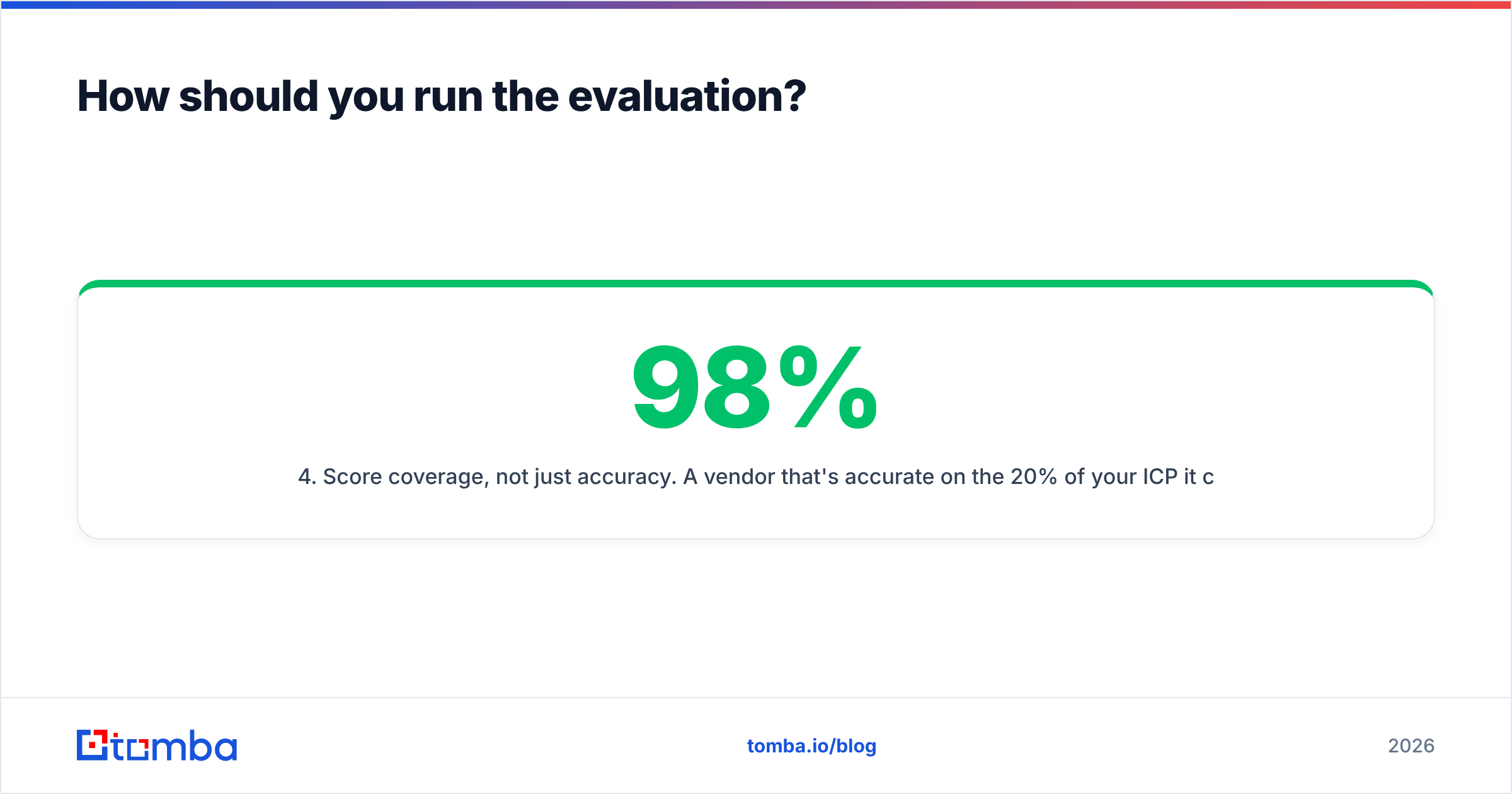
- Score coverage, not just accuracy. A vendor that's 98% accurate on the 20% of your ICP it can see is worse than one that's 92% accurate across 80%.
- Price it per usable record, not per seat or per month. Divide total annual cost by the number of records that survived step 3.
- Check the exit. Can you export what you built? Who owns enriched fields when you leave? Annual contracts make this question expensive to ask late.
That process usually resolves the FullCircl vs OneMoreLead question in about ten minutes of arithmetic — and often reveals that the answer is a third tool entirely.
The verdict#
FullCircl wins if you're a regulated UK business that needs company intelligence and compliant onboarding in one place, and you have the budget for a platform. OneMoreLead wins if you need cheap US contact volume today and you're disciplined about verification. Neither wins if your real job is finding and validating specific work email addresses at scale — that's a different tool category, and paying platform prices or accepting stale-list bounce rates to do it is the most common way teams waste data budget.
If that last case describes you, start with the Tomba Email Finder. Free tier gives you 25 searches a month to test accuracy against your own ICP before you spend anything; Starter is $49/mo and Growth is $99/mo, with the same lookups available through the API, Chrome extension, Google Sheets, and your CRM. Pull 200 records, verify them, compare the bounce rate to whatever a database export gives you, and let the numbers pick your vendor.
Related guides#
Ready to find emails that actually work?
Join 150,000+ professionals who stopped guessing and started sending. Free credits on signup — no credit card required.
Get the Tomba newsletter
Practical outbound tactics and product updates — once every two weeks.
About the author