9 Best FullContact Alternatives in 2026 (Tested & Compared)
FullContact built its name on identity resolution, not on getting a rep 500 verified work emails by Friday. Here are nine FullContact alternatives compared on price, match rates, API depth, and who each one actually fits.

TL;DR
- FullContact is an identity resolution platform first and a sales enrichment tool second. If your job is "give this rep 500 verified work emails by Friday," you are paying for machinery you don't use.
- The three most common reasons teams shop for FullContact alternatives: annual-only contracts, quote-gated pricing, and match rates that fall apart on small B2B domains.
- For contact discovery and email enrichment, Tomba starts at $49/mo with a free tier and a documented API — no sales call to see a number.
- For identity graph work at consumer scale, FullContact is still legitimately good. Don't replace it with an email finder and expect the same thing.
- Pick by job, not by feature count: prospecting, CRM hygiene, form shortening, and identity stitching are four different purchases.
What does FullContact actually do?#
FullContact is an identity resolution company. Its core product takes a fragmented signal — an email, a phone number, a hashed identifier, a device ID — and resolves it against a persistent identity graph to return a unified person or company profile. That's a genuinely hard engineering problem, and FullContact has been working on it since 2010.
The confusion starts because "enrichment" means two very different things depending on who says it.
An identity platform enriches known records. You already have the email; you want demographics, social handles, household data, and a stable person ID that survives across sessions and devices. That's FullContact's home turf, and it's why its customers skew toward adtech, martech, and large consumer brands doing cross-channel resolution.
A sales data tool enriches unknown targets. You have a company name and a job title, and you need a deliverable work email and a direct dial. That's a discovery problem, not a resolution problem, and it's where most people who search for FullContact alternatives actually live.
If you bought FullContact expecting the second thing and got the first, the tool isn't broken. It's aimed somewhere else.
Why are teams looking for FullContact alternatives in 2026?#
Four complaints show up repeatedly in G2 reviews and in procurement threads.
1. Quote-gated pricing. FullContact publishes tiers on its site but routes serious volume through sales. If you're a five-person team that needs 10,000 enrichments a month, a 30-minute discovery call to learn a number you could have read in ten seconds is friction you'll resent.
2. Annual commitments. Enterprise data contracts tend to be twelve-month, paid-up-front, with credits that expire. That's fine when your volume is predictable. It's punishing when you're testing a new outbound motion and don't know if you'll need 5,000 or 50,000 records.
3. B2B match rates on the long tail. Identity graphs are trained on scale. They perform beautifully on consumers and large enterprises, and noticeably worse on the 40-person software company in Lyon that your SDR is trying to reach. Ask any vendor for match rates segmented by company size, not blended.
4. No work-email discovery. FullContact resolves what you give it. It is not built to guess-and-verify firstname.lastname@domain.com against an SMTP server the way a dedicated email finder is. If work emails are the deliverable, you're buying the wrong category.
What should you compare when evaluating FullContact alternatives?#
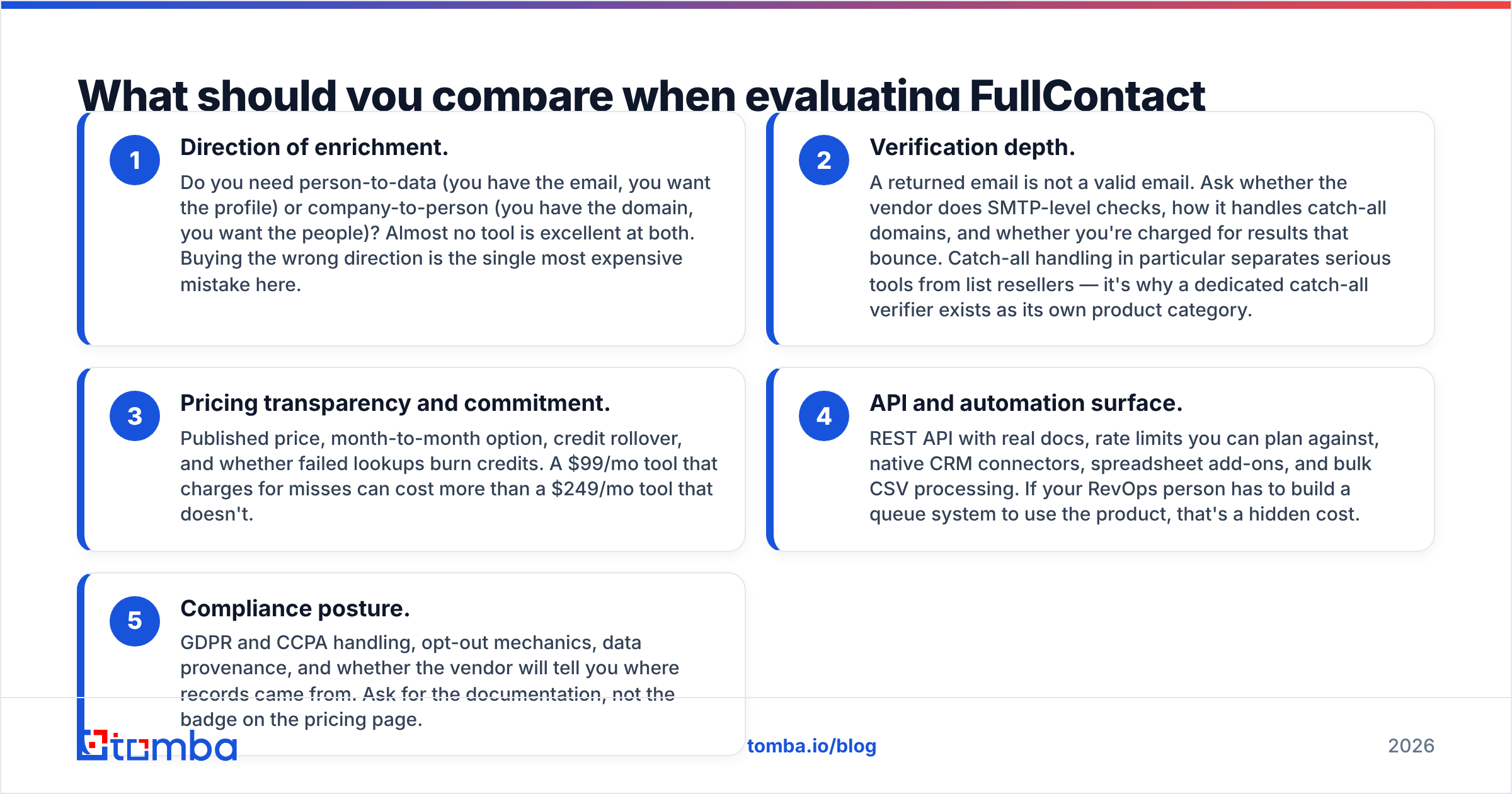
Before you look at a single logo, decide which of these five dimensions actually decides the purchase for you. Most buyers over-index on database size, which is the least useful number on any vendor's homepage.
- Direction of enrichment. Do you need person-to-data (you have the email, you want the profile) or company-to-person (you have the domain, you want the people)? Almost no tool is excellent at both. Buying the wrong direction is the single most expensive mistake here.
- Verification depth. A returned email is not a valid email. Ask whether the vendor does SMTP-level checks, how it handles catch-all domains, and whether you're charged for results that bounce. Catch-all handling in particular separates serious tools from list resellers — it's why a dedicated catch-all verifier exists as its own product category.
- Pricing transparency and commitment. Published price, month-to-month option, credit rollover, and whether failed lookups burn credits. A $99/mo tool that charges for misses can cost more than a $249/mo tool that doesn't.
- API and automation surface. REST API with real docs, rate limits you can plan against, native CRM connectors, spreadsheet add-ons, and bulk CSV processing. If your RevOps person has to build a queue system to use the product, that's a hidden cost.
- Compliance posture. GDPR and CCPA handling, opt-out mechanics, data provenance, and whether the vendor will tell you where records came from. Ask for the documentation, not the badge on the pricing page.
Which FullContact alternatives are worth it in 2026?#
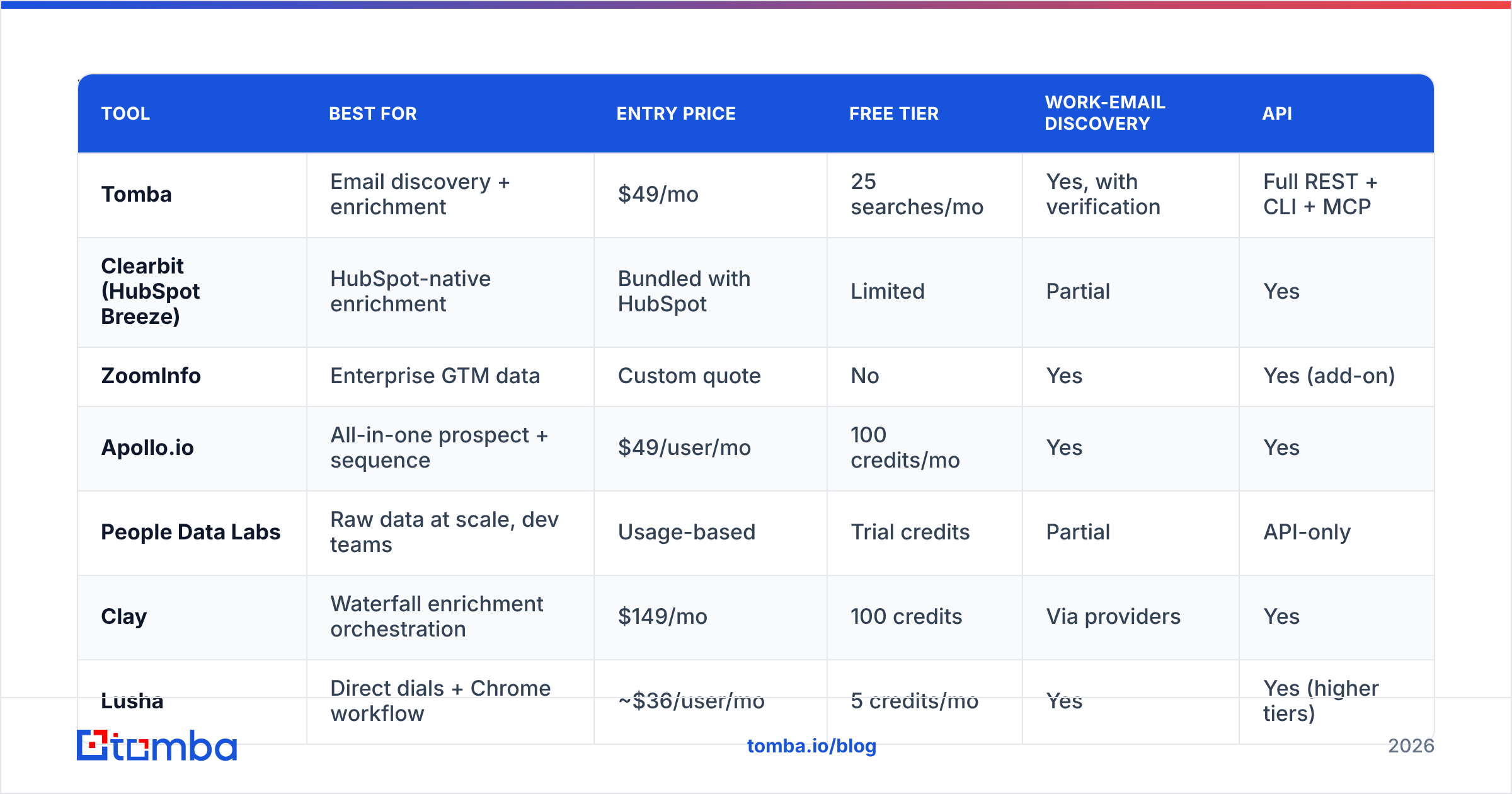
Here's the shortlist, compared on the attributes that decide real purchases. Prices are entry-level published rates as of early 2026 — always confirm on the vendor's own pricing page before you buy.
| Tool | Best for | Entry price | Free tier | Work-email discovery | API |
|---|---|---|---|---|---|
| Tomba | Email discovery + enrichment | $49/mo | 25 searches/mo | Yes, with verification | Full REST + CLI + MCP |
| Clearbit (HubSpot Breeze) | HubSpot-native enrichment | Bundled with HubSpot | Limited | Partial | Yes |
| ZoomInfo | Enterprise GTM data | Custom quote | No | Yes | Yes (add-on) |
| Apollo.io | All-in-one prospect + sequence | $49/user/mo | 100 credits/mo | Yes | Yes |
| People Data Labs | Raw data at scale, dev teams | Usage-based | Trial credits | Partial | API-only |
| Clay | Waterfall enrichment orchestration | $149/mo | 100 credits | Via providers | Yes |
| Lusha | Direct dials + Chrome workflow | ~$36/user/mo | 5 credits/mo | Yes | Yes (higher tiers) |
| BookYourData | Pay-as-you-go verified lists | Pay per contact | Sample credits | Yes | Yes |
| RocketReach | Broad contact lookup | ~$39/user/mo | Trial lookups | Yes | Yes (paid tier) |
1. Tomba — best for work-email discovery and lightweight enrichment#
Tomba solves the direction FullContact doesn't: you have a domain and a name, you need a deliverable business email. The domain search pulls every discoverable address at a company along with the detected email pattern, the finder resolves individual people, and the verifier runs SMTP-level checks before anything lands in your sequencer.
Pricing is published and month-to-month: Free (25 searches/mo), Starter $49/mo, Growth $99/mo, Pro $249/mo, Enterprise custom. You can see the full Tomba pricing breakdown without talking to anyone. The Tomba API covers finder, verifier, enrichment, and bulk endpoints, plus a CLI and an MCP server if you're wiring data into an agent workflow.
Where it wins: transparent pricing, no annual lock-in, strong catch-all handling, and a free tier big enough to actually test match rates on your own target accounts before you pay.
Where it doesn't: it is not an identity graph. If you need household-level consumer resolution or device stitching, this isn't the replacement.
2. Clearbit (now HubSpot Breeze Intelligence)#
Clearbit was the closest philosophical competitor to FullContact — company and person enrichment via API, with strong form-shortening and reveal products. Since the HubSpot acquisition it has been folded into Breeze Intelligence, which is excellent if you live in HubSpot and awkward if you don't.
Where it wins: native CRM enrichment, firmographic depth, buyer-intent signals inside the HubSpot workflow.
Where it doesn't: standalone access has narrowed considerably. If you're a Salesforce or Pipedrive shop, evaluate a Clearbit alternative rather than assuming a clean swap.
3. ZoomInfo#

The heavyweight. Enormous B2B database, org charts, intent data, conversation intelligence, and a workflow layer that genuinely runs enterprise GTM teams.
Where it wins: coverage of mid-market and enterprise North American companies, and depth of firmographic and technographic attributes.
Where it doesn't: pricing starts in the five figures annually and is always quoted. Contracts are famously hard to exit. For a team under 20 people, the total cost of ownership is rarely justified by the incremental data.
4. Apollo.io#
Apollo bundles a large contact database with sequences, dialer, and a basic CRM. It's the default "one tool instead of four" pick for early-stage sales teams.
Where it wins: value per dollar at the low end, and a genuinely useful free tier.
Where it doesn't: data quality is inconsistent on non-US records, and bundling means you're stuck with Apollo's sequencer even if you prefer another one. Teams that want the data without the suite often look at an Apollo alternative that exposes clean API access instead.
5. People Data Labs#
PDL sells raw data to engineering teams. No UI to speak of — you buy person and company datasets or hit the API, and you build the product on top.
Where it wins: breadth, flexible licensing including bulk dataset delivery, and pricing that scales with usage rather than seats.
Where it doesn't: there's no workflow. If nobody on your team writes code, this is a non-starter.
6. Clay#
Clay isn't a data provider — it's an orchestration layer that runs waterfall enrichment across dozens of providers, falling through to the next source when the first one misses. Pair it with a spreadsheet-native mental model and you get very high combined match rates.
Where it wins: highest achievable coverage, because you're querying many databases instead of one.
Where it doesn't: you pay for Clay and the underlying credits. Costs compound quickly, and the learning curve is real for non-technical users.
7. Lusha#
Lusha's strength is direct dials and a Chrome extension that reps actually use without training. It's a rep-adoption product more than a data-engineering product.
Where it wins: phone number coverage, simple per-seat pricing, fast onboarding.
Where it doesn't: credit limits bite quickly on the lower tiers, and API access sits on higher plans.
8. BookYourData#
BookYourData takes a different commercial approach: pay-as-you-go verified B2B lists with a bounce guarantee, no subscription required. For teams running periodic campaigns rather than continuous outbound, that model removes a lot of waste — you buy 5,000 contacts, you use 5,000 contacts, nothing expires. Filtering by industry, seniority, geography, and tech stack is straightforward, and the verification step is done before delivery rather than left to you.
Where it wins: no commitment, predictable per-record cost, clean list hygiene out of the box.
Where it doesn't: it's list-buying, not real-time API enrichment. If you need a person resolved inside a form-fill in 200ms, that's a different architecture.

9. RocketReach#
RocketReach is a broad lookup tool with a very large indexed contact base and a straightforward search interface. It's the pragmatic mid-market pick when you want more coverage than a Chrome extension and less commitment than ZoomInfo.
Where it wins: coverage breadth, simple pricing, decent bulk lookup.
Where it doesn't: verification is lighter than dedicated verifiers, so plan to run results through a separate email verifier before sending. Teams often compare it against a RocketReach alternative purely on cost per verified contact rather than cost per lookup.
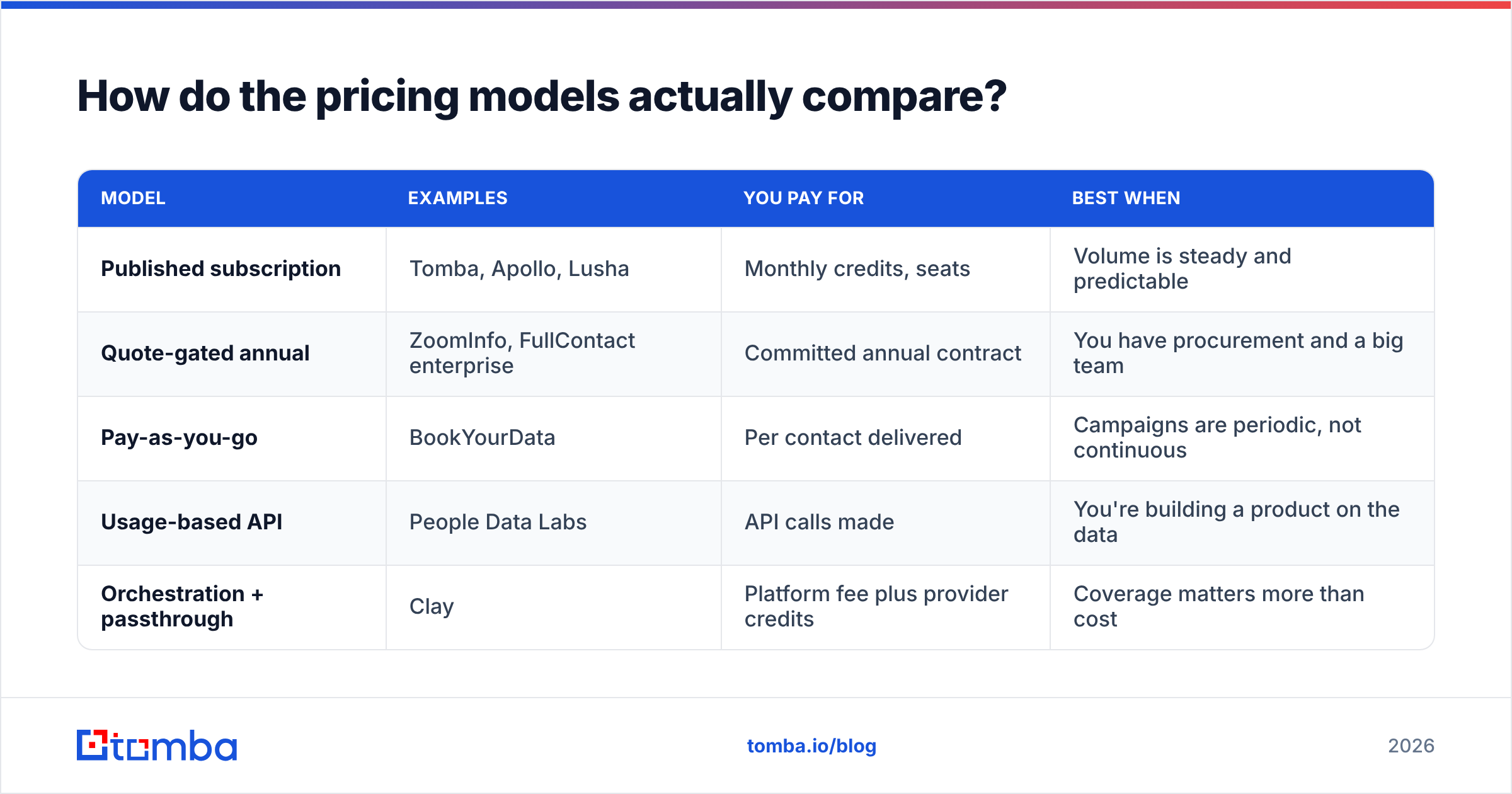
How do the pricing models actually compare?#
The sticker price is the least interesting number. What matters is cost per usable record — verified, deliverable, and not a duplicate of something already in your CRM.
| Model | Examples | You pay for | Best when |
|---|---|---|---|
| Published subscription | Tomba, Apollo, Lusha | Monthly credits, seats | Volume is steady and predictable |
| Quote-gated annual | ZoomInfo, FullContact enterprise | Committed annual contract | You have procurement and a big team |
| Pay-as-you-go | BookYourData | Per contact delivered | Campaigns are periodic, not continuous |
| Usage-based API | People Data Labs | API calls made | You're building a product on the data |
| Orchestration + passthrough | Clay | Platform fee plus provider credits | Coverage matters more than cost |
Two questions to ask every vendor before signing:
- Do failed lookups consume credits? If yes, a 60% match rate silently makes your effective price 67% higher.
- Do unused credits roll over? Annual contracts with monthly expiry are how vendors quietly bill you for capacity you never touched.
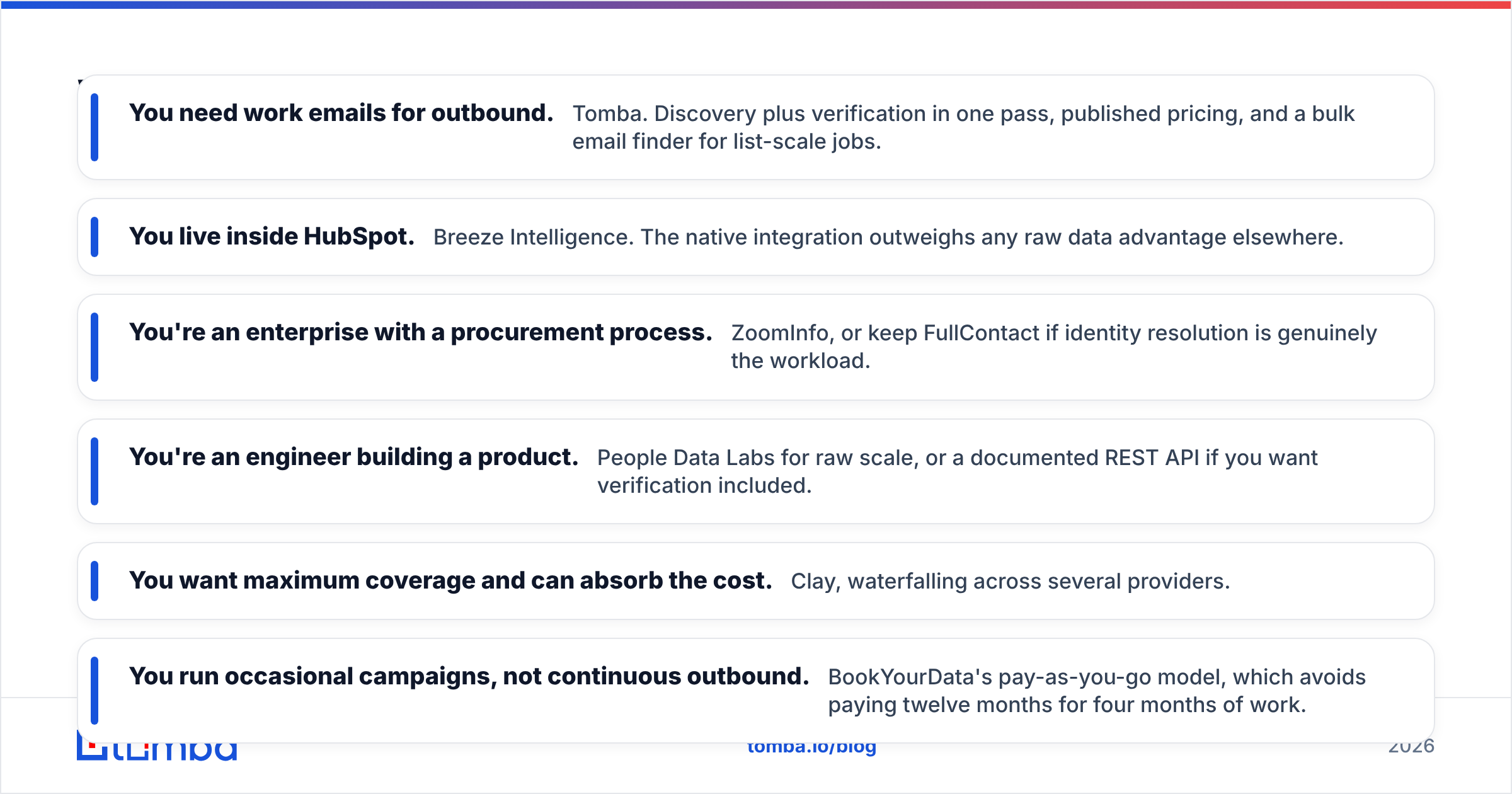
Which FullContact alternative fits your use case?#
- You need work emails for outbound. Tomba. Discovery plus verification in one pass, published pricing, and a bulk email finder for list-scale jobs.
- You live inside HubSpot. Breeze Intelligence. The native integration outweighs any raw data advantage elsewhere.
- You're an enterprise with a procurement process. ZoomInfo, or keep FullContact if identity resolution is genuinely the workload.
- You're an engineer building a product. People Data Labs for raw scale, or a documented REST API if you want verification included.
- You want maximum coverage and can absorb the cost. Clay, waterfalling across several providers.
- You run occasional campaigns, not continuous outbound. BookYourData's pay-as-you-go model, which avoids paying twelve months for four months of work.
- Your reps need phone numbers today. Lusha or RocketReach, both optimized for speed of adoption.
What's the honest verdict on FullContact?#
FullContact is not a bad product — it's a specialized one. If you're doing cross-channel identity resolution at consumer scale, check fullcontact.com and evaluate it on that basis, because most of the tools on this list can't do what it does.
But the majority of people typing "FullContact alternatives" into Google aren't running an identity graph. They're trying to get verified contact data into a sequencer without a twelve-month contract and a discovery call. That's a smaller, cheaper, more transparent purchase than the one FullContact is designed to sell.
Match the tool to the job. Test on your own target accounts, not the vendor's demo list. And segment your match-rate testing by company size — the blended number on the marketing page will always look better than what you'll get on the long tail where most B2B pipeline actually lives.
Ready to test it on your own list? Start with the Tomba Email Finder — the free tier gives you 25 searches a month with no card required, which is enough to run your real target accounts through it and compare match rates against whatever you're paying for now. If the numbers hold up, Starter is $49/mo, month-to-month, and the full API is included from day one.
Related guides#
Ready to find emails that actually work?
Join 150,000+ professionals who stopped guessing and started sending. Free credits on signup — no credit card required.
Get the Tomba newsletter
Practical outbound tactics and product updates — once every two weeks.
About the author