FullContact Pricing 2026: Reviews, Pros and Cons Compared
FullContact does not publish a simple price list, which makes budgeting hard. Here is what buyers actually report paying, what the platform does well, where it frustrates teams, and when a cheaper email-first tool wins.
TL;DR
- FullContact is an identity resolution and enrichment platform, not a prospecting tool. You buy it to stitch fragmented customer records together, not to build a cold outbound list.
- There is no clean public price list. Entry-level API access has historically included a free developer tier, but production contracts are sales-quoted, annual, and usually land in the five-figure range per year based on buyer reports.
- The strongest reviews praise match rates on person-level identity graphs and the quality of the API docs. The most common complaints are opaque pricing, annual commitments, and credit burn on unmatched records.
- If your actual job is "find and verify work email addresses for outbound," you are overpaying. A dedicated email finder starting at $49/mo covers that use case for a fraction of the cost.
- Use the decision table below: pick FullContact for identity resolution at scale, pick an email-first tool for prospecting, and only pay for both if you genuinely have two separate problems.
What is FullContact and who actually buys it?#
FullContact sells identity resolution. In plain terms: imagine a company with five filing cabinets — one from the website, one from the CRM, one from the support desk, one from the ad platform, one from an acquired company. The same human being appears in all five under slightly different names, emails, and devices. FullContact's job is to work out that those five folders are one person, then attach firmographic and demographic attributes to that unified profile.
That is a genuinely hard technical problem — the academic field is called record linkage — and it explains both the pricing model and the buyer profile. FullContact's typical customer is a marketing ops, data, or RevOps team at a mid-market or enterprise company that already has a lot of first-party data and needs it resolved and enriched. It is not a tool an SDR opens on a Monday morning to build a list of 200 prospects.
This distinction matters more than anything else in this review, because most people searching for FullContact pricing are comparing it against tools that solve a completely different problem. Judging FullContact against a $49/mo email finder is like comparing the price of a freight forwarder to the price of a postage stamp. Both move things. Only one is priced per item.
The product surface breaks down roughly like this:
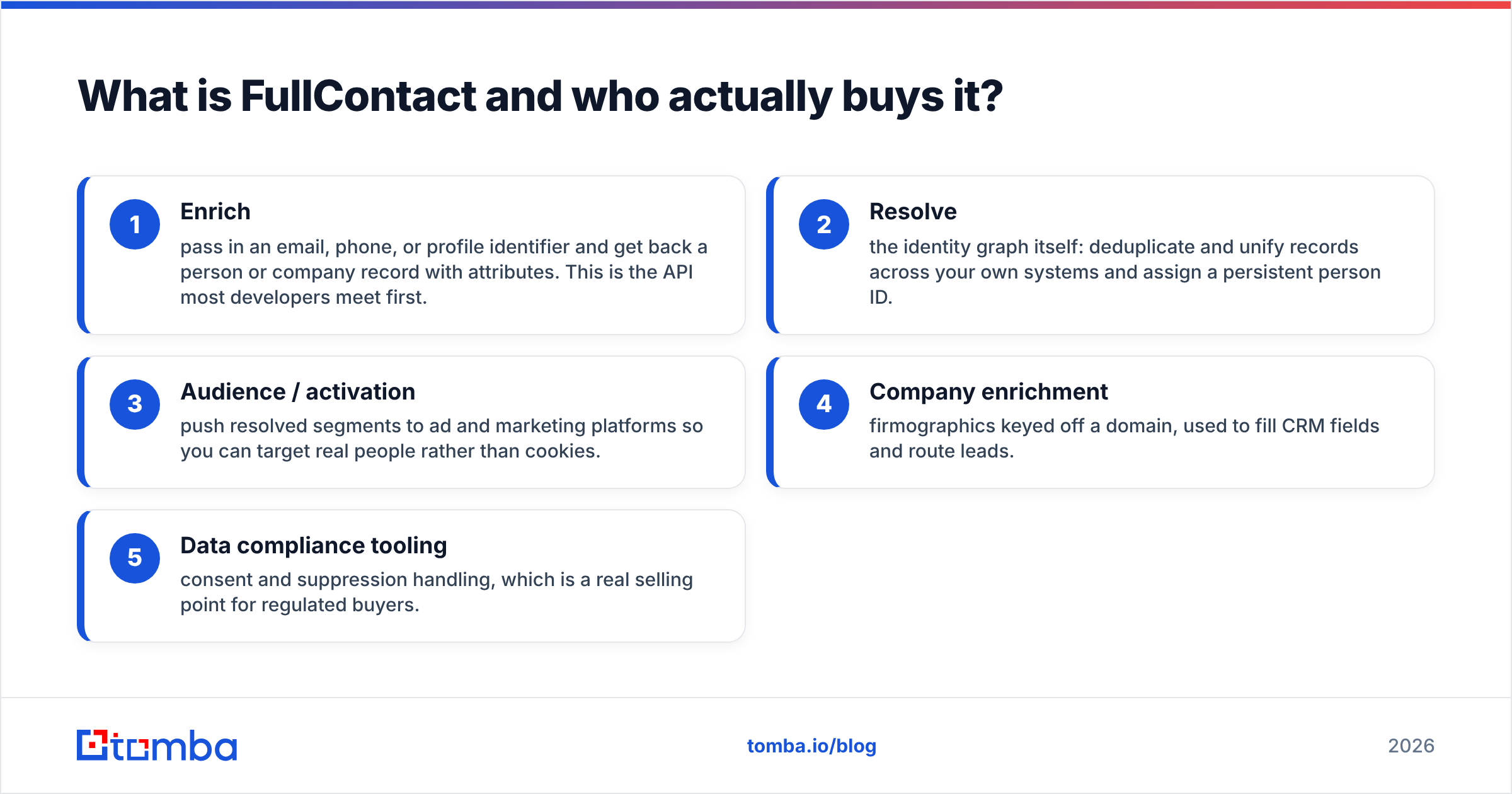
- Enrich — pass in an email, phone, or profile identifier and get back a person or company record with attributes. This is the API most developers meet first.
- Resolve — the identity graph itself: deduplicate and unify records across your own systems and assign a persistent person ID.
- Audience / activation — push resolved segments to ad and marketing platforms so you can target real people rather than cookies.
- Company enrichment — firmographics keyed off a domain, used to fill CRM fields and route leads.
- Data compliance tooling — consent and suppression handling, which is a real selling point for regulated buyers.
You can read the vendor's own framing on fullcontact.com, but note that the marketing language leans heavily on "identity" rather than "leads." That is a deliberate positioning choice, and it should shape your expectations before you take a sales call.

What does FullContact pricing actually look like in 2026?#
Here is the honest answer: FullContact does not publish a full self-serve price list for its production products. Anything you read — including this post — is directional. The numbers below reflect what buyers commonly report on review sites and in procurement discussions, not a quote you can hold the vendor to.
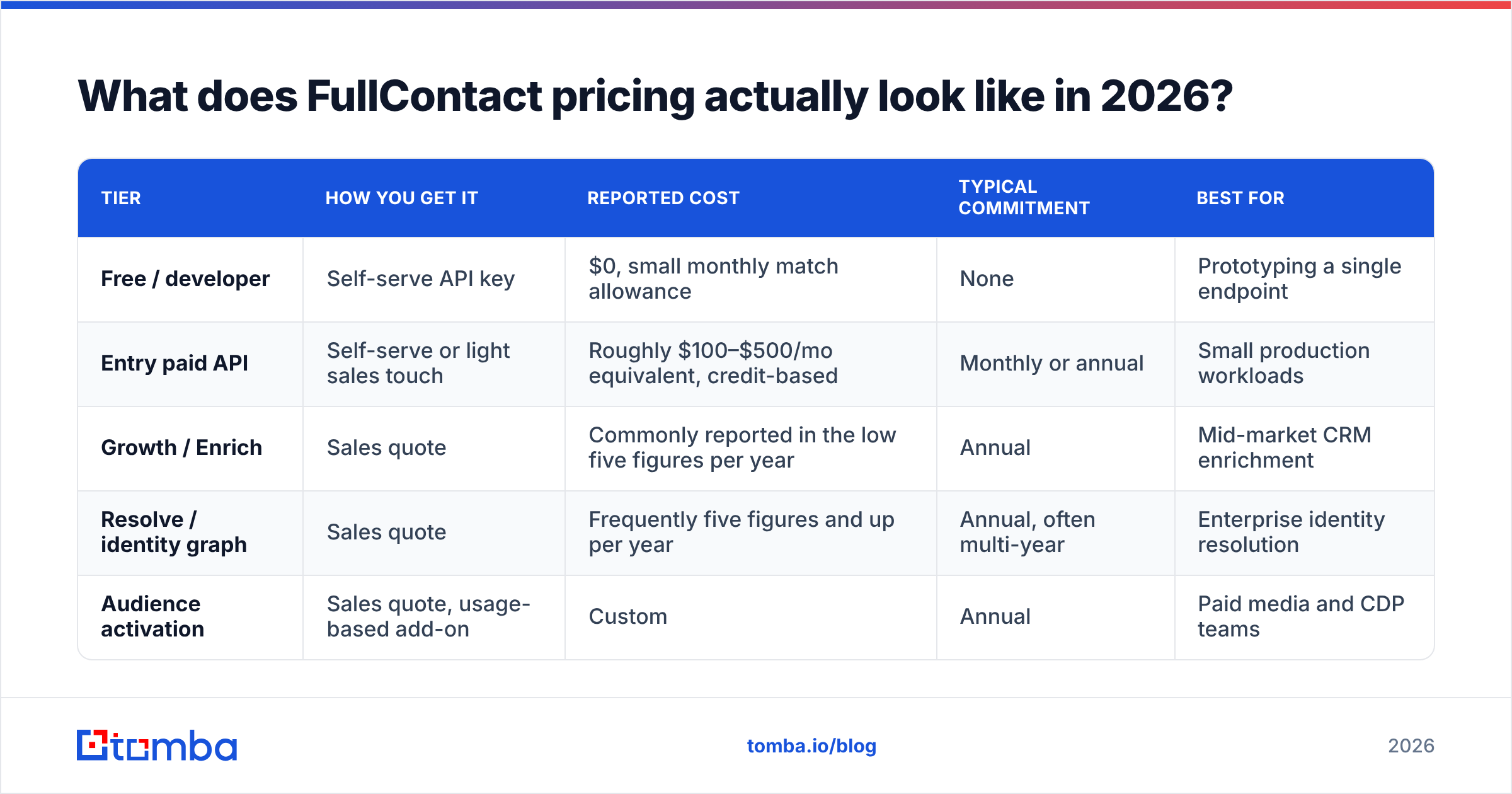
| Tier | How you get it | Reported cost | Typical commitment | Best for |
|---|---|---|---|---|
| Free / developer | Self-serve API key | $0, small monthly match allowance | None | Prototyping a single endpoint |
| Entry paid API | Self-serve or light sales touch | Roughly $100–$500/mo equivalent, credit-based | Monthly or annual | Small production workloads |
| Growth / Enrich | Sales quote | Commonly reported in the low five figures per year | Annual | Mid-market CRM enrichment |
| Resolve / identity graph | Sales quote | Frequently five figures and up per year | Annual, often multi-year | Enterprise identity resolution |
| Audience activation | Sales quote, usage-based add-on | Custom | Annual | Paid media and CDP teams |
Three structural things drive that cost, and they are the parts buyers most often miss.
It is credit-based, not seat-based. You are billed for API calls or matched records, not for how many people log in. That is great if two analysts run everything and terrible if your volume spikes unpredictably.
Match rate is the hidden multiplier. If you send 100,000 records and 60% resolve, your effective cost per usable record is not the list price — it is the list price divided by your match rate. Ask for a paid pilot on your data before signing. Vendor-reported match rates are measured on vendor-friendly samples.
Annual contracts are the norm above the developer tier. There is no meaningful month-to-month escape hatch once you are in enterprise territory. Budget accordingly, and negotiate a mid-term volume adjustment clause if your usage is seasonal.
For context on how a transparent, published model looks, compare that to Tomba pricing: Free at 25 searches/mo, Starter at $49/mo, Growth at $99/mo, Pro at $249/mo, and custom Enterprise. You can budget that in thirty seconds without a discovery call. Neither model is inherently wrong — quote-based pricing exists because enterprise data contracts genuinely vary — but the difference in buying friction is real, and it is the single most common theme in FullContact reviews.
What do FullContact reviews say — pros and cons?#
Aggregating public sentiment from G2 reviews and buyer conversations, the pattern is consistent enough to summarize.
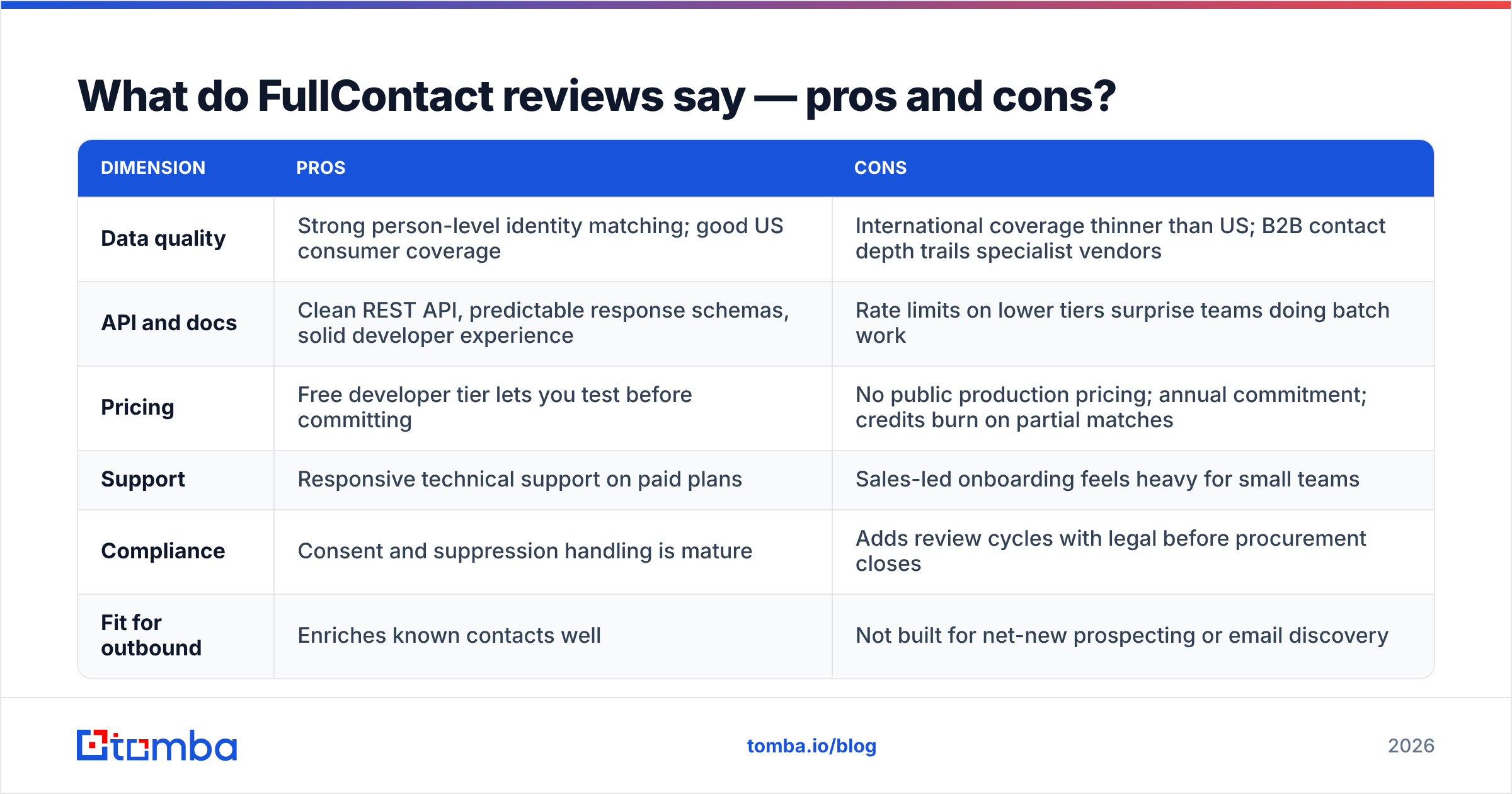
| Dimension | Pros | Cons |
|---|---|---|
| Data quality | Strong person-level identity matching; good US consumer coverage | International coverage thinner than US; B2B contact depth trails specialist vendors |
| API and docs | Clean REST API, predictable response schemas, solid developer experience | Rate limits on lower tiers surprise teams doing batch work |
| Pricing | Free developer tier lets you test before committing | No public production pricing; annual commitment; credits burn on partial matches |
| Support | Responsive technical support on paid plans | Sales-led onboarding feels heavy for small teams |
| Compliance | Consent and suppression handling is mature | Adds review cycles with legal before procurement closes |
| Fit for outbound | Enriches known contacts well | Not built for net-new prospecting or email discovery |
The praise clusters around engineering experience. Teams that integrate the Enrich endpoint into a signup flow or a CRM sync generally like it and stay. The criticism clusters around commercial experience. Small teams describe a mismatch between the effort of the buying process and the size of the problem they were trying to solve — they wanted a few thousand records enriched and got a quarterly business review.
The other recurring complaint is scope creep in the wrong direction: buyers who purchased FullContact expecting a prospecting database found that it enriches identifiers you already have rather than generating new ones. That is not a defect. It is the product working as designed. But it produces genuinely angry reviews when the sales conversation blurred the line.
Is FullContact worth it compared to the alternatives?#
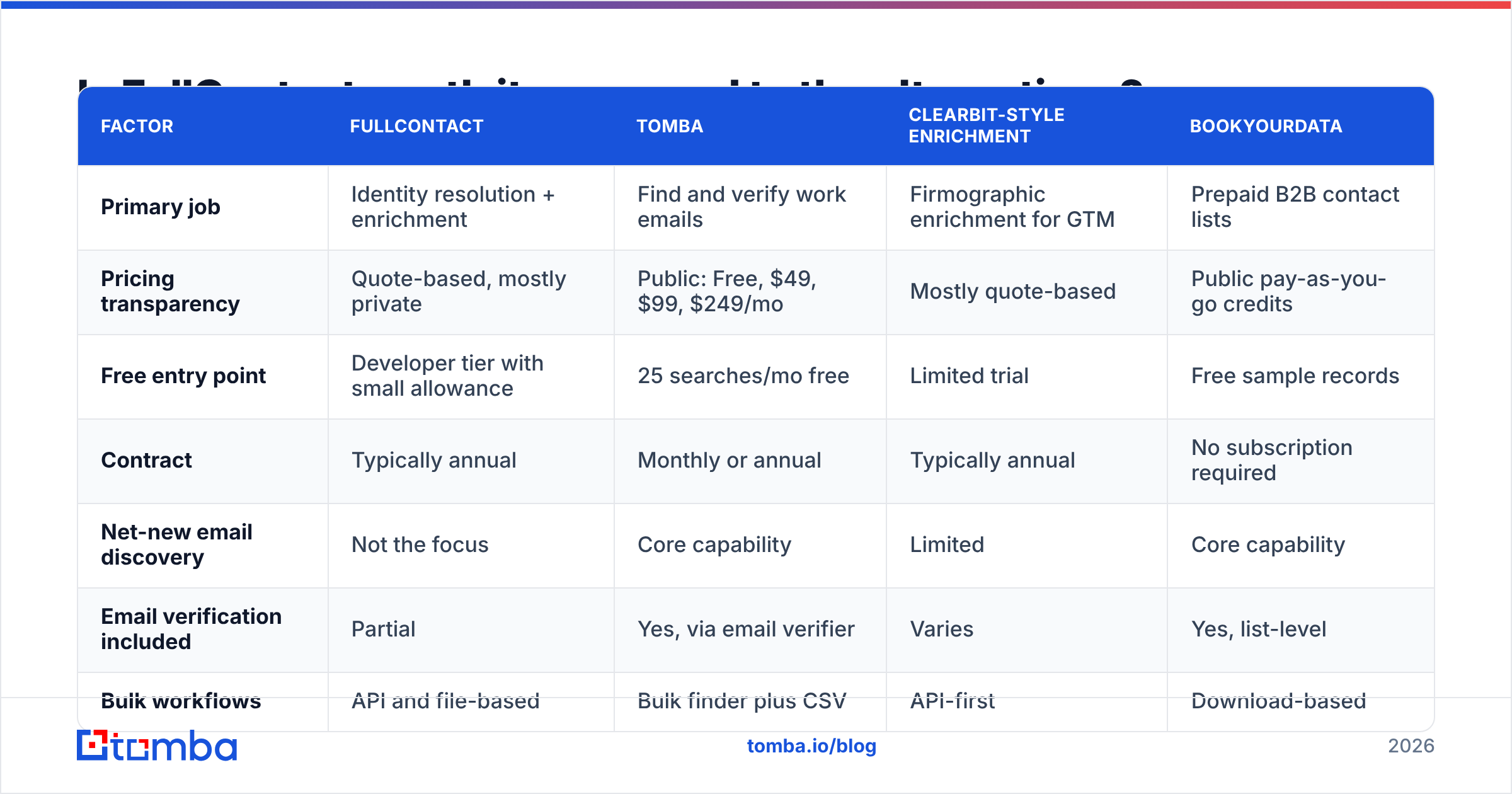
Depends entirely on which problem you are actually funding. Here is a straight comparison across the categories buyers usually shortlist together.
| Factor | FullContact | Tomba | Clearbit-style enrichment | BookYourData |
|---|---|---|---|---|
| Primary job | Identity resolution + enrichment | Find and verify work emails | Firmographic enrichment for GTM | Prepaid B2B contact lists |
| Pricing transparency | Quote-based, mostly private | Public: Free, $49, $99, $249/mo | Mostly quote-based | Public pay-as-you-go credits |
| Free entry point | Developer tier with small allowance | 25 searches/mo free | Limited trial | Free sample records |
| Contract | Typically annual | Monthly or annual | Typically annual | No subscription required |
| Net-new email discovery | Not the focus | Core capability | Limited | Core capability |
| Email verification included | Partial | Yes, via email verifier | Varies | Yes, list-level |
| Bulk workflows | API and file-based | Bulk finder plus CSV | API-first | Download-based |
| Best fit | Enterprise data teams | SDRs, agencies, founders, developers | Marketing ops at scale | Teams wanting a one-off list they own |
A few practical readings of that table.
If you already have a customer identity problem — duplicate records, anonymous traffic you want to tie to known people, ad audiences going stale — FullContact is a legitimate, well-engineered answer and the price reflects specialist infrastructure. Do not cheap out on that with a $49 tool; it will not solve it.
If your job is outbound, the equation flips hard. You need three things: a way to find addresses from a name and domain, a way to confirm those addresses will not bounce, and a way to do it in bulk without a procurement cycle. That is what a domain search plus verification workflow gives you, and it is priced per month with a card, not per year with a contract.
BookYourData sits in a third lane worth knowing about: prepaid, downloadable B2B lists with no subscription. Teams that want to own a dataset outright rather than call an API every month often prefer that model, and it is a reasonable peer to evaluate alongside both options above.
If you want to move off an enterprise enrichment contract without losing coverage, the practical migration path is usually: keep the identity graph if you truly use it, and move the email discovery and verification layer to a dedicated tool. Plenty of teams evaluating a Clearbit alternative or a FullContact alternative end up with exactly that split rather than a single replacement.

What are the hidden costs buyers miss?#
Four line items rarely appear in the first quote and reliably appear in the second year.
Unmatched record burn. Many usage models charge for the lookup attempt, not the successful match. At a 55% match rate, a 200,000-record enrichment run costs you nearly double per usable row versus the headline number. Negotiate match-only billing if you can; if you cannot, model the effective rate honestly.
Integration engineering. Budget developer time for the initial sync, the retry logic, and the inevitable schema drift when your CRM fields change. Two to four weeks of engineering is a normal first-year cost, and it is real money even though it never appears on the invoice.
Overage pricing. Overage rates are almost always worse than committed rates. If your volume is spiky — post-webinar surges, seasonal campaigns — a smaller commit plus overage can quietly cost more than a larger commit. Run both scenarios before signing.
Compliance review time. Consumer identity data pulls legal into the room. That is not a FullContact-specific problem, but it lengthens time-to-value, and if your only goal was filling in job titles on 5,000 CRM records, the overhead is disproportionate.
For a lighter-weight approach to the same CRM-hygiene goal, some teams run scheduled data enrichment against their existing contact list and skip the identity graph entirely. It resolves less, costs less, and takes an afternoon rather than a quarter.
How should you decide?#
Run this three-question test before you take the demo.
One: do you have duplicate humans across systems that you cannot currently link? If yes, identity resolution is your problem and FullContact belongs on the shortlist. If no, you are shopping in the wrong category.
Two: is your bottleneck records you already have, or records you do not have yet? Enrichment platforms improve records you already own. They do not manufacture new prospects. If your pipeline problem is "not enough contacts," you need discovery and verification, not resolution.
Three: can you tolerate an annual commitment and a sales-led buying cycle? If the answer is no — because you are a founder, an agency, or a small team that needs to start this week — the quote-based model is a structural mismatch regardless of how good the data is.
Score two or three yeses and FullContact is worth the evaluation, provided you insist on a paid pilot against your own data and you measure match rate rather than accepting the vendor benchmark. Score zero or one and you will be happier with a transparent, monthly tool that does one job well.
The bottom line#
FullContact is a credible identity resolution platform with a strong API and a pricing model built for enterprise data teams. If that describes you, the cost is defensible and the free developer tier gives you a genuine way to test before committing. If it does not describe you — if what you actually need is verified work email addresses for outbound at a price you can put on a card — the fit is poor and no negotiation fixes that.
For that second group: start with Tomba Email Finder. The free tier gives you 25 searches a month to test accuracy on companies you already know, Starter is $49/mo, and verification is built in so you are not paying twice to find and then confirm an address. No annual commitment, no quote call, no procurement cycle. Test it against ten domains you already have contacts at, check the hit rate yourself, and you will know within an hour whether you ever needed the enterprise contract at all.
Related guides#
Ready to find emails that actually work?
Join 150,000+ professionals who stopped guessing and started sending. Free credits on signup — no credit card required.
Get the Tomba newsletter
Practical outbound tactics and product updates — once every two weeks.
About the author