FullEnrich Pricing in 2026: Plans, Credits, and Real Costs
FullEnrich sells waterfall enrichment by the credit — and phone numbers cost 10x what emails do. Here is what a contact actually costs, where the plan math breaks, and when a flat-rate email finder wins.
TL;DR
- FullEnrich is a waterfall enrichment tool: one lookup fans out across 15+ data vendors and you pay for the result, not the attempt. Plans are credit-based and start in the ~$29–$49/month range, with annual billing knocking roughly 20–30% off.
- The number that decides your bill is not the plan price — it's the credit multiplier. Emails typically cost 1 credit; verified mobile numbers cost around 10. A 1,000-credit plan is 1,000 emails or ~100 phone numbers.
- Waterfall pricing wins when you need mobile numbers and hit-rate on hard-to-find personas. It loses when 90% of your workflow is "find and verify work emails at known domains."
- Credits usually expire monthly and unused balance does not roll over on most credit-based enrichment plans — check your contract before buying a big tier "to be safe."
- If your job is bulk email discovery and verification, a flat-rate finder like Tomba pricing at $49/mo Starter or $99/mo Growth is materially cheaper per email. Use both if you genuinely need phones.
What is FullEnrich and how does its pricing model work?#
FullEnrich is a B2B contact enrichment platform built around waterfall enrichment. Instead of querying one database, it chains requests across a stack of providers — if vendor one returns nothing, it tries vendor two, then three, and so on until it finds a verified email or mobile number, or exhausts the chain.
The commercial logic follows directly from that architecture. You are not renting a database; you are renting access to a queue of databases, and the vendor pays each supplier per successful call. So the pricing model is:
- Credit-based, not seat-based. You buy a monthly credit allowance. Seats are typically bundled or cheap; credits are the constraint.
- Success-only billing. You are charged when a contact is found. Misses do not burn credits. This is the single most user-friendly part of the model and it is genuinely better than pay-per-lookup tools.
- Asymmetric credit weights. An email costs ~1 credit. A verified mobile phone number costs ~10 credits. This is where budgets quietly detonate.
- Monthly reset. Credits are allocated per billing period and generally expire at the end of it. Annual plans front-load a discount but not always a rollover.
- API + integrations included. The API, CRM syncs, and CSV/bulk enrichment are usually available across paid tiers rather than gated behind an enterprise plan.
Read those five points again and you'll see the core insight: FullEnrich pricing is a phone-number pricing model wearing an email-enrichment coat. If you never buy phone numbers, you are paying a waterfall premium for something a single good provider already does.
Always confirm current numbers on the vendor's own pricing page — credit-based vendors reprice more often than seat-based SaaS, and public tiers shift quarterly.

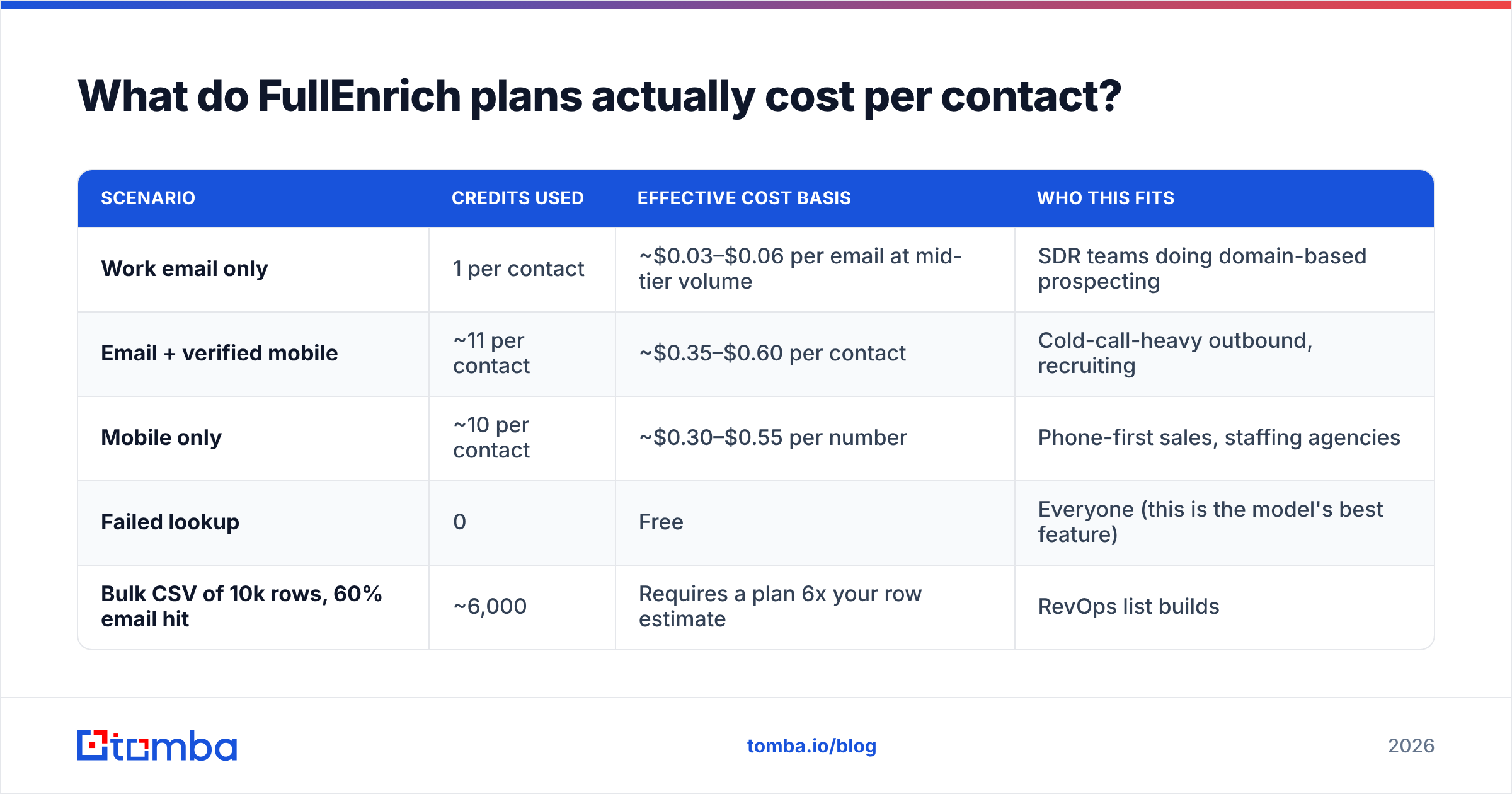
What do FullEnrich plans actually cost per contact?#
Here's the arithmetic that matters. Take any credit plan, divide the monthly price by the credits, then multiply by the credit weight of what you're actually enriching.
| Scenario | Credits used | Effective cost basis | Who this fits |
|---|---|---|---|
| Work email only | 1 per contact | ~$0.03–$0.06 per email at mid-tier volume | SDR teams doing domain-based prospecting |
| Email + verified mobile | ~11 per contact | ~$0.35–$0.60 per contact | Cold-call-heavy outbound, recruiting |
| Mobile only | ~10 per contact | ~$0.30–$0.55 per number | Phone-first sales, staffing agencies |
| Failed lookup | 0 | Free | Everyone (this is the model's best feature) |
| Bulk CSV of 10k rows, 60% email hit | ~6,000 | Requires a plan 6x your row estimate | RevOps list builds |
Two traps show up constantly in credit-model post-mortems:
Trap one: sizing your plan by row count instead of hit count. A 10,000-row list does not need 10,000 credits — it needs credits equal to your hit rate times rows, times the credit weight. At a 60% email hit rate, that's 6,000. But add mobiles at 40% coverage and 10x weight, and you've just added 40,000 credits to the same list. Same file, seven times the cost.
Trap two: assuming the waterfall always fires. Waterfall enrichment shines on sparse personas — founders at 12-person startups, contractors, non-LinkedIn-native industries. On a list of VPs at Fortune 5000 companies with predictable email patterns, the first provider in the chain resolves nearly everything, and you paid waterfall rates for a single-source result.

Is FullEnrich pricing better than flat-rate email finders?#
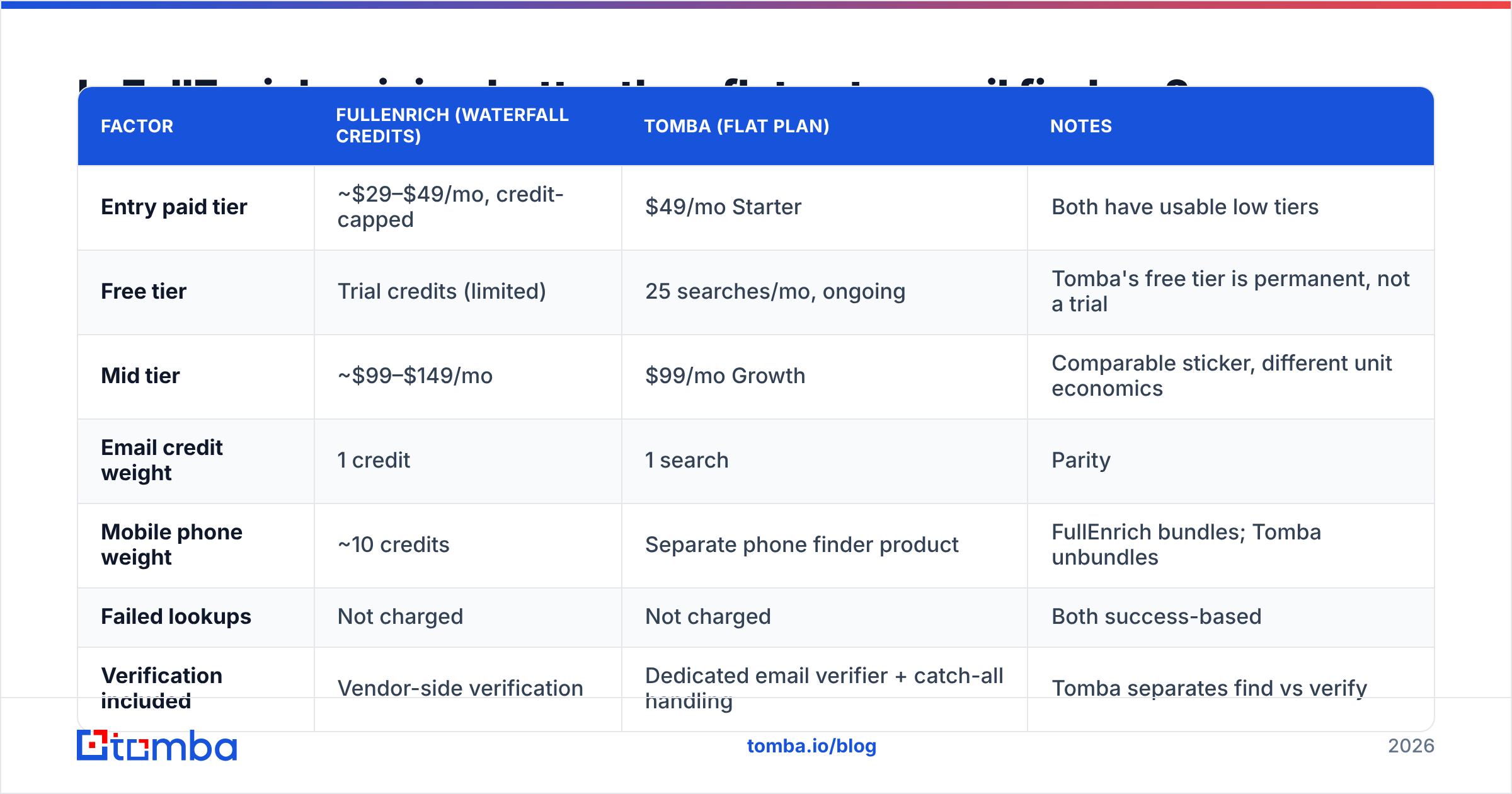
It depends entirely on what percentage of your enrichment volume is phone numbers. Below is a straight comparison against a flat-rate email-finding stack.
| Factor | FullEnrich (waterfall credits) | Tomba (flat plan) | Notes |
|---|---|---|---|
| Entry paid tier | ~$29–$49/mo, credit-capped | $49/mo Starter | Both have usable low tiers |
| Free tier | Trial credits (limited) | 25 searches/mo, ongoing | Tomba's free tier is permanent, not a trial |
| Mid tier | ~$99–$149/mo | $99/mo Growth | Comparable sticker, different unit economics |
| Email credit weight | 1 credit | 1 search | Parity |
| Mobile phone weight | ~10 credits | Separate phone finder product | FullEnrich bundles; Tomba unbundles |
| Failed lookups | Not charged | Not charged | Both success-based |
| Verification included | Vendor-side verification | Dedicated email verifier + catch-all handling | Tomba separates find vs verify |
| Bulk + API | Included on paid tiers | Included, plus bulk email finder and CLI | Both API-first |
| Best for | Phone-heavy, hard-to-find personas | High-volume email discovery at known domains | Different jobs |

The honest read: FullEnrich is not overpriced for what it does. Aggregating fifteen vendors and only charging on success is real engineering and real cost absorption. But it is priced for a phone-inclusive workflow. If your sequences are email-only — which is true for most SMB and mid-market outbound teams — you're subsidising a capability you never invoke.
When does the waterfall model justify the premium?#
Four situations where paying credit rates is clearly correct:
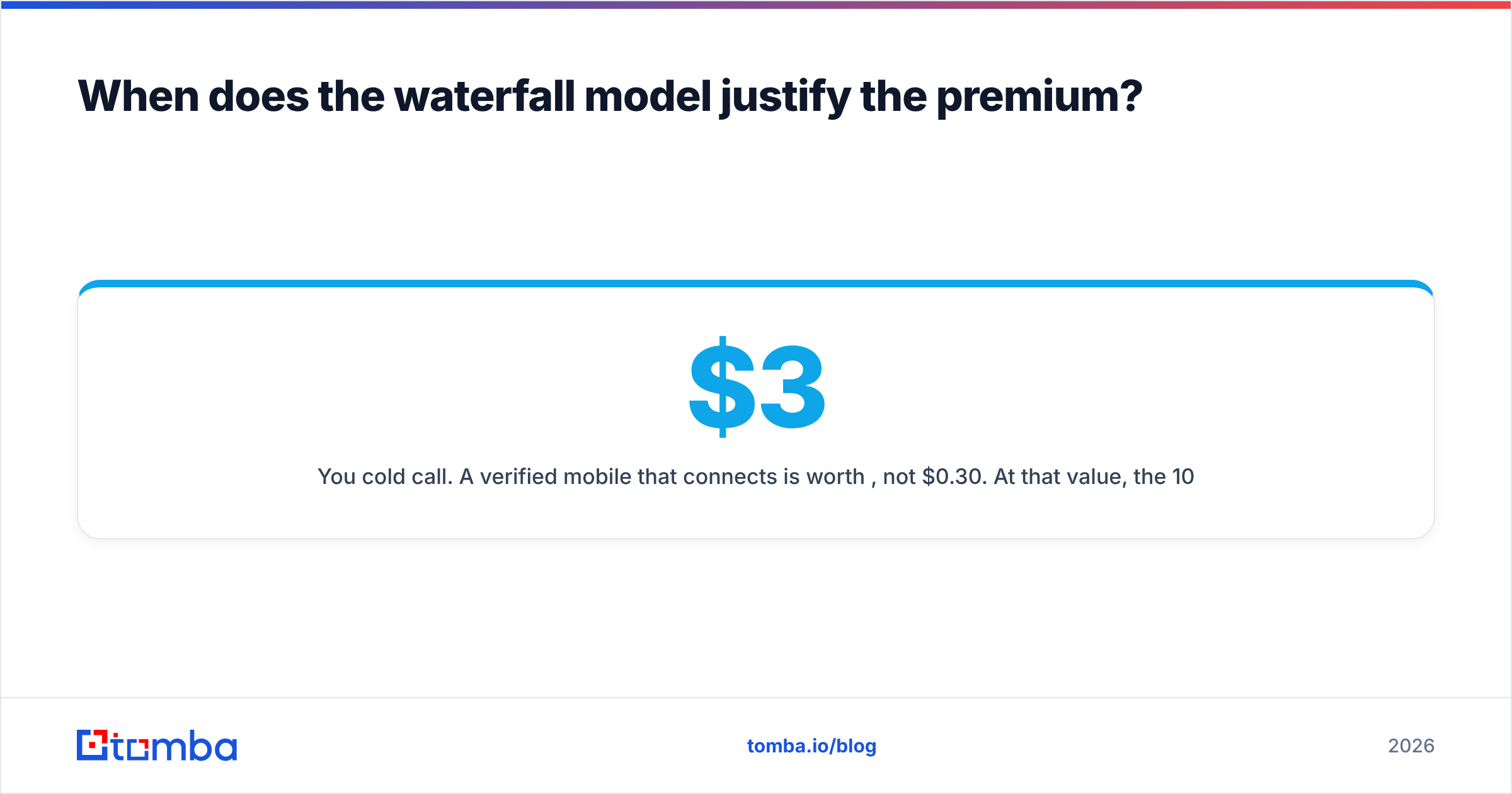
- You cold call. A verified mobile that connects is worth $3, not $0.30. At that value, the 10x credit weight is irrelevant and the multi-vendor coverage is the whole point.
- Your ICP is off-grid. Trades, healthcare practices, regional manufacturers, franchise owners — people whose contact data was never scraped cleanly from a single source. A waterfall's marginal hit rate on these lists can be 20–30 points above any single provider.
- You're enriching small volumes of very high-value accounts. 200 enterprise targets a month? Cost per contact is a rounding error. Buy the best coverage available.
- You already run a multi-vendor stack manually. If you're paying for three enrichment tools and writing fallback logic yourself, consolidating into one waterfall bill usually saves money and definitely saves engineering time.
And the mirror image — four situations where it's the wrong buy:
- Domain-pattern prospecting. If you know the company and the person's name, a domain search resolves the pattern once and applies it to every contact at that company. You do not need fifteen vendors to guess
first.last@. - List hygiene work. Cleaning an existing 50k-record CRM is a verification job, not a discovery job. Verification should cost a fraction of a cent per record, not a credit.
- You never dial. Paying for phone infrastructure you don't use is the definition of shelfware.
- Predictable monthly volume. Flat plans are cheaper than metered ones whenever your usage is stable. Metered pricing is insurance against volatility; if you have no volatility, you're just buying insurance.

What are the hidden costs in FullEnrich pricing?#
Every credit-based tool has line items that don't appear on the pricing page. Budget for these:
Credit expiry. Most monthly credit allocations reset. If you buy a 5,000-credit tier because "one month we'll need it," you're paying for peak capacity every month. Model your median month, not your best one, and top up with overage or a temporary upgrade when a big list lands.
Annual lock-in for the discount. The 20–30% annual saving is real, but it converts a variable cost into a fixed one. If your outbound motion is being redesigned — new ICP, new channel mix, new team size — the discount is not worth the rigidity.
Re-enrichment drift. B2B contact data decays roughly 25–30% per year as people change jobs. That means a static database of 20,000 contacts needs ~5,000–6,000 re-enrichments annually just to stay accurate. That's an ongoing credit line, not a one-time cost. See how data enrichment workflows handle this on a schedule rather than in panic bursts.
Duplicate spend. If two SDRs enrich the same contact through different workflows, most tools charge twice unless caching is explicit. Ask about dedupe behaviour before you sign — this alone can be 5–15% of credit burn on teams without CRM discipline.
The verification gap. "Found" and "deliverable" are not synonyms. A found email that bounces costs you a credit and damages sender reputation. If the tool's verification is a pass/fail flag rather than a full SMTP-level check with catch-all handling, you'll want a dedicated verifier in front of your sending platform anyway — which is another line item.
How should you compare FullEnrich against other 2026 options?#
Don't compare sticker prices. Compare cost per usable, deliverable contact delivered into your sequence. Here's the framework:
- Take a real sample. Pull 500 rows from your actual ICP — not a demo list, not a famous-companies list. Real accounts, real personas.
- Run the same file through every candidate. Most vendors will grant trial credits for exactly this. Use them.
- Measure four numbers per tool: hit rate, bounce rate on a test send, credits consumed, and total dollars spent.
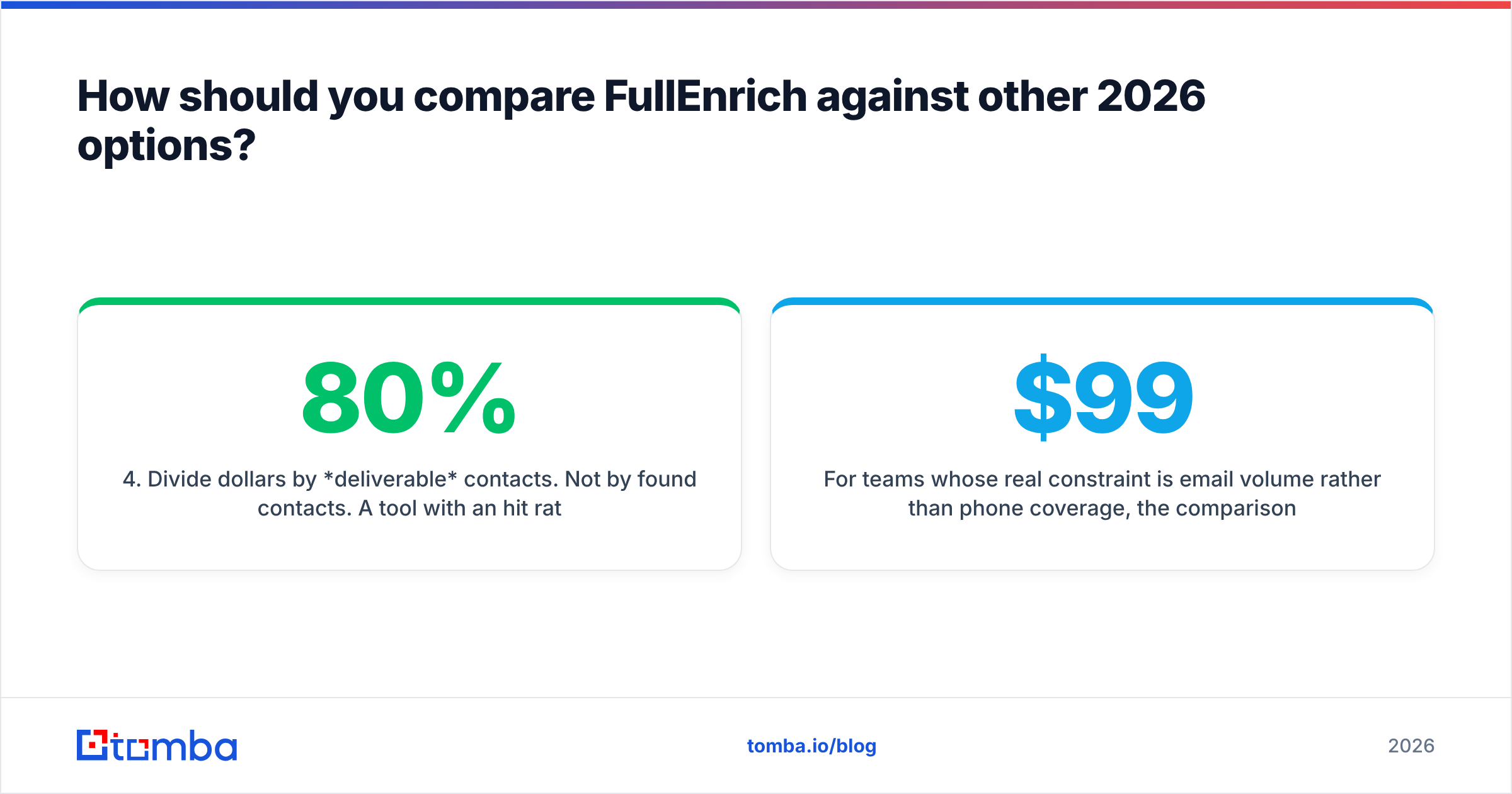
- Divide dollars by deliverable contacts. Not by found contacts. A tool with an 80% hit rate and 12% bounce loses to one with a 65% hit rate and 1% bounce, at the same price.
- Add the integration tax. A cheaper tool that needs a Zapier middleman and manual CSV shuttling costs somebody two hours a week. Price that in.
For alternatives worth putting in the same bake-off: BookYourData is a strong option if you'd rather buy pre-verified list access than pay per lookup — its pay-as-you-go model with a bounce guarantee suits teams that want predictable list costs without a subscription. Category-level reviews on G2's lead intelligence category are useful for spotting support and billing complaints that never appear in a sales demo. And for the strategic layer — how enrichment feeds scoring and routing — HubSpot's sales resources cover the downstream workflow well.
For teams whose real constraint is email volume rather than phone coverage, the comparison usually lands on flat-rate finders. A Tomba Email Finder plan at $99/mo Growth gives you predictable monthly cost, per-email verification, catch-all detection, and API access without credit-weight arithmetic on every list you build.
What's the verdict on FullEnrich pricing in 2026?#
Buy it if you dial. The waterfall model earns its premium on mobile numbers and hard-to-source personas, and success-only billing means you're never paying for misses. For recruiters, staffing firms, and phone-first sales teams, the 10x phone credit weight is a fair trade for coverage that no single vendor matches.
Skip it if you don't. If your outbound is email-only at known domains — which describes the majority of B2B SaaS prospecting — you're paying a multi-vendor aggregation premium to solve a single-vendor problem. Flat pricing will be 3–5x cheaper per usable email, and you'll spend zero minutes per month reconciling credit burn against plan tiers.
The hybrid is often right. Run a flat-rate email finder as the default engine for volume, and keep a small FullEnrich credit balance for the 5–10% of contacts that genuinely need waterfall coverage or a mobile number. That combination beats either tool alone on cost per meeting booked, which is the only metric that actually matters.
Whichever way you go, size the plan on your median month, test on your real ICP, and measure deliverability rather than hit rate. Credit models punish optimism.
Ready to cut your cost per verified email? Start with the Tomba Email Finder — 25 free searches a month with no trial clock, flat $49/mo Starter and $99/mo Growth plans, built-in verification and catch-all handling, and a full API so your enrichment runs where your data already lives. Run your next 500-row list through it alongside whatever you use today, then compare cost per deliverable contact. The math tends to make the decision for you.
Related guides#
Ready to find emails that actually work?
Join 150,000+ professionals who stopped guessing and started sending. Free credits on signup — no credit card required.
Get the Tomba newsletter
Practical outbound tactics and product updates — once every two weeks.
About the author