Funny Cold Email Subject Lines That Actually Get Replies
Humor in cold email is high-variance: it can double your reply rate or torch your credibility. Here are 40+ funny cold email subject lines, the data behind when jokes work, and the exact rules for using them safely.
TL;DR
- Funny cold email subject lines are high-variance. They lift open rates in casual, creative, and SMB markets and sink them in regulated, enterprise, and technical buying committees.
- Humor works when it is specific to the prospect. "Quick question" with a pun bolted on is not funny — it's noise. A line referencing their pricing page copy is.
- The failure mode isn't a bad joke. It's a joke sent to a stale, unverified list — you get spam complaints instead of laughs.
- Test humor as a variant, never as your whole strategy. Keep one plain-clear control line running in every sequence.
- Below: 40+ subject lines grouped by category, a comparison table of humor styles by industry, and the four rules that decide whether a joke lands or costs you the account.
Cold email humor is the sales equivalent of ordering the chef's special at a restaurant you've never visited. When it hits, you tell people about it for a year. When it misses, you quietly pay and never come back. The difference between the two outcomes isn't luck — it's how much you knew about the kitchen before you ordered.
This guide covers what actually happens when you put a joke in the subject line, which industries reward it, 40+ lines you can adapt today, and the operational work that has to happen before the joke matters at all.
Do funny cold email subject lines actually work?#
Sometimes. And the "sometimes" is doing enormous work in that sentence.
Here's the honest mechanics. A subject line has exactly one job: earn the open. Humor earns opens by breaking pattern — a prospect scanning 60 unread messages sees 58 variations of "Quick question re: [Company]" and one line that reads like a human wrote it. Pattern interrupt is real, and it's why funny lines routinely post open rates 10–25% above plain control lines in casual B2B verticals.
But open rate is a vanity metric if the reply rate collapses behind it. And that's the trap. A joke sets an expectation. If the body copy is a generic pitch deck in paragraph form, you've created a bait-and-switch, and the prospect punishes it — with a delete, or worse, a spam complaint that damages your sender reputation.
The pattern that shows up consistently across teams that test this properly:
- Humor lifts opens broadly — across almost every vertical, a well-crafted funny line beats a generic one on open rate.
- Humor lifts replies narrowly — mainly in marketing, agency, e-commerce, startup, hospitality, and creative-services buyers.
- Humor hurts replies in regulated and technical markets — finance, healthcare, legal, government, security, and enterprise IT buyers read jokes as a signal that you don't understand their world.
- Humor amplifies list quality, good or bad — a memorable line sent to the wrong person is memorably wrong.
- Humor decays faster than plain copy — a joke that worked in Q1 gets copied across your industry by Q3 and becomes the new generic.
That last point matters more than people expect. "Should I stay or should I go?" was a genuinely fresh follow-up line once. It is now so widely used that experienced buyers recognize it as a template on sight.
What makes a cold email joke land instead of flop?#
The difference is specificity. Generic humor is a costume; specific humor is proof of research.
Compare these two:
- "Subject: I'll bring the coffee ☕"
- "Subject: your careers page says you're hiring 4 SDRs. Condolences."
The first is a joke about nothing. Any rep could send it to any prospect. The second demonstrates that you read their careers page, understood the implication (they're scaling outbound, which means onboarding pain), and made a joke that only makes sense for them. That line earns a reply even from people who don't find it funny, because the research is visible.
Four rules govern whether humor helps or hurts:
- Punch at the situation, never at the person. Joke about the shared absurdity of B2B — endless demos, tool sprawl, "circle back" culture. Never joke about the prospect's company, product, headcount, or results. A prospect can laugh with you about the industry; they will not laugh about themselves.
- The body must pay off the subject. If the subject line is playful, the first sentence must acknowledge it and then get to the point fast. A funny subject followed by three paragraphs of corporate boilerplate reads as manipulation.
- Keep it under 50 characters. Roughly 40–60% of B2B email is opened on mobile, where subject lines truncate around 35–45 characters. A joke with the punchline in character 62 is not a joke — it's a truncated fragment.
- Match the humor register to the buyer's world. A CTO at a Series B infra startup and a compliance director at a regional bank do not find the same things funny. Same joke, opposite outcomes.
There's a fifth rule that isn't about writing at all: the joke only reaches a human if the address is real. Humor multiplies whatever your data quality already is. Send 500 clever lines to a list that's 30% stale and you've built an efficient machine for generating bounces. Run every list through an email verifier before you get creative with the copy.
Which humor styles fit which industries?#
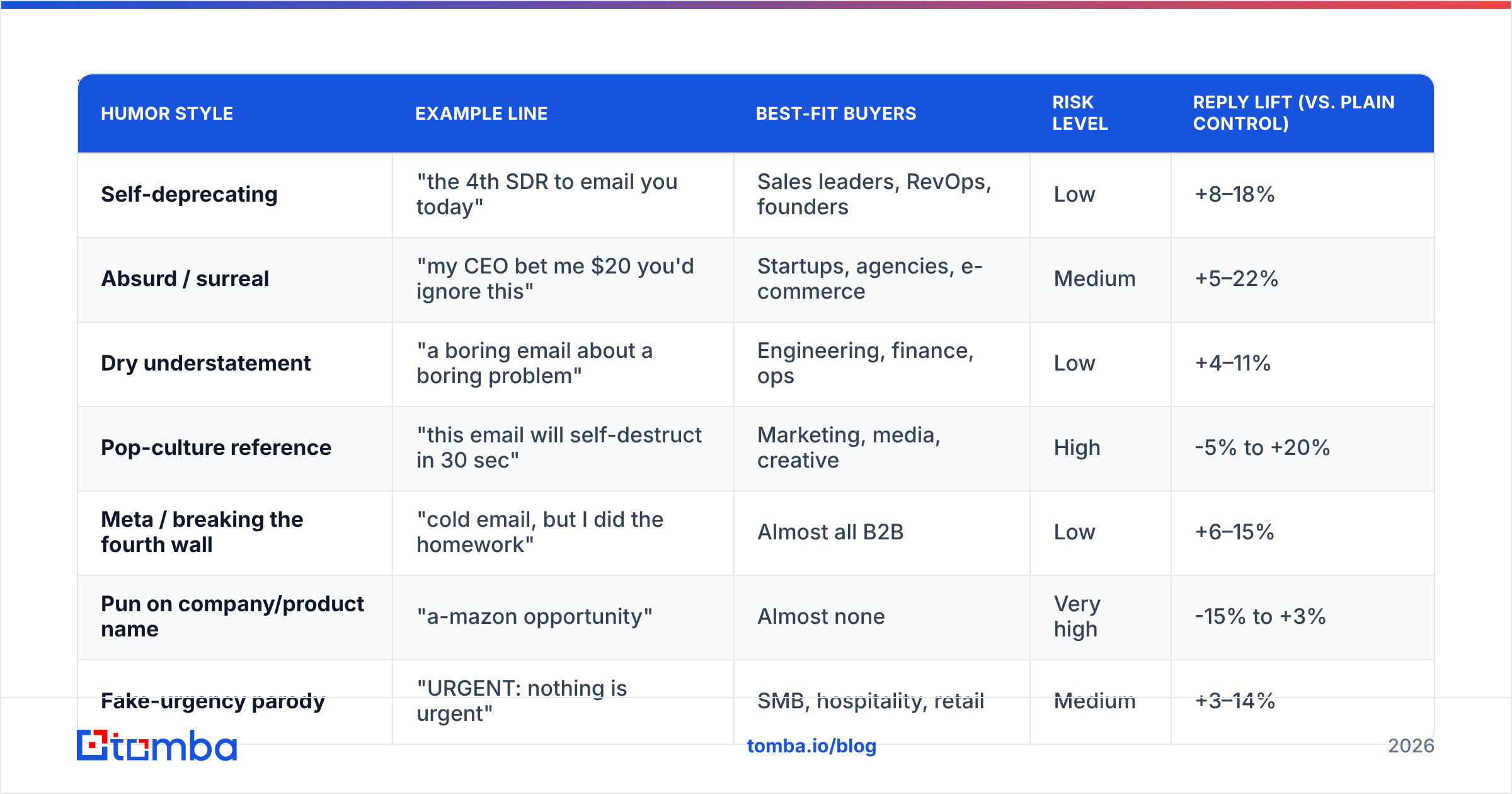
Not all humor is the same instrument. Self-deprecation, absurdity, understatement, and pop-culture reference carry different risk profiles. Here's how they map:
| Humor style | Example line | Best-fit buyers | Risk level | Reply lift (vs. plain control) |
|---|---|---|---|---|
| Self-deprecating | "the 4th SDR to email you today" | Sales leaders, RevOps, founders | Low | +8–18% |
| Absurd / surreal | "my CEO bet me $20 you'd ignore this" | Startups, agencies, e-commerce | Medium | +5–22% |
| Dry understatement | "a boring email about a boring problem" | Engineering, finance, ops | Low | +4–11% |
| Pop-culture reference | "this email will self-destruct in 30 sec" | Marketing, media, creative | High | -5% to +20% |
| Meta / breaking the fourth wall | "cold email, but I did the homework" | Almost all B2B | Low | +6–15% |
| Pun on company/product name | "a-mazon opportunity" | Almost none | Very high | -15% to +3% |
| Fake-urgency parody | "URGENT: nothing is urgent" | SMB, hospitality, retail | Medium | +3–14% |
Two takeaways. First, self-deprecating and meta humor are the safest bets — they signal awareness without requiring the prospect to share your taste. Second, name puns are almost always a mistake. The prospect has heard every pun on their company name since their first week. You are not the first.
Ranges above reflect commonly reported A/B results across outbound teams and vary enormously by list quality and offer. Treat them as directional, not as benchmarks to promise your VP.
What are the best funny cold email subject lines to steal?#
Adapt these — don't copy verbatim. The moment a line is used at scale it stops being a pattern interrupt. Substitute real details from the prospect's site, funding news, job postings, or product changelog.
Self-deprecating (safest, works nearly everywhere)
- "the 4th SDR to email you today"
- "professionally ignoring my own advice"
- "I'll keep this shorter than my last one"
- "you can say no, I have hobbies"
- "worst-case scenario: you delete this"
- "I checked — you did not ask for this"
- "cold email #2, slightly less cold"
- "written by a human, sadly"
Meta / fourth-wall (high safety, high specificity)
- "cold email, but I did the homework"
- "read your Q3 post, have one question"
- "this is a pitch. Here's the 10-sec version"
- "skip to the last line if you're busy"
- "no calendar link, promise"
- "I'll make this worth 20 seconds"
Dry understatement (good for technical and finance buyers)
- "a boring email about churn"
- "moderately relevant to your Q4"
- "small idea, low stakes"
- "probably a 3/10 priority for you"
- "unremarkable email, decent idea"
Absurd (startups, agencies, e-comm — use with care)
- "my CEO bet me $20 you'd ignore this"
- "I have a spreadsheet about you"
- "bribing you with data, not lunch"
- "hostage situation: your bounce rate"
- "three tabs and a theory about [Company]"
- "I made a chart. It's not great."
Follow-up lines (where humor performs best)
- "sending this into the void, part 3"
- "am I emailing a real person?"
- "closing the loop, opening a window"
- "last one, then I stop forever"
- "breaking up with your inbox"
- "should I keep going or take the hint?"
- "your inbox is winning"
Seasonal and event-based
- "post-conference email you expected"
- "before everyone's OOO ruins Q4"
- "a January email in a January inbox"
- "back from [Conference], one question"
Observation-based (highest reply rate, most work)
- "your careers page says 4 SDRs. Condolences."
- "noticed your pricing page changed"
- "you shipped [Feature]. One thought."
- "saw the Series B. Now the hard part."
- "your changelog is better than your homepage"
That last group takes the longest to write and outperforms everything else, because the humor is a delivery vehicle for research. To write them at volume you need to know who you're emailing — role, company, recent activity — which is a data problem before it's a copy problem. Pull the contact and firmographics first with data enrichment, then write the line.
How do you test humor without torching your domain?#
Treat funny lines as a controlled variant, not a strategy shift. The structure that works:
- Always keep a plain control. One clear, boring, benefit-first subject line runs in every sequence as the baseline. If your funny variant can't beat it on replies — not opens, replies — kill the variant.
- Split at the sequence level, not the email level. Testing a funny subject on email #1 and a plain one on email #2 tells you nothing, because the emails aren't comparable. Split your list 50/50 and run two complete sequences.
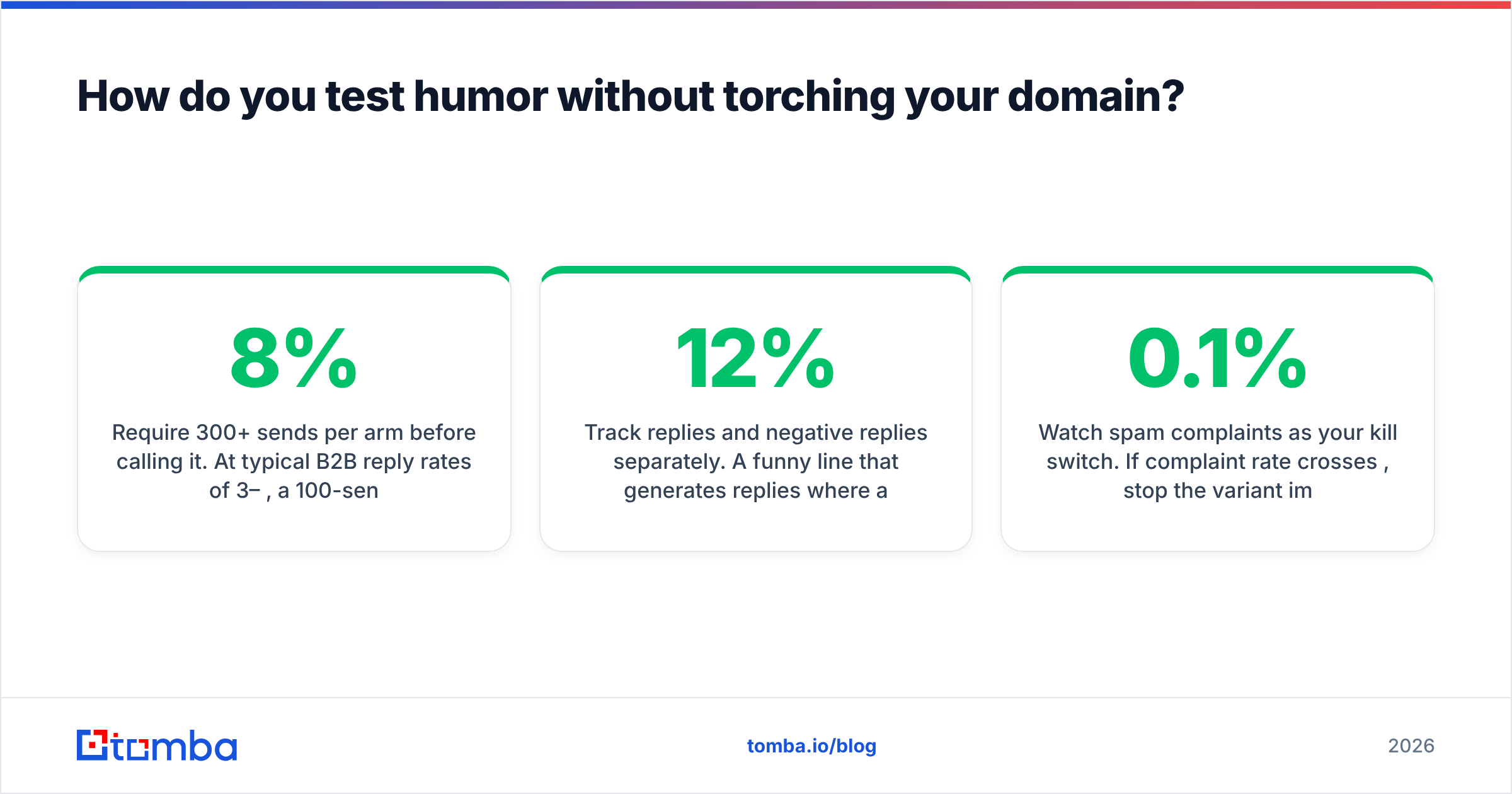
- Require 300+ sends per arm before calling it. At typical B2B reply rates of 3–8%, a 100-send test produces 3–8 replies, and the difference between 4 and 6 replies is noise, not signal.
- Track replies and negative replies separately. A funny line that generates 12% replies where a third say "unsubscribe, this is unprofessional" is worse than an 8% line with zero blowback.
- Watch spam complaints as your kill switch. If complaint rate crosses 0.1%, stop the variant immediately regardless of reply rate. Google and Yahoo bulk-sender rules from 2024 onward treat that threshold as a hard line — Google's official sender guidelines spell out the requirements.
- Re-test quarterly. Jokes age. A line that beat control in February may be industry-standard by August.
One thing to check before any of this: your sending infrastructure. Humor that hits the spam folder isn't funny to anyone. Confirm your authentication with an SPF checker and run draft copy through a spam checker before launching. Exclamation-heavy, all-caps, or emoji-stuffed "funny" lines are exactly the pattern spam filters were built to catch.
When should you skip the jokes entirely?#
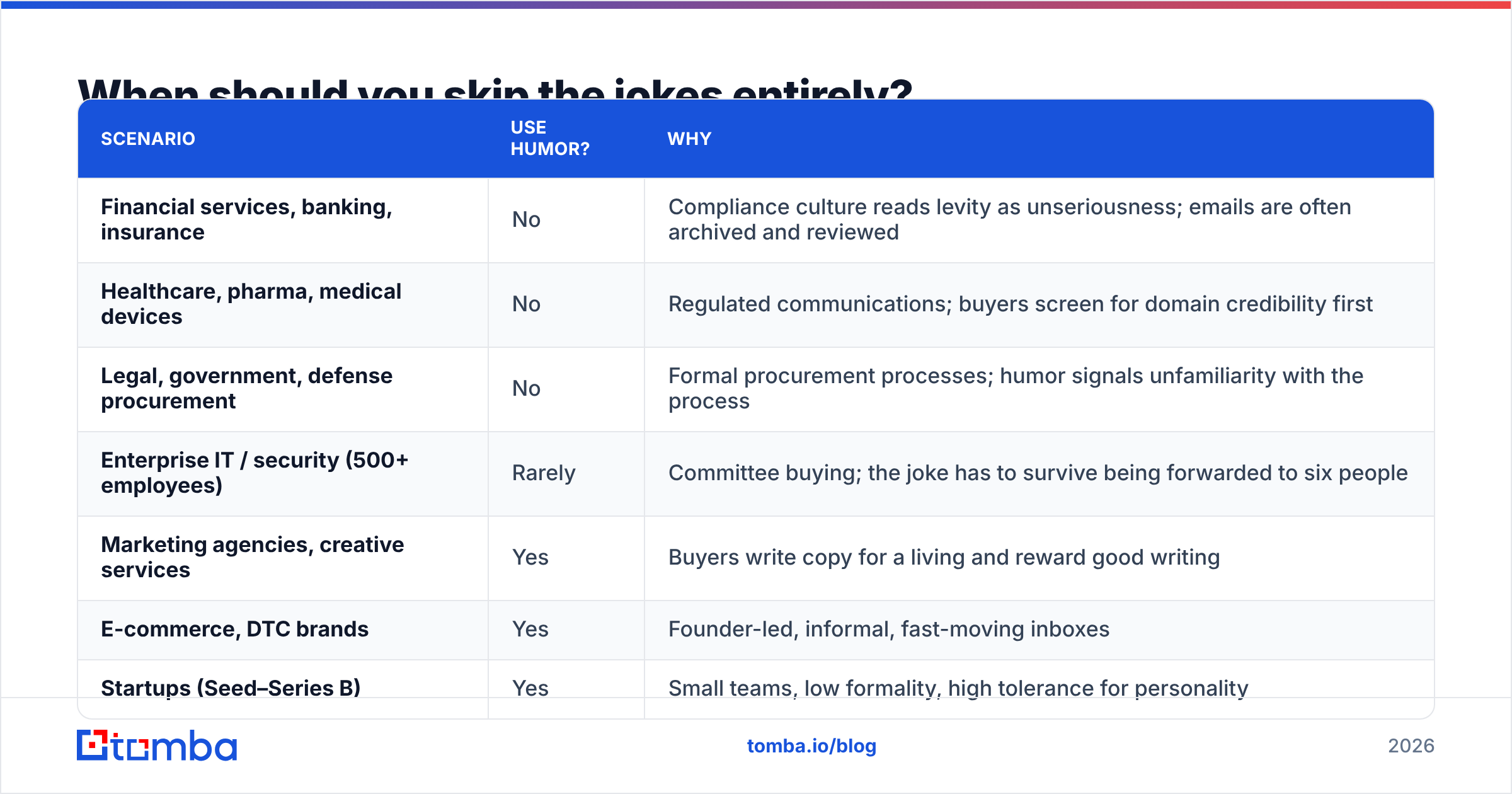
There are markets where humor in a first-touch subject line is a straightforward liability:
| Scenario | Use humor? | Why |
|---|---|---|
| Financial services, banking, insurance | No | Compliance culture reads levity as unseriousness; emails are often archived and reviewed |
| Healthcare, pharma, medical devices | No | Regulated communications; buyers screen for domain credibility first |
| Legal, government, defense procurement | No | Formal procurement processes; humor signals unfamiliarity with the process |
| Enterprise IT / security (500+ employees) | Rarely | Committee buying; the joke has to survive being forwarded to six people |
| Marketing agencies, creative services | Yes | Buyers write copy for a living and reward good writing |
| E-commerce, DTC brands | Yes | Founder-led, informal, fast-moving inboxes |
| Startups (Seed–Series B) | Yes | Small teams, low formality, high tolerance for personality |
| Hospitality, retail, restaurants | Yes | Operator buyers respond to plain-spoken, human copy |
| Manufacturing, logistics, industrial | Dry humor only | Understatement works; absurdity doesn't |
| Executive / C-suite at any company size | Rarely | Time-scarce; clarity outperforms cleverness |
The pattern: the more people involved in the buying decision, the worse humor performs. A joke is a one-to-one instrument. The moment your email gets forwarded to a procurement lead who wasn't in on the setup, the joke reads as unprofessional. If you're selling into a committee, be clear and be brief instead.
For a broader look at what works structurally in the body copy after the open, our cold email templates library covers the frameworks that pair well with each subject-line style. And if you want a starting draft to react against, the subject line generator will produce variants you can then make specific.
What does a complete funny cold email look like?#
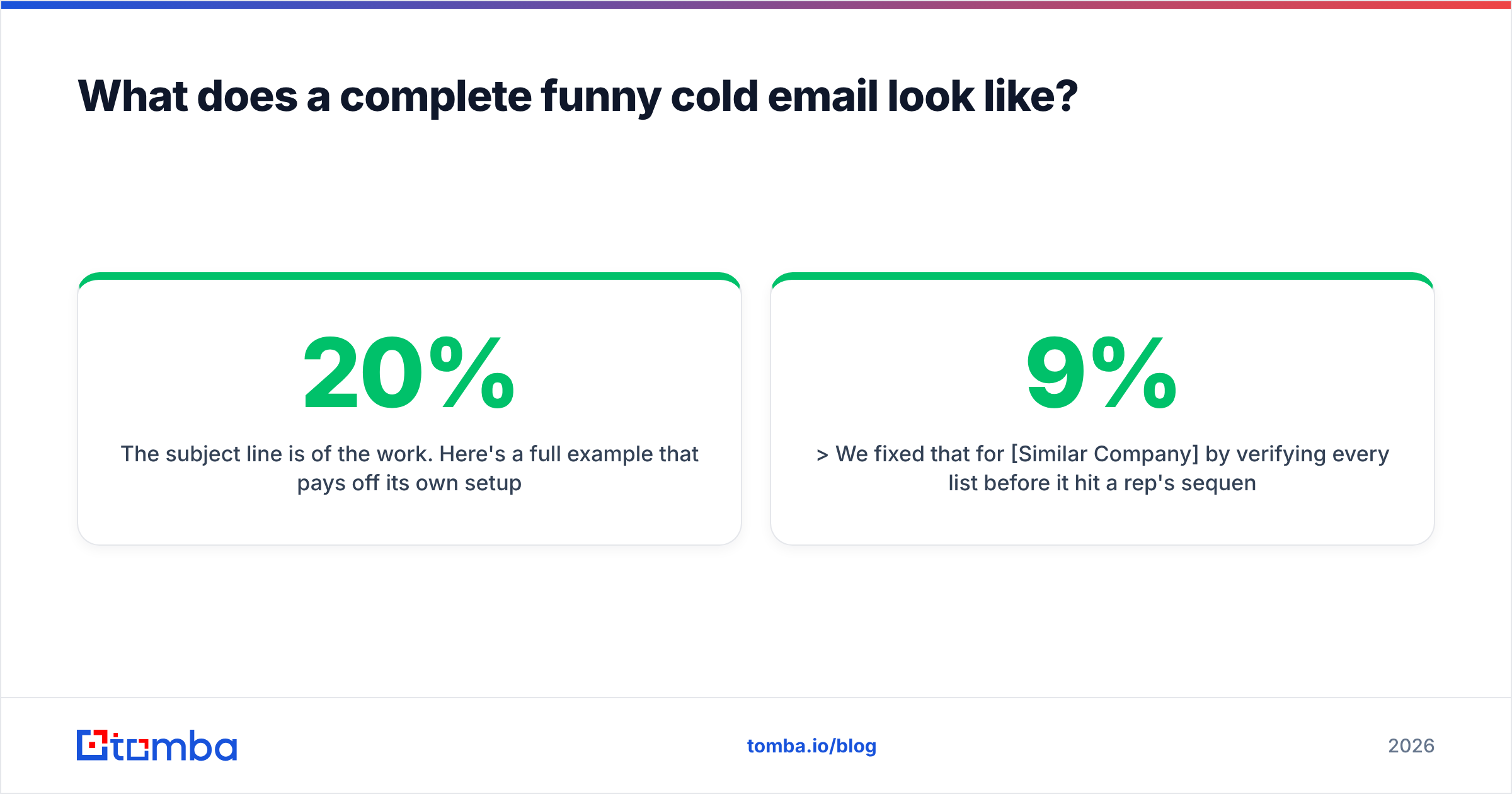
The subject line is 20% of the work. Here's a full example that pays off its own setup:
Subject: your careers page says 4 SDRs. Condolences.
Hi Maya —
Saw the four SDR openings. Congrats on the growth, and sorry about the onboarding.
Most teams hiring that fast hit the same wall around month two: the new reps burn through the clean list the senior reps already worked, and their bounce rate doubles. Pipeline looks fine on the dashboard until it doesn't.
We fixed that for [Similar Company] by verifying every list before it hit a rep's sequence — bounces went from 9% to under 2% in three weeks.
Worth 15 minutes, or should I check back after the new folks ramp?
— Sam
Notice what happens structurally. The joke lands in line one, gets acknowledged immediately, and then the email becomes serious and specific. The humor bought attention; the substance earned the reply. That's the correct ratio — roughly one joke, then get to work.
The inverse — funny subject, funny opener, funny middle, funny sign-off — reads as a performance, and prospects rarely reply to performances. According to HubSpot's research on sales email benchmarks, personalization and relevance consistently outweigh stylistic flourishes in driving replies. Humor is a delivery mechanism for relevance, not a substitute for it.
What should you fix before writing a single joke?#
In order of impact, the things that matter more than your subject line:
- List accuracy. A 4% bounce rate does more damage to your sending domain than any subject line does good. Verify before you send, every time.
- Targeting. The funniest possible line sent to a job title that can't buy your product produces zero pipeline.
- Authentication. SPF, DKIM, and DMARC correctly configured. Without them, your clever line never gets rendered.
- Offer clarity. If a prospect can't tell what you're selling after 15 seconds, humor just delayed their confusion.
- Follow-up cadence. Most replies come from emails 2–4. A great subject line on email #1 with no follow-up is wasted work.
- Then, and only then, humor.
Teams that get this order wrong spend weeks workshopping puns while their bounce rate quietly wrecks their domain. Teams that get it right find that plain, specific subject lines already perform well — and humor becomes a 10–20% optimization on top of a working system rather than a rescue attempt for a broken one.
Where do you get the data to write specific jokes?#
The best funny subject lines are research outputs. "Your careers page says 4 SDRs" requires you to know the company, find the page, and reach the right person with a valid address. That's three data steps before any writing happens.
Start by building the list with verified contacts rather than guessed patterns. Tomba's Email Finder returns professional addresses by name and domain with a confidence score attached, so you know which contacts are safe to send to and which need a second check. Plans start with a free tier at 25 searches per month, then $49/mo for Starter, $99/mo for Growth, and $249/mo for Pro — full Tomba pricing is on the site. Find the person, verify the address, then spend your creative energy on the line that only works for them. That order is the whole trick.
Related guides#
Ready to find emails that actually work?
Join 150,000+ professionals who stopped guessing and started sending. Free credits on signup — no credit card required.
Get the Tomba newsletter
Practical outbound tactics and product updates — once every two weeks.
About the author