Funny Email Openers That Actually Get Replies in 2026
Humor in cold email is high-risk, high-reward. Here are the funny email openers that lift reply rates, the ones that tank them, and how to tell which is which before you hit send.
TL;DR
- Funny email openers work when the joke is about the prospect's world, not about you being funny. Self-referential humor ("I'll keep this shorter than my attention span") is the most common failure mode.
- Humor lifts reply rate most in flat, saturated categories — SaaS tooling, agencies, recruiting — and least in regulated, high-ACV, or crisis-adjacent sales (finance, healthcare compliance, security incidents).
- The safest structures are: observational specificity, self-deprecation about your own outreach, absurd-but-tiny hyperbole, and the pattern-break one-liner. The riskiest: sarcasm, fake familiarity, and anything referencing a person's appearance or company misfortune.
- Humor amplifies whatever your list quality already is. A witty email to a bounced or wrong-persona address is just a faster way to burn a domain.
- Test humor as a variable, not a religion. Run it as an A/B against a straight opener on 200+ sends per arm before you decide.
Why do funny email openers work at all?#
Because the inbox is a pattern-matching machine, and your prospect has already learned the pattern.
Think of it like a highway billboard. After the fortieth billboard advertising the same insurance company, your eyes stop registering them — not because you dislike insurance, but because your brain has classified the shape as "skip." Cold emails have a shape too: "Hi {{FirstName}}, I noticed you're the VP of Ops at {{Company}}. I'm reaching out because..." Your prospect's brain filed that shape under skip somewhere around 2019.
Humor breaks the shape. It forces a half-second of conscious processing because the sentence didn't resolve the way the pattern predicted. That half-second is the entire game — it's the difference between the archive key and the second line.
There's a second mechanism that's less discussed: humor signals effort. A generic email costs nothing to send to ten thousand people. A joke that only lands for this prospect's specific situation implies a human read something. Even if the recipient never articulates it, the inference is "someone spent time on me," and reciprocity does the rest.
The catch is that both mechanisms are fragile. Pattern-breaks stop breaking patterns once everyone uses them — the "I'll be honest, this is a cold email" opener was fresh in 2021 and is now its own recognizable shape. And the effort signal collapses instantly if the joke could have been mail-merged to anyone.
What separates a funny opener from a cringe one?#
Four variables, in rough order of how often they get botched.
- Target of the joke. The joke should point at a shared frustration, an industry absurdity, or yourself. It should never point at the prospect, their company, their headcount, their funding round, or their appearance. "Your website looks like it was built in 2009" is not an opener, it's a reason to be blocked.
- Specificity. "Ops leaders are drowning in tabs" is a greeting-card observation. "You're probably reading this between the 9:15 standup and the 9:30 standup" is a joke that implies you know what a RevOps calendar looks like. Specificity is what converts a joke from filler into evidence of research.
- Brevity. A funny opener is one or two sentences. Anything longer stops being a hook and becomes a bit, and bits require an audience that has already agreed to listen. Cold prospects have not agreed to anything.
- Landing. The joke has to hand off cleanly to the actual reason you emailed. If the transition is "anyway, jokes aside," the joke was decorative. The best funny openers make the point through the humor, so removing the joke would remove information.
There's a fifth variable nobody controls for: whether the email arrives at all. A perfectly calibrated joke sent to a stale address contributes nothing except a bounce that nudges your sender reputation downward. Run your list through an email verifier before you spend an afternoon on wordplay.
Which funny email openers actually get replies?#
Here are seven structures that hold up, with the mechanic behind each. Adapt the wording — copying these verbatim guarantees they'll be burnt out within a quarter.
1. The self-aware cold email
"This is a cold email. You know it, I know it. The difference is I did the reading first — you shipped the API v3 changelog last Tuesday and quietly dropped webhook retries."
Works because the confession buys you two seconds of goodwill, and the specific detail immediately cashes it in. Fails when the confession isn't followed by proof of research; then it's just a cold email with extra steps.
2. The oddly specific observation
"Congrats on the Series B. I assume you're now in the phase where three people have opinions about the CRM and none of them agree."
Works because it describes an experience the prospect is actually having. It's funny in the way a good weather complaint is funny — recognition, not punchline.
3. The tiny absurdity
"I've written this email four times. The first three versions mentioned 'synergy.' Those versions are dead now."
Works because the hyperbole is small and self-directed. Nobody is insulted, and it establishes that you know what bad outreach looks like.
4. The false-precision stat
"Roughly 94% of the emails in your inbox this morning opened with 'Hope you're doing well.' I ran the numbers. By which I mean I did not."
Works because it parodies the sales habit of citing suspicious statistics, then immediately admits it. Risky with literal-minded technical buyers who will fact-check you.
5. The one-line pattern break
"Bad news: this is a sales email. Good news: it's 60 words."
Works because it trades on the scarcest thing you can offer — brevity — and then delivers on it. Only works if you actually deliver on it.
6. The shared-enemy joke
"Somewhere out there, a spreadsheet named final_leads_v7_ACTUAL.csv is ruining someone's Thursday. I'd like to talk about that spreadsheet."
Works because the enemy is a process, not a person. Every ops team has this file.
7. The unexpected sign-off setup
"I'll make you a deal: read two more sentences, and if you're not interested, reply with a single emoji and I'll never contact you again. I'll honor it. I've built the automation."
Works because it lowers the cost of responding to nearly zero and is mildly funny about the mechanics of sales tooling. Only use it if the promise is real.
Notice that none of these are jokes in the stand-up sense. They're tonal signals — they say "a person wrote this and that person is not going to waste your time." That's the actual payload.
When should you not be funny?#
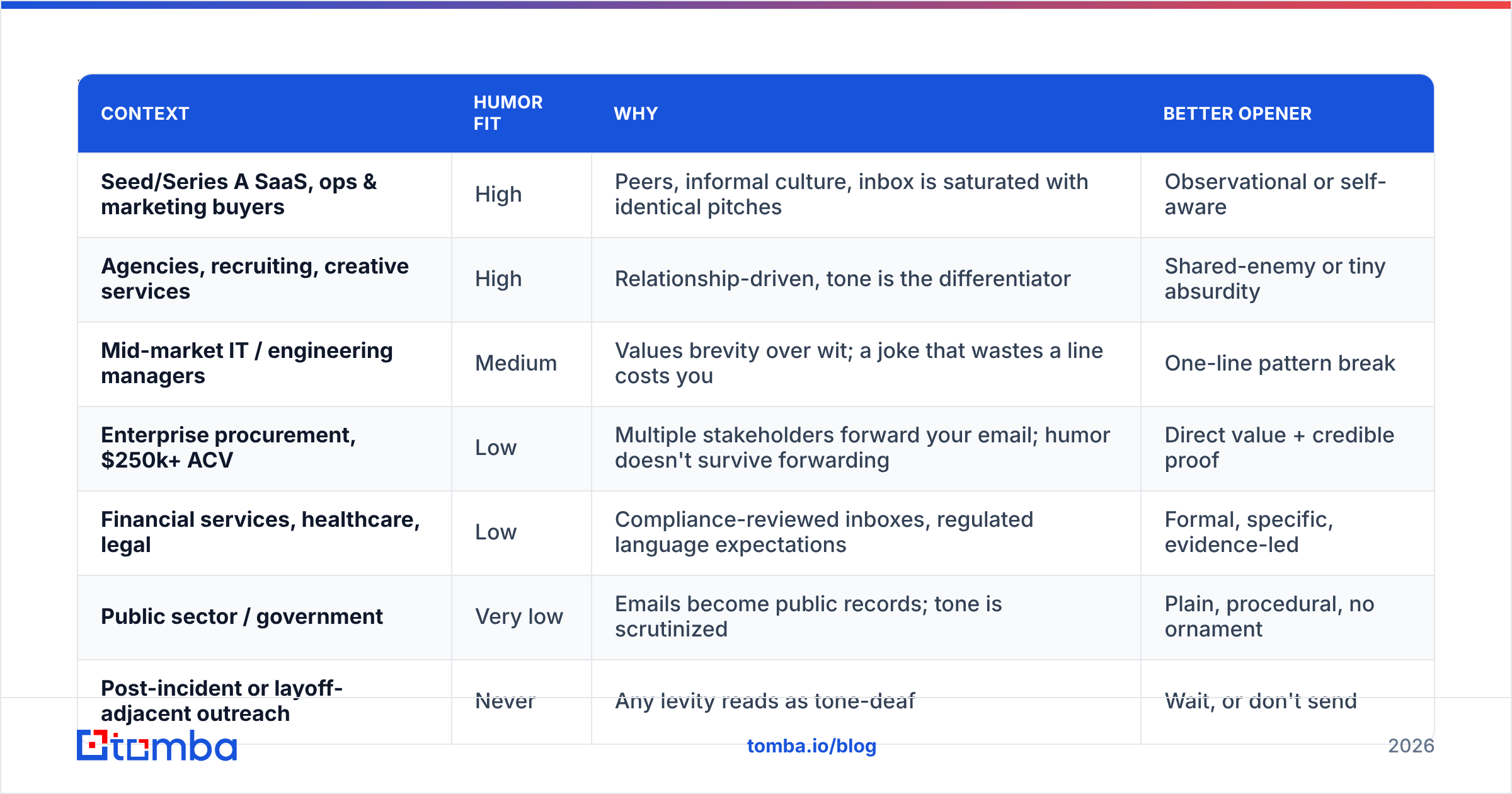
Humor has a context tax, and some contexts charge more than others. Use this to decide before you write.
| Context | Humor fit | Why | Better opener |
|---|---|---|---|
| Seed/Series A SaaS, ops & marketing buyers | High | Peers, informal culture, inbox is saturated with identical pitches | Observational or self-aware |
| Agencies, recruiting, creative services | High | Relationship-driven, tone is the differentiator | Shared-enemy or tiny absurdity |
| Mid-market IT / engineering managers | Medium | Values brevity over wit; a joke that wastes a line costs you | One-line pattern break |
| Enterprise procurement, $250k+ ACV | Low | Multiple stakeholders forward your email; humor doesn't survive forwarding | Direct value + credible proof |
| Financial services, healthcare, legal | Low | Compliance-reviewed inboxes, regulated language expectations | Formal, specific, evidence-led |
| Public sector / government | Very low | Emails become public records; tone is scrutinized | Plain, procedural, no ornament |
| Post-incident or layoff-adjacent outreach | Never | Any levity reads as tone-deaf | Wait, or don't send |
| Re-engaging a stalled deal you already lost | Medium-low | Humor can look like avoidance of the real conversation | Direct acknowledgment |
The forwarding test is the one most people skip. Ask yourself: if this email gets pasted into a Slack channel with four executives in it, does the joke still read as competent? If the answer is "depends who reads it," rewrite it.
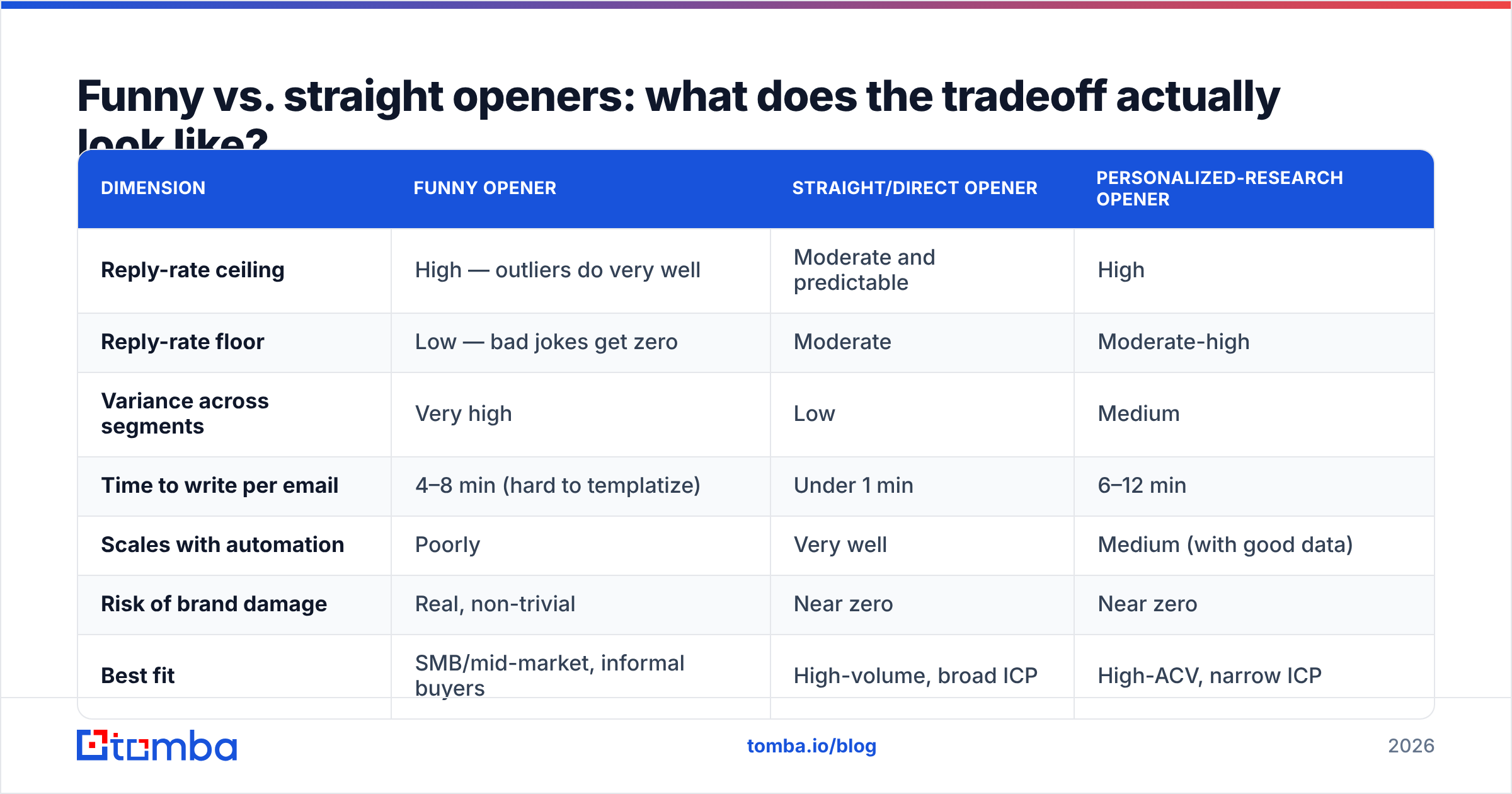
Funny vs. straight openers: what does the tradeoff actually look like?#
Nobody has clean universal numbers here, and anyone who quotes you a precise "humor lifts replies 47%" figure is selling something. What the aggregate of published outbound benchmarks and practitioner reports supports is directional: humor tends to widen the distribution. You get more replies at the top and more hard rejections at the bottom, with fewer polite non-answers in the middle.
| Dimension | Funny opener | Straight/direct opener | Personalized-research opener |
|---|---|---|---|
| Reply-rate ceiling | High — outliers do very well | Moderate and predictable | High |
| Reply-rate floor | Low — bad jokes get zero | Moderate | Moderate-high |
| Variance across segments | Very high | Low | Medium |
| Time to write per email | 4–8 min (hard to templatize) | Under 1 min | 6–12 min |
| Scales with automation | Poorly | Very well | Medium (with good data) |
| Risk of brand damage | Real, non-trivial | Near zero | Near zero |
| Best fit | SMB/mid-market, informal buyers | High-volume, broad ICP | High-ACV, narrow ICP |
| Works on second/third touch | Yes — often better than first | Yes | Yes |
| Survives being forwarded | Sometimes | Always | Always |
The row that decides most programs is "scales with automation." Humor is expensive per unit. If you're sending 3,000 emails a month across five personas, you cannot hand-write 3,000 jokes, and templated humor decays into the exact generic shape you were trying to escape.
The workable compromise: use a straight, tight structure as your default, and reserve funny openers for the top 10–15% of your list — the accounts where a reply is worth twenty minutes of your time. Pull those accounts precisely with domain search so you're writing for real named humans rather than role addresses, and check your response rate by arm rather than in aggregate.
How do you test humor without torching your domain?#
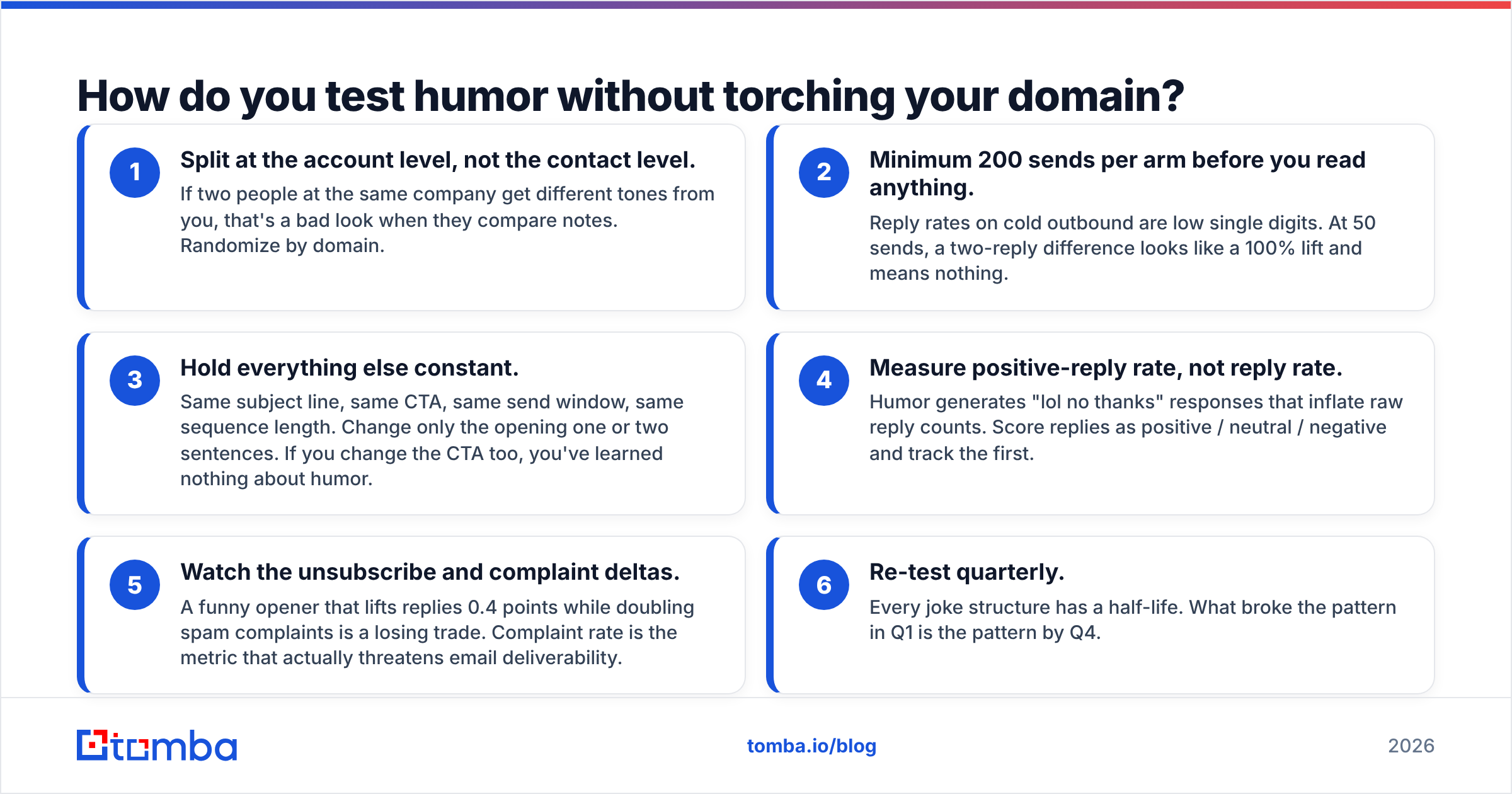
Treat it as a controlled experiment, not a vibe shift.
- Split at the account level, not the contact level. If two people at the same company get different tones from you, that's a bad look when they compare notes. Randomize by domain.
- Minimum 200 sends per arm before you read anything. Reply rates on cold outbound are low single digits. At 50 sends, a two-reply difference looks like a 100% lift and means nothing.
- Hold everything else constant. Same subject line, same CTA, same send window, same sequence length. Change only the opening one or two sentences. If you change the CTA too, you've learned nothing about humor.
- Measure positive-reply rate, not reply rate. Humor generates "lol no thanks" responses that inflate raw reply counts. Score replies as positive / neutral / negative and track the first.
- Watch the unsubscribe and complaint deltas. A funny opener that lifts replies 0.4 points while doubling spam complaints is a losing trade. Complaint rate is the metric that actually threatens email deliverability.
- Re-test quarterly. Every joke structure has a half-life. What broke the pattern in Q1 is the pattern by Q4.
One infrastructure note that has nothing to do with comedy and everything to do with whether your experiment is valid: if your bounce rate is above ~3%, your test results are noise. Bounces suppress delivery for the whole sending domain, which means half your "no reply" outcomes might be "no delivery" outcomes. Clean the list first. Google's Postmaster Tools and your ESP's own reputation dashboard will tell you whether you're measuring copy or measuring infrastructure.
[Screenshot placeholder: Google Postmaster Tools domain reputation graph showing spam-complaint rate over a 30-day window]
[Screenshot placeholder: A/B test results view in an outbound sequencer, comparing positive-reply rate for a humor arm vs. a control arm]
What are the funny openers to retire immediately?#
These were all good once. That's the problem.
- "Did you fall into a well?" / "Are you still alive?" — The most overused breakup-email joke in B2B. It also implies the prospect owes you a response, which they don't.
- "I'm going to assume you're either really busy or you've been eaten by a bear." — Same family, same fate.
- Fake reply threads. Subject lines like "RE: our conversation" when there was no conversation. This isn't humor, it's deception, and it's a fast route to a spam complaint.
- "Hey [First Name], quick question 😅" — The emoji doesn't make it a joke, and the "quick question" is never quick.
- Weather and local-sports references pulled from a data field. "How about those {{FavoriteTeam}}?" reads as automated the instant it's read, because it is.
- Anything about the recipient's photo, name pronunciation, or LinkedIn headline being unusual. Personal, unwelcome, and occasionally a compliance issue.
- "I promise I'm not a robot." Written by a robot roughly 40% of the time now.
- Long GIF-heavy emails. Beyond the taste question, image-heavy HTML degrades deliverability and gets clipped in Gmail.
If you want a test for whether a structure has expired: search the exact phrasing on LinkedIn. If there are three posts from sales influencers celebrating it, it's already saturated in your prospects' inboxes.
How do you write a funny opener in five minutes?#
A repeatable process beats waiting for inspiration.
- Read one real artifact. Their changelog, a job posting, a conference talk, a support-doc update. Not their homepage — everyone reads the homepage. Two minutes.
- Name the friction it implies. A job posting for two more implementation engineers implies onboarding is a bottleneck. A pricing-page change implies a packaging debate happened. One minute.
- Say the friction out loud in the most human phrasing you can. Not "scaling onboarding challenges" — "you're hiring two more people to do the thing that shouldn't need two more people." One minute.
- Cut it to under 20 words and check the forward test. If an executive pasted this in Slack, does it read as sharp or as smug? One minute.
- Attach the ask immediately. One sentence, one specific request, no calendar-link dumping.
The step people skip is the first one, and it's the only one that matters. Humor without a real observation underneath is just noise with a comedic rhythm. If you can't find the artifact, send the straight version — a boring email that's accurate beats a funny email that's generic.
For volume plays, contact enrichment can pre-populate the role, seniority, and tech-stack signals that tell you which friction to joke about, which cuts step one down considerably. And if you're writing for a persona you don't know well, a pass through the subject line generator is a cheap way to see what tonal registers are even available before you commit.
Does humor belong in the subject line too?#
Usually not in the same email.
A funny subject line plus a funny opener reads as a bit, and bits trigger the "this is marketing" classifier in a prospect's head. Pick one lane. The stronger combination is a plain, specific subject line — "webhook retries" or "your v3 changelog" — followed by a human opener. The subject earns the open on relevance; the opener earns the read on tone.
If you do go funny in the subject, keep it under 40 characters, avoid punctuation stacking, and never use a question mark plus an exclamation point together. Spam filters aren't as naive as they used to be about single tokens, but engagement patterns still matter: a clever subject that gets opened and instantly deleted trains the filter against you over time. Guidance from HubSpot's email research and vendor deliverability documentation consistently points the same direction — engagement quality outranks cleverness.
What does a complete funny cold email look like?#
Here's a full example with the structure annotated.
Subject: onboarding engineer #3
Saw the posting for your third implementation engineer this quarter. At some point "we'll hire our way out of it" becomes a business model. (observation + tiny absurdity, 18 words)
We work with three teams in your category who hit the same wall around 40 accounts. The fix wasn't headcount, it was cutting the data-cleanup step out of onboarding entirely — the part where someone manually chases missing contact records. (the actual point, delivered through the same frame)
Worth 15 minutes to see whether your bottleneck is the same one? If not, I'll go away and you'll never hear from me again. (low-cost CTA, mild closing humor)
Ninety-one words. One joke, one proof point, one ask. The humor isn't a decoration bolted onto a pitch — it's the vehicle for the diagnosis. That's the standard to hit.
Note also what's missing: no "hope this finds you well," no company boilerplate, no calendar link, no three-paragraph case study. Funny openers fail most often not because the joke was bad but because the writer used up the goodwill and then buried the point under 200 words of positioning.
Where do you go from here?#
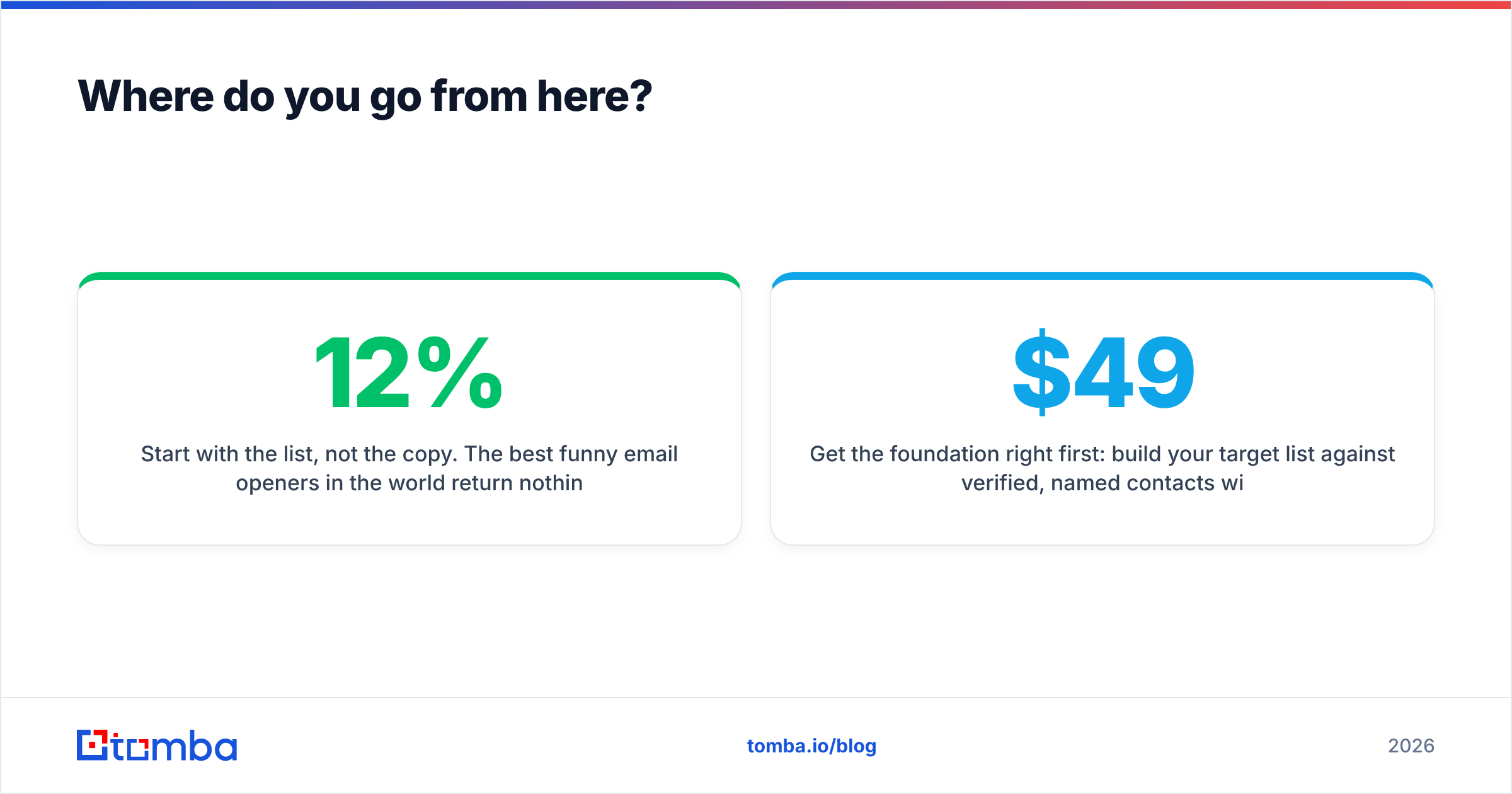
Start with the list, not the copy. The best funny email openers in the world return nothing if 12% of your addresses bounce, your target contact left the company in March, or you're writing to info@ instead of a named operations lead. Humor is a multiplier on data quality — and a multiplier on zero is still zero.
Get the foundation right first: build your target list against verified, named contacts with the Tomba Email Finder, which returns confidence-scored addresses by domain, name, or company so you know who you're actually writing to. The free tier gives you 25 searches a month to test the workflow, and paid plans start at $49/mo on Starter — see Tomba pricing for the full breakdown across Growth ($99/mo) and Pro ($249/mo). Once the list is clean, spend your creative energy where it compounds: on the ten accounts worth being funny for.
Related guides#
Ready to find emails that actually work?
Join 150,000+ professionals who stopped guessing and started sending. Free credits on signup — no credit card required.
Get the Tomba newsletter
Practical outbound tactics and product updates — once every two weeks.
About the author