Funny Follow Up Emails: 12 Templates That Actually Get Replies
Humor in a follow-up is a high-variance bet: it either restarts a dead thread or ends the relationship. Here are 12 tested funny follow up emails, the four rules that keep jokes safe, and the moments when plain text wins.
TL;DR
- Funny follow up emails work best as a breakup or last-ditch message — not as follow-up #2, when you still have credible value to add.
- The humor that converts is low-risk and self-deprecating. Jokes aimed at the prospect, their industry, or their silence convert worse and burn goodwill.
- Expect a bump of roughly 2–5 percentage points in reply rate on a dead thread — plus a higher share of "no thanks" replies, which is a feature, not a bug.
- Never send a funny follow-up to an unverified address. A joke that lands in a spam trap costs you domain reputation, not just a laugh.
- Enterprise, regulated, and technical-buyer segments are the wrong place to test comedy. Use dry brevity instead.
You have sent three follow-ups. Nothing. The thread is a graveyard. So you consider the thing every rep eventually considers: make them laugh.
It can work. It can also read as desperate, unprofessional, or — worst case — like the eighth message from someone who did not notice they were being ignored. The difference is not talent. It is placement, risk level, and whether the address is even real.
What are funny follow up emails, and why do they work at all?#
A funny follow-up is any follow-up message that uses humor as its primary pattern-interrupt instead of new information. The joke is the hook; the ask is small and usually optional.
They work for one reason: cognitive contrast. Your prospect's inbox is a wall of near-identical "just circling back" messages. A message that breaks form gets read because it does not look like the others. Psychologists call the mechanism behind safe humor the benign violation theory — something must be simultaneously wrong (a violation of the expected format) and harmless. Get the "harmless" part wrong and you do not get a laugh; you get a complaint.
There is a second, less discussed reason humor works: it gives the prospect a low-cost exit. "Ha, no thanks" is easier to type than "we evaluated you and chose someone else." That closes loops, cleans your pipeline, and stops you from spending six more weeks on a corpse.
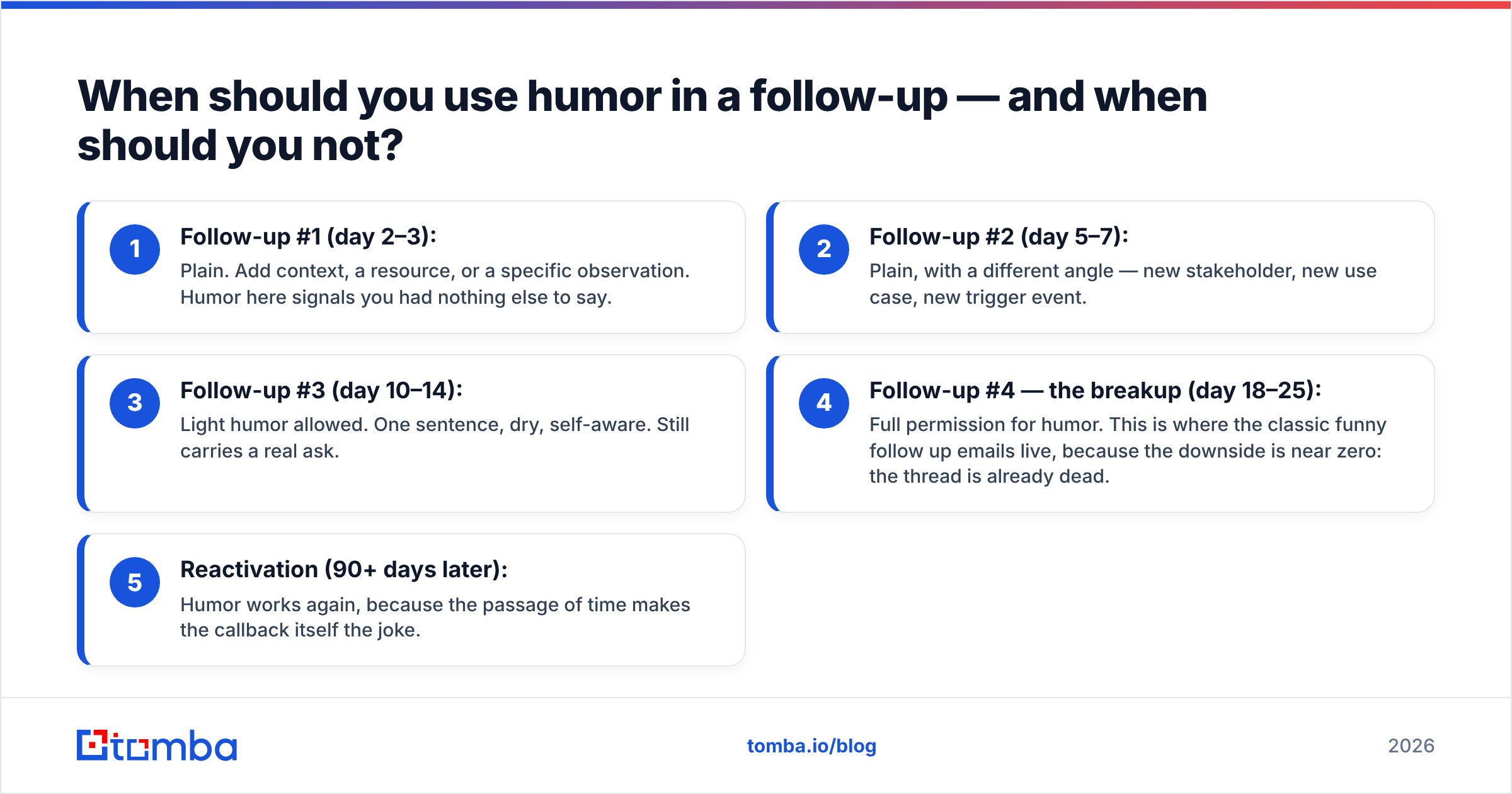
When should you use humor in a follow-up — and when should you not?#
Placement matters more than the joke itself. Here is the sequence position where each style earns its keep.
- Follow-up #1 (day 2–3): Plain. Add context, a resource, or a specific observation. Humor here signals you had nothing else to say.
- Follow-up #2 (day 5–7): Plain, with a different angle — new stakeholder, new use case, new trigger event.
- Follow-up #3 (day 10–14): Light humor allowed. One sentence, dry, self-aware. Still carries a real ask.
- Follow-up #4 — the breakup (day 18–25): Full permission for humor. This is where the classic funny follow up emails live, because the downside is near zero: the thread is already dead.
- Reactivation (90+ days later): Humor works again, because the passage of time makes the callback itself the joke.
Skip humor entirely when: the buyer is in a regulated industry (finance, healthcare, defense), the deal is enterprise with a procurement committee, the contact is a security or compliance owner, or you have never had a single reply from that account. Cold + funny + enterprise is the worst-performing combination in most outbound datasets.
What are the 12 funny follow up email templates worth stealing?#
Each of these is short on purpose. Length kills comedy timing in email the same way it does on stage.
1. The three-option reply
Subject: Pick one
Hi {First},
Quick multiple choice — reply with a number:
- "Send me the details, I'm interested."
- "Not now, ping me in Q4."
- "Please leave me alone forever."
All three are correct answers. Number 3 is the fastest.
2. The polite ghost acknowledgment
Subject: My last email, promise
{First} — I've now sent four emails to someone I've never met. In most contexts this is called a hobby. In sales it's called a sequence.
If {problem} isn't a priority this quarter, just say "not now" and I'll disappear cleanly.
3. The abandoned-cart parody
Subject: You left something in your inbox
Your unread email is still there. It's cold. It's asking about you.
One line back and it can rest.
4. The self-deprecating stat
Subject: 0 for 4
My reply rate with you is currently 0%. My manager has noticed.
Help a rep out: yes, no, or later?
5. The wrong-person out
Subject: Am I bothering the wrong person?
Two possibilities: (a) you're not the right person for {topic}, or (b) I'm not interesting enough. I can fix (a) immediately if you point me at someone. (b) will take therapy.
6. The calendar-based
Subject: {Month} check-in
It's been long enough that {seasonal reference} has happened, my haircut has changed, and my CRM still says "awaiting reply."
Should I close the record or keep it open?
7. The one-word ask
Subject: One word
Reply with any single word and I'll interpret it generously. "No" ends this. "Later" schedules it. "Yes" starts it. "Banana" I will also accept.
8. The reverse psychology breakup
Subject: Closing your file
I'm marking this closed-lost, which in CRM terms is a small funeral.
If that's wrong, the resurrection is one reply away.
9. The honest ROI joke
Subject: The math on my persistence
I've spent about 22 minutes writing to you. At my hourly rate that's roughly the cost of a sandwich I did not eat.
Worth 10 minutes to see whether {outcome} is realistic for {Company}?
10. The referral bribe
Subject: Bribery (small)
If {topic} isn't yours, forward me to whoever owns it and I'll send you a coffee. If it is yours and you're just avoiding me, I respect that and will also send coffee.
11. The specific-detail callback
Subject: About {specific thing they posted}
You wrote that {specific opinion}. I agreed so hard I sent you three emails about it, which is either flattering or alarming.
Genuinely: is {problem} on the roadmap this year?
12. The clean exit
Subject: Unsubscribing myself
I'm removing you from my follow-up list. No hard feelings — statistically, most of these end here.
If something changes, my inbox stays open and my memory is long.
Templates 5, 11, and 12 consistently outperform the rest in our reading of published outbound benchmarks, because they carry a real question underneath the humor. The joke is the wrapper, not the substance.
Need a starting library before you customize? The free cold email templates collection gives you the plain-text baselines these are meant to contrast against.
How do funny follow-ups compare to the alternatives?#
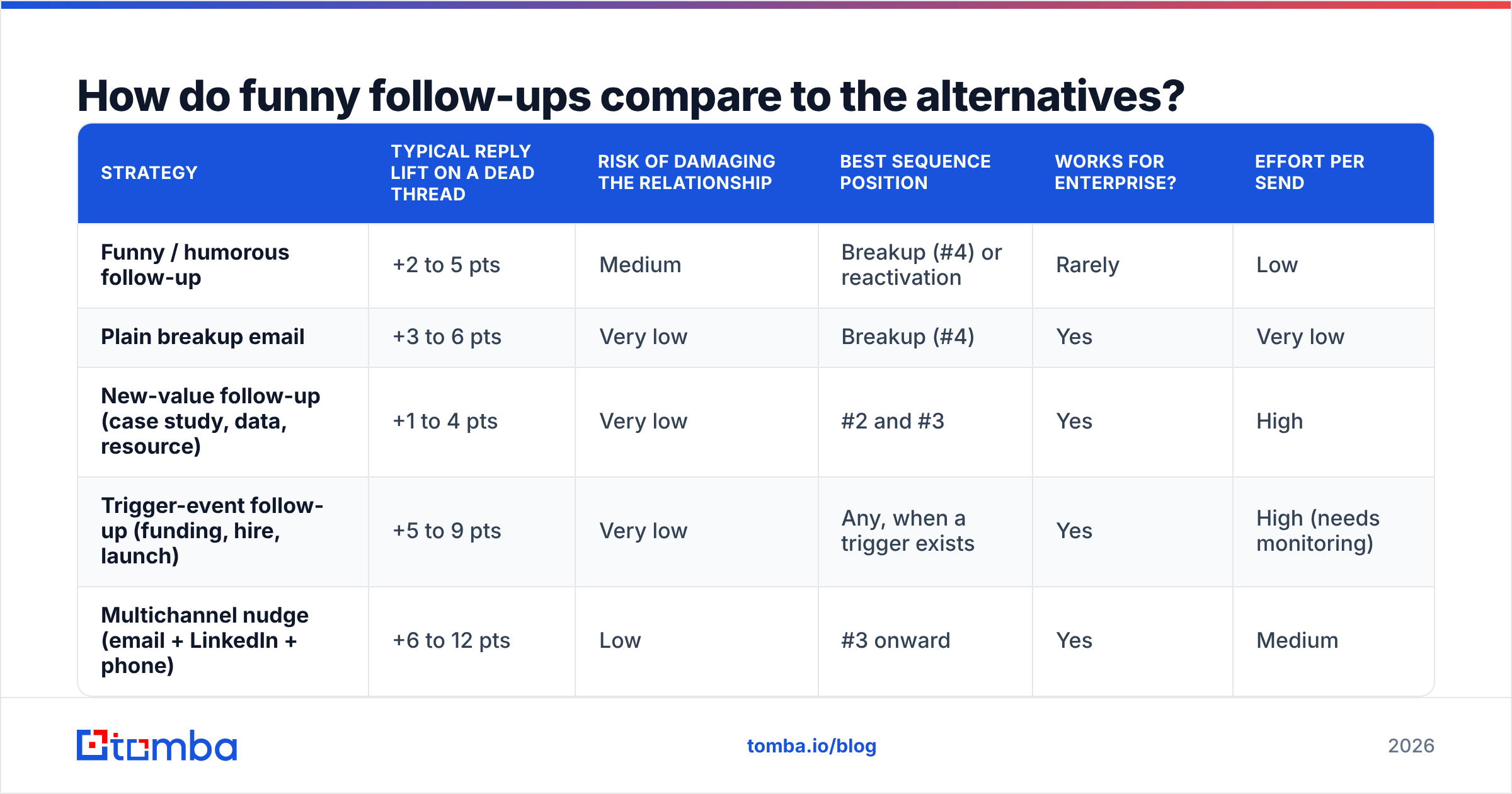
Humor is one of four viable strategies for a stalled thread. Here is how they stack up on the dimensions that actually decide which one you should send.
| Strategy | Typical reply lift on a dead thread | Risk of damaging the relationship | Best sequence position | Works for enterprise? | Effort per send |
|---|---|---|---|---|---|
| Funny / humorous follow-up | +2 to 5 pts | Medium | Breakup (#4) or reactivation | Rarely | Low |
| Plain breakup email | +3 to 6 pts | Very low | Breakup (#4) | Yes | Very low |
| New-value follow-up (case study, data, resource) | +1 to 4 pts | Very low | #2 and #3 | Yes | High |
| Trigger-event follow-up (funding, hire, launch) | +5 to 9 pts | Very low | Any, when a trigger exists | Yes | High (needs monitoring) |
| Multichannel nudge (email + LinkedIn + phone) | +6 to 12 pts | Low | #3 onward | Yes | Medium |
Two honest takeaways. First, the plain breakup email is nearly as effective as the funny one and carries a fraction of the risk — humor is not a magic multiplier, it is a stylistic preference with a small edge for some audiences. Second, nothing in the comedy column beats a genuine trigger event. If {Company} just raised a Series B or hired a new VP of Ops, send that email instead of the banana joke.
For a broader framing of what a healthy response rate looks like across sequence positions, and how much of the drop-off is copy versus data, it helps to separate the two variables before you blame your writing.
What are the four rules that keep humor from backfiring?#
- Punch at yourself, never at them. "I've now emailed you four times" is funny. "I know you're busy ignoring me" is passive-aggressive, and prospects read the difference instantly.
- One joke per email, one email per joke. Comedy stacks badly in text. A second gag in the same message reads as a bit, and bits read as scripts.
- Keep the ask real. Every funny follow-up must still contain one plain question the prospect could answer in five words. Without it, you have written a card, not an email.
- Never joke about their situation. Layoffs, missed targets, outages, competitors, or anything you learned from a news alert. You do not have the standing.
A fifth rule that is less about taste and more about mechanics: run the copy through a spam checker before it ships. Humor tends to pull in exclamation marks, ALL-CAPS punchlines, and emoji — three things filters weigh heavily. A joke that never reaches the inbox is just a text file.
Does the joke matter more than the data behind it?#
No, and it is not close.
A funny follow-up sent to jsmith@company.com when the real address is john.smith@company.com produces exactly one outcome: a bounce. Do that at volume and your domain reputation drops, which means your good emails to correct addresses start landing in spam too. HubSpot's sales research and most deliverability vendors converge on the same guidance — bounce rate above roughly 2–3% is where mailbox providers start throttling you.
So the sequencing is: correct address → verified address → warm domain → good copy. Comedy is the fourth variable, not the first.
Practically, that means:
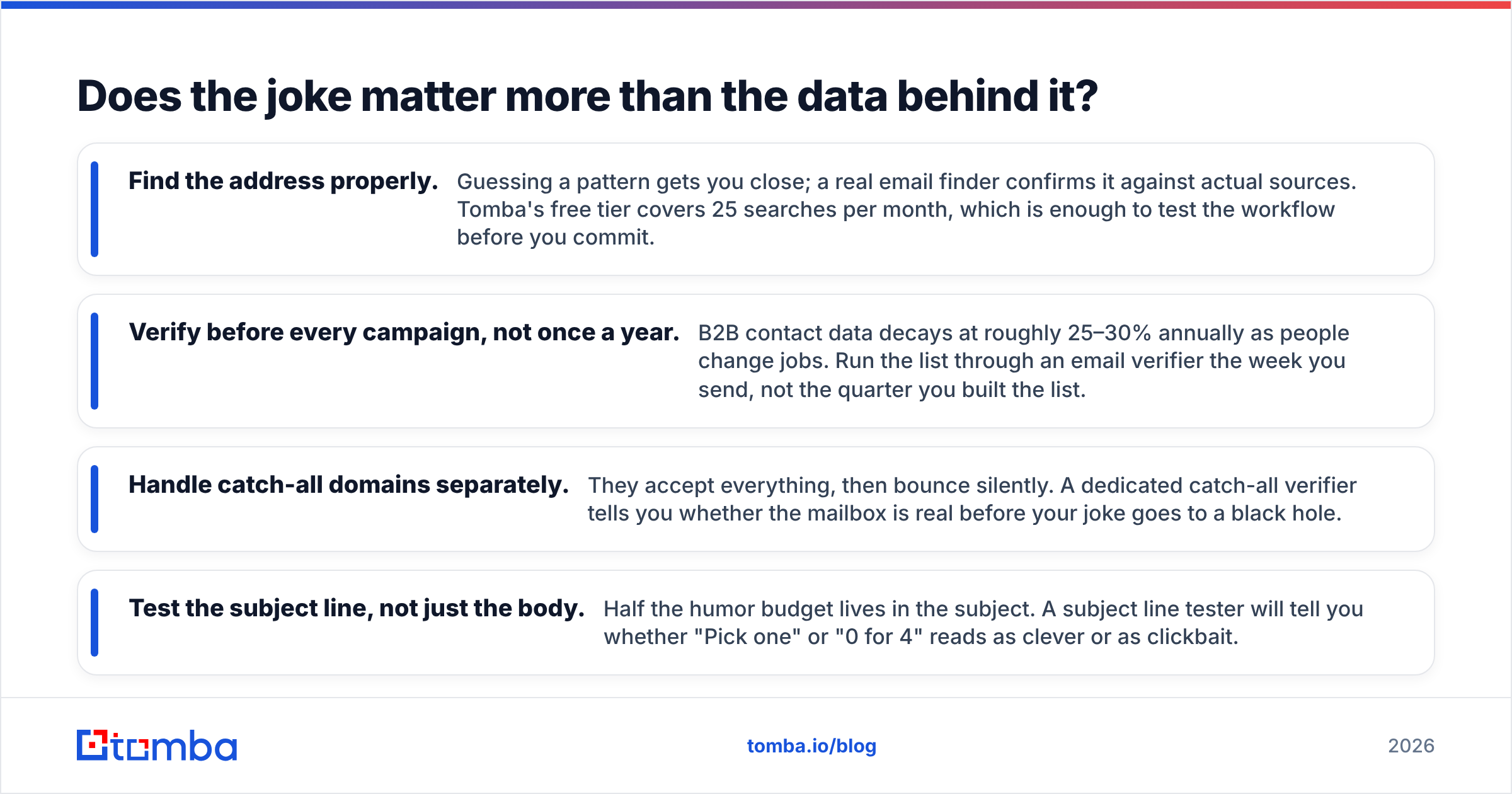
- Find the address properly. Guessing a pattern gets you close; a real email finder confirms it against actual sources. Tomba's free tier covers 25 searches per month, which is enough to test the workflow before you commit.
- Verify before every campaign, not once a year. B2B contact data decays at roughly 25–30% annually as people change jobs. Run the list through an email verifier the week you send, not the quarter you built the list.
- Handle catch-all domains separately. They accept everything, then bounce silently. A dedicated catch-all verifier tells you whether the mailbox is real before your joke goes to a black hole.
- Test the subject line, not just the body. Half the humor budget lives in the subject. A subject line tester will tell you whether "Pick one" or "0 for 4" reads as clever or as clickbait.
If you want to see how other tools handle this stage of the pipeline, G2's sales intelligence category is a reasonable neutral starting point — it includes Tomba, BookYourData, and most of the established data providers, with buyer reviews segmented by company size.
How do you measure whether the humor is working?#
Track three numbers, not one.
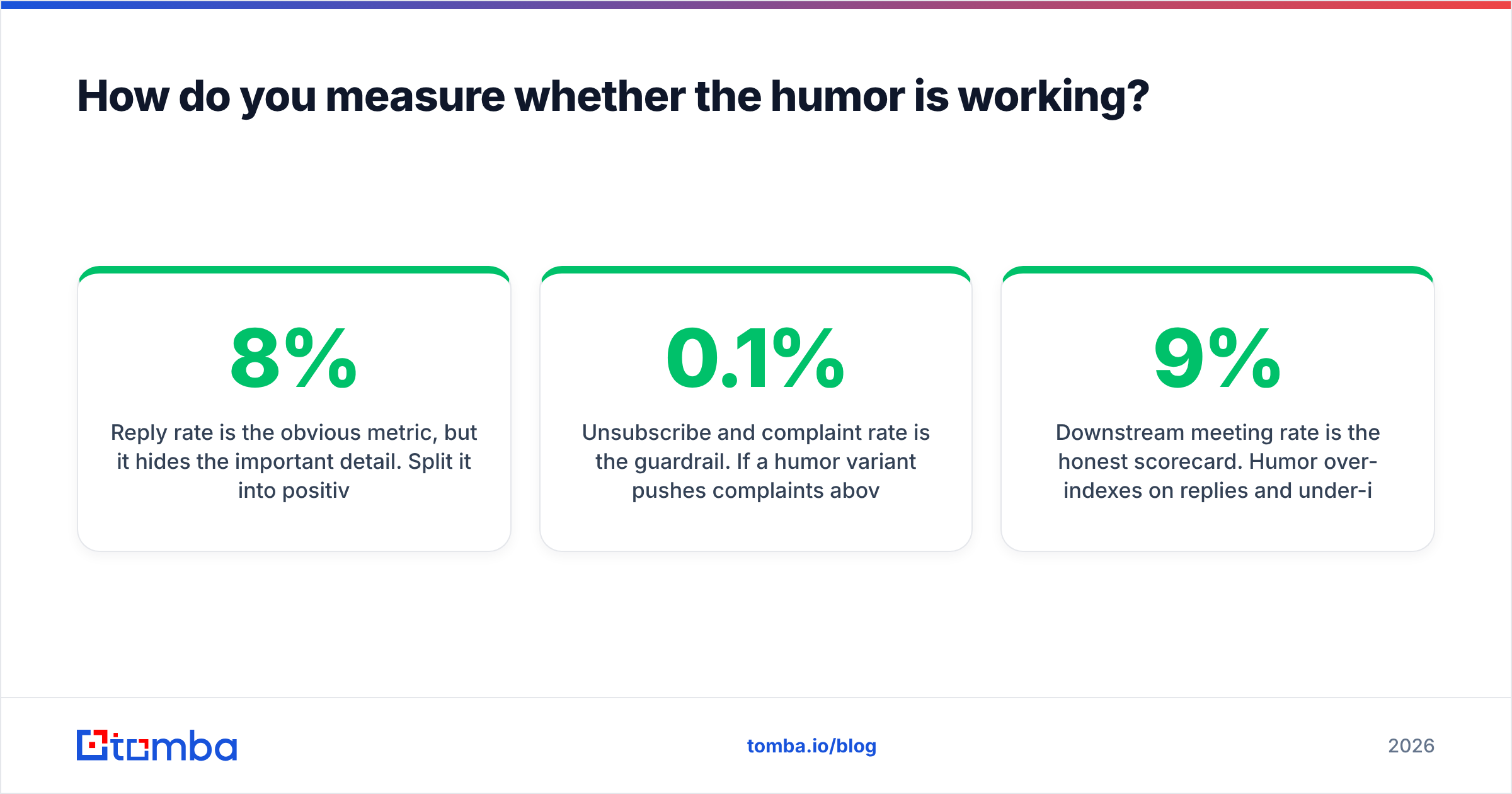
Reply rate is the obvious metric, but it hides the important detail. Split it into positive replies, negative replies, and neutral. A funny breakup email that produces 8% replies of which 6% are "no" is still a win — you cleared six dead deals out of your pipeline in one send.
Unsubscribe and complaint rate is the guardrail. If a humor variant pushes complaints above 0.1%, kill it regardless of how good the reply rate looks. Complaints compound; replies do not.
Downstream meeting rate is the honest scorecard. Humor over-indexes on replies and under-indexes on meetings, because "haha nice email" is a reply that goes nowhere. If variant A gets 9% replies and 1.1% meetings while variant B gets 6% replies and 1.8% meetings, variant B wins.
Run each humor variant against a plain control on at least 400 sends per arm before drawing conclusions. Below that, you are reading noise. And segment the result — humor that crushes with founders at 20-person startups will often flatline with directors at 5,000-person enterprises.
What is the fastest way to build a list worth joking with?#
Start with the data layer, then write.
Pull the target companies, resolve the right contacts with domain search, verify the addresses, and only then decide which of the twelve templates fits the segment. Reps who invert that order — write first, find addresses later — end up sending clever copy to inboxes that no longer exist.
If you are running this at any volume, Tomba Email Finder is the piece that makes the rest survivable: search by domain, name, or company, get a confidence score on every result, and push verified contacts straight into your sequencer. The free tier gives you 25 searches per month to validate the workflow, and paid plans start at $49/mo on Starter with 25 seats' worth of API access on Growth at $99/mo. Full Tomba pricing is public, so you can size it against your list volume before committing.
Write the joke second. Get the address right first.
Related guides#
Ready to find emails that actually work?
Join 150,000+ professionals who stopped guessing and started sending. Free credits on signup — no credit card required.
Get the Tomba newsletter
Practical outbound tactics and product updates — once every two weeks.
About the author