Funny Sales Emails: 12 Examples That Actually Get Replies
Humor is the highest-variance play in cold email. Here's what separates funny sales emails that book meetings from the ones that get you blocked — with 12 real examples, a risk table, and the rules that keep jokes on-brand.
TL;DR
- Funny sales emails work when the joke costs the reader nothing and proves you did research. They fail when the joke is the whole email.
- Self-deprecating humor and hyper-specific observations outperform puns, GIF walls, and "I'm not a robot, I promise" gags by a wide margin.
- Humor raises reply rate but also raises variance: more positive replies and more unsubscribes. Track both before you roll it out to a full list.
- Never joke about the prospect's revenue, headcount, layoffs, or a competitor's outage. Joke about yourself, the process, or the absurdity of cold email itself.
- A funny email sent to a bad address is still a bounce. Verify first, then be clever.
Why do funny sales emails work at all?#
Because humor is a costly signal. Anyone can paste a value proposition into a template. Writing a line that actually makes someone exhale through their nose requires that you understood something specific about them — their industry, their job, their week. That effort registers before the joke does.
There's an academic frame for this: the benign violation theory of humor, which says something is funny when it breaks a norm and stays clearly harmless. Cold email is full of norms to break — the fake "circling back," the invented mutual connection, the paragraph of adjectives about "AI-powered synergy." Naming those norms out loud is a violation. Doing it without insulting the reader keeps it benign.
That's the whole mechanic. A funny sales email is not a comedy set. It's a signal that says: I know this is an interruption, I know the genre is exhausting, and I respect you enough to skip the theater.
The failure mode is equally simple. When the humor doesn't reference anything real about the recipient, it reads as a template with a joke bolted on — which is worse than a plain template, because now you've wasted their time and performed effort you didn't spend.
What separates a funny sales email from a cringe one?#
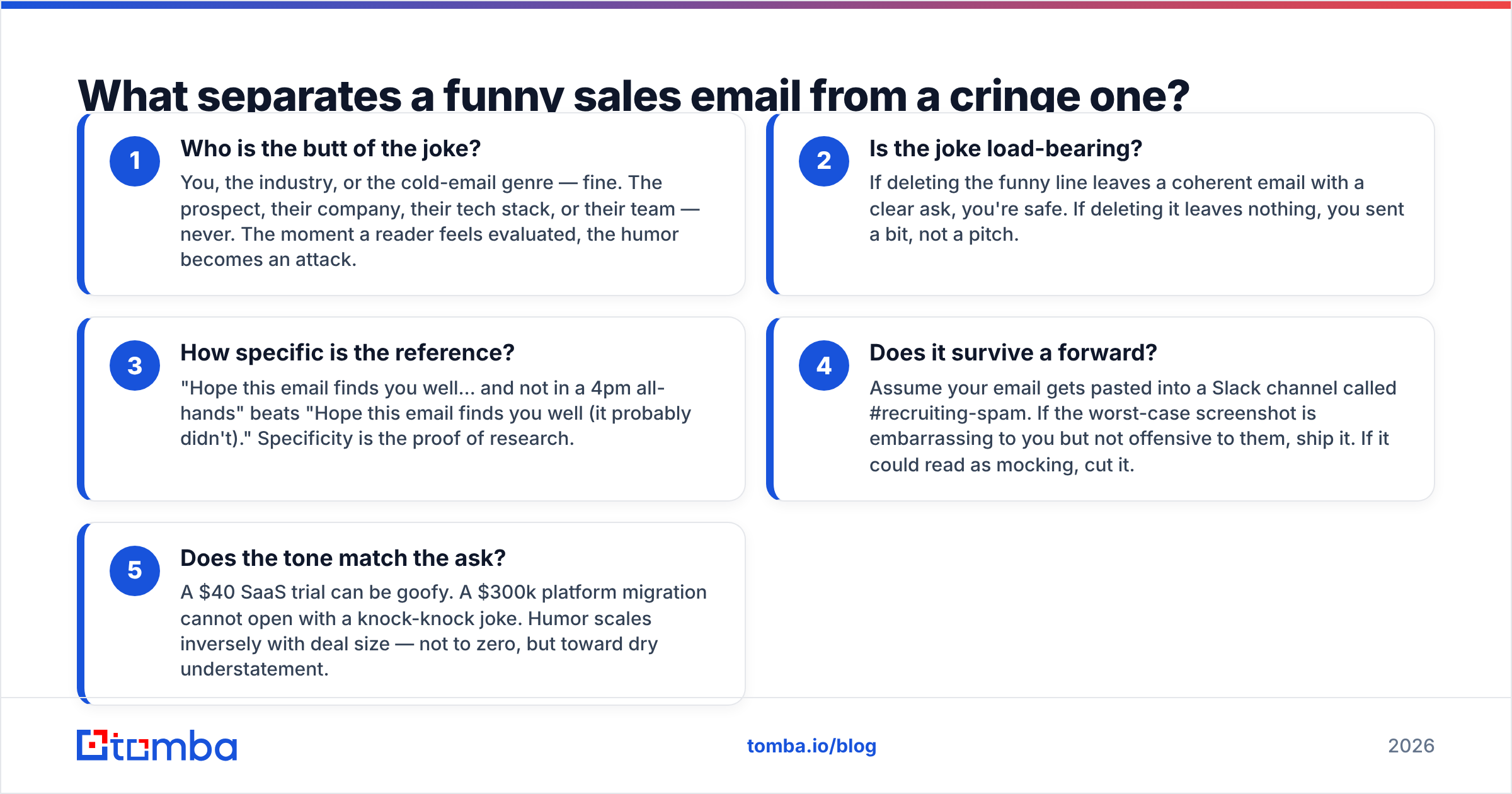
Five variables decide it. Run any draft through these before it goes out:
- Who is the butt of the joke? You, the industry, or the cold-email genre — fine. The prospect, their company, their tech stack, or their team — never. The moment a reader feels evaluated, the humor becomes an attack.
- Is the joke load-bearing? If deleting the funny line leaves a coherent email with a clear ask, you're safe. If deleting it leaves nothing, you sent a bit, not a pitch.
- How specific is the reference? "Hope this email finds you well… and not in a 4pm all-hands" beats "Hope this email finds you well (it probably didn't)." Specificity is the proof of research.
- Does it survive a forward? Assume your email gets pasted into a Slack channel called #recruiting-spam. If the worst-case screenshot is embarrassing to you but not offensive to them, ship it. If it could read as mocking, cut it.
- Does the tone match the ask? A $40 SaaS trial can be goofy. A $300k platform migration cannot open with a knock-knock joke. Humor scales inversely with deal size — not to zero, but toward dry understatement.
Most bad "funny" cold email fails variable 2. The writer found a joke, fell in love with it, and built the email around the punchline instead of around the meeting request.
Which humor styles perform, and which backfire?#
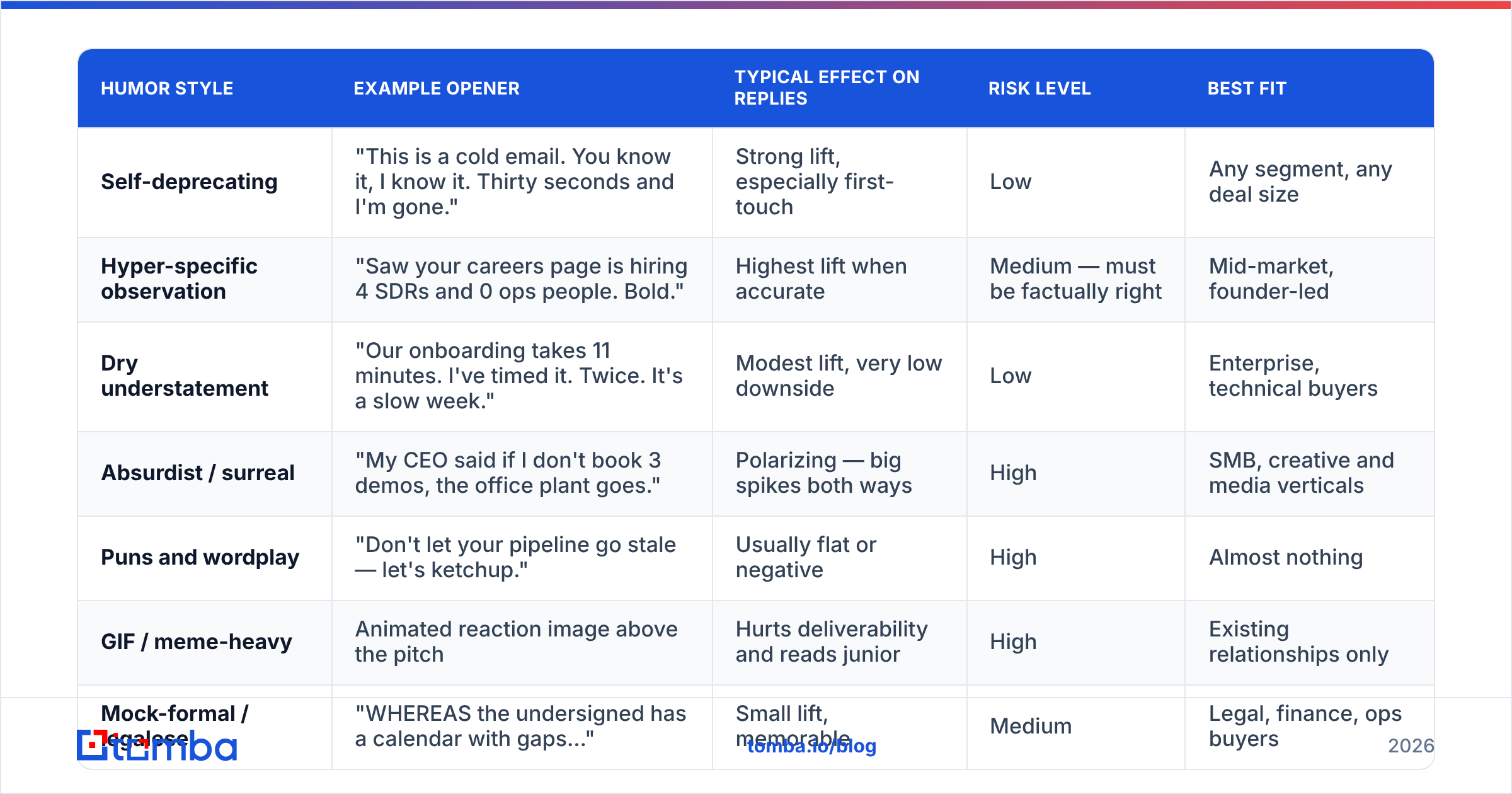
Not all comedy is equal in a B2B inbox. Here's how the common styles actually behave when you send them at volume:
| Humor style | Example opener | Typical effect on replies | Risk level | Best fit |
|---|---|---|---|---|
| Self-deprecating | "This is a cold email. You know it, I know it. Thirty seconds and I'm gone." | Strong lift, especially first-touch | Low | Any segment, any deal size |
| Hyper-specific observation | "Saw your careers page is hiring 4 SDRs and 0 ops people. Bold." | Highest lift when accurate | Medium — must be factually right | Mid-market, founder-led |
| Dry understatement | "Our onboarding takes 11 minutes. I've timed it. Twice. It's a slow week." | Modest lift, very low downside | Low | Enterprise, technical buyers |
| Absurdist / surreal | "My CEO said if I don't book 3 demos, the office plant goes." | Polarizing — big spikes both ways | High | SMB, creative and media verticals |
| Puns and wordplay | "Don't let your pipeline go stale — let's ketchup." | Usually flat or negative | High | Almost nothing |
| GIF / meme-heavy | Animated reaction image above the pitch | Hurts deliverability and reads junior | High | Existing relationships only |
| Mock-formal / legalese | "WHEREAS the undersigned has a calendar with gaps…" | Small lift, memorable | Medium | Legal, finance, ops buyers |
| Fake urgency jokes | "URGENT: nothing is urgent, I just wanted the open." | Negative — feels like a trick | High | Avoid |
Two patterns show up consistently in that table. First, humor that reduces the reader's burden (self-deprecation, understatement) is safe; humor that demands the reader's participation (puns, absurdism, meme stacks) is expensive. Second, anything that games the open — fake urgency, fake re: lines, fake "as discussed" — reads as a small betrayal even when it's meant as a joke. Sales leaders at Gong and HubSpot have both published the same finding from different angles: manipulative subject lines buy opens and lose replies.
What do funny sales emails actually look like?#
Twelve openers you can adapt. Each one is doing a job beyond the laugh.
1. The honest interruption
"This is a cold email. I'll be brief so we both feel better about it."
Job: disarms the defensive read. Works as a first line before any pitch.
2. The over-researched flex
"I read your Q3 shareholder letter. All 41 pages. Ask me anything about your Southeast Asia strategy."
Job: proves research, invites a reply that isn't yes/no.
3. The self-aware follow-up
"Follow-up #3. At #5 I legally have to leave you alone. Want me to get there, or should we talk?"
Job: makes persistence charming instead of grating.
4. The bad-at-my-job bit
"My manager tracks how many emails I send. She does not track how many are good. You're benefiting from this system."
Job: self-deprecation that still explains why you're writing.
5. The specific-time joke
"Sending this at 6:47am because that's when your last three blog posts went live. Fellow early-hours person?"
Job: shows genuine observation, opens a human thread.
6. The anti-buzzword
"I could say 'AI-powered revenue orchestration.' I won't. We find email addresses that don't bounce."
Job: contrast makes the plain claim land harder.
7. The tiny wager
"If our data doesn't beat your current provider on a 500-row sample, I'll send you a coffee and stop emailing. Both outcomes are good for you."
Job: humor plus an actual risk-reversal offer.
8. The mock changelog
"Changelog v1: emailed you. v2: emailed you again, slightly better. v3: this one, which has an actual question."
Job: works beautifully for technical buyers.
9. The unsubscribe joke that isn't a joke
"Reply 'no' and I'll delete you from every list I control. That's a real offer, not a bit."
Job: humor as a trust signal. Then honor it — always.
10. The deadpan credential
"We've been doing this since 2019, which in email-tooling years is roughly since the invention of fire."
Job: age-of-company proof that doesn't sound like a brag.
11. The wrong-person handoff
"If this isn't your problem, I'd love a name. If it is your problem, I'd love 12 minutes. If you send neither, I'll assume you're in meetings until 2027."
Job: makes the referral ask feel light.
12. The one-line reply bait
"Question: are you the person who gets blamed when the CRM has 30% dead contacts? Just checking who to apologize to."
Job: converts a pain point into a question people enjoy answering.
Notice what none of these do. None of them open with a pun. None of them use an exclamation point stack. None require the reader to already like you. And every single one can have its funny line removed and still leave a working email — which is the test from the section above.
How do you keep humor on-brand without a copy team?#
Set a floor, not a ceiling. The floor is a small written rule set every rep works inside:
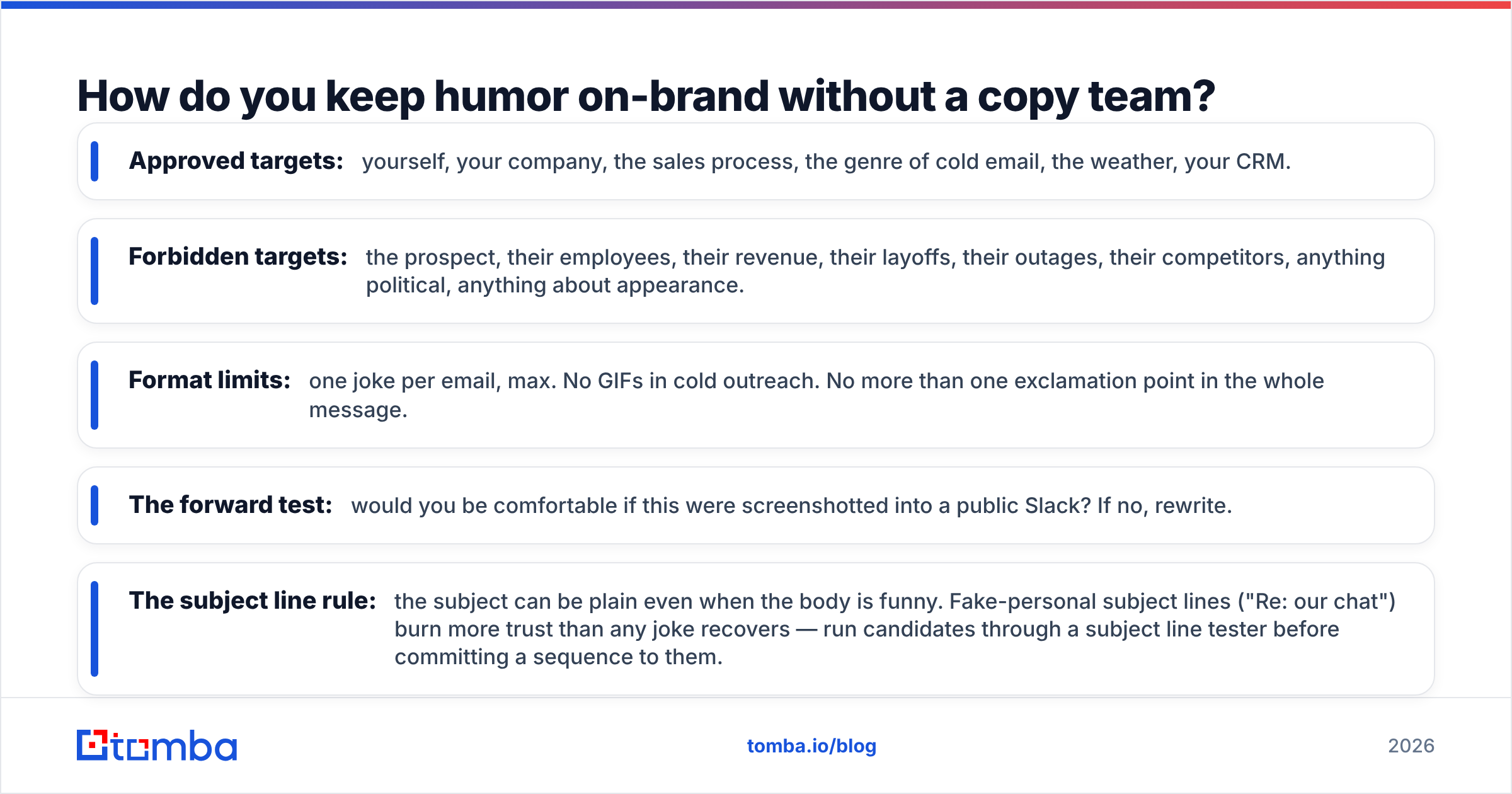
- Approved targets: yourself, your company, the sales process, the genre of cold email, the weather, your CRM.
- Forbidden targets: the prospect, their employees, their revenue, their layoffs, their outages, their competitors, anything political, anything about appearance.
- Format limits: one joke per email, max. No GIFs in cold outreach. No more than one exclamation point in the whole message.
- The forward test: would you be comfortable if this were screenshotted into a public Slack? If no, rewrite.
- The subject line rule: the subject can be plain even when the body is funny. Fake-personal subject lines ("Re: our chat") burn more trust than any joke recovers — run candidates through a subject line tester before committing a sequence to them.
If you want a starting library rather than a blank page, a maintained set of cold email templates is a faster on-ramp than asking each rep to invent voice from scratch. Give them the structure; let them supply the one specific line that makes it theirs.

Does humor hurt deliverability or reply quality?#
Humor itself is neutral to spam filters. What travels with humor is not.
Embedded GIFs and images push message size up and image-to-text ratio in the wrong direction. Exclamation points, all-caps punchlines, and words like "FREE" or "URGENT" — even used ironically — trip the same heuristics as sincere spam, because filters don't detect irony. Long HTML signatures with meme graphics compound it.
The practical rule: keep funny emails plain text, keep them short, and keep the punctuation boring. A dry line in a 70-word plain-text email is safe. The same line under a reaction GIF, in a 12-point purple font, is not.
Reply quality is a separate question, and the honest answer is that humor increases variance in both directions. Teams that A/B a humorous variant against a straight one typically see higher total replies and a higher share of "not interested but that made me laugh" responses — which are pleasant but not pipeline. Measure meetings booked, not replies. If the funny variant wins on replies and loses on meetings, you found a joke that entertains without qualifying.
One more constraint people forget: humor is the last thing that matters if your list is dirty. A perfect self-deprecating opener sent to jsmith@company.com when the pattern is john.smith@ is a bounce with a joke inside it. Run addresses through an email verifier before the sequence starts, and treat catch-all domains as a separate risk bucket. Bounce rate above 3% will cost you more inbox placement than any amount of clever copy earns back.
When should you skip the jokes entirely?#
Four situations where straight copy wins:
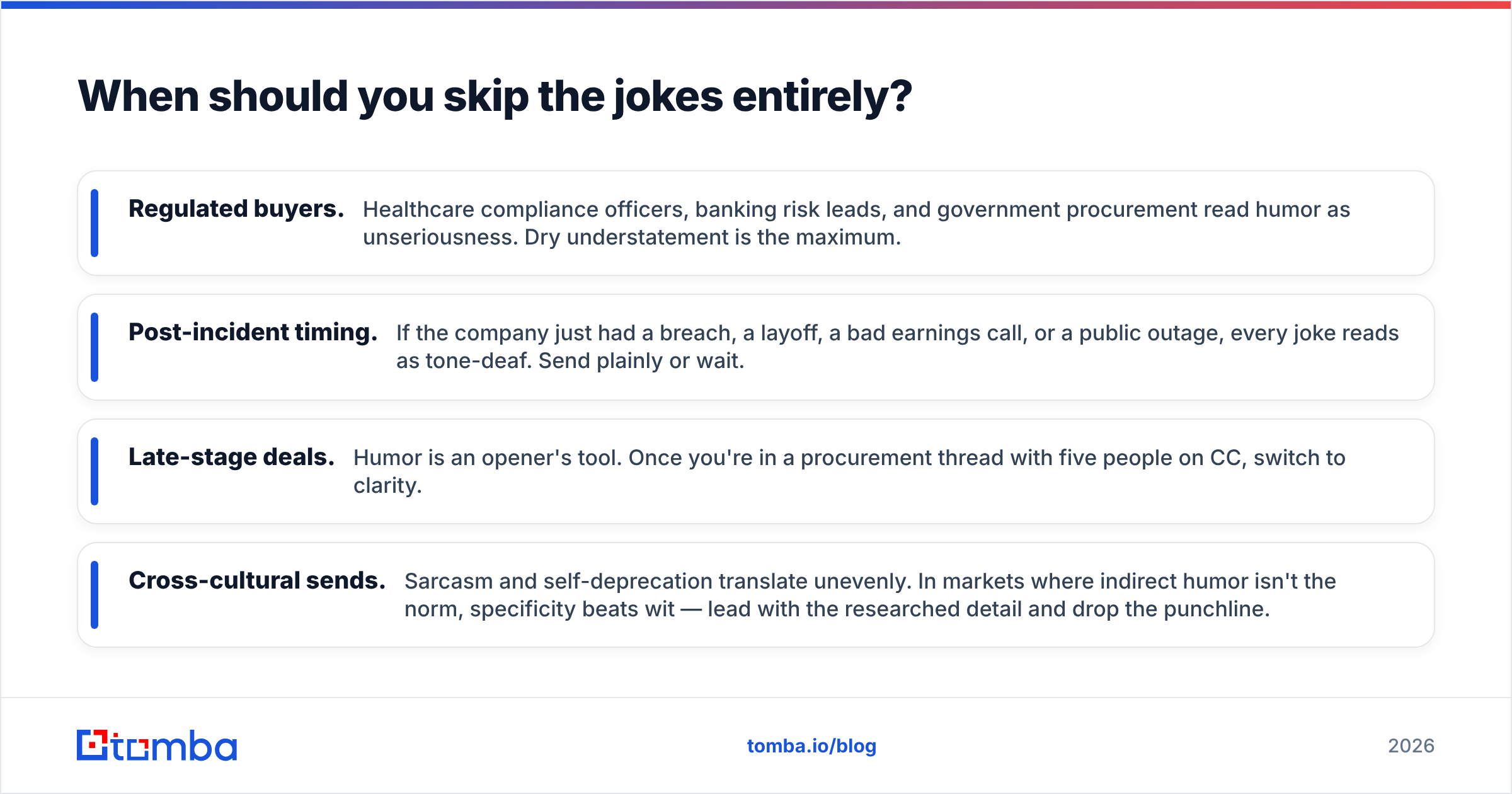
- Regulated buyers. Healthcare compliance officers, banking risk leads, and government procurement read humor as unseriousness. Dry understatement is the maximum.
- Post-incident timing. If the company just had a breach, a layoff, a bad earnings call, or a public outage, every joke reads as tone-deaf. Send plainly or wait.
- Late-stage deals. Humor is an opener's tool. Once you're in a procurement thread with five people on CC, switch to clarity.
- Cross-cultural sends. Sarcasm and self-deprecation translate unevenly. In markets where indirect humor isn't the norm, specificity beats wit — lead with the researched detail and drop the punchline.
The general principle: humor is a way to earn attention you haven't been given yet. Once you have attention, it stops paying and starts costing.
Start with clean data, then be funny#
The best-written joke in outbound is worthless if the address is wrong, the contact left the company nine months ago, or the domain is a catch-all that swallows everything. Copy is the multiplier; data is the base number. Multiply a zero and you still have zero.
Build the list first: pull verified, pattern-confirmed addresses with the Tomba Email Finder, verify before you send, and only then spend your energy on the line that makes someone smile. Tomba's free tier gives you 25 searches a month to test the workflow, with paid plans from $49/mo — see current Tomba pricing for the full breakdown. Get the addresses right, keep the emails plain-text and short, and let one honest, specific, self-aware line do the work that a hundred puns can't.
Related guides#
Ready to find emails that actually work?
Join 150,000+ professionals who stopped guessing and started sending. Free credits on signup — no credit card required.
Get the Tomba newsletter
Practical outbound tactics and product updates — once every two weeks.
About the author