G2 Intent Data in 2026: How It Works and What It Costs
G2 intent data tells you which companies are researching your category right now — but it rarely tells you who to email. Here's how the signals actually work, what they cost, and the workflow that turns them into booked meetings.
TL;DR
- G2 intent data is account-level, not person-level. It tells you a company touched your category page or profile — never which human did it.
- Expect a five-figure annual commitment. Buyer Intent is bundled into G2's paid marketing tiers, not sold as a cheap standalone feed.
- The signal decays fast. A category-page view is worth outreach in 24–72 hours and close to nothing after two weeks.
- The gap between "account is in-market" and "email sent" is where most teams fail. You need enrichment and verification to close it.
- G2 works best as a prioritization layer on top of an ICP list you already own — not as a lead source you buy in isolation.
What is G2 intent data, exactly?#
G2 intent data is a feed of company-level buying signals derived from activity on G2's review marketplace. When someone from a company visits your product profile, reads a competitor's page, or opens a category grid, G2 resolves that visitor's IP address to a company and reports it back to you.
Think of it like a doorbell camera on a store you don't own. You can see that a delivery van from Acme Corp pulled up outside, idled, and drove off. You know the company was interested. You do not know who was driving, what they wanted, or how to reach them.
That distinction drives every decision in this guide. G2 sells attention, not contacts. It is very good at telling you which of the 4,000 accounts in your CRM woke up last Tuesday. It is not a prospecting database, and buying it as one is the fastest way to waste the budget.
The underlying mechanism is reverse IP resolution plus first-party account matching. If a logged-in G2 user with a work email browses your category, that's a high-confidence match. If it's an anonymous visitor on a corporate network, it's an IP-to-company lookup with all the usual caveats — remote workers on residential IPs vanish, VPN users get mis-attributed, and large enterprises with shared egress ranges produce noisy matches.
Which G2 intent signals actually matter?#
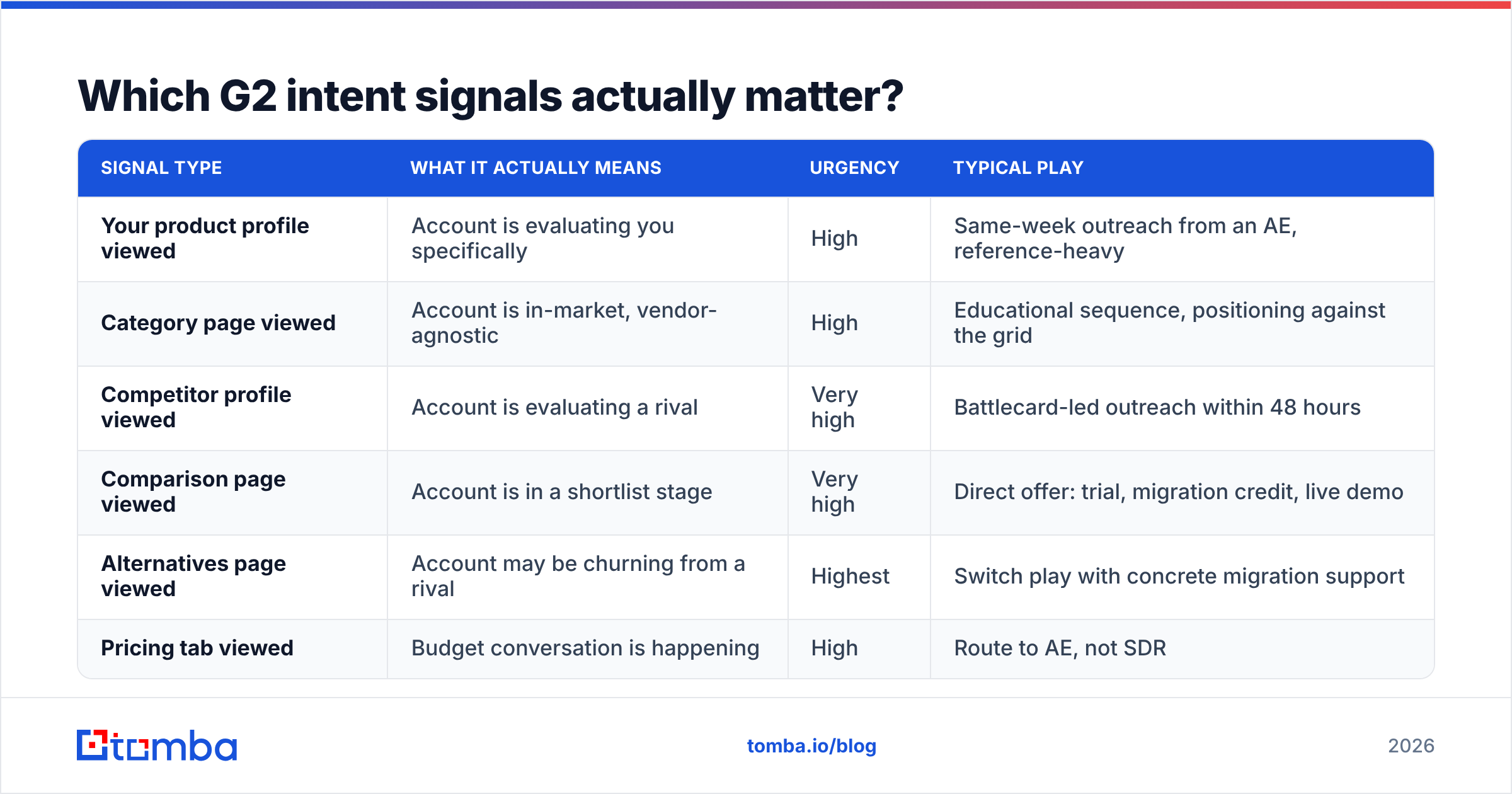
Not all signals carry the same weight. G2 exposes several activity types, and treating them as equivalent is the most common mistake teams make in their first quarter on the platform.
| Signal type | What it actually means | Urgency | Typical play |
|---|---|---|---|
| Your product profile viewed | Account is evaluating you specifically | High | Same-week outreach from an AE, reference-heavy |
| Category page viewed | Account is in-market, vendor-agnostic | High | Educational sequence, positioning against the grid |
| Competitor profile viewed | Account is evaluating a rival | Very high | Battlecard-led outreach within 48 hours |
| Comparison page viewed | Account is in a shortlist stage | Very high | Direct offer: trial, migration credit, live demo |
| Alternatives page viewed | Account may be churning from a rival | Highest | Switch play with concrete migration support |
| Pricing tab viewed | Budget conversation is happening | High | Route to AE, not SDR |
The pattern is consistent: specificity beats volume. An account that viewed your "Alternatives to Competitor X" page is dramatically more valuable than one that grazed a category grid, even though both show up in the same weekly export.
Here's how to score them in practice:
- Weight by page depth. Comparison and alternatives pages sit at the bottom of the research funnel. Score them 3–5x a category view.
- Weight by session count. One visit is curiosity. Four visits from three different IPs at the same company inside a week is a buying committee.
- Weight by recency. Apply a decay curve. A signal older than 14 days should score near zero, because someone else already got the meeting.
- Weight by ICP fit. An in-market account outside your segment is still outside your segment. Intent does not override qualification.
- Weight by existing pipeline state. An open opportunity showing competitor-page intent is a churn-risk alert, not a new lead.
How much does G2 Buyer Intent cost in 2026?#
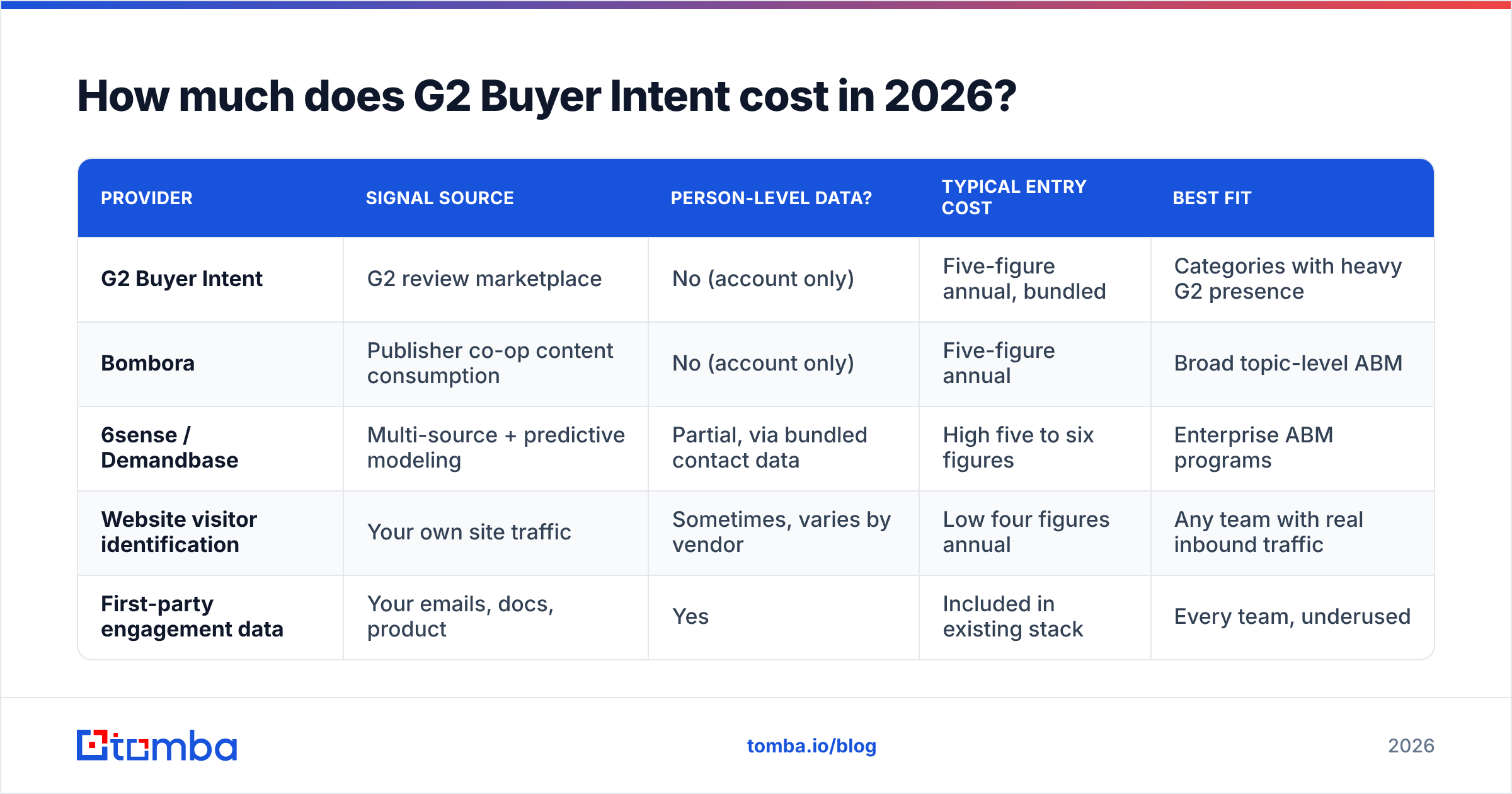
G2 does not publish a public price list for Buyer Intent, and that's deliberate — it's sold as part of a broader marketing package tied to your category, review volume, and profile placement.
What buyers consistently report: intent access is bundled into G2's paid tiers, and the realistic entry point is a five-figure annual contract. Once you add category sponsorship, competitive comparison placements, and content syndication, the number climbs quickly. Multi-year deals and Q4 timing are the two levers that actually move the quote.
Compare that against the alternatives you're likely evaluating:
| Provider | Signal source | Person-level data? | Typical entry cost | Best fit |
|---|---|---|---|---|
| G2 Buyer Intent | G2 review marketplace | No (account only) | Five-figure annual, bundled | Categories with heavy G2 presence |
| Bombora | Publisher co-op content consumption | No (account only) | Five-figure annual | Broad topic-level ABM |
| 6sense / Demandbase | Multi-source + predictive modeling | Partial, via bundled contact data | High five to six figures | Enterprise ABM programs |
| Website visitor identification | Your own site traffic | Sometimes, varies by vendor | Low four figures annual | Any team with real inbound traffic |
| First-party engagement data | Your emails, docs, product | Yes | Included in existing stack | Every team, underused |
Two honest observations. First, G2 intent is only worth it if your category on G2 is actually busy — a niche category with 40 reviews across all vendors will produce a trickle of signals that never justifies the contract. Check the category traffic before you sign, and ask your rep for a 90-day signal-volume estimate specific to your grid.
Second, most teams buy intent data before they've exhausted the free signal already sitting in their stack. Gartner and Forrester analysts have made this point for years: first-party engagement data — email replies, pricing-page visits, docs traffic, support tickets — is more predictive than any third-party feed, and you already own it. If your team isn't acting on your own website visitor reveal data, a purchased intent feed will not fix the underlying process problem.
Is G2 intent data accurate enough to act on?#
Accuracy in intent data has two separate components, and vendors love to blur them.
Company resolution accuracy — did G2 correctly identify which company that IP belongs to? For mid-market and enterprise accounts on corporate networks, resolution is generally reliable. For SMBs, remote-first companies, and anyone on consumer ISPs or VPNs, resolution is a coin flip at best. Post-2020 remote work permanently degraded IP-based attribution across the entire category, and no vendor has fully solved it.
Intent relevance accuracy — was that visit actually a buying signal? Here the false-positive rate is higher than most teams expect. Your own employees browsing your profile, competitors doing research, job seekers, analysts, students, and consultants all generate identical signals to a real buyer. Some of this gets filtered; plenty doesn't.
Practical calibration: treat G2 intent as a prioritization signal with roughly 30–50% precision, not a qualified lead. If you assume half your signals are noise and build your workflow around that assumption, you'll be pleasantly surprised. If you assume they're leads, your reps will burn a month on dead accounts and stop trusting the feed entirely — which is how six-figure intent contracts quietly get cancelled at renewal.
One more caveat that rarely makes it into the sales deck: G2 intent is inherently backward-looking within a single channel. It sees what happens on G2. It doesn't see the Slack conversation, the vendor RFP, or the analyst call that came first. It's one instrument on a dashboard, not the dashboard.
How do you turn a G2 account signal into a real conversation?#
This is where the money is made or lost. You have a company name and a signal timestamp. You need a named human with a working email address, in the next 48 hours.
The workflow that works:
- Filter to ICP first. Drop every signal outside your firmographic criteria before a human ever sees it. Intent without fit is a distraction with a timestamp.
- Identify the likely buying committee. For each surviving account, list the 3–5 roles who would own this purchase. Not "anyone at the company" — specific titles tied to the problem your product solves.
- Resolve those roles to real people. Use a domain search to pull the contactable people at that company, then filter by department and seniority. This is the step where account-level intent becomes person-level outreach.
- Verify before you send. Intent-triggered sends are time-sensitive, which means reps skip hygiene. Run every address through an email verifier first — a bounce spike on a rushed intent campaign will damage the sending domain you need for everything else.
- Enrich for personalization. Title, seniority, tenure, tech stack. A data enrichment pass gives your first line something real to say beyond "I saw you were researching our category."
- Reference the signal without being creepy. Never say "I saw you visited our G2 page." Say "a lot of teams in [their industry] are re-evaluating [category] this quarter." Same trigger, no surveillance vibes.
- Cap the window. If the signal is more than 10 days old, it goes into the normal nurture queue, not the priority lane.

Step 3 is the one teams consistently underinvest in. You paid a five-figure sum to learn that Acme Corp is in-market. If you then spend three days manually hunting for the VP of Operations' email address, the signal has expired before the first touch. Automating the account-to-contact hop with an email finder is what makes the intent contract pay for itself.
When is G2 intent data a bad investment?#
Be honest about these four scenarios before signing:
Your category is quiet on G2. Fewer than a few hundred reviews across the whole grid means low traffic, which means few signals. Ask for volume estimates in writing.
You sell to SMBs or remote-first companies. IP resolution fails hardest exactly where your buyers are. You'll pay enterprise prices for a feed with a large blind spot.
Your outbound motion isn't functional yet. Intent data compresses timing; it doesn't fix messaging, deliverability, or list quality. If your current sequences convert at near zero, faster targeting produces faster near zero.
You have no process to act inside 72 hours. If your SDR team works a weekly list on Mondays, a Wednesday signal is stale by the time anyone touches it. Intent data rewards operational speed and punishes batch workflows.
Conversely, G2 intent earns its keep when you have a defined ICP list, a working outbound engine, a busy G2 category, and a rep team that can act on a same-day alert. Under those conditions it's one of the cleaner intent signals available, precisely because G2 traffic is high-purchase-intent by nature — nobody browses review grids for fun.
What should you do instead if the budget isn't there?#
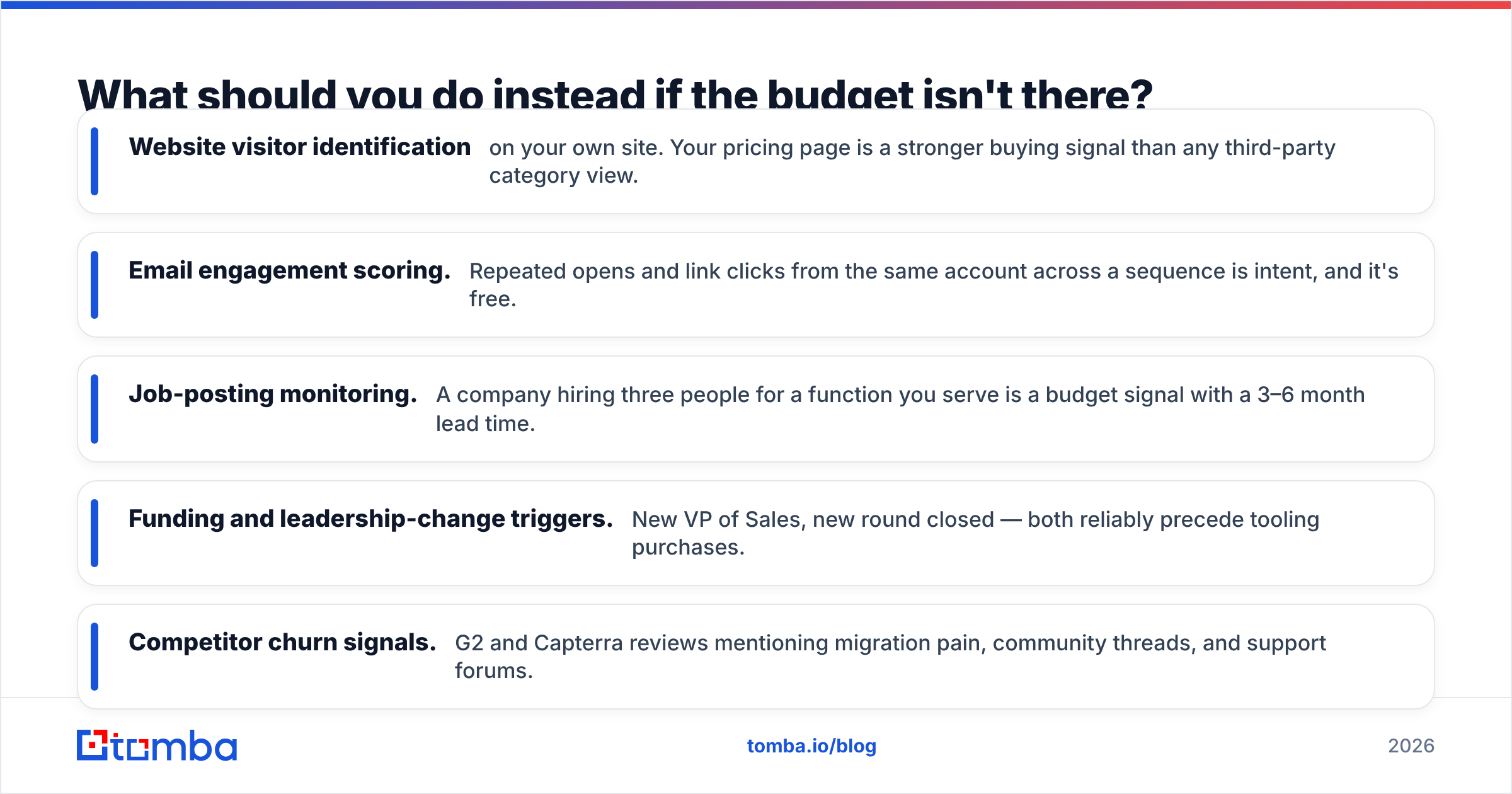
Build the poor-man's intent stack first. It costs a fraction and often outperforms:
- Website visitor identification on your own site. Your pricing page is a stronger buying signal than any third-party category view.
- Email engagement scoring. Repeated opens and link clicks from the same account across a sequence is intent, and it's free.
- Job-posting monitoring. A company hiring three people for a function you serve is a budget signal with a 3–6 month lead time.
- Funding and leadership-change triggers. New VP of Sales, new round closed — both reliably precede tooling purchases.
- Competitor churn signals. G2 and Capterra reviews mentioning migration pain, community threads, and support forums.
Combine two or three of those, resolve the accounts to named contacts, and you have a working intent motion for a small fraction of an enterprise contract. Vendors like BookYourData and other B2B contact providers cover the data-supply side well; the differentiator is whether your team acts on signals within days rather than weeks.
If and when volume justifies it, layer G2 on top. Intent data is a multiplier on an existing process — and a multiplier on zero is still zero.
The bottom line#
G2 intent data answers "which accounts are in-market right now?" with reasonable confidence and genuine speed. It does not answer "who do I email, and does that address work?" — and that second question is the one standing between a signal and a booked meeting.
Close that gap with Tomba's Email Finder: feed it the account domains from your intent export, get back verified, role-filtered contacts at the people who actually own the buying decision. The free tier covers 25 searches a month so you can test the workflow on last week's signals before committing, and paid plans start at $49/mo — see Tomba pricing for the full breakdown. Turn account-level noise into person-level pipeline while the signal is still warm.
Related guides#
Ready to find emails that actually work?
Join 150,000+ professionals who stopped guessing and started sending. Free credits on signup — no credit card required.
Get the Tomba newsletter
Practical outbound tactics and product updates — once every two weeks.
About the author