Gainio Pricing Reviews Pros and Cons: A 2026 Breakdown
Gainio sells one CRM plan at $9.50 per seat and has almost no independent reviews to back it up. Here is what that price really buys, where it falls short, and how to judge a tool nobody has reviewed yet.
Gainio pricing reviews pros and cons, in one place. Gainio sells a single CRM plan at $9.50 per seat, and almost no independent reviews back it up. This breakdown covers what that price buys, where the tool falls short, and how to judge a product nobody has reviewed yet.
TL;DR
- Gainio (the CRM at gain.io) sells a single plan at $9.50 per seat per month. The 14-day trial needs no credit card and allows up to 10 users. There are no tiers and no feature gating.
- Do not confuse it with gainio.com, an unrelated Finnish geospatial and fleet-tracking company, or the "Gainio" esports website template on ThemeForest. Three different products, one name.
- Gainio is a pipeline-and-offers CRM. It does not find emails, verify them, or enrich contacts. A cheap seat price does not erase your data budget.
The catch:
- The biggest red flag is not the price. It is the review vacuum. Trustpilot, GetApp, and Capterra listings exist with effectively zero reviews, and the site still pushes a waitlist CTA. That makes any Gainio pricing reviews pros and cons write-up, including this one, thin on evidence by necessity.
- Best fit: a 2-8 person team that wants cheap deal tracking plus a client-facing offer portal and can live with early-stage risk. Bad fit: anyone who needs integrations, an API, or a vendor track record.
What exactly is Gainio, and which Gainio are you looking at?#
Start here, because the search results are a mess.
Type "Gainio" into Google and you will hit at least three unrelated things: Gain.io, an SMB CRM built by Gain Solutions AS in Oslo, Norway; gainio.com, a Finnish geospatial and fleet-tracking outfit best known for running aprs.fi; and a gaming or esports HTML template sold on ThemeForest. Only the first is a sales tool, and it is the one this breakdown covers.
That name clash matters for a practical reason. When you search for "gainio pricing reviews pros and cons," a chunk of what surfaces is about the wrong company. Review sites have mixed the signal too. G2 lists products called "Gain" and "Gain CRM" that look like different vendors entirely: a content-approval app and a private-markets data platform. Before you trust any third-party rating, check that the listing points at gain.io and not one of its namesakes.
What does Gainio actually do?#
Gainio calls itself an all-in-one CRM for small teams. Based on the vendor's own feature and pricing pages, the product breaks into five buckets:
- Contacts and deals — contact records, deal records, custom fields, and custom deal stages. Standard CRM plumbing, nothing exotic.
- Visual pipeline — drag-and-drop deal stages, the Pipedrive-style board that most SMB buyers now treat as table stakes.
- Tasks, calendar, and notes — reminders, a built-in calendar, and two-way sync with Google Calendar and Outlook.
- Email and shared inbox — Gmail and Outlook sync, a shared team inbox, and reusable email templates.
- Offers module — the actual differentiator. You build an offer from a template, publish it to a branded client portal on your own domain, chat with the prospect inside it, and track whether they opened it.
That fifth bucket is the interesting one. Most CRMs at this price make you bolt on a separate proposal tool (PandaDoc, Qwilr, Better Proposals) at $19-$49 per user on top. Folding an offer portal into a $9.50 seat is a real bundling argument, not marketing noise.
What Gainio is not: it has no lead database, no email finder, no enrichment, and no data credits anywhere in the product. If you came here expecting an Apollo or Hunter competitor, this is a different category of tool. Your prospect data still has to come from somewhere. More on that below.
Gainio pricing reviews pros and cons: what does a seat cost in 2026?#
One number: $9.50 per seat per month. No Starter, Pro, or Enterprise ladder. No annual-versus-monthly split advertised. No feature paywall between tiers. Every user gets every feature.
Here is the fine print worth knowing before you swipe a card, pulled from the vendor's pricing page:
- Trial — 14 days, no credit card, and you can invite up to 10 users during it. That is unusually generous. Most CRMs cap trials at 3-5 seats.
- What counts as a billable seat — active users plus invited-but-not-yet-accepted users. Send five invites that nobody accepts and you pay for five seats. Clean up stale invites.
- Seat changes — add or remove anytime with immediate effect and pro-rata billing. Credit for removed seats lands on the next invoice.
Three more details decide whether the sticker price is the real price:
- Billing — Stripe, standard cards, cancel anytime.
- Free plan — none advertised by the vendor. One aggregator listing shows a "free plan" label with nothing behind it, which contradicts the official page. Trust the vendor page.
- The unpublished bit — the Offers feature list mentions "purchase additional offers," which implies a quota and an overage price. Neither number is published anywhere I could find. Ask sales before you build a workflow around offers.
That last point is the only real hidden-cost risk in an otherwise clear pricing model. A metered feature with an unpublished meter is a question you ask in the trial, not after.
How does Gainio pricing compare to other SMB CRMs?#
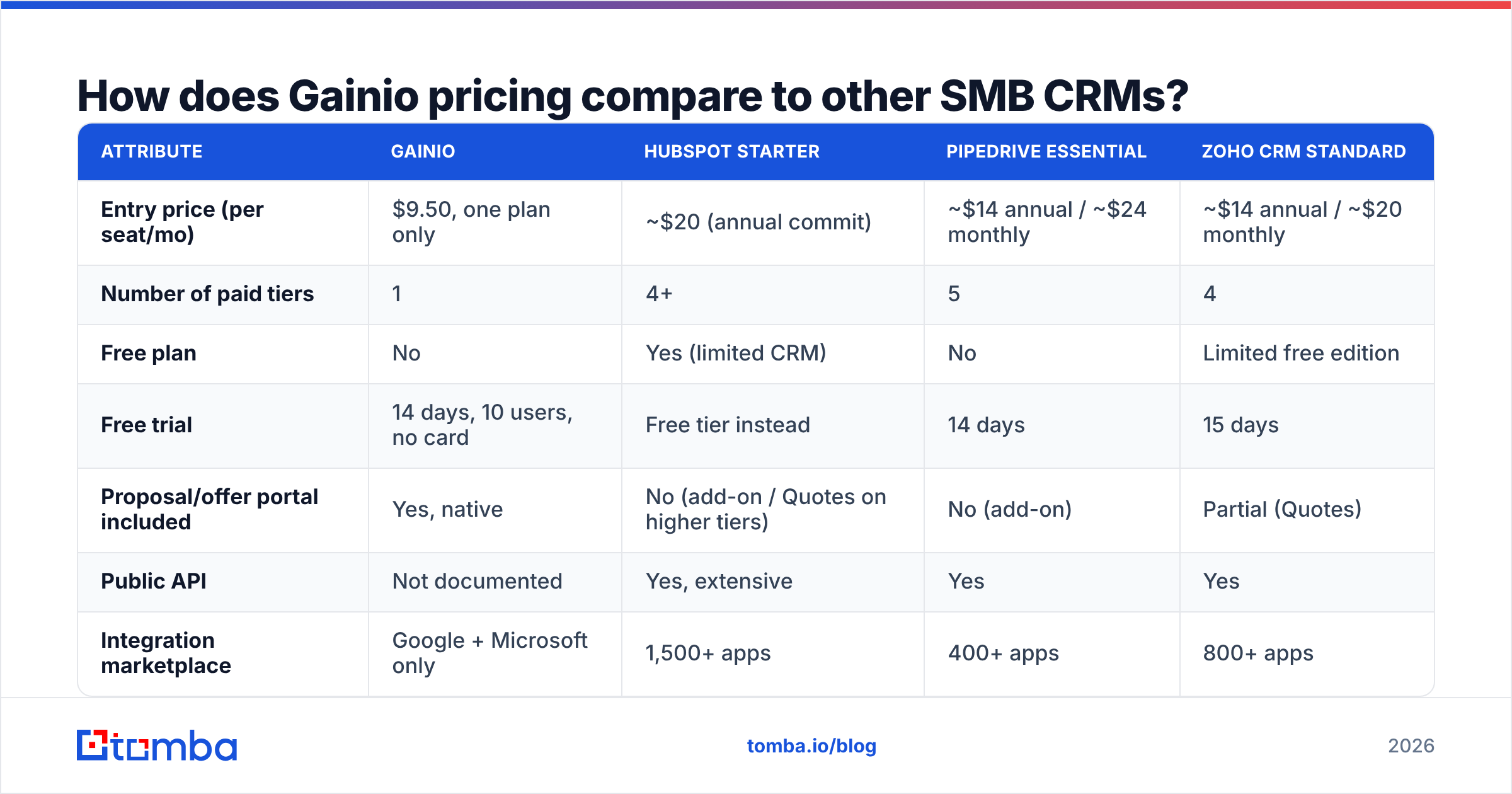
At $9.50 per seat, Gainio undercuts almost every mainstream CRM entry tier. The table below uses published list prices at the time of writing. Verify each one before budgeting, since CRM vendors reprice often and annual commitments change the math.
| Attribute | Gainio | HubSpot Starter | Pipedrive Essential | Zoho CRM Standard |
|---|---|---|---|---|
| Entry price (per seat/mo) | $9.50, one plan only | ~$20 (annual commit) | ~$14 annual / ~$24 monthly | ~$14 annual / ~$20 monthly |
| Number of paid tiers | 1 | 4+ | 5 | 4 |
| Free plan | No | Yes (limited CRM) | No | Limited free edition |
| Free trial | 14 days, 10 users, no card | Free tier instead | 14 days | 15 days |
| Proposal/offer portal included | Yes, native | No (add-on / Quotes on higher tiers) | No (add-on) | Partial (Quotes) |
| Public API | Not documented | Yes, extensive | Yes | Yes |
| Integration marketplace | Google + Microsoft only | 1,500+ apps | 400+ apps | 800+ apps |
| Independent reviews | Effectively none | Tens of thousands | Tens of thousands | Tens of thousands |
| Vendor maturity | Early access / waitlist | Public company | 15+ years | 25+ years |
Read that table as a trade, not a scoreboard. Gainio buys you roughly 30-50% off the cheapest credible alternative, plus a bundled offer portal. You pay for it in ecosystem depth, API access, and the ability to check claims against other buyers. For a two-person consultancy, that trade can be rational. For a 25-rep team with a RevOps function, it is not close. The missing API alone kills it.
What do Gainio reviews actually say?#
Almost nothing, and that is the finding.
- Trustpilot — the Gain.io profile currently invites you to "be the first to write a review." Zero reviews.
- GetApp — a listing exists with no reviews, no overall rating, and a 0.00/10 likelihood-to-recommend placeholder.
- Capterra — a listing exists. The review count appears to be zero.
- G2 — no confirmed profile for this specific product. The similarly named pages belong to other vendors.
The only positive sentiment available is the testimonial block on Gainio's own homepage. Several of those use placeholder avatars, and none are independently attributable. Treat them as marketing copy, not evidence. That is not an accusation of bad faith. It is what every pre-launch vendor's homepage looks like. But it means you cannot outsource your diligence to the crowd here.
One more maturity signal is worth flagging. The site's main CTA reads "Join Waitlist" rather than "Start free trial," even though full pricing is published. A product that publishes a price but gates signup behind a waitlist is early. Budget for that: no reviews, no migration guides, no Reddit threads about the export flow, no consultant who has done this before.
What are the pros of Gainio?#
Here is the upside half of the Gainio pricing reviews pros and cons ledger.
- Price transparency. One number, published, with the seat-counting rule and pro-rata policy spelled out. Plenty of $200/mo tools hide more than this $9.50 one does.
- No feature gating. You will not hit a wall six weeks in and find that custom fields live on the tier above. Everything ships on the single plan.
- A generous trial. Ten users for 14 days with no card is enough to run a real pilot with your whole team, not a solo tire-kick.
And the practical upside once you are in:
- The offers and client portal bundle. Branded proposal pages on a custom domain, with live chat and open tracking, would normally be a separate $30/user line item.
- Mobile apps on both platforms. iOS and Android at launch is not universal at this price.
- Low switching cost, by design. At $9.50 a seat with cancel-anytime billing, the money you risk on a failed pilot is close to noise. The real cost is your team's time.
What are the cons of Gainio?#
- No independent review corpus. You cannot check whether support answers, whether the sync breaks, or whether exports are clean. Every claim comes from the vendor.
- Early-stage vendor risk. Waitlist CTAs, 2026-dated assets, and a small Oslo team behind three products at once (CRM, HRM, helpdesk). Companies at this stage sometimes pivot or shut down. Plan your data export path on day one.
- Two integrations. Google Workspace and Microsoft 365, per the vendor FAQ. No Slack, no Stripe, no accounting, no marketplace. Compare that to HubSpot's 1,500+.
And the structural gaps:
- No documented public API. Without an API there is no Zapier bridge you can build yourself, no warehouse sync, and no enrichment pipeline writing into records. This is the single most limiting con for anyone with automation plans.
- Unpublished offer quotas. "Purchase additional offers" with no published limit or overage price is the one place the clear pricing goes opaque.
- No prospect data of any kind. The CRM stores contacts. It does not find them. Your cost per contact sits entirely outside this $9.50.
Who should buy Gainio, and who should walk away?#
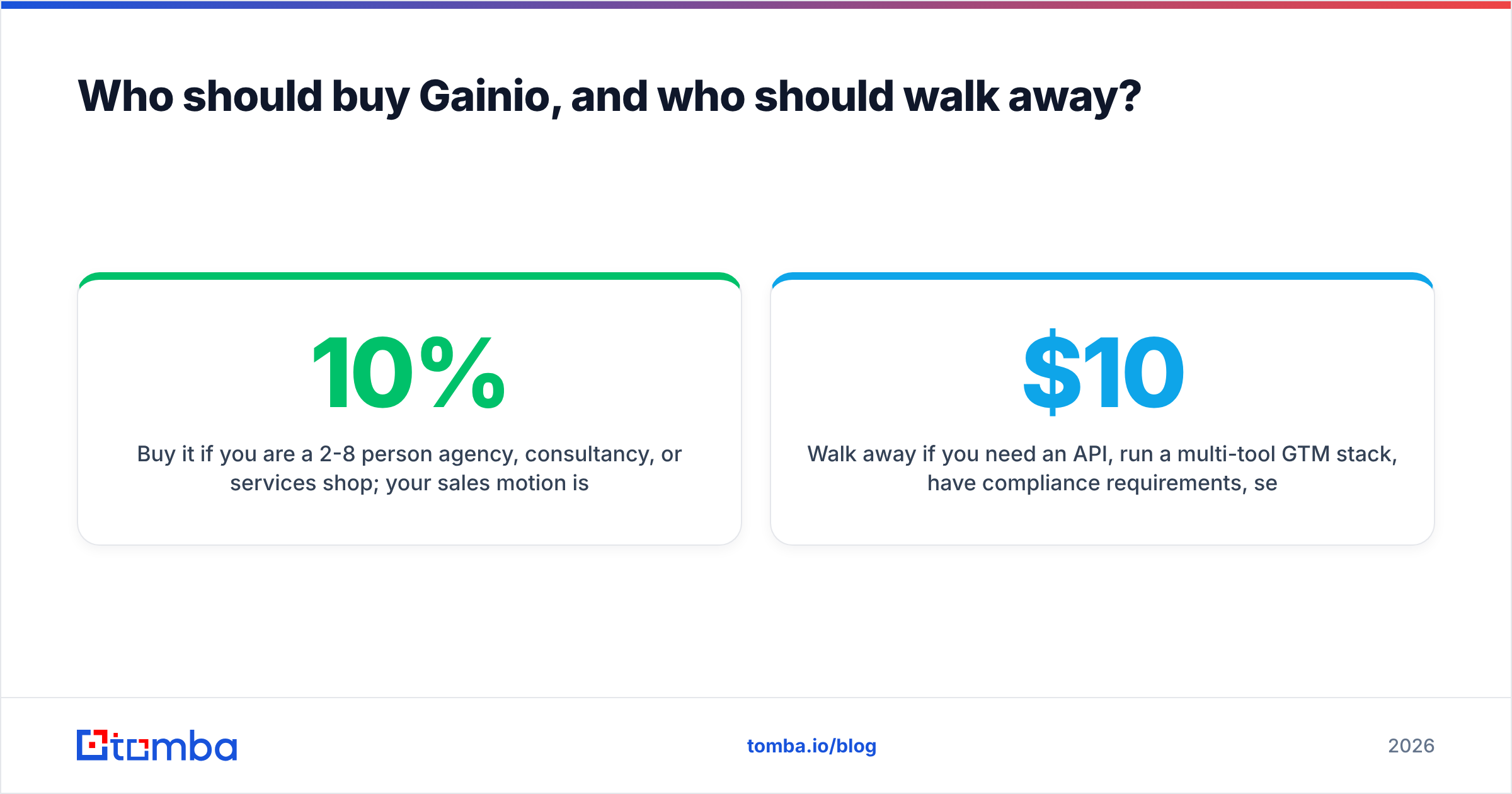
Buy it if you are a 2-8 person agency, consultancy, or services shop; your sales motion is proposal-heavy; your current CRM is a spreadsheet or an overpriced tool you use 10% of; and you can absorb the risk of a young vendor. Run the 10-user trial against a live pipeline for two weeks, then export everything on day 13 to test the escape hatch.
Walk away if you need an API, run a multi-tool GTM stack, have compliance requirements, sell into enterprise, or need a vendor with a support SLA and a five-year track record. The $10/seat saving versus Pipedrive is $1,200 a year on a 10-person team. That is less than one week of engineering time spent working around a missing integration.
Wait if you like the product but want evidence. Set a reminder for two quarters out and check whether the review count has moved off zero. A CRM that survives its first hundred paying customers looks very different from one that has not shipped past a waitlist.
What does Gainio pricing not cover, and how do you fill that gap?#
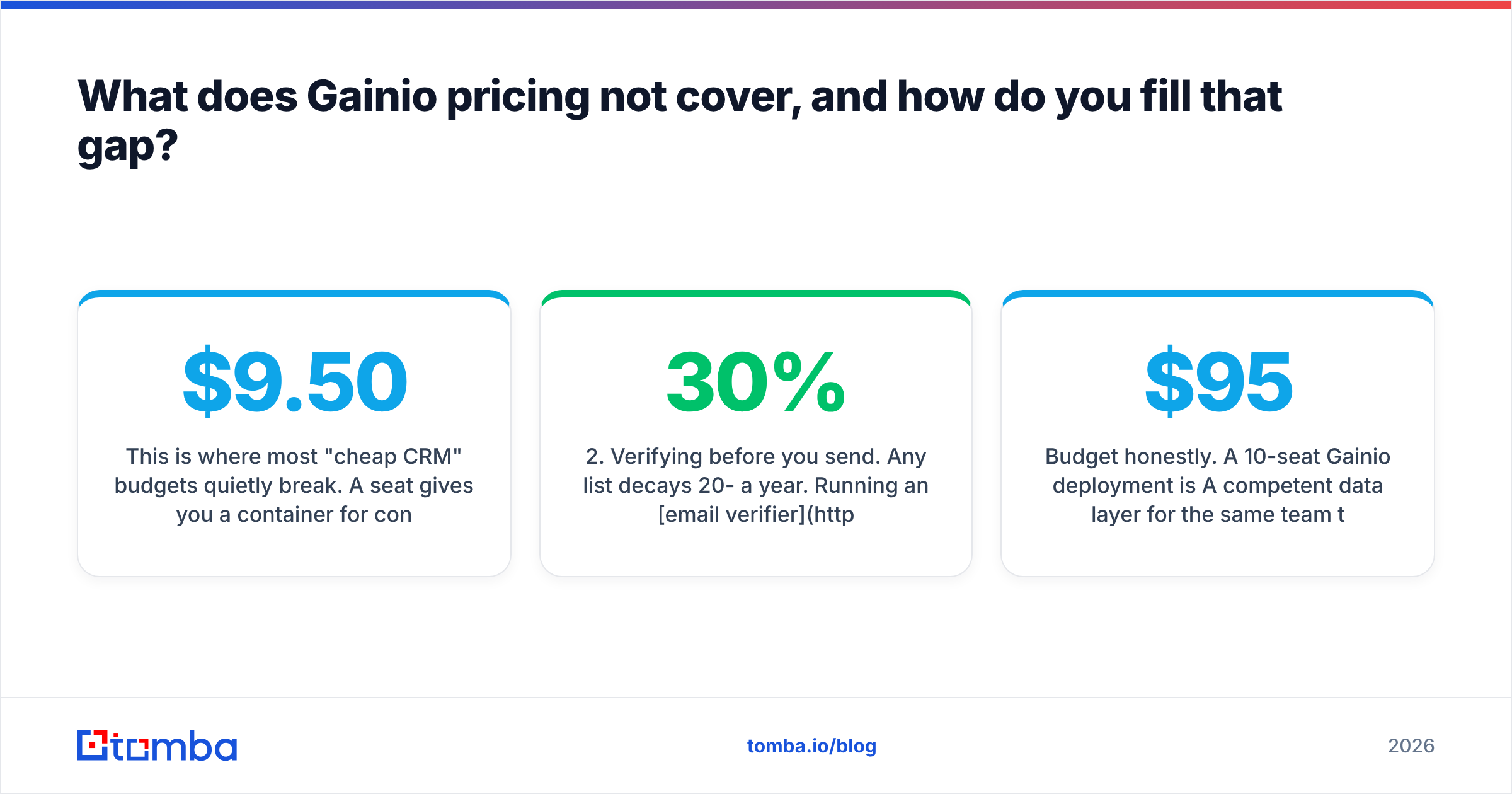
This is where most cheap-CRM budgets quietly break. A $9.50 seat gives you a container for contacts. It gives you exactly zero contacts.
For an outbound-led team, the data layer usually costs more than the CRM does:
- Finding the contact. Names from LinkedIn or a conference list are not addresses. An email finder turns a first name, last name, and company domain into a deliverable work address. A domain search pulls the published addresses at a target company in one call.
- Verifying before you send. Any list decays 20-30% a year. Running an email verifier pass before import keeps bounce rates under the 2% mark that mailbox providers watch, and keeps junk records out of your brand-new CRM.
The last two steps are where a missing API starts to hurt:
- Enriching the record. Title, seniority, company size, and tech stack turn a name into a segment. Data enrichment fills those fields so your pipeline stages mean something.
- Piping it in automatically. With a mature CRM you would wire enrichment straight into the record. Here you export CSVs by hand. If automation matters, that alone should push you toward a CRM with an open API. See how a HubSpot integration handles the same job without manual steps.
Budget honestly. A 10-seat Gainio deployment is $95 a month. A competent data layer for the same team usually runs $49-$249 a month depending on volume. You can check Tomba pricing for a concrete sense of the tiers: a free plan at 25 searches a month, then $49/mo Starter, $99/mo Growth, and $249/mo Pro. The CRM is the cheap part of the stack. That is exactly why squeezing it for the last dollar is usually the wrong place to spend your evaluation energy.
Gainio pricing reviews pros and cons: is it worth it in 2026?#
Conditionally yes, for a very specific buyer, with a very specific test.
The pricing is honest, the offers module is a real differentiator, and $9.50 a seat is low enough that a failed pilot costs time rather than money. What you cannot get is confirmation from anyone else that it works. That is the whole tension in the Gainio pricing reviews pros and cons question: the numbers check out, the evidence does not exist yet. Until reviews exist, treat Gainio as a pilot candidate rather than a system of record. Run the 10-user trial, load real deals, publish a real offer to a real client, then export the whole database and confirm the file is clean. If all three pass, the price is a bargain. If the export is messy, you learned it for free.
Whichever CRM you land on, remember that the container is not the contents. Your pipeline is only as good as the addresses in it.
Ready to fill your CRM with contacts that actually deliver? Start with the Tomba Email Finder — 25 free searches a month, no card, verified work addresses by name and domain, so whatever CRM you pick has real people in it on day one.
Related guides#
Ready to find emails that actually work?
Join 150,000+ professionals who stopped guessing and started sending. Free credits on signup — no credit card required.
Get the Tomba newsletter
Practical outbound tactics and product updates — once every two weeks.
About the author