Gallabox vs Wati (2026): WhatsApp Business API Compared
Gallabox and Wati both sell the same WhatsApp Business API underneath, so the real decision comes down to pricing model, automation depth, and who owns your contact data. Here is the honest breakdown.
TL;DR
- Gallabox and Wati are both official Meta Business Solution Providers reselling the same WhatsApp Business API, so message delivery and template rules are identical on both. The difference is the software wrapped around it.
- Wati is the more mature, support-desk-shaped product with a large template library, a strong Shopify ecosystem, and heavier per-seat pricing on higher tiers.
- Gallabox leans sales-and-CRM: contact properties, drip sequences, lead routing, and a cheaper entry point for small teams that want a shared inbox plus a bot builder.
- Neither tool finds you contacts. Both start working only after you already have a phone number and a documented opt-in — which is where most WhatsApp programmes actually fail.
- Pick Wati if support volume and template variety drive your usage. Pick Gallabox if you want lightweight CRM behaviour without buying a second system.
What are Gallabox and Wati?#
Both companies sell the same underlying pipe. Meta does not let you plug into the WhatsApp Business API directly unless you are a large enterprise with your own tech team; instead you go through a Business Solution Provider (BSP) that handles the number registration, template approvals, and message routing. Gallabox and Wati are both in that category.
That matters more than most comparison posts admit. Deliverability, template rejection rates, the 24-hour customer service window, quality ratings, and per-conversation charges are all set by Meta, not by the vendor. If a salesperson tells you their platform "gets better WhatsApp delivery," they are selling you something Meta controls.
What you are actually buying is:
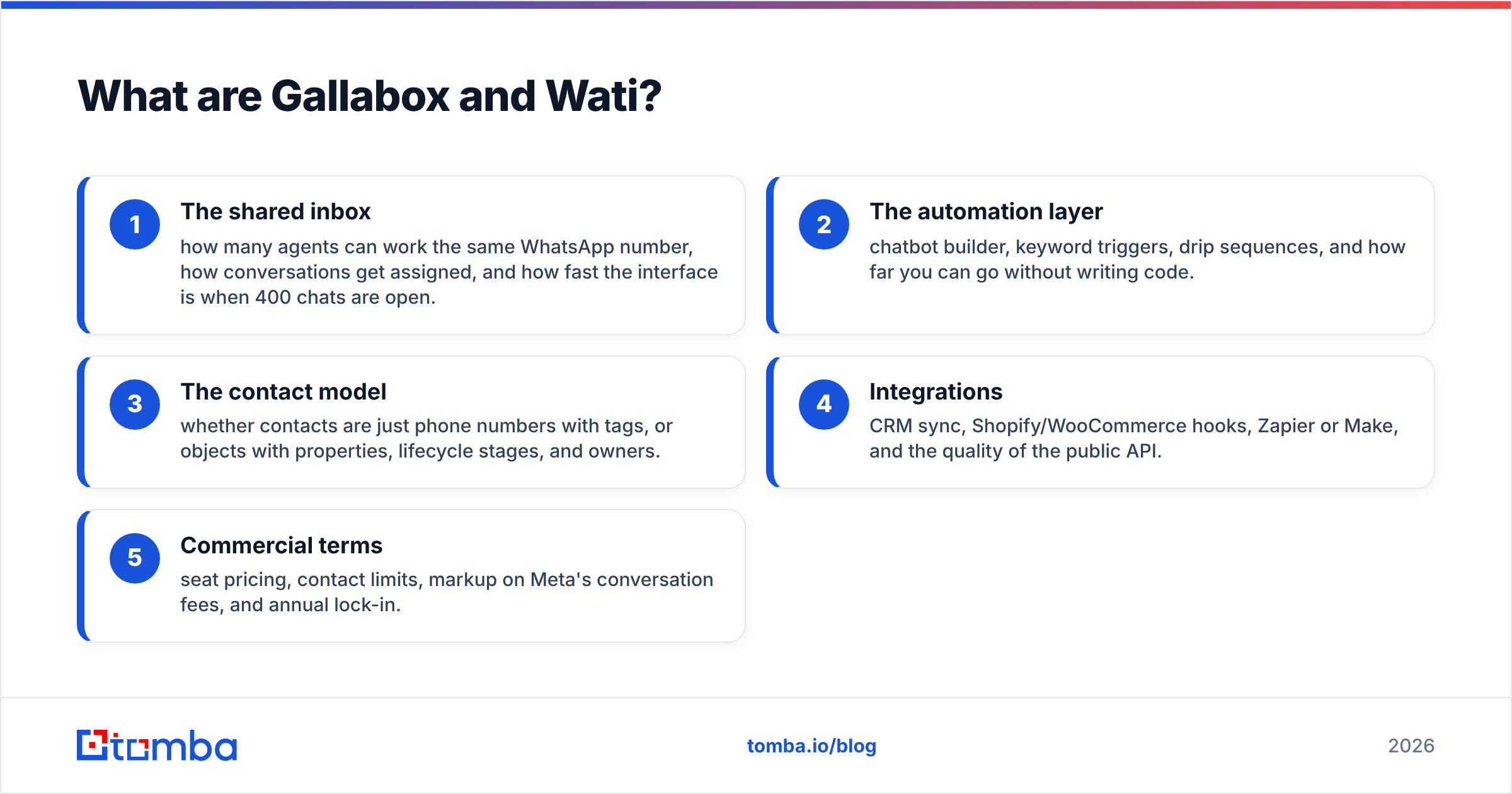
- The shared inbox — how many agents can work the same WhatsApp number, how conversations get assigned, and how fast the interface is when 400 chats are open.
- The automation layer — chatbot builder, keyword triggers, drip sequences, and how far you can go without writing code.
- The contact model — whether contacts are just phone numbers with tags, or objects with properties, lifecycle stages, and owners.
- Integrations — CRM sync, Shopify/WooCommerce hooks, Zapier or Make, and the quality of the public API.
- Commercial terms — seat pricing, contact limits, markup on Meta's conversation fees, and annual lock-in.
Wati launched earlier and grew through the e-commerce and customer-support crowd. Gallabox came in with a sales-first framing: treat WhatsApp as a pipeline channel, not a helpdesk channel. That positioning still shows in both products.

How do Gallabox and Wati compare head-to-head?#
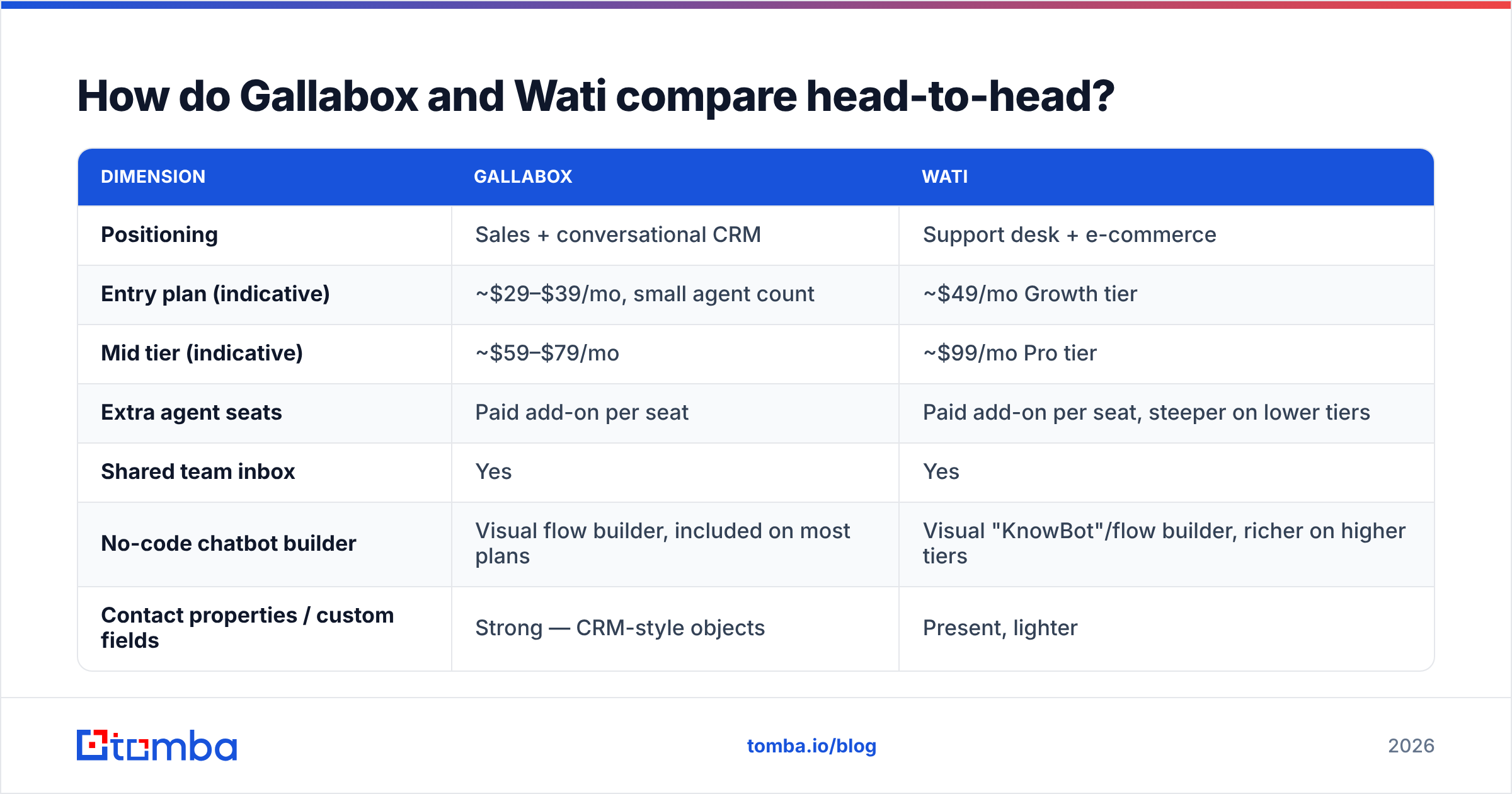
Here is the practical comparison. Treat the pricing row as indicative — both vendors reprice regularly and run region-specific plans (India, UAE, and global rates differ), so confirm on their own pricing pages before you sign.
| Dimension | Gallabox | Wati |
|---|---|---|
| Positioning | Sales + conversational CRM | Support desk + e-commerce |
| Entry plan (indicative) | ~$29–$39/mo, small agent count | ~$49/mo Growth tier |
| Mid tier (indicative) | ~$59–$79/mo | ~$99/mo Pro tier |
| Extra agent seats | Paid add-on per seat | Paid add-on per seat, steeper on lower tiers |
| Shared team inbox | Yes | Yes |
| No-code chatbot builder | Visual flow builder, included on most plans | Visual "KnowBot"/flow builder, richer on higher tiers |
| Contact properties / custom fields | Strong — CRM-style objects | Present, lighter |
| Broadcast + segmentation | Yes, list and attribute based | Yes, strong template library |
| Shopify / WooCommerce | Supported | Deeper native e-commerce flows |
| Native CRM sync | HubSpot, Zoho, Pipedrive, Zapier | HubSpot, Zoho, Zapier, Make |
| Public API + webhooks | Yes | Yes, well documented |
| Meta conversation fees | Passed through, some plans bundle credits | Passed through, markup varies by region |
| Best for | 3–20 rep sales teams working inbound leads | Support and order-status heavy operations |
The honest summary: these are peer products, not a strong-vs-weak matchup. Independent review aggregation on G2 puts them within a rounding error of each other on satisfaction. Your decision is about shape, not quality.
Which one is better for sales teams?#
Gallabox, in most cases — because of the contact model.
Think of it like the difference between a shared email inbox and a CRM. Both hold messages. Only one of them tells you that this person is a returning lead who downloaded a pricing sheet in March, is owned by Priya, and has a deal value attached. Gallabox stores contact attributes as first-class fields you can segment, route, and automate against. That means you can build a flow like: new inbound WhatsApp message → detect intent from keywords → set lifecycle = MQL → assign to the rep who owns that region → fire a follow-up sequence if no reply in 48 hours.
Wati can do most of that, but you feel the helpdesk DNA. Assignment and tagging are excellent; multi-property segmentation takes more workarounds or a CRM sync to do properly.
Where Wati pulls ahead for sales is volume broadcasting. If your motion is "send 8,000 approved templates about a new collection and route the repliers," Wati's template management and broadcast tooling is more battle-tested, especially with e-commerce catalogs attached.
One more thing that decides this for a lot of teams: seat economics. If you have 12 reps who all need inbox access, per-agent add-on costs dominate the sticker price on both platforms. Model the real number — base plan plus seats plus Meta conversation fees — before comparing headline tiers.
Which one is better for support and e-commerce?#
Wati. Three concrete reasons:
- Order and catalog flows. Native Shopify and WooCommerce integrations that fire abandoned-cart, order-confirmation, and shipping-update templates with less glue code.
- Template depth. A larger library of pre-approved template patterns, which shortens the painful Meta approval cycle when you are launching.
- Agent workflows. Canned replies, assignment rules, and SLA-ish behaviours are more developed, which matters when six agents share one number during a sale.
Gallabox handles support fine. It just was not built with a ticket queue as the centre of gravity.
What does WhatsApp actually cost beyond the software fee?#
This is the line item that surprises teams, and neither vendor controls it.
Meta charges per conversation, priced by category and country. Marketing conversations cost several times what service conversations cost, and rates vary wildly between markets — India is cheap, Brazil and the US are not. Read Meta's own WhatsApp pricing documentation before you build a business case, because the platform subscription is often the smaller half of your bill.
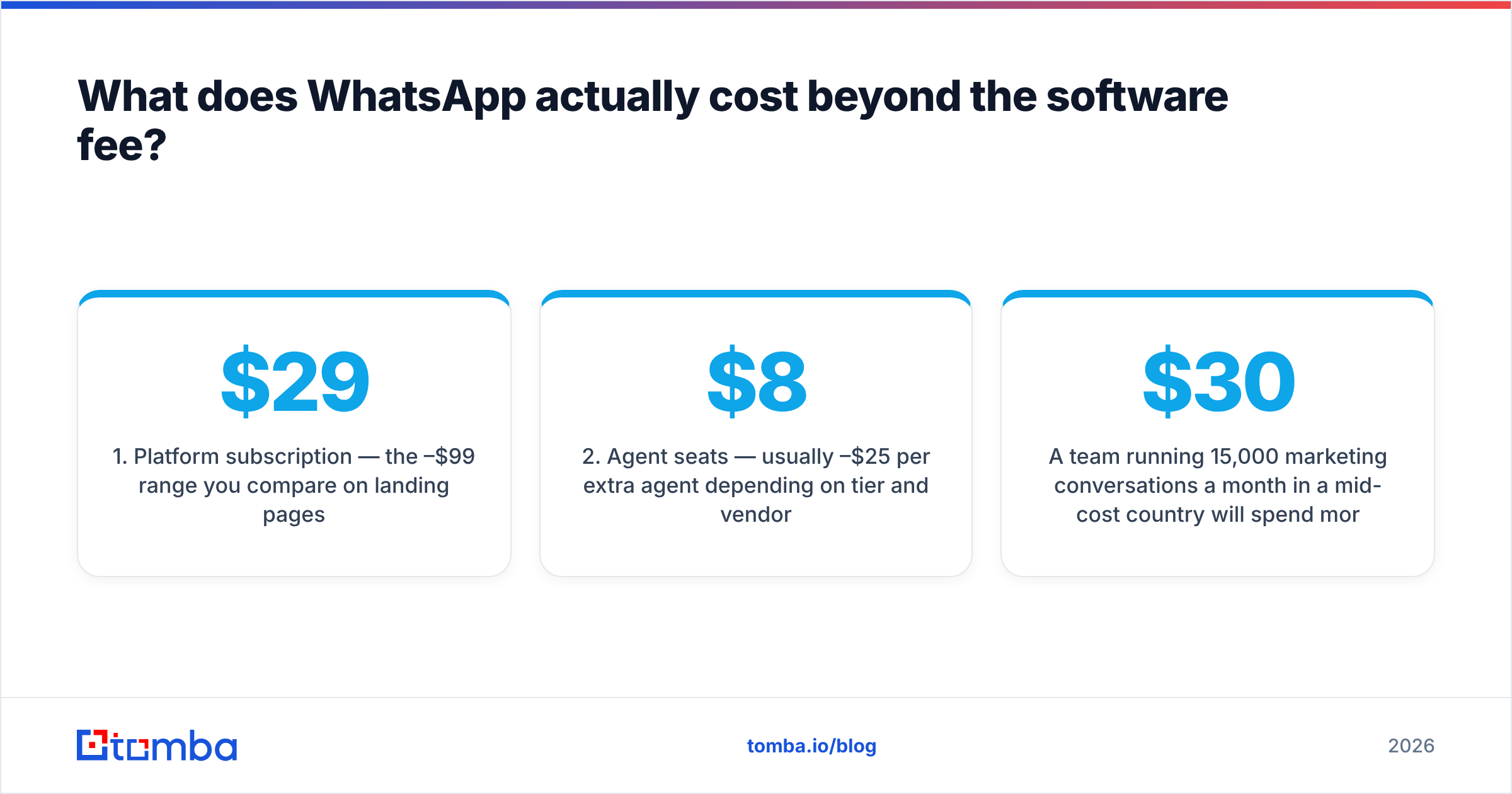
Budget in three layers:
- Platform subscription — the $29–$99/mo range you compare on landing pages.
- Agent seats — usually $8–$25 per extra agent per month depending on tier and vendor.
- Meta conversation charges — per-conversation, category-dependent, uncapped. A 10,000-message marketing campaign can cost more than a full year of software.
A team running 15,000 marketing conversations a month in a mid-cost country will spend more on Meta fees than on Gallabox and Wati combined. That reality should reframe the comparison: a $30/mo difference in subscription is noise. Whichever platform reduces wasted sends — better segmentation, better opt-in hygiene, fewer messages to dead numbers — wins on total cost.
What do both tools require before they work at all?#
A valid phone number and a legitimate opt-in. Neither platform gives you either one.
This is the gap that quietly kills WhatsApp programmes. You buy the software, connect the number, build a beautiful bot flow, and then discover your contact list is a spreadsheet of half-formatted mobile numbers scraped from a webinar signup two years ago. Templates get sent, recipients report them, your quality rating drops from Green to Yellow to Red, and Meta throttles your messaging limits. Recovering a burned number is slow and sometimes impossible.
Build the data layer before the messaging layer:
- Validate every number before import. Run the list through a phone validator so you are not sending templates to landlines, disconnected lines, or malformed international formats. Each bad send still costs a Meta conversation charge.
- Source numbers legitimately. A phone finder tied to verified company data beats a scraped list, both for accuracy and for defensibility if someone asks where the number came from.
- Enrich before you segment. Job title, company size, and industry turn a phone list into segments worth targeting. Contact enrichment fills those fields so your Gallabox properties or Wati attributes are actually populated.
- Keep an email fallback. WhatsApp opt-in is stricter than email in most jurisdictions. Teams that run both channels use a verified email as the first-touch channel and reserve WhatsApp for contacts who explicitly said yes. Run the list through an email verifier so that fallback does not bounce either.
Opt-in is not a formality. Meta's quality system is reactive to user reports, and users report messages they did not ask for. No amount of platform tuning fixes a list problem.
How do you decide between Gallabox and Wati?#
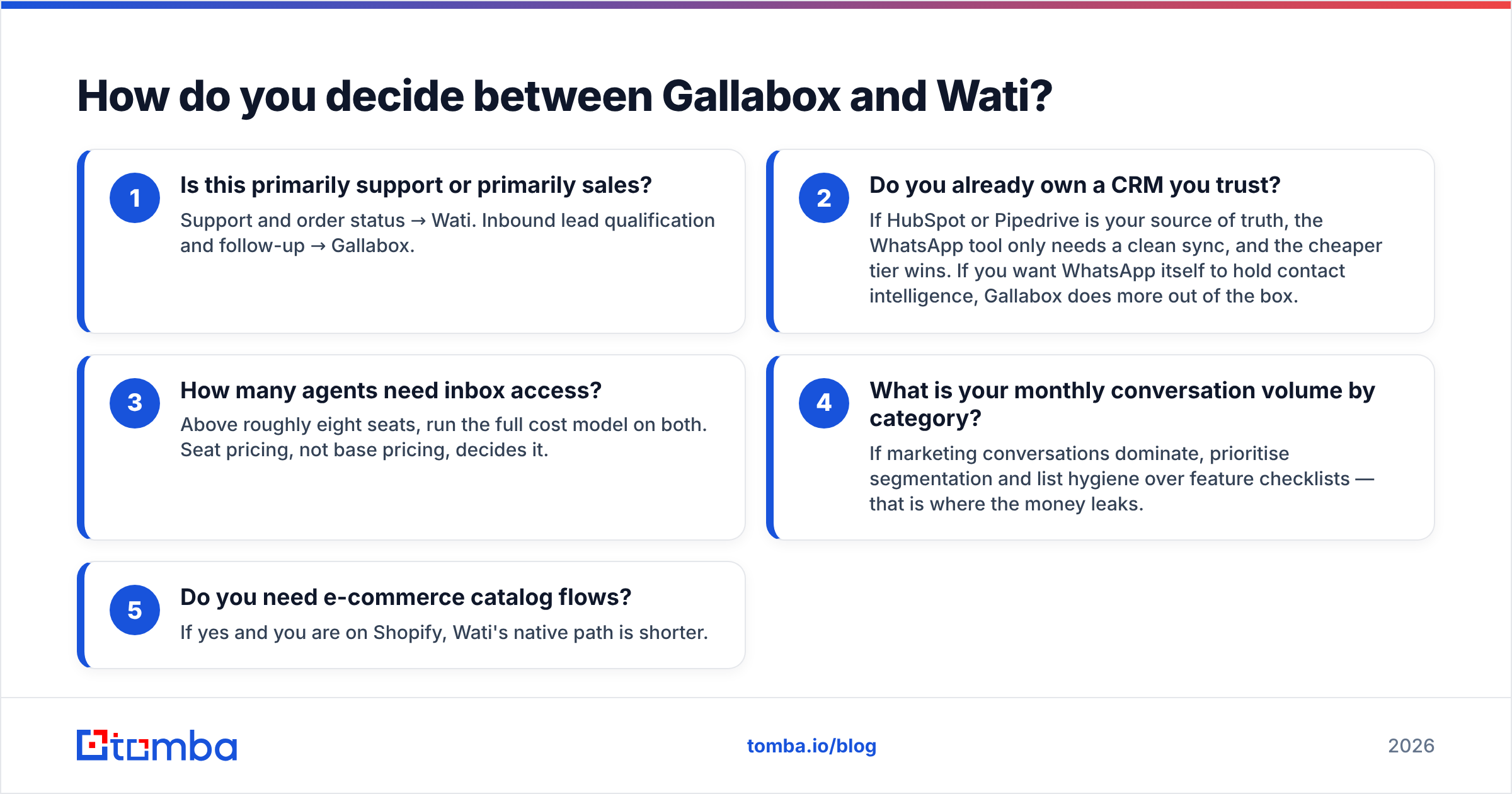
Work through these five questions in order. The first one that produces a clear answer is your answer.
- Is this primarily support or primarily sales? Support and order status → Wati. Inbound lead qualification and follow-up → Gallabox.
- Do you already own a CRM you trust? If HubSpot or Pipedrive is your source of truth, the WhatsApp tool only needs a clean sync, and the cheaper tier wins. If you want WhatsApp itself to hold contact intelligence, Gallabox does more out of the box.
- How many agents need inbox access? Above roughly eight seats, run the full cost model on both. Seat pricing, not base pricing, decides it.
- What is your monthly conversation volume by category? If marketing conversations dominate, prioritise segmentation and list hygiene over feature checklists — that is where the money leaks.
- Do you need e-commerce catalog flows? If yes and you are on Shopify, Wati's native path is shorter.
Still tied after all five? Run both trials with the same 200-contact segment and the same three template messages. Measure reply rate, time-to-first-response, and how long it took your team to build the bot flow. Two weeks of real usage beats two months of feature-matrix debate.
What are the common mistakes teams make with either platform?#
- Treating WhatsApp like email volume. A 10,000-recipient blast that works on email will get your number quality-rated down on WhatsApp within days. The channel rewards precision, not reach.
- Ignoring the 24-hour service window. Outside that window you can only send approved templates. Teams that plan free-form follow-ups discover this after building the workflow.
- Skipping template pre-approval time. Meta review can take hours or days, and rejections are common for promotional phrasing. Draft templates a week before launch.
- Not deduplicating contacts. The same person imported three times from three sources gets three messages and reports you once. Clean the list with a deduplication pass before import.
- Buying annual before validating fit. Both vendors discount annual heavily. Do not take the discount until a monthly trial has survived a real campaign.
- Assuming the vendor owns deliverability. They do not. Your quality rating is a function of your list and your content.
Is there a scenario where you should pick neither?#
Yes. If your buyers are enterprise B2B in North America or Western Europe, WhatsApp may simply not be where they work. Consumer WhatsApp penetration is enormous in India, LATAM, the Middle East, and Southeast Asia; it is far weaker as a business channel in the US. Paying for a WhatsApp platform to reach an audience that treats WhatsApp as family-only is an expensive way to learn a market lesson.
In that case, put the budget into verified email and phone data plus a sequencing tool, and revisit WhatsApp when a meaningful share of your inbound conversations already arrive there.
Which one wins?#
There is no single winner, and any post that declares one is selling an affiliate link. Wati is the safer choice for support-led and e-commerce operations with high template volume. Gallabox is the better fit for small sales teams that want CRM-shaped contact handling without stacking another subscription. Both ride the same Meta rails, both charge you for seats, and both are only as good as the contact list you feed them.
Which brings the decision back to the thing neither vendor sells: accurate, opt-in-safe contact data. If your WhatsApp numbers came from a scrape, no platform choice saves the campaign.
Start with the data layer. Use the Tomba Email Finder to build a verified contact base from company domains and names, enrich it with job titles and firmographics, then push only the opted-in, validated records into whichever WhatsApp platform you pick. The free tier gives you 25 searches a month to test accuracy on your own target accounts, and paid plans start at $49/mo — see Tomba pricing for the full breakdown. Get the list right first; the messaging tool is the easy part.
Related guides#
Ready to find emails that actually work?
Join 150,000+ professionals who stopped guessing and started sending. Free credits on signup — no credit card required.
Get the Tomba newsletter
Practical outbound tactics and product updates — once every two weeks.
About the author