Gamalogic Pricing, Reviews, Pros and Cons: 2026 Breakdown
A neutral 2026 teardown of Gamalogic's credit-based pricing, real user reviews, accuracy limits, and the honest pros and cons — plus how the per-lead cost compares to Tomba, Hunter, and Apollo.
TL;DR
- Gamalogic sells email finding and verification on a credit-bundle model, not a flat seat price — your real cost depends entirely on how many credits get burned on misses.
- Reviews skew positive on price-per-credit and API simplicity, and negative on coverage gaps for smaller domains and support response times.
- The pricing page is not the number that matters. The number that matters is cost per usable, verified email after bounces and catch-alls.
- If you send cold email, budget for verification separately — a finder that returns a "guess" without an SMTP check quietly shifts cost onto your sender reputation.
- Flat-rate alternatives like Tomba pricing ($49/mo Starter, $99/mo Growth, $249/mo Pro) are easier to forecast; credit bundles win when your volume is spiky and occasional.
What is Gamalogic and who is it actually for?#
Gamalogic is a B2B contact-data tool built around two jobs: finding a work email from a name plus a domain, and verifying whether an email is deliverable. It ships a web app, bulk CSV processing, and a REST API, and it's positioned toward developers and small teams who want to buy data access without a sales call. You can see the current product lineup on the official Gamalogic site.
The buyer profile it fits best:
- Solo founders and small agencies doing 500–5,000 lookups a month who don't want a subscription seat they'll under-use.
- Developers wiring enrichment into an internal CRM or a scraper pipeline, where an API key matters more than a slick UI.
- Spiky users — one big list build a quarter, then near-zero usage — where a credit bundle beats a monthly plan you forget to cancel.
- Price-sensitive teams benchmarking multiple providers and willing to route each lookup to whichever vendor returns a hit.
It fits worst for teams that need firmographics, intent data, or phone numbers in the same record. That's a different product category — closer to Apollo or ZoomInfo — and pricing it against a lookup tool is an apples-to-oranges comparison people make constantly.
How does Gamalogic pricing work in 2026?#
Short answer: you buy credits, and one credit is one lookup — hit or miss rules vary, so read that clause carefully.
Credit models all share the same skeleton, and Gamalogic's is no exception. Prices and bundle sizes change without notice, so treat the vendor's live pricing page as the source of truth and treat this section as a guide to the structure you're buying into.
Here's what actually drives your bill:
- Credit consumption rules. The single most important line in any credit-based contract: are you charged for a search or for a result? Vendors that charge only on a successful find are structurally cheaper even at a higher headline price per credit.
- Bundle tiering. Per-credit cost drops as bundle size rises. A 1,000-credit pack might cost 3–5× more per credit than a 100,000-credit pack.
- Expiry. Credits that expire monthly behave like a subscription. Credits that roll over behave like prepaid inventory. Check which you're getting.
- Verification as a separate line. Finding and verifying are usually metered separately. A "cheap" finder plus a paid verifier can land above a bundled competitor.
- API vs UI parity. Some tools gate the API behind a higher tier. If you're automating, confirm your tier includes it before you buy.

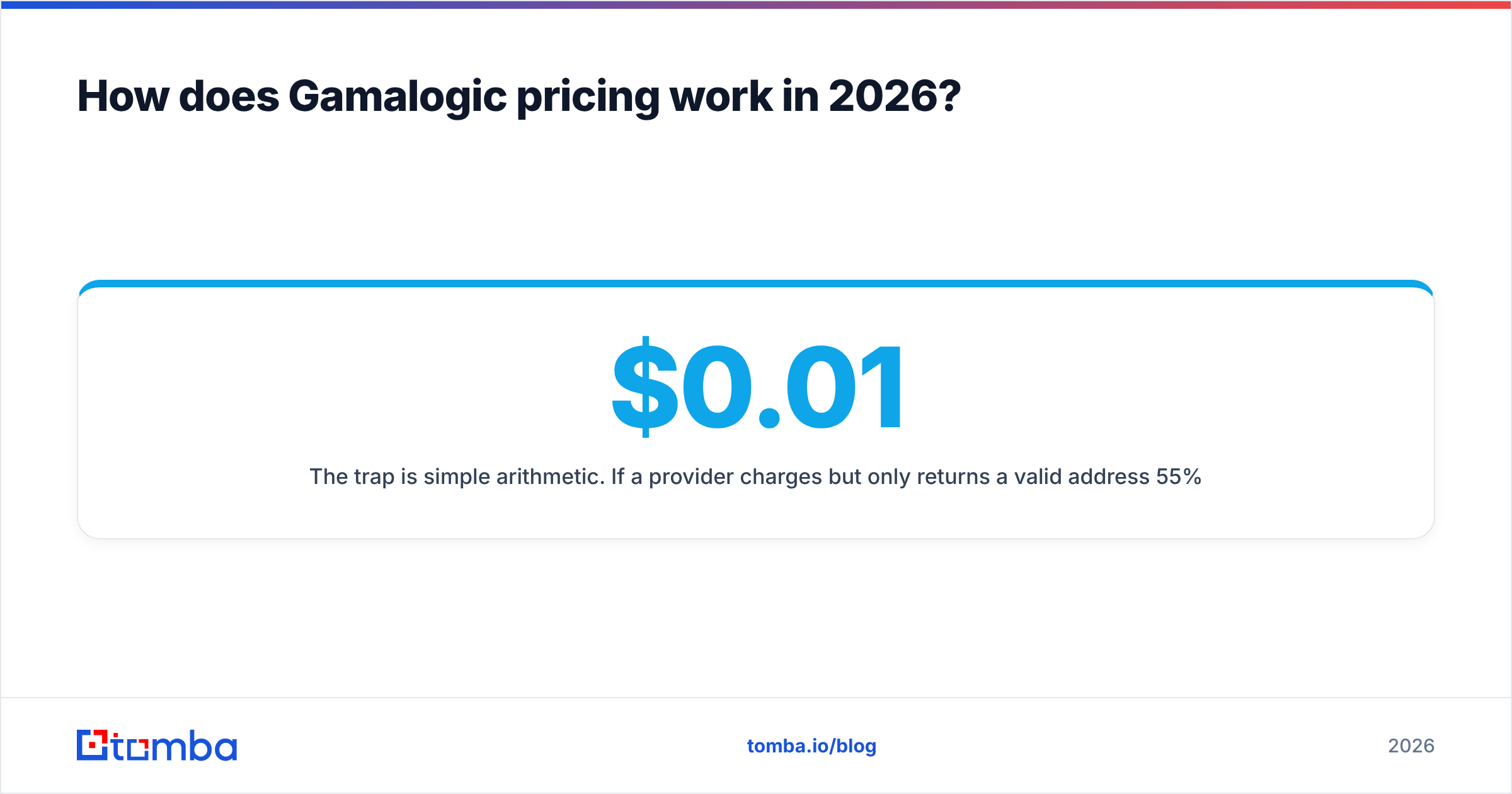
The trap is simple arithmetic. If a provider charges $0.01 per credit but only returns a valid address 55% of the time, your true cost per usable email is roughly $0.018. A provider at $0.02 per credit with an 85% hit rate costs about $0.024 — close enough that support quality and bounce rate decide the winner, not the sticker price.
What do Gamalogic reviews actually say?#
Public review volume for Gamalogic is thinner than for the category leaders, which is itself a data point — you're relying on fewer samples. Check the live listings on G2 and Capterra before you commit, since aggregate scores shift.
The recurring themes across user feedback in this segment break down like this:
What reviewers praise
- Cost per lookup. The most common positive is that the credit price undercuts bigger-name finders at comparable volume.
- API and bulk workflow. Developers report a short time-to-first-call — no lengthy onboarding, no forced demo.
- Straightforward UI. Fewer features means fewer places to get lost. Reviewers who wanted a lookup box and a CSV export got exactly that.
What reviewers criticize
- Coverage on long-tail domains. Hit rates hold up on well-indexed mid-market and enterprise domains, then fall off on small local businesses, freshly registered domains, and non-English-speaking regions.
- Catch-all ambiguity. Like most vendors, results on catch-all domains come back "accept-all" rather than confirmed, and the credit is still spent.
- Support latency. Smaller vendor, smaller support team. Fine for self-serve users, frustrating when a bulk job fails at 3am before a campaign launch.
None of that is disqualifying. It's the standard profile of a lean, price-competitive tool: strong on unit economics, thinner on edge-case coverage and hand-holding.
What are the honest pros and cons of Gamalogic?#
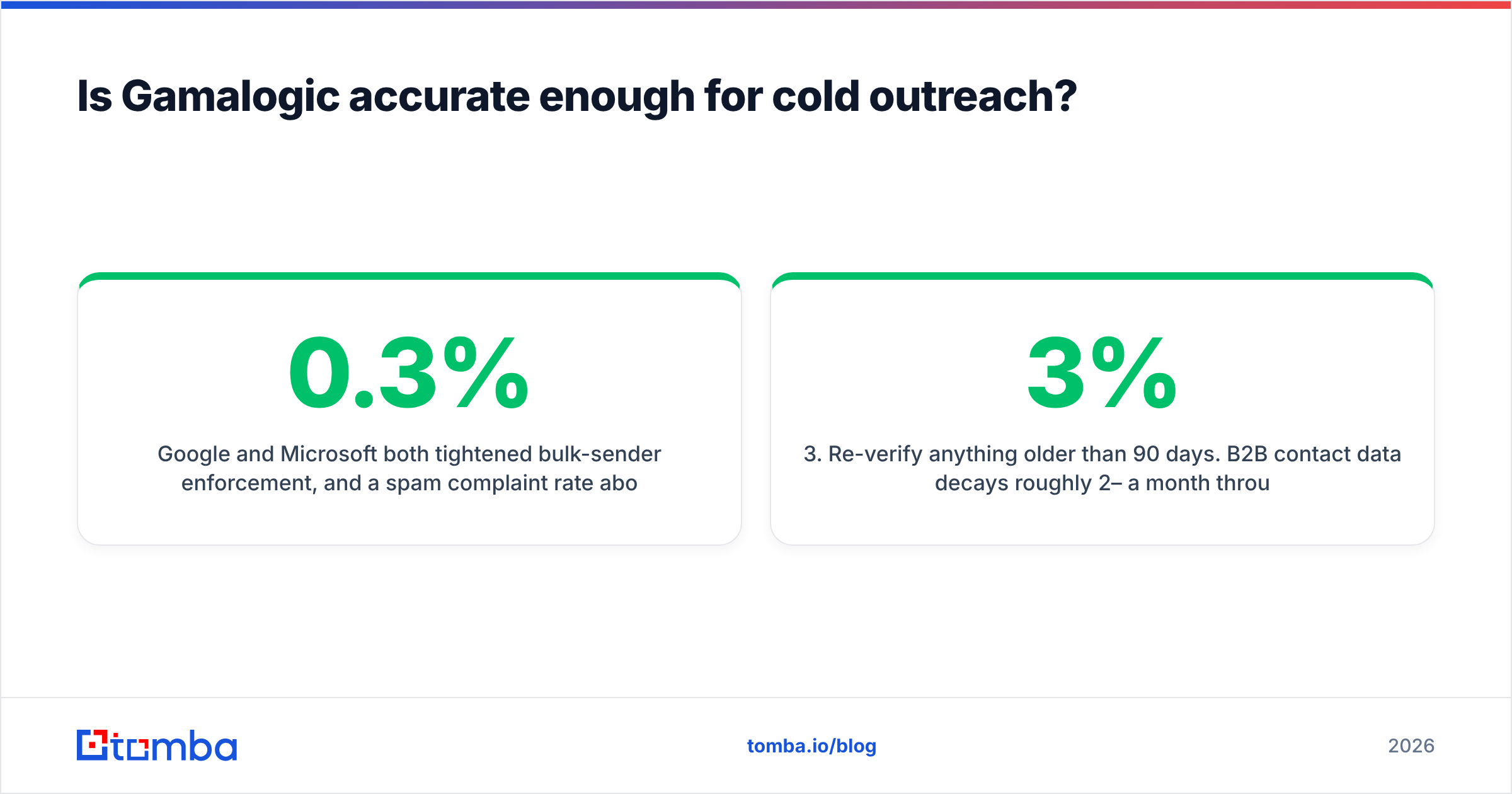
| Dimension | Where Gamalogic is strong | Where it falls short |
|---|---|---|
| Pricing model | Prepaid credits — no seat lock-in, good for spiky usage | Hard to forecast monthly spend; misses can still consume credits |
| Coverage | Solid on established company domains | Weaker on SMB, regional, and newly registered domains |
| Verification | SMTP-level checks available | Catch-all domains return ambiguous results (industry-wide issue) |
| API | Clean REST endpoints, quick integration | Fewer SDKs and no-code connectors than larger vendors |
| Data breadth | Email-focused and does that one job | No phone numbers, firmographics, or intent signals |
| Support | Responsive for self-serve questions | Slower on urgent bulk/API incidents |
| Trial | Free credits to test hit rate | Small sample makes hit-rate benchmarking noisy |
Run your own bake-off before signing anything. Take 200 contacts you already have confirmed emails for, strip the emails, and feed the name-plus-domain pairs to every vendor on your shortlist. Measure hit rate, false positives, and bounce rate on a live send. That test costs you an afternoon and saves you a quarter of wasted spend.
Is Gamalogic accurate enough for cold outreach?#
Accuracy is the only pricing variable that matters, because a bounced email costs far more than the credit that produced it.
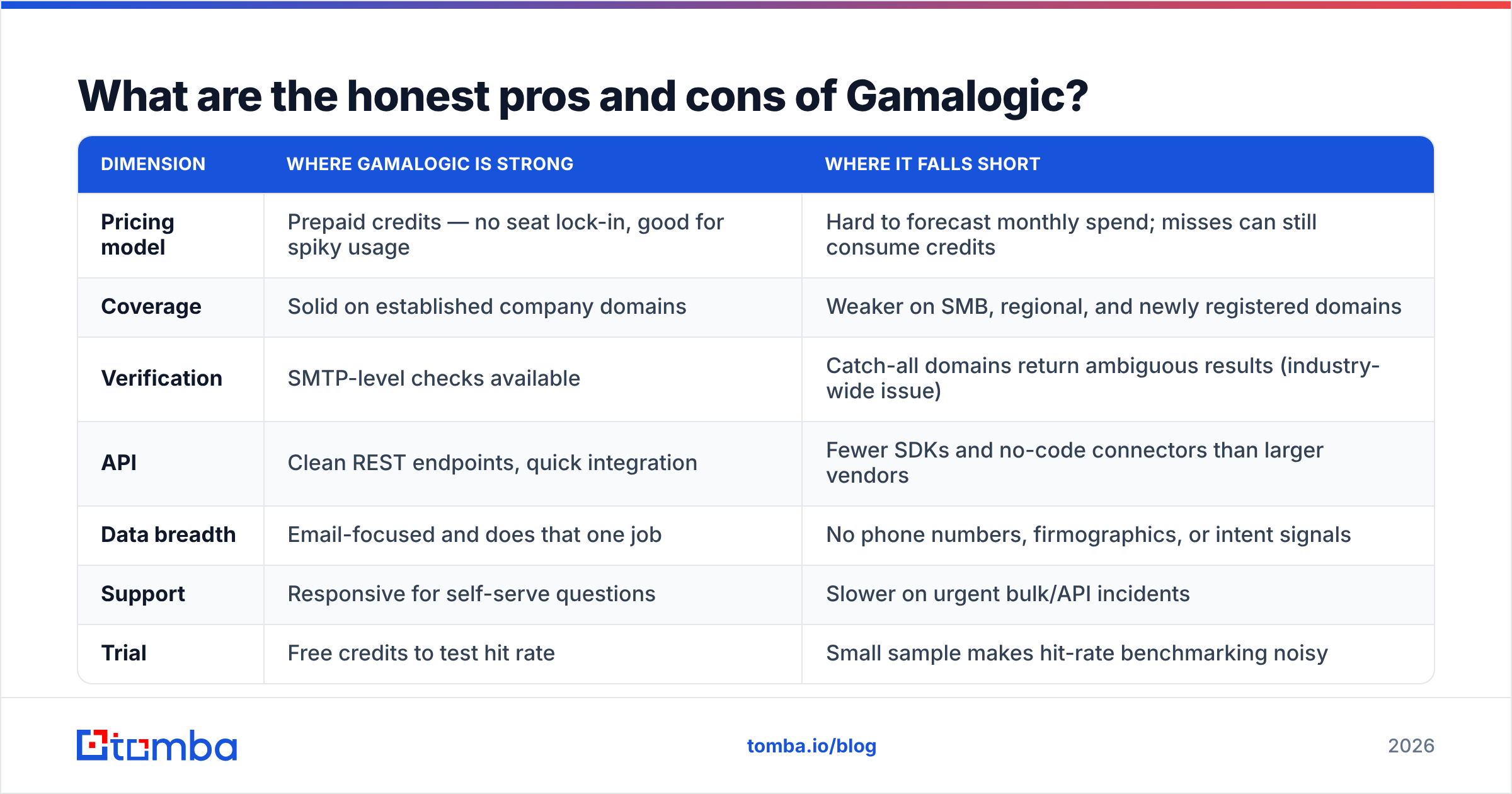
Google and Microsoft both tightened bulk-sender enforcement, and a spam complaint rate above 0.3% now triggers real throttling. A 5% bounce rate on a 2,000-contact campaign doesn't just waste 100 credits — it damages the sender reputation that makes the other 1,900 emails land. That's the asymmetry credit-price comparisons ignore.

Three rules for keeping a credit-based finder safe:
- Never send to an unverified find. Route every discovered address through a dedicated email verifier before it enters a sequence, regardless of which finder produced it.
- Segment catch-alls into their own list. Don't discard them and don't blast them — send low volume from a secondary domain and watch the bounce signal.
- Re-verify anything older than 90 days. B2B contact data decays roughly 2–3% a month through job changes. A list you bought in January is measurably worse by April.
If your outbound motion is high-volume, the deciding factor between vendors will be bounce rate on your ICP, not the published accuracy number on anyone's marketing page.
How does Gamalogic compare to other email finders on price?#
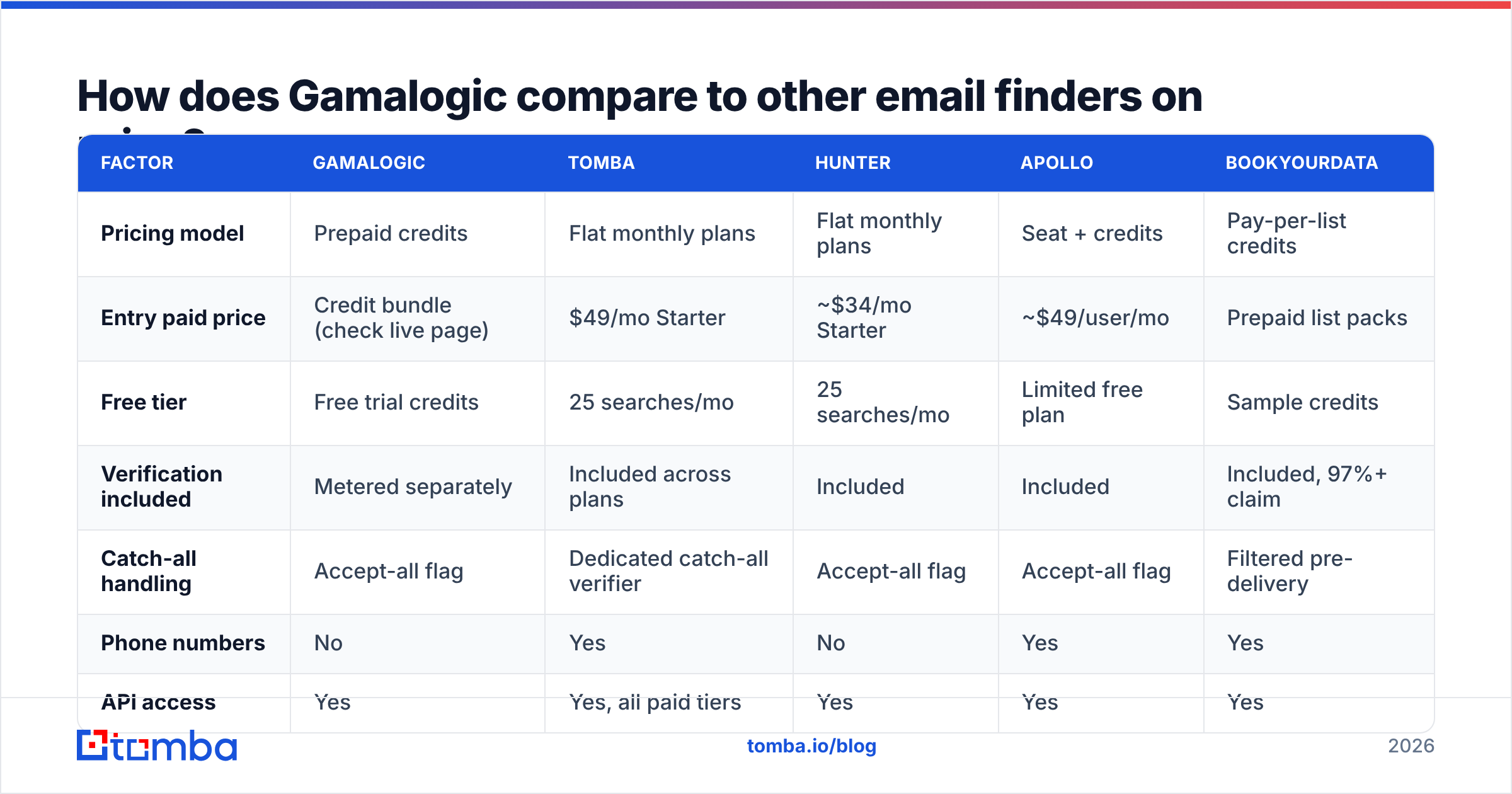
Here's the structural comparison. Flat-rate plans and credit bundles are genuinely different products, and the right pick depends on whether your volume is predictable.
| Factor | Gamalogic | Tomba | Hunter | Apollo | BookYourData |
|---|---|---|---|---|---|
| Pricing model | Prepaid credits | Flat monthly plans | Flat monthly plans | Seat + credits | Pay-per-list credits |
| Entry paid price | Credit bundle (check live page) | $49/mo Starter | ~$34/mo Starter | ~$49/user/mo | Prepaid list packs |
| Free tier | Free trial credits | 25 searches/mo | 25 searches/mo | Limited free plan | Sample credits |
| Verification included | Metered separately | Included across plans | Included | Included | Included, 97%+ claim |
| Catch-all handling | Accept-all flag | Dedicated catch-all verifier | Accept-all flag | Accept-all flag | Filtered pre-delivery |
| Phone numbers | No | Yes | No | Yes | Yes |
| API access | Yes | Yes, all paid tiers | Yes | Yes | Yes |
| Best for | Spiky, low-volume lookups | Predictable monthly outbound | Simple domain search | All-in-one sales engagement | Buying targeted prebuilt lists |

Two honest takeaways from that grid.
BookYourData solves a different problem well: if you want a targeted, pre-verified list delivered rather than a lookup API to integrate, buying the list outright is often faster and cheaper than metering your way to the same result. It's a legitimate pick, not a downgrade.
Flat-rate wins on forecasting. If you know you'll do 5,000–15,000 lookups a month, a $99/mo plan is a line item your CFO ignores. A credit balance you top up unpredictably is a line item you get asked about.

How do you calculate your real cost per lead?#
Use this formula before you buy anything:
Real cost per usable lead = (credit price ÷ hit rate) ÷ (1 − bounce rate)
Work an example. You buy credits at $0.015. The tool returns an address on 70% of lookups. Of those, 6% bounce on send.
- $0.015 ÷ 0.70 = $0.021 per returned address
- $0.021 ÷ 0.94 = $0.023 per deliverable address
Now compare against a flat plan. Tomba's $99/mo Growth tier amortized across, say, 8,000 successful finds lands near $0.012 per address — and it doesn't move when your hit rate does. That's the entire argument for flat pricing: your unit cost improves as your usage rises, instead of staying pinned to a per-credit rate.
The practical checklist for evaluating any finder's pricing:
- Confirm the miss policy — charged on search or on result?
- Confirm expiry — do unused credits roll over?
- Confirm verification is included or price it as a separate line.
- Run a 200-contact bake-off against ground-truth data you already own.
- Send a live 100-email test and record the actual bounce rate, not the vendor's claim.
- Price the annual case at your realistic 12-month volume, not this month's spike.
For step 4 and 5 at scale, a bulk email finder workflow beats manual spot-checking — upload the CSV, compare outputs side by side, and let the bounce data settle the argument.
Who should buy Gamalogic — and who should skip it?#
Buy it if: your volume is genuinely irregular, you're comfortable in an API, you're targeting well-indexed mid-market and enterprise domains, and you already run a separate verification step before sending. The credit model is honest for that profile and the per-lookup economics hold up.
Skip it if: you need phones and firmographics in the same call, you're prospecting into SMB or non-English regions where coverage thins out, you want one predictable invoice, or you need same-day support when a bulk job fails the night before a launch.
The larger point applies to every vendor in this category: the pricing page is a marketing artifact, and your bounce report is the truth. Two tools with identical sticker prices can differ by 2× in real cost per meeting booked, and the only way to know which is which is to test on your own ICP.
Ready to price it against a flat-rate option?#
If unpredictable credit balances are the part of this you want to stop managing, run the same test list through the Tomba Email Finder. The free tier gives you 25 searches a month to sanity-check hit rate on your own domains before spending anything, verification is included on every paid plan rather than metered separately, and the tiers are flat and forecastable at $49/mo Starter, $99/mo Growth, and $249/mo Pro. Build the 200-contact bake-off, compare the deliverable-address cost from both tools, and let your bounce rate pick the winner.
Related guides#
Ready to find emails that actually work?
Join 150,000+ professionals who stopped guessing and started sending. Free credits on signup — no credit card required.
Get the Tomba newsletter
Practical outbound tactics and product updates — once every two weeks.
About the author