Gamalogic vs Generect: Which B2B Email Data Tool Wins in 2026?
Gamalogic and Generect solve the same problem from opposite ends: one starts with verification, the other with company-level lead lists. Here is how they compare on accuracy, pricing, API depth and catch-all handling.
TL;DR
- Gamalogic leads with email finding and verification. It is the closer fit if your bottleneck is "I have names and domains, I need valid mailboxes."
- Generect leads with lead lists and an API-first pipeline built around LinkedIn-shaped company and people data. It fits teams building a data layer, not marketers buying credits.
- Neither publishes a fully transparent self-serve price ladder the way Tomba does, so budgeting means a sales conversation more often than not.
- On raw hit rate, no single vendor wins every vertical. Run the same 200-row test list through both before you commit annual spend.
- If you want a documented API, published pricing from $49/mo, and a free tier to test with, Tomba is the third option most teams should benchmark alongside these two.
What are Gamalogic and Generect?#
They are both B2B contact-data vendors, but they entered the market from different doors.
Gamalogic is positioned as an email finding and email verification service. The pitch is simple: give it a person's name plus a company domain, or upload a bulk list, and get back deliverable addresses with a validity signal attached. Verification is not an afterthought bolted onto a finder — it is a first-class product, sold on its own to teams that already have a list and just want to stop bouncing.
Generect sells lead generation infrastructure. Instead of "find this one email," the framing is "build me a list of people matching these filters, and give me an API so my system can do it repeatedly." Its data model leans heavily on LinkedIn-shaped attributes — headcount, industry, seniority, tenure — and it targets engineering-adjacent buyers who want to pipe leads into their own product or workflow rather than export CSVs.
That difference matters more than any feature checklist. One tool answers is this address real? The other answers who should I be emailing in the first place? Plenty of teams need both, which is why this comparison usually ends with "and what else do I need to bolt on."
How do Gamalogic and Generect compare at a glance?#
Here is the honest side-by-side, with Tomba included as a reference point because it sits between the two on scope.
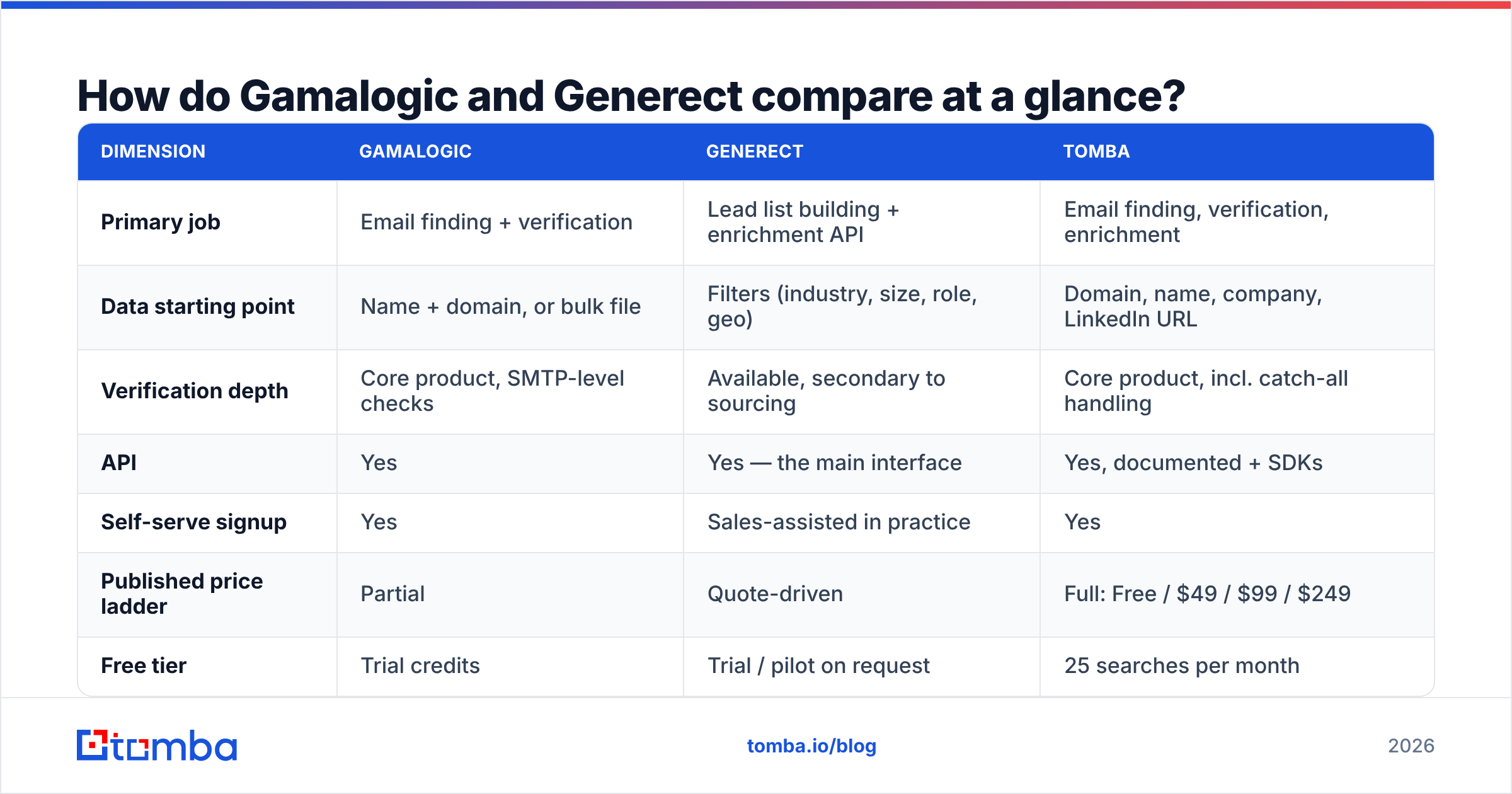
| Dimension | Gamalogic | Generect | Tomba |
|---|---|---|---|
| Primary job | Email finding + verification | Lead list building + enrichment API | Email finding, verification, enrichment |
| Data starting point | Name + domain, or bulk file | Filters (industry, size, role, geo) | Domain, name, company, LinkedIn URL |
| Verification depth | Core product, SMTP-level checks | Available, secondary to sourcing | Core product, incl. catch-all handling |
| API | Yes | Yes — the main interface | Yes, documented + SDKs |
| Self-serve signup | Yes | Sales-assisted in practice | Yes |
| Published price ladder | Partial | Quote-driven | Full: Free / $49 / $99 / $249 |
| Free tier | Trial credits | Trial / pilot on request | 25 searches per month |
| Best for | Cleaning and completing existing lists | Building lists programmatically | Teams that need both without two vendors |
The pattern to notice: Gamalogic and Generect barely overlap on the job to be done. If you are literally choosing between them, you probably have not defined which half of the problem is actually blocking your pipeline.
Corrected placeholder rendering below — the meme sits here:

Which one actually finds more valid emails?#
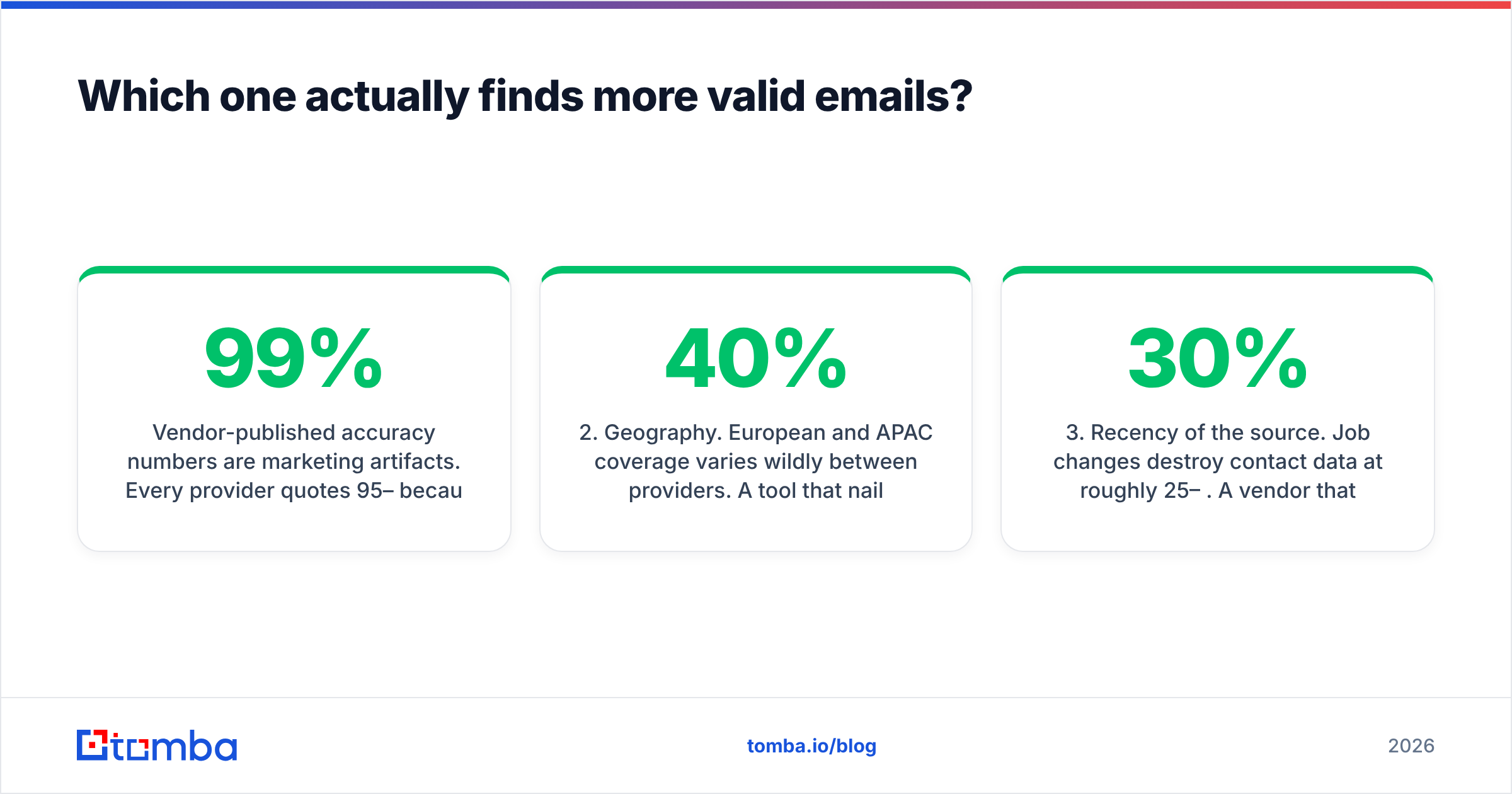
Vendor-published accuracy numbers are marketing artifacts. Every provider quotes 95–99% because every provider measures on a list it already covers well. The number that matters is your hit rate on your ICP.
That said, some structural things predict who will do better on your list:
- Domain concentration. If your targets cluster in a handful of large enterprises, most vendors will do fine — those email patterns are well documented. The spread only appears on long-tail SMB domains.
- Geography. European and APAC coverage varies wildly between providers. A tool that nails US SaaS can drop to 40% hit rate on German Mittelstand.
- Recency of the source. Job changes destroy contact data at roughly 25–30% per year. A vendor that refreshes quarterly will beat one refreshing annually, regardless of database size.
- Catch-all policy. Some vendors return catch-all addresses as "valid" to inflate hit rate. Those inflate your bounce rate later. Check whether the tool labels catch-all separately or quietly counts it as a win.

The practical test takes an afternoon. Take 200 contacts you already have confirmed addresses for — from closed-won deals, webinar signups, support tickets — strip the emails, and run the names and domains through each tool. Compare against ground truth. That single test tells you more than every G2 review combined, and you can read those on G2's email verification category afterward for the qualitative flavour.
Suggested visual: side-by-side screenshots of a Gamalogic bulk verification result page and a Generect list-builder query, both run against the same 200-row test file.
How does pricing actually work for each?#
This is where the comparison gets uncomfortable, because neither vendor makes it easy to model spend before you talk to someone.
Gamalogic publishes credit-based plans and offers self-serve entry, so you can at least estimate a per-credit cost. The variable to watch is whether failed lookups consume credits. On some platforms a search that returns nothing still bills; on others it does not. Over 50,000 monthly lookups at a 60% hit rate, that single policy difference is the whole budget argument.
Generect is quote-driven in practice. That is normal for API-first data vendors — pricing scales with volume, seats, and which enrichment fields you unlock — but it means you cannot compare it to a credit price without a call. If you are a two-person startup testing a channel, that friction is real.
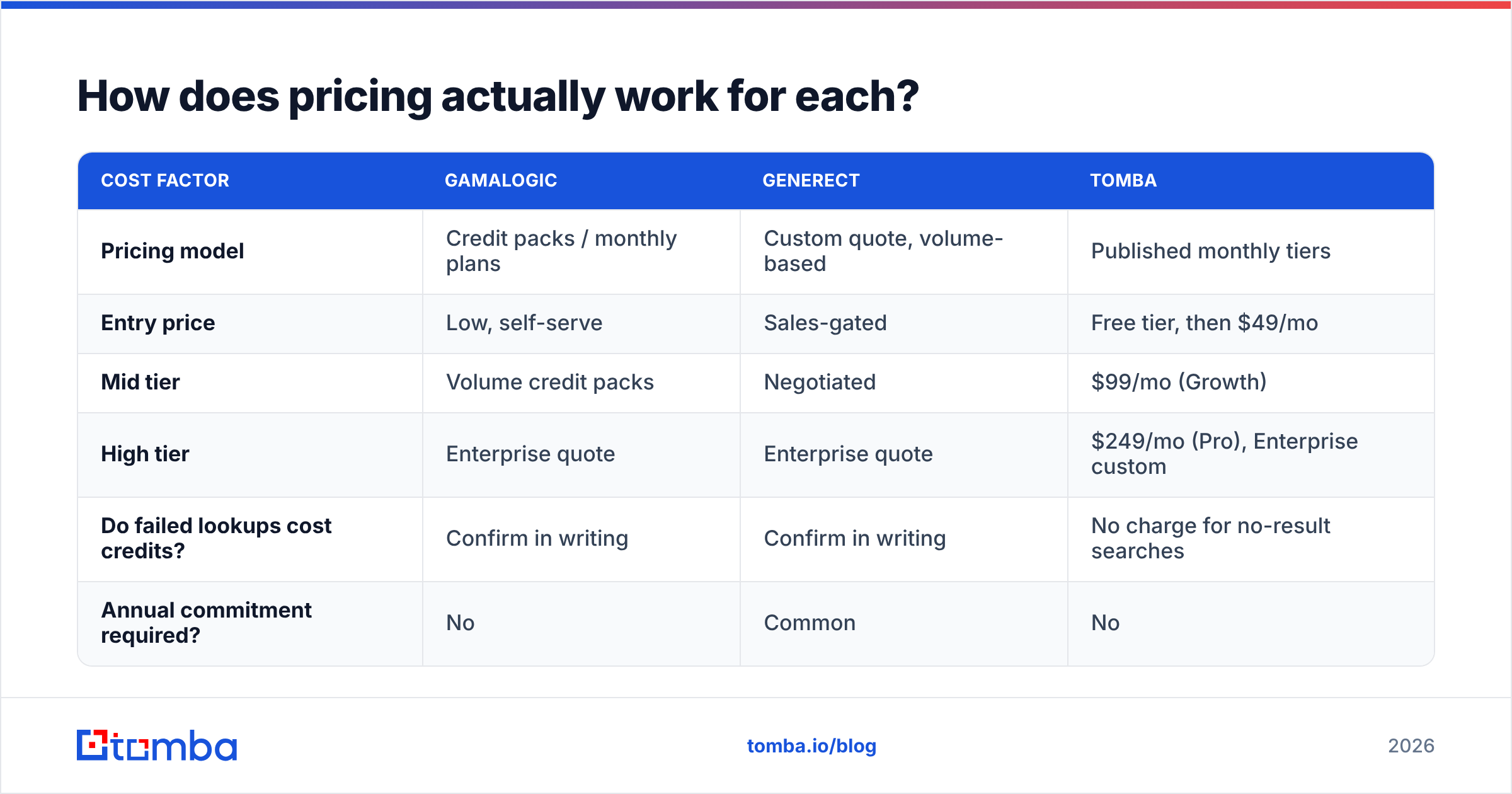
| Cost factor | Gamalogic | Generect | Tomba |
|---|---|---|---|
| Pricing model | Credit packs / monthly plans | Custom quote, volume-based | Published monthly tiers |
| Entry price | Low, self-serve | Sales-gated | Free tier, then $49/mo |
| Mid tier | Volume credit packs | Negotiated | $99/mo (Growth) |
| High tier | Enterprise quote | Enterprise quote | $249/mo (Pro), Enterprise custom |
| Do failed lookups cost credits? | Confirm in writing | Confirm in writing | No charge for no-result searches |
| Annual commitment required? | No | Common | No |
Two rules before you sign anything. First, get the failed-lookup policy in writing — not in a sales call, in the contract or the docs. Second, model your cost per verified, delivered email, not per credit. A cheaper credit that produces a catch-all you cannot safely mail is not cheaper.
For a baseline you can check without a meeting, Tomba pricing is published in full: a free tier at 25 searches per month, Starter at $49/mo, Growth at $99/mo, and Pro at $249/mo.
Is Generect's API better than Gamalogic's?#
For programmatic list building, probably yes — that is its core design. Generect is built for developers who want to embed lead sourcing into a product or an internal tool, so the API surfaces filtering, pagination, and enrichment as first-class concepts rather than as a wrapper around a UI feature.
Gamalogic's API is real and usable, but it is shaped around the finder-and-verifier workflow: submit an identity, get a verdict. If your use case is "verify 100k rows nightly," that is exactly the right shape. If your use case is "give me every VP of Ops at 50–200 person logistics companies in Benelux, refreshed weekly," it is not.
The evaluation questions that actually separate B2B data APIs:
- Rate limits and burst behaviour. What happens at 100 requests/second? Queue, throttle, or 429?
- Bulk vs single endpoints. Is there a real async bulk job endpoint, or do you loop single calls and pretend?
- Webhooks. Can long-running jobs call you back, or must you poll?
- Response schema stability. Are fields versioned? Silent schema changes break production pipelines.
- SDK coverage. Official libraries in your stack, or community wrappers that lag by three releases?
- Sandbox. Can you test without burning paid credits?
If you are building on top of any of these, the Tomba API documentation is a useful reference point for what a documented, versioned contact-data API looks like — including a bulk email finder path for batch jobs rather than looped single calls.
What happens with catch-all domains?#
Catch-all is the single biggest source of "the tool lied to me" complaints in this category, so it deserves its own section.
A catch-all domain accepts mail to any address at that domain — ceo@, asdfgh@, all of it — which means a standard SMTP check cannot prove a specific mailbox exists. Roughly 20–25% of B2B domains are configured this way, and the share is higher in enterprise and in regions with heavy Microsoft 365 usage.
Vendors handle this in one of three ways:
- Label it honestly. Return a distinct
catch-alloraccept-allstatus so you decide the risk. This is the correct behaviour. - Count it as valid. Inflates the advertised hit rate, transfers the bounce risk to you. Watch for this.
- Apply pattern confidence. Combine the catch-all signal with observed pattern data and source corroboration to produce a graded confidence score rather than a binary verdict.
Ask both vendors directly which of the three they do. If the answer is vague, assume option two and test accordingly. Tools that treat this seriously build a dedicated path for it — see how a catch-all verifier is scoped as its own product rather than a footnote in the main verifier.

Which should you pick for your team?#
Decide by workflow, not by feature count.
Pick Gamalogic if: you already have a source of names and companies — an events list, a scraped LinkedIn export, a dormant CRM segment — and your problem is turning it into deliverable addresses. Verification-first tools are underrated here. A 40,000-row CRM with 30% decayed contacts is worth more cleaned than a new list is worth bought.
Pick Generect if: you are building lead sourcing into software, or you need repeatable filtered lists refreshed on a schedule, and you have the engineering time to integrate an API properly. The quote-driven pricing stops being a problem once volume is high enough that per-credit pricing would hurt anyway.
Pick neither, and look wider, if: you need finding, verification, and enrichment from one contract, want to start today without a demo call, or are running under $500/month in data spend. That is the majority of small outbound teams, and it is where a self-serve platform with a published ladder wins on total cost and time-to-first-email.

A fourth path worth naming: run two vendors deliberately. Use the list builder for sourcing and a separate verifier as the gate before anything reaches your sending tool. It costs more per record, but a two-stage pipeline consistently produces lower bounce rates than any single vendor's internal verification, because the second vendor has no incentive to grade its own homework. If you go this route, keep the verifier independent of whoever sold you the list.
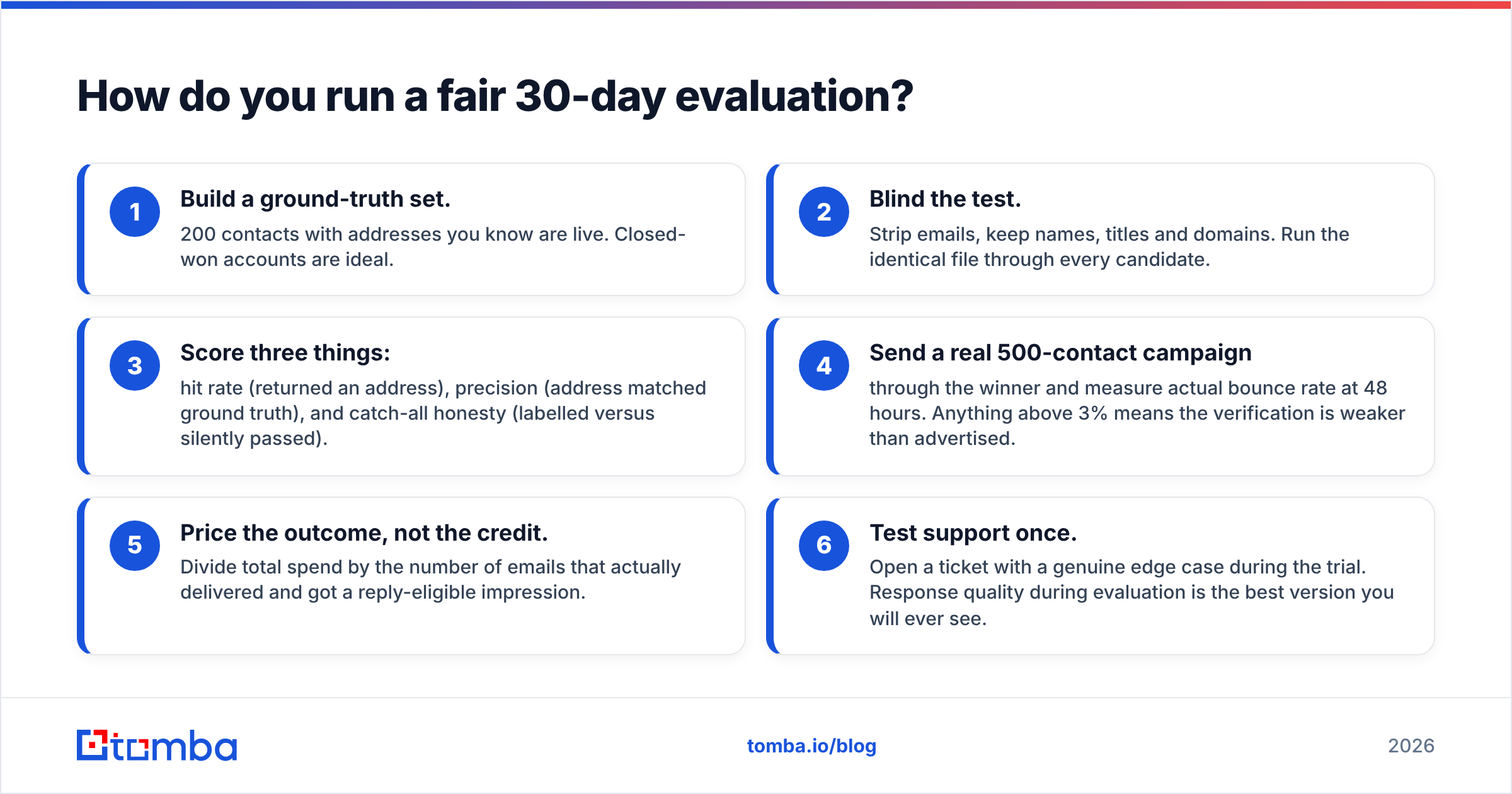
How do you run a fair 30-day evaluation?#
Skip the feature matrix. Run this instead.
- Build a ground-truth set. 200 contacts with addresses you know are live. Closed-won accounts are ideal.
- Blind the test. Strip emails, keep names, titles and domains. Run the identical file through every candidate.
- Score three things: hit rate (returned an address), precision (address matched ground truth), and catch-all honesty (labelled versus silently passed).
- Send a real 500-contact campaign through the winner and measure actual bounce rate at 48 hours. Anything above 3% means the verification is weaker than advertised.
- Price the outcome, not the credit. Divide total spend by the number of emails that actually delivered and got a reply-eligible impression.
- Test support once. Open a ticket with a genuine edge case during the trial. Response quality during evaluation is the best version you will ever see.
That sequence takes about three weeks and eliminates roughly 80% of buyer's remorse in this category. Track the delivery half of the equation too — a clean list still fails if your domain reputation is poor, and email deliverability problems get misattributed to data quality constantly.
Frequently asked questions#
Is Gamalogic or Generect cheaper? Gamalogic is generally cheaper to start because it offers self-serve entry with credit packs. Generect can be cheaper at high volume once negotiated. Below roughly 10,000 lookups a month, the self-serve option almost always wins on total cost including your own time.
Do either offer a free plan? Both offer trials rather than permanent free tiers, as far as their public pages indicate at the time of writing. If a standing free allowance matters — for occasional lookups or for testing an integration — check current terms directly with each vendor before assuming.
Can I use one for sourcing and the other for verification? Yes, and it is a reasonable architecture. Just make sure the verification vendor is independent from the sourcing vendor, or you lose the point of the second check.
What about GDPR? Any vendor selling EU contact data needs a documented lawful basis, a DPA, and a working opt-out path. Ask for all three in writing. This is not optional and it is not a checkbox — regulators have been active on B2B data sourcing since 2023.
Where does Tomba fit in this comparison?#
Honestly: as the benchmark you run alongside both, not necessarily as the automatic answer.
Tomba's overlap with Gamalogic is high — finding and verification are its core — and its overlap with Generect is partial, since data enrichment and domain search cover the "find everyone at this company" job without covering full filter-based list building. Where it separates from both is transparency: published pricing, a free tier you can test on today, documented API and SDKs, and catch-all handled as a labelled status rather than a rounding error in the hit-rate stat.
If your immediate blocker is turning a list of companies and names into addresses that actually deliver, start with the Tomba Email Finder. The free tier gives you 25 searches a month — enough to run a real sample against your own ICP before spending anything, and enough to score it honestly against whatever Gamalogic or Generect quote you. Run the same 200-row test through all three, keep the one that wins on your data, and ignore everyone's accuracy badge including ours.
Related guides#
Ready to find emails that actually work?
Join 150,000+ professionals who stopped guessing and started sending. Free credits on signup — no credit card required.
Get the Tomba newsletter
Practical outbound tactics and product updates — once every two weeks.
About the author