Gamalogic vs Kipplo: Which Email Finder Wins in 2026?
Gamalogic and Kipplo both promise verified B2B emails at a low price. Here's how they differ on accuracy, catch-all handling, API depth and true cost per usable contact — plus where a third option beats both.
TL;DR
- Gamalogic is a bulk-first email finder and verifier built around cheap, high-volume credit packs and a simple API. It suits teams that already have a name-and-domain list and mostly need validation throughput.
- Kipplo positions itself further up the funnel — prospect discovery plus enrichment — so it is closer to a lightweight lead database than a pure verification engine.
- Neither tool wins on every axis. Gamalogic tends to be cheaper per credit; Kipplo tends to give you more contact context per record.
- The number that actually matters is cost per usable contact, not cost per credit. A $0.001 credit that returns a "risky" result you cannot send to costs you infinity.
- If you need one platform that covers discovery, finding, verification, catch-all handling and enrichment through a single API, a broader tool like Tomba Email Finder removes the stitching work entirely.
What are Gamalogic and Kipplo?#
Gamalogic (gamalogic.com) markets itself as a low-cost email finder and bulk email verifier. Its pitch is volume economics: upload a CSV of first name, last name and domain, get back guessed-and-validated addresses, pay very little per row. It exposes an API and a bulk upload flow, and its typical buyer is a growth team or agency processing tens of thousands of rows a month.
Kipplo sits a step earlier in the workflow. Rather than assuming you already have a list, it leans on search and enrichment — find companies, find people inside them, attach a work email, attach whatever firmographic context it holds. That makes it feel more like a database product with a finder attached, whereas Gamalogic feels like a finder with a database attached.
That single architectural difference explains almost every downstream difference in pricing, accuracy behaviour and API design. Keep it in mind as you read the rest of this comparison — it is the thing most head-to-head posts skip.

How do Gamalogic and Kipplo compare head to head?#
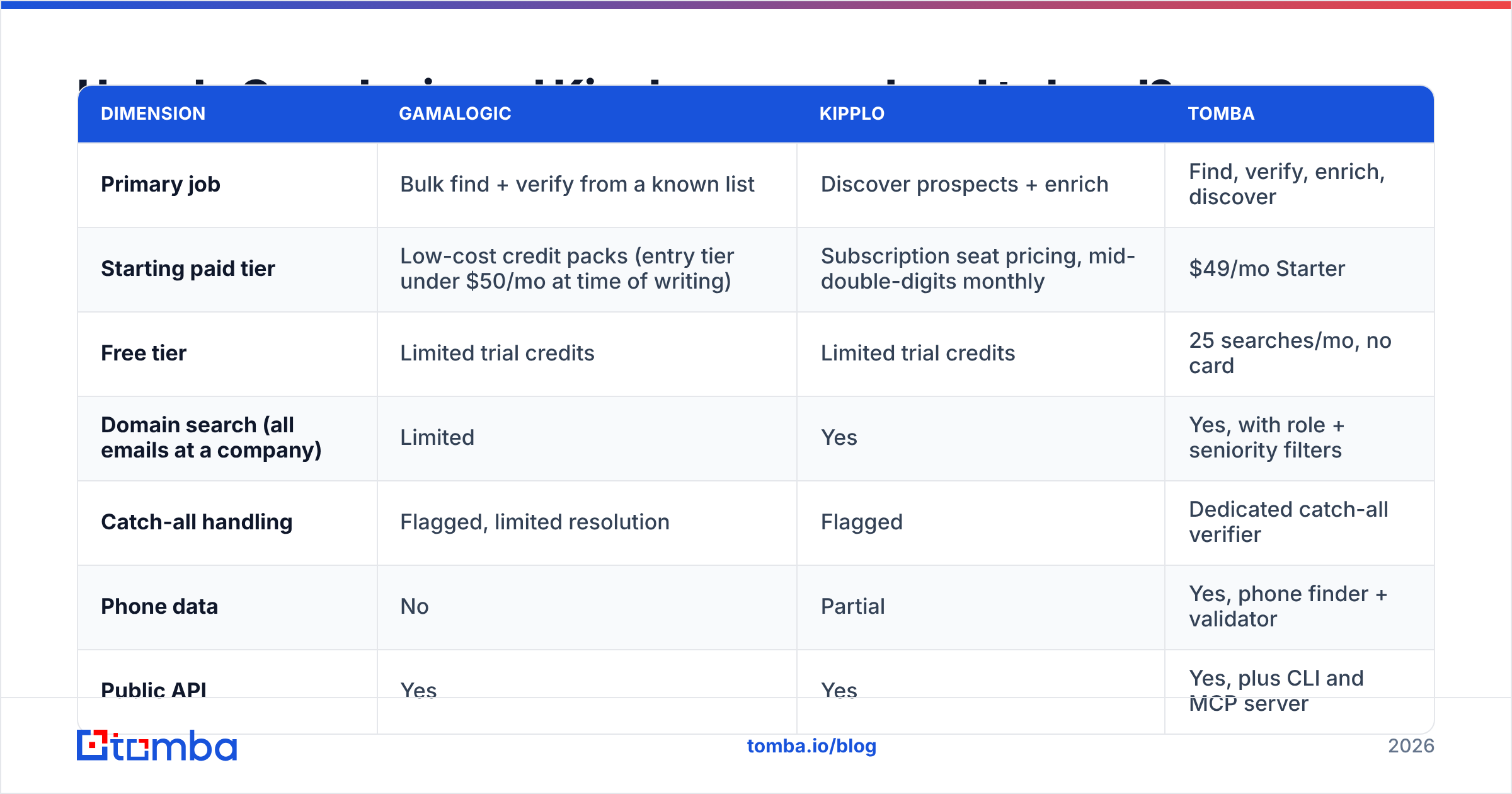
Here is the practical comparison. Treat the pricing rows as directional — both vendors change packaging often, so confirm on their own pages before you buy.
| Dimension | Gamalogic | Kipplo | Tomba |
|---|---|---|---|
| Primary job | Bulk find + verify from a known list | Discover prospects + enrich | Find, verify, enrich, discover |
| Starting paid tier | Low-cost credit packs (entry tier under $50/mo at time of writing) | Subscription seat pricing, mid-double-digits monthly | $49/mo Starter |
| Free tier | Limited trial credits | Limited trial credits | 25 searches/mo, no card |
| Domain search (all emails at a company) | Limited | Yes | Yes, with role + seniority filters |
| Catch-all handling | Flagged, limited resolution | Flagged | Dedicated catch-all verifier |
| Phone data | No | Partial | Yes, phone finder + validator |
| Public API | Yes | Yes | Yes, plus CLI and MCP server |
| Native spreadsheet add-ons | Limited | Limited | Google Sheets, Excel, Airtable |
| Best for | High-volume list cleaning | Early-stage prospect research | Teams that need one stack end to end |
Three things stand out.
First, Gamalogic's advantage is unit cost, and it is real. If your job is "clean 200,000 rows this quarter," per-credit price dominates every other consideration.
Second, Kipplo's advantage is context. When you do not yet know who to contact, a finder that requires a name and a domain is useless. Kipplo answers the earlier question.
Third, neither covers the full span. You will likely bolt on a second tool — a verifier if you choose Kipplo, a discovery source if you choose Gamalogic. That stitching cost is invisible on a pricing page and very visible in your ops calendar.

Which one actually returns more valid emails?#
Accuracy is where marketing copy and reality diverge most sharply. Every vendor in this category advertises a number in the nineties. Those numbers are measured differently, and almost none of them are independently audited.
Here is the framework that survives vendor spin:
- Hit rate — of 1,000 input rows, how many returned any address at all? Gamalogic typically posts strong hit rates because pattern-guessing plus SMTP probing will produce a candidate for most corporate domains. Kipplo's hit rate depends more on whether the person exists in its dataset.
- Deliverable rate — of those hits, how many actually accepted mail? This is the honest denominator. A tool returning 900 addresses of which 700 bounce is worse than one returning 500 of which 490 land.
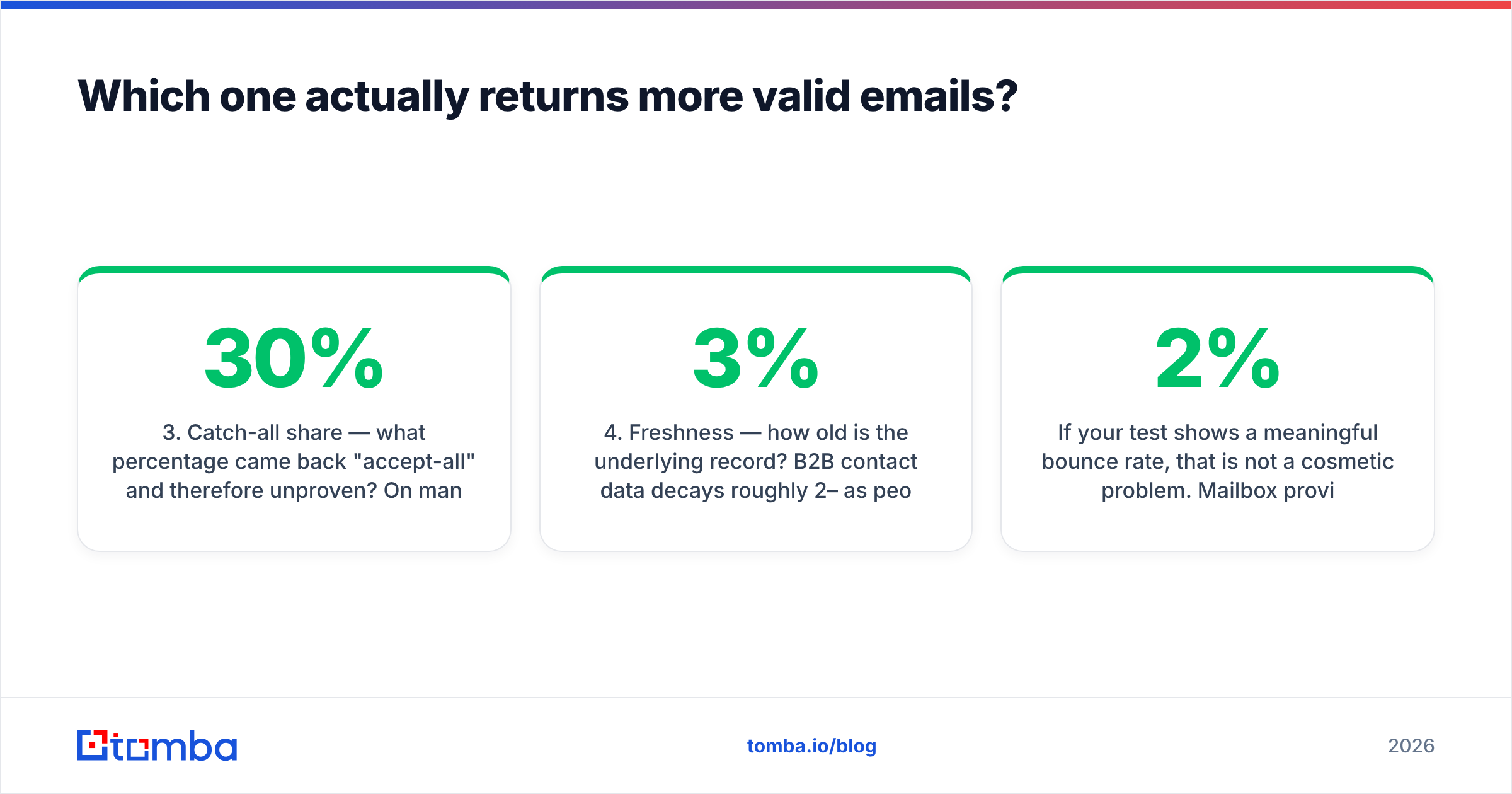
- Catch-all share — what percentage came back "accept-all" and therefore unproven? On many mid-market domains this is 20–30% of results, and how a tool treats that bucket changes your effective yield enormously.
- Freshness — how old is the underlying record? B2B contact data decays roughly 2–3% per month as people change roles, so a database-first tool needs continuous refresh to stay honest.
- Role-account contamination — are you being billed for info@, sales@ and support@ addresses you will never use?

Run your own test before committing. Take 300 contacts you already have confirmed addresses for, strip the emails, and feed the names and domains to both trials. Score hit rate and deliverable rate separately. This takes an afternoon and is worth more than every review site combined — though G2's email finder category is a reasonable place to sanity-check whether other buyers hit the same walls you did.
If your test shows a meaningful bounce rate, that is not a cosmetic problem. Mailbox providers treat hard bounces as a reputation signal, and sustained bounce rates above roughly 2% start suppressing inbox placement for your entire domain. The mechanics of bounce messages are worth understanding before you scale any list.
How do they handle catch-all domains?#
This is the single biggest hidden differentiator between the two, and most comparisons ignore it.
A catch-all (accept-all) domain accepts mail to any address at the SMTP layer, whether or not the mailbox exists. That means standard verification cannot prove anything. Tools respond in one of three ways:
- Flag and pass the cost to you. The address is returned as "risky" or "unknown," you are still billed, and you decide whether to gamble. This is the common behaviour on budget tools.
- Flag and exclude. The address is suppressed and not billed. Cleaner, but your yield drops.
- Resolve with secondary signals. Cross-reference other data sources, pattern confidence, historical engagement and mailbox-level probing to assign a real confidence score instead of shrugging.
Gamalogic and Kipplo both sit largely in the first two camps. If a third of your target market runs Google Workspace with catch-all enabled — extremely common in agencies, consultancies and EU mid-market — that bucket is where your budget quietly evaporates.
This is where a dedicated catch-all verifier changes the arithmetic. Resolving even half of an unknown bucket into confirmed-deliverable addresses can lift usable yield by 10–15 percentage points on the same input list, which swamps any per-credit price difference between the two vendors.
What does each really cost per usable contact?#
Ignore the headline price. Run this calculation instead:
Cost per usable contact = (monthly price ÷ credits) ÷ (deliverable rate × (1 − role-account share))
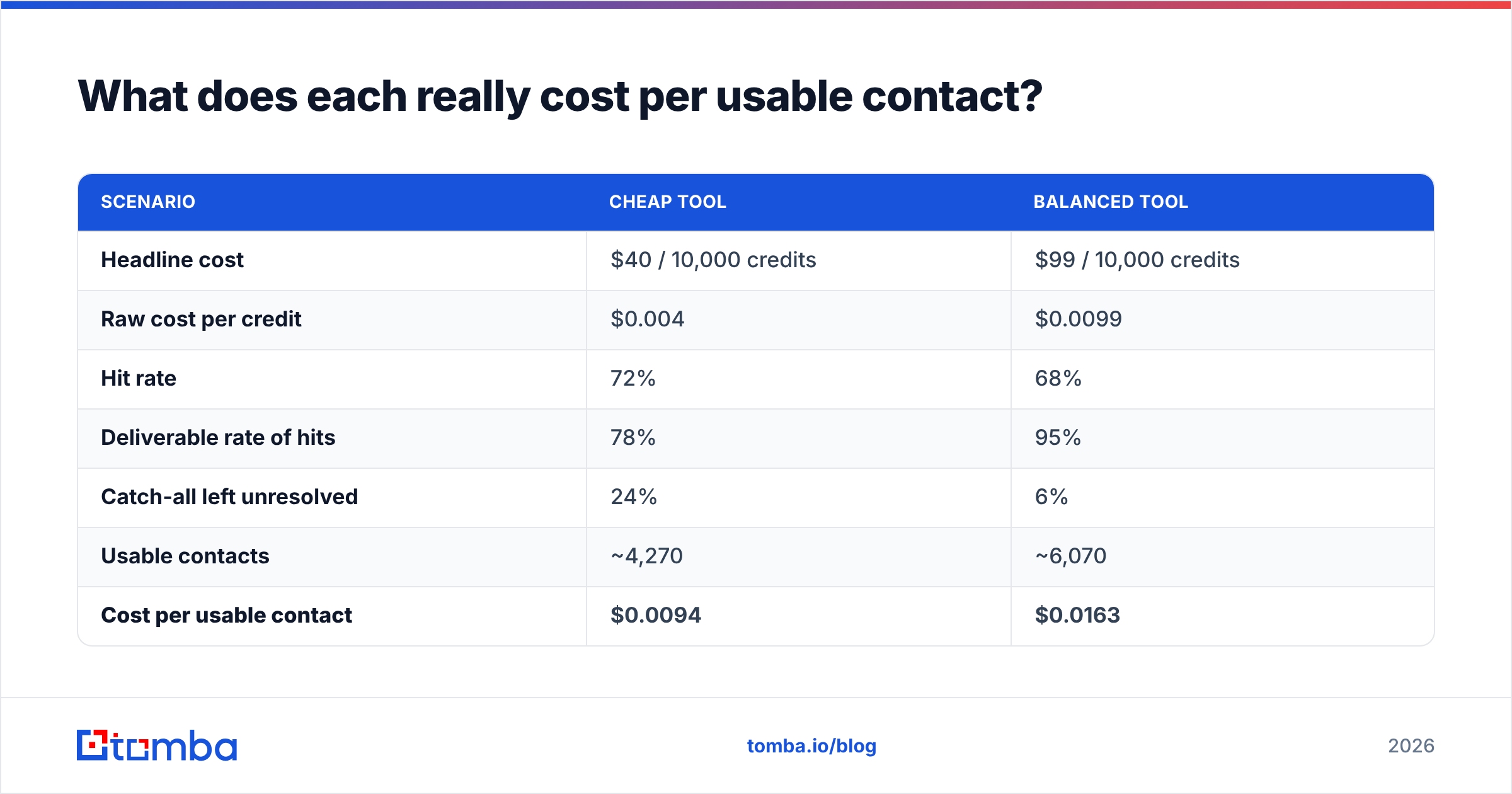
Worked example on a 10,000-row list:
| Scenario | Cheap tool | Balanced tool |
|---|---|---|
| Headline cost | $40 / 10,000 credits | $99 / 10,000 credits |
| Raw cost per credit | $0.004 | $0.0099 |
| Hit rate | 72% | 68% |
| Deliverable rate of hits | 78% | 95% |
| Catch-all left unresolved | 24% | 6% |
| Usable contacts | ~4,270 | ~6,070 |
| Cost per usable contact | $0.0094 | $0.0163 |
| Bounces sent (reputation cost) | ~1,580 | ~320 |
The cheap tool still wins on pure cost per usable contact in this example — but it also handed you roughly five times more bounces. If those bounces cost you a warmed sending domain, the $60 saved becomes the most expensive $60 in your quarter. That trade is the real decision, and it is not visible on either vendor's pricing page.
For reference, Tomba pricing runs a free tier at 25 searches/month, Starter at $49/mo, Growth at $99/mo, Pro at $249/mo and custom enterprise contracts — which puts it between the two on sticker price and ahead of both on how much of the workflow one subscription covers.

Which tool fits which team?#
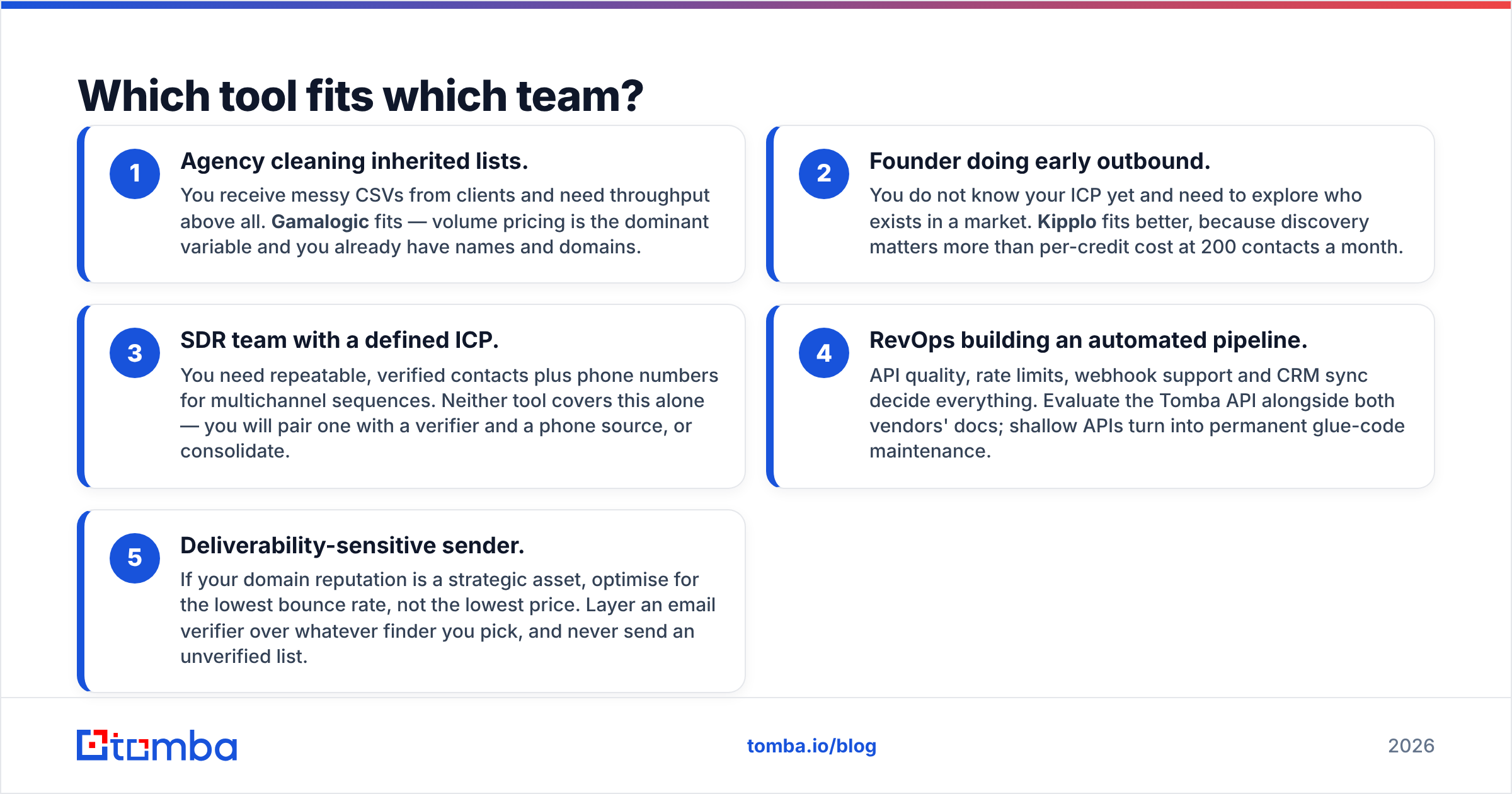
Use these five profiles rather than a generic winner declaration:
- Agency cleaning inherited lists. You receive messy CSVs from clients and need throughput above all. Gamalogic fits — volume pricing is the dominant variable and you already have names and domains.
- Founder doing early outbound. You do not know your ICP yet and need to explore who exists in a market. Kipplo fits better, because discovery matters more than per-credit cost at 200 contacts a month.
- SDR team with a defined ICP. You need repeatable, verified contacts plus phone numbers for multichannel sequences. Neither tool covers this alone — you will pair one with a verifier and a phone source, or consolidate.
- RevOps building an automated pipeline. API quality, rate limits, webhook support and CRM sync decide everything. Evaluate the Tomba API alongside both vendors' docs; shallow APIs turn into permanent glue-code maintenance.
- Deliverability-sensitive sender. If your domain reputation is a strategic asset, optimise for the lowest bounce rate, not the lowest price. Layer an email verifier over whatever finder you pick, and never send an unverified list.
Where do both tools fall short?#
Honest limitations, based on what each product is architecturally built to do:
Gamalogic's gaps. Discovery is thin — it expects you to bring the list. Enrichment beyond the email itself is minimal, so no phone, no seniority, no tech stack. Catch-all resolution is limited, which means a meaningful share of results arrive as unusable "unknown." And support and documentation depth reflect the budget positioning.
Kipplo's gaps. Database coverage is narrower than the incumbents, so hit rates vary sharply by geography and company size — strong on US SaaS, weaker on European mid-market and non-English markets. Verification is a feature rather than the core engine, so you will still want independent validation before sending. Seat-based pricing also scales awkwardly if you want the whole GTM team touching the tool.
Shared gaps. Neither offers deep native spreadsheet workflows, and neither gives you a single pane covering domain-level discovery, individual finding, catch-all resolution, phone data and enrichment. If your process spans all of those, you are running two or three subscriptions and reconciling exports.
That consolidation problem is the strongest argument for evaluating a third option. Domain search that surfaces every public address at a company, data enrichment that attaches role and company context, and a bulk email finder for list-scale jobs all running against the same credit pool removes a lot of operational overhead — even when a single-purpose competitor prices lower per credit.
How should you run the evaluation?#
Do not choose on a features table, including this one. Run a controlled bake-off:
- Build a 300-row truth set. Contacts you have already emailed successfully. Strip the addresses.
- Trial all candidates in the same week. Data changes; comparing a January export to an August one proves nothing.
- Score four numbers per tool. Hit rate, deliverable rate, catch-all percentage, role-account percentage.
- Send one small real campaign — 200 contacts per tool through the same sending infrastructure — and compare bounce rates. Verification claims and inbox reality are different things.
- Time the integration. How long did it take to move results into your CRM? Multiply by 52 weeks.
The tool that wins that test is your answer, regardless of which name sits on this page.
The bottom line#
Gamalogic vs Kipplo comes down to where you sit in the funnel. Gamalogic is the better buy when you already know who you want and need cheap validation at volume. Kipplo is the better buy when you are still figuring out who to target and value context over unit price. Neither is a complete outbound data stack, and both will leave you buying a second tool.
If you would rather consolidate — find addresses by name or domain, verify them, resolve catch-alls, pull phone numbers and enrich records through one API and one credit pool — start with Tomba Email Finder. The free tier gives you 25 searches a month with no card required, which is enough to run the 300-row truth-set test above and see how the numbers land against your own list before you commit a dollar.
Related guides#
Ready to find emails that actually work?
Join 150,000+ professionals who stopped guessing and started sending. Free credits on signup — no credit card required.
Get the Tomba newsletter
Practical outbound tactics and product updates — once every two weeks.
About the author