Gamalogic vs Saleshandy (2026): Which Tool Should You Use?
One tool finds and verifies email addresses. The other sends thousands of sequences a day. Here's an honest breakdown of where Gamalogic and Saleshandy actually overlap — and which one your outbound stack really needs.
Short answer first: gamalogic vs saleshandy is not a fair fight. The two tools do different jobs. Gamalogic finds and checks email addresses. Saleshandy sends cold email at scale. Here is where they overlap, what each one costs, and which half you should buy first.
TL;DR
- Gamalogic and Saleshandy are not the same kind of product. Gamalogic is a data tool: find emails, check emails, bulk lists, API.
- Saleshandy is a sending platform: sequences, inbox rotation, warmup, reply tracking. A lead database sits on top.
- If you cannot find good addresses, a data tool wins. If you cannot send 2,000 emails a week without burning your domain, Saleshandy wins.
- Most teams who weigh gamalogic vs saleshandy end up buying both. Some swap the data half for a tool with deeper checks and a real API.
- The two price models have different shapes. One sells credit packs. The other sells seats plus credits. A simple monthly price will mislead you.
- Check every address before you send. Bad data hurts your sender score more than a short list hurts your pipeline.
Gamalogic vs Saleshandy: what does each tool do?#
Gamalogic is an email finding and checking service. You give it a name and a domain, or a whole CSV file. It hands back likely work addresses and a signal for each one. There is a bulk screen and an API. The tool sits upstream of your outreach. It is a tap, not an engine.
Saleshandy began as an email tracking tool. It is now a full cold outreach platform. You get multi-step sequences, many mailboxes, inbox rotation, built-in warmup, one shared inbox, reply sentiment tags, and a B2B lead database. Its whole design points at one goal: send a lot of mail without getting flagged.
That gap matters more than any feature list. Comparing the two is like comparing a fuel supplier to a delivery van. You need both to move a package. Only one fills the tank.
They do overlap in one place. Both say they hand you verified B2B addresses. That claim is worth testing, because real hit rates vary a lot.

Gamalogic vs Saleshandy: how do the features compare?#
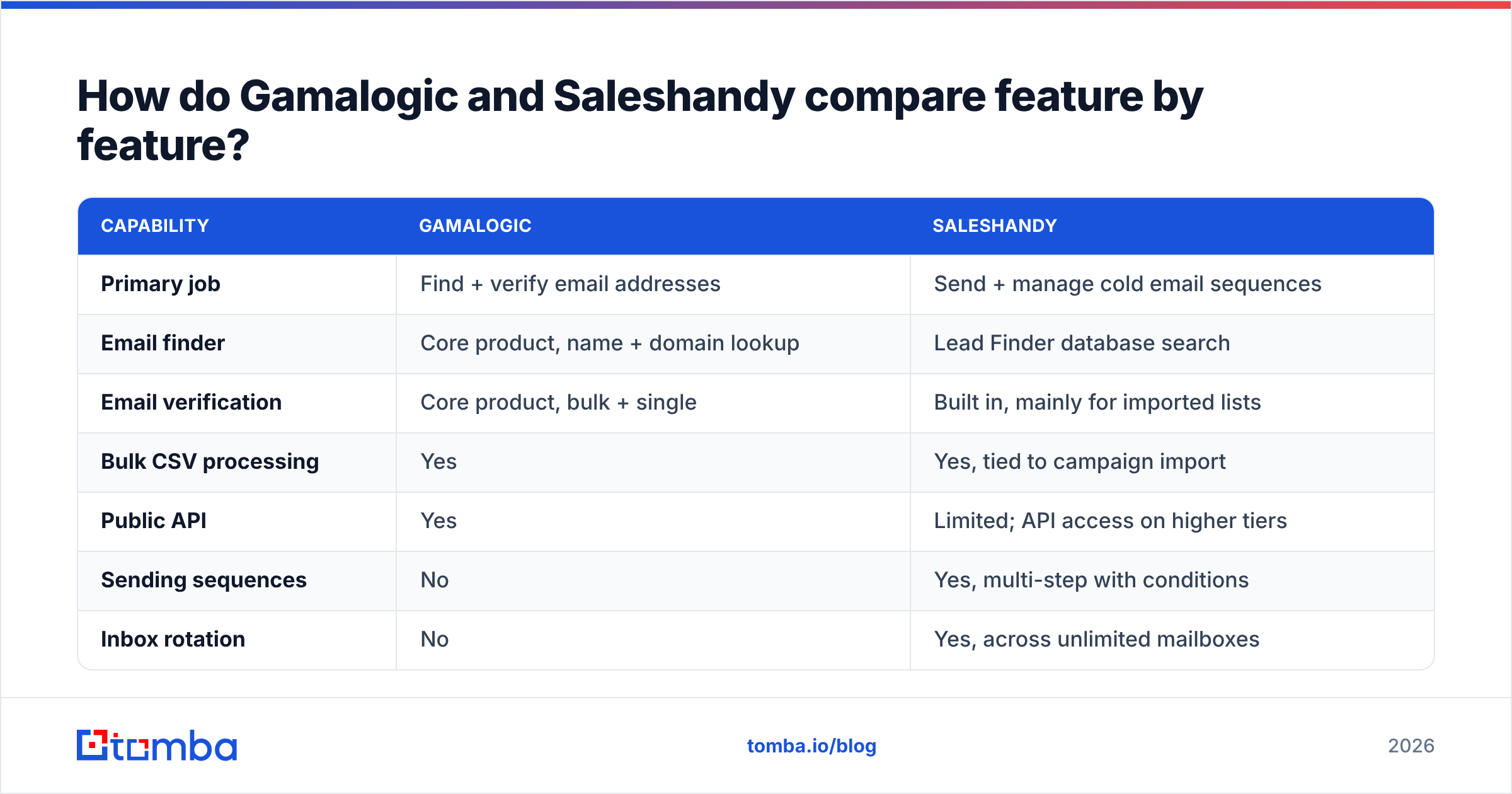
Here is the honest side by side. Treat the details as directional. Both vendors change plans often, so check their live pages before you buy.
| Capability | Gamalogic | Saleshandy |
|---|---|---|
| Primary job | Find + verify email addresses | Send + manage cold email sequences |
| Email finder | Core product, name + domain lookup | Lead Finder database search |
| Email verification | Core product, bulk + single | Built in, mainly for imported lists |
| Bulk CSV processing | Yes | Yes, tied to campaign import |
| Public API | Yes | Limited; API access on higher tiers |
| Sending sequences | No | Yes, multi-step with conditions |
| Inbox rotation | No | Yes, across unlimited mailboxes |
| Built-in warmup | No | Yes |
| Unified inbox / reply handling | No | Yes, with sentiment tagging |
| CRM integrations | Via API / export | Native (HubSpot, Pipedrive, Zoho, Salesforce) |
| Deliverability tooling | Verification only | Warmup, rotation, spam-word checks, sending limits |
| Best for | Data teams, developers, list builders | SDR teams running volume outbound |
Read that table twice. Almost every row Gamalogic wins is a data row. Almost every row Saleshandy wins is a sending row. That is the core of gamalogic vs saleshandy. Neither tool makes the other one useless.
Which tool finds and checks better emails?#
This is the only real contest. Four things drive data quality.
- Coverage — how many rows come back with an address. Database tools like Saleshandy's Lead Finder do well in well-covered markets. Think US mid-market software and tech job titles. They thin out fast on small regional firms and young startups. Lookup tools like Gamalogic work another way. They try a pattern-based find on almost any domain. Raw coverage looks higher, but the confidence range is wider.
- Accuracy — how many of those addresses are real. Here the depth of the check matters. Good checks cover MX records, an SMTP handshake, role accounts, throwaway domains, and catch-all servers. A tool that calls every catch-all address valid is not checking. It is guessing politely.
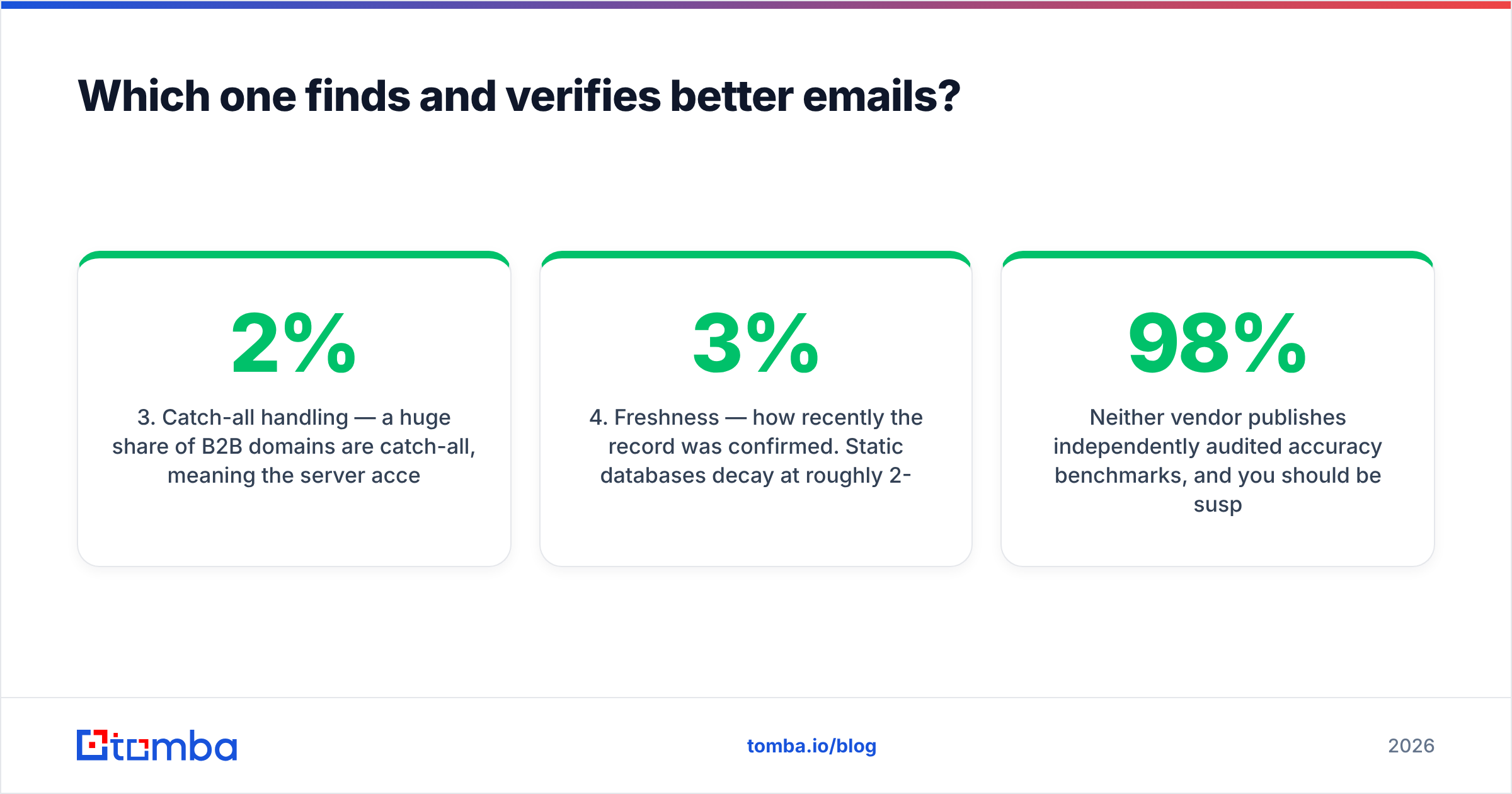
- Catch-all handling. Many B2B domains accept every address sent to them. Weak tools mark these as valid. Strong tools mark them accept-all and add a separate score. If your tool blurs the two, your real bounce rate will beat your dashboard. A good catch-all verifier is the gap between a 2% and an 8% bounce rate on one list.
- Freshness — how recently the record was confirmed. Static databases decay by about 2-3% a month as people switch jobs. Live lookups skip that problem, but each call costs more.
Neither vendor shares audited accuracy tests. Be wary of any 98% accuracy claim with no named method behind it.
Here is the practical move. Build a 200-row test list you already know the answers to. Use your own customers, your own team, and a few partners. Run it through each tool. Count the real hits. That ten-minute test beats any review, including this one.
Want a second opinion from other buyers? G2's software category pages are the least bad public source. Just note that review counts skew toward tools that chase reviews hard.
Gamalogic vs Saleshandy pricing: which one costs less?#
The two models are not just different numbers. They are different shapes.
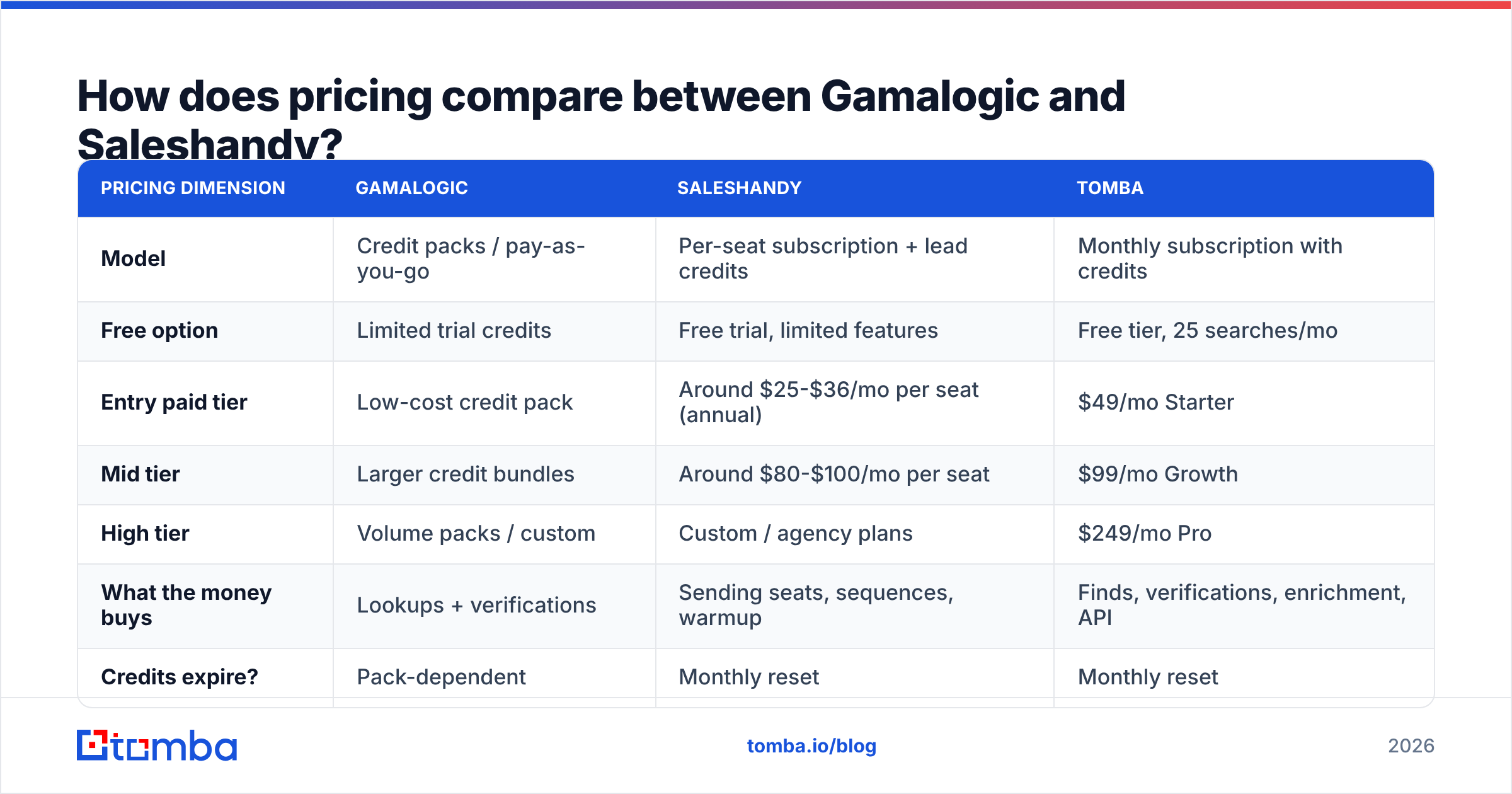
| Pricing dimension | Gamalogic | Saleshandy | Tomba |
|---|---|---|---|
| Model | Credit packs / pay-as-you-go | Per-seat subscription + lead credits | Monthly subscription with credits |
| Free option | Limited trial credits | Free trial, limited features | Free tier, 25 searches/mo |
| Entry paid tier | Low-cost credit pack | Around $25-$36/mo per seat (annual) | $49/mo Starter |
| Mid tier | Larger credit bundles | Around $80-$100/mo per seat | $99/mo Growth |
| High tier | Volume packs / custom | Custom / agency plans | $249/mo Pro |
| What the money buys | Lookups + verifications | Sending seats, sequences, warmup | Finds, verifications, enrichment, API |
| Credits expire? | Pack-dependent | Monthly reset | Monthly reset |
| API included | Yes | Higher tiers only | All paid tiers |
The trap is the headline price. A $30 seat that needs 5,000 lead credits on top is not cheaper than a $49 data plan with finds, checks, and API calls in one bucket. Model your real monthly volume first: leads sourced, addresses checked, emails sent. Then price all three columns against it. See full Tomba pricing for a fixed reference point on the data side.
One cost never shows up on a pricing page: bounce cost. Cheap data can push your bounce rate from 2% to 7%. You pay for that in domain reputation. Repairing it takes weeks of warmup, not dollars.
Is Saleshandy better than Gamalogic at scale?#
Yes, for the sending half. Say you send 2,000 emails a week from many mailboxes. Inbox rotation, per-mailbox caps, warmup, and one shared reply inbox keep that machine alive. Gamalogic does not play in that lane, and does not claim to.
Still, three caveats are worth knowing before you sign.
- Seat pricing scales with headcount, not results. A four-person team pays four times what one person pays. That holds even when three of them send from shared sequences.
- A bundled lead database is a convenience, not a strategy. These records are often licensed or pooled. The same rows sit in your rivals' sequences too. Fresh pipeline usually comes from sourcing your own accounts.
- Sending features do not fix bad lists. Warmup and rotation soften the damage. They do not erase it. Google and Microsoft now hold bulk senders to strict bounce and complaint limits. Basic email deliverability know-how is no longer optional.

When is Gamalogic the better pick?#
Pick a dedicated data tool when any of these are true.
- You already like your sender. Instantly, Smartlead, Lemlist, or your own SMTP setup may work fine. You do not need a second sending layer. You need better input.
- You are building something programmatic. Maybe you enrich records inside a product, score leads, or fire lookups on a trigger. That needs an API with clear rate limits, not a campaign screen.
- Your buyers sit outside the well-covered zone. Think markets outside the US, firms under 50 staff, or technical trades. Static databases are thinnest right there.
- You clean lists for other people. Agencies need bulk speed and a clear valid / invalid / accept-all / unknown label. They do not need a sequence builder.
A pure data tool has one honest weakness. It stops at the handoff. You still need a tool that sends, tracks, and handles replies. Budget for both.
What stack do most teams run?#
The pattern is steady once the trial dust settles: one data layer plus one sending layer, picked apart from each other.
The data layer has one job. Give you a list where every row is a real person, at a real company, with an address that lands. Add enough context to write something personal.
The sending layer has another job. Get those messages into inboxes without tripping filters. Buying both from one vendor is easy. It is rarely best, because the vendor that is great at one is seldom great at the other.
A specialist like Tomba fits the data slot cleanly. The email finder handles name-plus-domain lookups and whole-domain discovery. The email verifier runs full MX and SMTP checks, and labels catch-all servers instead of hiding them behind a vague valid.
The Tomba API ships on every paid tier. A developer can wire lookups into a product without an enterprise upgrade. Pricing starts free at 25 searches a month, then $49/mo Starter, $99/mo Growth, and $249/mo Pro.
Pair that with whichever sender fits your volume. Saleshandy is a strong pick there. You land on what most good outbound teams run: specialist data in, specialist sending out.
Gamalogic vs Saleshandy: which should you choose?#
Quick decision rules:
| Your situation | Pick |
|---|---|
| Need sequences, warmup, inbox rotation, reply management | Saleshandy |
| Need clean, verified addresses for a sender you already own | Gamalogic-style data tool |
| Need both, on a tight budget | Sender + dedicated data tool, not a bundle |
| Building enrichment into a product or internal workflow | Data tool with a real API |
| Sending in non-US or SMB-heavy markets | Live lookup over static database |
| Bounce rate already above 4% | Fix verification first, sending second |
Here is the real answer to gamalogic vs saleshandy. The two tools answer different questions. Saleshandy answers how to send more without breaking things. Gamalogic answers how to get addresses worth sending to. Work out which one costs you pipeline this quarter. Buy for that. Revisit the other half next quarter.
Ready to fix the data half of your stack?#
Are your sequences fine, but your bounce rate or list quality is holding you back? Start upstream. Try the Tomba Email Finder free: 25 searches a month, no card needed. Run it against the same 200-row test list you would use on anyone else. Find the addresses. Check them properly, catch-all domains included. Then export them, or pull them through the API into the sender you already trust. Better input beats better sequences every time.
Related guides#
Ready to find emails that actually work?
Join 150,000+ professionals who stopped guessing and started sending. Free credits on signup — no credit card required.
Get the Tomba newsletter
Practical outbound tactics and product updates — once every two weeks.
About the author