Gamalogic vs SalesIntel: Which B2B Data Tool Wins in 2026?
Gamalogic sells cheap bulk email verification. SalesIntel sells human-verified contacts at enterprise prices. They solve different problems — here's which one your pipeline actually needs, and where a cheaper third option beats both.
TL;DR
- Gamalogic is a low-cost email finder and bulk verifier. It competes on price per credit, not on database depth. Good for cleaning lists you already own.
- SalesIntel is a human-verified B2B contact database with intent data, technographics, and direct dials. It competes on data quality at enterprise pricing — typically five figures a year.
- They are not really the same product. Gamalogic answers "is this address real?"; SalesIntel answers "who should I call, and what's their mobile number?"
- If you need both a database and accurate verification without a five-figure contract, a mid-market email finder like Tomba covers most of the ground at $49–$249/mo.
- The deciding question is not price. It's whether your bottleneck is list hygiene or list creation.
What are Gamalogic and SalesIntel, actually?#
Two vendors, two very different bets on where B2B revenue teams lose money.
Gamalogic is an email finding and verification service built around bulk throughput. You upload a CSV of names and domains, or a list of addresses you already collected, and it returns found emails plus deliverability verdicts. Its pitch is volume economics: cents per verification, API access, and a simple credit model. There is no meaningful firmographic layer, no intent signals, no phone data.
SalesIntel sits at the opposite end. It's a full B2B data platform whose core differentiator is human verification — a research team that re-checks contact records on a rolling cycle, which the company markets as a 95%+ accuracy claim on human-verified records. On top of that sit intent data (via Bombora), technographics, firmographics, and direct-dial mobile numbers. It's sold as an annual seat-plus-credits contract and lands squarely in the mid-market-to-enterprise segment alongside ZoomInfo and Cognism.
So when someone searches "Gamalogic vs SalesIntel," they're usually asking one of two hidden questions:
- I have a list. Which one cleans it better and cheaper? → That's a Gamalogic-shaped problem.
- I have no list. Which one builds it? → That's a SalesIntel-shaped problem.
Answering the wrong question is how teams end up paying $18,000/yr for a tool they use as a spellchecker.
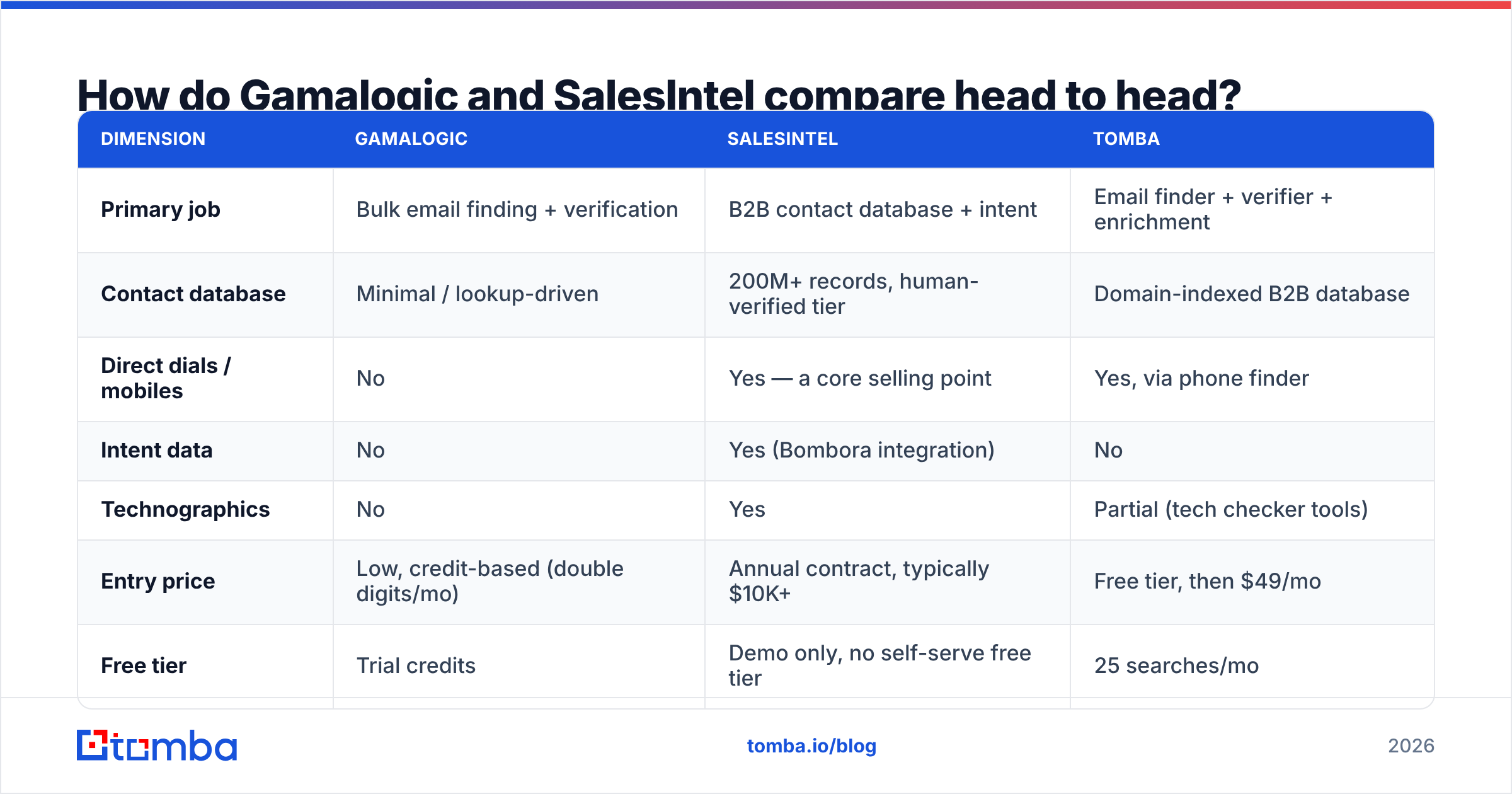
How do Gamalogic and SalesIntel compare head to head?#
Here's the practical breakdown. Pricing for both vendors moves with negotiation and volume, so treat the figures as directional ranges reported by users on G2 and vendor pages rather than fixed rate cards.
| Dimension | Gamalogic | SalesIntel | Tomba |
|---|---|---|---|
| Primary job | Bulk email finding + verification | B2B contact database + intent | Email finder + verifier + enrichment |
| Contact database | Minimal / lookup-driven | 200M+ records, human-verified tier | Domain-indexed B2B database |
| Direct dials / mobiles | No | Yes — a core selling point | Yes, via phone finder |
| Intent data | No | Yes (Bombora integration) | No |
| Technographics | No | Yes | Partial (tech checker tools) |
| Entry price | Low, credit-based (double digits/mo) | Annual contract, typically $10K+ | Free tier, then $49/mo |
| Free tier | Trial credits | Demo only, no self-serve free tier | 25 searches/mo |
| Self-serve signup | Yes | No — sales-led | Yes |
| API | Yes | Yes | Yes, documented |
| Catch-all handling | Basic | Not the focus | Dedicated catch-all verifier |
| Best for | Cleaning owned lists cheaply | Enterprise ABM, calling motions | SMB/mid-market outbound teams |
Read that table twice before you look at price. The row that matters most is "Primary job." Gamalogic and SalesIntel overlap on maybe 20% of their surface area.
Which one has better data accuracy?#
Different definitions of accuracy — that's the honest answer.
SalesIntel's accuracy claim is about record correctness: is this person still in this role, at this company, with this mobile number? Human verification is genuinely expensive to run, and it shows in the price. For a team doing 200 outbound calls a week into named accounts, a wrong direct dial costs more than the credit did. SalesIntel's model is defensible there.
Gamalogic's accuracy claim is about deliverability: will this address bounce? That's an SMTP-level question. Any competent verifier answers it reasonably well on standard mailboxes. The differentiation between budget verifiers shows up in three edge cases:
- Catch-all domains — servers that accept everything, then silently discard. Most cheap verifiers return "unknown" and bill you anyway. A catch-all verifier that applies pattern confidence plus secondary signals is what separates a usable result from a coin flip.
- Role accounts —
info@,sales@,support@. Technically deliverable, commercially useless, and they wreck reply-rate math. - Greylisting and rate-limited MX servers — a verifier that doesn't retry marks good addresses as risky, and you throw away real prospects.
Ask both vendors the same question during evaluation: what percentage of my test list came back "unknown" or "accept-all"? That number, not the headline accuracy percentage, predicts your real bounce rate.
How to run a fair accuracy test in under an hour:
- Build a 500-row control set from contacts you can independently confirm (past customers, LinkedIn-confirmed titles, replied leads).
- Strip the known answers and submit the same file to every vendor on trial credits.
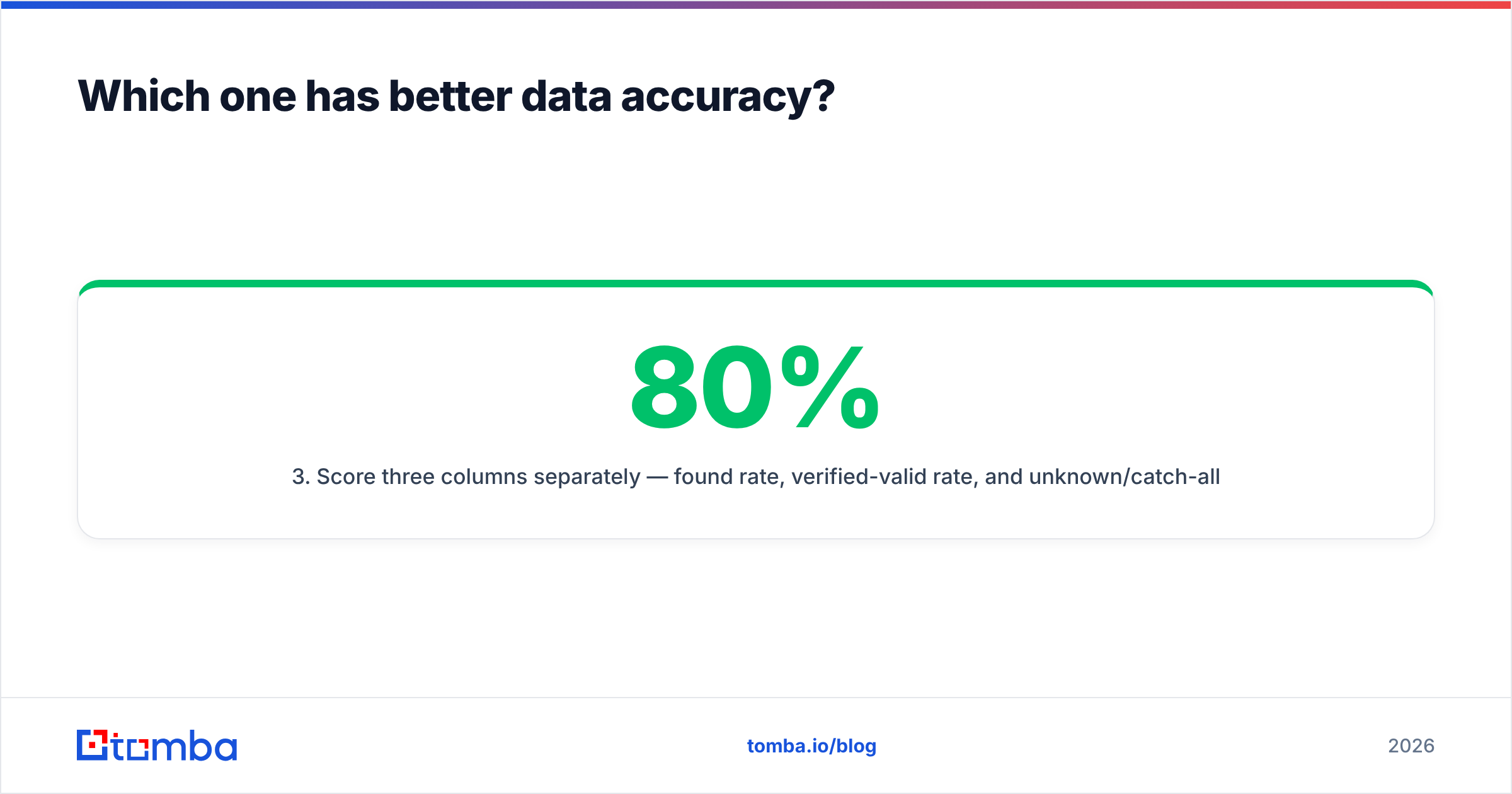
- Score three columns separately — found rate, verified-valid rate, and unknown/catch-all rate. A vendor that "finds" 80% but marks half of them unknown found 40%.
- Send a real 200-address batch through your ESP and record the hard-bounce percentage. This is the only number that costs you domain reputation.
- Divide total spend by confirmed-valid contacts. That's your true cost per usable record — usually 2–4x the sticker credit price.
Most teams skip step 5 and then wonder why the "cheap" option wasn't cheap.
Is SalesIntel worth the enterprise price tag?#
Yes — for a narrow, identifiable profile. No for most people reading this.
SalesIntel earns its cost when all of these are true:
- You run an account-based motion with a defined target list of a few thousand companies.
- Phone is a primary channel, not an afterthought. Direct dials are where SalesIntel's spend goes.
- You have enough SDR headcount that intent signals change daily prioritization.
- Your ACV is high enough that one extra closed deal repays the annual contract.
If you're a five-person team sending 2,000 cold emails a month, you are paying for research labor and Bombora intent licensing you will never touch. That's not a knock on the product — it's a mismatch. The same logic applies in reverse: a 200-seat enterprise trying to run ABM off a bulk verifier will fail, because the verifier has no opinion about who to contact.
One structural caveat on the sales-led model: there's no self-serve tier, so you can't quietly evaluate it on a Tuesday afternoon. Budget two to three weeks for demo, trial data sample, and procurement. Compare that with tools where you can test 25 lookups in five minutes.

What are the hidden costs neither vendor advertises?#
Four cost centers show up after signing, and they're where comparisons usually go wrong.
Credit burn on failures. Many platforms charge for a lookup regardless of whether it returns a usable result. If 30% of your queries return unknown, your effective price is 1.43x the listed price. Ask explicitly: are unknown results billed?
Credit expiry. Monthly credits that don't roll over convert seasonal outbound into wasted spend. Annual contracts with monthly credit resets are the worst version of this.
Enrichment round-trips. If your database vendor gives you a company but not a verified email, you pay a second vendor to close the gap. Teams routinely stack a database plus a email verifier plus a phone tool and end up managing three invoices for one workflow.
Deliverability damage. The cost you can't invoice. A 6% bounce rate on a new sending domain will get you throttled, and recovery takes weeks of warmup. Bounce control isn't a nice-to-have line item — it's the thing protecting your entire outbound channel. Google's own bulk sender guidelines put a hard spam-rate ceiling on senders, and bad list hygiene is the fastest route to breaching it.
Where does Tomba fit between them?#
In the gap that both leave open: a real database plus verification, self-serve, without an annual contract.
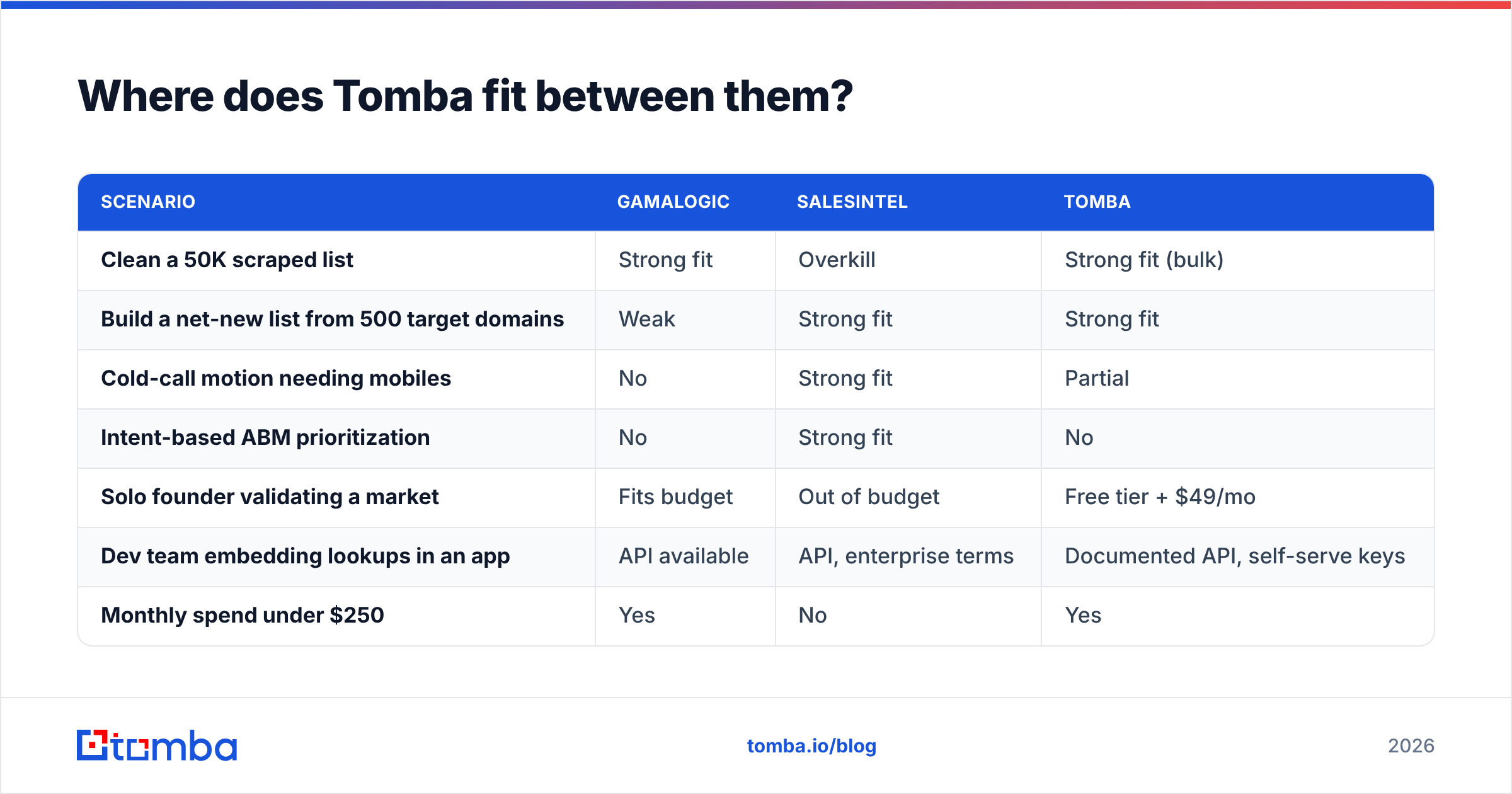
Tomba's email finder resolves name + domain to a verified address, and domain search returns the contacts a company publishes plus its email pattern — the list-creation job Gamalogic doesn't do. Verification, catch-all handling, phone finder, and data enrichment sit in the same account, so you're not stitching three vendors together.
| Scenario | Gamalogic | SalesIntel | Tomba |
|---|---|---|---|
| Clean a 50K scraped list | Strong fit | Overkill | Strong fit (bulk) |
| Build a net-new list from 500 target domains | Weak | Strong fit | Strong fit |
| Cold-call motion needing mobiles | No | Strong fit | Partial |
| Intent-based ABM prioritization | No | Strong fit | No |
| Solo founder validating a market | Fits budget | Out of budget | Free tier + $49/mo |
| Dev team embedding lookups in an app | API available | API, enterprise terms | Documented API, self-serve keys |
| Monthly spend under $250 | Yes | No | Yes |
Tomba pricing runs Free (25 searches/mo), Starter $49/mo, Growth $99/mo, Pro $249/mo, and Enterprise custom. That range covers the space between "I need a cheap verifier" and "I need a data platform," which is precisely where most Gamalogic-vs-SalesIntel searchers actually sit.
Worth noting: other credible options exist depending on your motion. BookYourData is a solid pay-as-you-go choice if you want to buy a targeted list outright with no subscription — a different commercial model that suits one-off campaigns well. Cognism and Lusha compete more directly with SalesIntel on European coverage and mobile data respectively.
How should you actually decide?#
Run this sequence rather than comparing feature grids.
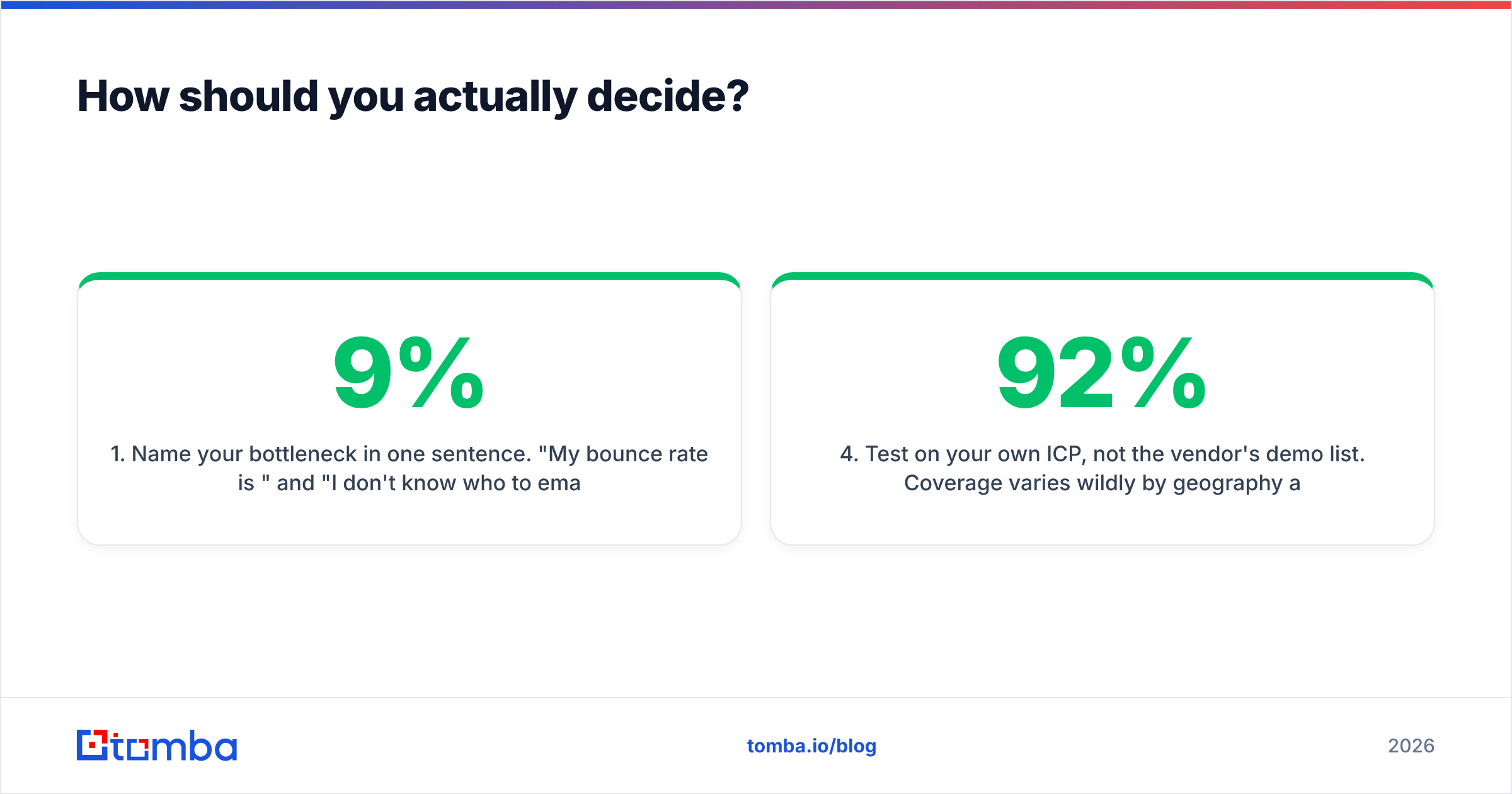
- Name your bottleneck in one sentence. "My bounce rate is 9%" and "I don't know who to email at these 800 accounts" lead to opposite purchases.
- Count your monthly volume honestly. Under 5,000 lookups a month, enterprise pricing never amortizes.
- Check your primary channel. Phone-first teams should weight direct-dial coverage above everything else. Email-first teams should weight catch-all handling and bounce rate.
- Test on your own ICP, not the vendor's demo list. Coverage varies wildly by geography and company size. A tool with 92% coverage of US SaaS may hit 40% on German manufacturing.
- Model 12-month total cost, including overage, expiry, and the second vendor you'll need to fill the gap.
- Confirm exit terms. Can you export contacts you paid for after cancelling? Sales-led contracts often say no.
If steps 1–3 point at hygiene, the cheap verifier wins and you should spend the savings on more sending domains. If they point at discovery plus phone, SalesIntel is a legitimate purchase and you should negotiate hard on credit rollover. If you land in the middle — which most teams do — a self-serve platform with both finding and verification is the efficient answer.
What does the decision look like in practice?#
A 12-person SaaS company doing $30K ACV, email-first, targeting 2,000 mid-market accounts: they don't need intent data yet, because with 2,000 accounts they can cover the whole list quarterly. They need accurate emails at volume and a clean sending reputation. Enterprise data contract is a bad trade.
A 60-person company selling $150K deals into named enterprise accounts, phone-heavy, with an SDR team that lives in cadences: they need direct dials, org charts, and intent to sequence the right week. A bulk verifier is irrelevant to their bottleneck.
Neither team is wrong. They just have different bottlenecks, and the "vs" framing hides that.
Before you sign anything, run the same 500-row test file through every finalist and compare cost per confirmed-valid contact. The rank order changes more often than you'd expect.
Ready to test the middle path? Start with Tomba Email Finder — 25 free searches a month, no sales call, no annual contract. Run your own control list through it alongside whatever else you're evaluating, check the bounce rate on a real send, and let the numbers pick your vendor instead of the demo deck.
Related guides#
Ready to find emails that actually work?
Join 150,000+ professionals who stopped guessing and started sending. Free credits on signup — no credit card required.
Get the Tomba newsletter
Practical outbound tactics and product updates — once every two weeks.
About the author