Gamalogic vs Sparklane: Which B2B Data Tool Wins in 2026?
Gamalogic sells email discovery by the credit. Sparklane sells predictive account intelligence by the seat. They solve different problems — here is which one actually fits your outbound motion, and where a cheaper third option beats both.
TL;DR
- Gamalogic is an email-finding and verification engine. You pay per credit, you get addresses back, and you plug them into whatever sequencer you already run. It is a data-plumbing tool, not a strategy tool.
- Sparklane is predictive sales intelligence, weighted toward European (especially French) company data. It scores accounts, surfaces buying signals, and pushes shortlists into your CRM. Contact discovery is a feature, not the product.
- They are not really competitors. If you are comparing them side by side, you are probably trying to answer a different question: "do I need more contacts, or better account selection?"
- Pricing models differ structurally. Gamalogic sells volume, Sparklane sells seats and annual contracts with a sales-led quote. Budget expectations are an order of magnitude apart.
- If your bottleneck is verified email addresses at global scale, a dedicated finder like Tomba — $49/mo Starter, free tier at 25 searches — covers the same job as Gamalogic with a wider toolset and a public API.
What is Gamalogic and what does it actually do?#
Gamalogic (gamalogic.com) is a B2B email discovery and verification platform. The core loop is simple: give it a name plus a company domain, or upload a list, and it returns professional email addresses with a validity signal attached. It also runs standalone verification on lists you already own, which is the part most teams end up using more heavily than they expect.
The product sits in the same conceptual box as Hunter, Findymail, Anymail Finder, and Tomba. It is a utility. There is no sequencer, no dialer, no intent scoring, no account-based orchestration. That is deliberate, and for a lot of teams it is the right shape — you already have Instantly or Smartlead for sending, you already have HubSpot for pipeline, and what you are missing is the contact layer that feeds both.
Where Gamalogic differentiates is on bulk throughput and a pricing posture aimed at high-volume list builders rather than enterprise procurement. It is a self-serve tool. You can be running searches the same afternoon.
The trade-off: coverage is pattern-and-verification driven, which works well for companies with predictable email conventions and degrades on smaller firms, catch-all domains, and regions with thinner web footprints. That is not a Gamalogic-specific weakness — it is the physics of the whole category — but it matters when you compare it against a database-first vendor.
What is Sparklane and who is it built for?#
Sparklane (sparklane-group.com) is a different animal. It is a predictive lead generation and sales intelligence platform, originally built in France, with unusually deep coverage of French and broader European company data — legal filings, financial signals, hiring activity, news events, corporate structure.
The pitch is account selection, not contact volume. Sparklane ingests your closed-won history, builds a model of what a good account looks like, and then continuously surfaces companies matching that profile along with the trigger event that makes them timely: a funding round, a new office, a leadership change, a tender publication. Those accounts land in your CRM with a score and a reason.
Contact data exists inside Sparklane, but it is there to make the recommended account actionable. Nobody buys Sparklane because they need 40,000 email addresses this quarter. They buy it because their reps are spending too long deciding who to call, and because European data — where registry information is rich but scattered — is genuinely hard to assemble yourself.
That also means Sparklane is sold the way enterprise software is sold: demo, scoping call, seat-based annual contract, onboarding. You will not swipe a card and start today.

Gamalogic vs Sparklane: how do they compare head-to-head?#
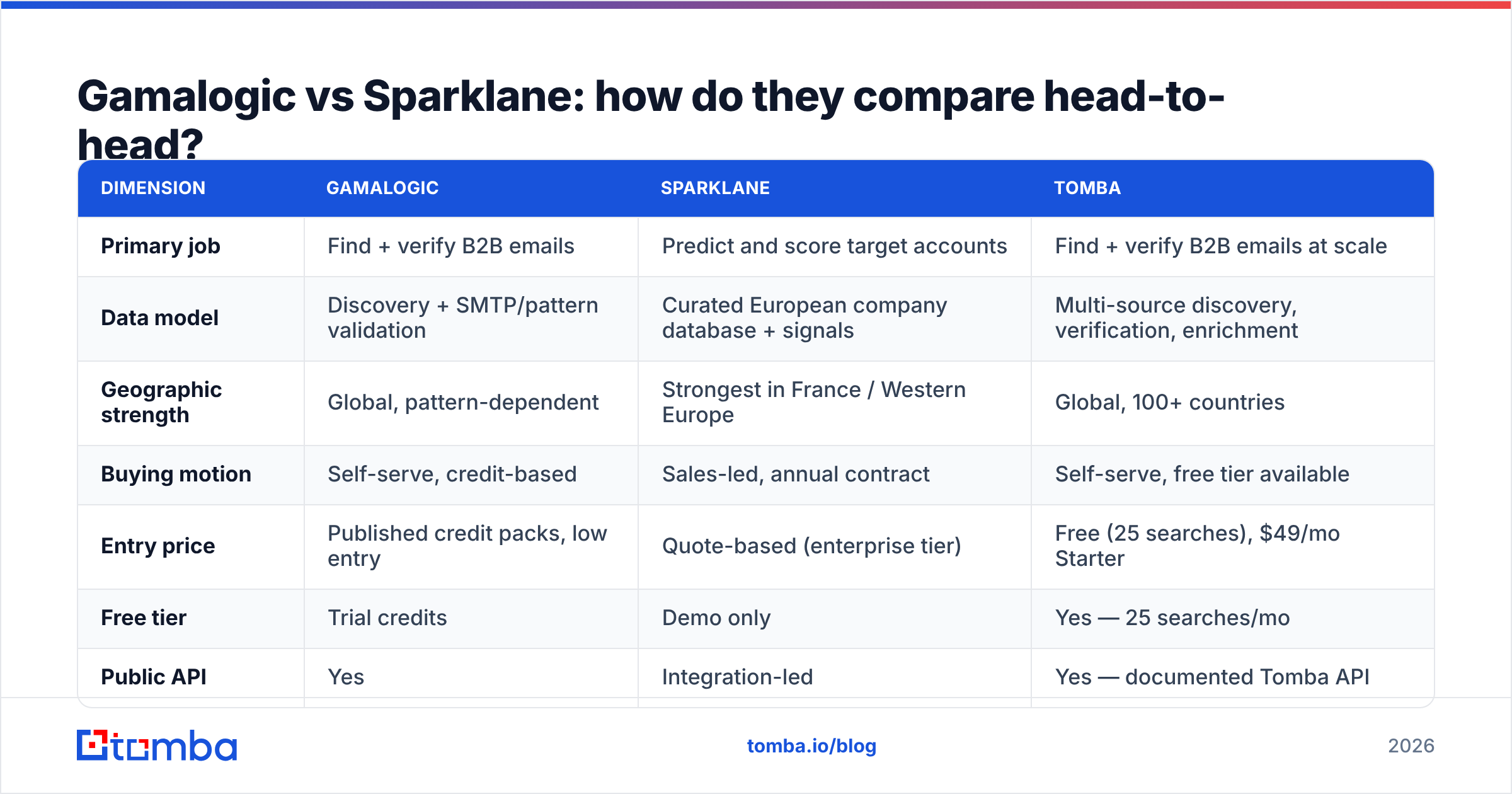
Here is the honest side-by-side. Note how few rows are genuinely apples-to-apples — that is the real finding.
| Dimension | Gamalogic | Sparklane | Tomba |
|---|---|---|---|
| Primary job | Find + verify B2B emails | Predict and score target accounts | Find + verify B2B emails at scale |
| Data model | Discovery + SMTP/pattern validation | Curated European company database + signals | Multi-source discovery, verification, enrichment |
| Geographic strength | Global, pattern-dependent | Strongest in France / Western Europe | Global, 100+ countries |
| Buying motion | Self-serve, credit-based | Sales-led, annual contract | Self-serve, free tier available |
| Entry price | Published credit packs, low entry | Quote-based (enterprise tier) | Free (25 searches), $49/mo Starter |
| Free tier | Trial credits | Demo only | Yes — 25 searches/mo |
| Public API | Yes | Integration-led | Yes — documented Tomba API |
| Bulk processing | Yes | Not the use case | Yes — bulk email finder |
| Intent / trigger signals | No | Yes — core feature | No |
| CRM push | Via integrations | Native, central to product | HubSpot, Salesforce, Pipedrive, Zapier |
| Best for | List builders, agencies, SDR teams | ABM teams selling into Europe | Teams needing verified emails + enrichment |
Read that table again and the answer usually resolves itself. If more than half of your "yes" column sits under signals and CRM orchestration, you are shopping for Sparklane. If it sits under discovery, verification, and volume, you are shopping in Gamalogic's category — and you should be price-comparing it against every other finder, not against Sparklane.
Which one gives you more accurate email addresses?#
Accuracy is the wrong single number to chase, but it is the number everyone asks about, so let's be precise about what it means.
Two metrics matter and vendors conflate them constantly:
- Hit rate — of 1,000 contacts you submit, how many come back with any address at all. Discovery tools win here on well-indexed domains.
- Deliverable accuracy — of the addresses returned, how many actually accept mail. This is where bounce rates are born.
A tool can post a 95% hit rate and still wreck your sender reputation if a third of those hits are guessed permutations on a catch-all domain. Conversely, a conservative tool that returns fewer addresses but flags catch-alls honestly will keep you under the 2–3% bounce threshold that Google and Microsoft now enforce aggressively.

Gamalogic competes directly on this axis and publishes validity confidence with results. Sparklane does not really play here — its contact data is a companion to account intelligence, and you should not benchmark it against dedicated finders on raw hit rate any more than you would benchmark a CRM on it.
The practical move regardless of vendor: never send to a list straight out of a finder. Run it through a dedicated email verifier as a second pass, and treat catch-all domains as their own bucket using a catch-all verifier rather than letting them ride in the main sequence. Two-stage validation cuts bounce rates more than switching vendors ever will.
How does pricing compare between Gamalogic and Sparklane?#
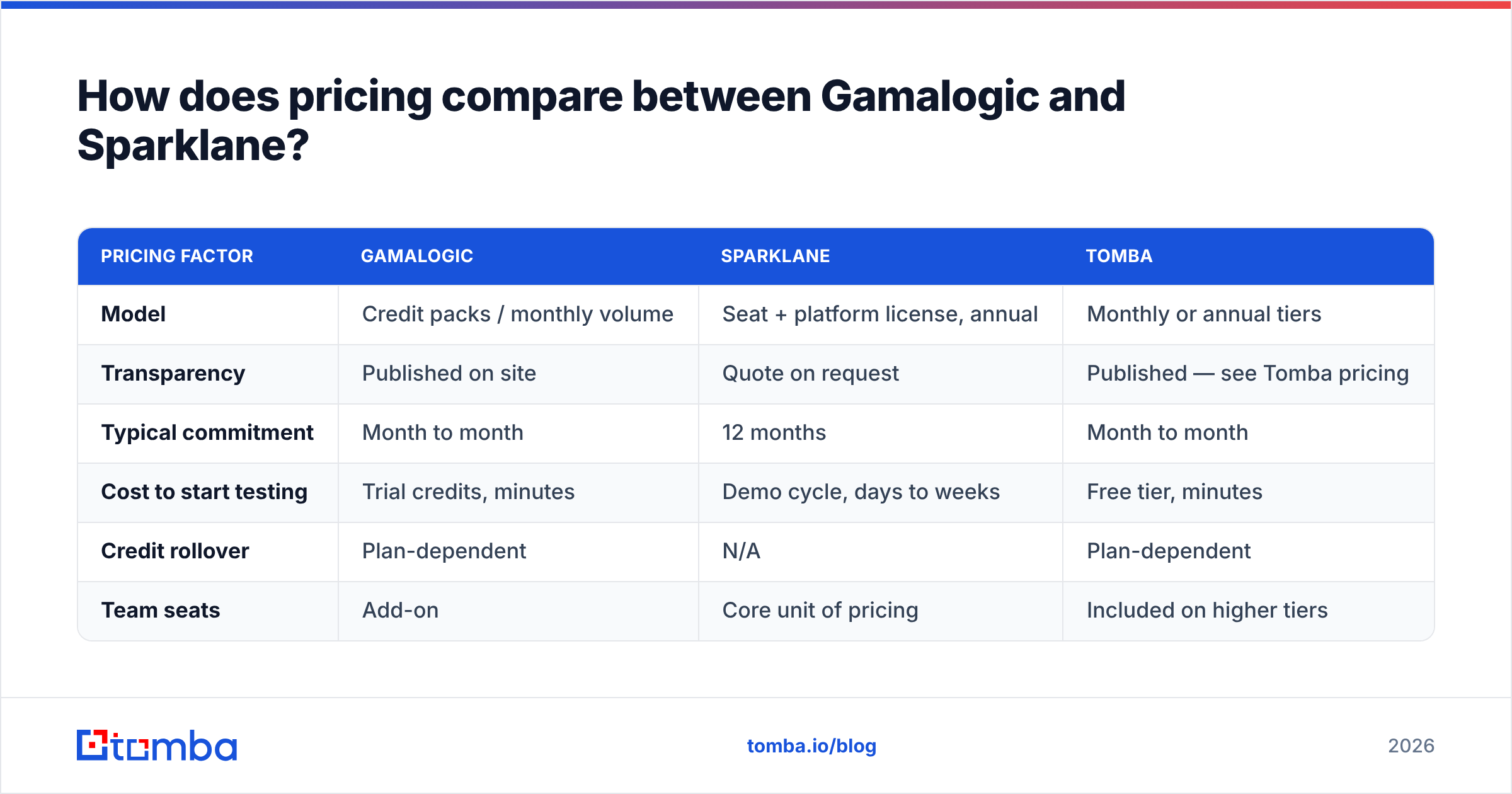
The pricing structures are not comparable, which is itself the most useful thing to know before you take a call.
| Pricing factor | Gamalogic | Sparklane | Tomba |
|---|---|---|---|
| Model | Credit packs / monthly volume | Seat + platform license, annual | Monthly or annual tiers |
| Transparency | Published on site | Quote on request | Published — see Tomba pricing |
| Typical commitment | Month to month | 12 months | Month to month |
| Cost to start testing | Trial credits, minutes | Demo cycle, days to weeks | Free tier, minutes |
| Credit rollover | Plan-dependent | N/A | Plan-dependent |
| Team seats | Add-on | Core unit of pricing | Included on higher tiers |
Two consequences follow.
First, time to value is wildly different. You can evaluate Gamalogic or Tomba on a Tuesday afternoon with a 50-contact sample from your own closed-won list — the only test that matters, since it measures coverage on your ICP rather than on a vendor's benchmark. Sparklane evaluation is a procurement project.
Second, the failure modes differ. Overbuying credits wastes a few hundred dollars. Overbuying an annual intelligence platform that your reps do not log into wastes a five-figure budget line and a year. G2 and Capterra reviews for the sales-intelligence category are worth reading precisely for this — the recurring complaint is never data quality, it is adoption. Check current review volume on G2 before committing to any annual seat-based contract.
Where does Tomba fit in this comparison?#
If you landed here searching "Gamalogic vs Sparklane," there is a decent chance the real question is "what is the best contact data tool for my budget?" So here is the neutral positioning.
Tomba occupies the same functional slot as Gamalogic — discovery and verification — but with a broader surrounding toolkit. Beyond the core email finder, you get domain search for mapping every addressable contact at a company, data enrichment for filling in job titles and firmographics, a phone finder, and a LinkedIn finder for turning profile URLs into work addresses.

What it does not do is replace Sparklane. There is no predictive account scoring, no European registry intelligence, no trigger-event feed. If your ABM motion depends on knowing that a French mid-market manufacturer just filed for expansion, Tomba is not that product and no email finder is.
The honest framing is a stack, not a bake-off:
- Account selection layer — Sparklane, 6sense, or your own analyst work. Decides who is worth pursuing.
- Contact discovery layer — Tomba, Gamalogic, or similar. Turns accounts into named, reachable people.
- Verification layer — a dedicated verifier pass before every send. Protects deliverability.
- Sending layer — Instantly, Smartlead, Outreach, Salesloft. Handles sequencing and reply routing.
- System of record — HubSpot, Salesforce, Pipedrive. Where everything reconciles.
Most teams under 50 reps do not need layer 1 as software. They need layers 2 through 5 working properly, and they buy layer 1 far too early.

Who should choose Sparklane?#
Pick Sparklane when all of the following are true:
- Your market is Europe, especially France. This is the strongest single argument for the platform. European company data is fragmented across national registries, and Sparklane has done the assembly work.
- You run account-based selling, not volume outbound. A rep working 30 named accounts benefits enormously from trigger alerts. A rep sending 2,000 emails a month does not.
- Your deal sizes justify seat costs. If average contract value is under a few thousand dollars, the math on an annual intelligence license rarely closes.
- You have CRM discipline. Sparklane's value shows up inside Salesforce or HubSpot. If your CRM is a graveyard, the signals land nowhere.
- Someone owns adoption. Sales intelligence platforms die quietly when no one is responsible for the weekly ritual of reviewing scored accounts.
Who should choose Gamalogic — or a direct alternative?#
Pick a discovery-first tool when your constraint is contacts, not targeting:
- You already know your ICP and can generate a company list from LinkedIn Sales Navigator, a directory, or your own B2B database queries.
- You need volume with predictable unit economics. Credit pricing scales linearly and you can forecast it.
- You want API access. Programmatic enrichment inside your own workflows — an email finder API call on every new signup or CRM record — is where these tools earn their keep beyond manual list building.
- You are an agency or run multiple ICPs. Seat-based platforms punish this shape; credit-based tools do not.
- You want to test before committing. A free tier or trial credits let you validate coverage on your actual target list in an hour.
If that describes you, evaluate Gamalogic against Tomba, Hunter, and Findymail on the same 100-row sample rather than against Sparklane. Compare hit rate, bounce rate after verification, and cost per deliverable address — not cost per credit. The cheapest credit is worthless if 20% of results bounce.
What should you test before you buy either one?#
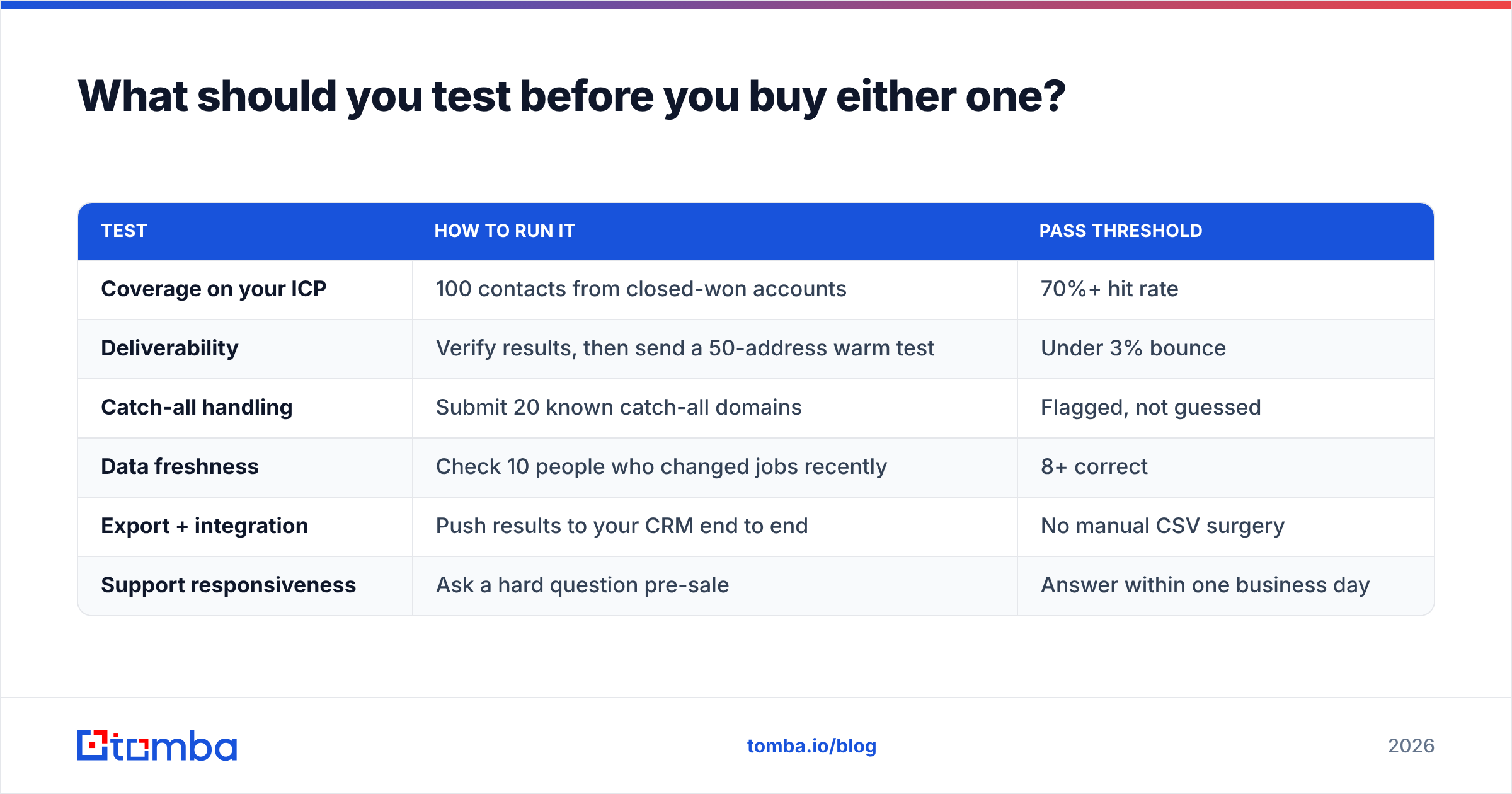
Run this before any contract:
| Test | How to run it | Pass threshold |
|---|---|---|
| Coverage on your ICP | 100 contacts from closed-won accounts | 70%+ hit rate |
| Deliverability | Verify results, then send a 50-address warm test | Under 3% bounce |
| Catch-all handling | Submit 20 known catch-all domains | Flagged, not guessed |
| Data freshness | Check 10 people who changed jobs recently | 8+ correct |
| Export + integration | Push results to your CRM end to end | No manual CSV surgery |
| Support responsiveness | Ask a hard question pre-sale | Answer within one business day |
Vendors who dislike this test are telling you something. Vendors who volunteer it — including on the free tier — are usually confident in coverage.
The verdict#
Gamalogic and Sparklane are not substitutes. Gamalogic wins if your problem is "I need verified email addresses, cheaply, at volume, today." Sparklane wins if your problem is "my reps are targeting badly and I sell into Europe." Buying one to solve the other's problem is the single most common — and most expensive — mistake in this comparison.
If you have concluded that contact data is the actual gap, start with the cheapest credible test. Tomba's free tier gives you 25 searches a month with no card, Starter is $49/mo, Growth is $99/mo, and Pro is $249/mo — and every plan includes verification, domain search, and full API access rather than gating them behind an enterprise tier. Run your closed-won sample through the Tomba Email Finder, verify the output, and measure cost per deliverable address. If the number beats what you are paying now, you have your answer without sitting through a single demo.
Related guides#
Ready to find emails that actually work?
Join 150,000+ professionals who stopped guessing and started sending. Free credits on signup — no credit card required.
Get the Tomba newsletter
Practical outbound tactics and product updates — once every two weeks.
About the author