Gamalogic vs Tomba (2026): Which Email Finder Wins?
Gamalogic and Tomba both promise verified B2B emails at a low price. We compare match rates, catch-all handling, credit models, API depth and real cost per usable contact.
TL;DR
- Gamalogic is a lean, credit-priced email finder and verifier built around bulk CSV work and a straightforward API. It does one job and keeps the bill small.
- Tomba covers more of the prospecting surface: email finder, verifier, domain search, catch-all verifier, phone finder, enrichment, plus native Sheets, Excel, Airtable and CRM connectors.
- On single-contact lookups the two are closer than the marketing suggests. The gap opens on catch-all domains, bulk throughput, and what happens after the email is found.
- Price per usable contact matters more than list price. A cheaper tool with a 20-point lower match rate is not cheaper.
- Pick Gamalogic if you want a low-cost verifier bolted onto an existing stack. Pick Tomba if you want the finding, verifying and enriching to live in one place with an API you can build on.
What are Gamalogic and Tomba?#
Gamalogic is an email-finding and email-verification service aimed at teams that already have a list — or a way to build one — and need to turn names and domains into deliverable addresses without paying enterprise sales-intelligence prices. Its product surface is deliberately narrow: find, verify, do it in bulk, expose it over an API.
Tomba is a B2B email-finder and lead-enrichment platform. The email finder is the core, but it ships alongside a verifier, a domain search that returns every public address on a company domain, a dedicated catch-all verifier, a phone finder, and a data enrichment layer that fills in job title, seniority, LinkedIn URL and company firmographics.
That difference in scope drives almost every other difference in this comparison. Gamalogic is a component. Tomba is a workflow.
How do Gamalogic and Tomba compare at a glance?#
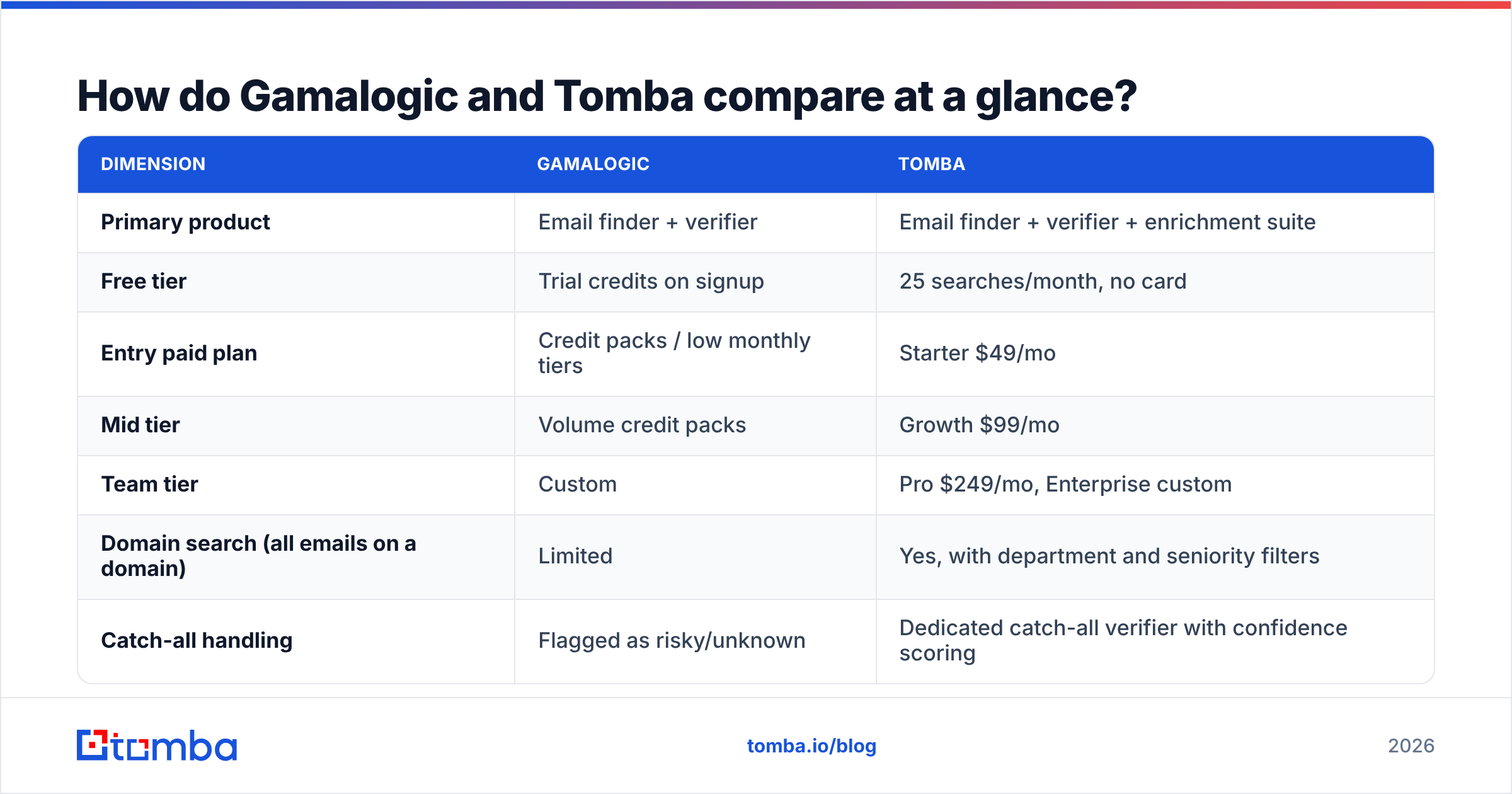
| Dimension | Gamalogic | Tomba |
|---|---|---|
| Primary product | Email finder + verifier | Email finder + verifier + enrichment suite |
| Free tier | Trial credits on signup | 25 searches/month, no card |
| Entry paid plan | Credit packs / low monthly tiers | Starter $49/mo |
| Mid tier | Volume credit packs | Growth $99/mo |
| Team tier | Custom | Pro $249/mo, Enterprise custom |
| Domain search (all emails on a domain) | Limited | Yes, with department and seniority filters |
| Catch-all handling | Flagged as risky/unknown | Dedicated catch-all verifier with confidence scoring |
| Phone numbers | No | Yes (phone finder) |
| Bulk CSV | Yes | Yes (bulk email finder) |
| Native spreadsheet add-ons | Limited | Google Sheets, Excel, Airtable |
| CRM connectors | Via Zapier/API | HubSpot, Salesforce, Pipedrive, Zapier, Make |
| API | REST, credit-metered | REST + CLI + MCP server |
| Chrome extension | Yes | Yes |
Read the table as a scope map, not a scoreboard. If half those rows are features you'd never touch, Gamalogic's narrower surface is a feature, not a gap — you're not subsidising modules you don't open.
Which one finds more valid emails?#
This is the only question that decides the purchase, and it is the one both vendors answer with their own numbers.
Here is the honest framing. Every email finder works the same way underneath: it learns a company's address pattern (first.last@, flast@, first@), applies it to the person you asked about, then tries to confirm the guess against public sources and SMTP signals. Vendors differ on three things — how many domains they have patterns for, how much confirming evidence they hold, and how they behave when the evidence is thin.

Where you'll actually see the spread:
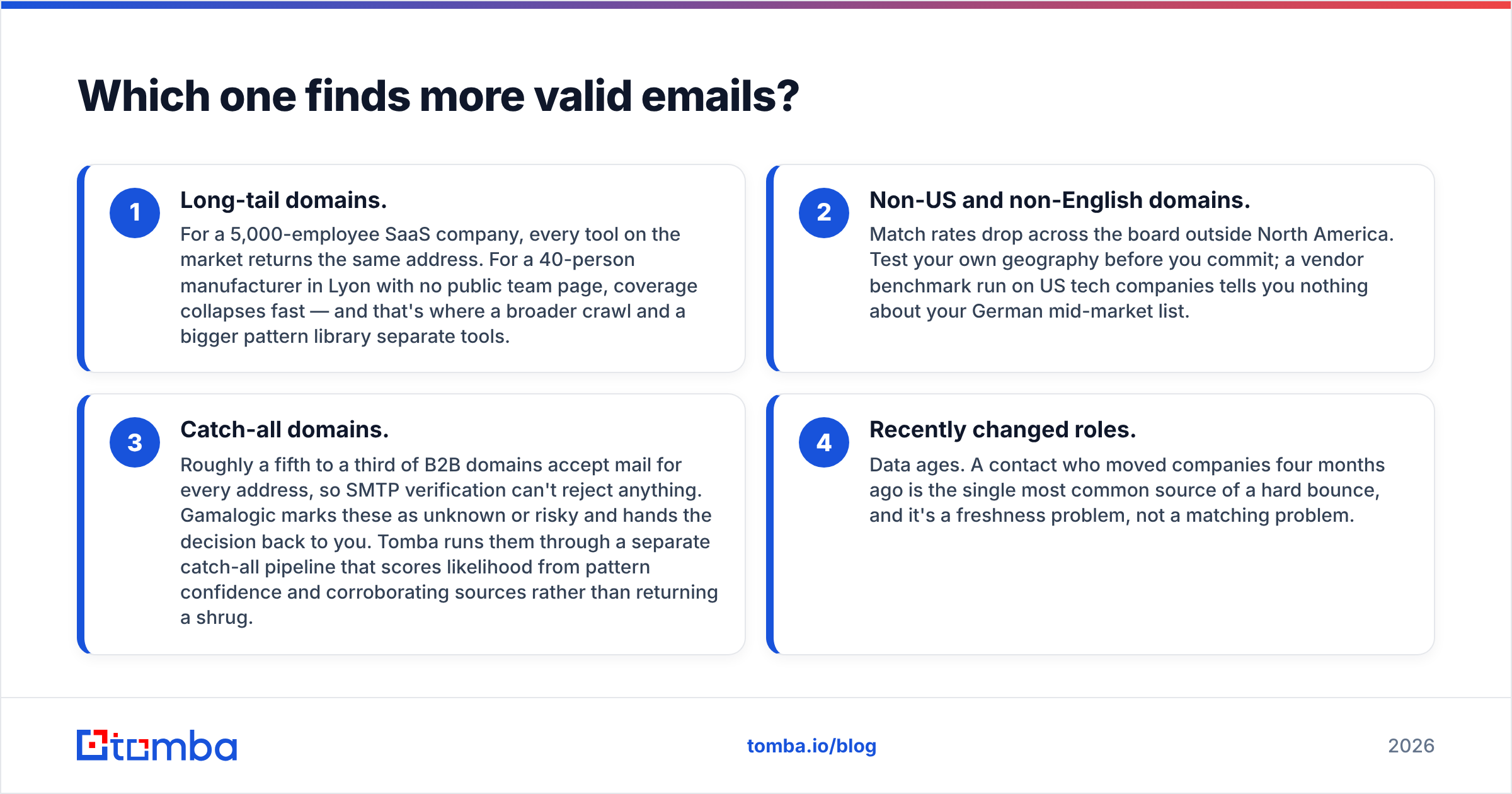
- Long-tail domains. For a 5,000-employee SaaS company, every tool on the market returns the same address. For a 40-person manufacturer in Lyon with no public team page, coverage collapses fast — and that's where a broader crawl and a bigger pattern library separate tools.
- Non-US and non-English domains. Match rates drop across the board outside North America. Test your own geography before you commit; a vendor benchmark run on US tech companies tells you nothing about your German mid-market list.
- Catch-all domains. Roughly a fifth to a third of B2B domains accept mail for every address, so SMTP verification can't reject anything. Gamalogic marks these as unknown or risky and hands the decision back to you. Tomba runs them through a separate catch-all pipeline that scores likelihood from pattern confidence and corroborating sources rather than returning a shrug.
- Recently changed roles. Data ages. A contact who moved companies four months ago is the single most common source of a hard bounce, and it's a freshness problem, not a matching problem.
How to test this properly, in an hour: take 100 contacts you already know are valid — past customers, closed-won records, people who replied to you. Strip the emails. Run both tools on names plus domains. Score three numbers: match rate (did it return anything), accuracy (was the return correct), and false-confidence rate (how often did it call a wrong address "valid"). That third number is the expensive one, and no vendor publishes it.

How do the verification engines differ?#
Finding an address and proving it accepts mail are two different jobs. Both tools do both, with different philosophies.
Gamalogic's verifier is classic and transparent: syntax check, domain and MX record lookup, disposable-domain detection, role-account detection (info@, sales@), then an SMTP handshake where the receiving server allows it. Results come back valid, invalid, or unknown. That last bucket is honest, and it's also your problem to solve.
Tomba's email verifier runs the same chain and then adds a scoring layer on top for the ambiguous cases, plus a separate catch-all finder path. The practical effect: fewer contacts stranded in "unknown," which means fewer good leads discarded out of caution and fewer risky ones sent anyway.
Why this matters more in 2026 than it did three years ago: Google and Yahoo's bulk-sender rules made bounce rate a hard gate rather than a soft metric. Cross 2% and your sending domain's reputation degrades in days, not weeks. A verifier that dumps 30% of your list into "unknown" doesn't protect you — it just moves the gamble to you. If you're sending at volume, pair either tool with basic hygiene: an SPF checker, DMARC alignment, and warmed sending domains.
How does pricing compare?#
Gamalogic sells credits. Tomba sells monthly plans with included searches. Neither model is inherently better, but they reward different usage shapes.

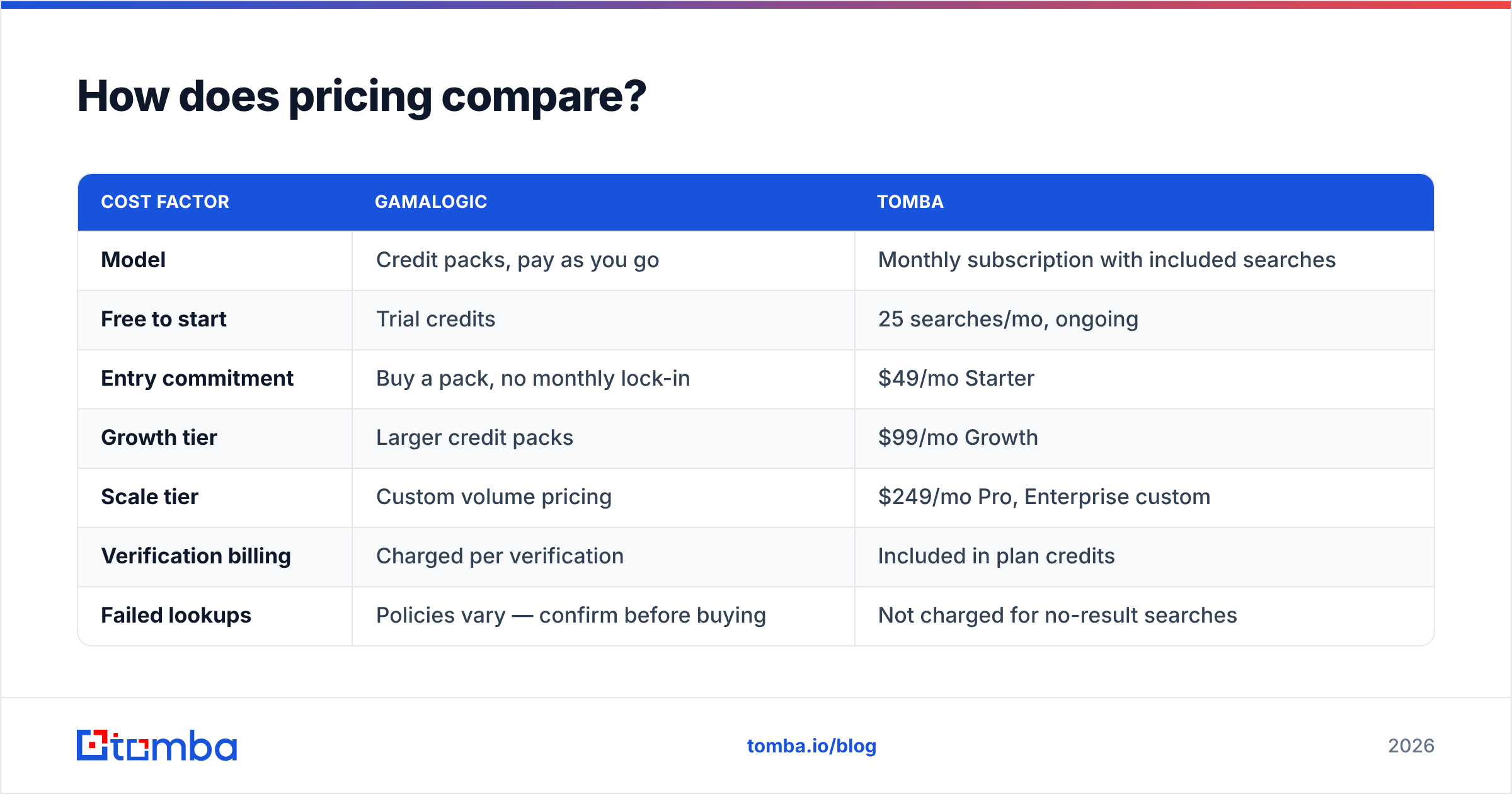
| Cost factor | Gamalogic | Tomba |
|---|---|---|
| Model | Credit packs, pay as you go | Monthly subscription with included searches |
| Free to start | Trial credits | 25 searches/mo, ongoing |
| Entry commitment | Buy a pack, no monthly lock-in | $49/mo Starter |
| Growth tier | Larger credit packs | $99/mo Growth |
| Scale tier | Custom volume pricing | $249/mo Pro, Enterprise custom |
| Verification billing | Charged per verification | Included in plan credits |
| Failed lookups | Policies vary — confirm before buying | Not charged for no-result searches |
| Best for | Sporadic, project-based enrichment | Continuous outbound with predictable volume |
Confirm current numbers on each vendor's own pricing page before you buy — credit tiers change, and this is a snapshot. Tomba pricing is public and flat; Gamalogic's packs are listed on their site.
The comparison that actually matters is cost per usable contact, not cost per credit:
- Tool A: $0.01 per credit, 55% match rate, 8% of "valid" results bounce → roughly $0.020 per contact that survives to a real inbox.
- Tool B: $0.02 per credit, 78% match rate, 2% bounce → roughly $0.026 per contact.
Tool B looks 2x more expensive per credit and lands within 30% of Tool A per usable contact — while burning far less sender reputation and far less SDR time on dead addresses. Run this math with your own numbers from the 100-contact test above. It usually flips the intuitive answer.
One more line item people forget: the tool you don't buy. If Gamalogic covers finding and verifying but you still need phone numbers, firmographics and a CRM push, you're paying for a second and third vendor. Tomba's suite pricing absorbs those into one line. If you already own an enrichment vendor you're happy with, that consolidation is worth nothing to you.

Which has the better API and developer experience?#
If you're wiring a finder into a product or an internal pipeline, this section outweighs everything above.
Gamalogic exposes a clean REST API with per-endpoint credit metering. Documentation is compact, authentication is straightforward, and it's easy to wrap in a script. For a single-purpose integration — "enrich this row when it hits the queue" — that's genuinely all you need.
Tomba ships a wider developer surface:
- REST API — email finder API with finder, verifier, domain search, enrichment and phone endpoints under one key, with official SDKs.
- CLI — command line email finder for shell pipelines and one-off batch jobs without writing code.
- MCP server — MCP server for email so an AI agent can call the finder as a tool, which matters if you're building agentic prospecting rather than static scripts.
- No-code paths — Sheets and Airtable add-ons that cover the 80% case without an engineer.
Rate limits and concurrency are the thing to test in trial, not read about. Both tools throttle; find out where before you architect around them.
Which should you choose for your use case?#
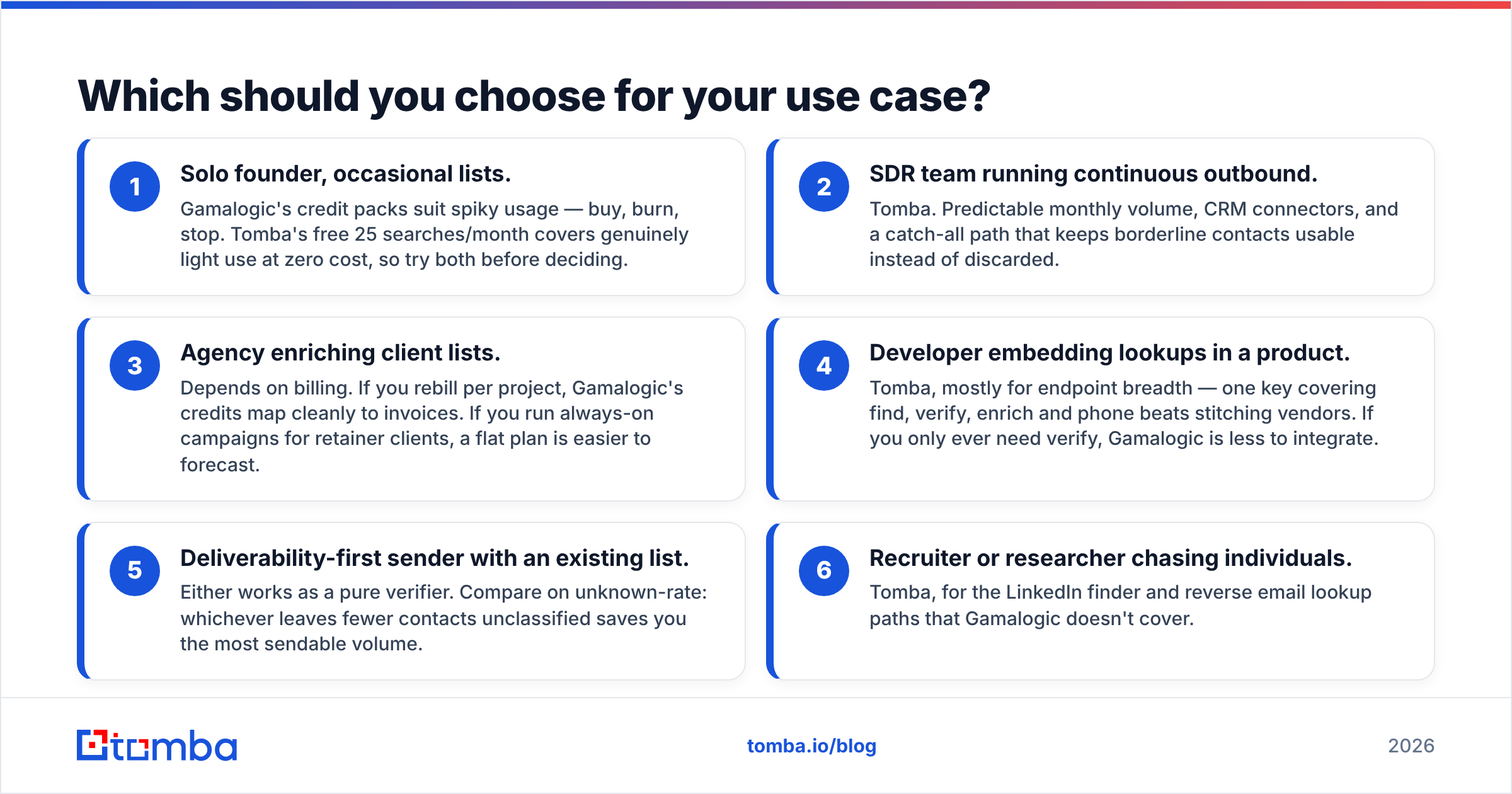
- Solo founder, occasional lists. Gamalogic's credit packs suit spiky usage — buy, burn, stop. Tomba's free 25 searches/month covers genuinely light use at zero cost, so try both before deciding.
- SDR team running continuous outbound. Tomba. Predictable monthly volume, CRM connectors, and a catch-all path that keeps borderline contacts usable instead of discarded.
- Agency enriching client lists. Depends on billing. If you rebill per project, Gamalogic's credits map cleanly to invoices. If you run always-on campaigns for retainer clients, a flat plan is easier to forecast.
- Developer embedding lookups in a product. Tomba, mostly for endpoint breadth — one key covering find, verify, enrich and phone beats stitching vendors. If you only ever need verify, Gamalogic is less to integrate.
- Deliverability-first sender with an existing list. Either works as a pure verifier. Compare on unknown-rate: whichever leaves fewer contacts unclassified saves you the most sendable volume.
- Recruiter or researcher chasing individuals. Tomba, for the LinkedIn finder and reverse email lookup paths that Gamalogic doesn't cover.
What do independent reviews say?#
Treat vendor pages as claims and third-party listings as weak evidence. Both tools carry profiles on G2 and similar directories, and the pattern in this category is consistent: reviewers praise low-cost tools for price and simplicity, and criticise them for coverage on niche domains; they praise broader platforms for consolidation, and criticise them for having features they don't use.
None of that substitutes for your own test. Review volume in this category is thin enough that a handful of enthusiastic or frustrated users can swing a rating by half a star. Run the 100-contact benchmark. It takes an hour and it's the only data that reflects your actual market. If you're unclear on how these systems source data in the first place, the mechanics of address verification and SMTP handshakes are worth twenty minutes of reading before you evaluate anyone's accuracy claim.
What's the verdict on Gamalogic vs Tomba?#
Gamalogic wins on focus. It's a competent finder-and-verifier with a credit model that suits irregular usage and an API simple enough to integrate in an afternoon. If your stack is already assembled and you're filling one hole, it fills that hole cheaply.
Tomba wins on scope and on what happens after the match. Domain search, a real catch-all pipeline, phone numbers, enrichment, spreadsheet add-ons and CRM connectors mean the contact goes from "found" to "in the sequence" without a second vendor or a CSV round-trip. Starting at $49/mo with a permanent free tier, it's priced as a platform without enterprise pricing.
The tiebreaker is your unknown-rate and your total vendor count. Test both on the same 100 contacts, count how many survive to a real reply, and let that number decide.
Ready to benchmark it yourself? Start with the Tomba Email Finder — 25 free searches a month, no card required. Run your own list through it, compare the match rate and bounce rate against whatever you're using today, and upgrade only if the numbers justify it.
Related guides#
Ready to find emails that actually work?
Join 150,000+ professionals who stopped guessing and started sending. Free credits on signup — no credit card required.
Get the Tomba newsletter
Practical outbound tactics and product updates — once every two weeks.
About the author