Gamification in Sales: What Actually Works (2026 Guide)
Leaderboards and confetti do not close deals. Here is what gamification in sales actually changes, which metrics are safe to gamify, what the major platforms cost, and the data problem that quietly kills every contest.
TL;DR
- Gamification in sales is behavior design, not decoration. It works when it rewards the inputs a rep controls, and fails when it rewards closed revenue they only partly control.
- The most reliable lifts show up in activity consistency and CRM hygiene, not in win rate. Expect better forecasting inputs before you expect a bigger number at quarter end.
- Dedicated platforms (Ambition, Spinify, SalesScreen, Zoominfo Engage-style tools) run roughly $20–$80 per user per month. Most teams under 10 reps can replicate 80% of the value with a CRM dashboard and a Slack channel.
- The fastest way to kill a contest is bad contact data. If half the "100 emails sent" are bounces, you are paying people to burn your domain.
- Fix the data layer first, gamify second. Points on top of a broken list just accelerate the wrong behavior.
What is gamification in sales?#
Gamification in sales is the practice of applying game mechanics — points, levels, leaderboards, badges, streaks, head-to-head contests — to the daily work of a sales team so that the behaviors you want become visible, competitive, and repeatable.
Think of it like a gym with a whiteboard. Nobody lifts more because the whiteboard exists. They lift more because the whiteboard makes yesterday's number impossible to ignore, and because someone else's number is written right underneath. The mechanic does not create motivation; it makes existing motivation legible.
That distinction matters, because it explains the failure pattern. Gartner has warned for years that most gamification programs underdeliver — not because game mechanics do not influence behavior, but because organizations bolt them onto goals employees have no direct control over. A leaderboard ranking reps by closed-won revenue in a 9-month enterprise cycle is a lottery scoreboard, not a game.
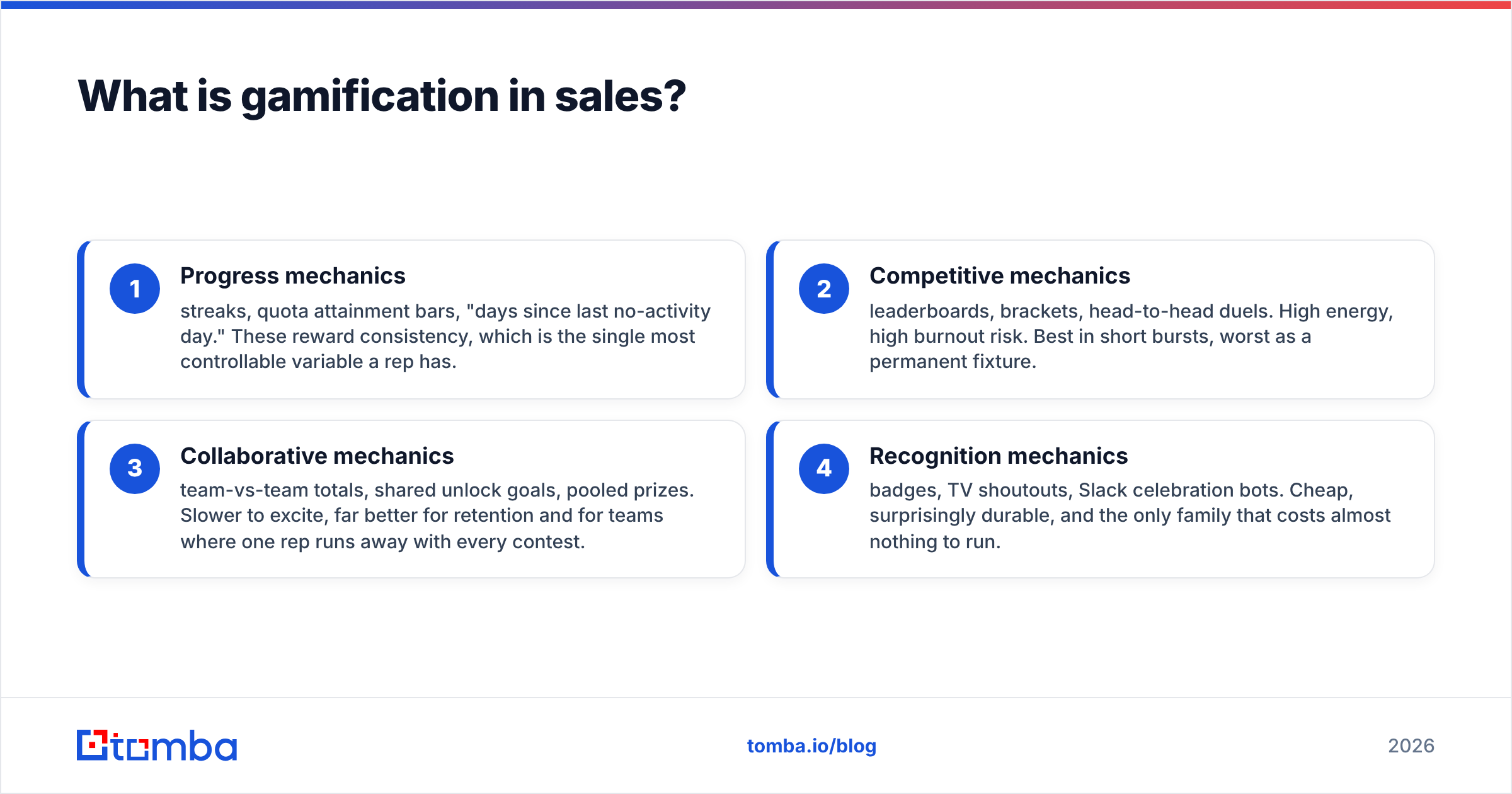
The mechanics that survive contact with a real sales floor break into four families:
- Progress mechanics — streaks, quota attainment bars, "days since last no-activity day." These reward consistency, which is the single most controllable variable a rep has.
- Competitive mechanics — leaderboards, brackets, head-to-head duels. High energy, high burnout risk. Best in short bursts, worst as a permanent fixture.
- Collaborative mechanics — team-vs-team totals, shared unlock goals, pooled prizes. Slower to excite, far better for retention and for teams where one rep runs away with every contest.
- Recognition mechanics — badges, TV shoutouts, Slack celebration bots. Cheap, surprisingly durable, and the only family that costs almost nothing to run.
Most teams reach for family two, get a two-week spike, and conclude gamification does not work. The spike was real. The design was wrong.
Why does most sales gamification fail?#
Because it measures what is easy to count instead of what is worth doing.
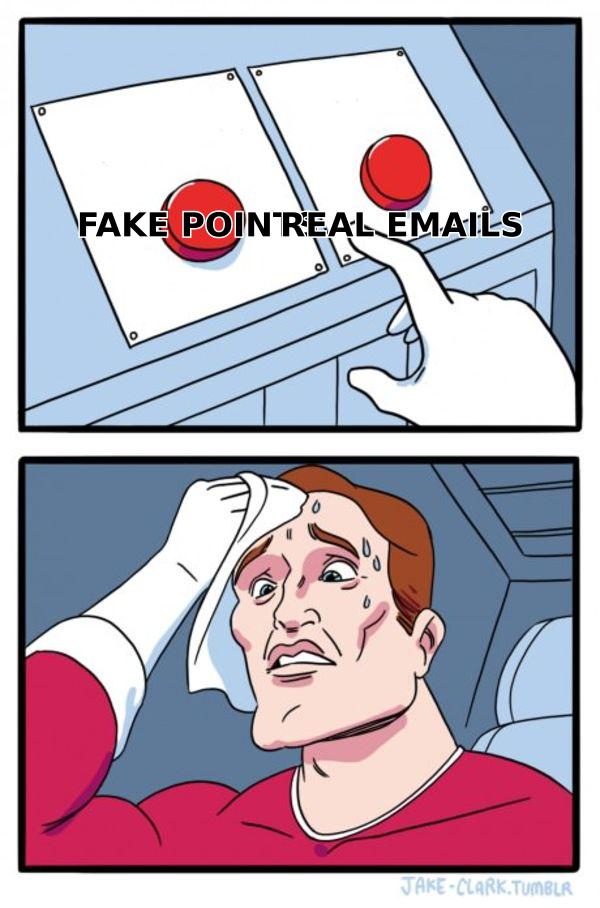
The classic failure sequence: leadership announces a contest for "most calls made this month." Within four days, reps discover that a 12-second call still counts as a call. Dial volume triples. Connect rate collapses. The leaderboard looks fantastic. Pipeline does not move. This is Goodhart's Law in a headset — when a measure becomes a target, it ceases to be a good measure.
Four other predictable failure modes:
- The same person wins every time. If your top rep takes first place for six straight months, everyone else stops competing by month three. Ranked-tier contests (rookies compete against rookies) or "most improved" scoring fixes this faster than any prize increase.
- Rewards outweigh the work. A $500 prize for a metric that takes 40 extra hours to move reads as an insult. A $50 prize for a metric that takes a focused afternoon reads as a game.
- The scoreboard lags. If the leaderboard updates nightly, the feedback loop is dead. Game mechanics work on near-instant feedback. Anything over a few minutes is a report, not a game.
- The underlying data is wrong. This is the quiet killer and it deserves its own section below.
Which metrics should you gamify — and which should you never touch?#
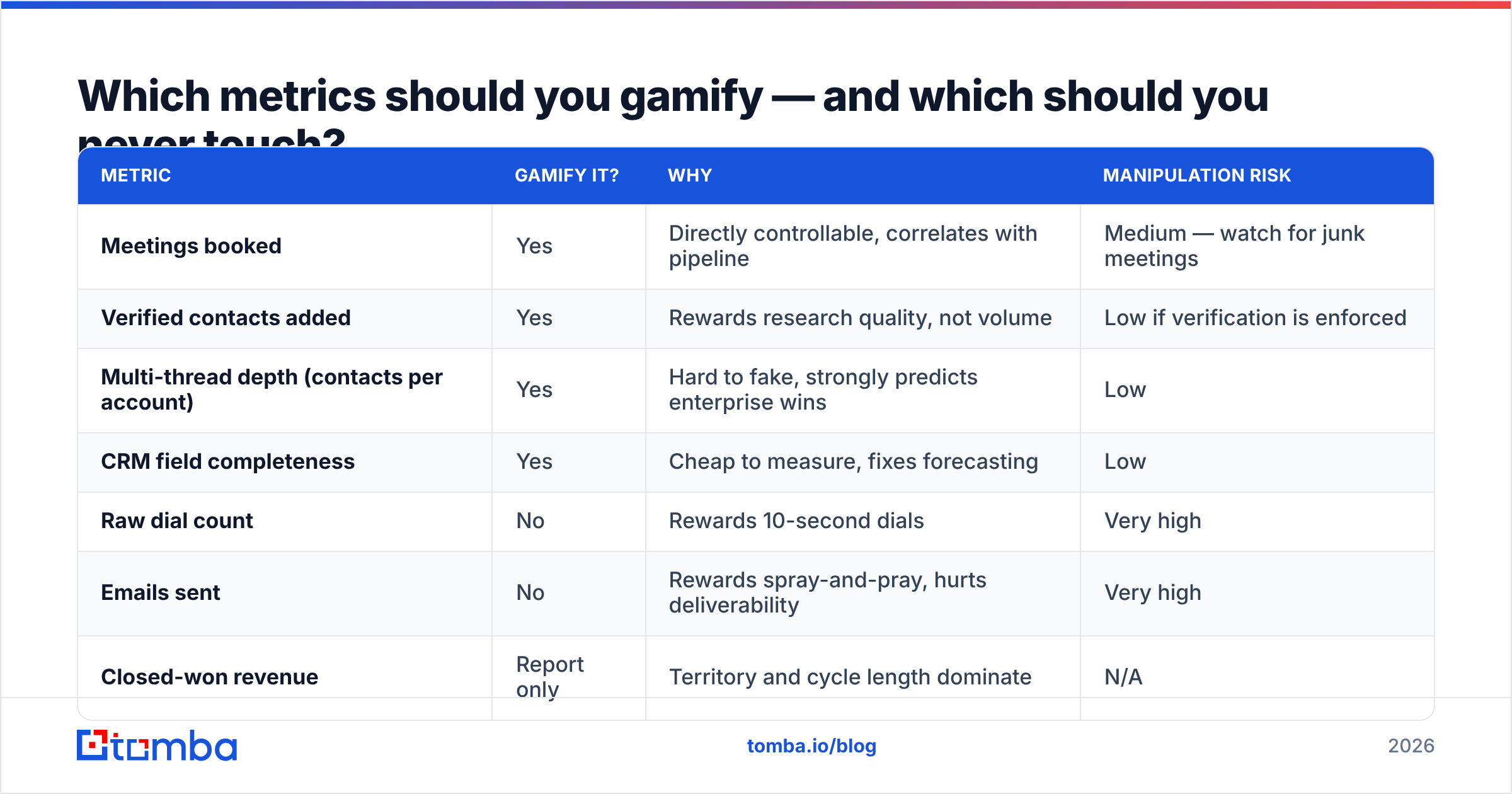
Gamify inputs and leading indicators. Report on outcomes. The line is simple: if a rep can single-handedly move the number this week through effort alone, it is gamifiable.
| Metric | Gamify it? | Why | Manipulation risk |
|---|---|---|---|
| Meetings booked | Yes | Directly controllable, correlates with pipeline | Medium — watch for junk meetings |
| Verified contacts added | Yes | Rewards research quality, not volume | Low if verification is enforced |
| Multi-thread depth (contacts per account) | Yes | Hard to fake, strongly predicts enterprise wins | Low |
| CRM field completeness | Yes | Cheap to measure, fixes forecasting | Low |
| Raw dial count | No | Rewards 10-second dials | Very high |
| Emails sent | No | Rewards spray-and-pray, hurts deliverability | Very high |
| Closed-won revenue | Report only | Territory and cycle length dominate | N/A |
| Pipeline created ($) | Cautiously | Reps inflate deal size to climb | High |
Notice the pattern. The safe metrics are the ones where quality is built into the definition. "Emails sent" is unsafe. "Emails sent to verified addresses that did not bounce" is safe — because the only way to game it is to do the research properly.
That is the whole trick, and it is why data quality and gamification are the same project. If you want a deeper breakdown of the downstream metric, our glossary entry on response rate covers how bounce noise distorts every activity KPI sitting above it.
What do sales gamification platforms actually cost?#
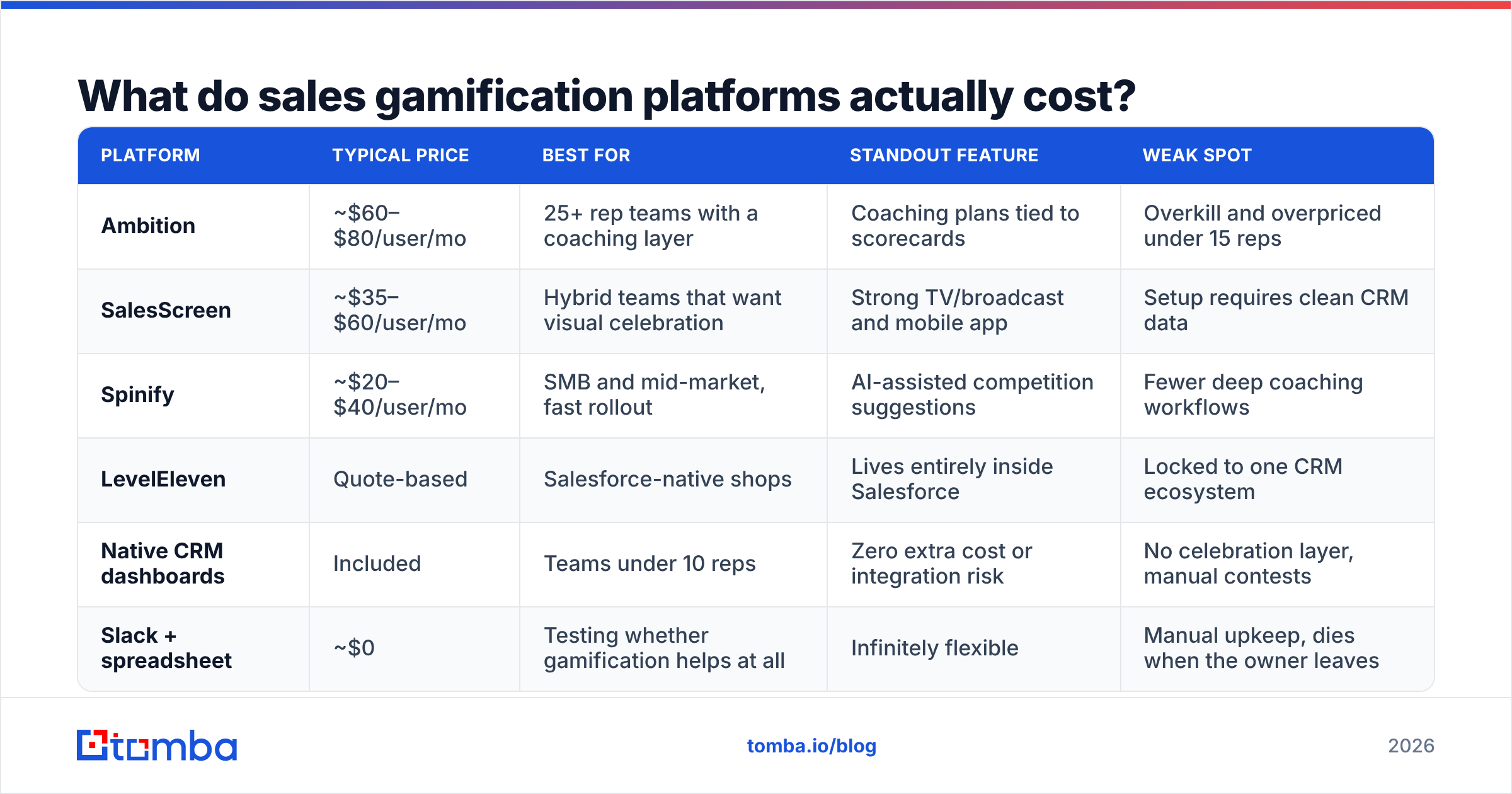
Pricing in this category is mostly quote-based, which is a polite way of saying it scales with headcount and how badly they think you need it. Published and commonly reported ranges as of early 2026:
| Platform | Typical price | Best for | Standout feature | Weak spot |
|---|---|---|---|---|
| Ambition | ~$60–$80/user/mo | 25+ rep teams with a coaching layer | Coaching plans tied to scorecards | Overkill and overpriced under 15 reps |
| SalesScreen | ~$35–$60/user/mo | Hybrid teams that want visual celebration | Strong TV/broadcast and mobile app | Setup requires clean CRM data |
| Spinify | ~$20–$40/user/mo | SMB and mid-market, fast rollout | AI-assisted competition suggestions | Fewer deep coaching workflows |
| LevelEleven | Quote-based | Salesforce-native shops | Lives entirely inside Salesforce | Locked to one CRM ecosystem |
| Native CRM dashboards | Included | Teams under 10 reps | Zero extra cost or integration risk | No celebration layer, manual contests |
| Slack + spreadsheet | ~$0 | Testing whether gamification helps at all | Infinitely flexible | Manual upkeep, dies when the owner leaves |
Before you sign anything, do the arithmetic that vendors avoid: a 30-rep team on a $60/user platform is spending $21,600 a year. That needs to produce roughly one extra mid-market deal annually just to break even. If your current problem is that reps cannot find good contacts to call, that $21,600 buys a lot more contacts than it buys confetti.
Check current, verified user reviews on G2 before trusting any published price — this category renegotiates aggressively and public pricing pages go stale within a quarter. Salesforce's own guidance on sales performance management is also worth reading if you are already in that ecosystem, since native tooling may cover more than you think.
How do you run a sales contest that actually moves pipeline?#
Run it like an experiment, not a party. Six steps, in order:
- Pick one bottleneck metric. Not three. If discovery-to-demo conversion is your weak stage, the contest scores demos booked from existing discovery calls — nothing else.
- Define the quality gate inside the metric. "Demos booked" becomes "demos booked that were actually held." This single edit removes 90% of gaming.
- Set the window short. Two weeks beats a quarter. Short windows create urgency and let you re-run with a fixed design if the first attempt distorts behavior.
- Make the scoreboard live. Sync from your CRM at least every 15 minutes and put it where reps already are — Slack, Teams, or a wall screen. A dashboard nobody opens is not a game.
- Tier the field. Split by tenure or by baseline performance. Rookies compete with rookies. Add a "most improved versus your own 90-day average" category so the ceiling is not owned by one person.
- Publish the post-mortem. Compare the contest window to the two weeks before and after. If the metric spikes during and craters after, you rented behavior instead of building it.
The post-mortem step is the one everyone skips and the one that separates a real program from morale theater. A contest that produces a spike followed by an equal-sized trough has produced nothing except a tired team.
Does gamification work for remote and hybrid sales teams?#
Better than it works in an office, with one design change: shift the weight from competition to recognition.
In a physical bullpen, the ambient signal is free. You hear the calls, you see the bell, you feel who is having a good week. Remote teams lose all of that. Gamification's real job on a distributed team is not to create competition — it is to restore the ambient signal that distance removed.
What that means practically:
- Broadcast wins, not ranks. An automated Slack post ("Priya just booked her third demo at a Fortune 1000 account") does more for a remote team than a leaderboard showing who is in seventh place.
- Use asynchronous streaks. A rep in a different timezone cannot win a live sprint. They can absolutely maintain a 14-day activity streak.
- Cap the visibility of the bottom. Show the top five, show everyone their own trend, and never publish a full ranked list to the whole company. Public bottom-ranking is the single fastest driver of attrition in these programs.
- Prize with time, not trinkets. A remote rep values a Friday afternoon off more than a branded speaker.
What quietly destroys every gamification program?#
Bad contact data. Every time.
Here is the mechanism. You launch a contest on outbound activity. Reps pull contacts from a stale list or an unverified scrape. Thirty percent of the sends bounce. Your sender reputation drops, so the emails that do reach valid inboxes start landing in spam. Reply rates fall. Reps conclude outbound does not work, and management concludes gamification does not work. Both conclusions are wrong. The list was wrong.
Gamification is an amplifier. Point it at a clean data layer and it amplifies good prospecting. Point it at a dirty one and it amplifies domain damage at a faster rate than your team could have managed manually.
The prerequisite checklist before any contest launch:
- Contact source is documented. You know where every record came from and when it was last confirmed.
- Every address is verified before send. Run the list through an email verifier and treat bounce rate above 3% as a red flag, not a rounding error.
- Catch-all domains are flagged, not guessed. A catch-all accepts everything and tells you nothing; handle those separately rather than counting them as valid.
- Records are enriched, not just found. A name and an email is a target. A name, email, role, and company context is a conversation. Contact enrichment is what makes a "personalization" contest possible in the first place.
- Duplicates are removed. Two reps working the same contact turns a contest into an internal conflict within a week.
Teams that do this find that the interesting gamification metric changes on its own. Instead of scoring "emails sent," you score "verified contacts researched and multi-threaded." That is a metric worth winning.
How do you measure whether gamification is actually paying for itself?#
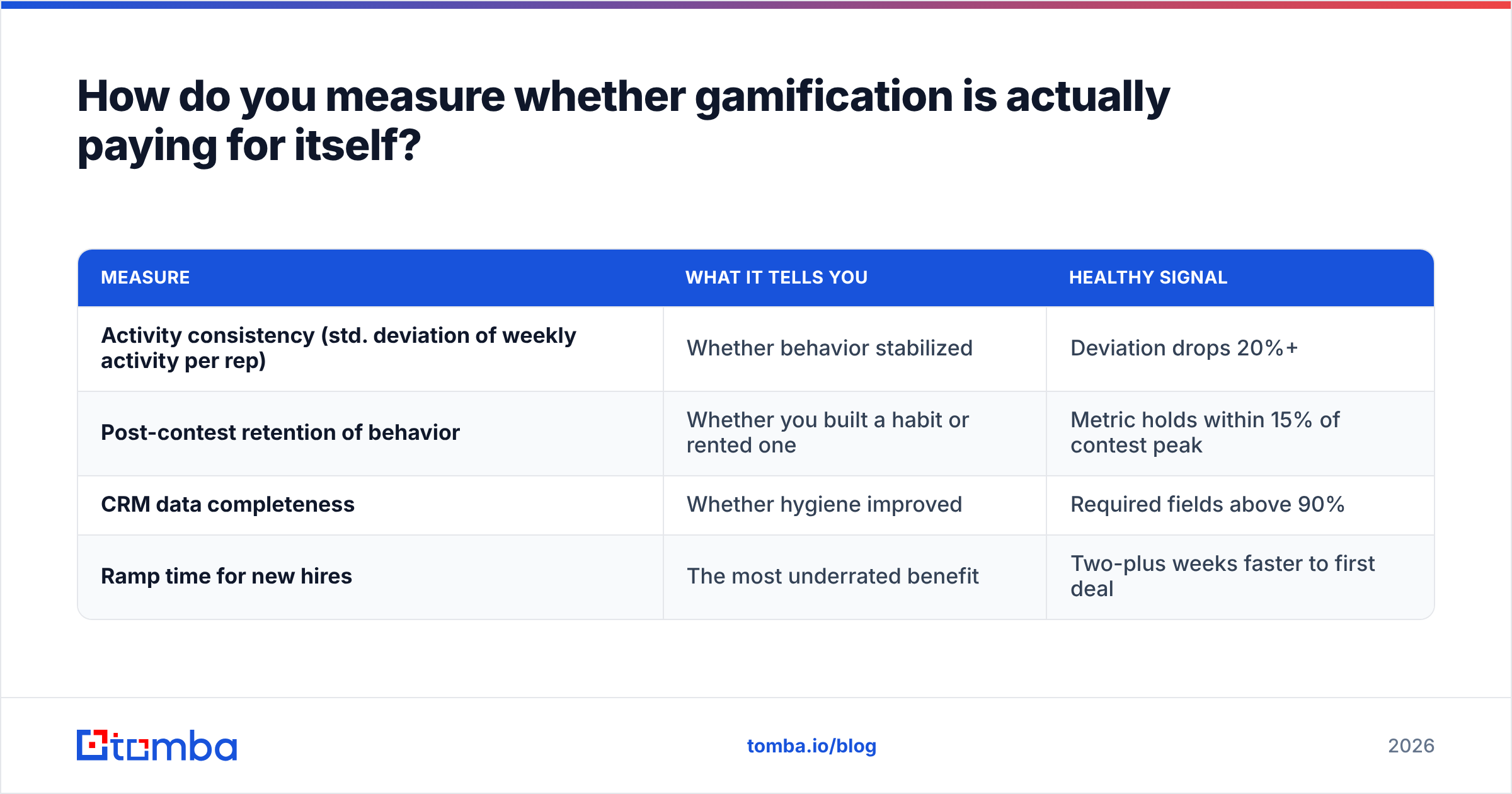
Track four numbers across a full quarter, comparing the gamified period against an equivalent baseline period:
| Measure | What it tells you | Healthy signal |
|---|---|---|
| Activity consistency (std. deviation of weekly activity per rep) | Whether behavior stabilized | Deviation drops 20%+ |
| Post-contest retention of behavior | Whether you built a habit or rented one | Metric holds within 15% of contest peak |
| CRM data completeness | Whether hygiene improved | Required fields above 90% |
| Ramp time for new hires | The most underrated benefit | Two-plus weeks faster to first deal |
Notice that win rate is not on that list. Win rate is influenced by pricing, product, competition, and market conditions far more than by whether Marcus got a badge. If you promise leadership a win-rate lift from a gamification purchase, you will be explaining yourself in ninety days.
The honest pitch to leadership is narrower and much more defensible: gamification makes rep behavior consistent and visible, which makes coaching targeted and forecasting accurate. Those are real, compounding wins. Revenue follows them indirectly.
Where should you start?#
If you have never run a structured program, do not buy software. Run three two-week contests on a spreadsheet and a Slack channel. Score a quality-gated input metric. Publish the post-mortem each time. If behavior holds between contests, you have proven the mechanic works on your team and you now have real requirements to take to a vendor. If it does not hold, you just saved $20,000.
And before the first contest starts, fix the input. A leaderboard built on a list of guessed addresses is a scoreboard for a game nobody can win.
That is where Tomba's Email Finder fits: verified professional email addresses by name, domain, or company, so the activity your team is competing on is activity that actually lands. The free tier gives you 25 searches a month to sanity-check your current list quality, and paid plans start at $49/mo on the Starter tier — see Tomba pricing for the full breakdown. Clean the data, then hand your reps a game worth playing.
Related guides#
Ready to find emails that actually work?
Join 150,000+ professionals who stopped guessing and started sending. Free credits on signup — no credit card required.
Get the Tomba newsletter
Practical outbound tactics and product updates — once every two weeks.
About the author