Gamification Lead Generation: How It Works in 2026
Quizzes, spin-to-win wheels and ROI calculators can triple opt-in rates — or fill your CRM with junk. Here is how gamification lead generation actually performs, and when to skip it.
TL;DR
- Gamification lead generation works because it swaps a demand ("give me your email") for a trade ("answer 6 questions, get your score"). Interactive formats routinely pull 2-4x the opt-in rate of a static gated PDF.
- The catch is data quality. Spin-to-win wheels and sweepstakes attract prize-hunters who type
asdf@gmail.com. Assessments, ROI calculators and configurators attract buyers. - Pick the mechanic by intent stage: quizzes for top of funnel, calculators for mid, benchmark tools and audits for bottom.
- Budget realistically: $39-$999/mo for the interactive-content platform, plus verification and enrichment on the back end so your CRM does not rot.
- The winning stack is interactive front end + strict verification + enrichment. Without the last two, gamification just makes your bounce rate worse faster.
What Is Gamification Lead Generation?#
Gamification lead generation is the practice of wrapping your lead capture in a game-like interaction — a quiz, an assessment, a calculator, a spin-to-win wheel, a points system, a leaderboard, a configurator — so that giving up contact details feels like a fair trade rather than a toll booth.
The mechanic is old. Cosmo quizzes, frequent-flyer tiers, and airline status bars all predate SaaS. What changed is that building one no longer needs an engineering sprint. A marketer can ship a scored assessment in an afternoon and pipe results into HubSpot.
The psychology is not mysterious either. Three things do the work:
- Progress bias — once someone answers question 1 of 6, abandoning feels like losing something. A static form has no sunk cost.
- Personalized payoff — a result page that says "your outbound setup scores 41/100, here is the weakest link" is worth more than a generic ebook, so the email feels cheaper to give.
- Self-declared data — every question is a qualification field the prospect volunteers instead of you buying it. Company size, tech stack, budget band, timeline.
- Reciprocity and status — leaderboards, badges, and benchmark percentiles ("you rank in the top 18% of agencies") create a reason to share the result, which turns one lead into a small referral loop.
That fourth point is why gamification lead generation gets pitched as a growth channel and not just a form-conversion trick. Whether it works that way depends entirely on which mechanic you pick.
Which Gamification Mechanics Actually Generate B2B Leads?#
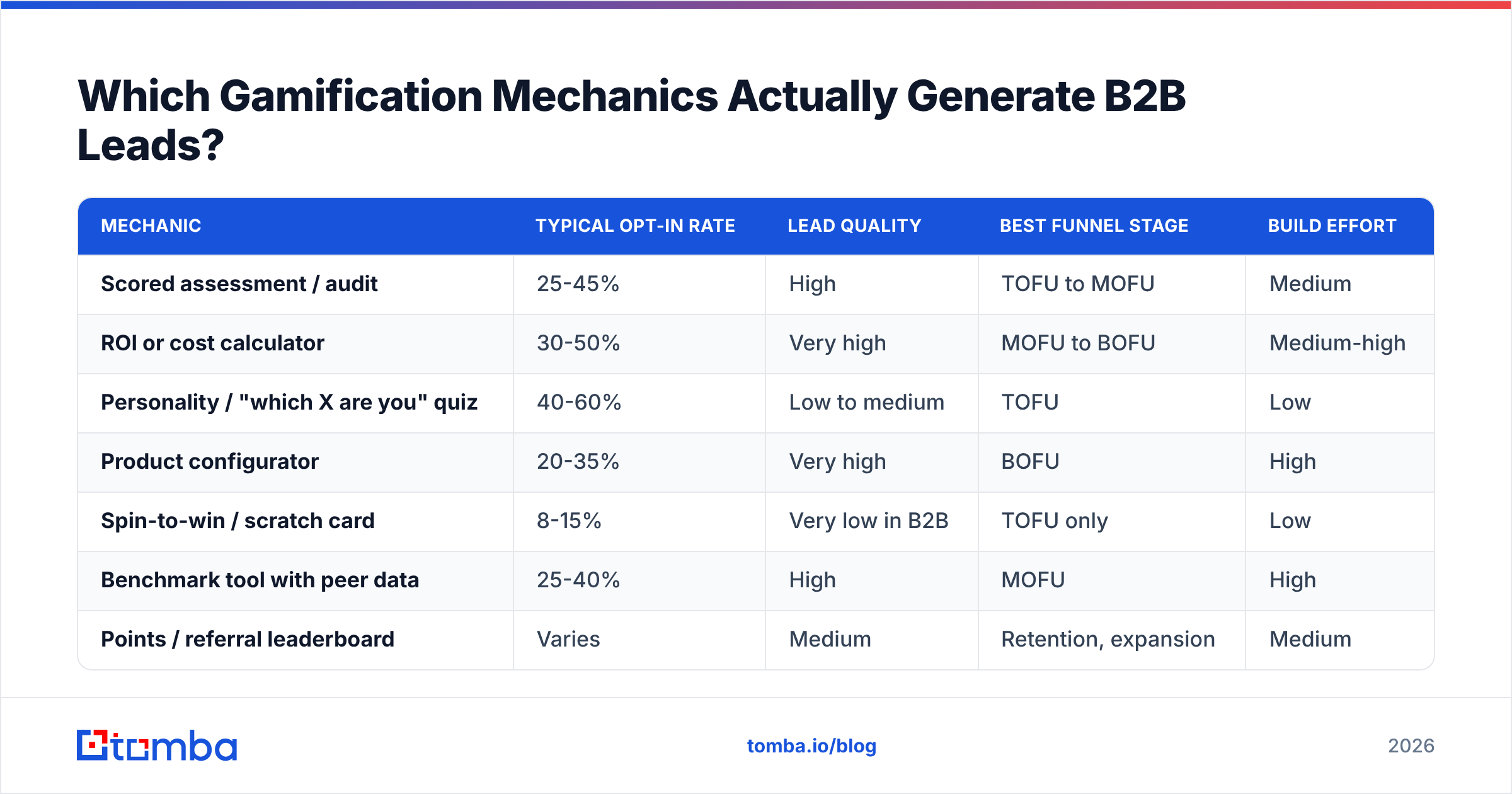
Not all of them. The consumer playbook — wheels, scratch cards, sweepstakes — transfers badly to B2B because the incentive selects for the wrong person. Here is how the common mechanics compare on the metrics that matter.
| Mechanic | Typical opt-in rate | Lead quality | Best funnel stage | Build effort |
|---|---|---|---|---|
| Scored assessment / audit | 25-45% | High | TOFU to MOFU | Medium |
| ROI or cost calculator | 30-50% | Very high | MOFU to BOFU | Medium-high |
| Personality / "which X are you" quiz | 40-60% | Low to medium | TOFU | Low |
| Product configurator | 20-35% | Very high | BOFU | High |
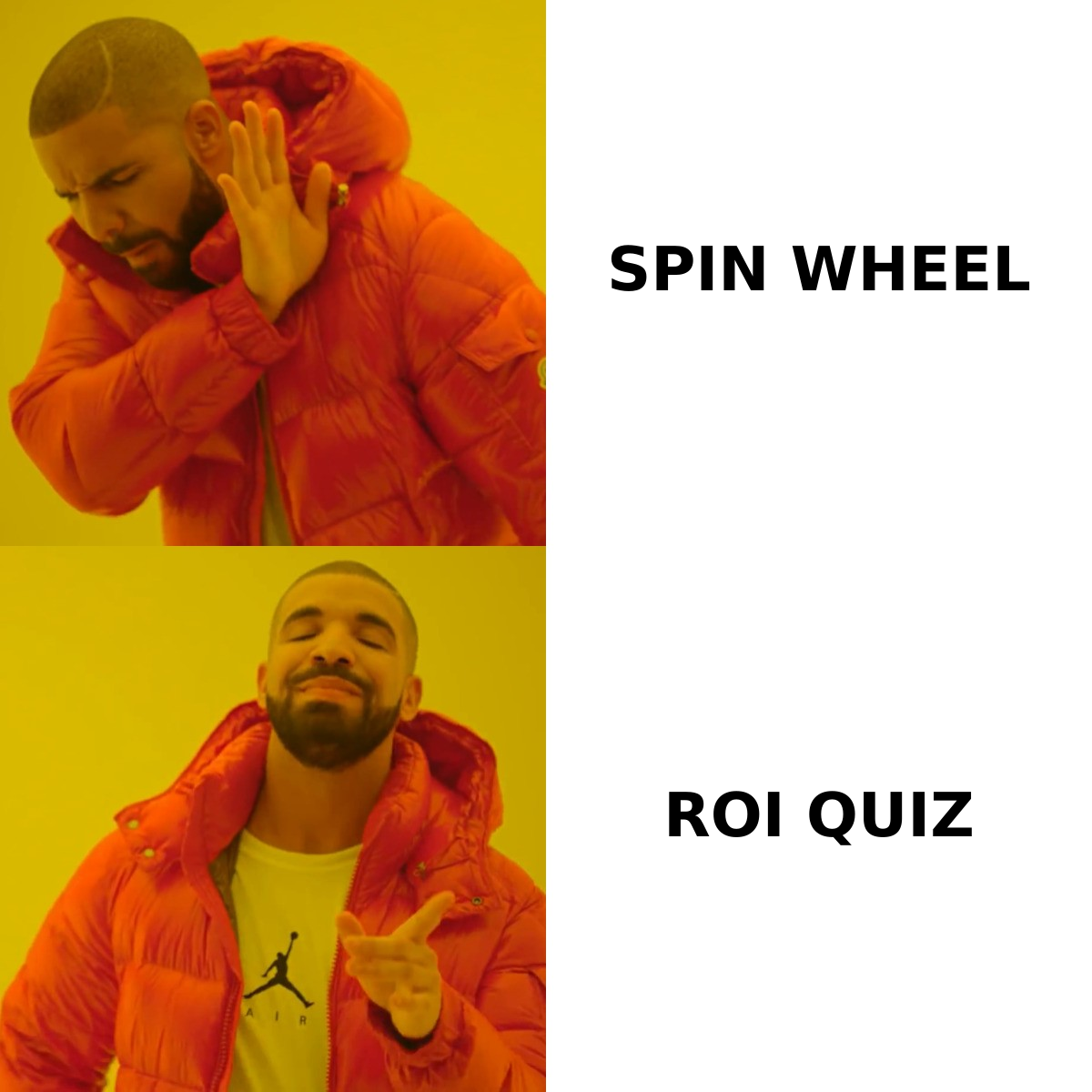
| Spin-to-win / scratch card | 8-15% | Very low in B2B | TOFU only | Low |
| Benchmark tool with peer data | 25-40% | High | MOFU | High |
| Points / referral leaderboard | Varies | Medium | Retention, expansion | Medium |
Read that table as a trade-off curve, not a ranking. Personality quizzes convert best and qualify worst. Configurators qualify best and convert worst. The sweet spot for most B2B teams is the scored assessment: high enough completion to feed the funnel, specific enough to tell sales something useful.
A concrete example. A payroll software company runs a "Compliance Risk Score" assessment: 8 questions on headcount, states of operation, contractor mix, and current payroll provider. Completion rate lands around 38%. Every completion arrives in the CRM with headcount, geography, and incumbent vendor attached. That is a sales-ready record, not a name on a list.
Compare that with the same company running a wheel that gives away a $50 gift card. It gets more entries. It gets almost no meetings.
Does Gamification Actually Improve Conversion Rates?#
Yes, on the capture metric — and that is exactly where teams get fooled.
Interactive content consistently beats static content on engagement. HubSpot's research on interactive content and vendor benchmarks from Outgrow both put interactive formats well ahead of downloadable PDFs on conversion. Directionally, expect something in the 2-4x range against a gated whitepaper on the same traffic.
But conversion rate is a vanity metric if the denominator of your pipeline math changes. Track these four instead:
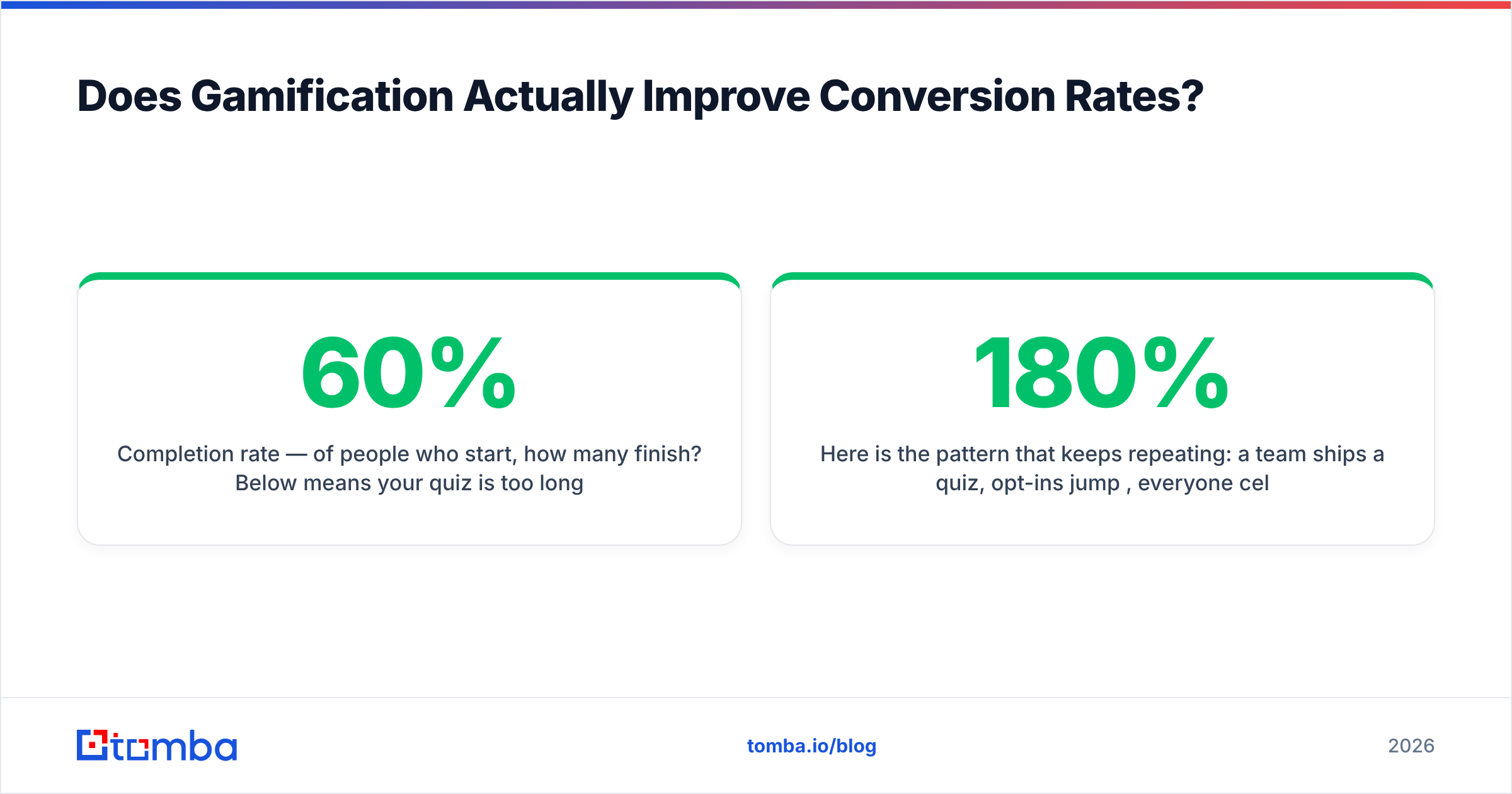
- Completion rate — of people who start, how many finish? Below 60% means your quiz is too long or asks for something uncomfortable too early.
- Verified-email rate — of captured emails, how many are real and deliverable? This is where wheels collapse. Run every capture through an email verifier before it touches your sending domain.
- Cost per qualified lead — not cost per lead. Divide platform cost plus paid traffic by the number of leads that match ICP.
- Meeting rate within 30 days — the only number your CFO cares about.
Here is the pattern that keeps repeating: a team ships a quiz, opt-ins jump 180%, everyone celebrates, then the cold sequence goes out and bounce rates spike past 8%. Mailbox providers notice. Sender reputation drops. Two months later the team's email deliverability is worse than before gamification and the "win" is net negative.

The fix is boring and non-negotiable: verification at the point of capture, enrichment before the record hits a sequence.
How Do You Keep Gamified Leads From Polluting Your CRM?#
Treat the game as the top of a pipe with three filters bolted underneath it.
Filter 1 — Syntax and disposable domains at form time. Reject obvious junk in the browser before submission. A free email checker handles the manual spot-checks; for form-level blocking you want an API call.
Filter 2 — Real-time verification on submit. MX lookup, SMTP handshake, catch-all detection. Personal Gmail addresses on a B2B assessment are a signal, not a disqualifier — but a business address you cannot verify is a liability. Catch-all domains need their own treatment; a catch-all verifier tells you whether the domain accepts everything or the mailbox genuinely exists.
Filter 3 — Enrichment before routing. A quiz gives you self-declared data. Enrichment gives you verifiable data. Run the domain through data enrichment to attach headcount, industry, tech stack, and funding, then compare it against what the prospect claimed. Mismatches are useful: someone who says "500+ employees" from a 4-person consultancy domain is either aspirational or testing your tool.
A workable routing rule set:
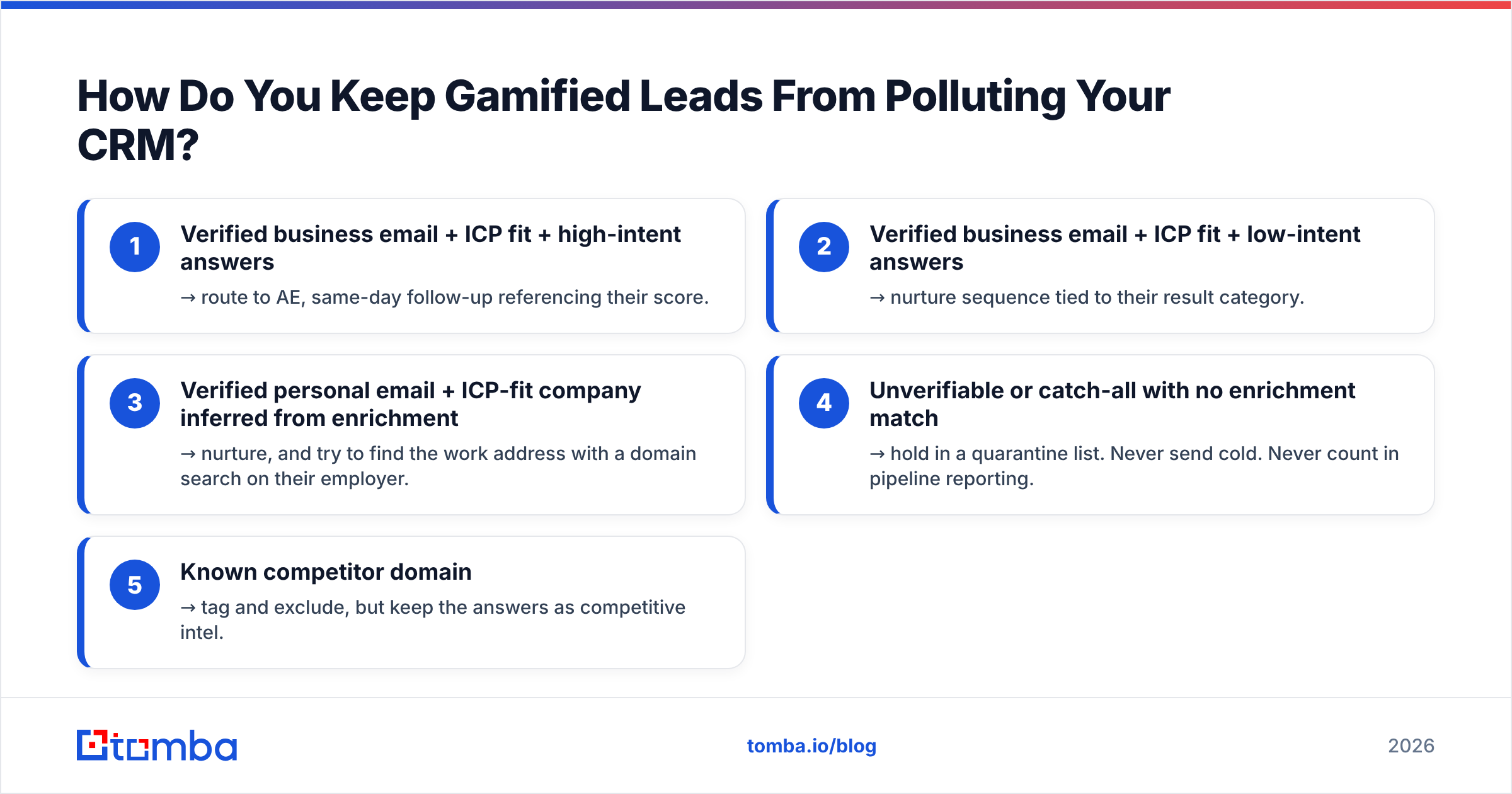
- Verified business email + ICP fit + high-intent answers → route to AE, same-day follow-up referencing their score.
- Verified business email + ICP fit + low-intent answers → nurture sequence tied to their result category.
- Verified personal email + ICP-fit company inferred from enrichment → nurture, and try to find the work address with a domain search on their employer.
- Unverifiable or catch-all with no enrichment match → hold in a quarantine list. Never send cold. Never count in pipeline reporting.
- Known competitor domain → tag and exclude, but keep the answers as competitive intel.
That quarantine bucket is the discipline most teams skip. It usually holds 15-30% of gamified captures, and it is the single biggest reason gamification gets blamed for deliverability problems it did not directly cause.
What Does a Gamification Lead Generation Stack Cost in 2026?#
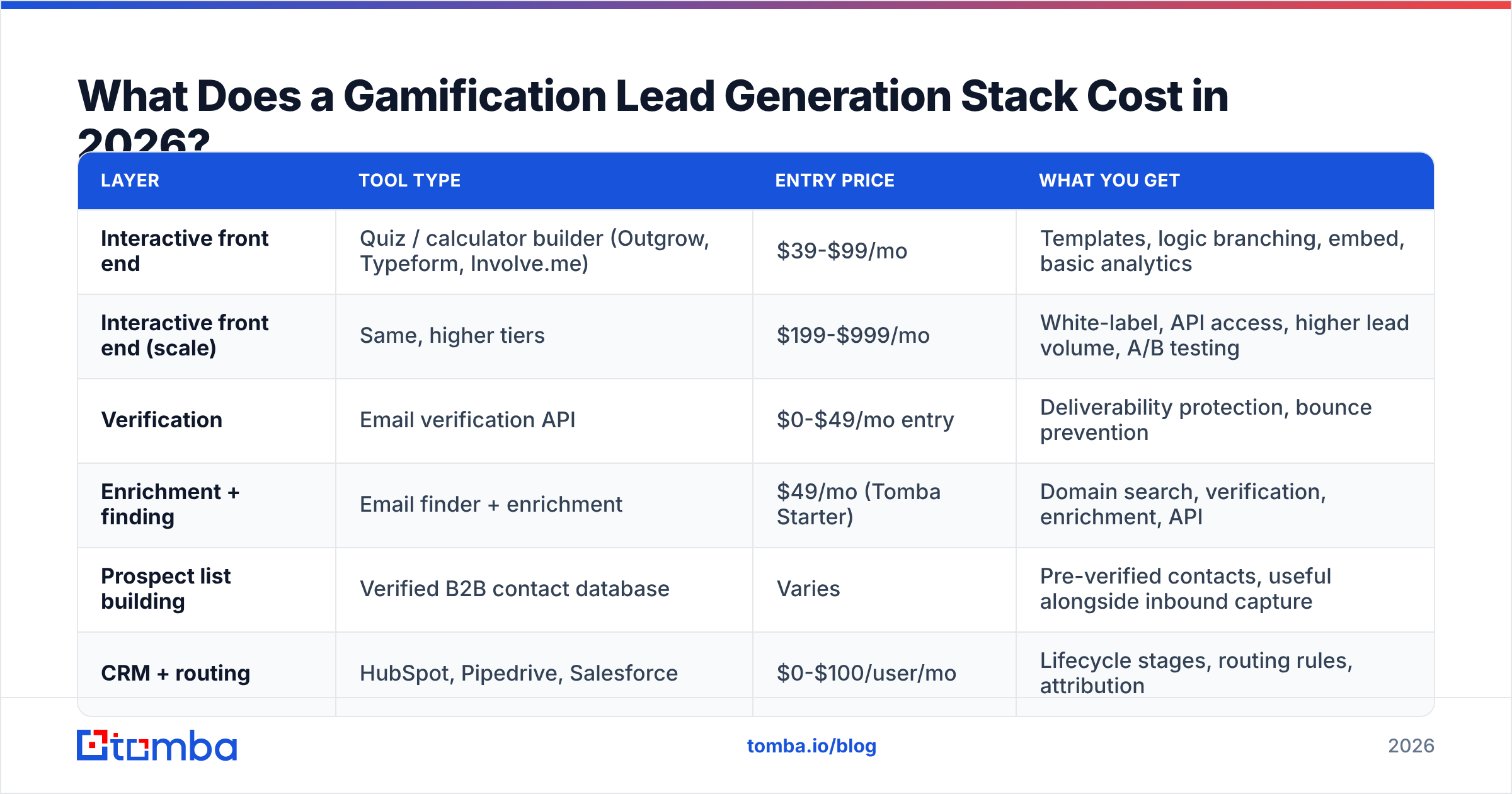
Two cost centers: the interactive layer and the data layer. Most teams budget the first and forget the second.
| Layer | Tool type | Entry price | What you get |
|---|---|---|---|
| Interactive front end | Quiz / calculator builder (Outgrow, Typeform, Involve.me) | $39-$99/mo | Templates, logic branching, embed, basic analytics |
| Interactive front end (scale) | Same, higher tiers | $199-$999/mo | White-label, API access, higher lead volume, A/B testing |
| Verification | Email verification API | $0-$49/mo entry | Deliverability protection, bounce prevention |
| Enrichment + finding | Email finder + enrichment | $49/mo (Tomba Starter) | Domain search, verification, enrichment, API |
| Prospect list building | Verified B2B contact database | Varies | Pre-verified contacts, useful alongside inbound capture |
| CRM + routing | HubSpot, Pipedrive, Salesforce | $0-$100/user/mo | Lifecycle stages, routing rules, attribution |
On the data layer, Tomba pricing starts with a free tier at 25 searches a month, then Starter at $49/mo, Growth at $99/mo, and Pro at $249/mo, with Enterprise custom. That covers finding, verifying, and enriching in one place, which matters when you are trying to keep the number of API integrations behind a quiz down to one.
For teams that want to pair inbound gamification with a pre-built outbound list, BookYourData is a solid pay-as-you-go option with strong accuracy guarantees — a reasonable complement when your quiz traffic is still ramping and you need volume in the meantime.
Rough all-in for a small B2B team: $150-$250/mo. That buys a calculator, verification on every capture, and enrichment before routing. Compare it against a single wasted SDR week and the math is not close.
When Should You Skip Gamification Entirely?#
Four situations where it is the wrong tool:
- Your traffic is under ~2,000 sessions/month. A quiz at 35% conversion on 500 visitors is 175 leads. The build effort and monthly platform cost rarely pay back. Spend that energy on outbound and use a bulk email finder to build lists instead.
- Your ACV is very high and your buying committee is small. If you sell $400k contracts to 60 accounts, gamification is noise. Named-account outbound wins.
- You are in a regulated vertical with consent friction. Health, finance, and legal buyers are often barred from typing real details into an ungated tool. Completion rates crater.
- You cannot resource the result page. The quiz is not the product; the result is. If nobody will write 6 differentiated result pages with real recommendations, you have built a form with extra steps.
There is also a softer failure mode: gamifying a decision the buyer has not started making. A "which CRM are you?" quiz aimed at someone who has never considered switching CRMs generates entertained non-buyers. Match the mechanic to demonstrated intent.
How Do You Build Your First Gamified Lead Magnet?#
A realistic two-week path:
- Pick one question your buyers already argue about internally. "Are we spending too much on tooling?" "Is our outbound setup broken?" That question becomes the assessment.
- Write the result pages first. Four to six outcome buckets, each with a specific diagnosis and a next step. If you cannot make them distinct, narrow the question.
- Reverse-engineer 6-8 questions that sort people into those buckets, and make every question do double duty as a CRM field.
- Put the email gate after the last question, before the result. Gating up front kills completion. Gating after showing the result kills capture. In between is the sweet spot.
- Wire verification and enrichment into the submit handler, not into a nightly batch job. Bad data routed to sales once cannot be un-routed.
- Instrument drop-off per question. The question where 40% of people leave is either too personal or badly worded. Fix it, do not delete it.
For step 5, the email finder API handles verification and enrichment in the same call your form already makes, which keeps the whole thing to one integration instead of three. If you'd rather not touch code, the HubSpot integration applies the same checks on record creation.
One more thing worth measuring: response rate on follow-ups that reference the quiz result versus generic follow-ups. Referencing the specific score is usually the biggest single lift in the whole program, and it costs nothing.
Is Gamification Lead Generation Worth It in 2026?#
For most B2B teams with meaningful inbound traffic: yes, with conditions.
It is worth it when you pick a mechanic that qualifies (assessment, calculator, configurator) rather than one that merely attracts (wheel, sweepstakes). It is worth it when you treat captured emails as unverified until proven otherwise. It is worth it when the result page is genuinely useful on its own, so that even the people who never buy leave with something.
It is not worth it as a bolt-on conversion hack. Teams that ship a quiz because a competitor shipped one get a short-lived opt-in bump and a long-lived data problem.
The honest summary: gamification changes the shape of your lead flow more than the size of your pipeline. More people enter, and they enter with more attached information. Whether that turns into revenue depends on the unglamorous machinery behind the form — verification, enrichment, routing, and a sales team that actually reads the score before dialing.
Where Should You Start?#
Start with the filter, not the game. If your gamified capture is going to triple the number of emails hitting your CRM, the thing that determines whether that helps or hurts is what happens in the 200 milliseconds after submit.
Tomba Email Finder covers that layer: find the work address behind a personal signup, verify deliverability before anything enters a sequence, and enrich the record with company data so routing rules have something real to work with. The free tier gives you 25 searches a month to test the flow end to end, and Starter is $49/mo when you are ready to run it on live traffic. Build the quiz second — it works far better when the plumbing behind it already does.
Related guides#
Ready to find emails that actually work?
Join 150,000+ professionals who stopped guessing and started sending. Free credits on signup — no credit card required.
Get the Tomba newsletter
Practical outbound tactics and product updates — once every two weeks.
About the author