Gamification Sales Training: The 2026 Playbook That Works
Points and leaderboards do not make reps better — scoring the right behaviors does. Here is how gamification sales training actually changes ramp time, activity quality, and win rates in 2026.
TL;DR
- Gamification sales training works when it scores controllable behaviors (calls booked, discovery questions asked, mock-call scores) and fails when it scores outcomes reps cannot control in a single day.
- The biggest measurable win is not motivation — it is ramp time. Structured challenge-based onboarding consistently gets new hires to first closed deal faster than passive video training.
- Leaderboards are the most-used and most-abused mechanic. Public single-ranking boards demotivate the bottom 60% of your team. Use tiers, streaks, and personal-best tracking instead.
- Budget roughly $20–$40 per user per month for a dedicated platform, or run a zero-cost version in your CRM plus a spreadsheet for the first quarter.
- Gamified activity targets amplify whatever data your reps are working from. Dirty lists just make people hit bounce quotas faster.
What is gamification sales training?#
Gamification sales training is the practice of applying game mechanics — points, levels, challenges, streaks, badges, leaderboards, and rewards — to how sales reps learn and practice their job.
Think of it like a driving school that uses a simulator instead of a lecture. You can explain parallel parking for forty minutes, or you can let someone attempt it fifteen times in an afternoon with an instant score after each try. The second approach produces drivers. Technically, gamification works because it compresses the feedback loop: the gap between "I did a thing" and "I found out if the thing was good" shrinks from a quarter to a minute.
That is the whole mechanism. Everything else — the confetti animation, the badge art, the TV screen in the bullpen — is decoration on top of fast feedback.
Two categories often get confused:
- Gamified learning — certification paths, scored role-plays, objection-handling quizzes, product knowledge levels. This runs during onboarding and enablement.
- Gamified performance — daily activity competitions, dial contests, pipeline-creation sprints, team-vs-team quarters. This runs on the floor, forever.
Most teams buy a tool for the second and then wonder why their onboarding is still four months long. The two need separate design.
Why does gamification work on sales teams specifically?#
Sales is one of the few corporate functions where the work is already a game: there is a score (quota), a clock (the quarter), opponents (competitors), and a public ranking. Reps self-select into that structure. Adding explicit mechanics is less of a leap than it would be in, say, legal or finance.
The behavioral levers doing the work:
- Immediate feedback. A rep who learns on Tuesday that their discovery call scored 4/10 on "questions before pitching" can fix it on Wednesday. A rep who learns it in a quarterly review cannot.
- Progress visibility. Partial completion is a strong motivator. A progress bar at 80% pulls harder than one at 0% — the reason loyalty cards give you two free stamps up front.
- Autonomy over path. Letting a rep choose which certification to attack next converts a mandate into a decision.
- Social proof, carefully dosed. Seeing a peer's approach beats being told about a best practice by a manager.
- Loss aversion via streaks. People protect a 14-day streak far harder than they chase a 15th point.
Gamification as a discipline has plenty of failed corporate deployments behind it, and the failure mode is nearly always the same: the mechanics were bolted onto work nobody wanted to do, rather than used to accelerate a skill people were already trying to build.
What should you actually gamify?#
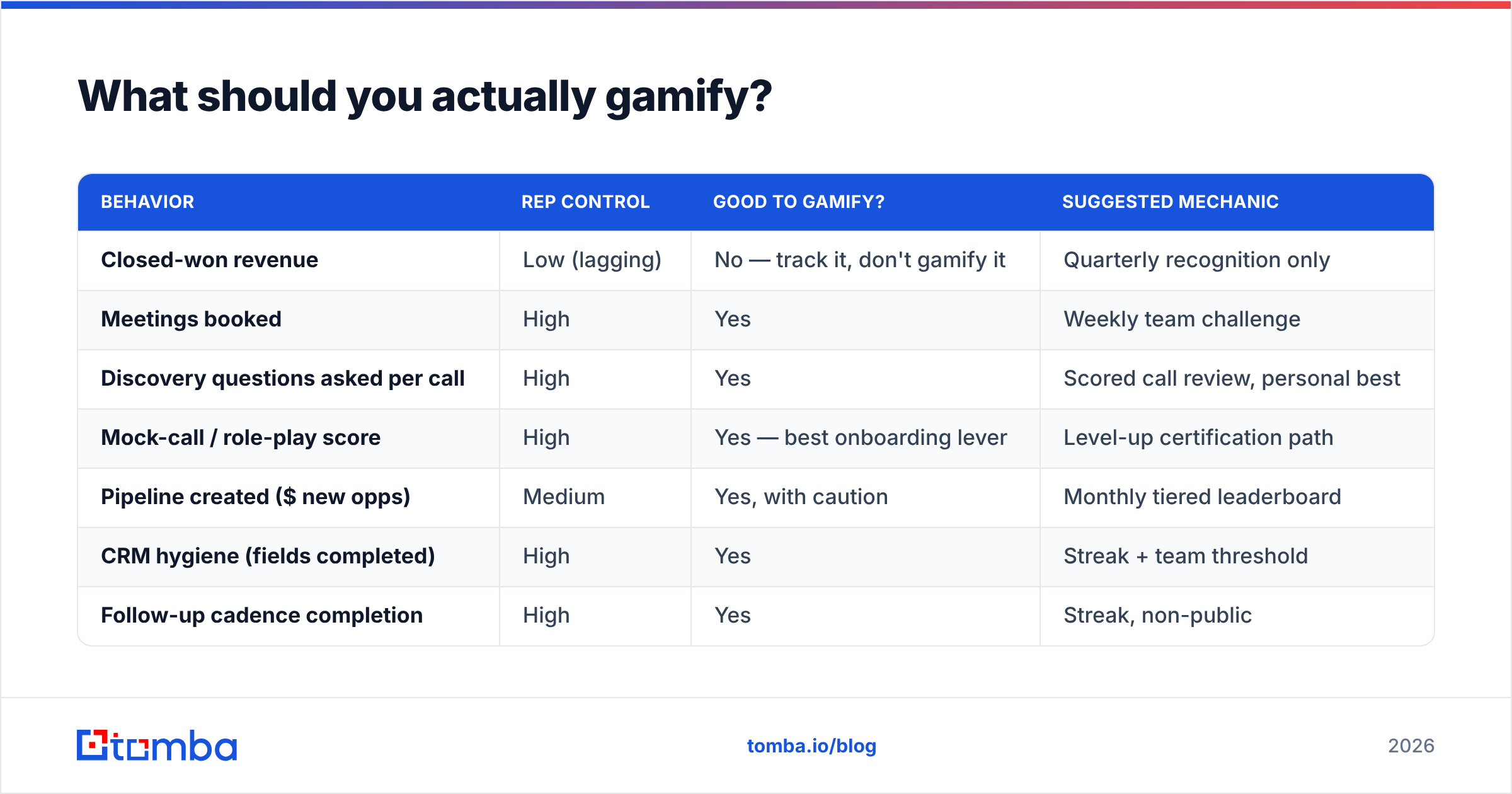
Score inputs, not outcomes. A rep controls how many discovery calls they run this week. They do not control whether a $180K enterprise deal signs before the 31st. Scoring the second produces theater and sandbagging; scoring the first produces reps.
Here is the split that holds up across most B2B teams:
| Behavior | Rep control | Good to gamify? | Suggested mechanic |
|---|---|---|---|
| Closed-won revenue | Low (lagging) | No — track it, don't gamify it | Quarterly recognition only |
| Meetings booked | High | Yes | Weekly team challenge |
| Discovery questions asked per call | High | Yes | Scored call review, personal best |
| Mock-call / role-play score | High | Yes — best onboarding lever | Level-up certification path |
| Pipeline created ($ new opps) | Medium | Yes, with caution | Monthly tiered leaderboard |
| CRM hygiene (fields completed) | High | Yes | Streak + team threshold |
| Follow-up cadence completion | High | Yes | Streak, non-public |
| Email reply rate | Medium | Partially | Team benchmark, not individual ranking |
| Call recording review of a peer | High | Underrated — yes | Badge + peer credit |
Notice the pattern. Anything with a same-day feedback loop and a clear "did it / didn't do it" answer is a good candidate. Anything that depends on a buying committee's mood in six weeks is not.
One nuance on response rate: it sits in the middle because it is half rep behavior (message quality, targeting) and half data quality. A rep working a scraped, unverified list will lose a reply-rate contest to a rep with clean contacts no matter how good their writing is. Gamify it at the team level, or normalize by list quality — otherwise you are scoring luck.
Which sales gamification platforms are worth it in 2026?#
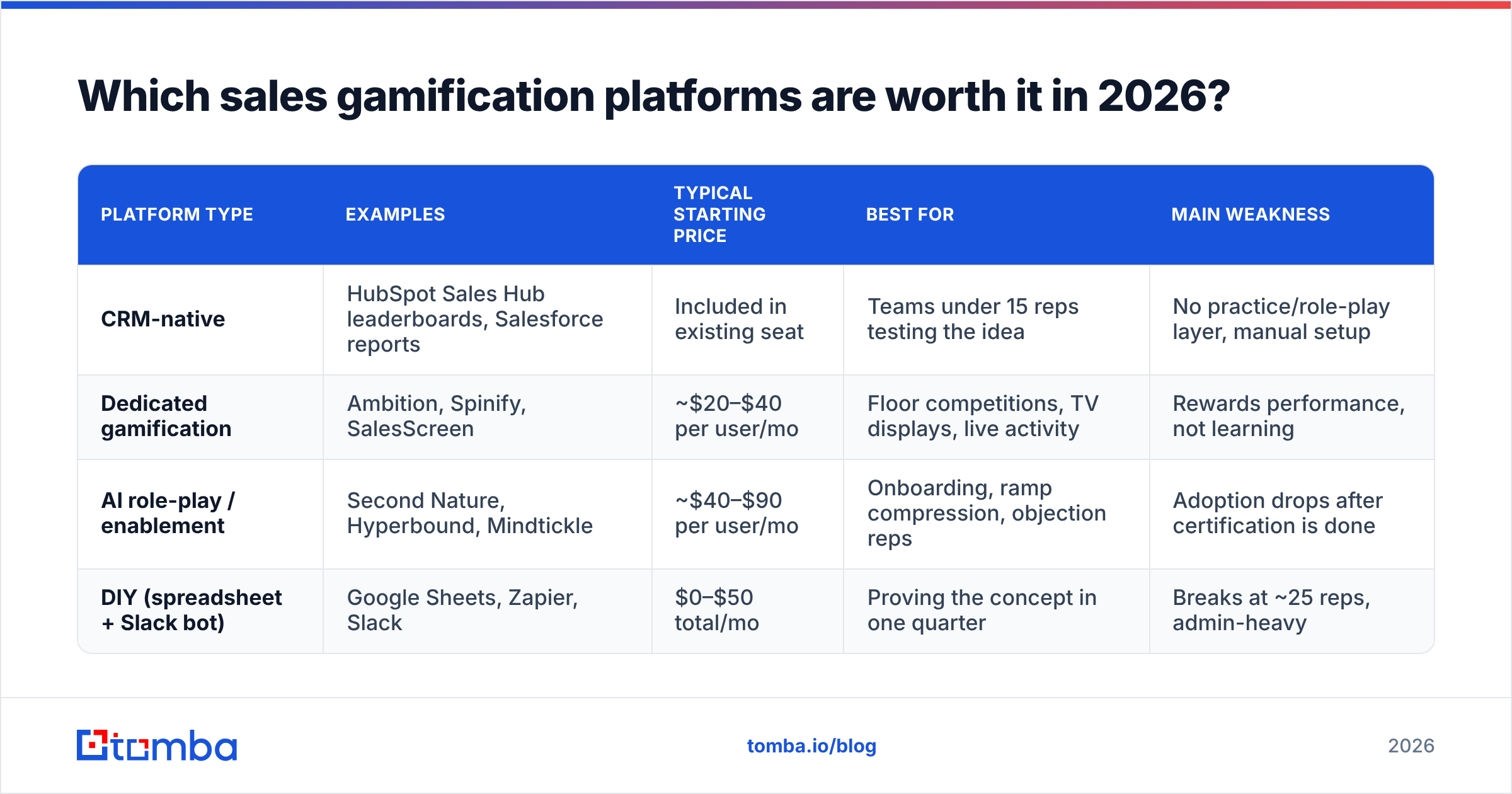
The category has consolidated. Most tools now sit in one of three buckets: CRM-native dashboards, dedicated gamification layers, and enablement platforms with practice modules built in.
| Platform type | Examples | Typical starting price | Best for | Main weakness |
|---|---|---|---|---|
| CRM-native | HubSpot Sales Hub leaderboards, Salesforce reports | Included in existing seat | Teams under 15 reps testing the idea | No practice/role-play layer, manual setup |
| Dedicated gamification | Ambition, Spinify, SalesScreen | ~$20–$40 per user/mo | Floor competitions, TV displays, live activity | Rewards performance, not learning |
| AI role-play / enablement | Second Nature, Hyperbound, Mindtickle | ~$40–$90 per user/mo | Onboarding, ramp compression, objection reps | Adoption drops after certification is done |
| DIY (spreadsheet + Slack bot) | Google Sheets, Zapier, Slack | $0–$50 total/mo | Proving the concept in one quarter | Breaks at ~25 reps, admin-heavy |
If you have never run a structured program, do not buy the $40/seat tool first. Run one quarter of the DIY version — a shared sheet, a Slack channel, one weekly challenge, one certification path — and see whether managers actually run it. The failure rate on gamification software is driven almost entirely by manager abandonment in week five, not by feature gaps. The G2 sales gamification category is a reasonable place to read unfiltered reviews once you know what you need.
How do you design a gamified onboarding path?#
This is where gamification earns real money, because ramp time is expensive and measurable. A rep who reaches full productivity in 3 months instead of 5 hands you two extra selling months per hire.
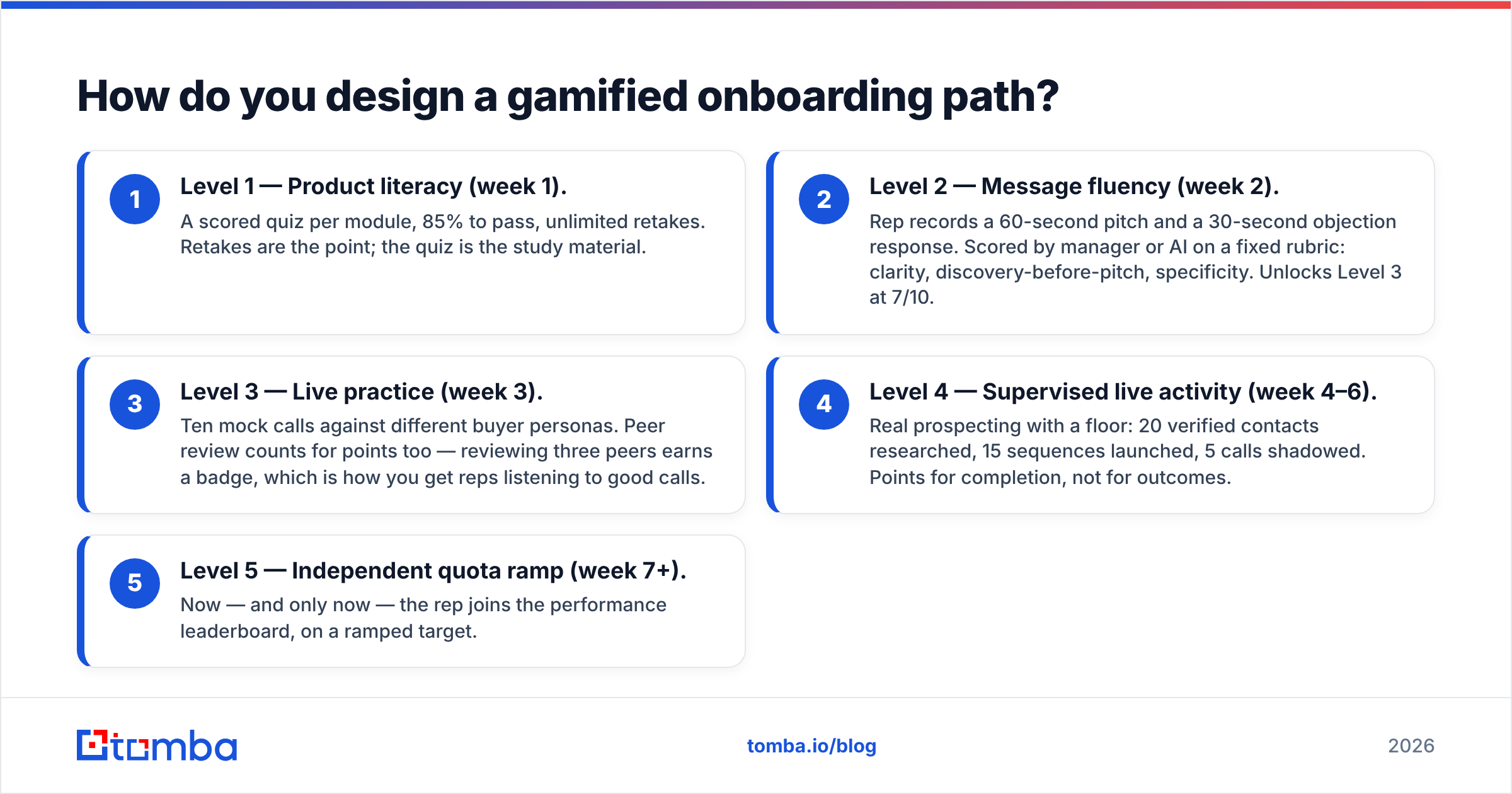
A workable structure, in five levels:
- Level 1 — Product literacy (week 1). A scored quiz per module, 85% to pass, unlimited retakes. Retakes are the point; the quiz is the study material.
- Level 2 — Message fluency (week 2). Rep records a 60-second pitch and a 30-second objection response. Scored by manager or AI on a fixed rubric: clarity, discovery-before-pitch, specificity. Unlocks Level 3 at 7/10.
- Level 3 — Live practice (week 3). Ten mock calls against different buyer personas. Peer review counts for points too — reviewing three peers earns a badge, which is how you get reps listening to good calls.
- Level 4 — Supervised live activity (week 4–6). Real prospecting with a floor: 20 verified contacts researched, 15 sequences launched, 5 calls shadowed. Points for completion, not for outcomes.
- Level 5 — Independent quota ramp (week 7+). Now — and only now — the rep joins the performance leaderboard, on a ramped target.
The gate mechanic matters more than the points. Reps who can skip to live dialing on day three will, and their first 200 conversations will be their training material. That is an expensive way to learn.
For Level 4 to work, the list your new hire is prospecting has to be real. Give a ramping rep a list with 30% bad addresses and you have taught them that outbound does not work. Building that starter list with a proper email finder and running it through an email verifier before the rep touches it removes the single most common ramp-killer.
What are the failure modes to avoid?#
Five ways these programs die, in order of frequency:
- The single public leaderboard. One ranked list, everyone visible, updated live. Your top three reps love it. Ranks 4 through 20 learn every morning that they are losing, which is the opposite of motivating. Fix: tier the board (top third / middle third / rising), show personal-best deltas, or rank on improvement rather than absolute numbers.
- Gamifying volume alone. Score dials and you get 200 four-second dials. Score emails sent and you get spray. Every volume metric needs a paired quality metric — connect rate alongside dials, reply rate alongside sends, meeting-held rate alongside meetings-booked. This is also where email deliverability quietly gets destroyed: an activity contest with no bounce ceiling is a domain-reputation incident with a countdown timer.
- Rewards that dwarf the behavior. A $2,000 prize for a one-week contest turns colleagues into competitors and encourages gaming. Frequent small rewards (lunch, a half-day, first pick on inbound) outperform rare large ones.
- Manager non-participation. If the sales manager does not announce results, comment on the board, and reference it in one-on-ones, the program is dead in three weeks. Budget manager time, not just software.
- No sunset plan. Every mechanic decays. Rotate challenge types quarterly — team-vs-team, individual streaks, "beat your own Q3," bingo cards for varied activities. Novelty is part of the mechanism.
Gartner's research on sales enablement has repeatedly found that seller adoption, not tooling, is the constraint in most enablement programs — a pattern you can read across their sales practice materials. Gamification does not escape that rule; it is subject to it.
How do you measure whether it worked?#
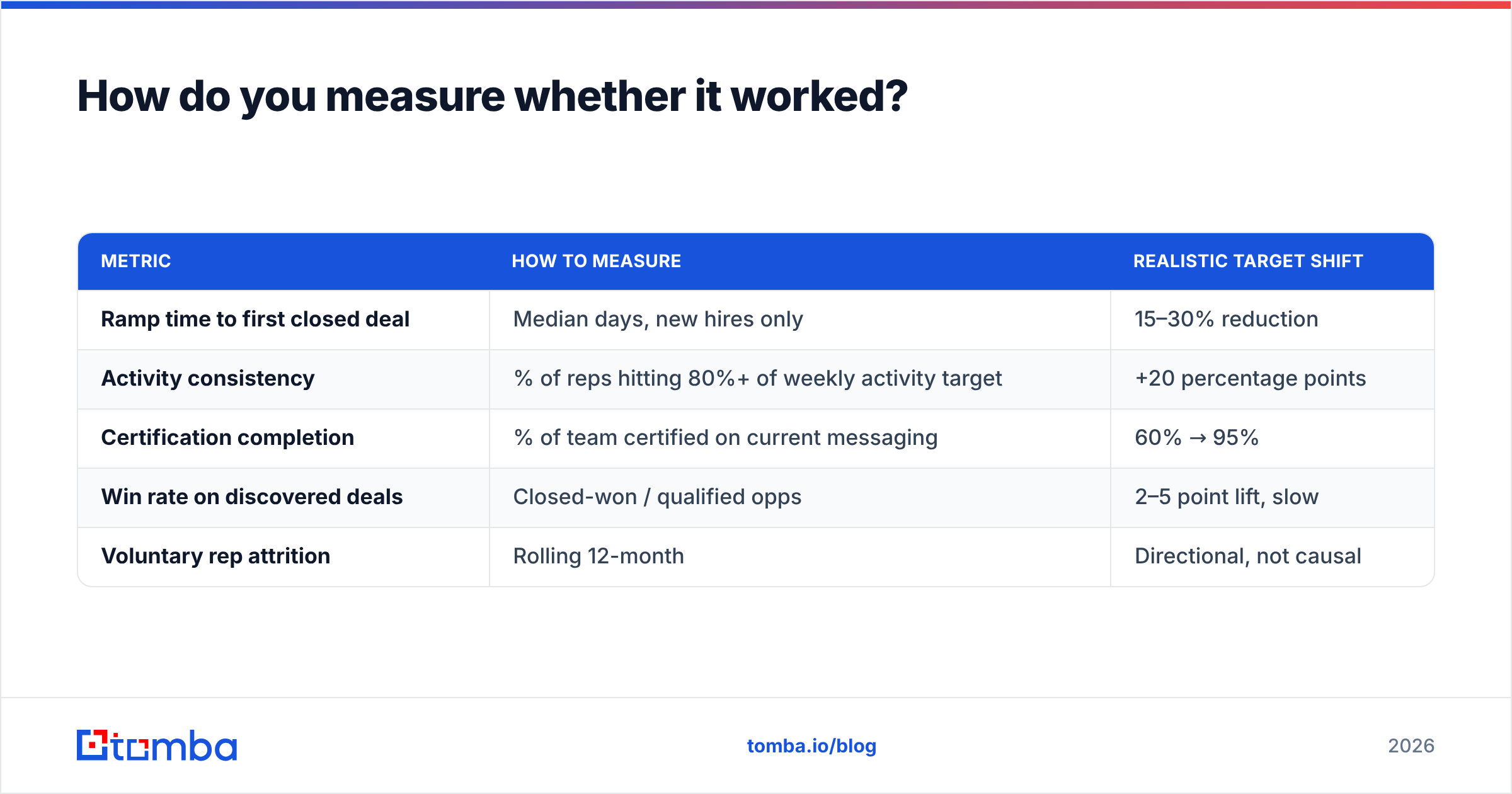
Pick your baseline before you launch, or you will be arguing anecdotes in ninety days. Four metrics, measured for the two quarters before and the two after:
| Metric | How to measure | Realistic target shift |
|---|---|---|
| Ramp time to first closed deal | Median days, new hires only | 15–30% reduction |
| Activity consistency | % of reps hitting 80%+ of weekly activity target | +20 percentage points |
| Certification completion | % of team certified on current messaging | 60% → 95% |
| Win rate on discovered deals | Closed-won / qualified opps | 2–5 point lift, slow |
| Voluntary rep attrition | Rolling 12-month | Directional, not causal |
Do not promise a win rate jump in the first quarter. Win rate moves last, because it depends on deals that entered the pipeline before your program existed. Activity consistency and certification completion move in weeks — lead with those when you report to the CRO, and hold win rate as the six-month claim.
Also track one counter-metric per game. If you gamify meetings booked, track meeting-held rate. If bookings go up 40% and held rate falls from 70% to 45%, your reps are booking ghosts and the program is net negative. Every incentive creates a workaround; your job is to watch for it before your board does. HubSpot's ongoing sales research and benchmarks are a decent external reference point when you need to sanity-check your numbers against the wider market.
Is gamification worth it for a small team?#
Below about eight reps, skip the software. Leaderboards need a population to be meaningful — ranking five people just tells four of them they are not first.
What still works at small scale:
- Personal-best tracking. Each rep competes against their own last four weeks.
- Streaks. Consecutive days of hitting a small, achievable activity floor.
- Certification levels. Works at any headcount, including a team of one.
- Team-vs-goal. The whole team against a shared number, with a shared reward. Cooperative beats competitive under ten people.
At 25+ reps, dedicated tooling starts to pay for itself in manager hours saved. At 100+, you almost certainly already have some form of it, and the real question is whether the mechanics are scoring behaviors or vanity.
Where does data quality fit into all of this?#
Gamification is an amplifier. It makes your team do more of whatever you tell it to do — which means the inputs you hand reps determine whether that amplification helps or hurts.
A gamified prospecting sprint on a verified, well-segmented list produces meetings. The same sprint on a scraped list produces bounces, spam complaints, and a burned sending domain — plus a team that now believes the process does not work. That belief is much harder to undo than a bad quarter.
Practical guardrails before you launch any activity-based competition:
- Cap the bounce rate. Any rep above 3% bounces forfeits contest points for the week. This makes list hygiene part of the game.
- Verify before you distribute. Run every list through verification before it reaches a rep, especially for ramping hires.
- Standardize enrichment. If one rep has job titles and company size and another has only emails, your leaderboard is measuring data access, not skill. Consistent data enrichment across the team removes that noise.
- Score research quality. Award points for documented account research, not just contacts added. It is the behavior that separates a booked meeting from a booked no-show.
Getting started#
Run one quarter, one cohort, one mechanic. Pick the behavior with the shortest feedback loop you have — probably scored role-plays for new hires, or a weekly team pipeline-creation challenge for the floor. Baseline your four metrics. Rotate the mechanic at the end of the quarter whether it worked or not.
And before any of it, fix the list. The fastest way to make a gamified activity target backfire is to point motivated reps at contacts that do not exist. Use the Tomba Email Finder to build verified prospect lists your team can actually work — free tier includes 25 searches per month, with paid plans starting at $49/mo on Tomba pricing. Clean inputs first, then turn on the scoreboard.
Related guides#
Ready to find emails that actually work?
Join 150,000+ professionals who stopped guessing and started sending. Free credits on signup — no credit card required.
Get the Tomba newsletter
Practical outbound tactics and product updates — once every two weeks.
About the author