Gap Selling Questions: 40 Discovery Prompts That Work
Gap selling lives or dies on the questions you ask before you pitch. Here are 40 discovery prompts organized by layer, a scoring rubric, and an honest comparison against SPIN, MEDDIC and Challenger.
TL;DR
- Gap selling questions have one job: quantify the distance between where a buyer is today and where they need to be, in the buyer's own numbers — not yours.
- Most reps ask current state questions and stop. The money is in the impact and root cause layers, which is where you learn whether the deal is worth running at all.
- Four question layers matter: current state, future state, impact, root cause. A fifth — decision process — keeps you from winning a gap that nobody is funded to close.
- Gap selling beats SPIN on diagnosis depth and loses to MEDDIC on deal governance. Serious teams run gap selling for discovery and MEDDIC for forecasting.
- Good questions need good inputs. Walking into discovery without knowing the account's headcount, tech stack, and who actually owns the problem wastes the first ten minutes of every call.
What is gap selling, actually?#
Gap selling is a diagnostic sales methodology popularized by Keenan in Gap Selling. The premise is blunt: buyers do not buy products, they buy a change in their situation. Your job is not to describe features. Your job is to find the gap — the measurable distance between the buyer's current state and their desired future state — and prove it is expensive enough to fix now.
Think of it like a mechanic. Nobody walks into a garage and says "sell me a timing belt." They say "there's a noise." The mechanic asks questions until the noise has a cause, a cost, and a deadline. Only then does a part get quoted. Sales reps skip straight to quoting the part, then wonder why the buyer "went dark."
The methodology itself is simple. The execution is not, because it depends almost entirely on question quality. A rep with mediocre product knowledge and excellent gap selling questions will out-close a rep with the opposite profile. That is the whole thesis, and it is why Keenan's own material at A Sales Guy spends far more time on discovery mechanics than on closing lines.
Why do most gap selling calls still fail?#
Because reps confuse interrogation with diagnosis. They arrive with a list, march down it, and take notes. The buyer answers politely, nothing compounds, and the call ends with "send me a deck."
Here is what separates a real diagnostic call from a checklist:
- Every question earns the next one. You are not collecting answers, you are following a thread. If a buyer says "our reply rate dropped," the next question is about when and what changed, not the next bullet on your sheet.
- You quantify before you sympathize. "That sounds frustrating" is worth nothing. "So that's roughly 40 fewer meetings a quarter — what does a meeting convert at for you?" is worth the whole call.
- You hunt for the root cause, not the symptom. Low reply rates are a symptom. Bad data, bad targeting, bad copy, and domain reputation damage are causes. Different causes mean different solutions, and one of them may not be you.
- You are willing to disqualify. If the gap is small, unfunded, or owned by nobody, the correct outcome is a polite exit. Pipeline you cannot close is a tax on your quarter.
- You write the gap down in the buyer's words. If your CRM note says "wants better data," you did not run discovery. If it says "12 SDRs, 22% bounce rate, 3 domains burned in Q1, VP wants under 3% by October," you did.
Research from HubSpot's sales discovery guidance points the same direction: the reps who ask more diagnostic follow-ups, not more total questions, are the ones with better win rates.
What are the four layers of a gap?#
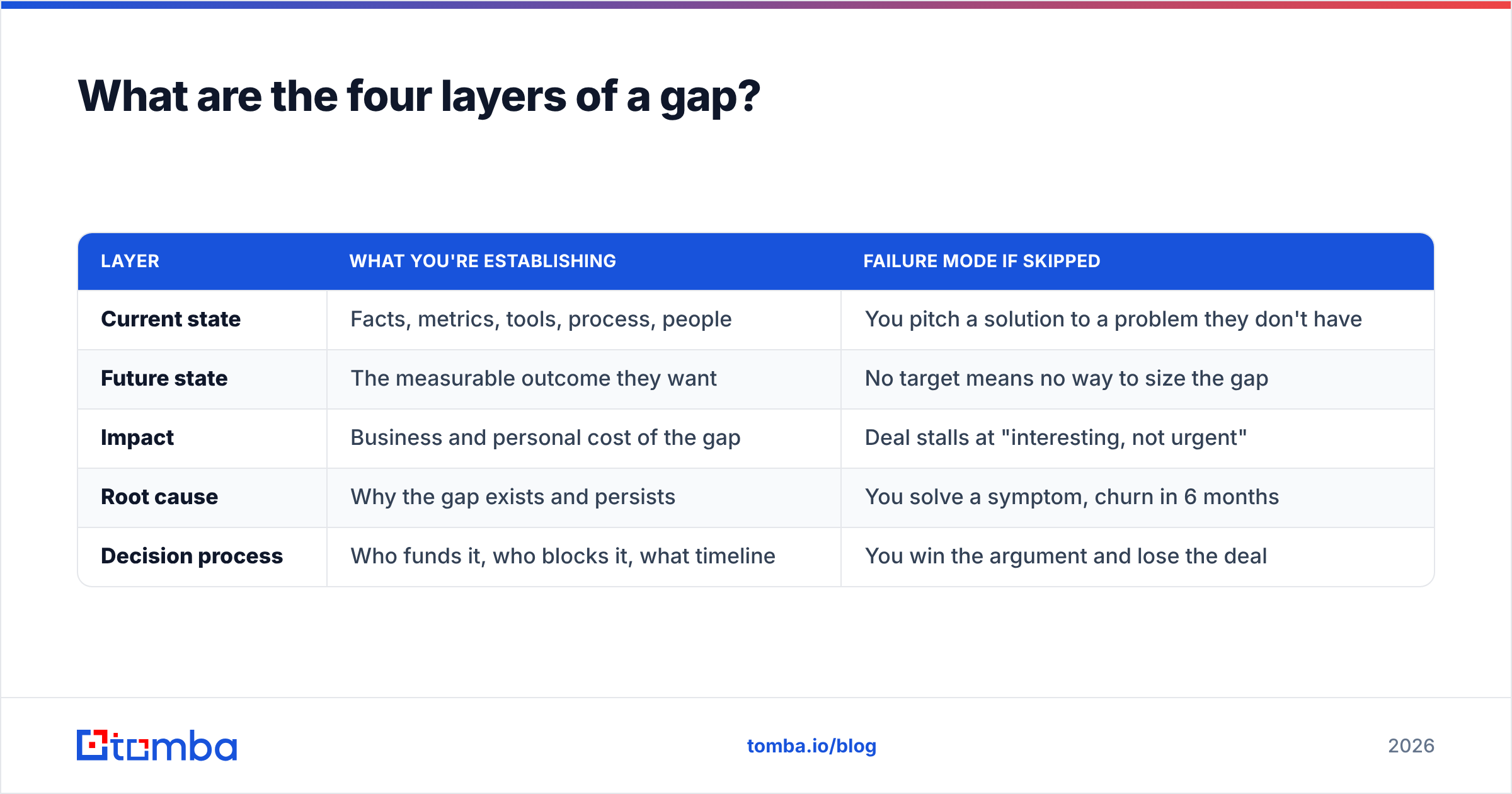
Gap selling organizes discovery into layers. Each one answers a different question, and skipping any of them creates a specific, predictable failure mode.
| Layer | What you're establishing | Failure mode if skipped |
|---|---|---|
| Current state | Facts, metrics, tools, process, people | You pitch a solution to a problem they don't have |
| Future state | The measurable outcome they want | No target means no way to size the gap |
| Impact | Business and personal cost of the gap | Deal stalls at "interesting, not urgent" |
| Root cause | Why the gap exists and persists | You solve a symptom, churn in 6 months |
| Decision process | Who funds it, who blocks it, what timeline | You win the argument and lose the deal |
The layers are cumulative. You cannot size impact without a current-state number to compare against. You cannot diagnose root cause without knowing what they have already tried. Run them in order.
What gap selling questions should you actually ask?#
Below are 40 questions grouped by layer. Do not read them off a list — pick five or six per layer and let the conversation route you.
Current state (10 questions)#
- Walk me through how this process runs today, start to finish.
- Who touches it, and at what step?
- What tools are in the stack for this right now?
- How long has it worked this way?
- What's the number you report on this internally?
- What was that number last quarter, and the quarter before?
- How do you know when it's going badly — what's the first signal?
- What workarounds has the team invented?
- How much time per week does that workaround cost?
- What have you already tried to fix it?
Question 10 is the highest-value item in this block. The answer tells you what will be compared against you, what already failed, and — critically — whether this buyer has budget history for the problem.
Future state (8 questions)#
- What does "solved" look like twelve months from now?
- What number would that be, specifically?
- Who decided that target, and why that figure?
- What happens in the business if you hit it?
- What does the team do differently once it's fixed?
- Is there a date attached to that outcome?
- If nothing changes, where does this number land by year-end?
- What's the minimum improvement that would be worth the effort?
Question 18 protects you from the "we want 10x" fantasy. The minimum viable improvement is the number your business case actually has to clear.
Impact (8 questions)#
- What is the gap costing in revenue terms right now?
- How does that show up on someone's P&L?
- Who feels it most — which team, which person?
- What's the downstream effect on the teams next to it?
- What does this cost you personally, in your week?
- What else can't the team work on because they're firefighting this?
- If this is still broken in two quarters, what's the consequence for you?
- Has anyone above you asked about it recently?
Questions 23 and 25 are the ones reps skip because they feel intrusive. They are the difference between a business case and a champion. Business cases get benchmarked. Champions get funded.
Root cause (7 questions)#
- When did this start, and what changed around then?
- Is it a people problem, a process problem, or a data problem?
- What has to be true for this to keep happening?
- What's the one input you'd fix first if you could only fix one?
- Why did the last attempt to fix it not stick?
- Is this specific to one team, or does it show up everywhere?
- If we removed the tool entirely, would the problem go away?
Question 33 is a scalpel. If the answer is "no," the tool was never the cause, and any tool you sell will fail the same way.
Decision process (7 questions)#
- Who else has to agree before this moves?
- What's the approval path for spend at this size?
- Has a project like this been approved here before? What made it through?
- What's the strongest internal argument against doing this?
- What would need to be in a business case for your CFO to sign it?
- What could push this to next fiscal year?
- If we agreed today, what's the realistic first-value date?
Question 37 outperforms "what are your concerns?" every time, because it makes the buyer argue the other side out loud instead of defending their own position.
How does gap selling compare to SPIN, MEDDIC and Challenger?#
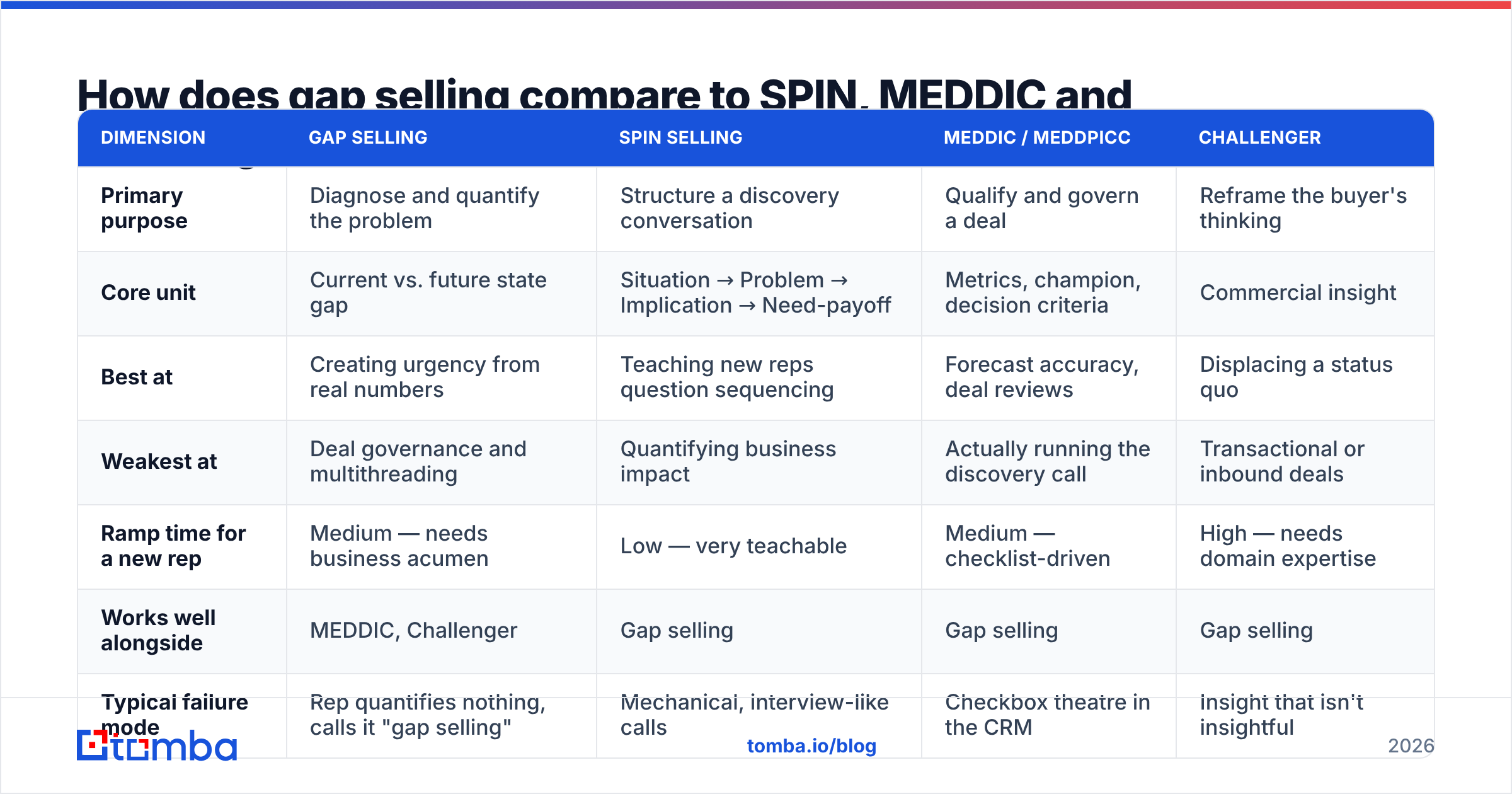
None of these are competitors in the way vendors are. They solve different parts of the same problem, and mature teams stack them. Here is the honest breakdown.
| Dimension | Gap Selling | SPIN Selling | MEDDIC / MEDDPICC | Challenger |
|---|---|---|---|---|
| Primary purpose | Diagnose and quantify the problem | Structure a discovery conversation | Qualify and govern a deal | Reframe the buyer's thinking |
| Core unit | Current vs. future state gap | Situation → Problem → Implication → Need-payoff | Metrics, champion, decision criteria | Commercial insight |
| Best at | Creating urgency from real numbers | Teaching new reps question sequencing | Forecast accuracy, deal reviews | Displacing a status quo |
| Weakest at | Deal governance and multithreading | Quantifying business impact | Actually running the discovery call | Transactional or inbound deals |
| Ramp time for a new rep | Medium — needs business acumen | Low — very teachable | Medium — checklist-driven | High — needs domain expertise |
| Works well alongside | MEDDIC, Challenger | Gap selling | Gap selling | Gap selling |
| Typical failure mode | Rep quantifies nothing, calls it "gap selling" | Mechanical, interview-like calls | Checkbox theatre in the CRM | Insight that isn't insightful |
The practical pattern most enterprise teams land on, and the one reflected in Gartner's sales research, is this: gap selling questions run the call, MEDDIC fields capture the output, and the deal review interrogates the fields. If your CRM has a MEDDIC section but your reps have never been trained on diagnostic questioning, you have a reporting layer sitting on top of nothing.
How do you score a gap before you quote?#
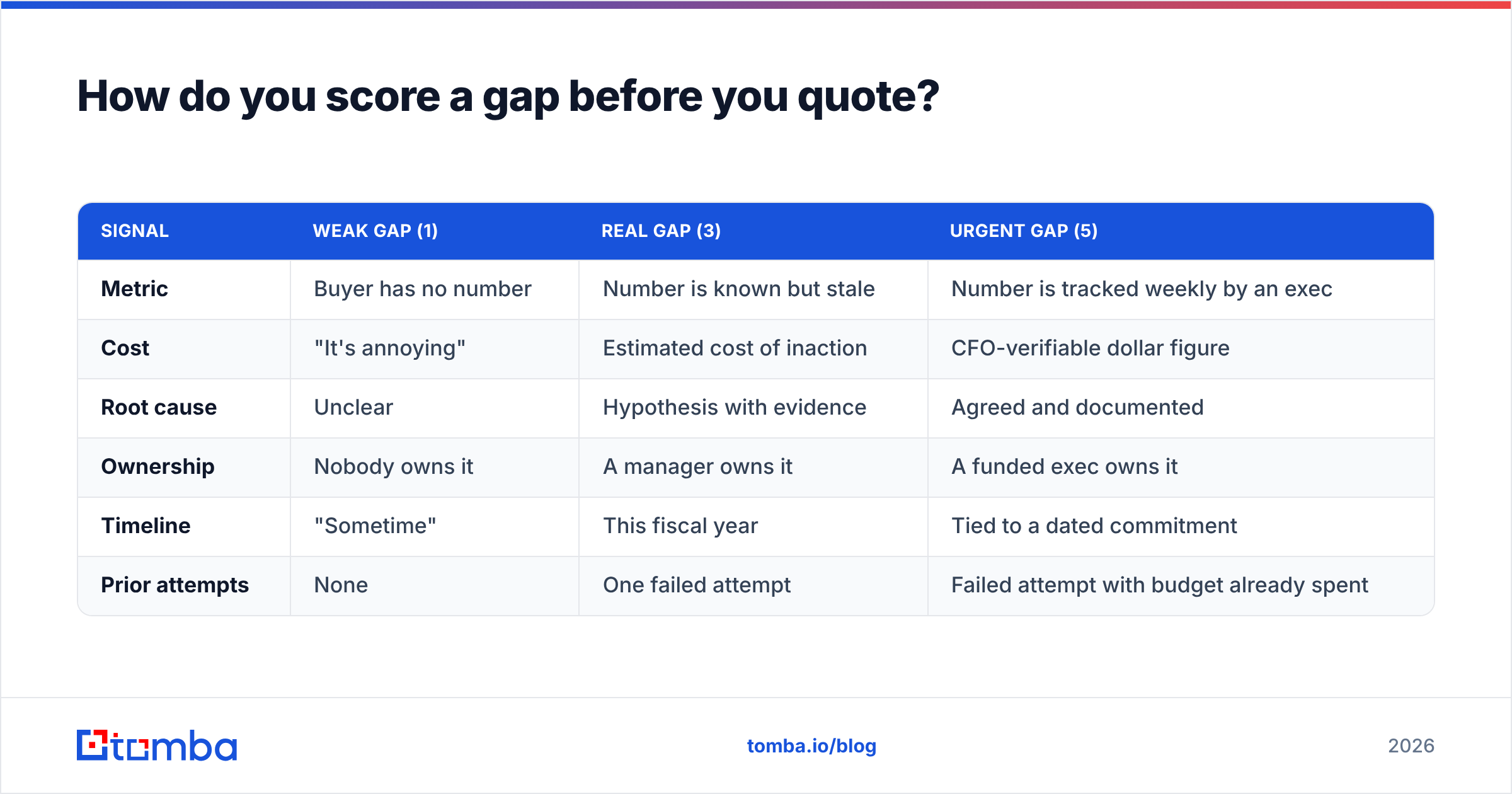
Quantify it or drop it. Use a simple rubric at the end of every discovery call, before you build anything.
| Signal | Weak gap (1) | Real gap (3) | Urgent gap (5) |
|---|---|---|---|
| Metric | Buyer has no number | Number is known but stale | Number is tracked weekly by an exec |
| Cost | "It's annoying" | Estimated cost of inaction | CFO-verifiable dollar figure |
| Root cause | Unclear | Hypothesis with evidence | Agreed and documented |
| Ownership | Nobody owns it | A manager owns it | A funded exec owns it |
| Timeline | "Sometime" | This fiscal year | Tied to a dated commitment |
| Prior attempts | None | One failed attempt | Failed attempt with budget already spent |
Score under 15 out of 30 and you are running a nurture, not a deal. Be honest about it in your pipeline — inflated forecasts cost more than lost deals. If you want to align that scoring with your funnel definitions, keep it consistent with how you define a marketing qualified lead so the handoff doesn't reset the diagnosis.
What does this sound like on a real call?#
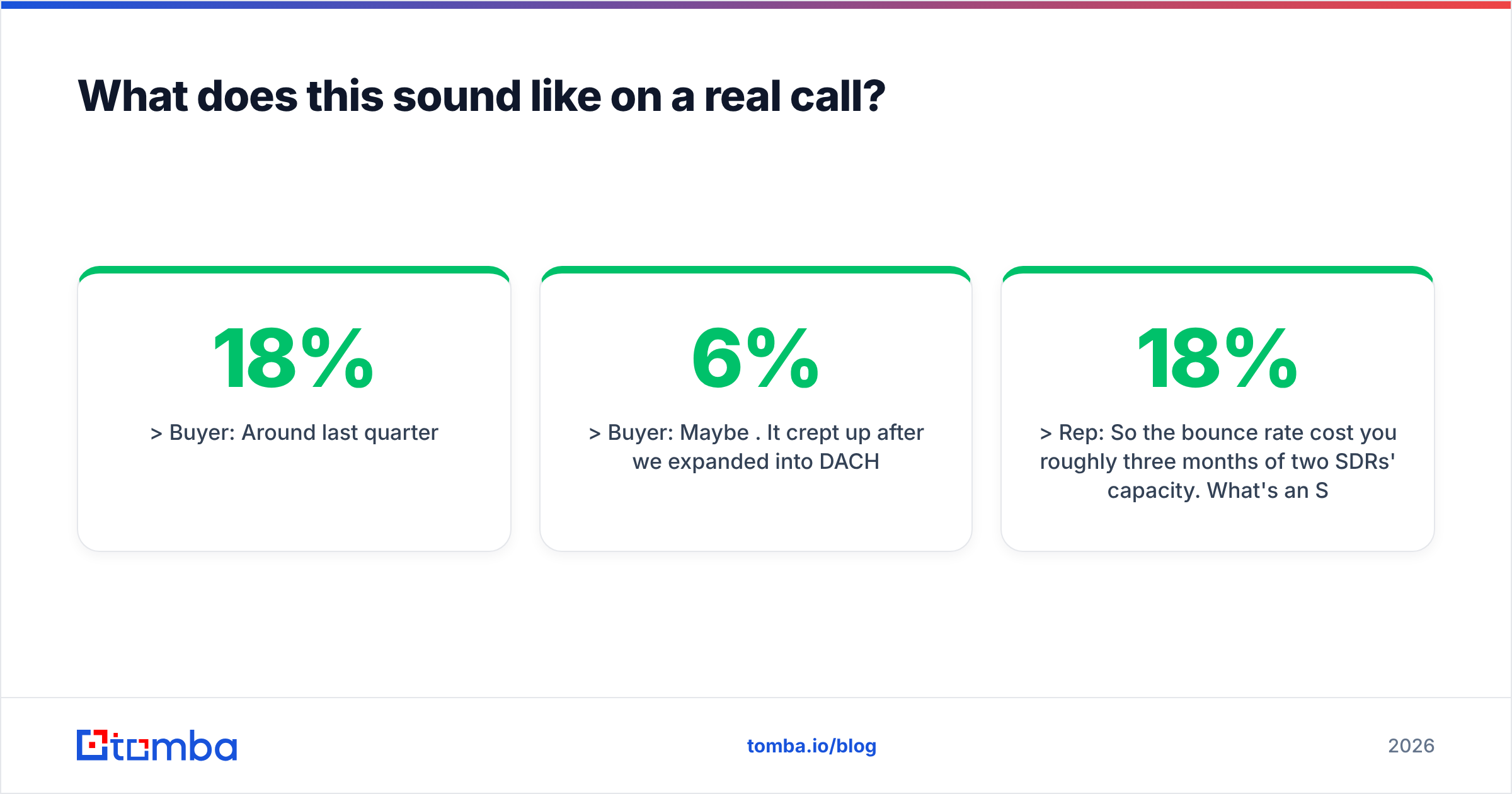
Compressed, but this is the shape:
Rep: How does your team source contacts for outbound today?
Buyer: Mostly a database subscription, plus manual LinkedIn work.
Rep: What's your bounce rate on the sends?
Buyer: Around 18% last quarter.
Rep: What was it before?
Buyer: Maybe 6%. It crept up after we expanded into DACH.
Rep: So the expansion changed the data quality. What did that do to your sending domains?
Buyer: We had to retire two.
Rep: How long does a new domain take to warm before it produces meetings?
Buyer: Five, six weeks.
Rep: So the 18% bounce rate cost you roughly three months of two SDRs' capacity. What's an SDR's quarterly meeting quota?
That last question converts a data-hygiene complaint into a headcount cost. Nothing was pitched. The buyer built the business case out loud, which is the only version they will defend to their CFO.
How do you get the inputs that make these questions sharp?#
You cannot ask precise questions about a company you know nothing about. The gap between a generic call and a diagnostic one is usually 15 minutes of pre-call research: headcount by function, tooling in use, recent hires, who owns the metric you're about to interrogate.
Three things worth doing before every first call:
- Confirm you're talking to the gap owner. Use domain search to map who actually sits in the function, so you can name the two other stakeholders in question 34 instead of asking who they are.
- Enrich the account before you dial. Contact enrichment gives you headcount, seniority, and role data — enough to ask "how do your four AEs split territories?" instead of "tell me about your team."
- Have a second channel ready. A phone finder turns a stalled email thread into a five-minute call that answers three impact questions at once.
Research does not replace discovery. It buys you the right to skip the boring questions and start at layer two, which is where buyers start paying attention.
What should you stop asking?#
Retire these immediately. They signal that you have not done the work:
- "What keeps you up at night?" — theatrical, and nobody answers it honestly.
- "What's your budget?" — asked before impact, it caps your deal at their guess.
- "Are you the decision maker?" — invites a yes that means nothing.
- "Would it be helpful if we could...?" — a pitch wearing a question mark.
- "What are your pain points?" — outsources your diagnosis to the buyer.
Replace each with the corresponding numbered question above. The pattern is consistent: ask about facts and consequences, never about feelings and hypotheticals.
Where should you start this week?#
Pick your five open deals with the vaguest CRM notes. For each, write down the current-state number, the future-state number, the cost of the gap, and the root cause. Any deal where you cannot fill all four fields gets one call booked with questions from the impact and root-cause blocks. You will disqualify at least one and re-energize at least one — that trade is almost always net positive for your quarter.
Then fix the input side. Diagnostic questions only work when you reach the person who owns the metric, and that starts with accurate contact data. Tomba Email Finder gets you to the right stakeholder by name, role, and domain, with verification built in so your discovery calls actually get booked instead of bouncing. The free tier covers 25 searches a month, and paid plans start at $49/mo — see Tomba pricing for the full breakdown. Better questions deserve better prospects to ask them to.
Related guides#
Ready to find emails that actually work?
Join 150,000+ professionals who stopped guessing and started sending. Free credits on signup — no credit card required.
Get the Tomba newsletter
Practical outbound tactics and product updates — once every two weeks.
About the author