Gap Selling Summary: Keenan's Framework, Explained for 2026
Keenan's Gap Selling in plain English: what the gap actually is, how to build a Problem Identification Chart, how it stacks up against SPIN, Challenger and MEDDIC, and the three places reps consistently fumble it.
TL;DR
- Gap selling is Keenan's discovery-first methodology: you don't sell a product, you sell the distance between a buyer's current state and their future state. No gap, no deal.
- The core artifact isn't a script — it's the Problem Identification Chart (PIC), a pre-call document mapping problems, root causes, business impact, and the questions that surface each one.
- It overlaps heavily with SPIN and MEDDIC but differs on emphasis: SPIN is question mechanics, MEDDIC is deal qualification, gap selling is problem forensics.
- The failure mode is predictable. Reps memorize the vocabulary ("current state," "future state") and still run a demo-first call because they never did the pre-call homework.
- It works for outbound only if your targeting is right. A perfect gap question sent to the wrong person at a verified email address is still a wasted send.
What is gap selling in one paragraph?#
Gap selling says that buyers don't buy products — they buy change. Your job is to document where the buyer is now (current state), where they want or need to be (future state), and the measurable, business-relevant distance between those two points. That distance is the gap. The size of the gap determines whether a deal exists at all, how urgent it is, and how much the buyer will pay. Your product is never the subject of the conversation until you can prove it closes a specific gap you've already quantified.
Think of it like a doctor's appointment. You don't walk in and get handed a prescription because the pharmacy has inventory to move. You get examined. Symptoms get traced to a cause. Only then does treatment get named — and by that point you're not price-shopping the medication, you're relieved someone finally diagnosed the thing. Gap selling is the sales version of that sequence: diagnose thoroughly, prescribe last.
Keenan (Jim Keenan, of A Sales Growth Company) published Gap Selling in 2018, and the reason it's still on rep reading lists in 2026 is unglamorous: it's one of the few sales books that's mostly about doing homework rather than about clever phrasing.
What exactly is "the gap"?#
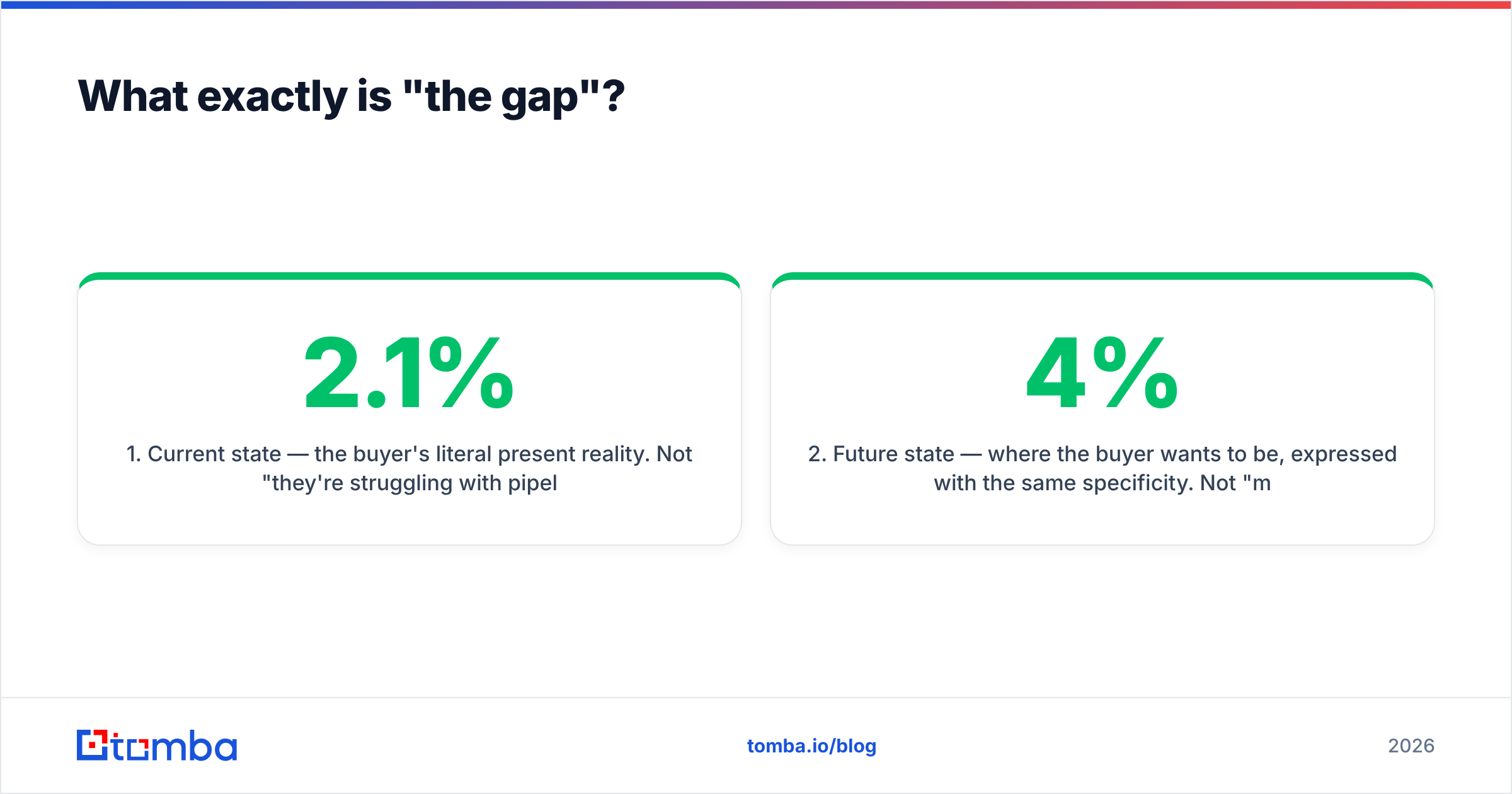
The gap has three components, and skipping any one of them turns the whole framework into vocabulary cosplay.
- Current state — the buyer's literal present reality. Not "they're struggling with pipeline." Rather: 14 SDRs, 42 dials/day each, 2.1% connect rate, 6-week ramp, 31% attainment last quarter. Numbers, tools, people, process, and the emotions attached to them.
- Future state — where the buyer wants to be, expressed with the same specificity. Not "more meetings." Rather: 4% connect rate by Q3, ramp cut to 3 weeks, 60% attainment.
- The gap itself — the delta, plus what it costs to leave it open. This is the part reps skip. A gap without a cost is trivia.
- Root cause — why the gap exists. Buyers almost always misdiagnose their own problems. If they'd correctly identified the root cause, they'd probably have fixed it already.
- Impact — what the gap does downstream to revenue, headcount, churn, personal reputation, board conversations. Impact is what converts a "nice to have" into a funded project.
The order matters. Most reps jump from a vague current state straight to their product's future state, which is how you end up with a deal that stalls at "we're going to revisit this next quarter."
What is the Problem Identification Chart and how do you build one?#
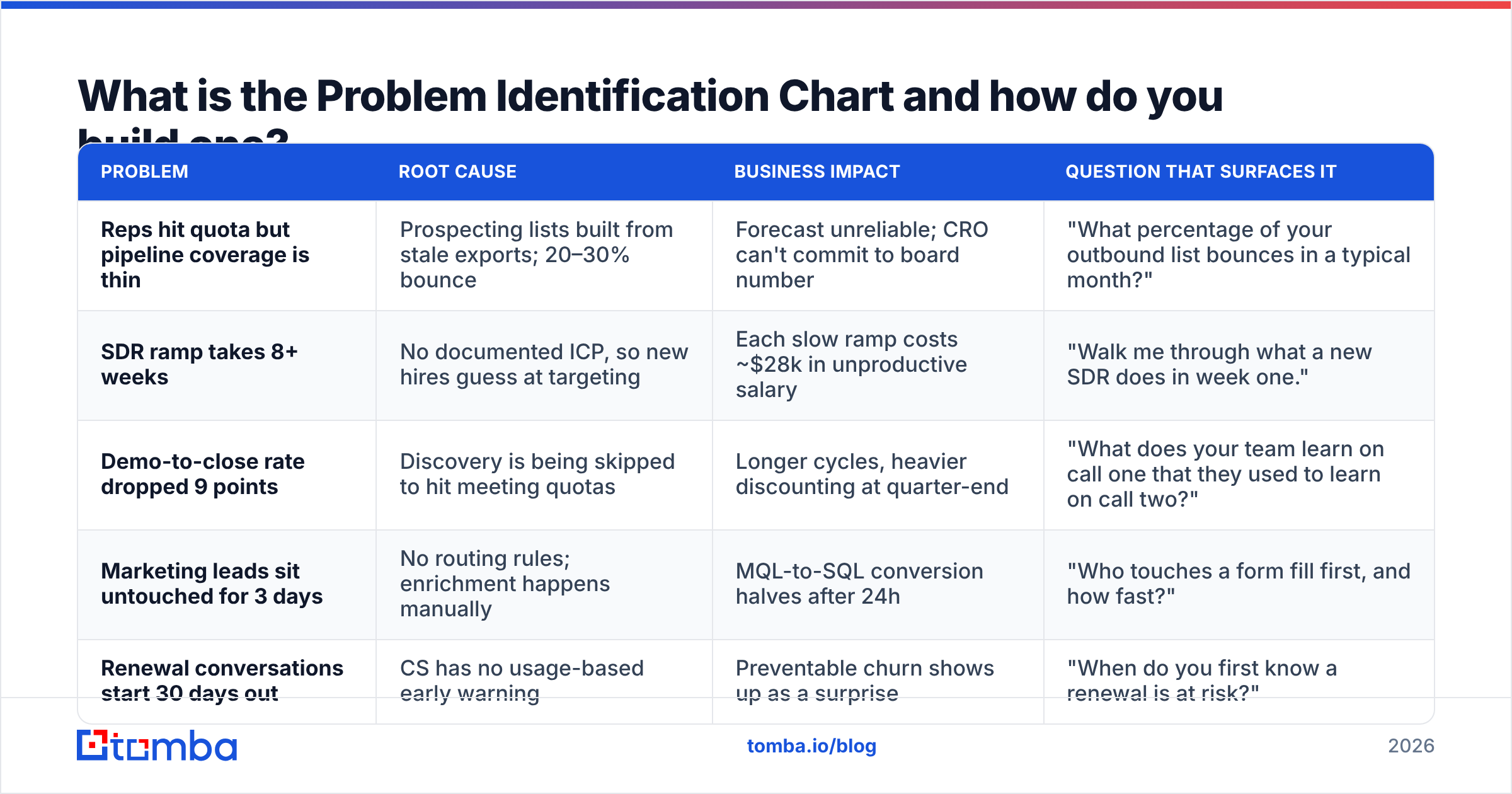
The PIC is the book's most transferable artifact. It's built before the call, not during it, and it forces you to already know the problems your product solves better than the buyer knows them.
Build one per persona, per segment. Each row is a problem you've genuinely seen in the market.
| Problem | Root cause | Business impact | Question that surfaces it |
|---|---|---|---|
| Reps hit quota but pipeline coverage is thin | Prospecting lists built from stale exports; 20–30% bounce | Forecast unreliable; CRO can't commit to board number | "What percentage of your outbound list bounces in a typical month?" |
| SDR ramp takes 8+ weeks | No documented ICP, so new hires guess at targeting | Each slow ramp costs ~$28k in unproductive salary | "Walk me through what a new SDR does in week one." |
| Demo-to-close rate dropped 9 points | Discovery is being skipped to hit meeting quotas | Longer cycles, heavier discounting at quarter-end | "What does your team learn on call one that they used to learn on call two?" |
| Marketing leads sit untouched for 3 days | No routing rules; enrichment happens manually | MQL-to-SQL conversion halves after 24h | "Who touches a form fill first, and how fast?" |
| Renewal conversations start 30 days out | CS has no usage-based early warning | Preventable churn shows up as a surprise | "When do you first know a renewal is at risk?" |
Once the chart exists, discovery stops being improvisation. You're not fishing — you're testing hypotheses. And when a buyer describes a symptom, you can move to root cause in one hop because you've already written down the three most likely causes.
A practical note: your PIC is only as good as your market research. If you can't name the actual titles, tools, and metrics your buyers use, you're guessing. Pull real org data — contact enrichment on your closed-won accounts will tell you which titles actually signed and which ones were passengers.
How does gap selling compare to SPIN, Challenger, and MEDDIC?#
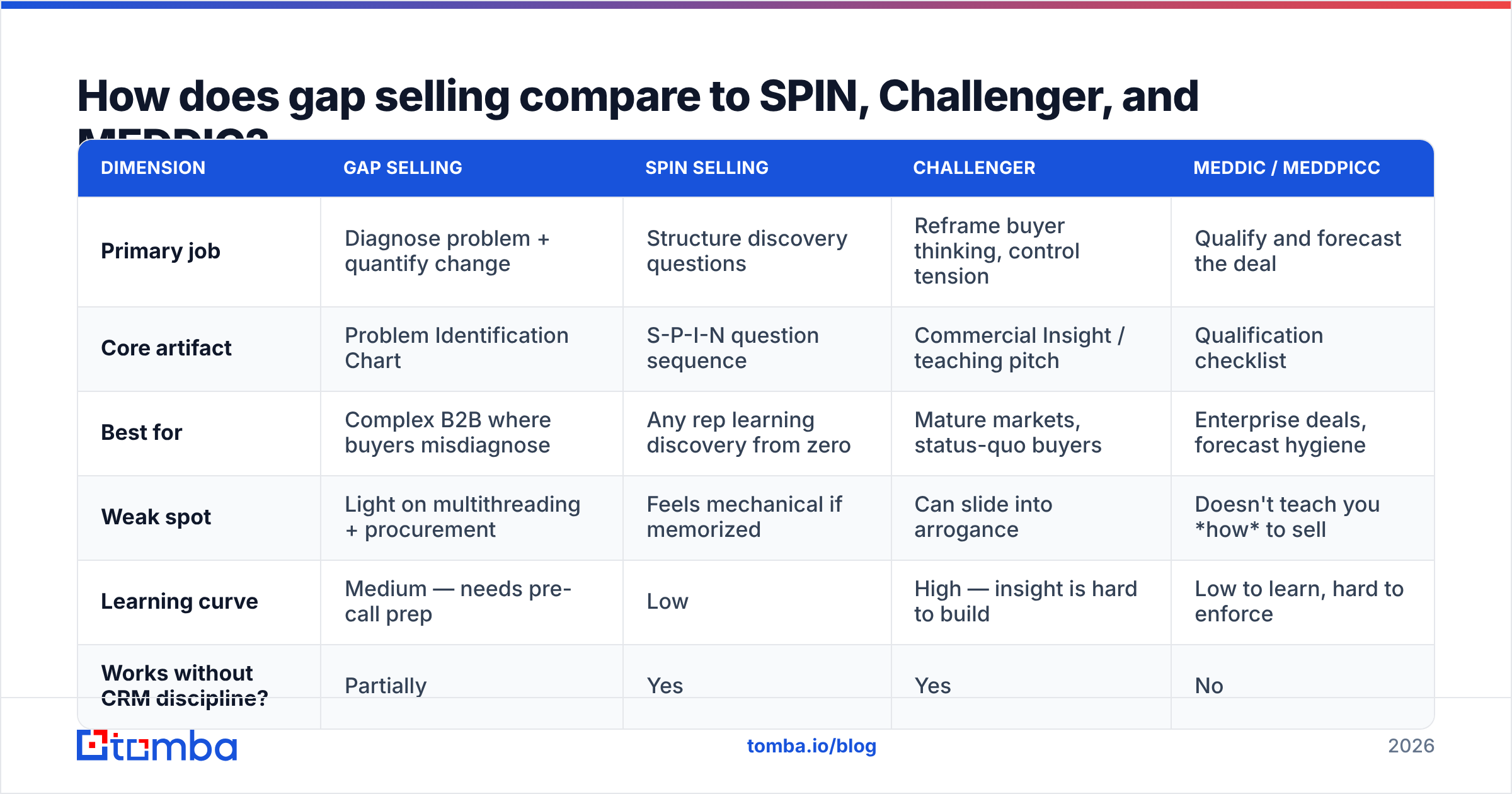
They're not competitors so much as different layers of the same stack. Here's the honest breakdown:
| Dimension | Gap Selling | SPIN Selling | Challenger | MEDDIC / MEDDPICC |
|---|---|---|---|---|
| Primary job | Diagnose problem + quantify change | Structure discovery questions | Reframe buyer thinking, control tension | Qualify and forecast the deal |
| Core artifact | Problem Identification Chart | S-P-I-N question sequence | Commercial Insight / teaching pitch | Qualification checklist |
| Best for | Complex B2B where buyers misdiagnose | Any rep learning discovery from zero | Mature markets, status-quo buyers | Enterprise deals, forecast hygiene |
| Weak spot | Light on multithreading + procurement | Feels mechanical if memorized | Can slide into arrogance | Doesn't teach you how to sell |
| Learning curve | Medium — needs pre-call prep | Low | High — insight is hard to build | Low to learn, hard to enforce |
| Works without CRM discipline? | Partially | Yes | Yes | No |
If you're building a sales motion from scratch, the pragmatic combination is: SPIN for question mechanics, gap selling for the diagnostic depth, MEDDPICC as the qualification gate before anything enters commit. Challenger is the optional layer on top once your team can actually teach something a buyer doesn't already know. Gartner's sales research has been consistent for years that buyer confusion — not lack of information — is what kills deals, which is exactly the problem gap selling targets.
Worth noting for context: the question-based discovery lineage traces back to Neil Rackham's research in the 1980s. Gap selling isn't a rejection of that work; it's an argument that reps stopped doing the "I" (implication) part properly.
What does a gap selling discovery call actually sound like?#
Less clever than you'd expect. The tone is calm, curious, and slightly stubborn.
Opening the current state:
- "Before I tell you anything about us — walk me through how you're handling [process] today."
- "Who's involved, and what does each person actually do in that flow?"
- "How long has it worked that way?"
Quantifying:
- "What's that number today? And what was it a year ago?"
- "How are you measuring it — or is that part of the problem?"
Getting to root cause:
- "Why do you think it's happening?" (Then: "What makes you say that?")
- "What have you already tried? What happened?"
Establishing impact:
- "What does that cost you in a quarter — dollars, headcount, or time?"
- "Who else in the business feels it when that number slips?"
- "What happens if nothing changes for another six months?"
Future state:
- "What would 'fixed' look like, numerically?"
- "By when does it need to be fixed, and what's driving that date?"
Two rules make these work. First, silence after the question — the useful answer is usually the second one. Second, never accept an adjective where a number belongs. "Pretty bad" is not a data point.

Where do reps get gap selling wrong?#
Three failure modes, in descending order of frequency.
They do discovery without doing homework. The whole method assumes you arrive knowing the likely problems. Without a PIC, "discovery" becomes an interrogation the buyer resents. If you're asking questions you could have answered from the company's job postings, tech stack, or funding announcement, you're burning credibility. Check what a company runs before the call with a website tech stack lookup — it takes thirty seconds and changes the first question you ask.
They quantify the gap but never validate it with a second stakeholder. A number one person gives you is a hypothesis. A number two people independently confirm is a business case. Gap selling is comparatively quiet on multithreading, which is why pairing it with MEDDPICC matters in deals over a certain size.
They confuse a problem with a gap. Everyone has problems. A gap only exists when the buyer both recognizes the problem and wants a materially different state. Plenty of companies have known problems they've decided to live with. Recognizing that early saves you a quarter of dead pipeline — and disqualifying fast is the most underrated skill in the book.
A fourth, subtler one: reps apply gap selling to the deal but not to their own funnel. If your team's response rate is 1.2% and you've decided the fix is "better subject lines," you've just misdiagnosed your own root cause the same way your buyers misdiagnose theirs. Usually it's targeting or data quality, not copy.
Does gap selling work for cold outbound?#
Yes, but with a constraint most summaries gloss over: gap selling is a conversation methodology, and cold email is not a conversation. You can't run a discovery sequence in 90 words.
What transfers to outbound is the PIC, compressed. A gap-selling cold email states one specific problem you believe the recipient has, hints at a root cause they may not have considered, and asks whether it's real. It doesn't describe your product.
Weak version: "We help sales teams book more meetings with AI-powered prospecting."
Gap version: "Most teams running 4-tool prospecting stacks find 18–25% of their exported contacts bounce within 60 days — usually because the source data is refreshed quarterly, not weekly. Is that roughly where you sit, or have you already solved it?"
The second one earns a reply because it's falsifiable and specific. The buyer either says "no, we're at 4%" (great, you learned something) or "yeah, actually" (great, you have a call).
The prerequisite is that the message reaches a real human. Gap-quality messaging on a bad list produces nothing. Before you invest in problem-specific sequences, make sure the underlying contact data is clean — run addresses through an email verifier and confirm you're targeting the person who actually owns the problem, not whoever appeared first in an export. Free tools like a spam checker will also tell you if your carefully written diagnostic email is landing in Promotions.
For a broader view of how the methodology fits into modern sales enablement, HubSpot's sales resources cover the tooling side reasonably well, and peer reviews on G2 are useful for pressure-testing which enablement platforms actually support problem-based call planning versus just recording calls.
Is Gap Selling still worth reading in 2026?#
Yes, with a caveat. The book is repetitive — Keenan makes the core argument early and then makes it again, forcefully, for another two hundred pages. If you read summaries and skim, you'll get 80% of the value in an hour.
But the 20% you'd miss is the part that changes behavior: the insistence that you cannot sell change you haven't measured. Eight years after publication, that's still the thing most reps skip, and it's still the thing that separates a forecast you can defend from one you're hoping about.
The methodology has aged well specifically because it's not tactic-dependent. Channels changed. AI-generated outreach flooded inboxes. Buyer committees grew. None of that touches the core claim — that a documented, quantified, root-caused gap is what makes someone spend money. If anything, in a market where every rep can generate polished copy instantly, the differentiator has shifted further toward who actually understands the buyer's problem.
Read it if: you sell complex B2B, your deals stall at "let's revisit next quarter," or your discovery calls consistently end with a demo request you can't qualify.
Skip it if: you sell transactional, low-consideration products, or your bottleneck is genuinely volume rather than conversion.
Where should you start?#
Pick one segment. Build a five-row Problem Identification Chart this week. Run your next ten discovery calls against it and log which problems actually showed up versus which you assumed. That single exercise will tell you more about your market than a quarter of pipeline reviews.
Then fix the input side. The best diagnostic questions in the world do nothing if they're pointed at the wrong accounts or bounce before delivery. Tomba Email Finder gets you verified, current contact data for the specific decision-makers who own the problems on your PIC — by name, by company, or by domain — so your gap-based outreach reaches people who can actually authorize the change you're proposing. Start free with 25 searches a month, or move to a paid plan from $49/mo when the motion is working; see Tomba pricing for the full breakdown. Diagnose properly, target properly, and the close takes care of itself.
Related guides#
Ready to find emails that actually work?
Join 150,000+ professionals who stopped guessing and started sending. Free credits on signup — no credit card required.
Get the Tomba newsletter
Practical outbound tactics and product updates — once every two weeks.
About the author