Gatekeeper Marketing: How to Reach Decision Makers in 2026
Gatekeeper marketing treats the executive assistant, ops manager, and procurement lead as buyers with real influence — not obstacles to dodge. Here is the 2026 playbook: roles, scripts, data requirements, and a tool comparison.
TL;DR
- Gatekeeper marketing means treating the people who screen access — executive assistants, chiefs of staff, ops managers, procurement — as a real audience with their own goals, not as an obstacle to trick.
- The "go around them" advice from 2015 is now the weakest play. In most enterprise deals the gatekeeper is a scoring member of the buying committee, not a switchboard.
- The two things that decide whether gatekeeper marketing works: knowing exactly who the gatekeeper is, and having a direct contact channel that does not depend on being transferred.
- A gatekeeper-first sequence typically runs 3 touches to the screener before any touch to the economic buyer — and converts better than a cold sequence straight to the VP.
- Measure it separately. Gatekeeper touches have their own reply rate, their own referral rate, and a meeting-set rate that lags 2–3 weeks behind direct outreach.
What is gatekeeper marketing?#
Gatekeeper marketing is the practice of building targeted messaging, content, and outreach for the people who control access to a decision maker — and treating that access as something you earn rather than something you bypass.
Think of it like getting into a members' club. The old approach was to memorize a fake name and hope the doorman was distracted. The gatekeeper marketing approach is to have a reason to be there that the doorman can verify in five seconds, and to make it obvious that letting you in makes his night easier, not harder.
The Wikipedia definition of a gatekeeper is broad — anyone who controls access to something. In B2B, four roles do most of the gating:
- Executive assistants and chiefs of staff — control calendar, inbox triage, and often the first quality filter on any vendor.
- Operations and RevOps managers — control whether a tool gets evaluated at all, because they own the stack it would plug into.
- Procurement and vendor management — control the paperwork path, security review, and renewal cycle.
- IT and security reviewers — control whether the deal survives the questionnaire stage.
None of these people sign the contract. All of them can kill the deal in one sentence.
Why did "get past the gatekeeper" stop working?#
Three things changed, and they compound.
Buying committees got bigger. Gartner's ongoing research on the B2B buying journey has tracked the average enterprise purchase to a committee of six to ten people. When ten people touch a decision, the screener is not adjacent to the process — the screener is in the process.
Phone systems changed. Direct-dial extensions, mobile-first work, and Teams/Slack-native comms mean the front-desk transfer barely exists anymore. There is no receptionist to talk past. There is an inbox with a filter and a calendar with an approver.
Assistants got tooling. The modern EA runs inbox rules, a vendor triage doc, and a shared "we already evaluated this category" note. Deception scales badly against that. Get flagged once and the flag persists across every rep at your company.
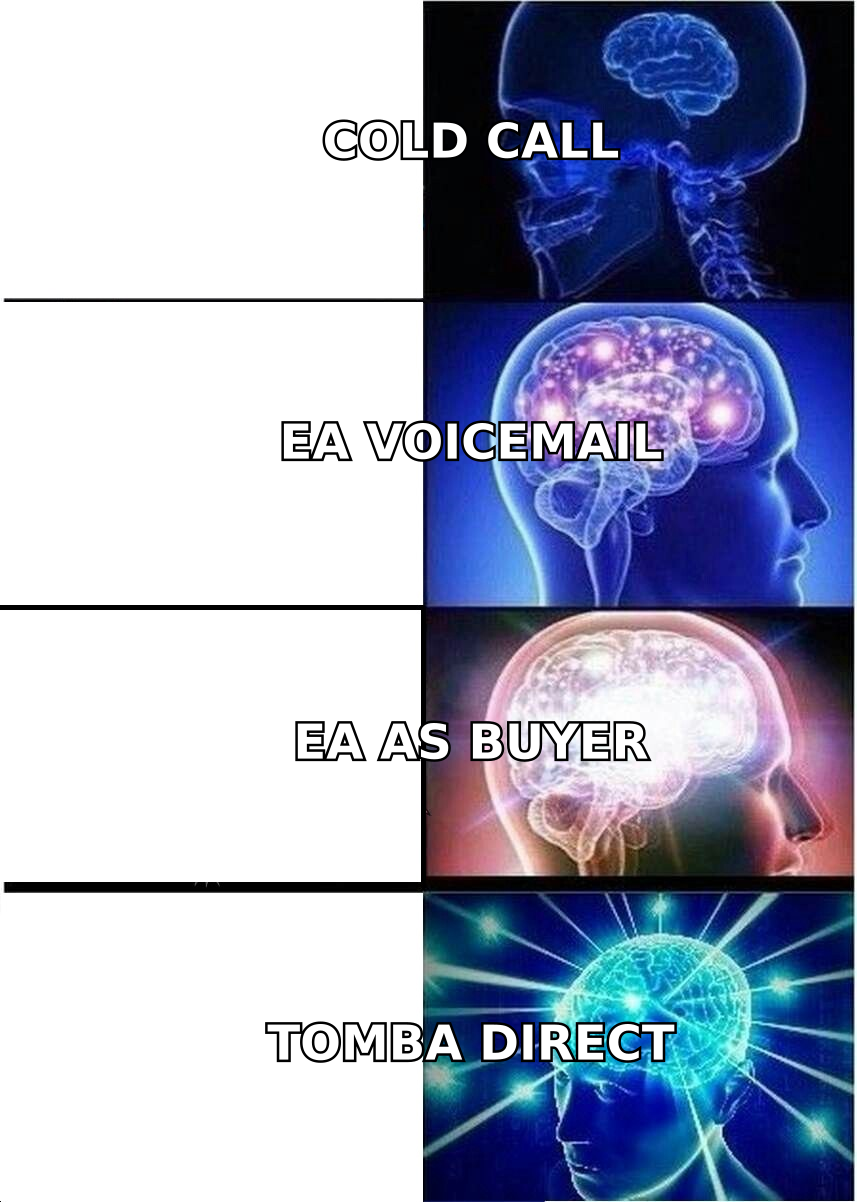
The practical upshot: your job is not to sound like an internal colleague. Your job is to be so obviously relevant that forwarding you is the low-risk choice.
Who are the gatekeepers in a modern buying committee?#
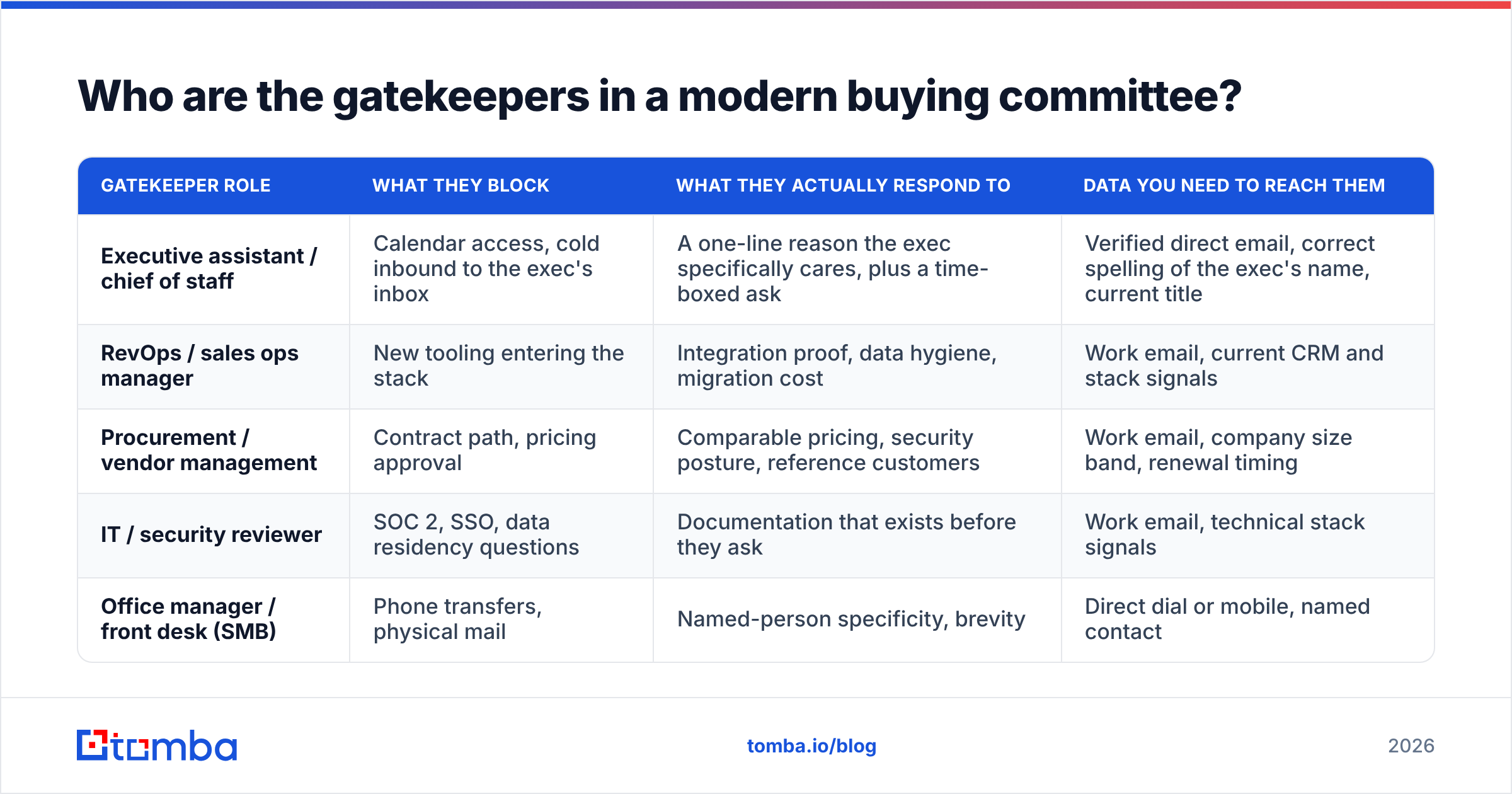
Map the roles before you write a single line of copy. Each one blocks for a different reason and unblocks for a different reason.
| Gatekeeper role | What they block | What they actually respond to | Data you need to reach them |
|---|---|---|---|
| Executive assistant / chief of staff | Calendar access, cold inbound to the exec's inbox | A one-line reason the exec specifically cares, plus a time-boxed ask | Verified direct email, correct spelling of the exec's name, current title |
| RevOps / sales ops manager | New tooling entering the stack | Integration proof, data hygiene, migration cost | Work email, current CRM and stack signals |
| Procurement / vendor management | Contract path, pricing approval | Comparable pricing, security posture, reference customers | Work email, company size band, renewal timing |
| IT / security reviewer | SOC 2, SSO, data residency questions | Documentation that exists before they ask | Work email, technical stack signals |
| Office manager / front desk (SMB) | Phone transfers, physical mail | Named-person specificity, brevity | Direct dial or mobile, named contact |
Read the fourth column again. Every one of these routes needs a verified direct contact, not a switchboard number and a hope. That is the unglamorous part of gatekeeper marketing that most playbooks skip: the strategy is downstream of the data.
If your list only has info@company.com, you do not have a gatekeeper strategy. You have a lottery ticket. A domain search across the target company surfaces the named people behind the generic inbox, which is the precondition for everything below.
Is going through the gatekeeper better than going around?#
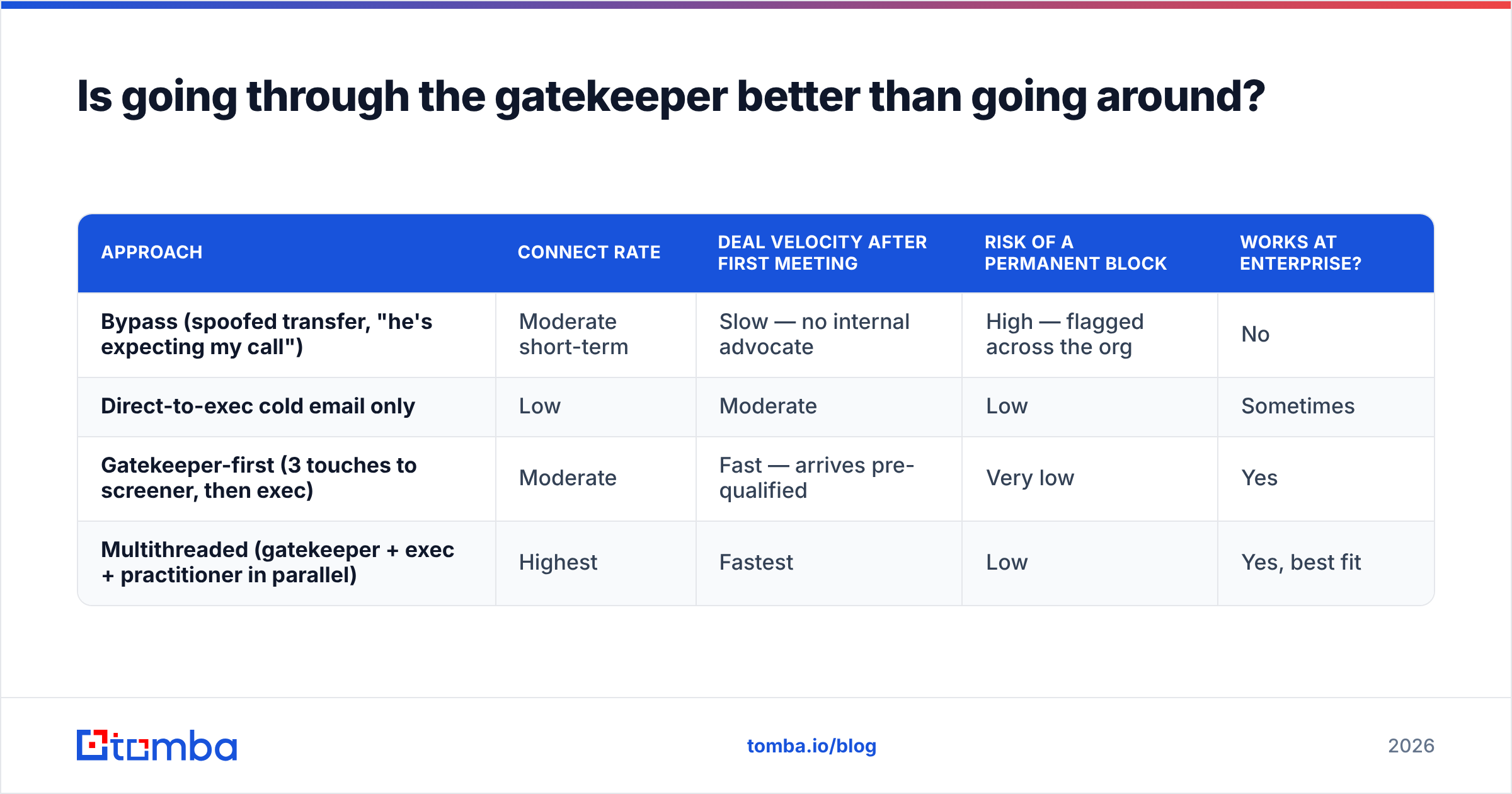
Going through wins on almost every metric that matters over a quarter. Going around wins on a single-touch vanity metric and loses on everything downstream.
| Approach | Connect rate | Deal velocity after first meeting | Risk of a permanent block | Works at enterprise? |
|---|---|---|---|---|
| Bypass (spoofed transfer, "he's expecting my call") | Moderate short-term | Slow — no internal advocate | High — flagged across the org | No |
| Direct-to-exec cold email only | Low | Moderate | Low | Sometimes |
| Gatekeeper-first (3 touches to screener, then exec) | Moderate | Fast — arrives pre-qualified | Very low | Yes |
| Multithreaded (gatekeeper + exec + practitioner in parallel) | Highest | Fastest | Low | Yes, best fit |
The mechanism is simple. A meeting the assistant booked for you carries the assistant's implicit endorsement. A meeting you extracted by dodging the assistant carries nothing, and the exec will forward your follow-up to the assistant anyway — who now has a grudge.
Multithreading is the version that scales. HubSpot's sales research library has documented for years that multithreaded deals close at materially higher rates than single-threaded ones, and the gatekeeper is usually the cheapest second thread to open.
What does a gatekeeper-first sequence look like?#
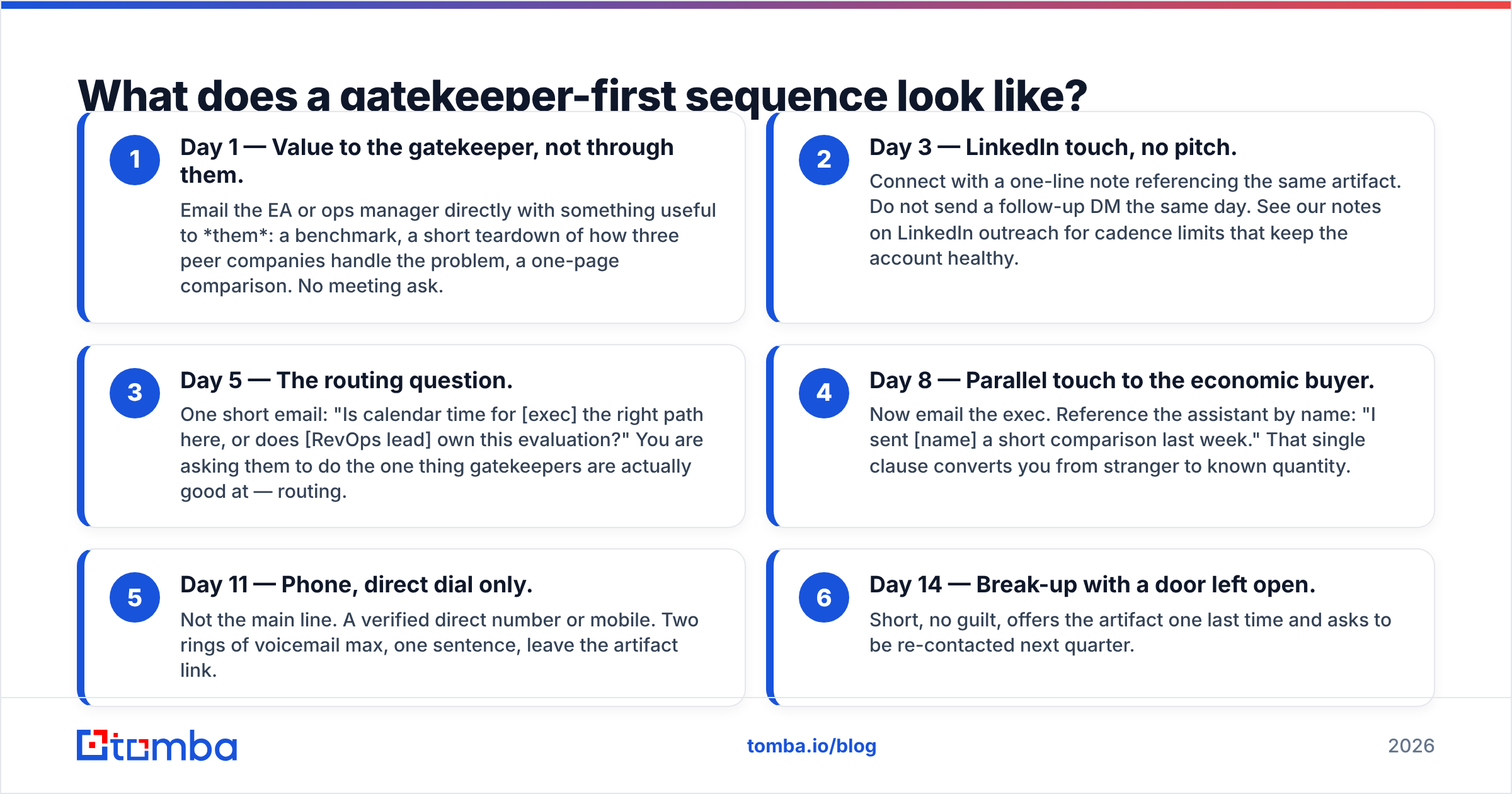
Here is a concrete 14-day structure. Adapt the intervals, keep the order.
- Day 1 — Value to the gatekeeper, not through them. Email the EA or ops manager directly with something useful to them: a benchmark, a short teardown of how three peer companies handle the problem, a one-page comparison. No meeting ask.
- Day 3 — LinkedIn touch, no pitch. Connect with a one-line note referencing the same artifact. Do not send a follow-up DM the same day. See our notes on LinkedIn outreach for cadence limits that keep the account healthy.
- Day 5 — The routing question. One short email: "Is calendar time for [exec] the right path here, or does [RevOps lead] own this evaluation?" You are asking them to do the one thing gatekeepers are actually good at — routing.
- Day 8 — Parallel touch to the economic buyer. Now email the exec. Reference the assistant by name: "I sent [name] a short comparison last week." That single clause converts you from stranger to known quantity.
- Day 11 — Phone, direct dial only. Not the main line. A verified direct number or mobile. Two rings of voicemail max, one sentence, leave the artifact link.
- Day 14 — Break-up with a door left open. Short, no guilt, offers the artifact one last time and asks to be re-contacted next quarter.
Notice what is absent: no "quick question," no fake familiarity, no pretending you spoke last week. The gatekeeper's entire job is detecting exactly that, and they are better at it than you are at hiding it.
What phone scripts actually get you transferred?#
Three patterns hold up. All three work because they give the gatekeeper a clean decision instead of a judgment call.
The named-routing script. "Hi — I'm trying to figure out who owns vendor evaluation for [specific category] over there. Is that [name] or someone on the ops side?" You are not asking for a transfer. You are asking for a fact. Facts are cheap to give away.
The honest-cold script. "I'll be upfront — this is a cold call. I work with [two named peer companies] on [specific problem]. Is that worth thirty seconds of [exec]'s week, or should I send something you can look at first?" The honesty buys you the benefit of the doubt, and the fallback ("send something") is an easy yes.
The reference-back script. Only usable if you did step 1 of the sequence. "I sent over a comparison on Tuesday — just checking whether it made sense to pass along or whether I aimed at the wrong team." Now you are following up on an existing thread, which is a completely different conversation.
What fails, reliably: claiming a prior relationship, calling during obvious lunch hours to catch a junior on the desk, and any phrasing that implies the gatekeeper is an obstacle. They can hear it.
What data does gatekeeper marketing actually require?#
You need four fields per gatekeeper, and they need to be current:
- Verified work email — bounces on an EA's inbox are worse than bounces on an exec's, because the EA's domain reputation feedback loop is tighter. Run every address through an email verifier before send.
- Direct dial or mobile — the main line is dead weight in 2026. A phone finder that returns direct numbers is the difference between a 4% and a 20% connect rate.
- Current title and reporting line — "EA to the CRO" and "EA to the CEO" are different sequences entirely.
- Company stack and headcount signals — this is what makes the day-1 artifact relevant rather than generic. Contact enrichment fills these in at list-build time so reps are not researching one account at a time.
The order matters. Find the named person, verify the address, enrich the context, then write. Teams that write first and source contacts second end up with beautiful copy landing on catch-all inboxes.
Which tools support gatekeeper prospecting?#
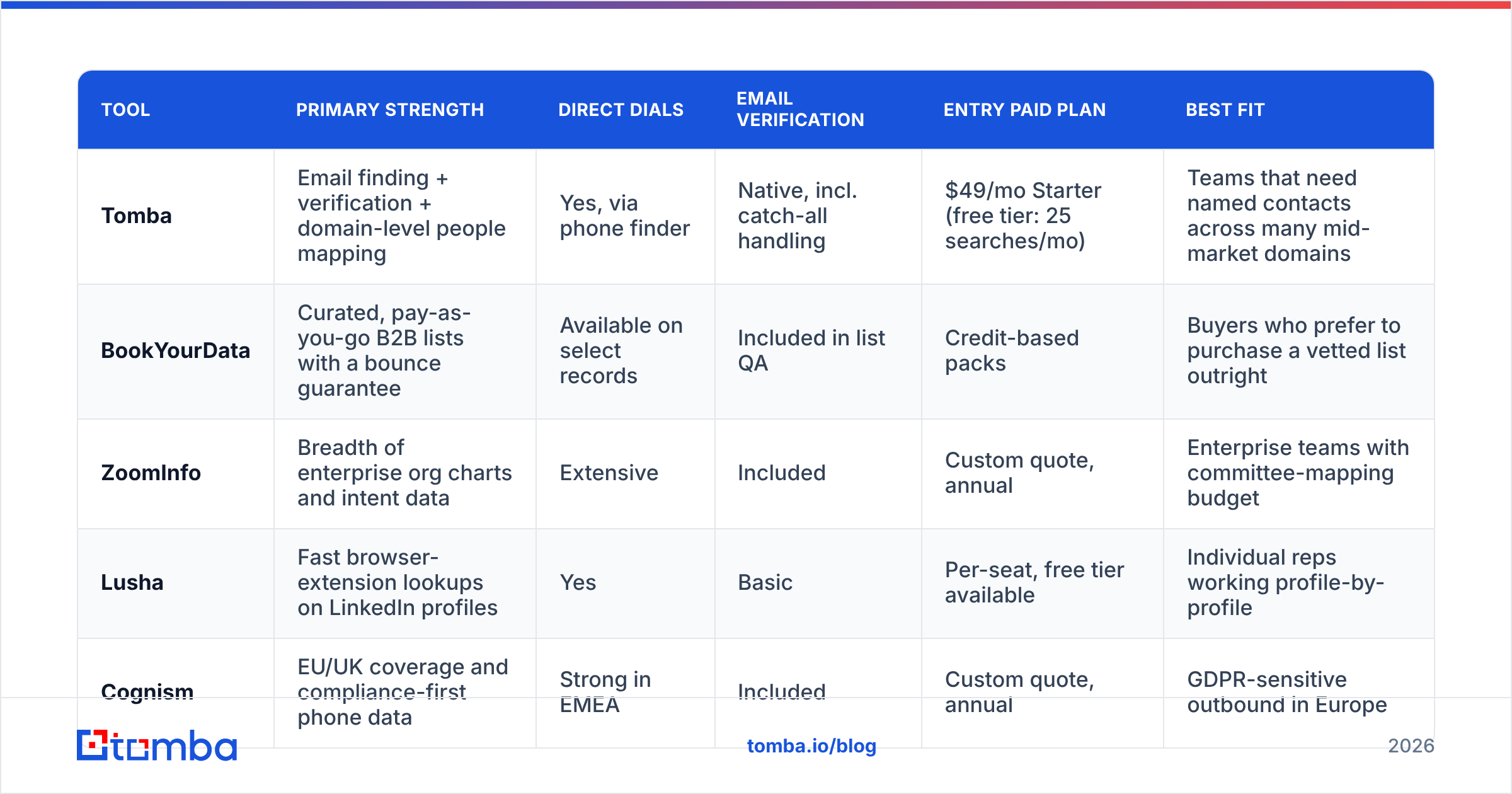
The category splits into three jobs: finding the named gatekeeper, verifying you can reach them, and getting a phone route. Very few tools do all three well, so most teams run two.
| Tool | Primary strength | Direct dials | Email verification | Entry paid plan | Best fit |
|---|---|---|---|---|---|
| Tomba | Email finding + verification + domain-level people mapping | Yes, via phone finder | Native, incl. catch-all handling | $49/mo Starter (free tier: 25 searches/mo) | Teams that need named contacts across many mid-market domains |
| BookYourData | Curated, pay-as-you-go B2B lists with a bounce guarantee | Available on select records | Included in list QA | Credit-based packs | Buyers who prefer to purchase a vetted list outright |
| ZoomInfo | Breadth of enterprise org charts and intent data | Extensive | Included | Custom quote, annual | Enterprise teams with committee-mapping budget |
| Lusha | Fast browser-extension lookups on LinkedIn profiles | Yes | Basic | Per-seat, free tier available | Individual reps working profile-by-profile |
| Cognism | EU/UK coverage and compliance-first phone data | Strong in EMEA | Included | Custom quote, annual | GDPR-sensitive outbound in Europe |
Public pricing shifts; confirm current tiers on each vendor's site or on G2 before you commit to an annual contract.
The honest read: if your motion is enterprise committee mapping with intent data layered on top, the big platforms earn their price. If your motion is high-volume mid-market outbound where you need the ops manager's verified address at 200 companies this month, a focused email finder plus verification will cost a fraction of a seat-based enterprise contract and cover the same ground. BookYourData is a reasonable third path when you would rather buy a pre-vetted list than build one — different workflow, same destination.
Check Tomba pricing against your monthly contact volume rather than your seat count; the two models produce very different bills at the same usage.
How do you measure gatekeeper marketing?#
Do not fold gatekeeper touches into your overall sequence stats. They behave differently and the blended number hides both the wins and the failures.
Track these four separately:
- Gatekeeper reply rate. Expect it to be higher than exec reply rate, often meaningfully so — assistants answer routing questions because answering is faster than deleting.
- Referral rate. The percentage of gatekeeper replies that name a person or route you onward. This is the real health metric.
- Assisted meeting rate. Meetings where a gatekeeper touch preceded the booking. Compare against your unassisted response rate baseline.
- Time-to-meeting lag. Gatekeeper-first sequences book slower and close faster. If you judge them on week-one meetings you will kill the play before it pays.
One warning on attribution: if your CRM only stamps the contact who accepted the invite, gatekeeper influence disappears from reporting entirely. Add a simple "assisted by" field or a tag. Otherwise the play gets defunded by a dashboard that cannot see it.
What are the most common gatekeeper marketing mistakes?#
- Treating the EA as a junior. Chiefs of staff frequently outrank the person you are trying to reach in practical authority. Talking down to them ends the account.
- Sending the exec pitch to the gatekeeper. Different reader, different job, different email. Reusing the copy signals you did not think about who you were writing to.
- Blasting a role-based inbox.
assistant@andoffice@addresses are usually shared, monitored, and reputation-sensitive. Find the named person. - Skipping verification. A bounce inside a small company's admin team gets discussed. Two bounces and your domain is in a filter rule.
- Only touching the gatekeeper. Gatekeeper-first is not gatekeeper-only. If you never open a parallel thread to the buyer, you have added a step, not a path.
Where should you start this quarter?#
Pick twenty target accounts. For each one, name the exec, name the likely gatekeeper, and get both verified addresses plus one direct dial. Write a single artifact worth forwarding — a real comparison, a real benchmark, not a case study PDF. Run the fourteen-day sequence exactly as written. Measure referral rate, not meetings, for the first three weeks.
If the referral rate clears 15%, scale the list. If it does not, the artifact is the problem, not the strategy.
The bottleneck for nearly every team that tries this is step one: getting accurate, verified contact details for the specific named humans in the buying committee rather than a generic company inbox. That is exactly what the Tomba Email Finder is built for — search by domain, name, or company, get a confidence-scored address, and verify it before it ever reaches a send queue. Start on the free tier with 25 searches a month, map one account's full committee end to end, and see whether the gatekeeper turns out to be your blocker or your best advocate.
Related guides#
Ready to find emails that actually work?
Join 150,000+ professionals who stopped guessing and started sending. Free credits on signup — no credit card required.
Get the Tomba newsletter
Practical outbound tactics and product updates — once every two weeks.
About the author