Gatekeeper Sales in 2026: How to Get Past the Front Desk
Gatekeepers block roughly 90% of unsolicited calls to executives. Here is what actually works in 2026 — scripts, data plays, and the direct-dial approach that skips the front desk entirely.
TL;DR
- A gatekeeper is anyone who controls access to your buyer — receptionists, executive assistants, IVR menus, and increasingly, AI call screeners and spam-risk filters.
- Trick-based scripts ("Tell him it's about the thing we discussed") still work occasionally, but they poison the relationship and burn the account. Assistants talk to each other.
- The highest-leverage move in 2026 is not a better script — it's better data. A verified direct dial or a personal-domain email means there is no gatekeeper to beat.
- Treat the assistant as a buyer influencer, not an obstacle. EAs control calendars, vendor shortlists, and renewal reminders.
- Blended sequences (direct dial + email + LinkedIn) outperform pure phone prospecting by a wide margin because they give the gatekeeper's boss three chances to self-select in.
What Is Gatekeeper Sales, Exactly?#
Gatekeeper sales is the practice of working through — or around — the people and systems that control access to a decision maker. In practice, that means four different things now, and most reps only prepare for the first one.
- The human receptionist. Front-desk staff at companies with physical offices. Their job is triage, and they are measured on how little noise reaches leadership. Increasingly rare below 200 employees.
- The executive assistant (EA). A senior, well-paid professional who often has real budget influence. At the enterprise level, the EA is frequently the person who compiles the vendor shortlist. Treating them like an obstacle is the single most expensive mistake in enterprise outbound.
- The phone system. IVR trees, extension-only dialing, and "if you know your party's extension" dead ends. No script beats this — only data does.
- The algorithmic gatekeeper. Spam-likely labeling on carrier networks, AI voicemail screeners on iOS and Android, Gmail's promotions tab, and inbox-level filters. This category has grown fastest since 2023 and is now the biggest single reason your outreach never gets seen.
The old playbook assumed category one. Most of your blocked calls in 2026 are categories three and four — which is why "just be more confident on the phone" advice keeps failing.
Why Do Most Gatekeeper Scripts Fail Now?#
Because they were engineered for a world where the phone number on the website was the only way in.
Classic tactics — calling at 7:45am before the receptionist arrives, claiming you were "asked to follow up," name-dropping a colleague you never spoke to — share a common flaw: they buy you thirty seconds of access at the cost of your credibility. If the deal is worth $60k ARR and takes nine months to close, you will speak to that assistant again. They remember.
There is also a measurable cost. Research summarized across B2B sales-effectiveness studies consistently puts cold-call connect rates in the low single digits, and the number of touches needed to book a meeting has climbed for a decade. Adding deception doesn't move the connect rate — it just changes who hangs up on you.
The tactics that survived scrutiny share three traits:
- They are truthful. You can say exactly what you said to the assistant when the executive picks up.
- They give the gatekeeper a decision they can make. "Is Dana the right person for procurement tooling, or is that someone else?" is answerable. "Is Dana in?" is not.
- They reduce the gatekeeper's work. Offering to email a one-paragraph summary the EA can forward is a favor, not a dodge.
How Should You Actually Talk to a Gatekeeper?#
Lead with clarity and a specific name. Vagueness triggers the screening reflex; specificity signals legitimacy.
The framework that holds up:
- State your name and company plainly. "Hi, this is Marc from Tomba." No mumbling, no fake familiarity. Reps who obscure their company get screened at a much higher rate because obscurity is the tell.
- Name the person and the reason in one sentence. "I'm trying to reach Dana Reyes about how her RevOps team sources contact data." Reason first, ask second.
- Ask a routing question, not an access question. "Is Dana still the person handling that, or has it moved to someone else?" You almost always get an answer, and often a better name.
- Accept the "no" and convert it. If access is denied, ask for the two things gatekeepers give freely: the correct email address and the best time to try again.
- Offer to make their life easier. "Would it help if I sent a short summary you can forward? I'll keep it to four lines."
- Thank them by name and use it next time. "Thanks, Priya." Three calls later, "Hi Priya, it's Marc again" is a different conversation entirely.
What to avoid outright: fake urgency, claiming a prior relationship, pretending to be a customer or partner, and the "I'll just hold" power play. Each of these has a short-term hit rate and a long-term account cost.
Is Fighting the Gatekeeper Even the Right Strategy?#
Usually not. The most efficient path is to make the gatekeeper irrelevant to the first touch.
Every hour spent perfecting a front-desk script is an hour not spent on the thing that actually changes outcomes: knowing the buyer's direct line and personal work email before you dial. When you have a verified mobile number, there is no receptionist. When you have a verified email that passes SPF/DKIM and lands in the primary tab, there is no IVR tree.
That is the real 2026 shift. Gatekeeper strategy has largely become a data quality problem wearing a communication-skills costume.
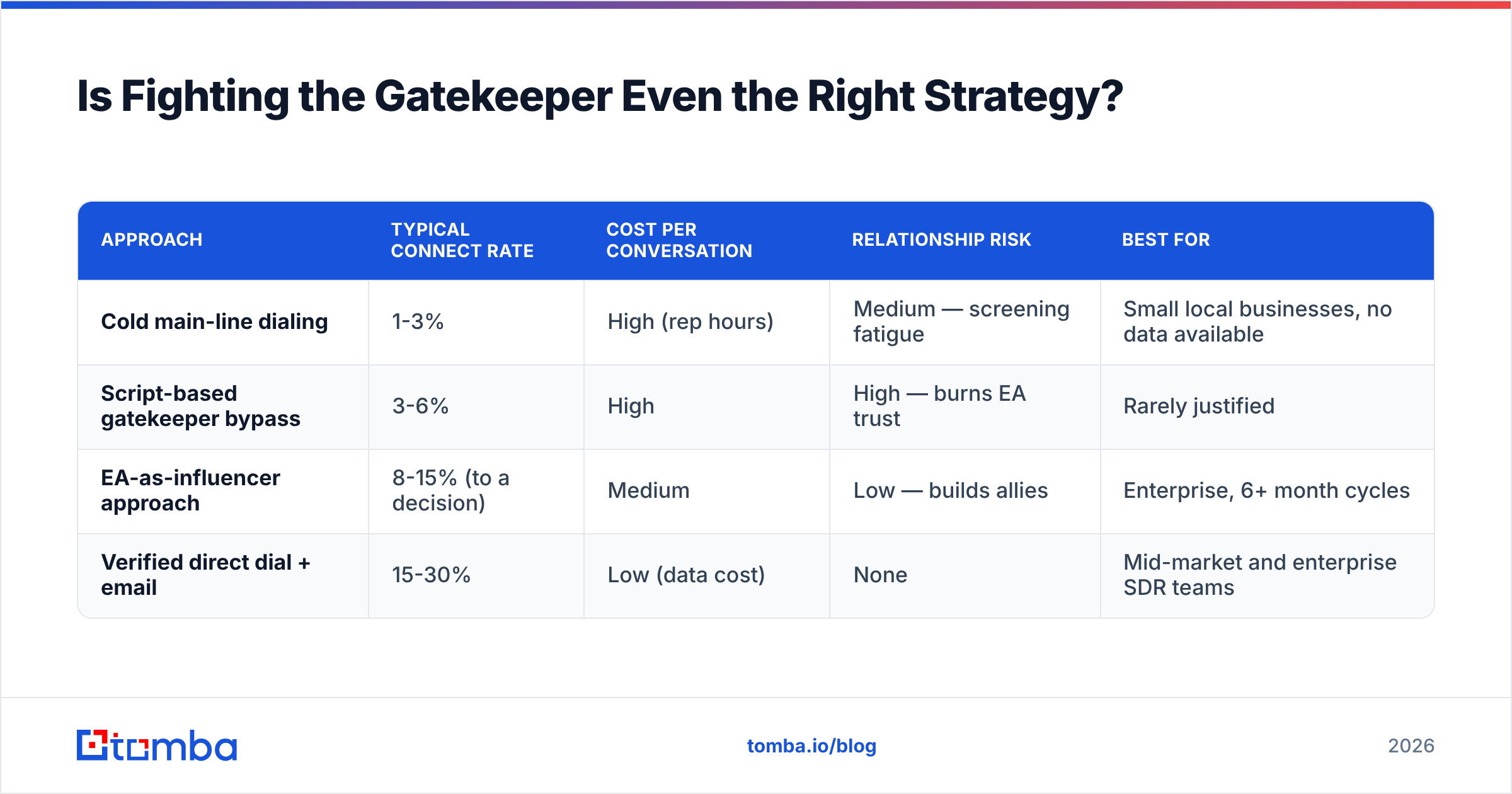
Here is how the three main routes compare on the metrics that matter:
| Approach | Typical connect rate | Cost per conversation | Relationship risk | Best for |
|---|---|---|---|---|
| Cold main-line dialing | 1-3% | High (rep hours) | Medium — screening fatigue | Small local businesses, no data available |
| Script-based gatekeeper bypass | 3-6% | High | High — burns EA trust | Rarely justified |
| EA-as-influencer approach | 8-15% (to a decision) | Medium | Low — builds allies | Enterprise, 6+ month cycles |
| Verified direct dial + email | 15-30% | Low (data cost) | None | Mid-market and enterprise SDR teams |
The fourth row is where most modern outbound teams have moved. It also explains why data spend has shifted from headcount to tooling in most SDR budgets.
What Data Do You Need to Skip the Front Desk?#
Four fields, in priority order:
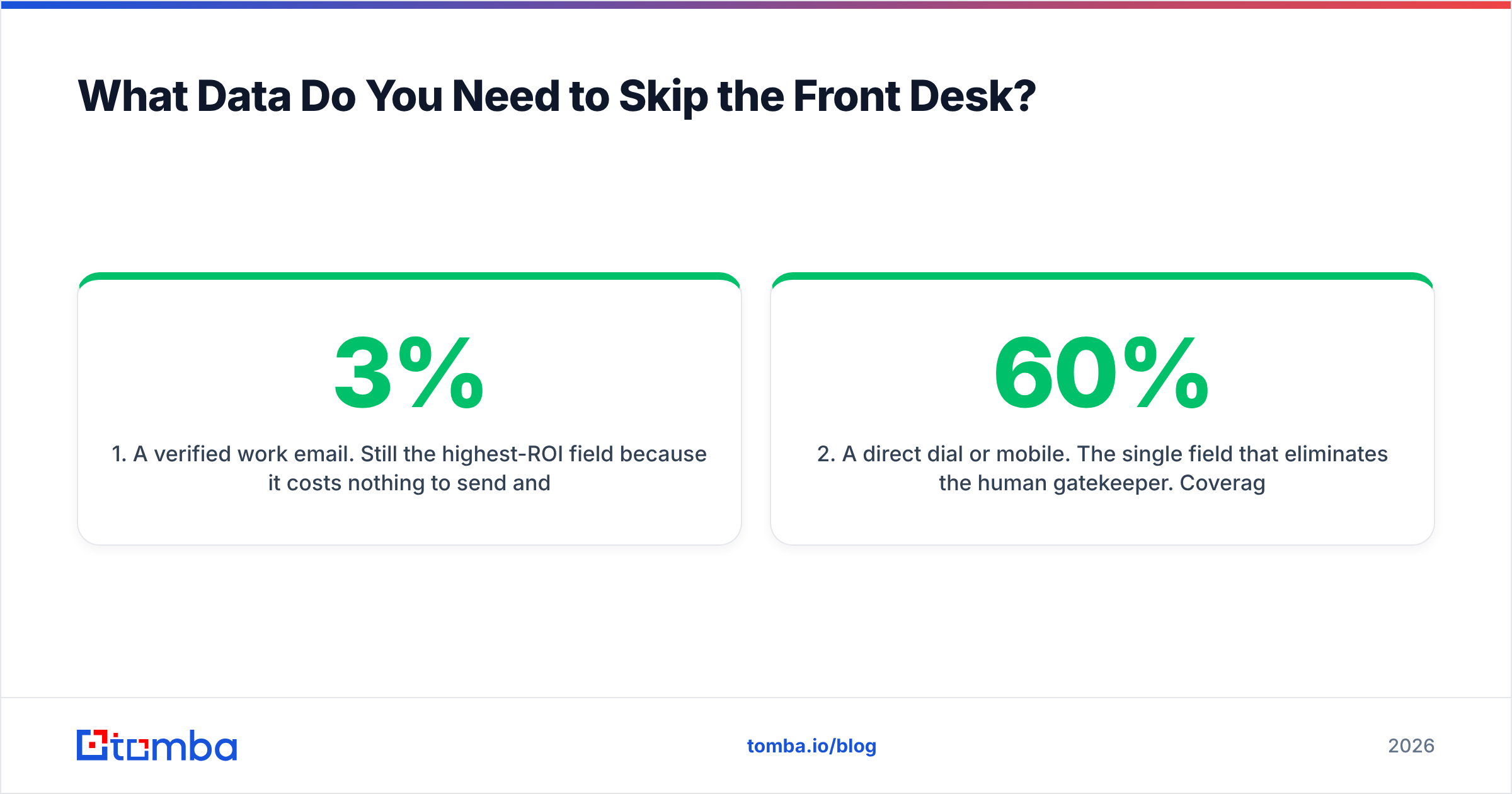
- A verified work email. Still the highest-ROI field because it costs nothing to send and nothing to be ignored. Use a email verifier before every send — bounce rates above 3% start damaging sender reputation, which creates an algorithmic gatekeeper of your own making.
- A direct dial or mobile. The single field that eliminates the human gatekeeper. Coverage varies wildly by vendor and region; expect 30-60% coverage on mid-market contacts and treat any vendor claiming 95% with suspicion.
- The company's email pattern. If you know a company uses
first.last@, you can infer and verify addresses for an entire org chart. A domain search gives you the pattern plus known contacts in one call. - The EA's name. Underrated. Knowing the assistant's name before you call converts a cold screening into a warm routing conversation.
A quick note on where this data comes from, because it matters for compliance and accuracy. Vendors fall into three camps: crawl-and-verify (public web sources plus SMTP validation), contributed data (users share their address books — check your jurisdiction's rules on this), and licensed panels. Crawl-and-verify sources are generally the safest under GDPR because the underlying data was published for business contact purposes, but you still need a lawful basis and a working opt-out. Review any vendor's data sources before you build a motion on top of them.
How Do the Main Data Tools Compare for Gatekeeper Bypass?#
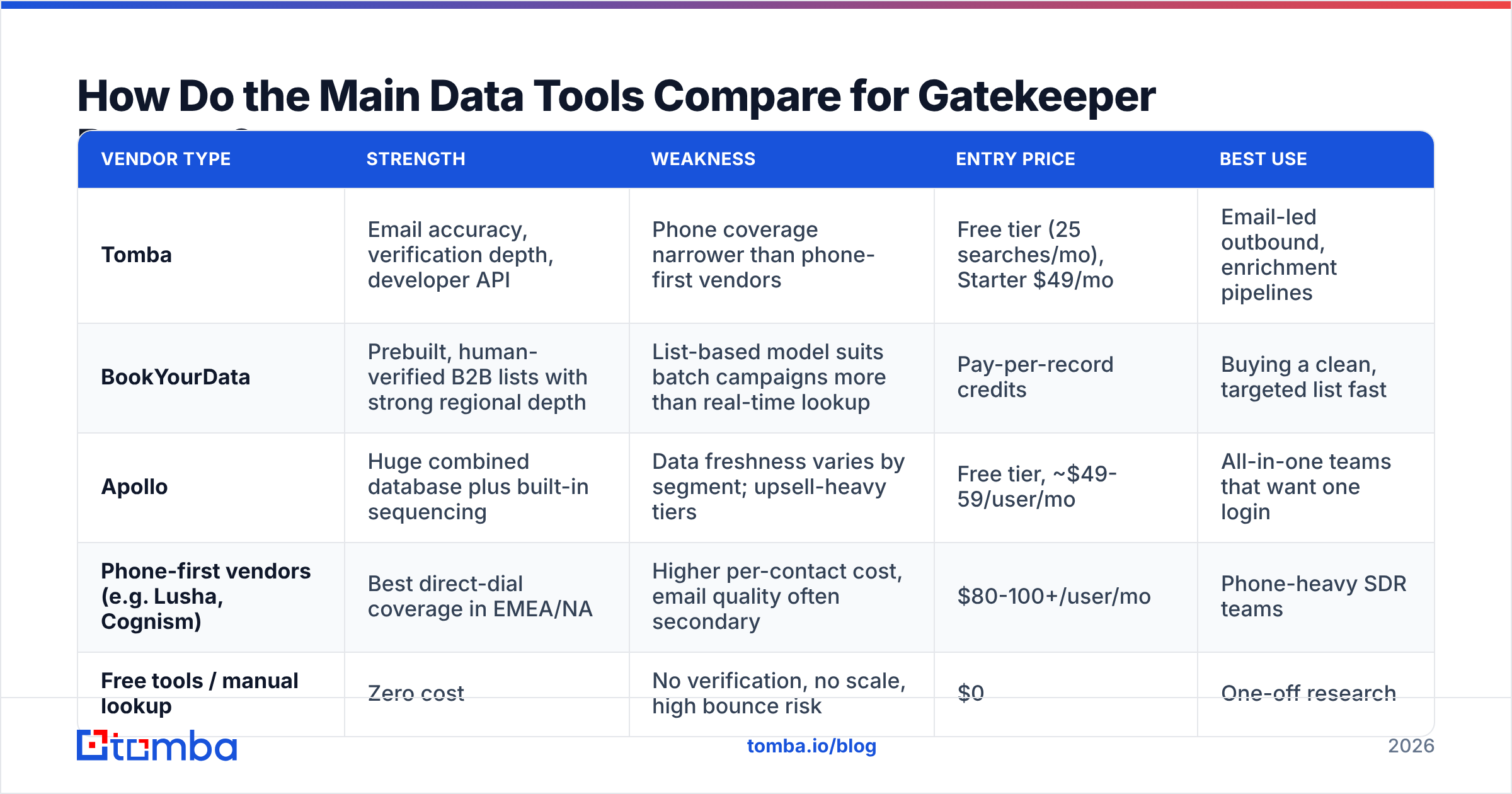
Contact-data vendors are not interchangeable. Some optimize for volume, some for accuracy, some for phone coverage specifically. Here is an honest read on the categories:
| Vendor type | Strength | Weakness | Entry price | Best use |
|---|---|---|---|---|
| Tomba | Email accuracy, verification depth, developer API | Phone coverage narrower than phone-first vendors | Free tier (25 searches/mo), Starter $49/mo | Email-led outbound, enrichment pipelines |
| BookYourData | Prebuilt, human-verified B2B lists with strong regional depth | List-based model suits batch campaigns more than real-time lookup | Pay-per-record credits | Buying a clean, targeted list fast |
| Apollo | Huge combined database plus built-in sequencing | Data freshness varies by segment; upsell-heavy tiers | Free tier, ~$49-59/user/mo | All-in-one teams that want one login |
| Phone-first vendors (e.g. Lusha, Cognism) | Best direct-dial coverage in EMEA/NA | Higher per-contact cost, email quality often secondary | $80-100+/user/mo | Phone-heavy SDR teams |
| Free tools / manual lookup | Zero cost | No verification, no scale, high bounce risk | $0 | One-off research |
Two practical notes. First, most teams end up with two sources, not one — an email-accuracy vendor and a phone-coverage vendor — because no single provider leads on both. Second, always test on your own ICP before committing. Run 100 known-good contacts through a trial and measure the match rate yourself; vendor-published accuracy figures are measured on their own samples.
If you want to compare cost structures directly, Tomba pricing runs Free (25 searches/mo), Starter $49/mo, Growth $99/mo, Pro $249/mo, and Enterprise custom — credit-based rather than per-seat, which matters if you have more researchers than dialers. For independent cross-checks on any vendor in this space, G2's lead intelligence category carries enough verified reviews to spot the pattern behind the marketing claims.
How Do You Turn the Gatekeeper Into an Ally?#
This is the play most reps skip, and it's the one that wins enterprise deals.
Executive assistants at the VP-and-above level are not clerical staff. They manage calendars, screen vendors, brief their executive before meetings, and — critically — remember who was respectful when the answer was no. In long sales cycles, the EA is often the only person who has been in every meeting.
Concrete moves that work:
- Ask for their help explicitly. "You probably know his priorities this quarter better than anyone. Is contact data even on the list, or am I wasting your time?" Honest question, useful answer either way.
- Send them the material directly. Not a deck. A four-line summary and one link. Make it forwardable without editing.
- Respect the timing they give you. If they say "try after the 15th," call on the 16th, not the 12th. This is the cheapest trust you will ever buy.
- Follow up with them, not around them. Going over an EA's head after they told you no is how accounts get permanently blacklisted.
- Give them a reason to say yes. If your product saves their executive time, say that in the EA's terms: fewer calendar conflicts, fewer escalations, fewer emergency requests.
HubSpot's sales research has consistently found that referral and internal-introduction paths convert at multiples of cold outreach; an EA who forwards your note is functionally an internal referral. That is worth more than any bypass script.
What Does a Modern Gatekeeper-Proof Sequence Look Like?#
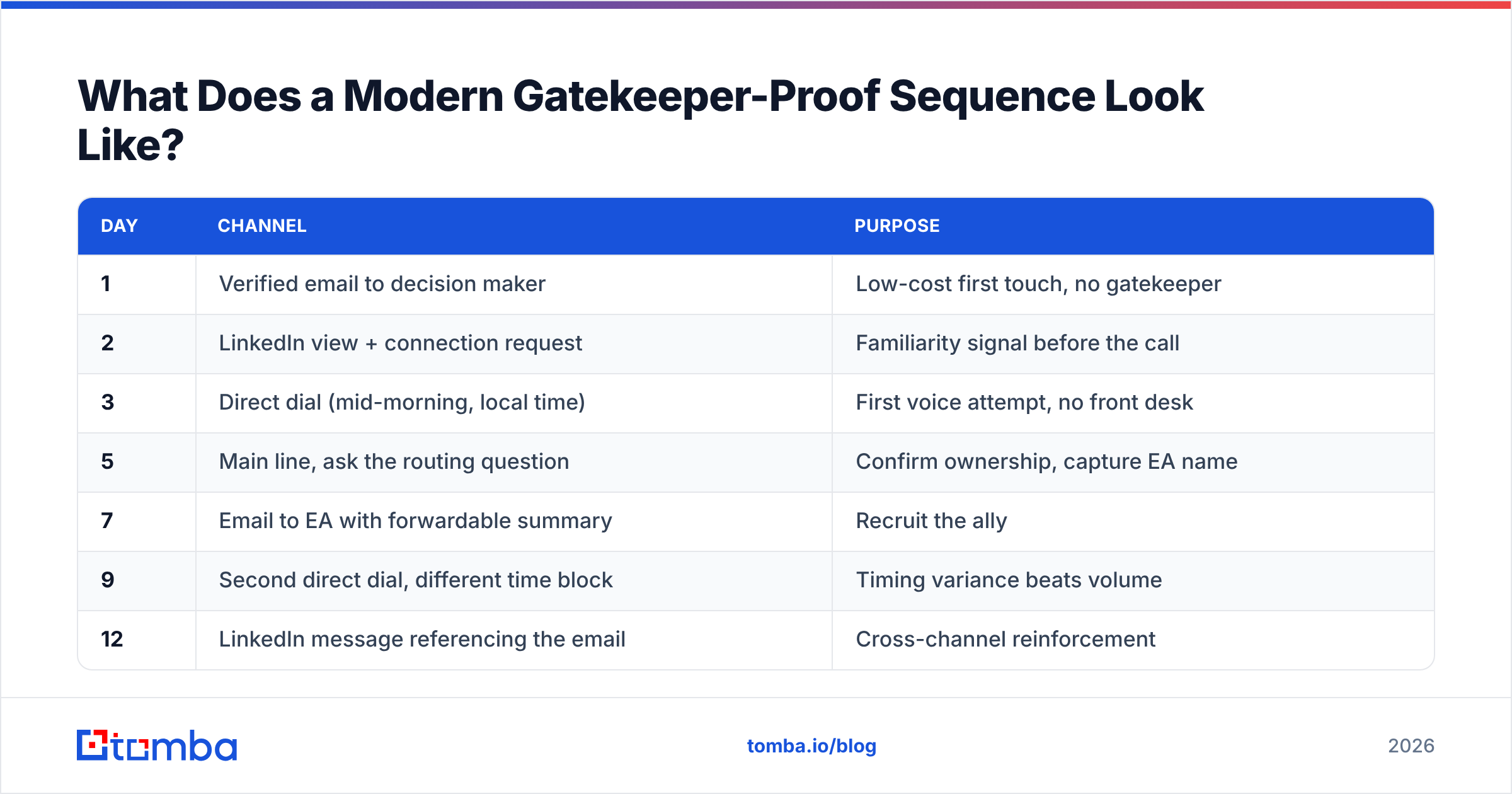
Multi-channel, data-first, and patient. A workable 14-day structure:
| Day | Channel | Purpose |
|---|---|---|
| 1 | Verified email to decision maker | Low-cost first touch, no gatekeeper |
| 2 | LinkedIn view + connection request | Familiarity signal before the call |
| 3 | Direct dial (mid-morning, local time) | First voice attempt, no front desk |
| 5 | Main line, ask the routing question | Confirm ownership, capture EA name |
| 7 | Email to EA with forwardable summary | Recruit the ally |
| 9 | Second direct dial, different time block | Timing variance beats volume |
| 12 | LinkedIn message referencing the email | Cross-channel reinforcement |
| 14 | Break-up email with a clear opt-out | Preserves reputation for the next quarter |
Three rules that make it work. Vary your call times across morning, midday, and late afternoon rather than hammering the same slot. Keep every email under 90 words. And verify the entire list before day one — a sequence built on a 12% bounce list will get your domain filtered before you reach step three, and inbox filters are the one gatekeeper that never takes a message.
For building that list at scale, run your target accounts through a bulk email finder in one pass rather than looking up contacts one at a time. It's the difference between a rep spending Monday researching and a rep spending Monday dialing.
What Should You Stop Doing in 2026?#
- Stop calling the main line first. It should be your third option, not your first.
- Stop using deception scripts. The hit rate doesn't justify the account risk, and enterprise EAs compare notes.
- Stop sending unverified email. Every hard bounce is a small permanent tax on your domain.
- Stop measuring dials. Measure conversations and meetings. Dial counts reward the wrong behavior and hide bad data.
- Stop treating the EA as a hurdle. In deals over $50k, they are frequently a scorer on the evaluation.
The through-line is simple: gatekeepers exist because bad outreach exists. The teams that get through are the ones whose outreach is specific enough that screening it out would be a mistake — and who have the direct contact data to make screening moot in the first place.
Where to Start#
Pick your top 50 target accounts. Find the decision maker's verified work email and direct dial before you make a single call. Then run the 14-day sequence above and measure meetings booked, not dials placed. If your connect rate doesn't at least double, the problem is your message — but in most audits we've seen, the problem was the data.
Tomba Email Finder is built for exactly this first step: give it a name and a domain, or just a domain, and get back verified professional email addresses with a confidence score and the sources behind them. The free tier covers 25 searches a month, which is enough to test it against contacts you already know before you commit to anything. Start there, get the data right, and the gatekeeper problem shrinks to a footnote.
Sources: G2 Lead Intelligence category, HubSpot Sales Blog, Gartner B2B buying research
Related guides#
Ready to find emails that actually work?
Join 150,000+ professionals who stopped guessing and started sending. Free credits on signup — no credit card required.
Get the Tomba newsletter
Practical outbound tactics and product updates — once every two weeks.
About the author