8 Best Gazelle Alternatives in 2026 for B2B Lead Data
Gazelle.ai is strong at spotting fast-growing companies, but it is quote-only and stops at the firm level. Here are 8 Gazelle alternatives compared on price, contact data, coverage and honest fit.
TL;DR
- Gazelle.ai is a company-intelligence platform: it predicts which companies are growing, expanding, or worth targeting. It is not a contact-data tool, and its pricing is quote-only.
- Most teams searching for Gazelle alternatives want one of three things: a public price, verified contact-level data (emails and mobiles), or both.
- Split your stack decision by job: account selection (Gazelle.ai, Crunchbase, Vainu, 6sense) vs contact acquisition (Tomba, Apollo, Cognism, BookYourData).
- If you already know your accounts, an email finder plus verifier is dramatically cheaper than another annual intelligence contract — Tomba starts at $49/mo with a free 25-search tier.
- The most common 2026 setup: keep one signal source, replace the rest with an API you can meter per credit.
What is Gazelle.ai and who actually uses it?#
Gazelle.ai is an AI-driven company intelligence platform built around a simple premise: instead of ranking companies by static firmographics, rank them by growth probability. It scores millions of company records globally and surfaces the ones most likely to expand, invest, hire, or open a new location.
That framing explains its user base. Economic development organizations use it to find companies likely to build a facility in their region. Site-selection consultants, commercial real estate teams, and a slice of B2B sales orgs use it the same way — as a targeting layer, not an outreach layer. You can see the product positioning on gazelle.ai directly.
Three things matter before you compare it to anything else:
- It is account-level, not contact-level. You get companies, growth signals, and some executive records. You do not get a reliable, continuously verified email and mobile for every buyer on a committee.
- Pricing is quote-only. As of early 2026, there is no public self-serve price page. That means procurement cycles, annual commitments, and a renewal conversation you cannot benchmark without talking to sales.
- Its geography and firmographic depth are its moat. For international expansion and investment-attraction use cases, the growth modeling is genuinely differentiated. For "find me 500 verified emails at mid-market SaaS companies," it is the wrong instrument.
That last point is why most people searching for Gazelle alternatives are not unhappy with Gazelle.ai — they are trying to solve a different job with it.
Why do teams look for Gazelle alternatives?#
From renewal conversations and review threads on G2, the reasons cluster tightly:
- The quote is opaque. You cannot compare an unpublished annual number against a $49/mo tool without doing math you were never given the inputs for.
- Seats do not scale to SDR teams. Intelligence platforms price by seat; outbound teams need volume, not seats.
- Contact data gaps force a second purchase anyway. You identify a growing manufacturer in Ohio, then spend twenty minutes hunting for the VP of Operations' email. That is a second tool, a second invoice, and a second onboarding.
- Signals age faster than the contract. A growth score refreshed quarterly is useful for territory planning and useless for a Tuesday send.
- Non-sales teams struggle to justify seats. Marketing, RevOps, and research all want occasional queries; nobody wants a full seat for them.
What should you compare in a Gazelle alternative?#
Do not compare feature checklists. Compare these six dimensions, in this order:
- Job to be done — Are you choosing accounts, or contacting people inside accounts? Almost no tool is excellent at both, and paying enterprise prices for the half you do not use is the single most common waste in a GTM stack.
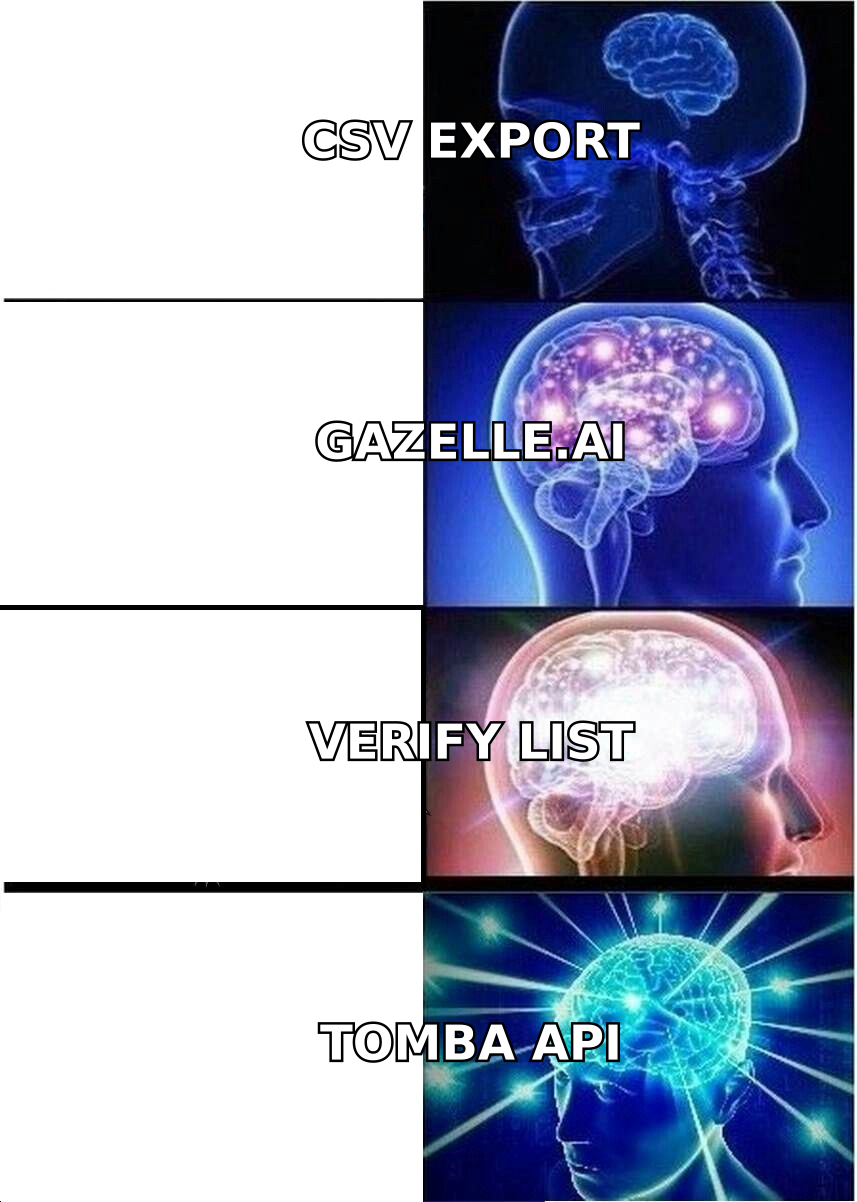
- Pricing transparency — Public price page, self-serve checkout, and per-credit metering beat "book a demo" every time when you are under $50k in annual data spend.
- Contact-level accuracy — Ask for the bounce guarantee, not the database size. A 200M-record database with 20% bounce rate is worse than a 40M-record database at 3%.
- Verification depth — SMTP checks, catch-all handling, role-account detection, and disposable filtering. Catch-all verification is where most vendors quietly fail.
- API and workflow fit — If your RevOps team cannot hit it programmatically, it becomes a manual export habit within a quarter.
- Exit cost — Can you leave mid-contract? Do credits expire? Do you keep exported data?
Score any shortlist against those six and the field narrows fast.
Which are the best Gazelle alternatives in 2026?#
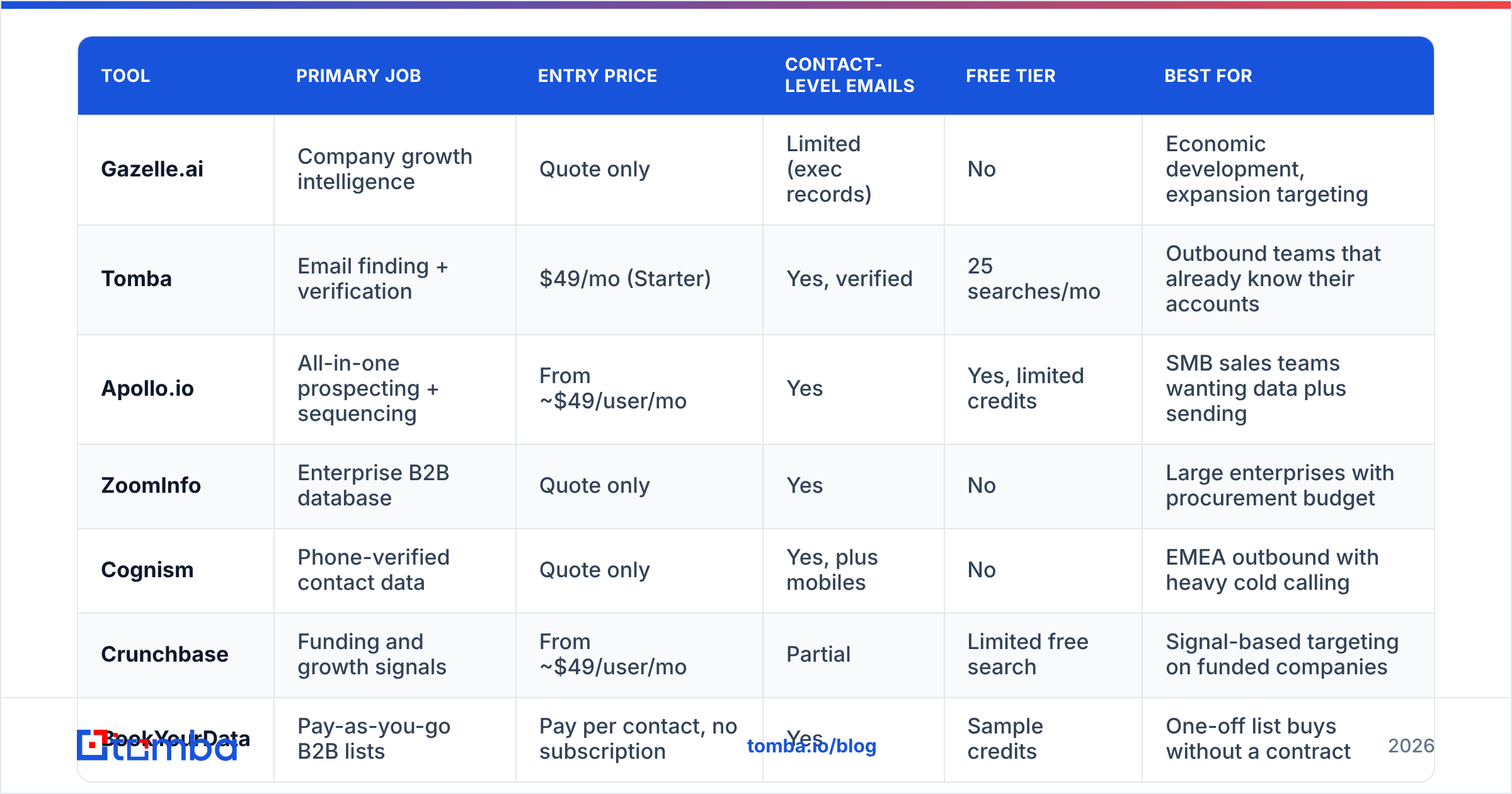
Here is the head-to-head. Prices are the publicly listed entry points as of 2026; quote-only vendors are marked as such rather than guessed.
| Tool | Primary job | Entry price | Contact-level emails | Free tier | Best for |
|---|---|---|---|---|---|
| Gazelle.ai | Company growth intelligence | Quote only | Limited (exec records) | No | Economic development, expansion targeting |
| Tomba | Email finding + verification | $49/mo (Starter) | Yes, verified | 25 searches/mo | Outbound teams that already know their accounts |
| Apollo.io | All-in-one prospecting + sequencing | From ~$49/user/mo | Yes | Yes, limited credits | SMB sales teams wanting data plus sending |
| ZoomInfo | Enterprise B2B database | Quote only | Yes | No | Large enterprises with procurement budget |
| Cognism | Phone-verified contact data | Quote only | Yes, plus mobiles | No | EMEA outbound with heavy cold calling |
| Crunchbase | Funding and growth signals | From ~$49/user/mo | Partial | Limited free search | Signal-based targeting on funded companies |
| BookYourData | Pay-as-you-go B2B lists | Pay per contact, no subscription | Yes | Sample credits | One-off list buys without a contract |
| Vainu | Company data with EU depth | Quote only | Partial | Trial | Nordic and European account intelligence |
Tomba — when you already know who to target#
Tomba is the narrow, cheap end of the spectrum, and that is the point. It does not try to score which companies are growing. It answers "who works here and what is their real email," then proves the answer.
The email finder resolves an address from a name and domain; the email verifier runs SMTP-level checks before you send; domain search returns every discoverable address at a company with role and confidence labels. Tomba pricing is public: free at 25 searches/mo, $49/mo Starter, $99/mo Growth, $249/mo Pro, custom Enterprise.
Pick it when: your ICP is already defined and your bottleneck is deliverable contact data, not account discovery. Skip it when: you genuinely need growth prediction and site-selection modeling — that is Gazelle.ai's home turf, and Tomba does not compete there.
Apollo.io — data plus sequencing in one seat#
Apollo bundles a contact database with sequencing, dialing, and basic CRM sync. For a small team that wants one login instead of three, it is a reasonable consolidation play. The tradeoff is that bundled data quality varies by segment, and heavy senders often end up layering a dedicated verifier on top anyway. If you are evaluating it, the Apollo alternative breakdown covers where the bundling helps and where it hurts.
ZoomInfo — the enterprise default, at enterprise cost#

ZoomInfo remains the widest commercial B2B dataset and the most complete intent layer. It is also quote-only, annually committed, and priced for organizations where the data team is a cost center with a budget line. If Gazelle.ai's quote already felt heavy, ZoomInfo will not feel lighter — but for enterprises consolidating five vendors into one, the math sometimes works.
Cognism — mobiles, compliance, and EMEA coverage#
Cognism's differentiator is phone-verified mobile numbers and a compliance posture built for GDPR-heavy markets. If your motion is cold calling into Europe, it is a stronger swap for Gazelle.ai than anything on this list. Pricing is quote-only and typically annual.
Crunchbase — signals without the enterprise contract#
If what you actually valued in Gazelle.ai was "tell me which companies are growing," Crunchbase covers a meaningful slice of that for a published per-seat price. Funding rounds, headcount trends, and acquisition activity are all there. Crunchbase is weaker on private, non-venture-backed companies — which is exactly where Gazelle.ai is strong — so treat it as a partial substitute, not a drop-in.
BookYourData — buy the list, skip the contract#
BookYourData takes the opposite approach to every quote-only vendor here: you pay per contact, with no subscription and no annual commitment. For teams running a defined campaign against a defined segment — say 5,000 contacts in one vertical — it removes the procurement cycle entirely. It is a genuinely good fit when your need is episodic rather than continuous, and the pay-as-you-go model makes budgeting trivial for one-off campaigns.
Vainu — European company intelligence#
Vainu indexes company data with unusual depth in the Nordics and broader EU, pulling from registries and news sources. Like Gazelle.ai, it is an account-selection tool rather than a contact tool, so plan for a contact layer alongside it.
6sense and Demandbase — intent, not identity#
Both are ABM platforms that tell you which accounts are researching your category right now. They answer a different question than Gazelle.ai (in-market timing vs growth trajectory) and cost enterprise money. Worth a look only if your GTM motion is account-based and your budget already assumes six figures.
How do company-intelligence tools differ from contact-data tools?#
This is the distinction that decides your shortlist, so make it explicit:
- Company intelligence (Gazelle.ai, Vainu, Crunchbase, 6sense) answers which accounts deserve attention. Output: a company list with scores, signals, and firmographics.
- Contact data (Tomba, Cognism, BookYourData, Apollo) answers how to reach the humans inside those accounts. Output: names, titles, verified emails, phone numbers.
- Engagement (Instantly, Salesloft, Outreach) answers how to run the sequence. Output: sent mail, replies, tasks.
Paying an intelligence price for a contact job is the classic overspend. Paying a contact price and expecting growth prediction is the classic under-spend. Map your gap first, then buy for exactly that gap.

Is a cheaper Gazelle alternative actually better?#
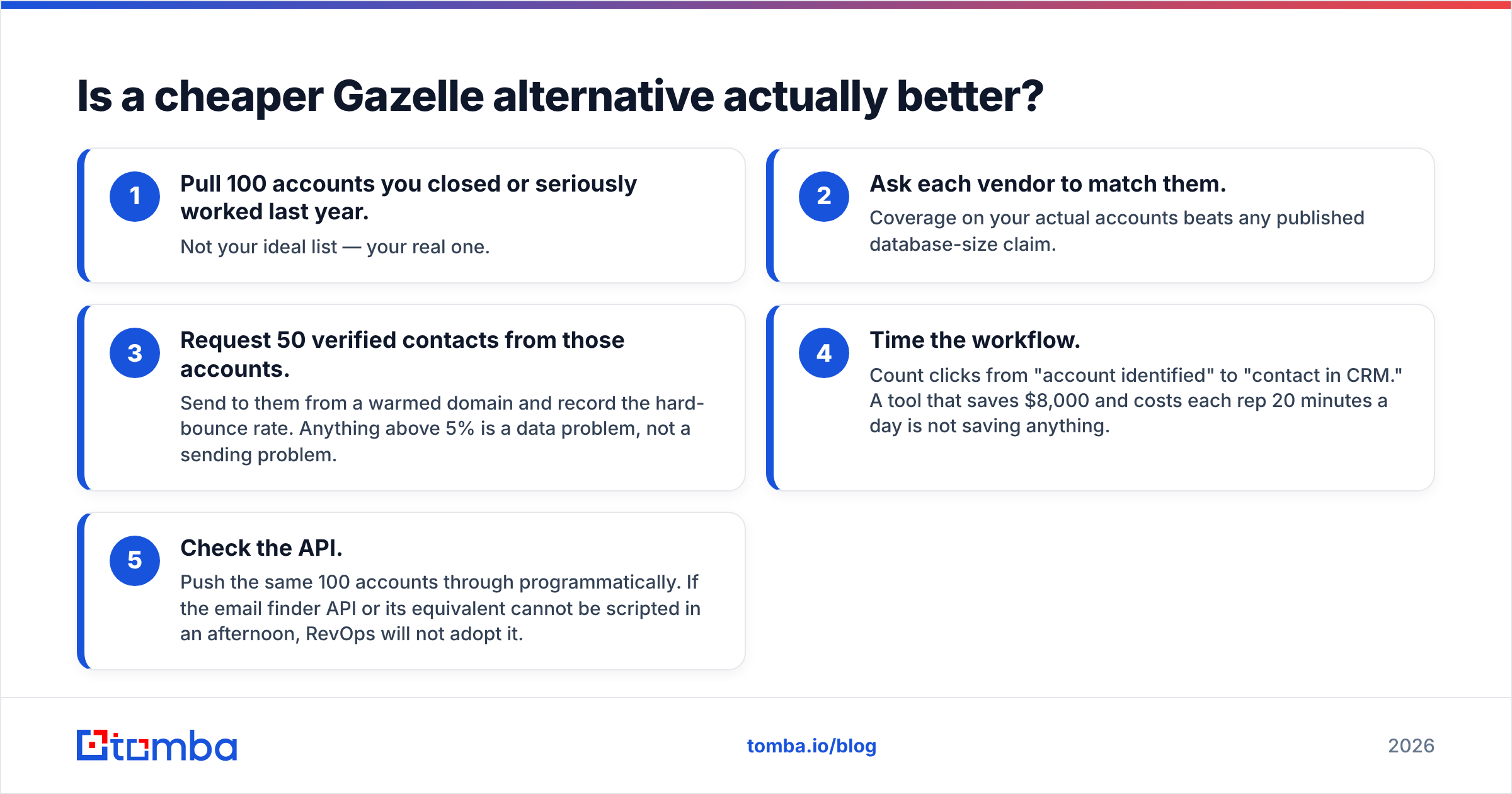
Cheaper is better only if the cheaper tool covers the job you are paying for. Run this test before you switch:
- Pull 100 accounts you closed or seriously worked last year. Not your ideal list — your real one.
- Ask each vendor to match them. Coverage on your actual accounts beats any published database-size claim.
- Request 50 verified contacts from those accounts. Send to them from a warmed domain and record the hard-bounce rate. Anything above 5% is a data problem, not a sending problem.
- Time the workflow. Count clicks from "account identified" to "contact in CRM." A tool that saves $8,000 and costs each rep 20 minutes a day is not saving anything.
- Check the API. Push the same 100 accounts through programmatically. If the email finder API or its equivalent cannot be scripted in an afternoon, RevOps will not adopt it.
Run that on a two-week trial and the ranking becomes obvious without a single vendor deck.
How do you migrate off Gazelle without losing pipeline?#
- Export before renewal, not after. Confirm in writing what data you retain post-contract.
- Freeze your ICP definition. Migrations fail when teams change targeting and tooling at the same time — you lose the ability to attribute the drop.
- Re-verify everything you import. Records that sat in a CRM for six months decay at roughly 2–3% per month. Run a bulk verify pass on the whole export before anyone sends.
- Keep one signal source. Do not go to zero on intelligence. Even a $49/seat Crunchbase license preserves the "who is growing" input.
- Run parallel for 30 days. Overlap the contracts by a month. It costs one extra invoice and prevents an empty pipeline quarter.
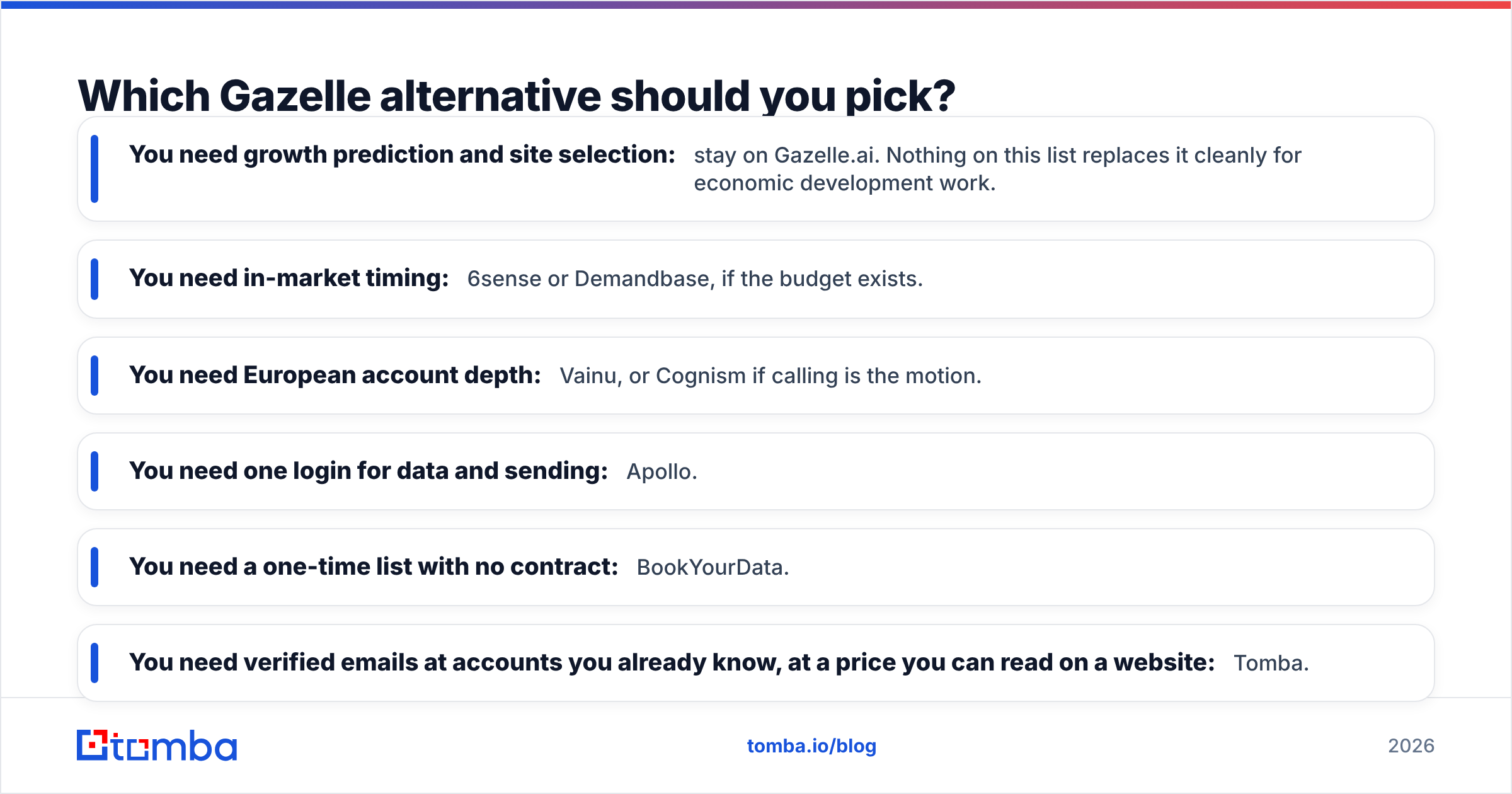
Which Gazelle alternative should you pick?#
- You need growth prediction and site selection: stay on Gazelle.ai. Nothing on this list replaces it cleanly for economic development work.
- You need in-market timing: 6sense or Demandbase, if the budget exists.
- You need European account depth: Vainu, or Cognism if calling is the motion.
- You need one login for data and sending: Apollo.
- You need a one-time list with no contract: BookYourData.
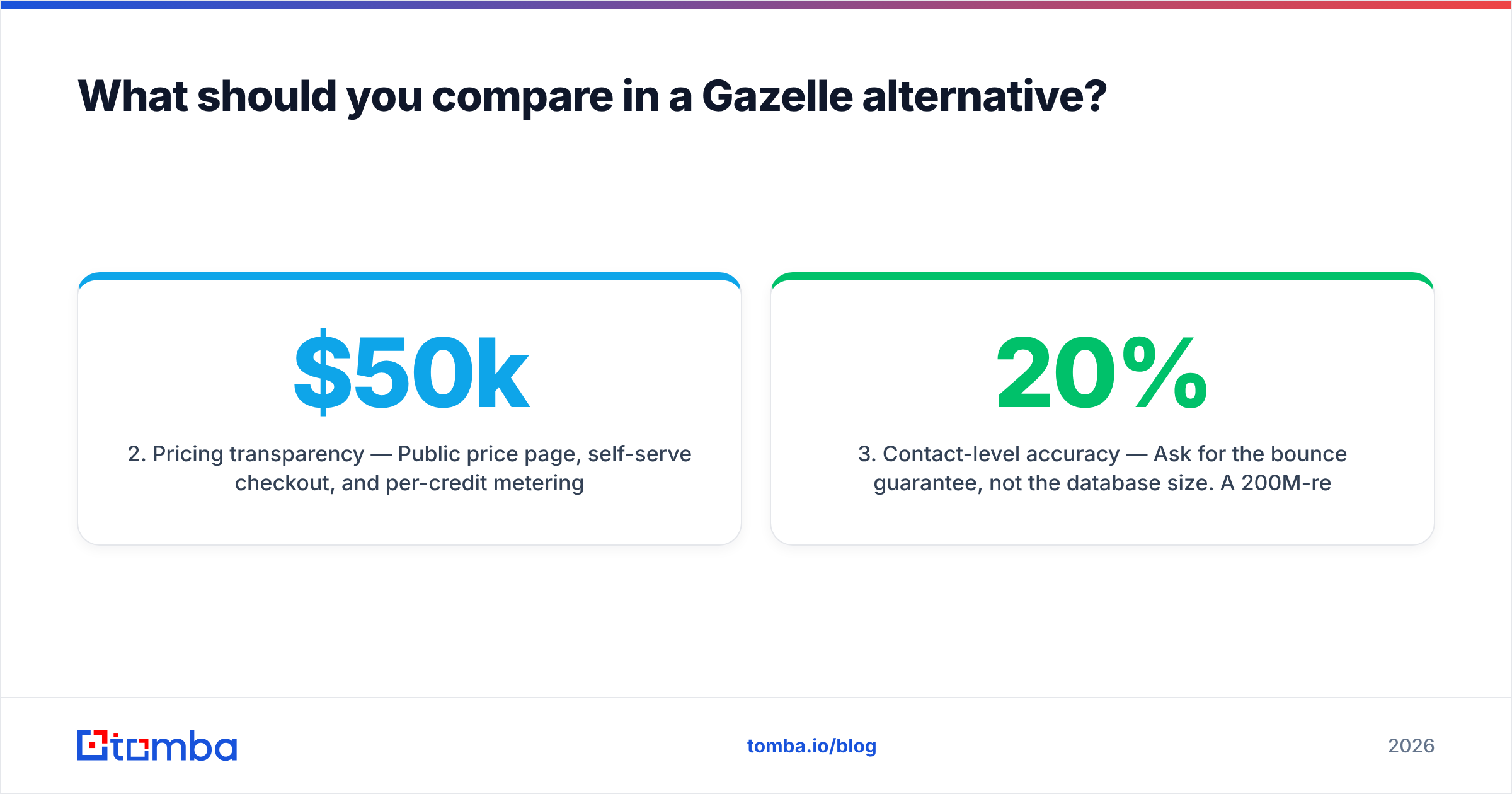
- You need verified emails at accounts you already know, at a price you can read on a website: Tomba.
Most teams reading this fall into that last bucket and did not realize it. If your reps can name the 400 accounts that matter and still cannot reach the buyers inside them, you do not have an intelligence problem — you have a contact-data problem, and it costs a fraction as much to fix.
Start with the Tomba Email Finder. The free tier gives you 25 searches a month with no card, which is enough to test coverage against your own account list before you commit to anything. Paid plans begin at $49/mo, credits are metered rather than seat-locked, and every result runs through the same verification layer — so what lands in your sequence is what actually lands in an inbox.
Related guides#
Ready to find emails that actually work?
Join 150,000+ professionals who stopped guessing and started sending. Free credits on signup — no credit card required.
Get the Tomba newsletter
Practical outbound tactics and product updates — once every two weeks.
About the author