Gazelle.ai Pricing, Reviews, Pros and Cons (2026 Review)
Gazelle.ai pricing is hidden behind a demo call. Here's what buyers actually report paying, what reviewers praise and complain about, and when a cheaper contact-data stack does the same job.
TL;DR
- Gazelle.ai pricing is quote-only. There is no public price page. Deals run through a demo, and reported annual contracts range from four to five figures.
- The real strength is growth prediction, not contact data. Reviewers praise the signals. They flag the contact records as weak.
- It is built for economic development groups, site selectors, and investment teams. A standard B2B sales team pays for a use case it does not have.
- The fair comparison is Gazelle.ai versus a signal source plus a cheap contact tool. That stack often costs a fifth as much.
- Get the renewal price, the seat overage rate, and the export cap in writing. Those three lines cause most buyer regret.
What is Gazelle.ai?#
Gazelle.ai is an AI company intelligence platform. It scores and ranks businesses by how likely they are to grow, expand, or invest in a new site. Most B2B tools ask who works at a company. Gazelle.ai asks a different question: which companies are about to spend big money, and where?
That framing explains the pricing and the reviews.
The core audience is economic development groups, investment agencies, chambers of commerce, and site-selection consultants. Their job is to win a new plant for their region. It is not to book 40 calls a month. Gazelle.ai blends financial data, hiring signals, news, and ownership data into a growth score. It then surfaces companies that look ready to move.
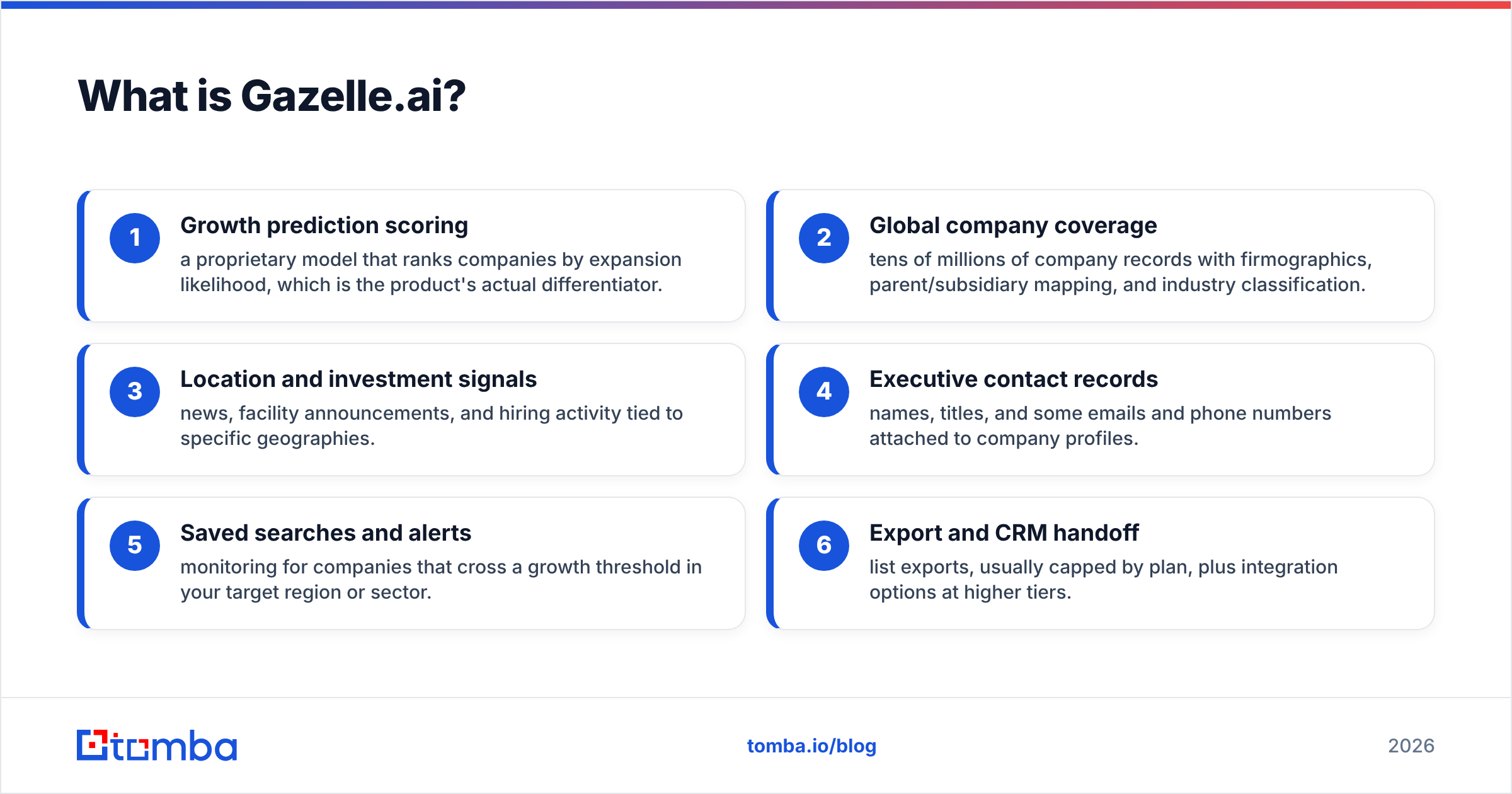
You can see the current positioning on the official Gazelle.ai site. The feature set usually includes:
- Growth prediction scoring — a model that ranks companies by how likely they are to expand. This is the real differentiator.
- Global company coverage — tens of millions of company records, with firm details, parent and subsidiary links, and industry codes.
- Location and investment signals — news, plant announcements, and hiring tied to a place.
- Executive contact records — names, titles, and some emails and phone numbers.
- Saved searches and alerts — a ping when a company crosses a growth threshold in your region.
- Export and CRM handoff — list exports, usually capped by plan, plus integrations at higher tiers.
Read that list again. Items 1 to 3 are the product. Item 4 is a bonus, and it behaves like one.
Gazelle.ai pricing in 2026: how much does it cost?#
Gazelle.ai pricing is not published anywhere. There is no self-serve checkout, no starter tier, and no free plan. You book a demo, a rep scopes your use case, and you get a quote.
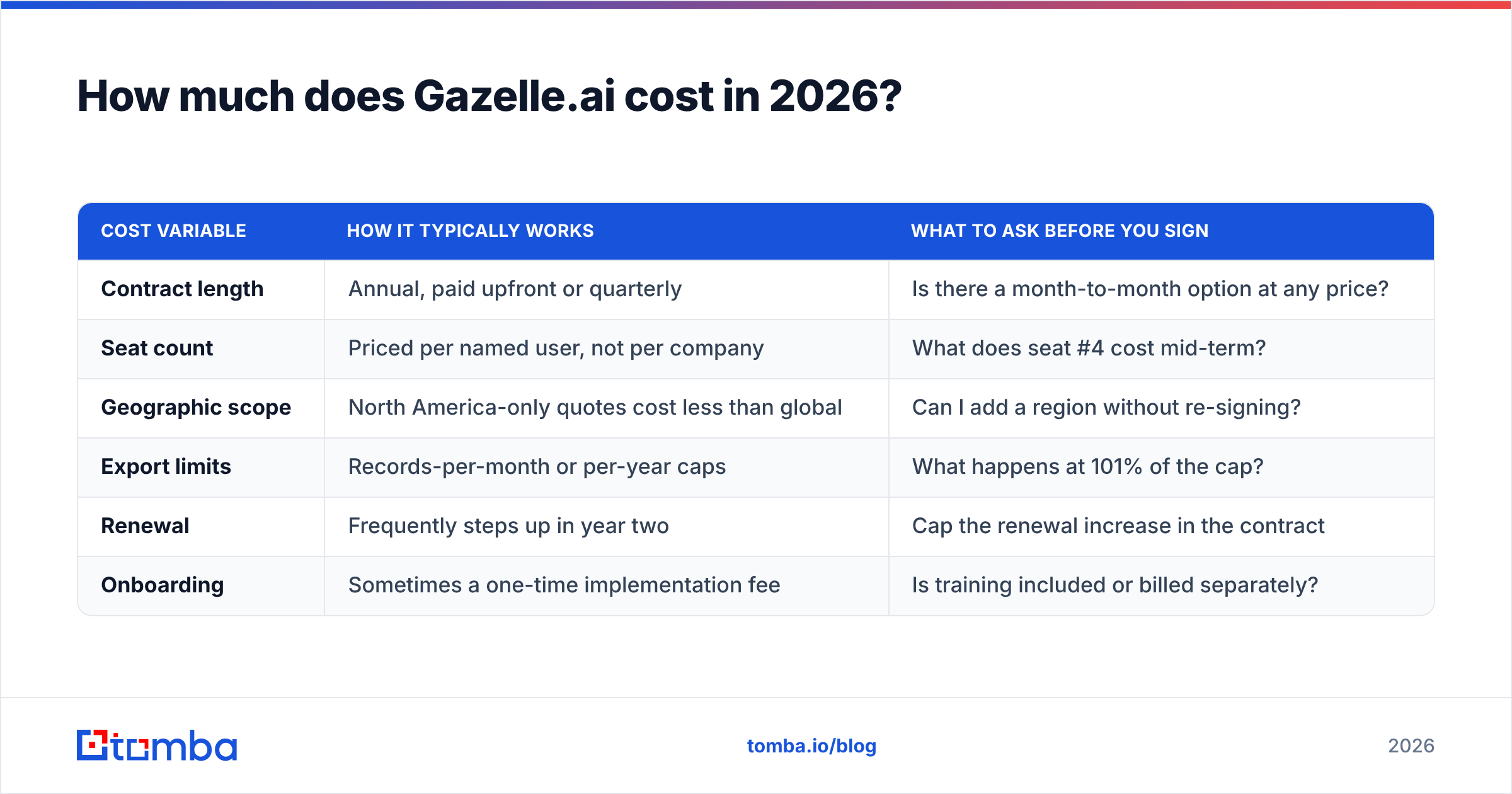
Here is what buyers can expect. These are directional numbers based on how quote-only data vendors sell, not vendor-confirmed figures. Get every line in writing.
| Cost variable | How it typically works | What to ask before you sign |
|---|---|---|
| Contract length | Annual, paid upfront or quarterly | Is there a month-to-month option at any price? |
| Seat count | Priced per named user, not per company | What does seat #4 cost mid-term? |
| Geographic scope | North America-only quotes cost less than global | Can I add a region without re-signing? |
| Export limits | Records-per-month or per-year caps | What happens at 101% of the cap? |
| Renewal | Frequently steps up in year two | Cap the renewal increase in the contract |
| Onboarding | Sometimes a one-time implementation fee | Is training included or billed separately? |
Across quote-only company data platforms, buyers report a low four-figure annual minimum. That covers one seat and one region. Multi-seat global deals with API access climb into the mid five figures. Gazelle.ai pricing sits inside that band. If a quote lands far outside it, ask what was added or removed.
Two things shape quote-only pricing.
You are priced on your budget, not your usage. A public agency with a grant-funded data budget gets a different number than a 12-person startup. That is not a scandal. It is how enterprise data sales works. It also means the first number you hear is rarely the last one on offer.
The demo is the paywall. You cannot check fit, sector coverage, or contact quality without a call. Often you sign a trial agreement first. Compare that with a tool that has transparent published pricing, where you can test 25 records before you talk to anyone. That gap in friction is the point.
What do Gazelle.ai reviews actually say?#
Review volume is thin next to mass-market sales tools. You will find a modest number of entries on G2 and Capterra, not thousands. Low volume is normal for a niche product with a few hundred customers. It does mean you should weigh each review with care. Ask the rep for two reference customers in your exact segment.
Here are the themes that repeat.
Praised often: the growth model finds companies teams would have missed. The interface is clean, and non-technical staff pick it up fast. Support is responsive and human. The global coverage really does reach beyond the US.
Criticized often: contact data is stale or thin for smaller firms. Executive emails bounce or belong to people who left. Pricing feels opaque, and renewal talks get tense. Export limits bite sooner than expected. Some regional and small-business coverage is thinner than the demo suggests.
That split is the most useful thing in this review. Nobody says the growth signals are bad. Plenty of people say they could not reach the person the signal pointed to.
What are the pros of Gazelle.ai?#
The growth score is a real differentiator. Most B2B databases sell you a filter on static data: industry, headcount, revenue band. Gazelle.ai sells a forecast instead. If your job is to catch a company before it announces a plant, that is a different product. Cheap contact tools do not replace it.
Coverage outside the US is real. Many databases that claim global reach are 80% North America with a thin European tail. Gazelle.ai grew up in investment attraction, so non-US records are a first-class concern.
Parent-subsidiary mapping is unusually good. Knowing that a mid-size plant belongs to a large parent changes who you call. That hierarchy data is hard to build, and Gazelle.ai has invested in it.
Human account management. A quote-only deal buys you a named contact. Public-sector teams with reporting duties and non-technical users get real value from that.
Purpose-built reporting. Outputs are shaped for board and council presentations. If that is your world, it saves hours.
What are the cons of Gazelle.ai?#
Contact data is the weak link. It is also the part most teams need daily. A growth signal without a reachable decision-maker is a research note, not a pipeline. If your work ends in an email or a call, you will bolt on a dedicated email verifier or finder. That means paying twice.
Opaque pricing slows evaluation. No free tier. No public numbers. No way to sanity-check the budget before a sales cycle. If you must prove ROI in a quarter, a two-week procurement dance is a real cost.
Wrong shape for standard B2B sales teams. If you sell software to marketing directors, plant announcements do not help you. You pay a premium for a forecast engine tuned to someone else's problem.
Export caps limit outbound volume. The model assumes you chase a few high-value targets with care. It does not assume a 5,000-contact sequence. That fits an agency. It does not fit a growth team.
Annual lock-in. Quote-only almost always means yearly. If coverage in your niche is thin, you learn that in month two and pay through month twelve.
How does Gazelle.ai compare to other B2B data tools?#
The useful comparison is against the tools teams weigh alongside it. That means one signals platform, plus the contact tools people bolt on later.
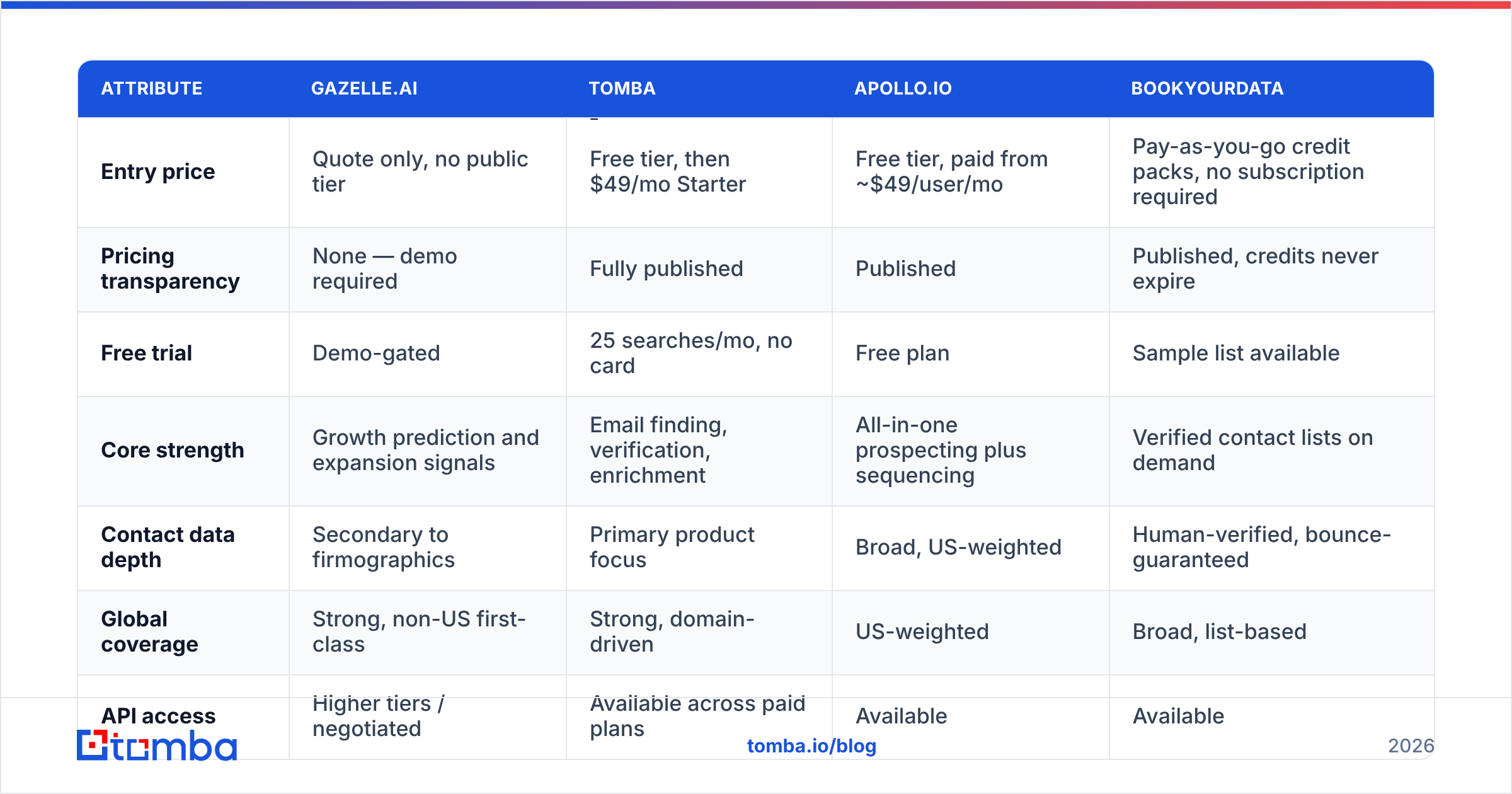
| Attribute | Gazelle.ai | Tomba | Apollo.io | BookYourData |
|---|---|---|---|---|
| Entry price | Quote only, no public tier | Free tier, then $49/mo Starter | Free tier, paid from ~$49/user/mo | Pay-as-you-go credit packs, no subscription required |
| Pricing transparency | None — demo required | Fully published | Published | Published, credits never expire |
| Free trial | Demo-gated | 25 searches/mo, no card | Free plan | Sample list available |
| Core strength | Growth prediction and expansion signals | Email finding, verification, enrichment | All-in-one prospecting plus sequencing | Verified contact lists on demand |
| Contact data depth | Secondary to firmographics | Primary product focus | Broad, US-weighted | Human-verified, bounce-guaranteed |
| Global coverage | Strong, non-US first-class | Strong, domain-driven | US-weighted | Broad, list-based |
| API access | Higher tiers / negotiated | Available across paid plans | Available | Available |
| Contract | Annual | Monthly or annual | Monthly or annual | No contract |
| Best fit | EDOs, site selection, investment attraction | Outbound teams that need reachable, verified contacts | SDR teams wanting data plus sequencing in one seat | Teams that want a clean list without a subscription |
BookYourData deserves a note. If your problem is a verified list with no recurring bill, its pay-as-you-go model solves that cleanly. It is a fair alternative to a subscription. It solves a different problem than Gazelle.ai, not a worse one.
Is Gazelle.ai worth it, or should you build a cheaper stack?#
Run the math before the demo, not after.
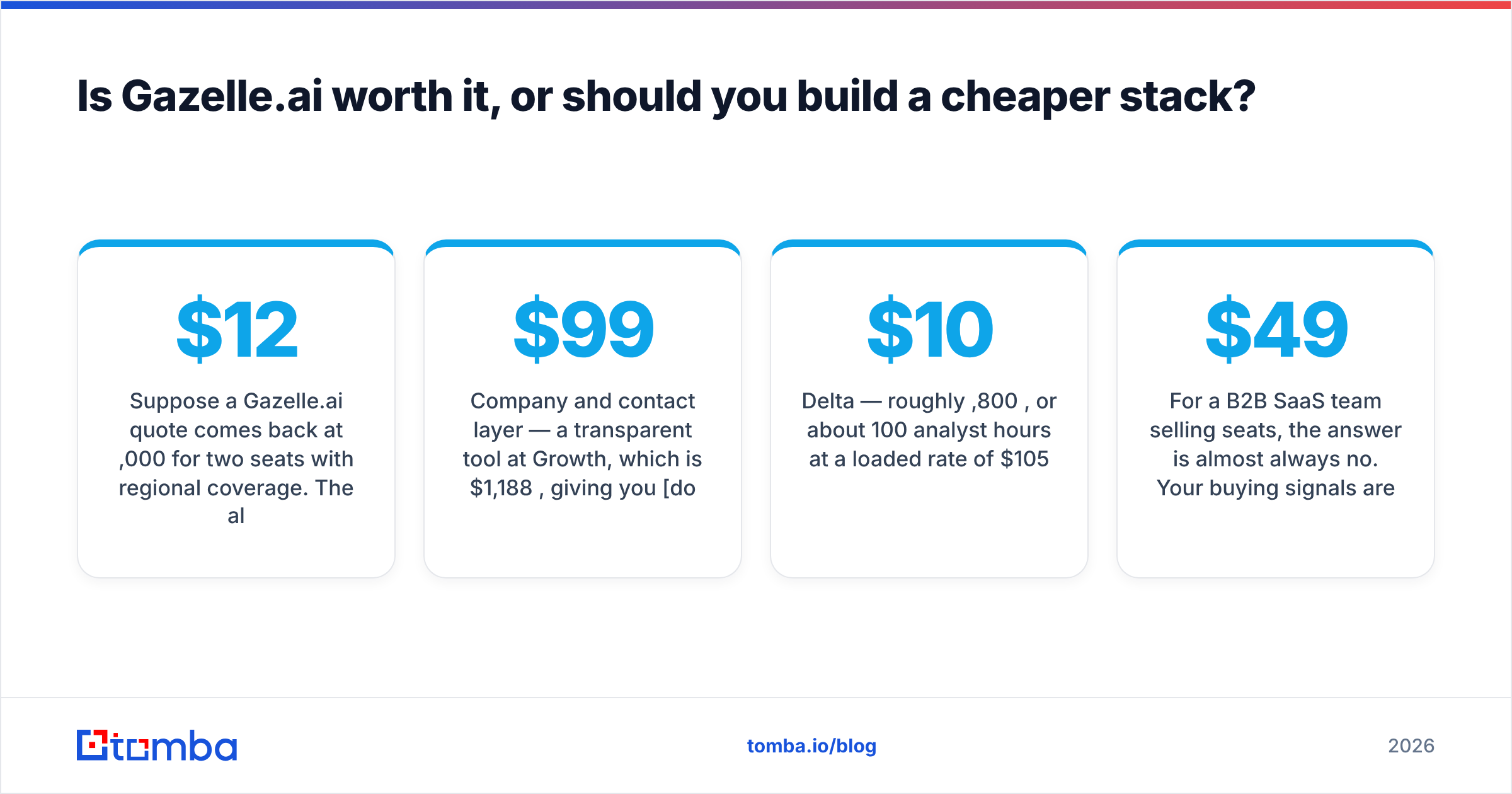
Say a Gazelle.ai pricing quote comes back at $12,000 a year for two seats and one region. The cheaper stack looks like this:
- Signals layer — free public sources: job boards, permit filings, trade press, and government investment news. Free, but it costs analyst hours.
- Company and contact layer — a transparent tool at $99/mo Growth, or $1,188 a year. You get domain search, verified emails, and data enrichment with no procurement cycle.
- Delta — about $10,800 a year. At a loaded rate of $105 an hour, that is 100 analyst hours.
So the real question is simple. Does the prediction model save your team more than 100 hours a year of manual signal hunting?
For a two-person agency covering a metro region, the answer is often yes. Tracking expansion signals by hand across thousands of companies is exactly the work the platform automates. One landed facility pays for a decade of the subscription.
For a B2B SaaS team selling seats, the answer is almost always no. Your buying signals are product usage, funding rounds, and hiring near your category. Those are cheaper and easier to see. What you need is volume of accurate, verified contacts. That is a $49–$99 per month problem, not a $12,000 a year one.
There is a middle case. Some teams want the signals but cannot live with the contact-data gap. If that is you, budget for both. Buy Gazelle.ai for targeting. Pair it with a verification layer so signals turn into conversations, not bounces. Just know that your true cost is the quote plus the fixer. Price the decision on that combined number.
What should you ask on the Gazelle.ai demo?#
Bring this list. It will save you a renewal argument in 18 months.
- Show me 20 companies in my sector and region, live. Not the curated demo account. Coverage claims hold up or collapse in four minutes of live filtering.
- What is the bounce rate on those executive emails? Ask for a number. If they will not give one, assume you buy the contact data as-is.
- What is the year-two renewal price, and can we cap the rise? Put the cap in the contract, not the email thread.
- What is the export cap, and what happens if we pass it? An overage rate or a hard stop are both survivable. Surprises are not.
- Can we exit at 90 days if coverage is thin? A short exit clause costs the vendor little and tells you a lot.
The bottom line#
Gazelle.ai is a good product with a narrow use case. Gazelle.ai pricing is the part that makes it hard to judge. If you attract investment, select sites, or grow a regional economy, the growth engine is worth the quote call. The contact-data gap is then a manageable annoyance. If you run outbound for a B2B company, you are buying a specialist tool for a job a general one does better and cheaper.
Either way, deals get made in the contact layer. That layer should be open, testable, and verified before it hits your sequencer. Start with the Tomba Email Finder. You get 25 free searches a month, no demo call, and no annual commitment. Pricing is published, from $49/mo, when you outgrow the free tier. Test it against the list your current platform hands you. Let the bounce rate settle the argument.
Related guides#
Ready to find emails that actually work?
Join 150,000+ professionals who stopped guessing and started sending. Free credits on signup — no credit card required.
Get the Tomba newsletter
Practical outbound tactics and product updates — once every two weeks.
About the author