Gazelle vs Apollo.io (2026): Which B2B Data Tool Wins?
Gazelle.ai and Apollo.io both sell B2B intelligence, but they answer different questions. One tells you which companies are about to expand; the other hands you 200M+ contacts and a sequencer. Here's which one earns your budget in 2026.
Gazelle vs Apollo.io comes down to one question: do you need to know which companies to chase, or how to reach the people inside them? Gazelle.ai answers the first. Apollo.io answers the second.
TL;DR
- Gazelle.ai is a company-intelligence platform, not a sales engagement tool. It predicts which companies are growing, expanding, or likely to invest. It was built for economic development organizations, site selectors, and investment attraction teams.
- Apollo.io is a go-to-market suite. You get a very large contact database plus sequencing, a dialer, CRM sync, and AI writing. It is built for SDRs who need to email 500 people this month.
- They barely overlap. Compare them feature for feature and Apollo looks like the winner. That is only because you are scoring a telescope against a hammer.
- Pricing works differently. Apollo lists per-seat tiers from about $49/user/mo (annual). Gazelle.ai quotes annual contracts and does not publish list prices.
- Neither is a great email-accuracy layer. Both ship stale contact records at scale. That is why most teams add a dedicated finder and verifier — like Tomba's email verifier — in front of their sending tool.
Gazelle vs Apollo.io: what are these two tools?#
Start here. The "Gazelle vs Apollo.io" search usually comes from someone who was handed both names in the same buying committee thread. They assume the two are substitutes. They are not.
Gazelle.ai is an AI-driven company intelligence platform. It covers millions of companies globally and leans hard on growth signals: which firms are hiring, expanding facilities, raising capital, or moving in ways that usually come before an investment decision.
Its main customers are economic development organizations (EDOs), investment promotion agencies, chambers of commerce, and commercial real estate or site selection teams. The core question it answers is "which companies should our region be talking to, and why now?"
Apollo.io is a sales execution platform. It pairs a contact and company database (Apollo advertises well over 200 million contacts and tens of millions of companies) with the tooling to act on it.
That tooling covers filters, list building, sequences, a dialer, email deliverability features, meeting booking, CRM enrichment, and AI-assisted copy. The question it answers is "who do I email today, and how do I run the whole cadence without leaving one tab?"
So the honest framing is not "which is better." It is this: are you buying a targeting brain or an outbound engine?
Gazelle vs Apollo.io: how do they compare head-to-head?#
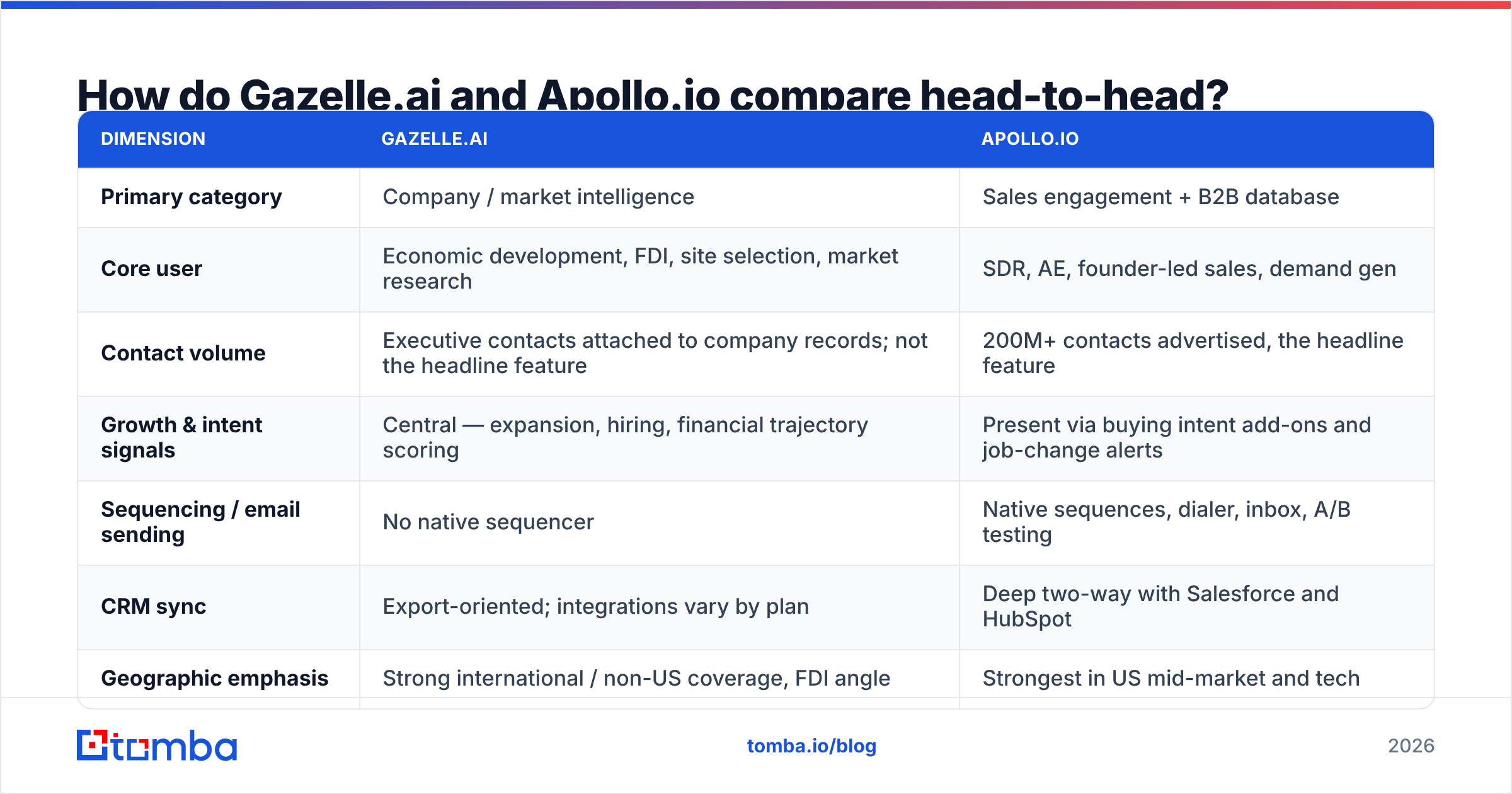
| Dimension | Gazelle.ai | Apollo.io |
|---|---|---|
| Primary category | Company / market intelligence | Sales engagement + B2B database |
| Core user | Economic development, FDI, site selection, market research | SDR, AE, founder-led sales, demand gen |
| Contact volume | Executive contacts attached to company records; not the headline feature | 200M+ contacts advertised, the headline feature |
| Growth & intent signals | Central — expansion, hiring, financial trajectory scoring | Present via buying intent add-ons and job-change alerts |
| Sequencing / email sending | No native sequencer | Native sequences, dialer, inbox, A/B testing |
| CRM sync | Export-oriented; integrations vary by plan | Deep two-way with Salesforce and HubSpot |
| Geographic emphasis | Strong international / non-US coverage, FDI angle | Strongest in US mid-market and tech |
| Pricing transparency | Quote-based annual contracts, no public list price | Public per-seat tiers plus a free plan |
| Free tier | No self-serve free tier | Yes, with limited monthly credits |
| Learning curve | Analyst-style, report-heavy | Rep-friendly, list-and-send in minutes |
Look at rows 3, 5, and 8 together and the decision usually resolves itself. If your bottleneck is "we don't know which accounts deserve attention," Gazelle's scoring earns its keep. If it is "we know the accounts, we just can't reach anyone," Apollo's volume and sequencer is the cheaper fix.

What does Gazelle.ai actually do well?#
- Expansion and investment prediction. Gazelle scores companies on growth and on how likely they are to expand into new markets. You do not assemble the signals yourself. For an EDO justifying a trade mission, that scoring is the product.
- International coverage where US-centric tools thin out. Databases built for American SaaS sales get sparse in Southeast Asia, the Gulf, francophone Africa, or Central Europe. Gazelle grew up in foreign direct investment, so its non-US records are usually more complete.
- Analyst-grade company profiles. Financials, employee trend lines, parent and subsidiary structure, facility footprint. That is what a research analyst needs to write a one-pager on a target. It is not what an SDR needs to write a subject line.
- Defensible target lists for stakeholders. When a board or a ministry asks "why these 40 companies," a signal-scored list survives the question. A filter query on job title does not.
- Low-volume, high-value workflows. Gazelle fits teams chasing dozens of relationships worth millions each, not thousands worth $500 each.
Where it falls short for a normal sales team is just as clear. There is no sequencer, no dialer, and no deliverability tooling. Contact-level email data is not the center of the platform. You will export the list and work it somewhere else.
What does Apollo.io actually do well?#
- Volume and speed. Build a filtered list of 2,000 contacts, push it into a sequence, and start sending the same afternoon. Gazelle is not shaped to do this.
- All-in-one economics. For a small team, one Apollo seat can replace a database subscription, a sequencer, and a dialer. That bundling is the real reason Apollo grew so fast — scan the review volume on G2 and the pattern is obvious.
- CRM enrichment. Two-way sync with Salesforce and HubSpot updates fields automatically, so the CRM does not rot between quarters.
- A genuinely usable free tier. You can test data quality on your own ICP before you spend anything. That is rare in this category, so use it during evaluation.
- AI help that is actually wired in. Copy suggestions, account research summaries, and scoring sit in the same workflow instead of a separate tab.
Its weaknesses are just as well documented by users. Data freshness swings by segment. Bounce rates on unverified exports can embarrass a new domain. Non-US coverage is patchy. Per-seat pricing adds up fast once you hire. If those tradeoffs bother you, our breakdown of Apollo alternatives covers the tools people migrate to and why.
Which one has better data coverage and accuracy?#
Different axes, so answer it in two parts.
Breadth of contacts: Apollo, easily. Hundreds of millions of contact records beat a platform whose contact layer hangs off company intelligence. If you need 5,000 VP Ops emails in North America this quarter, Gazelle is the wrong tool.
Depth per company: Gazelle, easily. Financial trajectory, facility data, ownership structure, and expansion signals are not fields Apollo tries to own at that depth.
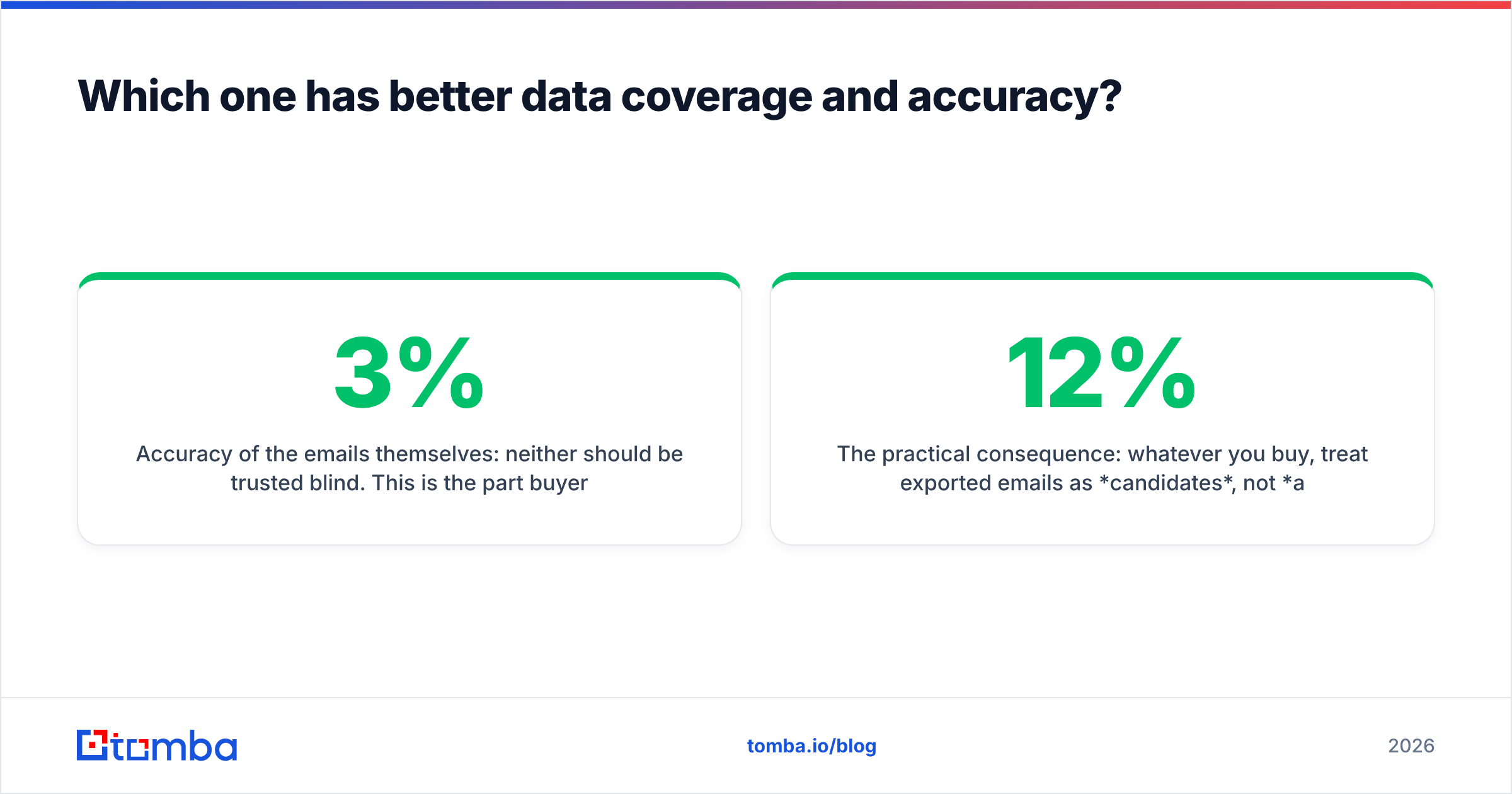
Accuracy of the emails themselves: trust neither one blind. Buyers underrate this part. Large aggregated databases decay about 2–3% a month as people change roles. That is 25–30% of a list rotting every year, and it hits every vendor in the category. A record that was right when it was scraped is wrong when you export it eleven months later.
So treat exported emails as candidates, not addresses. Verify them before they touch your sending domain. One campaign that bounces at 12% can cost more in sender reputation than a year of subscription savings.

Gazelle vs Apollo.io: how does pricing compare?#
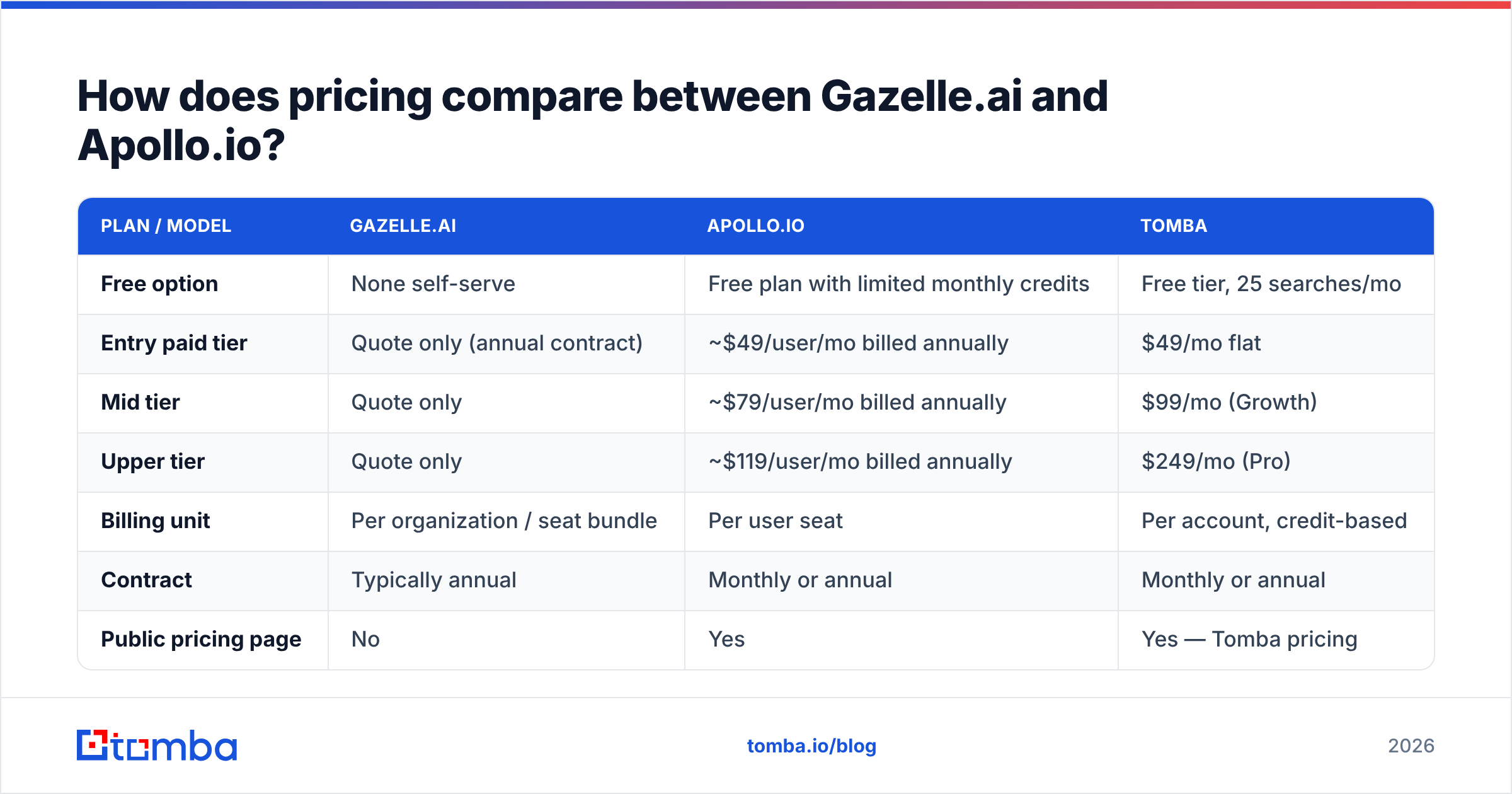
| Plan / model | Gazelle.ai | Apollo.io | Tomba |
|---|---|---|---|
| Free option | None self-serve | Free plan with limited monthly credits | Free tier, 25 searches/mo |
| Entry paid tier | Quote only (annual contract) | ~$49/user/mo billed annually | $49/mo flat |
| Mid tier | Quote only | ~$79/user/mo billed annually | $99/mo (Growth) |
| Upper tier | Quote only | ~$119/user/mo billed annually | $249/mo (Pro) |
| Billing unit | Per organization / seat bundle | Per user seat | Per account, credit-based |
| Contract | Typically annual | Monthly or annual | Monthly or annual |
| Public pricing page | No | Yes | Yes — Tomba pricing |
Apollo's published figures move, and monthly billing runs higher than the annual rates above. Confirm on the vendor page before you budget.
The structure matters more than the exact numbers: Apollo charges per seat, Gazelle charges per contract, and credit-based finders charge per lookup. A five-person SDR pod on Apollo's upper tier costs far more than the sticker suggests. A credit-based email finder costs the same whether two people use it or twenty.
Gazelle's missing price page is not a red flag. It is normal for platforms sold to institutional buyers with procurement cycles. It does mean you cannot self-serve, cannot trial without a sales conversation, and cannot easily compare cost per record against a self-serve competitor.
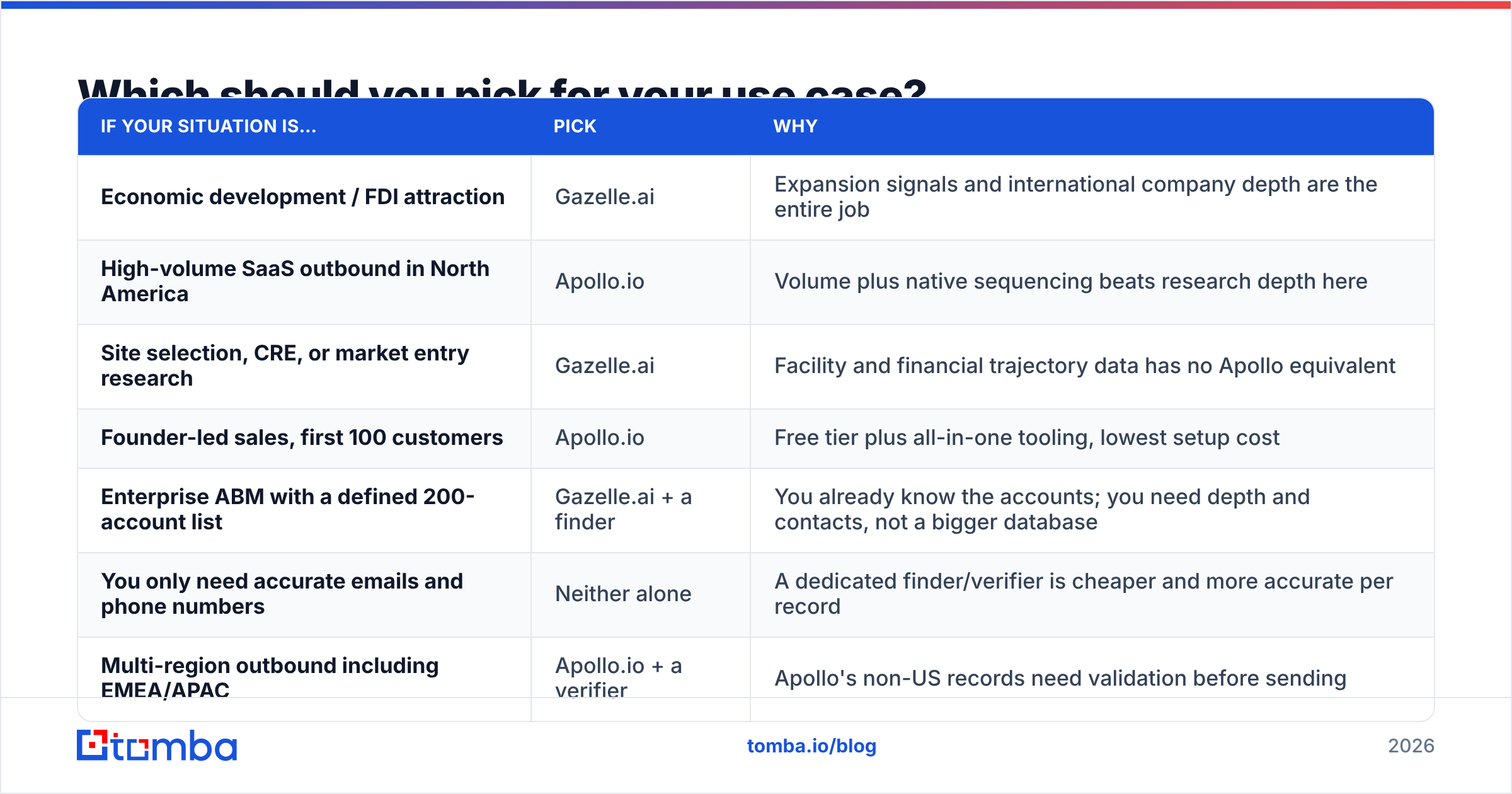
Which should you pick for your use case?#
| If your situation is… | Pick | Why |
|---|---|---|
| Economic development / FDI attraction | Gazelle.ai | Expansion signals and international company depth are the entire job |
| High-volume SaaS outbound in North America | Apollo.io | Volume plus native sequencing beats research depth here |
| Site selection, CRE, or market entry research | Gazelle.ai | Facility and financial trajectory data has no Apollo equivalent |
| Founder-led sales, first 100 customers | Apollo.io | Free tier plus all-in-one tooling, lowest setup cost |
| Enterprise ABM with a defined 200-account list | Gazelle.ai + a finder | You already know the accounts; you need depth and contacts, not a bigger database |
| You only need accurate emails and phone numbers | Neither alone | A dedicated finder/verifier is cheaper and more accurate per record |
| Multi-region outbound including EMEA/APAC | Apollo.io + a verifier | Apollo's non-US records need validation before sending |
That sixth row is where budget gets wasted. Teams buy a $12,000 intelligence platform because they need email addresses. By month two, the intelligence features go unused.
Where do both platforms leave gaps?#
Three gaps show up in both tools. Plan around them before you sign anything.
- Verification is an afterthought. Neither platform promises that an address will not bounce. Apollo offers verification signals, but exported lists still bounce at rates that spook new domains. Gazelle is not in the deliverability business at all. If you send at volume, run exports through a dedicated email verifier — including proper catch-all verification, which is where most naive checkers quietly guess.
- Catch-all and role-based addresses inflate your "valid" counts. A domain set to accept all mail returns "deliverable" for anything. Tools that ignore catch-alls report a clean list that bounces in production.
- Neither is a single source of truth. Gazelle knows the company. Apollo knows the contact. Your CRM knows the relationship. Something has to reconcile them. That is a data enrichment job, and treating it as one from day one saves a painful cleanup later.
The Gazelle vs Apollo.io choice is really a stack question. Efficient teams run three layers. One intelligence layer (Gazelle, intent data, or your own research) decides who. One contact layer (a finder plus a verifier) works out how to reach them. One execution layer (Apollo, Instantly, Smartlead, or your sequencer of choice) sends. Collapsing all three into one vendor is how you end up paying $2,000 a month with a 14% bounce rate.
Is there a middle path between the two?#
Yes, and it costs less than either.
If what you really need is "find and verify work email addresses at a specific set of companies," you do not need Gazelle's prediction engine or Apollo's dialer. You need accurate contact discovery, nothing more. That is a $49/month problem, not a $12,000/year one.
In practice: keep whatever already tells you which accounts matter — a hand-built list from LinkedIn, a conference attendee sheet, or your own website visitors. Then run domain search against those companies to pull the right people. Verify before sending. Push the clean records into the sequencer you already pay for. You keep Apollo's execution value if you have it, and you skip paying twice for a database you use for one field.
Gazelle vs Apollo.io: the verdict#
Gazelle.ai wins if your job is deciding which companies to pursue, especially outside the US, and especially when the answer has to survive a stakeholder challenge. It is a research instrument sold to institutional buyers, and it is good at that.
Apollo.io wins if your job is contacting a lot of people fast, you sell in the US, and you would rather have one tool at 80% than four at 95%. Test the free tier against your real ICP first. Data quality swings by segment, and your segment is the only one that counts.
Neither wins on email accuracy alone, which is the input every downstream metric depends on. Layer verification in either way.
If contact accuracy is the real constraint on your pipeline, start with the Tomba Email Finder. The free tier gives you 25 searches a month to test on companies you already know. Starter runs $49/mo flat rather than per seat. Every result passes through the same verification and catch-all logic before it reaches your sequencer, so the addresses you paid an intelligence platform to identify actually land in an inbox.
Related guides#
Ready to find emails that actually work?
Join 150,000+ professionals who stopped guessing and started sending. Free credits on signup — no credit card required.
Get the Tomba newsletter
Practical outbound tactics and product updates — once every two weeks.
About the author