Gazelle vs Oceanio: Which B2B Data Platform Wins in 2026?
Gazelle vs Oceanio: both promise better-fit accounts from AI-driven company data, but they solve different jobs. Here is how coverage, contact quality and pricing compare in 2026.
Gazelle vs Oceanio is a common shortlist for B2B teams buying company data in 2026. Both tools sell AI-driven account discovery. Both are quote-based. But they answer two different questions.
TL;DR
- Gazelle (gazelle.ai) tracks company growth and expansion. It suits economic development agencies, site-selection consultants and commercial real estate teams.
- Ocean.io does lookalike search. Feed it your best customers. It returns similar companies, plus firmographic and technographic filters.
- Neither one publishes a price list. Both sell annual contracts with seat minimums. Expect a demo first.
- Neither one is an email finder. If you send outbound email, you still need a finder and a verifier.
- Pick Gazelle if growth events define a good account. Pick Ocean.io if your customer list does. Either way, add a cheap contact layer on top.
Gazelle vs Oceanio: what does each tool do?#
People lump the two into one bucket: "AI company data platforms." That hides the real split.
Gazelle answers one question. Which companies are growing, investing, hiring or moving into my region right now? It scores each company on growth and expansion. Economic development groups and site-selection consultants lean on it hard. They need to know which plant is about to double in size. The data is company-level: sites, subsidiaries, growth signals, industry codes. Person-level records are thin.
Ocean.io answers a different one. Who else looks like my best customers? You upload a customer list or a few seed domains. The tool ranks lookalike companies by how close they are. It reads website copy and firmographics, not just SIC codes. It fits the classic sales stack: build a list, push it to HubSpot, run outbound.
So the honest way to frame Gazelle vs Oceanio is not "whose data is better." It is "whose idea of a good account matches how you sell."
Gazelle vs Oceanio: how do they compare head-to-head?#
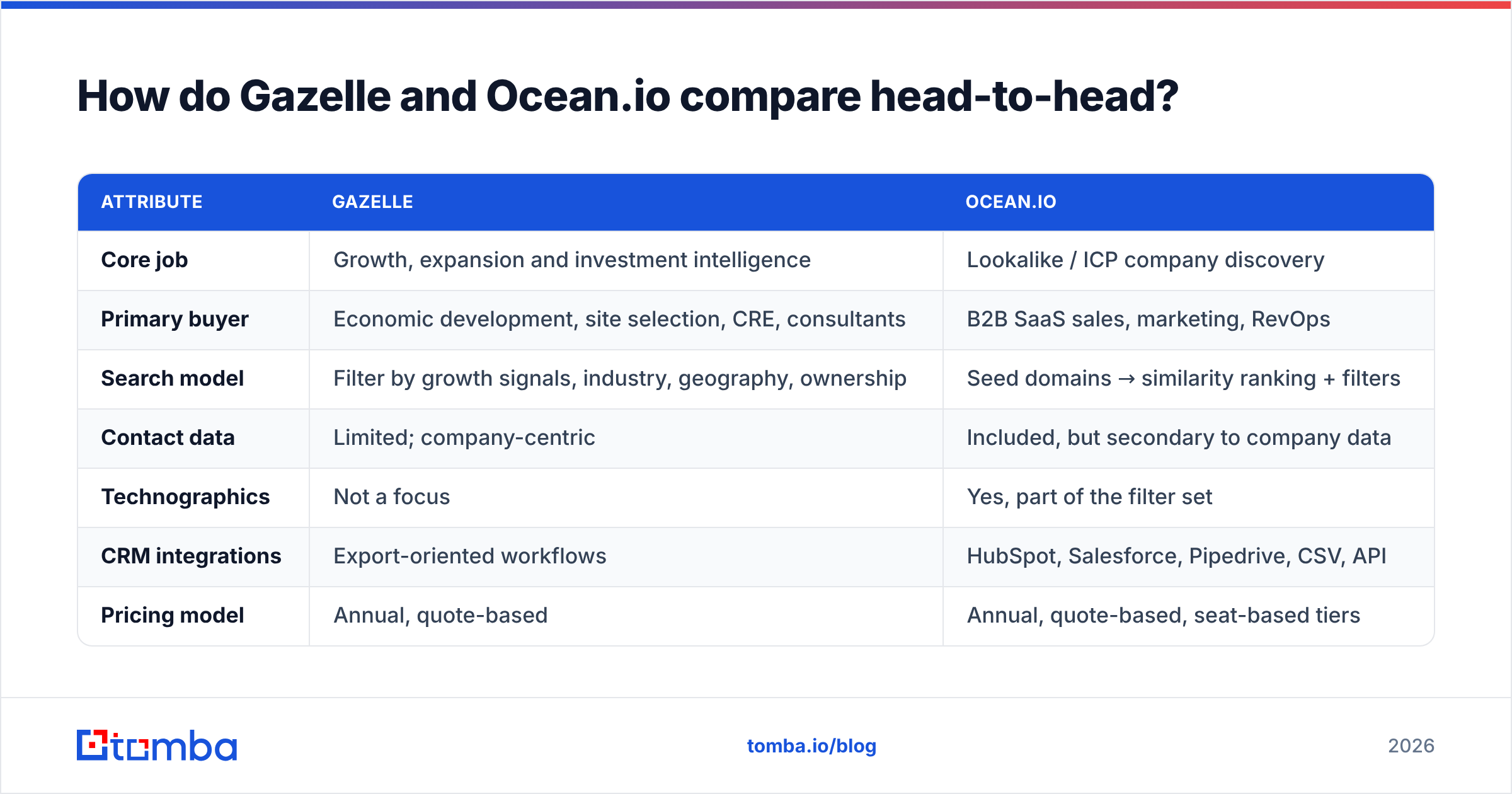
| Attribute | Gazelle | Ocean.io |
|---|---|---|
| Core job | Growth, expansion and investment intelligence | Lookalike / ICP company discovery |
| Primary buyer | Economic development, site selection, CRE, consultants | B2B SaaS sales, marketing, RevOps |
| Search model | Filter by growth signals, industry, geography, ownership | Seed domains → similarity ranking + filters |
| Contact data | Limited; company-centric | Included, but secondary to company data |
| Technographics | Not a focus | Yes, part of the filter set |
| CRM integrations | Export-oriented workflows | HubSpot, Salesforce, Pipedrive, CSV, API |
| Pricing model | Annual, quote-based | Annual, quote-based, seat-based tiers |
| Free self-serve tier | No | No (demo-gated trial) |
| Typical time-to-value | Weeks (analyst-led research) | Days (list build → sequence) |
Two things stand out.
First, both are demo-gated. You cannot sign up, run ten searches and decide. That cost is real. It is two calls, a security review and a procurement cycle before you know if the data covers your market.
Second, contact data is a side dish on both menus. That is fine for account research or ABM ads. It is a real problem if you send 300 cold emails a week.
Gazelle vs Oceanio: what data do you actually get?#
Here is what lands in your CSV.
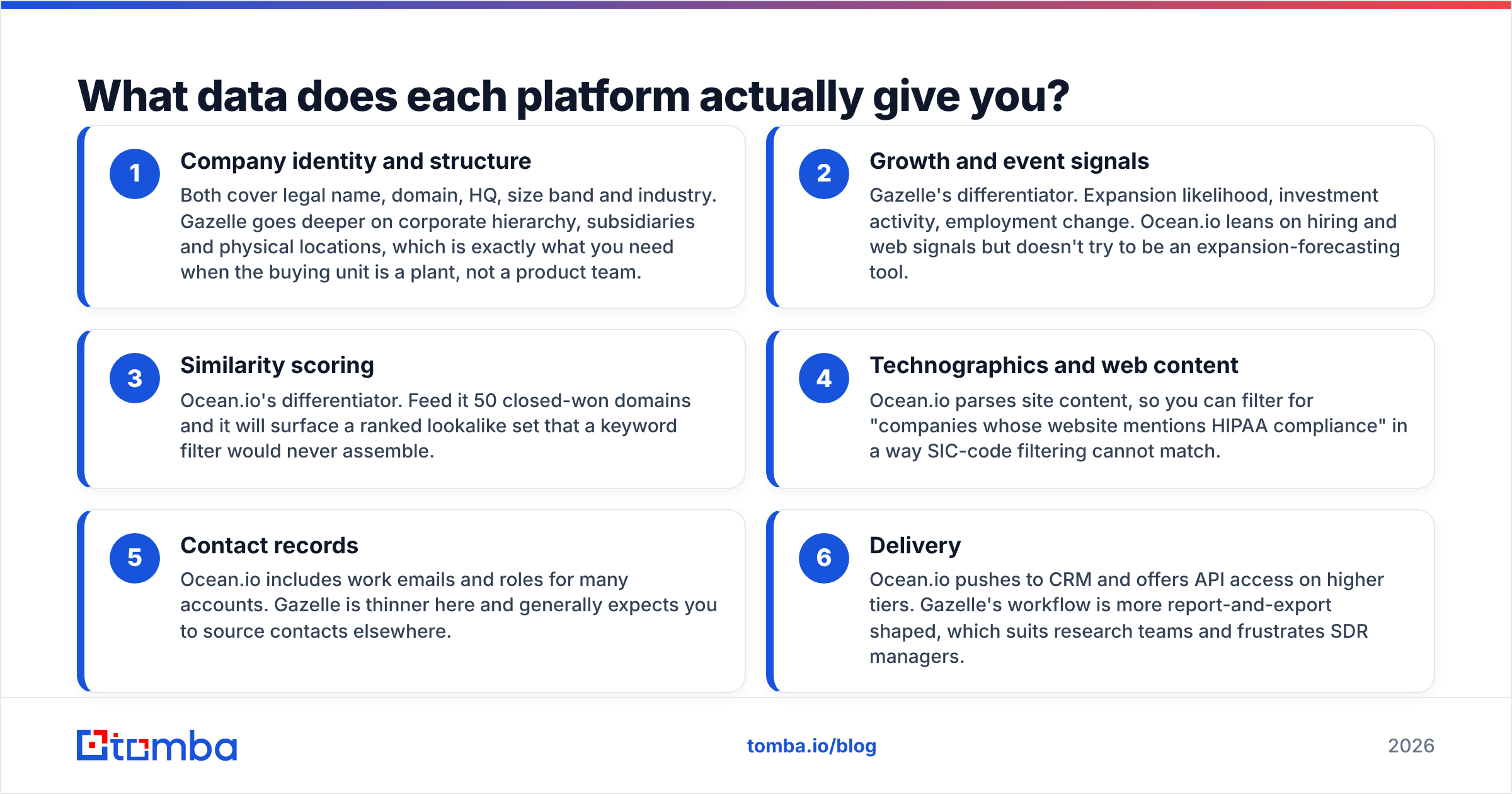
- Company identity — Both cover name, domain, HQ, size band and industry. Gazelle goes deeper on parent-child structure and physical sites. That matters when the buyer sits in a plant, not a product team.
- Growth signals — Gazelle's edge. Expansion odds, investment activity, headcount change. Ocean.io reads hiring and web signals, but it does not forecast expansion.
- Similarity scoring — Ocean.io's edge. Feed it 50 closed-won domains. You get a ranked lookalike set that no keyword filter would build.
Three more points decide the day-to-day fit.
- Technographics and site content — Ocean.io reads website copy. You can filter for firms whose site mentions HIPAA. SIC codes cannot do that.
- Contact records — Ocean.io ships work emails and roles for many accounts. Gazelle is thin here and expects you to source contacts elsewhere.
- Delivery — Ocean.io pushes to your CRM and opens an API on higher tiers. Gazelle is report-and-export shaped. Research teams like that. SDR managers do not.
A simple model: Gazelle is a research desk, Ocean.io is a list builder. Neither is a contact database in the way an outbound team means the phrase.
Gazelle vs Oceanio: which one finds better-fit accounts?#
It comes down to one thing. Is your ICP describable or demonstrable?
Describable ICP. You can write it down. "US manufacturers, 200 to 2,000 staff, adding capacity, in these six states." That is Gazelle turf. Filters plus growth signals beat similarity scoring when the rules are clear.
Demonstrable ICP. You cannot say why your best 40 customers are your best 40. But you have the list. That is Ocean.io turf. Lookalike models exist for exactly that case.
Try this test before either demo. Take your last 20 closed-won accounts. Now write the filter that would have found all 20 and skipped your last 20 losses. Wrote it in five minutes? Then you do not need lookalikes. You need better coverage and better contact data. Could not write it? Then similarity search earns its price.
One more tie-breaker in the Gazelle vs Oceanio call: shared seats. Ocean.io is safer if marketing uses the tool too. Lookalike audiences move cleanly into paid ABM. G2 reviews describe joint sales and marketing use, not pure SDR use.
How accurate is the contact data?#
Set your hopes low here. This is where most buyers get burned.
Company-level data is solid on both. Domains, size, sites and industry are the parts these vendors fund, and both refresh often. The person layer is weaker:
- Role coverage swings by market. Both cover US and Western European mid-market well. Coverage thins fast in LATAM, MENA, Eastern Europe and firms under 20 staff.
- Catch-all domains break naive checks. Many large domains accept every address. So "valid" in an export often means "we cannot tell," not "safe to send." Add a catch-all verifier step.
Two more rules keep bounce rates down.
- Fresh beats big. A record from 14 months ago at a firm with 30% churn in its GTM org is a bounce in waiting. Ask each vendor for the median age of person records in your segment. A vague answer is still an answer.
- Nobody covers the last mile. Neither tool promises delivery, and neither should. Serious teams verify on their own, whatever the source.
The workflow that holds up is simple. Build the account list in the tool that models your ICP best. Then resolve and verify contacts in a tool built for that one job. Run every export through an email verifier before it touches your sending domain.
What does Gazelle vs Oceanio cost?#
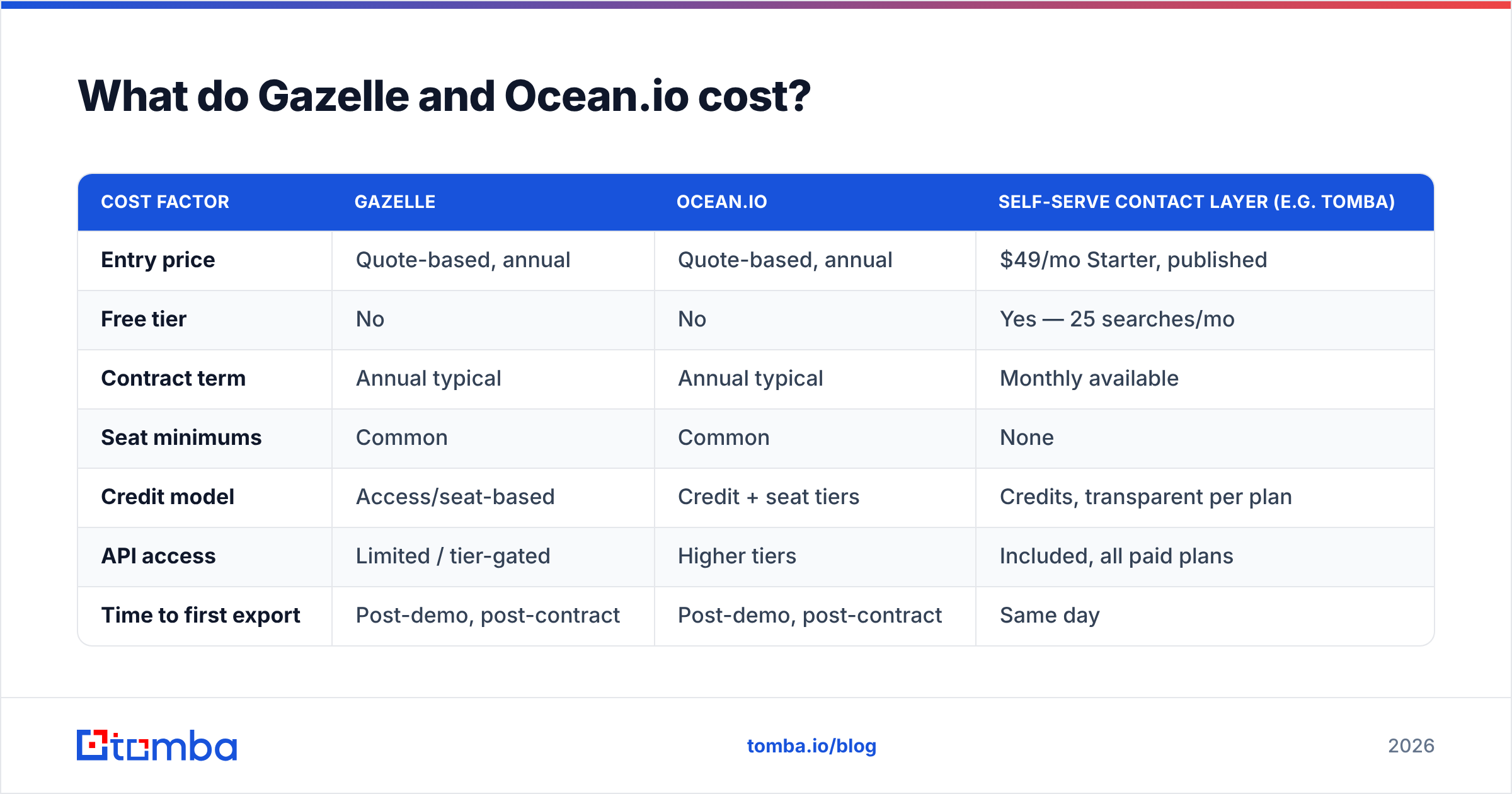
Neither vendor posts a price list today. So treat any hard number on a comparison blog with care, including reseller quotes. You can still plan around the shape of the cost.
| Cost factor | Gazelle | Ocean.io | Self-serve contact layer (e.g. Tomba) |
|---|---|---|---|
| Entry price | Quote-based, annual | Quote-based, annual | $49/mo Starter, published |
| Free tier | No | No | Yes — 25 searches/mo |
| Contract term | Annual typical | Annual typical | Monthly available |
| Seat minimums | Common | Common | None |
| Credit model | Access/seat-based | Credit + seat tiers | Credits, transparent per plan |
| API access | Limited / tier-gated | Higher tiers | Included, all paid plans |
| Time to first export | Post-demo, post-contract | Post-demo, post-contract | Same day |
The point is simple. Enterprise data tools charge for access. Contact tools charge for usage. Need 2,000 verified emails a month? Access pricing is a costly way to buy them. Need a market map for a board deck? A usage-priced email tool will not help. Most teams need both. Most overpay by asking one tool to do both jobs.
For a look at open usage pricing, see Tomba pricing: Free (25 searches a month), Starter $49, Growth $99, Pro $249, Enterprise custom.
Which should you choose in 2026?#
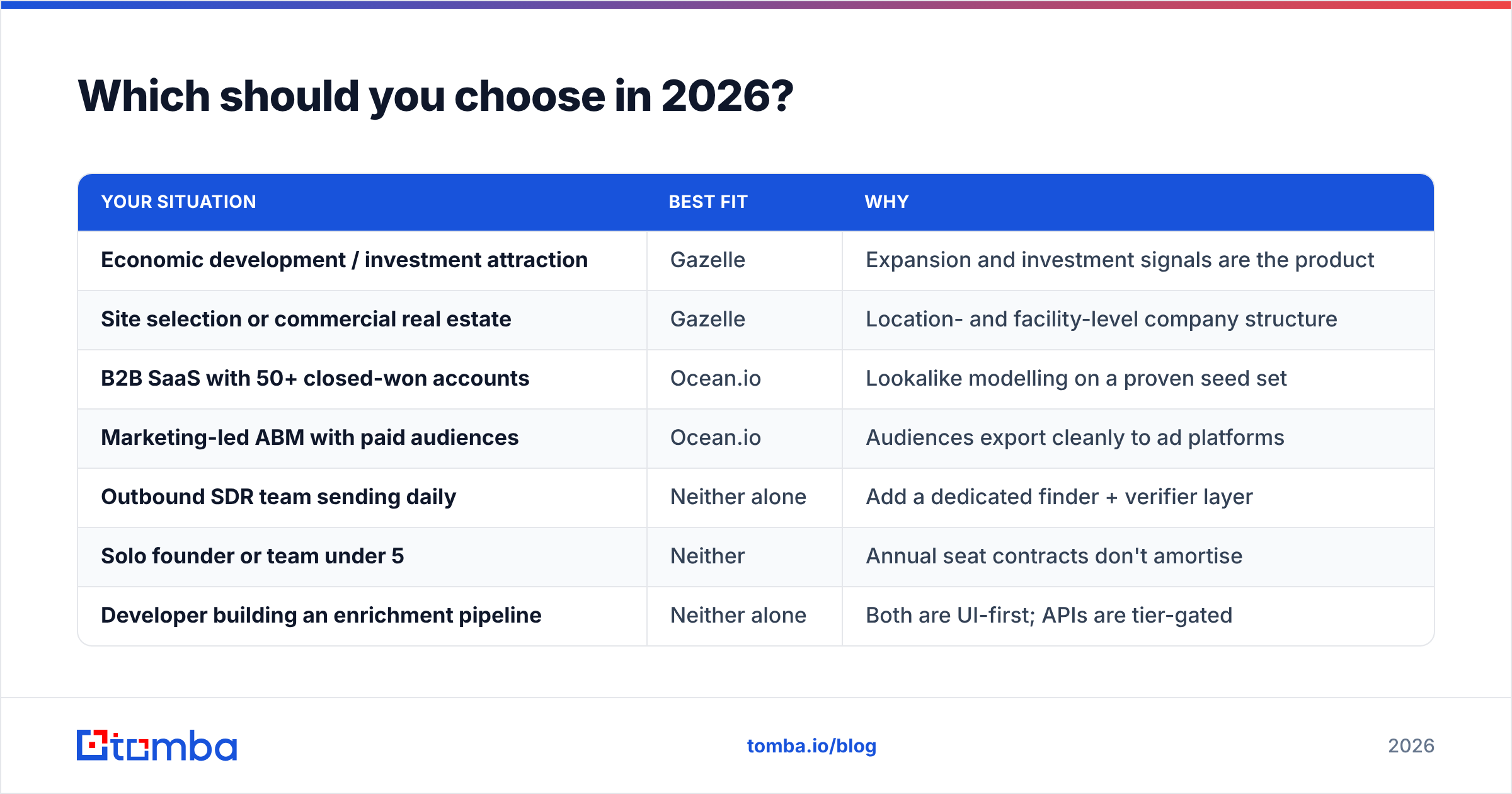
| Your situation | Best fit | Why |
|---|---|---|
| Economic development / investment attraction | Gazelle | Expansion and investment signals are the product |
| Site selection or commercial real estate | Gazelle | Location- and facility-level company structure |
| B2B SaaS with 50+ closed-won accounts | Ocean.io | Lookalike modelling on a proven seed set |
| Marketing-led ABM with paid audiences | Ocean.io | Audiences export cleanly to ad platforms |
| Outbound SDR team sending daily | Neither alone | Add a dedicated finder + verifier layer |
| Solo founder or team under 5 | Neither | Annual seat contracts don't amortise |
| Developer building an enrichment pipeline | Neither alone | Both are UI-first; APIs are tier-gated |
In the last three rows, skip both for now. An annual research-grade contract is the wrong first buy when your real block is "I cannot reach the 400 accounts I already have."
Do you still need an email finder either way?#
Yes, almost always. The reason is design, not rivalry.
Account tools optimise for breadth across companies. Email tools optimise for depth on one domain. Those are different problems with different sources. Vendors who claim both usually win neither.
A stack that works with either tool:
- Find accounts — Gazelle or Ocean.io, based on whether your ICP is describable or demonstrable.
- Find people — run each domain through a domain search to see who works there today, not who worked there months ago.
- Verify — check every address. Treat catch-all domains as their own risk bucket.
- Enrich and sync — push clean records back with data enrichment so reps see one source of truth, not three.
- Automate — wire it up with the Tomba API so nobody exports CSVs by hand on a Friday.
That split protects your budget too. The account tool is the annual, hard-to-exit part. Keep the contact layer separate and usage-priced. Then you can swap either half without breaking the other.
The bottom line on Gazelle vs Oceanio#
Gazelle wins when growth events define a good account. Ocean.io wins when your customer base does. Both are well-built platforms with real buyers. Both will book a demo before they quote a price.
Neither one replaces the dull layer in the middle. Something has to turn company names into verified addresses. That gap is where most outbound leaks. Not in picking accounts. In reaching them.
Start there. Run a target list through the Tomba Email Finder on the free tier. 25 searches, no demo, no annual contract. See how many of those accounts are reachable today. High hit rate? Targeting was never your problem. Low one? You just found the cheapest fix in your stack.
Related guides#
Ready to find emails that actually work?
Join 150,000+ professionals who stopped guessing and started sending. Free credits on signup — no credit card required.
Get the Tomba newsletter
Practical outbound tactics and product updates — once every two weeks.
About the author