Gazelle vs SignalHire in 2026: Which B2B Data Tool Wins?
Gazelle vs SignalHire gets compared constantly, but the two tools solve different problems. Here is the honest breakdown: data coverage, contact accuracy, pricing models, and which one belongs in your outbound stack.
Gazelle vs SignalHire is a common shortlist for B2B data buyers. It is also the wrong fight. One tool picks the companies. The other finds the people.
TL;DR
- Gazelle vs SignalHire is not a like-for-like matchup. Gazelle is a company-intelligence database for market research, site selection, and account discovery. SignalHire is a contact finder for reaching people by email and phone.
- Pick Gazelle if your bottleneck is "which companies should we target?" It scores growth signals across millions of firms in 200+ countries. Contracts are annual and quote-based.
- Pick SignalHire if your bottleneck is "how do I reach this person?" Pricing is self-serve. The browser extension works on LinkedIn and GitHub. Recruiting features come bundled.
- Neither is cheap or flexible enough if you only need verified work emails at volume. A dedicated email finder with a free tier and a real API usually costs less per usable contact.
- For most teams the answer is a stack, not a duel. Use one source to choose accounts. Use another to find and verify contacts.
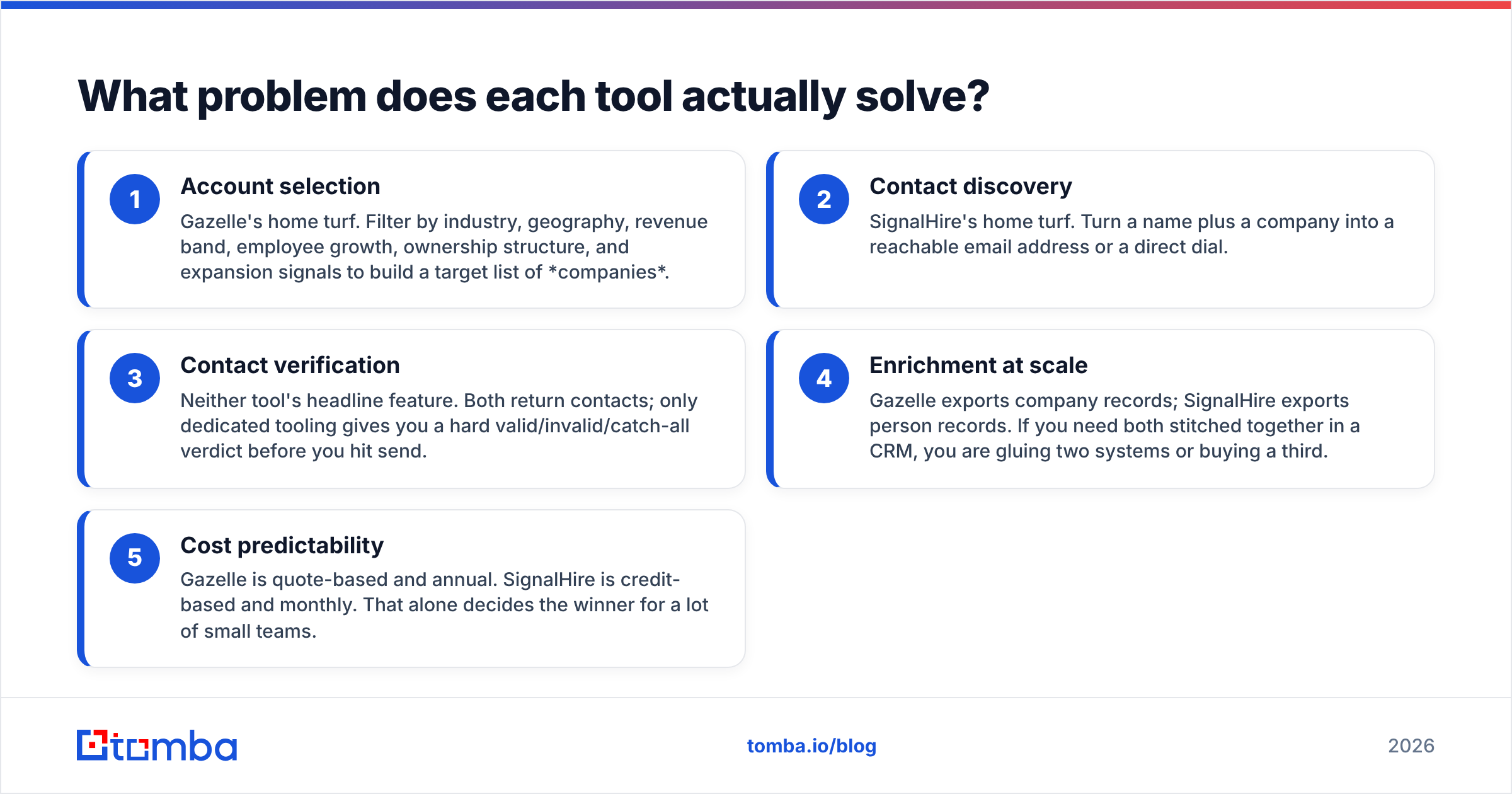
Gazelle vs SignalHire: what problem does each tool solve?#
Think of it like buying a house. Gazelle.ai is the neighbourhood report. It tells you which areas are growing and who is hiring. SignalHire is the phone book. It gives you the name, email, and number of the person at number 42. Both help. Only one lets you send an email today.
Gazelle.ai calls itself an AI-driven company intelligence platform. Its buyers are economic development agencies, foreign direct investment teams, commercial bankers, and enterprise sales teams. The pitch is predictive. It ranks which companies are likely to grow, hire, or expand into a region, based on firm data and signals from a global company base.
SignalHire is a contact-finding tool. Search a name or open a profile, and it returns work emails, personal emails, and phone numbers. A Chrome extension overlays LinkedIn, GitHub, and other public profiles. It also adds a light applicant-tracking layer, because many users are recruiters rather than SDRs.
That gap shapes everything else: pricing, data freshness, API design, and who signs the contract.
Here is the split in plain terms:
- Account selection — Gazelle's home turf. Filter by industry, geography, revenue band, headcount growth, ownership, and expansion signals to build a list of companies.
- Contact discovery — SignalHire's home turf. Turn a name plus a company into an email address or a direct dial.
- Contact verification — Neither tool's main job. Both hand you contacts. Only dedicated tooling gives you a hard valid, invalid, or catch-all verdict before you send.
- Enrichment at scale — Gazelle exports company records. SignalHire exports person records. If you need both in one CRM, you glue two systems together or buy a third.
- Cost predictability — Gazelle is quote-based and annual. SignalHire is credit-based and monthly. For small teams, that alone picks the winner.

Gazelle vs SignalHire: how do they compare head-to-head?#
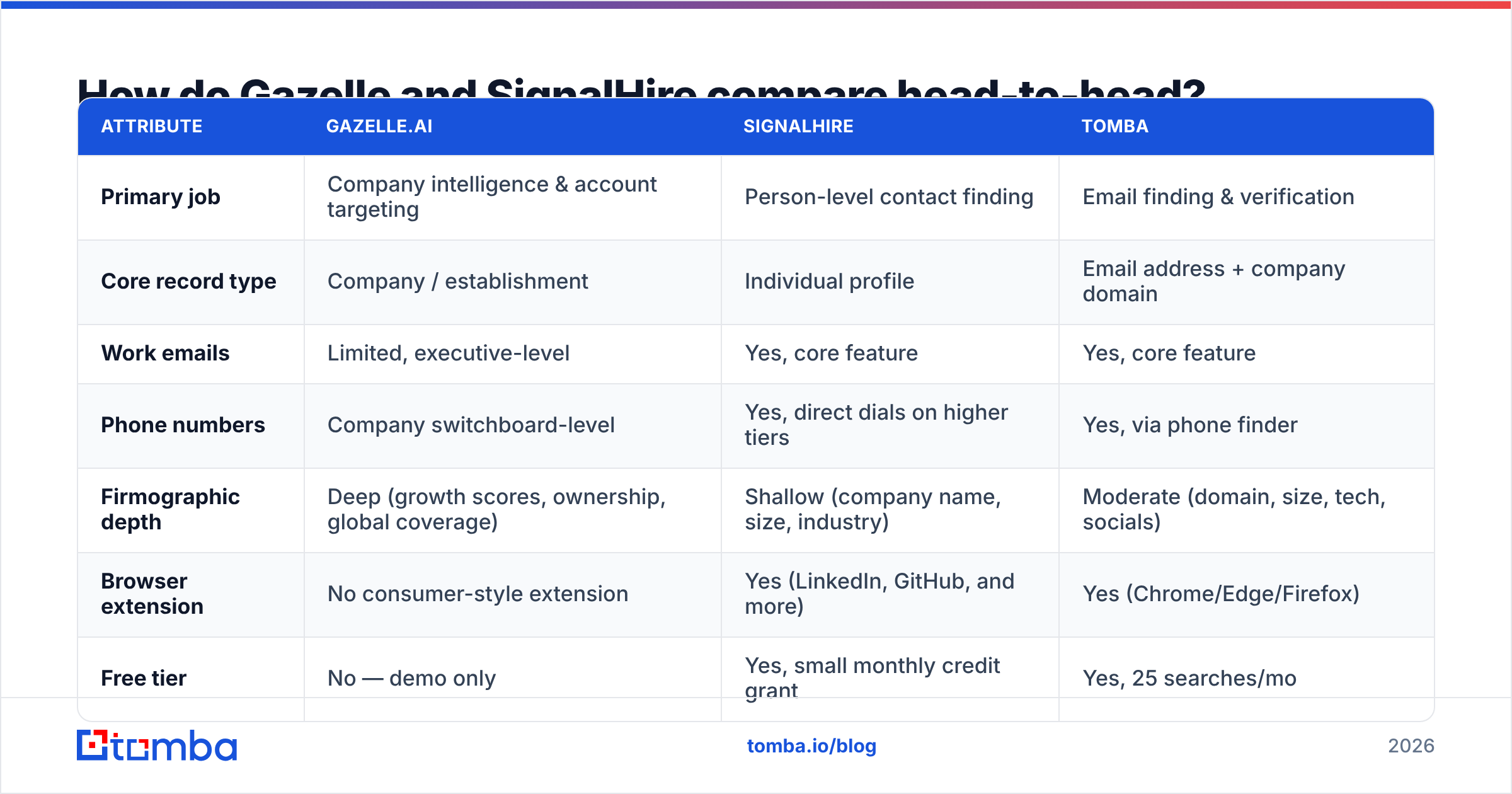
The table below shows how each vendor positions itself in 2026. Plan names and credit limits change often. Treat the pricing as directional, and check the vendor's own page before you buy.
| Attribute | Gazelle.ai | SignalHire | Tomba |
|---|---|---|---|
| Primary job | Company intelligence & account targeting | Person-level contact finding | Email finding & verification |
| Core record type | Company / establishment | Individual profile | Email address + company domain |
| Work emails | Limited, executive-level | Yes, core feature | Yes, core feature |
| Phone numbers | Company switchboard-level | Yes, direct dials on higher tiers | Yes, via phone finder |
| Firmographic depth | Deep (growth scores, ownership, global coverage) | Shallow (company name, size, industry) | Moderate (domain, size, tech, socials) |
| Browser extension | No consumer-style extension | Yes (LinkedIn, GitHub, and more) | Yes (Chrome/Edge/Firefox) |
| Free tier | No — demo only | Yes, small monthly credit grant | Yes, 25 searches/mo |
| Entry paid price | Quote-based, annual contract | Self-serve, roughly $49/mo entry tier | $49/mo Starter |
| Mid tier | Quote-based | Credit bundles scale up | $99/mo Growth |
| API access | Enterprise / add-on | Yes | Yes, on all paid plans |
| Contract length | Annual, typically | Monthly or annual | Monthly or annual |
| Best fit | EDOs, banks, ABM/enterprise GTM | Recruiters, agency SDRs | Outbound teams, developers, agencies |

Here is the pattern most buyers miss. Gazelle's price stays hidden until you talk to sales. SignalHire's price is public, but credits burn whether or not the contact bounces. Those are two different kinds of risk.
Gazelle vs SignalHire: which has better data coverage?#
The answer depends on what you measure. Anyone who gives you a single number is selling something.
On company coverage, Gazelle wins. It markets a global company base across 200+ countries, with private-company records, hierarchy mapping, and modelled growth scores. Say you want every manufacturer with 50–250 staff in three provinces that grew headcount last year. SignalHire cannot answer that, and does not try.
On person coverage, SignalHire wins. Its index comes from public professional profiles. So it leans toward tech, recruiting roles, and markets where LinkedIn use is high. Coverage thins out elsewhere. Mid-market European manufacturing is one example. So are roles that never publish a profile at all.
On email deliverability, both fall into the same trap. A returned email is not a verified email. Person-level data decays fast. People change jobs, companies move domains, and aliases get retired. Reviews on G2 show the same complaint across the whole contact-data category. The headline "found" rate looks great. The bounce rate shows up later, after the campaign has already hurt your sender reputation.

The fix is process, not brand loyalty. Run every list through an email verifier before it reaches your sequencer. Treat any domain that accepts all mail as its own risk bucket, and handle it with a catch-all verifier. Teams that do this often report bounce rates under 2%. The same sources can run 8–12% without it.
Gazelle vs SignalHire pricing: what does each one cost in 2026?#
Gazelle.ai publishes no price list. Deals are scoped by seat count, geographic coverage, and delivery method. They land as annual contracts. That is normal for the economic-development and enterprise-research market it serves. It also means a two-person startup cannot test it on a Tuesday afternoon.
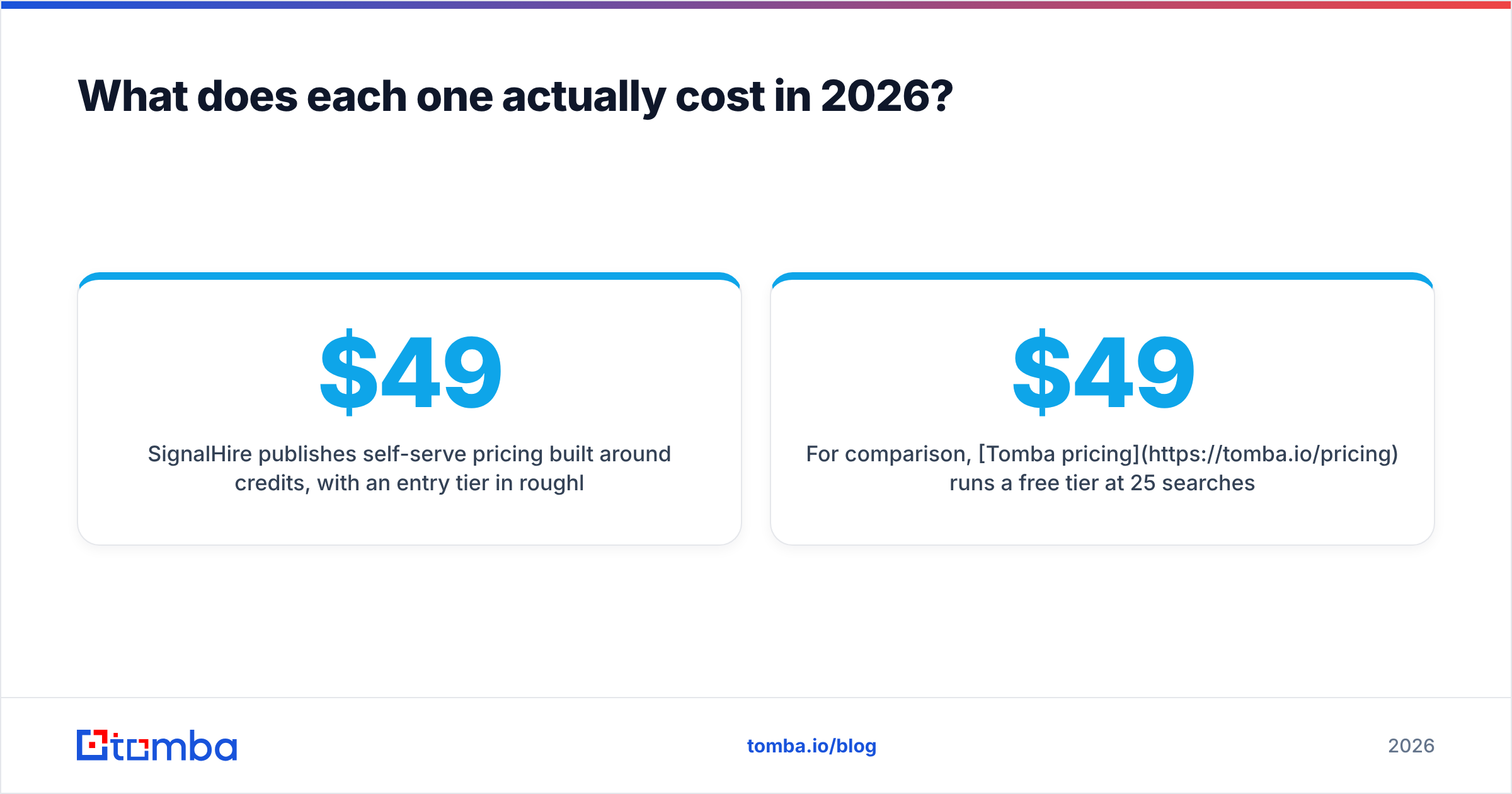
SignalHire publishes self-serve pricing built on credits. The entry tier sits near $49 per month, with larger bundles above it. One credit usually reveals one contact. Two things to watch:
- Credit burn on misses. Vendors treat "found nothing useful" differently. Read the fine print on what counts as a spent credit before you buy a big bundle.
- Phone credits versus email credits. Direct dials are the costly part of any contact database. Two plans can match on price and still differ a lot on phone reveals.

For comparison, Tomba pricing starts with a free tier of 25 searches per month. Starter is $49/mo, Growth is $99/mo, Pro is $249/mo, and Enterprise is custom. The headline number is not the point. Verification sits inside the same workflow. You do not pay one vendor to find an address and a second vendor to tell you it is dead.
Who should choose Gazelle.ai?#
Choose Gazelle if any of these fit you:
- You sell to regions, not just companies. Economic development groups, investment attraction teams, and site-selection consultants get value here that no contact finder can match.
- Your ICP is defined by growth. Headcount jumps, capital spend, and ownership changes are first-class filters, not afterthoughts.
- You need global private-company data. Coverage outside North America and Western Europe is a real edge.
- You can approve an annual contract. This is not a tool you expense on a card.
Where it disappoints: daily outbound. Gazelle hands you a clean target list, then leaves you to source the contacts somewhere else.
Who should choose SignalHire?#
Choose SignalHire if:
- You work profile by profile. Recruiters and agency researchers who live inside LinkedIn save real time with the extension.
- You need phone numbers as often as emails. Direct-dial coverage is a genuine strength in tech and recruiting.
- You want light ATS features bundled. Small recruiting teams get candidate tracking in the same tool and drop a subscription.
- You want month-to-month billing. No annual lock-in beats most enterprise data platforms.
Where it disappoints: bulk work. Feeding 10,000 domains through it, deduplicating, verifying, and syncing to a CRM is not what the product is built for. Credit costs get uncomfortable fast at that volume.
Where does each tool fall short for outbound teams?#
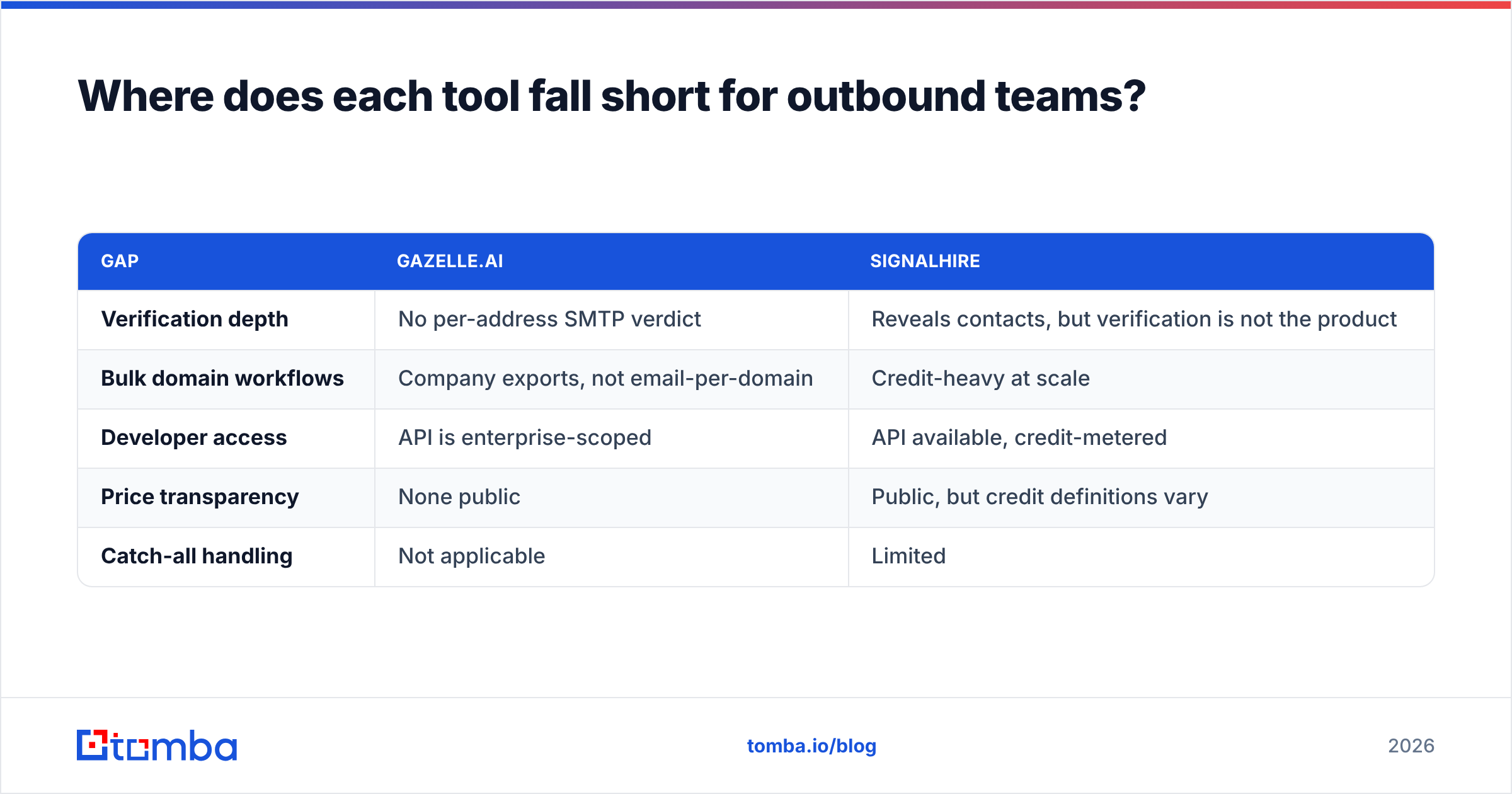
Three gaps show up in almost every evaluation we have seen. The table sums them up.
| Gap | Gazelle.ai | SignalHire |
|---|---|---|
| Verification depth | No per-address SMTP verdict | Reveals contacts, but verification is not the product |
| Bulk domain workflows | Company exports, not email-per-domain | Credit-heavy at scale |
| Developer access | API is enterprise-scoped | API available, credit-metered |
| Price transparency | None public | Public, but credit definitions vary |
| Catch-all handling | Not applicable | Limited |
That last row matters more than it looks. Roughly one in five business domains accepts mail for any address. A naive verifier calls it "valid". Your bounce lands three days later. Handling it well takes a purpose-built catch-all finder, not a general contact database.
The wider category matters too. Tools like BookYourData take another credible route. They sell prebuilt lists with an accuracy guarantee, which suits teams that want a finished list instead of a search workflow. So the right shortlist depends on one question: do you want to build lists or buy them?
How should you test both before committing?#
Run the same test you would run on any data vendor. It takes an afternoon and saves you quarters.
- Build a 100-row gold list. Real companies in your ICP, real target roles. Add hard cases: non-English domains, small firms, recent rebrands.
- Measure hit rate and bounce rate separately. Hit rate is how many contacts came back. Bounce rate is how many survived a real send. Vendors quote the first. Your domain reputation cares about the second.
- Check freshness, not just presence. Sample 20 returned contacts and confirm each person still works there. Job-change decay is the silent killer of bought data.
- Price it per usable contact. Divide the monthly cost by the number of contacts that passed verification. That number is what you really pay.
- Test the export path. If it cannot reach your CRM without a manual CSV dance, your reps will skip it. Check the integrations for any tool you shortlist.
So — Gazelle vs SignalHire: which wins?#
Verdict: in the Gazelle vs SignalHire matchup, SignalHire wins for contact-level outbound and Gazelle wins for account-level strategy. They are not substitutes.
If you run an SDR team and need pipeline this quarter, SignalHire is the more useful buy and the easier one to start. If you map opportunity by geography for research, banking, or investment work, Gazelle holds data that SignalHire simply does not carry.
And if you only need a clean, verified work email for every contact on a target list, neither tool is the cheapest path. That is the job the Tomba Email Finder is built for. Domain search, pattern detection, SMTP verification, and catch-all handling sit in one workflow. The free tier lets you test on your own gold list first. Start with 25 free searches, run your 100-row benchmark, and let the bounce rate pick the winner.
Related guides#
Ready to find emails that actually work?
Join 150,000+ professionals who stopped guessing and started sending. Free credits on signup — no credit card required.
Get the Tomba newsletter
Practical outbound tactics and product updates — once every two weeks.
About the author