Gazelle vs SMARTe: Which B2B Data Platform Wins in 2026?
Gazelle vs SMARTe is a strange match-up. Gazelle.ai maps companies and growth signals. SMARTe hands your reps emails and mobile numbers. Here is which half of the problem each one solves, which fits your team, and where both fall short.
Gazelle vs SMARTe is a strange match-up. One tool maps companies. The other hands your reps an email and a mobile number. This guide breaks down the real gap between them, so you can pick fast.
TL;DR
- They are not real rivals. Gazelle.ai is company-level market data. It is built for economic development, site selection, and expansion research. SMARTe is contact-level sales data. It is built for SDRs who need an email and a cell number right now.
- Pick Gazelle if your question is "which firms are growing, foreign-owned, or about to expand into my region?"
- Pick SMARTe if your question is "I have a target account and a job title. Get me the inbox and the cell."
- Both are quote-only. Neither one posts a price. That slows down small-team buying. It also makes budget planning hard for a 3-person GTM team.
- Neither one replaces checking. Run any list you export through an email verifier first. Stale B2B contact data is the top cause of bounces in outbound.
What is Gazelle.ai, and who uses it?#
Gazelle.ai is an AI-driven company database. Its promise is not "find me a contact." It is "help me read a market."
The tool tracks millions of firms worldwide. It holds fields most sales tools skip: parent and subsidiary links, foreign ownership, plant locations, growth scores, and the odds a firm will expand. That mix is rare. It also explains who buys it. The heaviest users are economic development groups, investment agencies, chambers of commerce, site-selection consultants, and corporate real estate teams.
Think of a satellite map next to a street photo. Gazelle shows you which cities are growing. It shows where the new highways go. It does not tell you who lives at number 14.
That framing matters. Many Gazelle vs SMARTe posts treat both as swap-in lead lists. They are not. Buy Gazelle and expect an SDR-ready contact file, and you will be let down. The reason has nothing to do with build quality.
Where Gazelle is strong:
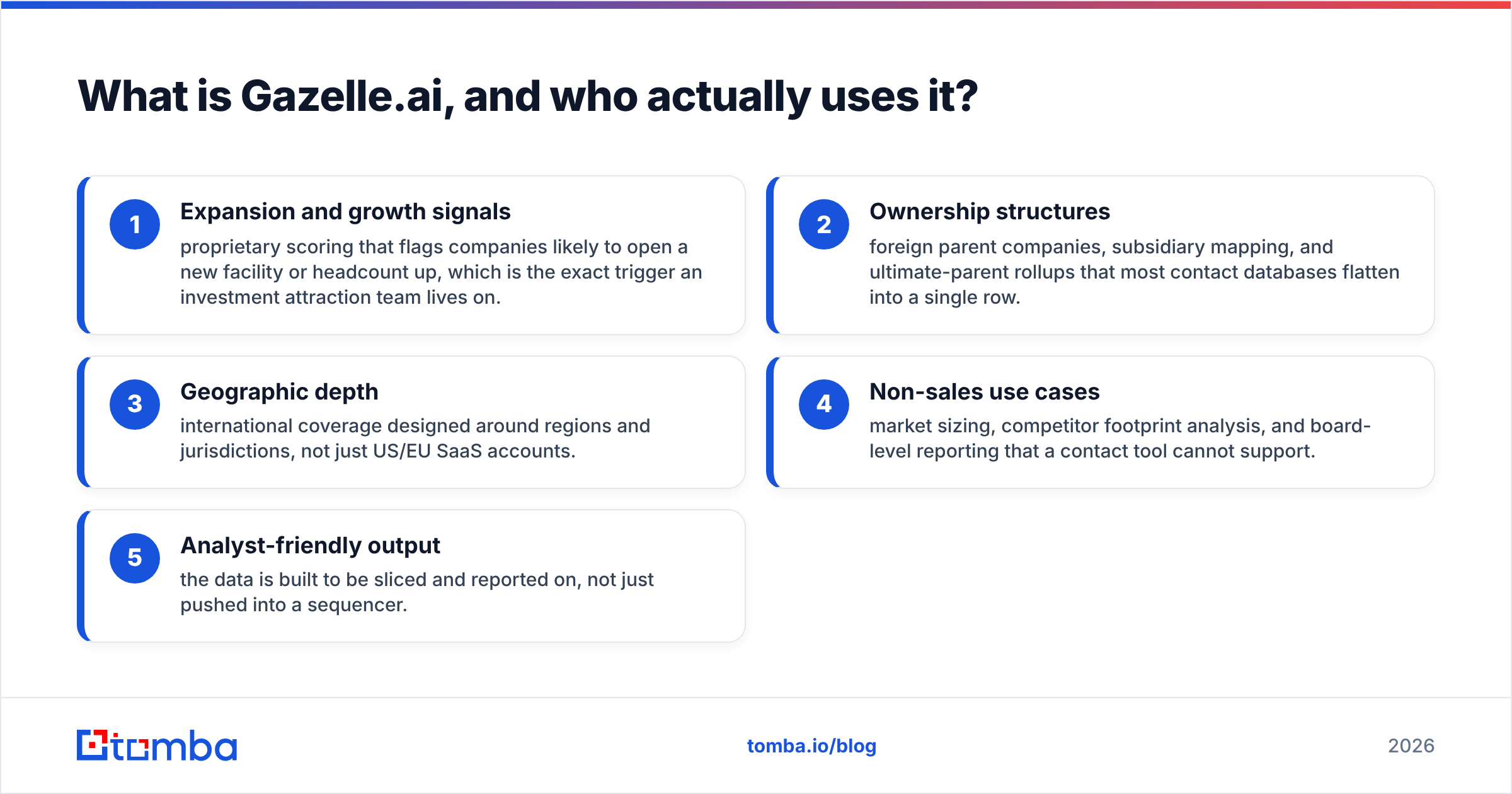
- Growth signals — scores that flag firms likely to open a plant or add staff. That is the exact trigger an investment team lives on.
- Ownership maps — foreign parents, subsidiary links, and top-parent rollups. Most contact tools flatten all of that into one row.
- Geographic depth — global coverage built around regions and local rules, not just US and EU SaaS accounts.
- Non-sales work — market sizing, rival footprint checks, and board reports. A contact tool cannot do any of it.
- Analyst-ready output — the data is built to slice and report on, not to dump into a sequencer.
What is SMARTe, and how is it different?#
SMARTe sits at the other end of the funnel. It is a B2B contact and account tool aimed at revenue teams: SDRs, AEs, and demand gen.
Its pitch is reach. SMARTe leans on large volumes of checked work emails and mobile numbers. It pushes hard on coverage outside North America, in EMEA and APAC. It also stresses GDPR and CCPA-aligned handling. The workflow will feel familiar. There is a Chrome add-on that reveals contact details on LinkedIn and company sites. There is in-app search with firm and tech filters. You build lists and push them to Salesforce, HubSpot, Outreach, and Salesloft.
Gazelle answers "which market." SMARTe answers "which human, and how do I reach them."

That split shapes the rest. SMARTe fights Apollo, ZoomInfo, Lusha, Cognism, and BookYourData. Buyers there compare match rates and mobile coverage line by line. Gazelle fights Dun & Bradstreet, Orbis, and niche site-selection data. Buyers there compare ownership maps and country coverage. Different buyers. Different budgets. Different renewal math.
Gazelle vs SMARTe: how do they compare head-to-head?#
Here is the honest side-by-side. Where a vendor posts no number, the table says so. It does not invent one. Confirm the current figures in your own demo.
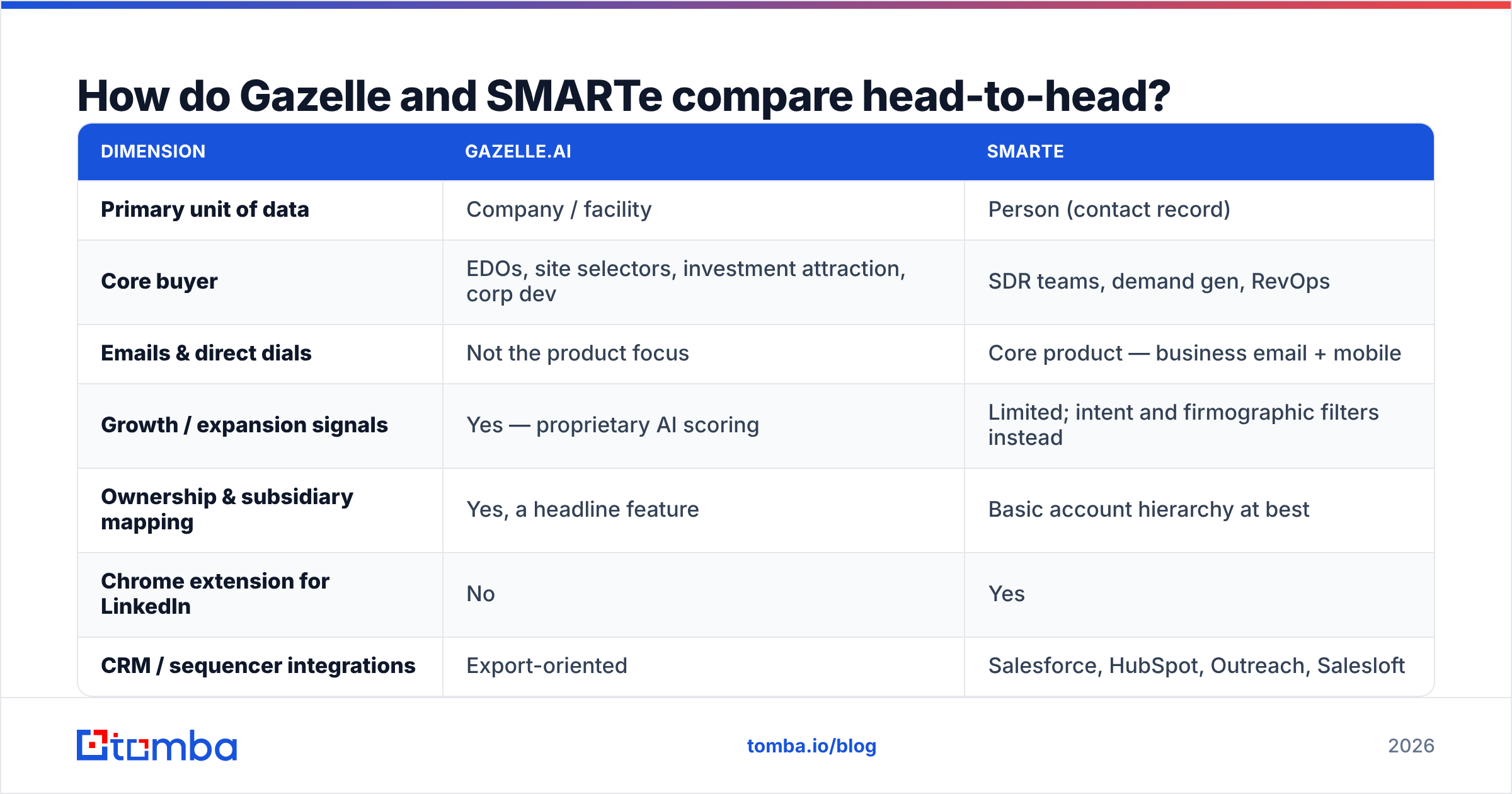
| Dimension | Gazelle.ai | SMARTe |
|---|---|---|
| Primary unit of data | Company / facility | Person (contact record) |
| Core buyer | EDOs, site selectors, investment attraction, corp dev | SDR teams, demand gen, RevOps |
| Emails & direct dials | Not the product focus | Core product — business email + mobile |
| Growth / expansion signals | Yes — proprietary AI scoring | Limited; intent and firmographic filters instead |
| Ownership & subsidiary mapping | Yes, a headline feature | Basic account hierarchy at best |
| Chrome extension for LinkedIn | No | Yes |
| CRM / sequencer integrations | Export-oriented | Salesforce, HubSpot, Outreach, Salesloft |
| International coverage emphasis | Global, jurisdiction-first | Global, with strong EMEA/APAC contact push |
| Free self-serve tier | No — demo/quote only | Limited free credits, then quote |
| Published pricing | No | No |
| Typical contract shape | Annual license, seat-based | Annual, credit + seat based |
Four things jump out of that table.
First, the middle is nearly empty. One tool ranks a region's fastest-growing plants. The other finds a VP of Engineering's cell number. Those are not swaps for each other. If a rep tells you they are, they are selling.
Second, neither one posts a price. That is normal in enterprise data. It still costs you. Your review stretches from an afternoon to three weeks. And you cannot compare cost per contact without sitting through two demos.
Third, SMARTe fits a modern outbound stack. Add-on, sequencer push, credit model. It drops into the flow SDRs already run. Gazelle output tends to land in a spreadsheet or a BI dashboard.
Fourth, coverage claims cannot be checked from outside. Both cite big record counts. Record count is the least useful number in B2B data. What matters is match rate on your ICP. And bounce rate on your send. That is the part most posts skip.
Is Gazelle better than SMARTe for outbound?#
For pure outbound, SMARTe is the better fit. It is not close. Gazelle was never built for it.
But there is a real hybrid play. Teams selling into regional markets, plants, freight, or heavy industry use it. It is worth spelling out.
- Build the account list in Gazelle. Filter by growth score, foreign owner, plant count, and region. You end up with 300 firms that are truly growing. Not 3,000 that merely share a SIC code.
- Find the people in SMARTe (or a peer tool). Take those 300 domains. Pull the decision makers with emails and mobiles.
- Verify before you send. Contact data rots by 2-3% a month as people switch jobs. A list built in January is badly wrong by June.
- Fill the gaps. Every provider misses 15-40% of any list. Patch the holes with a second source.
- Push to CRM with a source tag. Tag which tool gave you each record. Then measure bounce rate by source at renewal. That one habit turns your next talk from vibes into proof.
That stack works. What fails is buying a market-data license and hoping it feeds a sequencer. Or buying a contact list and hoping it answers a board question about regional investment flows.
Gazelle vs SMARTe: what do they cost in 2026?#
Neither one posts a price. Both run demo-gated, quote-based sales.
Here is the likely shape, based on how peer tools in each category are packaged. Treat it as a guide, not a quote.
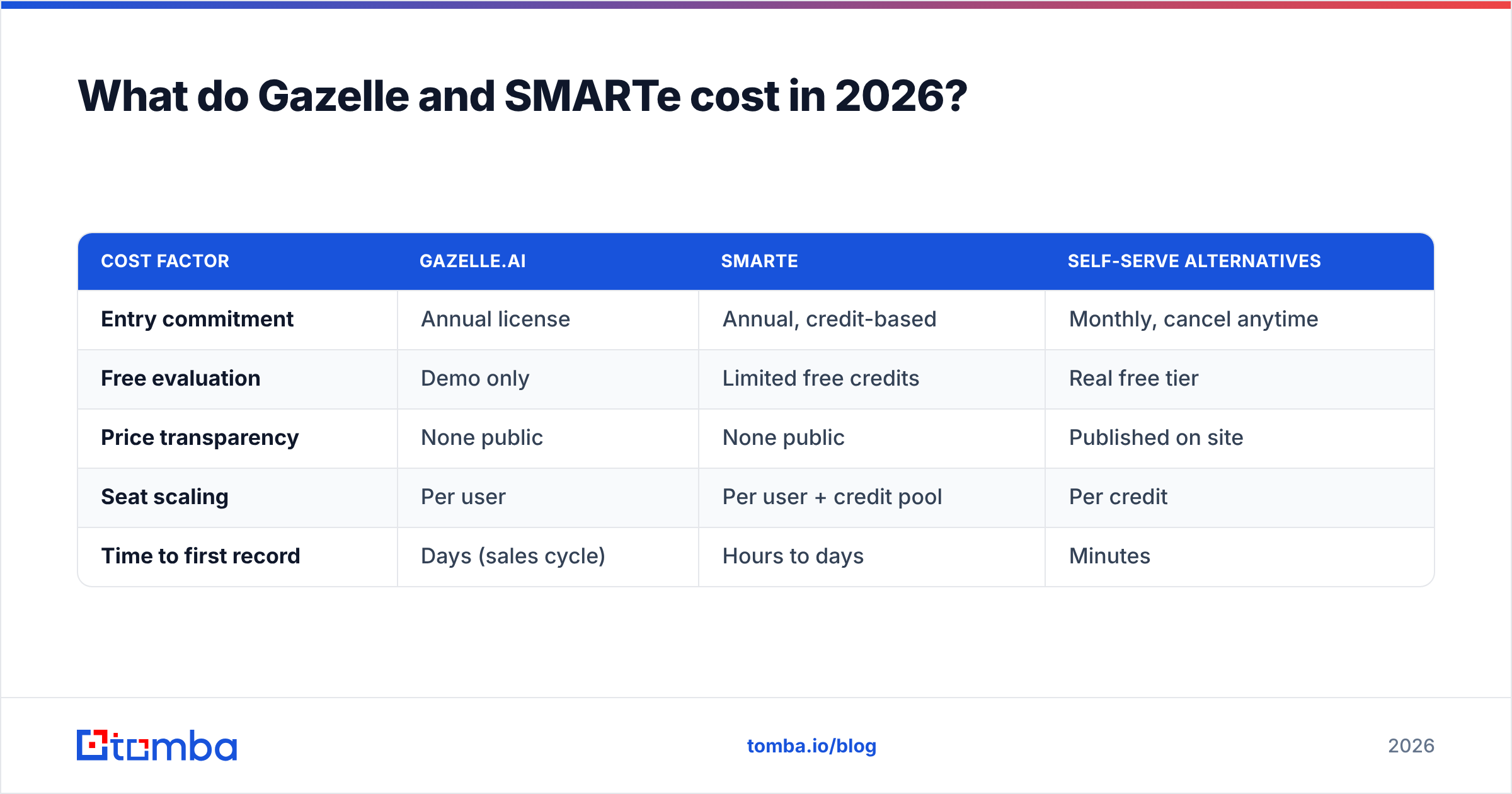
| Cost factor | Gazelle.ai | SMARTe | Self-serve alternatives |
|---|---|---|---|
| Entry commitment | Annual license | Annual, credit-based | Monthly, cancel anytime |
| Free evaluation | Demo only | Limited free credits | Real free tier |
| Price transparency | None public | None public | Published on site |
| Seat scaling | Per user | Per user + credit pool | Per credit |
| Time to first record | Days (sales cycle) | Hours to days | Minutes |
Compare that with open pricing. Tomba's plans start free at 25 searches a month. Starter is $49/mo, Growth is $99/mo, and Pro is $249/mo. All posted. All self-serve. No call needed. That is not a claim that Tomba does what Gazelle does. It does not. It is a claim that you should not have to book a call to learn a price.

The rule of thumb is simple. A 5-person team should avoid opaque annual deals. A government agency with a mandate and a budget line should expect them. There, the depth is worth it.
Where do both tools leave gaps?#
Every B2B data tool fails in the same three ways. Know them before the demo. It will save you a quarter of wasted budget.
Gap 1: decay. No database is current. Titles change. People leave. Firms get bought. A "verified" flag often means verified at intake, not this week. Run a fresh check right before any send. A good email verification step catches role accounts, dead mailboxes, and typo traps. It does that before they cost you sender trust.
Gap 2: catch-all domains. Many large domains accept every address at the SMTP layer. Then they drop the bad mail in silence. A standard check returns "unknown." Most teams then skip those contacts and lose real buyers. Or they send blind and burn sender trust. A catch-all verifier is the only clean fix.
Gap 3: holes in your own ICP. Blended match rates are marketing numbers. Your rate on German mid-market freight firms or US regional health systems may be half the headline. The only fix is a paid pilot on 200 real accounts. Measure three things: match rate, bounce rate after checking, and mobile connect rate. Do it before you sign, not after.
One more gap is worth naming. Neither tool is built as a developer primitive. Want to enrich records inside your own app or pipeline? Then you want an email finder API with a clear per-call price. Not a seat license with an export button.
Which one should you choose?#
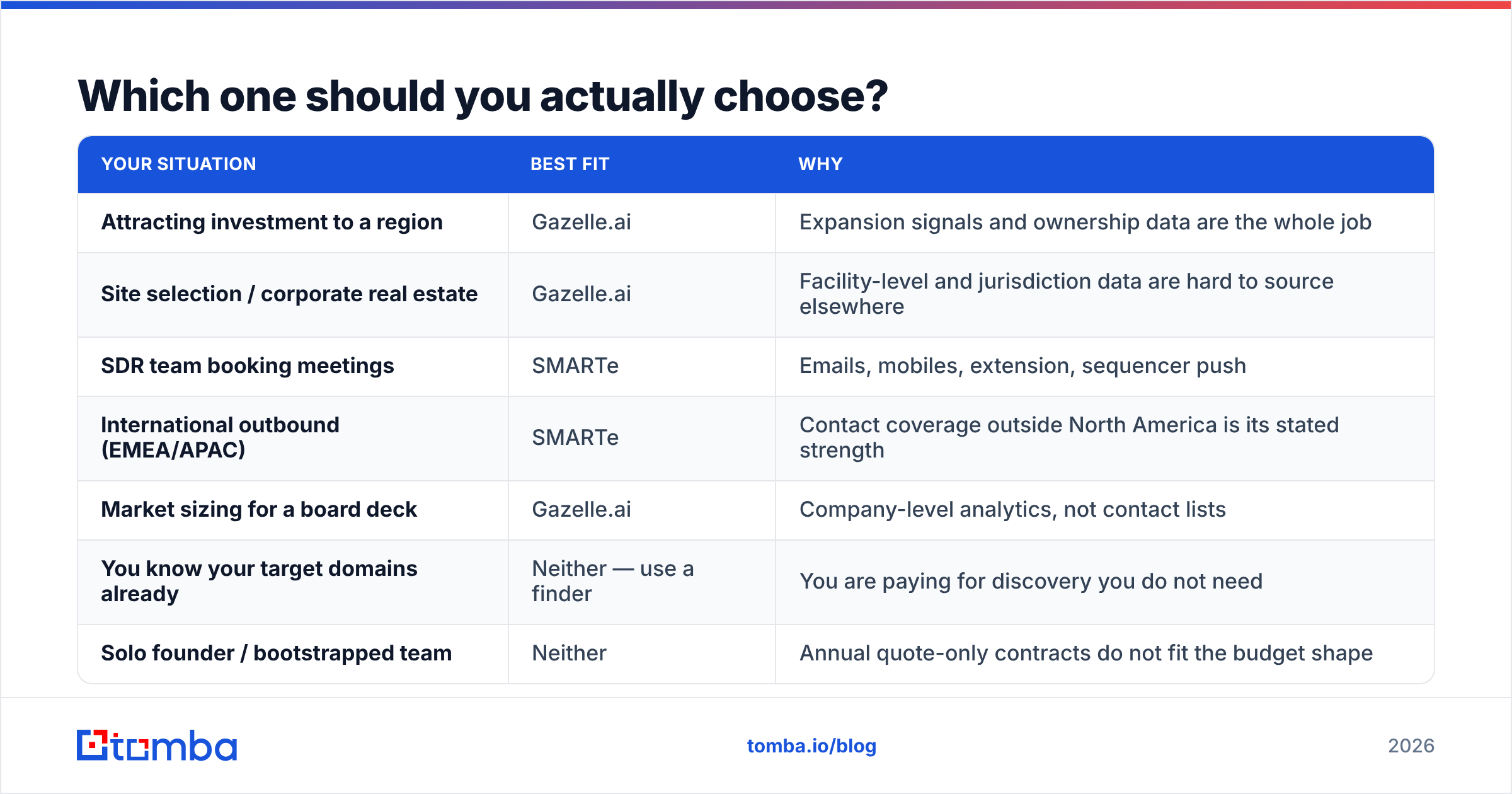
Match the tool to the question on your desk.
| Your situation | Best fit | Why |
|---|---|---|
| Attracting investment to a region | Gazelle.ai | Expansion signals and ownership data are the whole job |
| Site selection / corporate real estate | Gazelle.ai | Facility-level and jurisdiction data are hard to source elsewhere |
| SDR team booking meetings | SMARTe | Emails, mobiles, extension, sequencer push |
| International outbound (EMEA/APAC) | SMARTe | Contact coverage outside North America is its stated strength |
| Market sizing for a board deck | Gazelle.ai | Company-level analytics, not contact lists |
| You know your target domains already | Neither — use a finder | You are paying for discovery you do not need |
| Solo founder / bootstrapped team | Neither | Annual quote-only contracts do not fit the budget shape |
| Building enrichment into your own app | Neither | You need an API-first provider with per-call pricing |
The last three rows matter most. They cover a big share of the people who read a Gazelle vs SMARTe comparison.
Say you already know which firms you want to reach. Maybe you have an event list, a partner page, a scraped set of domains, or a stale CRM. Then you do not have a discovery problem. You have a reach problem. Paying for a full market-data license to fix that is a category error. So is an enterprise contact seat. What you need is domain search to pull the people at those domains. Then a check pass. Then an export. That flow costs a fraction of either tool. It takes an afternoon.
Same story if you enrich records in code. Seat pricing fights your architecture. You want per-call math.
What is the verdict on Gazelle vs SMARTe?#
Gazelle.ai wins on market data. SMARTe wins on reach. Neither one wins the other's category. Be wary of any Gazelle vs SMARTe verdict that crowns a single overall winner.
Choose Gazelle if your output is a report, a map, or an investment case. Choose SMARTe if your output is a sequence with a reply rate on it. Need both? Budget for both. Or pair Gazelle with a cheap, open contact source instead of a second enterprise deal.
Either way, run the pilot. Take 200 accounts from your real ICP. Measure match rate and post-check bounce rate. That week will teach you more than any vendor deck, any G2 grid, or any blog post. This one included. Review data on the sales intelligence category is a fair sanity check on support and onboarding. It will never tell you how a database performs on your segment.
Need the contact layer without the annual deal? Is your bottleneck turning a list of target firms into verified, sendable inboxes? Start with the Tomba Email Finder. Search by domain, name, or company. Verify in the same flow. Export straight to your CRM. Pricing is posted. It starts free at 25 searches a month and scales to $49/mo when you outgrow it. No demo call to learn the cost.
Related guides#
Ready to find emails that actually work?
Join 150,000+ professionals who stopped guessing and started sending. Free credits on signup — no credit card required.
Get the Tomba newsletter
Practical outbound tactics and product updates — once every two weeks.
About the author