Gazelle vs Wiza (2026): Which B2B Data Tool Should You Buy?
Gazelle sells company intelligence by annual contract. Wiza sells LinkedIn-sourced contacts by the credit. They solve different halves of the same problem — here is which one your team actually needs, and when neither is the right buy.
TL;DR
- They are not the same category. Gazelle is a company-intelligence database built for account selection and market research. Wiza is a contact-extraction tool built to turn LinkedIn Sales Navigator lists into emails and phone numbers.
- Gazelle wins on firmographics and signals — growth scores, subsidiaries, global company coverage, and the "who should we target" question.
- Wiza wins on speed to a sendable list — you already know the accounts, you need the people and their inboxes, today.
- Pricing models are opposite. Gazelle is quote-based annual licensing with no public self-serve tier. Wiza is credit-based with a free trial allotment and monthly plans.
- Neither is a cheap verification layer. If your bottleneck is valid emails at scale rather than account discovery, a dedicated email finder plus a verifier costs a fraction of either.
If you searched "gazelle vs wiza," you are probably in one of two situations: you have budget for one data tool and want the one that produces pipeline, or a vendor pitched you one and you want to sanity-check it against the other. This post answers both without pretending the two products overlap more than they do.
What is Gazelle?#
Gazelle is an AI-driven company intelligence platform. Its origin story is economic development — helping regions and investment agencies identify which companies were expanding, hiring, or opening facilities — and that DNA still shapes the product. It leans heavily toward account-level intelligence rather than person-level contact data.
What you get, in practical terms:
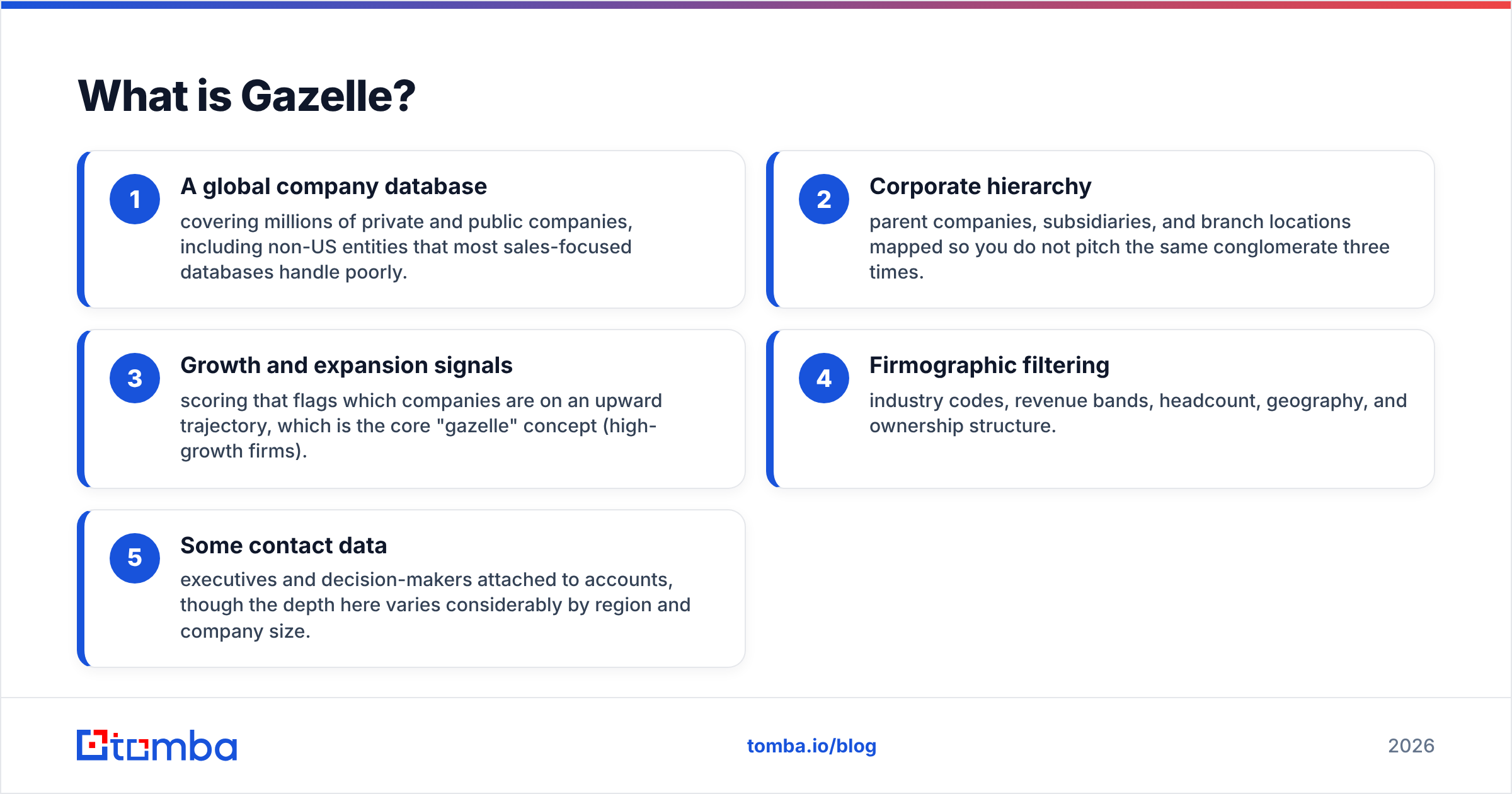
- A global company database covering millions of private and public companies, including non-US entities that most sales-focused databases handle poorly.
- Corporate hierarchy — parent companies, subsidiaries, and branch locations mapped so you do not pitch the same conglomerate three times.
- Growth and expansion signals — scoring that flags which companies are on an upward trajectory, which is the core "gazelle" concept (high-growth firms).
- Firmographic filtering — industry codes, revenue bands, headcount, geography, and ownership structure.
- Some contact data — executives and decision-makers attached to accounts, though the depth here varies considerably by region and company size.
Gazelle is a targeting tool. You use it to answer "which 400 companies deserve our attention this quarter." It is not designed as a bulk export machine for cold email lists.
What is Wiza?#
Wiza sits at the opposite end of the funnel. It is a contact-data tool built almost entirely around LinkedIn. You build a search in Sales Navigator (or upload a list of profiles), run Wiza, and it returns work emails, personal emails, and — on higher tiers — mobile numbers, verified in real time.
The workflow is deliberately narrow:
- Chrome extension that reads your Sales Navigator search or list and exports the results.
- Real-time verification at export time, so bounced-out addresses are supposed to be filtered before they hit your CSV.
- Credit-based pricing, where an email costs one credit and a phone number costs more.
- CRM push into HubSpot, Salesforce, Outreach, and similar, plus a straightforward API.
Wiza's honest pitch is speed. From "I have an ICP filter in Sales Navigator" to "I have a CSV of verified contacts" is minutes, not days.
How do Gazelle and Wiza compare head-to-head?#
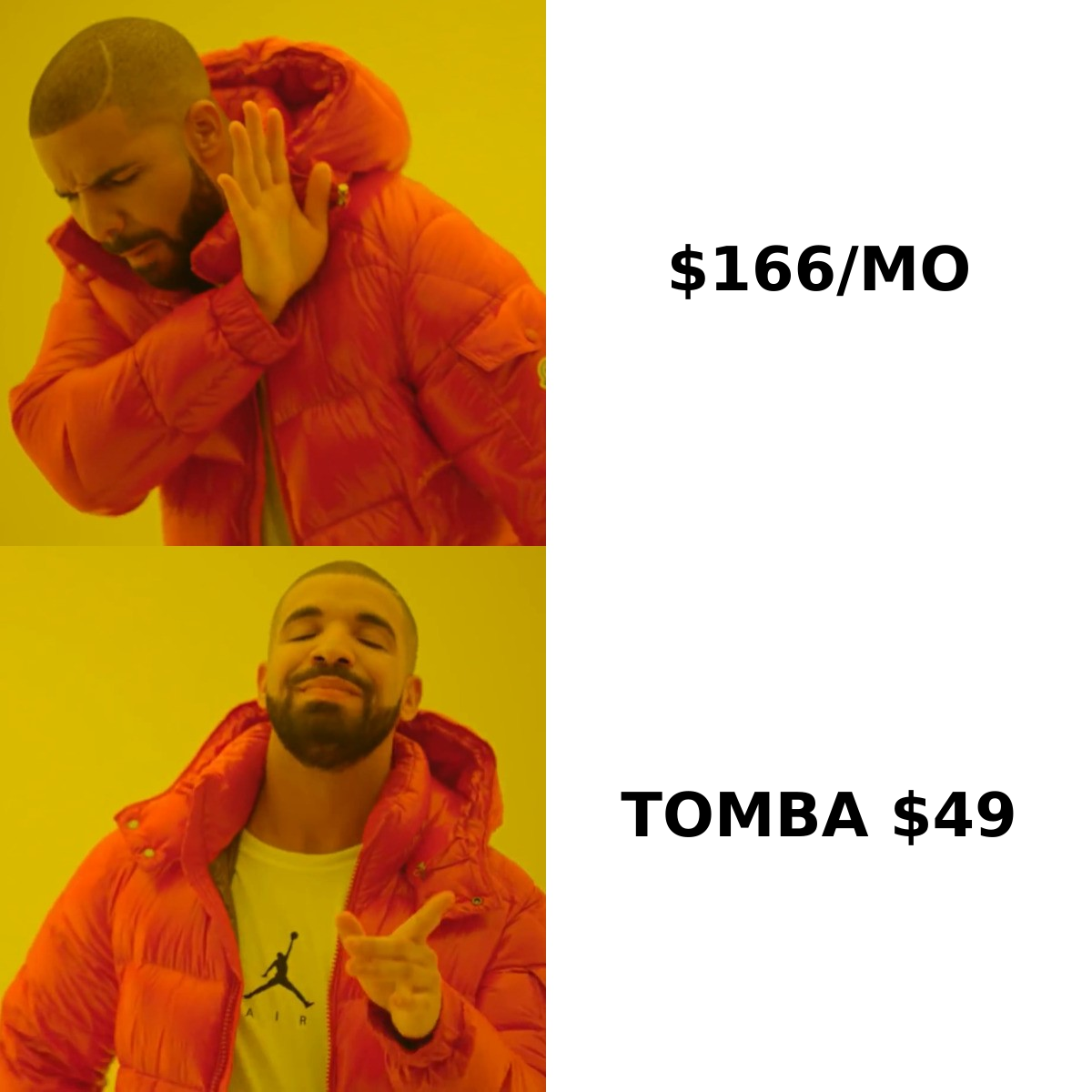
| Attribute | Gazelle | Wiza |
|---|---|---|
| Primary job | Account selection and market intelligence | Contact extraction from LinkedIn |
| Data unit | Companies (with some contacts) | People (emails, phones) |
| Core source | Aggregated company filings, news, growth signals | LinkedIn / Sales Navigator profiles + verification |
| Global coverage | Strong outside North America | Follows LinkedIn density (weak where LinkedIn is weak) |
| Buying motion | Sales call, demo, annual contract | Self-serve signup, credits, monthly plan |
| Free tier | No public self-serve free plan | Limited free credits on signup |
| Best for | Market entry, ABM account lists, expansion research | SDR teams filling sequences weekly |
| Worst for | Building a 5,000-contact cold email list | Discovering accounts you have never heard of |
| Learning curve | Moderate (analyst-style filters) | Low (extension + click) |
| API | Available on enterprise arrangements | Yes, documented and self-serve |
The table makes the real conclusion obvious: for most outbound teams these are complements, not substitutes. Gazelle tells you where to aim. Wiza loads the magazine. Choosing "one or the other" only makes sense when one half of that problem is already solved for you.
Which one has better data coverage?#
Depends entirely on what you are counting.
On companies, Gazelle is deeper. If your ICP includes manufacturers in Poland, logistics firms in Brazil, or mid-market industrials that never raised venture capital, Gazelle's coverage of non-tech and non-US entities is a genuine differentiator. Most sales databases are built on a tech-startup-shaped view of the world; Gazelle is not.
On people, Wiza is deeper — with a caveat. Wiza's ceiling is LinkedIn's ceiling. Where LinkedIn adoption is high (North America, Western Europe, SaaS, professional services), you will find the person you want. Where adoption is thin (parts of APAC, Japan, plenty of industrial and public-sector roles, most of the trades), the profile simply does not exist, and no amount of credits will produce it.
This is the trap in "gazelle vs wiza" comparisons that only look at headline database sizes. A 20-million-company index and a 900-million-profile index are not comparable numbers. Ask instead: of the 300 accounts I actually care about, how many decision-maker emails can each tool produce? Run that test with a sample list of 50 target accounts before you sign anything. Vendors will happily do it on a demo call, and the results are far more informative than any G2 grid.
How accurate is the contact data?#
Every vendor in this space quotes a headline accuracy number, and every one of those numbers is measured differently. Some report the share of returned emails that pass SMTP validation. Some report the share of attempted lookups that return anything at all. Those two figures can differ by 40 points on the same dataset.
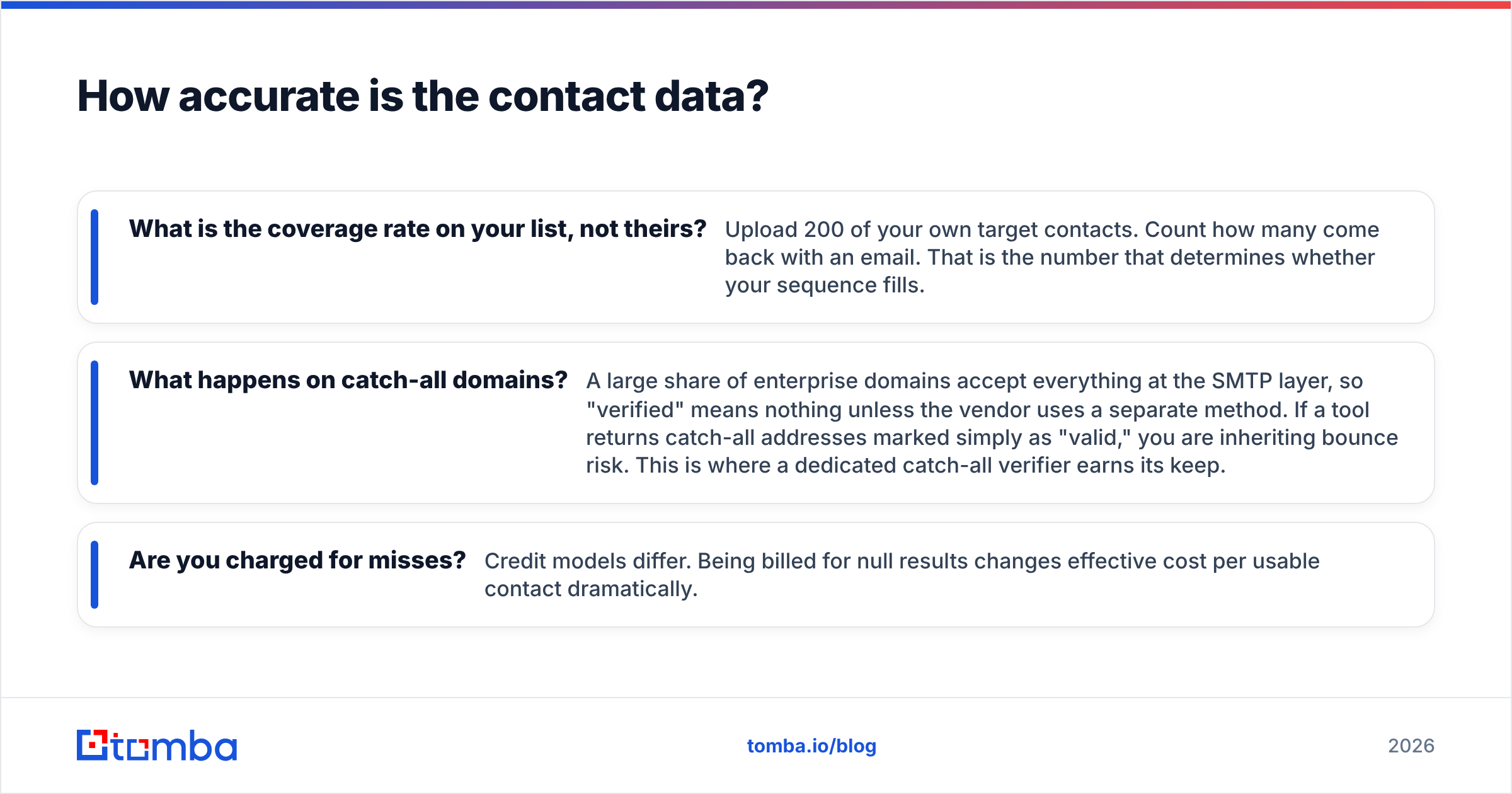
Three questions cut through the marketing:
- What is the coverage rate on your list, not theirs? Upload 200 of your own target contacts. Count how many come back with an email. That is the number that determines whether your sequence fills.
- What happens on catch-all domains? A large share of enterprise domains accept everything at the SMTP layer, so "verified" means nothing unless the vendor uses a separate method. If a tool returns catch-all addresses marked simply as "valid," you are inheriting bounce risk. This is where a dedicated catch-all verifier earns its keep.
- Are you charged for misses? Credit models differ. Being billed for null results changes effective cost per usable contact dramatically.
Wiza's real-time verification is a real advantage over static database exports, and in practice its bounce rates are competitive. Gazelle's contact records are secondary to its firmographics, so treat any emails you pull from it as raw input that still needs email verification before you send.

What does Gazelle vs Wiza actually cost?#
Here is where the two products diverge hardest — and where a lot of buyers get surprised.
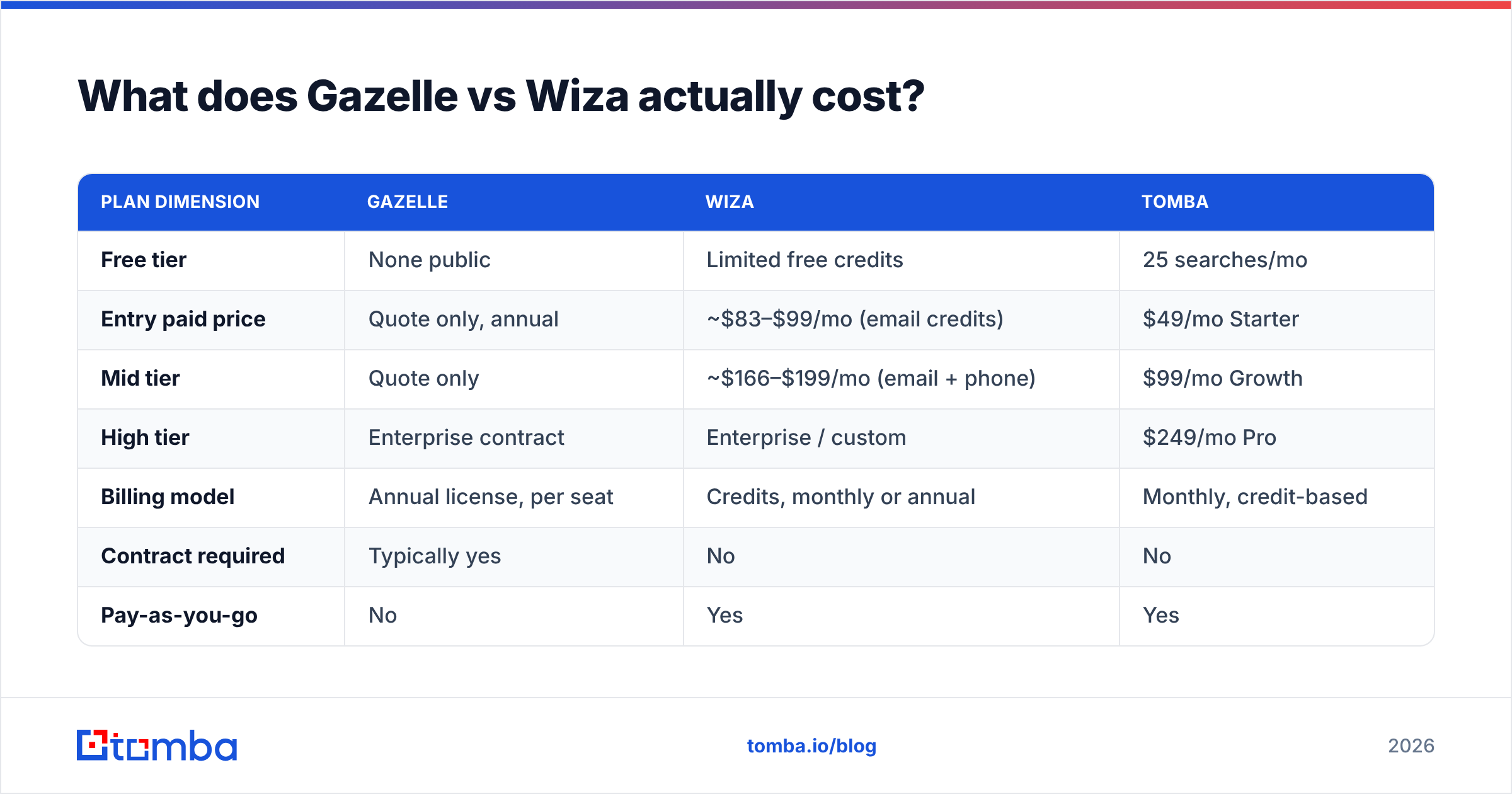
| Plan dimension | Gazelle | Wiza | Tomba |
|---|---|---|---|
| Free tier | None public | Limited free credits | 25 searches/mo |
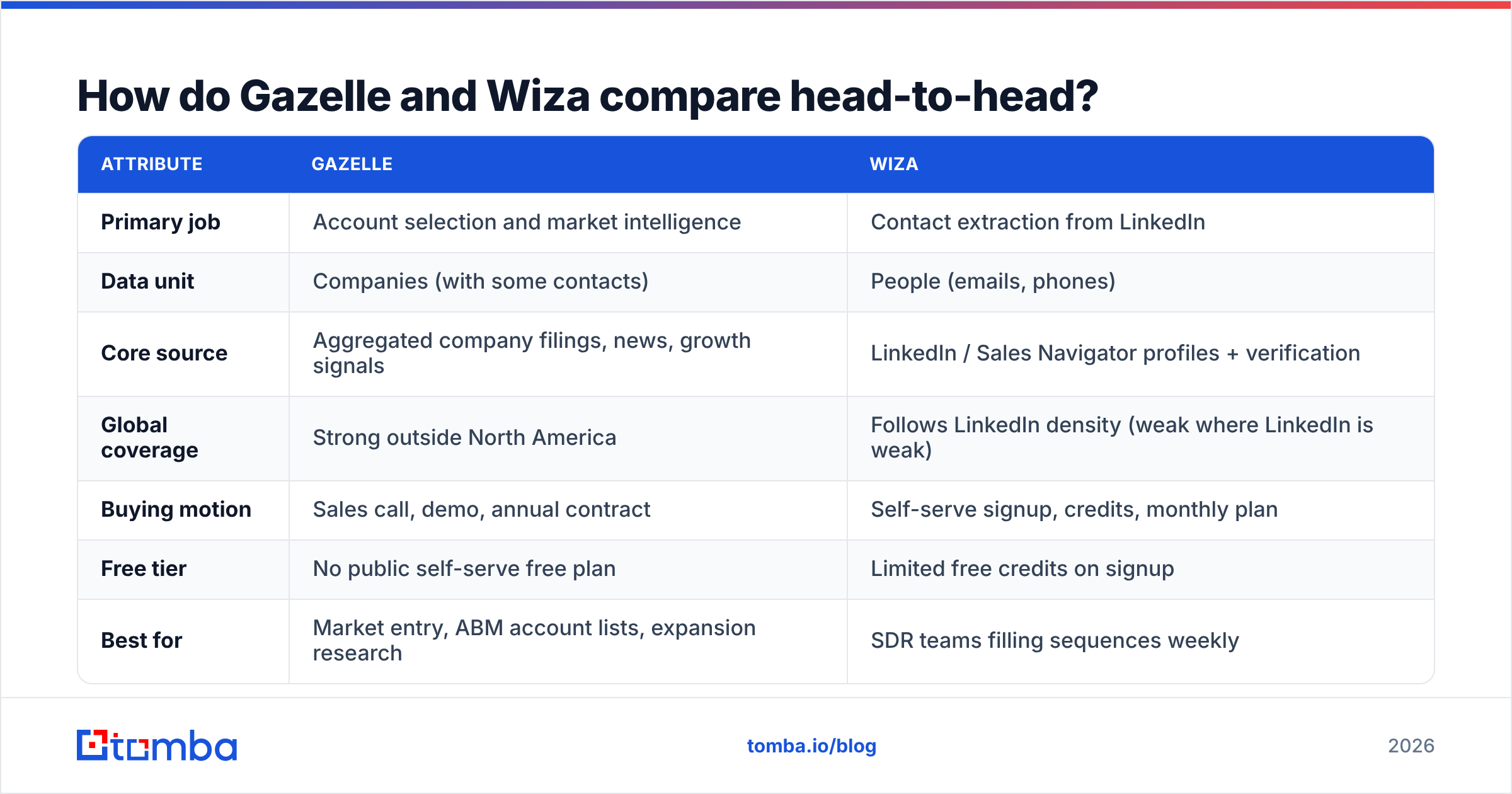
| Entry paid price | Quote only, annual | ~$83–$99/mo (email credits) | $49/mo Starter |
| Mid tier | Quote only | ~$166–$199/mo (email + phone) | $99/mo Growth |
| High tier | Enterprise contract | Enterprise / custom | $249/mo Pro |
| Billing model | Annual license, per seat | Credits, monthly or annual | Monthly, credit-based |
| Contract required | Typically yes | No | No |
| Pay-as-you-go | No | Yes | Yes |
Prices for third-party tools are as advertised at the time of writing; check each vendor's own pricing page before you budget, since credit definitions change more often than the price tags do. Tomba's numbers are on the Tomba pricing page.
The structural difference matters more than the specific figures. Gazelle is an annual commitment with a sales cycle. You will do a demo, negotiate seats, and sign for twelve months. That is normal for market-intelligence software and fine if you are an economic development agency or a corporate strategy team. It is painful if you are a four-person startup that wants to test outbound for six weeks.
Wiza is closer to a utility. Sign up, buy credits, stop when you want. The cost creeps up when you need phone numbers — mobile data is expensive to source everywhere — and when your team exports far more than it actually sequences. Audit your credit burn monthly; the most common waste pattern in credit-based tools is exporting 5,000 contacts and emailing 800 of them.
Who should choose Gazelle?#
Pick Gazelle if two or more of these describe you:
- You sell into non-US or non-tech markets where LinkedIn-sourced lists come back thin and generic databases return stale records.
- Your unit of work is the account, not the contact. ABM programs, territory planning, and market-entry research all live at the company level.
- You need corporate hierarchy. Knowing that three prospects roll up to one parent changes how you route and price.
- You have a budget cycle, not a credit card. Annual licensing is a feature when procurement expects it and a bug when it does not.
- Growth signals drive your prioritization. If "is this company expanding" is a scoring input in your lead management model, Gazelle is built for exactly that.
Who should choose Wiza?#
Pick Wiza if:
- Your reps already live in Sales Navigator. The workflow fit is excellent and adoption friction is near zero.
- You need contacts weekly, not quarterly. Credit-based, self-serve tooling suits a team that refills sequences on a cadence.
- Your ICP is LinkedIn-dense — SaaS, agencies, professional services, mid-to-large companies in North America and Western Europe.
- You want mobile numbers alongside emails and are willing to pay a premium for them.
- You want no contract. Testing outbound for a quarter should not require a legal review.
If Wiza's LinkedIn dependency is the sticking point, the Wiza alternative landscape is worth a look — several tools reach the same contacts through domain-based discovery rather than profile scraping, which behaves very differently on companies with low LinkedIn adoption.
Where do both tools fall short?#
Three gaps show up repeatedly in real deployments.
1. Neither is a cost-efficient verification layer. Both charge data-platform prices. If you already have a list — from a conference, a webinar, a partner, or your CRM's decaying contact table — paying per-credit rates to re-enrich it is expensive. A standalone verifier plus a bulk email finder handles that job at a fraction of the cost.
2. Neither replaces a database you can query by domain. A surprisingly common need is "give me every reachable contact at these 500 domains," with no LinkedIn URL and no firmographic filtering involved. That is a domain search problem, and it is the fastest path from a target-account list to sendable contacts.
3. Coverage gaps are structural, not fixable by buying more credits. If a persona is not on LinkedIn and not in the company index, no plan tier changes that. Mature teams run two or three sources and dedupe, rather than betting everything on a single vendor. For region-heavy or industry-specific lists, purpose-built providers like BookYourData are a reasonable second source alongside whichever primary tool you pick — different sourcing methods surface different people, and that overlap gap is where your incremental pipeline lives.
What is the practical verdict?#
If you must pick one and you already know your target accounts, pick Wiza. It converts existing targeting into sendable contacts faster and with less commitment than anything in Gazelle's product line.
If you do not yet know who to sell to — especially outside North America — pick Gazelle. Contact data is a solved, commoditized problem; account intelligence in underserved markets is not, and that is where Gazelle's price is defensible.
If your real problem is "I need verified work emails, at volume, without an annual contract," neither is the efficient answer. That is a tooling question with a much cheaper solution: source accounts however you like, then run them through a dedicated finder-and-verifier stack. At $49/mo for Starter and a free tier for testing, the economics are not close.
Start with the Tomba Email Finder — search by domain, name, or company, verify in the same pass, and export straight into your CRM without a procurement cycle. Run it against 25 of your target accounts on the free tier, compare the hit rate to whatever Gazelle or Wiza quoted you, and let your own list decide the winner.
Related guides#
Ready to find emails that actually work?
Join 150,000+ professionals who stopped guessing and started sending. Free credits on signup — no credit card required.
Get the Tomba newsletter
Practical outbound tactics and product updates — once every two weeks.
About the author