Gazelle vs Zintlr: Which B2B Data Platform Wins in 2026?
Gazelle.ai sells company-level growth intelligence. Zintlr sells contact-level prospecting data with personality profiles. They barely compete — and picking wrong costs you a year of budget. Here's the honest breakdown.
TL;DR
- Gazelle vs Zintlr is not a fair fight. The two tools do different jobs.
- Gazelle.ai tracks firms. It flags the ones that grow, hire, or move.
- Zintlr tracks people. It hands a rep a work email and a phone number.
- Pick Gazelle if you need to know which firms to chase.
- Pick Zintlr if you need to know who to email today.
- Neither tool proves an email still works. Run each list through an email verifier before you send.
- Price is the sharpest split. Zintlr posts its plans. Gazelle quotes once a year.
What is Gazelle.ai, and who buys it?#
Gazelle.ai is a company data tool. It does not hand you a contact. It points at firms that may grow, invest, or move.
The database holds tens of millions of firms. Most are private, so they rarely show up in market data. A scoring layer sits on top. It rates growth odds from staff counts, sales trends, sites, and parent-child links.
That tells you who buys it. The core base is economic development groups, trade bodies, real estate teams, and site pickers. If you want a plant built in your county, Gazelle fits. If you want fifteen demos this week, it does not.
So Gazelle is strong at picking accounts. It is thin on the last step: who do I email, and will that email bounce?
What is Zintlr, and how is it different?#
Zintlr sits at the other end of the funnel. Search by firm, role, place, or trade. Then pull work emails, direct dials, and LinkedIn links into your sequence.
Its hook is a personality layer. Zintlr guesses how a buyer likes to be pitched: blunt or soft, detail or big picture. That lift is real only if your reps rewrite their openers. Teams that ignore it pay for a feature they never open.
Zintlr also ships a LinkedIn add-on. That matters more than the feature list hints. Most sales tools die because they live in a second tab. A tool inside the workflow gets used.

Where does Gazelle vs Zintlr really split?#
Five things drive the split. The rest is detail.
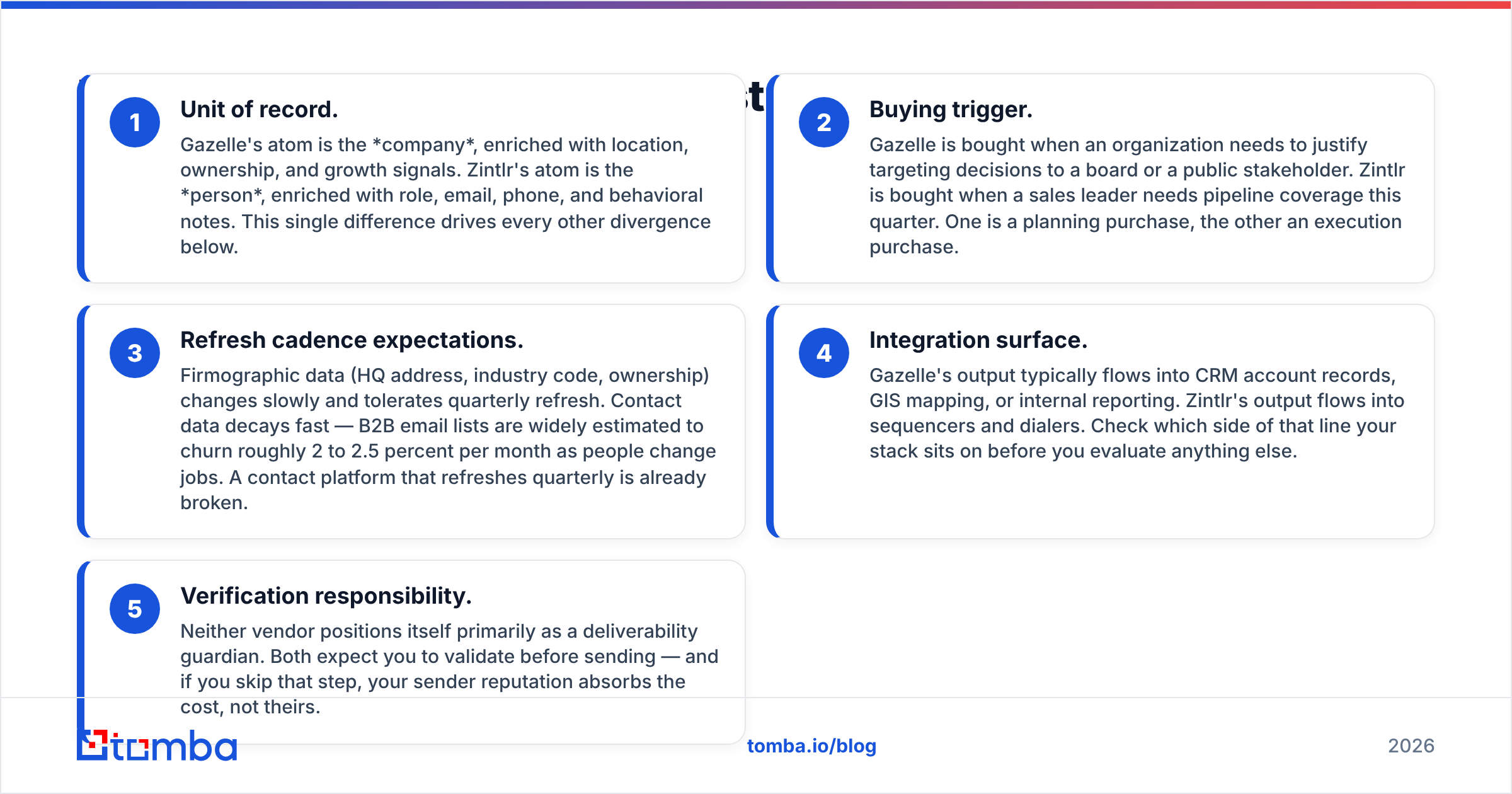
- Unit of record. Gazelle starts with the firm: site, owner, growth signs. Zintlr starts with the person: role, email, phone, style notes. Everything else flows from that.
- Buying trigger. Gazelle gets bought to defend targeting choices to a board. Zintlr gets bought to fill the pipe this quarter. One is planning. The other is doing.
- Refresh speed. Firm data moves slowly, so a quarterly refresh is fine. Contact data rots fast. B2B lists lose roughly 2% to 2.5% of addresses each month as people switch jobs.
- Where the data lands. Gazelle output goes to CRM accounts, maps, and reports. Zintlr output goes to sequencers and dialers. Check which one your stack needs.
- Who checks the email. Neither vendor guards your inbox rate. Both expect you to verify first. Skip that step and your domain pays, not theirs.
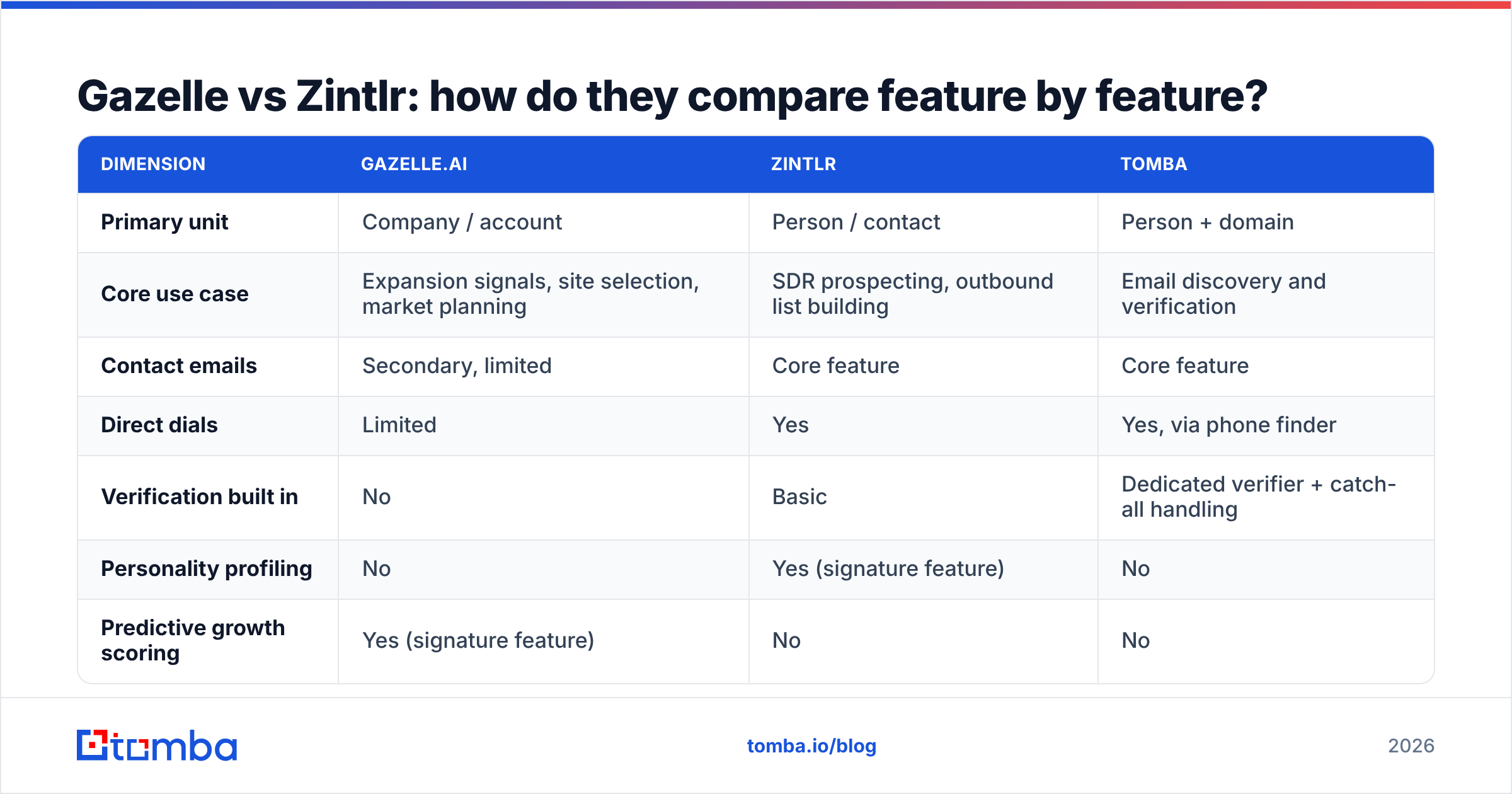
Gazelle vs Zintlr: how do they compare feature by feature?#
The table below reflects public claims as of early 2026. Prices and coverage move fast, so check the vendor sites before you sign. Tomba sits here as a third point of view, since most of these teams really have a contact data problem.
| Dimension | Gazelle.ai | Zintlr | Tomba |
|---|---|---|---|
| Primary unit | Company / account | Person / contact | Person + domain |
| Core use case | Expansion signals, site selection, market planning | SDR prospecting, outbound list building | Email discovery and verification |
| Contact emails | Secondary, limited | Core feature | Core feature |
| Direct dials | Limited | Yes | Yes, via phone finder |
| Verification built in | No | Basic | Dedicated verifier + catch-all handling |
| Personality profiling | No | Yes (signature feature) | No |
| Predictive growth scoring | Yes (signature feature) | No | No |
| Browser extension | Limited | Yes (LinkedIn) | Yes (Chrome) |
| Pricing model | Annual custom quote | Published self-serve tiers | Free tier, then $49 / $99 / $249 per month |
| Free entry point | Demo only | Limited free plan | 25 searches per month |
| API access | Enterprise-tier | Available on paid plans | Available across paid plans |
| Best for | EDOs, site selectors, CRE, market analysts | SDR teams, agencies, founders doing outbound | Teams that need verified addresses at volume |
Two things stand out. First, the Gazelle vs Zintlr overlap is smaller than the search term implies. Most teams on the fence are unsure which problem they have. Second, the two price models do not compare. A yearly license and a monthly seat only line up once you know your volume.
Which platform has better data quality?#
Both are strong, but on different things. Neither one posts an audited accuracy score you can hold it to.
Gazelle is deep on private firms. It also links parents, units, and sites. That map is hard to build, and it explains the price. Contact records are not the point of the product. Expecting SDR-grade emails from it is a category error, not a vendor failure.
Zintlr is strong on contact volume and speed inside LinkedIn. Its weak spot is common to mid-market contact tools. Coverage thins outside tech, North America, and Western Europe. Some emails are guessed from a pattern and never checked at the mail server. Read G2 reviews with that in mind. The same two gripes repeat across the whole category: bounce rates and stale job titles.
Here is the part most Gazelle vs Zintlr posts skip. A found email is not a live email. Job changes alone kill a fifth to a third of B2B records each year. A guessed address on a catch-all domain can look fine to a weak checker and still go nowhere. Send at scale to that list and your domain takes the hit. That damage takes months to undo.
So verify between export and send, whichever tool you pick. A pass through a bulk email finder is cheap next to the cost of a burned domain.
What does each one cost in 2026?#
The Gazelle vs Zintlr price gap is not subtle.
Zintlr posts self-serve plans, including a small free tier. Seats are priced for single reps and lean teams. A founder can put it on a card and test it in an afternoon. Check the live numbers, since self-serve prices shift a few times a year.
Gazelle posts nothing. Expect a demo, a yearly contract, and a data license price. Buyers here tend to have a budget line and a procurement cycle already in place.
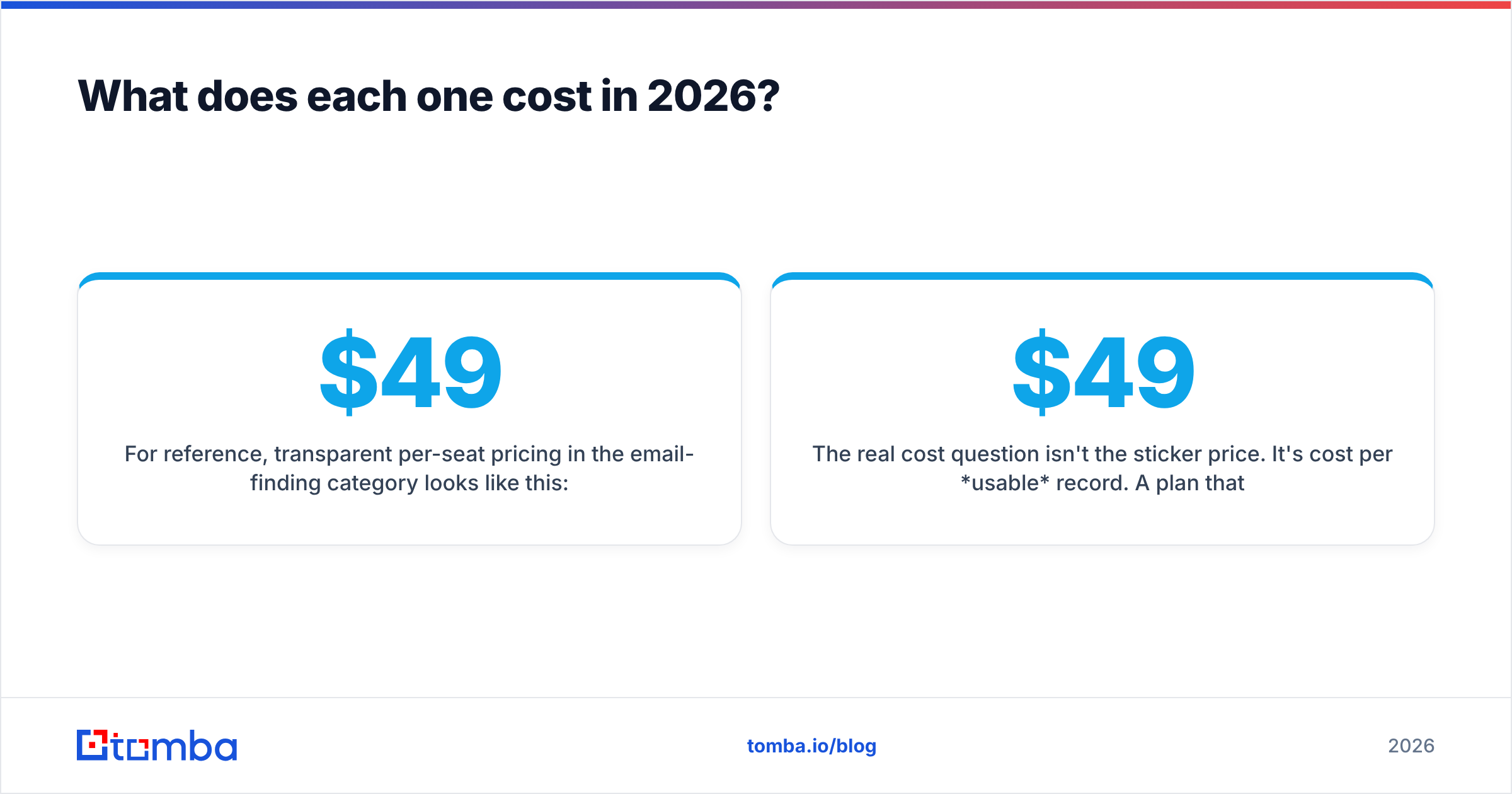
For a clear per-seat baseline, look at Tomba. The free tier gives 25 searches a month. Paid plans run $49, $99, and $249 a month, with custom terms above that. See the Tomba pricing page.
Sticker price is the wrong question. Cost per usable record is the right one. A $49 plan with 400 live addresses beats a free plan with 1,000 records when a third bounce. Bounces do more than waste time. They hurt the campaigns you send next month.
Which should you choose for your team?#
The Gazelle vs Zintlr choice comes down to the job, not the review score.
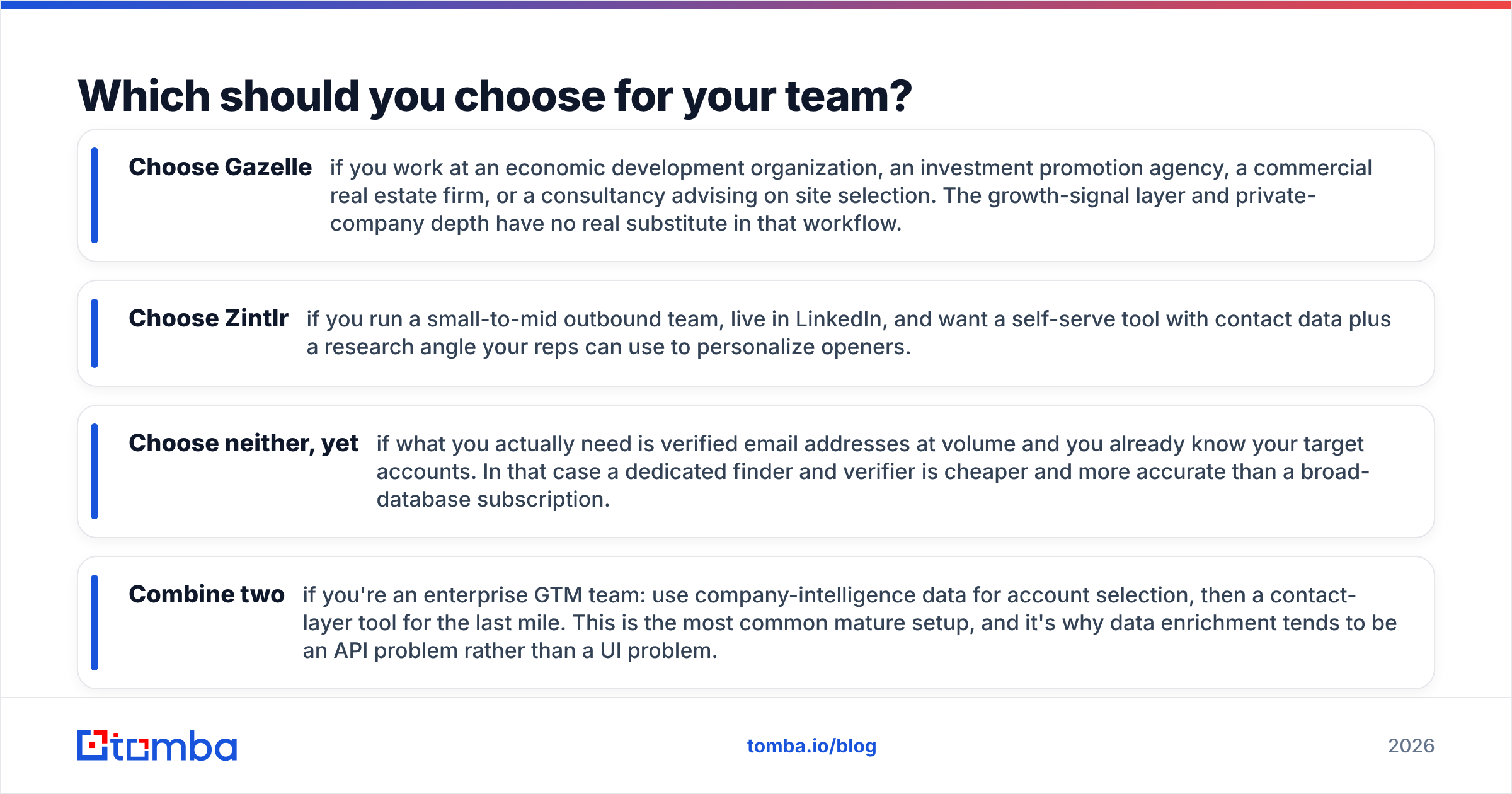
- Choose Gazelle if you work in economic development, trade promotion, real estate, or site selection. Nothing else covers private firms and growth signs as well.
- Choose Zintlr if you run a small outbound team, live in LinkedIn, and want contact data plus a research angle for your openers.
- Choose neither, yet if you already know your target accounts and just need live emails. A finder and verifier costs less and hits more.
- Use both if you are a large GTM team. Pick accounts with firm data. Close the last mile with contact data. That is why data enrichment is an API job, not a UI job.
If you go the both route, the plumbing matters more than any feature. Pull account lists from one tool. Resolve contacts through the Tomba API inside your own pipeline. That skips the CSV shuffle, which quietly kills most data workflows within a quarter.
What do both platforms leave you to solve?#
Gazelle vs Zintlr aside, three gaps stay open.
Catch-all domains. Many large mail servers accept every address. A basic check then returns "valid" for a mailbox that does not exist. Lists full of big firms need catch-all logic, not a generic pass.
Job changes. The contact you pulled in January may be gone by March. Verify before each big send, not once a year.
Sending hygiene. Clean data feeds good email deliverability, but it is not the whole job. Auth records, ramp speed, and copy still decide who reaches the inbox. Neither vendor owns that layer, and neither claims to.
Frequently asked questions#
Is Gazelle a direct rival to Zintlr? Not really. They share the "B2B data" label and little else. Gazelle sells account insight. Zintlr sells contacts. Most teams comparing them have not yet named their real problem.
Why does Gazelle vs Zintlr come up so often? Both get filed under B2B data tools, so they land on the same shortlist. Once you name the job, the choice is usually clear in a minute.
Which has better email accuracy? Zintlr, by design. Contact data is its core product. Gazelle treats it as a side field. Neither posts an audited number, so verify before you send.
Can I use both? Yes, and large teams often do. Use Gazelle to plan targets and a contact tool to reach them. Just make them meet in your CRM, not in a spreadsheet.
Do I still need a separate verifier? Yes. Treat every export as raw input, above all where catch-all domains are common. Verification is the cheapest line in the stack.
The verdict#
The Gazelle vs Zintlr verdict is short. Gazelle wins on account insight for growth and location work. Zintlr wins on speed to a contact for self-serve teams. Neither wins on live, verified email, because neither was built for it.
Is your real block finding and confirming the right work email? Then start there. The Tomba Email Finder looks up an address by name, domain, or company. It checks that address against several sources. Then it gives you a confidence score before you send. The free tier gives 25 searches a month. Test it on a list where you already know the answers. That is how you should judge any data vendor, these two included.
Related guides#
Ready to find emails that actually work?
Join 150,000+ professionals who stopped guessing and started sending. Free credits on signup — no credit card required.
Get the Tomba newsletter
Practical outbound tactics and product updates — once every two weeks.
About the author