GDPR Sales Automation: How to Stay Compliant in 2026
Automated outbound and GDPR can coexist — but only if your data sourcing, consent basis, and retention rules are built into the stack. Here is the practical compliance playbook.
TL;DR — GDPR sales automation in 2026
- GDPR does not ban cold outreach. It bans unaccountable data processing. You can run GDPR sales automation legally if you can prove three things: where each contact came from, why you wrote to them, and how fast you delete them on request.
- Article 6(1)(f) — legitimate interest — is the workable lawful basis for B2B cold email in most EU markets. It needs a written Legitimate Interest Assessment (LIA), not a checkbox.
- Your stack is a processing chain. Every tool in it (finder, enricher, sequencer, CRM) needs a Data Processing Agreement and a clear sourcing story.
- Three failure points get companies fined: no record of source, no working opt-out, and stale contact data kept forever.
- Build compliance into the pipeline — suppression lists, source fields, retention jobs. Auditing after the fact is where the cost is.
What does GDPR actually require from automated sales?#
Short version: GDPR sales automation demands accountability per contact. You must be able to say what you hold, where it came from, why you are allowed to hold it, and how someone makes you stop.
Think of GDPR like a customs regime for personal data. Nobody stops you at the border for moving goods. They stop you when you can't produce the paperwork. Sales automation moves thousands of records a week. If the paperwork isn't created as the records move, you will never produce it under audit.
The rules apply to any data that identifies a living person. firstname.lastname@company.com is personal data. So is a work phone number tied to a named individual. A generic info@company.com inbox usually is not. That puts role-based addresses in a lower-risk tier. They also convert worse, so few teams rely on them.
Four obligations do the heavy lifting for outbound teams:
- Lawful basis (Art. 6) — You need one before the first send, not after the first reply. For B2B prospecting this is nearly always legitimate interest.
- Transparency (Art. 13/14) — You collected the data indirectly, so Article 14 applies. At first contact, tell them who you are, where you got their details, and what you plan to do with them.
- Data subject rights (Art. 15–22) — Access, rectification, erasure, and objection. Objection to direct marketing is absolute. When someone says stop, you stop. There is no balancing test.
- Retention limitation (Art. 5(1)(e)) — You cannot keep a prospect record forever because "they might buy in 2029."
The ePrivacy Directive sits on top for electronic messages. This is where national rules differ most. Germany and Austria expect stricter consent for B2B email. The UK, Ireland, and the Netherlands broadly accept "corporate subscriber" outreach on legitimate interest. The official GDPR text is worth reading once. Your DPO's read of your target markets matters more.
Is legitimate interest enough for cold outbound in 2026?#
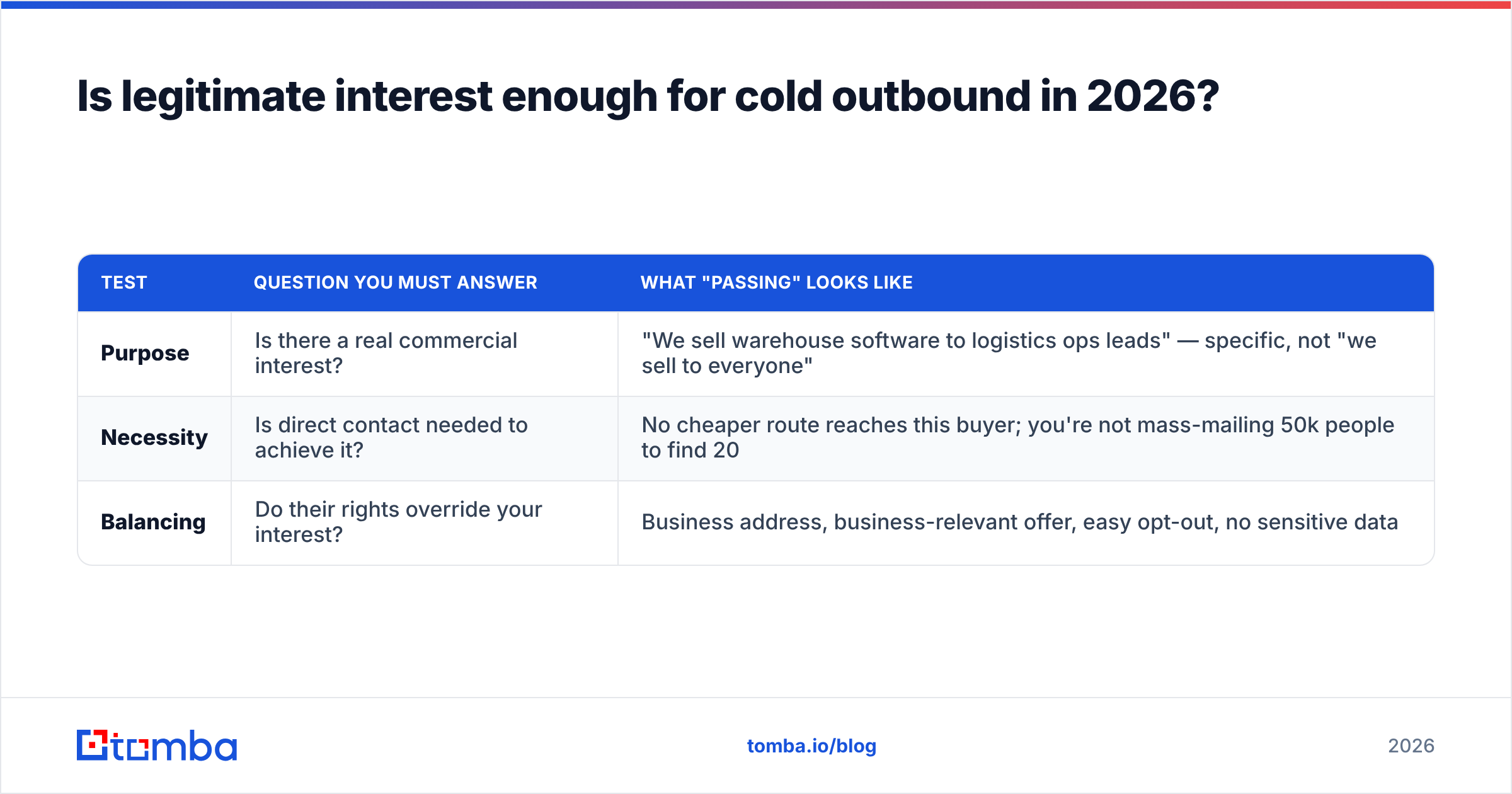
Yes — if you write it down, and if the outreach is genuinely relevant to the recipient's job.
Legitimate interest is a three-part test you record before you start sending:
| Test | Question you must answer | What "passing" looks like |
|---|---|---|
| Purpose | Is there a real commercial interest? | "We sell warehouse software to logistics ops leads" — specific, not "we sell to everyone" |
| Necessity | Is direct contact needed to achieve it? | No cheaper route reaches this buyer; you're not mass-mailing 50k people to find 20 |
| Balancing | Do their rights override your interest? | Business address, business-relevant offer, easy opt-out, no sensitive data |
Teams fail the balancing test when they target too broadly. You found a domain pattern and emailed all 5,000 staff? That is not legitimate interest. It is spray-and-pray with a legal wrapper. Now take the 4 people whose LinkedIn title says "Head of Procurement" at companies that match your ICP. That is defensible, because the relevance is obvious to the reader.
Practical LIA hygiene:
- Write it once per campaign type, not per contact. A one-page LIA covering "outbound to logistics ops leaders in DACH" is fine.
- Date it and version it. An LIA written in 2024 for a product you no longer sell is worse than none.
- Record the ICP filter you used. "Job title contains X, company size 50–500, industry Y" is your relevance evidence.
- Re-run the balancing test when you change channels. Email LI ≠ phone LI ≠ LinkedIn DM LI. Cold calling also has national do-not-call registries.
Note what legitimate interest does not buy you. It never overrides an objection. And in most member states it does not apply to consumer (B2C) email at all, where ePrivacy demands opt-in consent.
Where does your data come from — and can you prove it?#
This question decides whether your stack is compliant. Most teams cannot answer it.
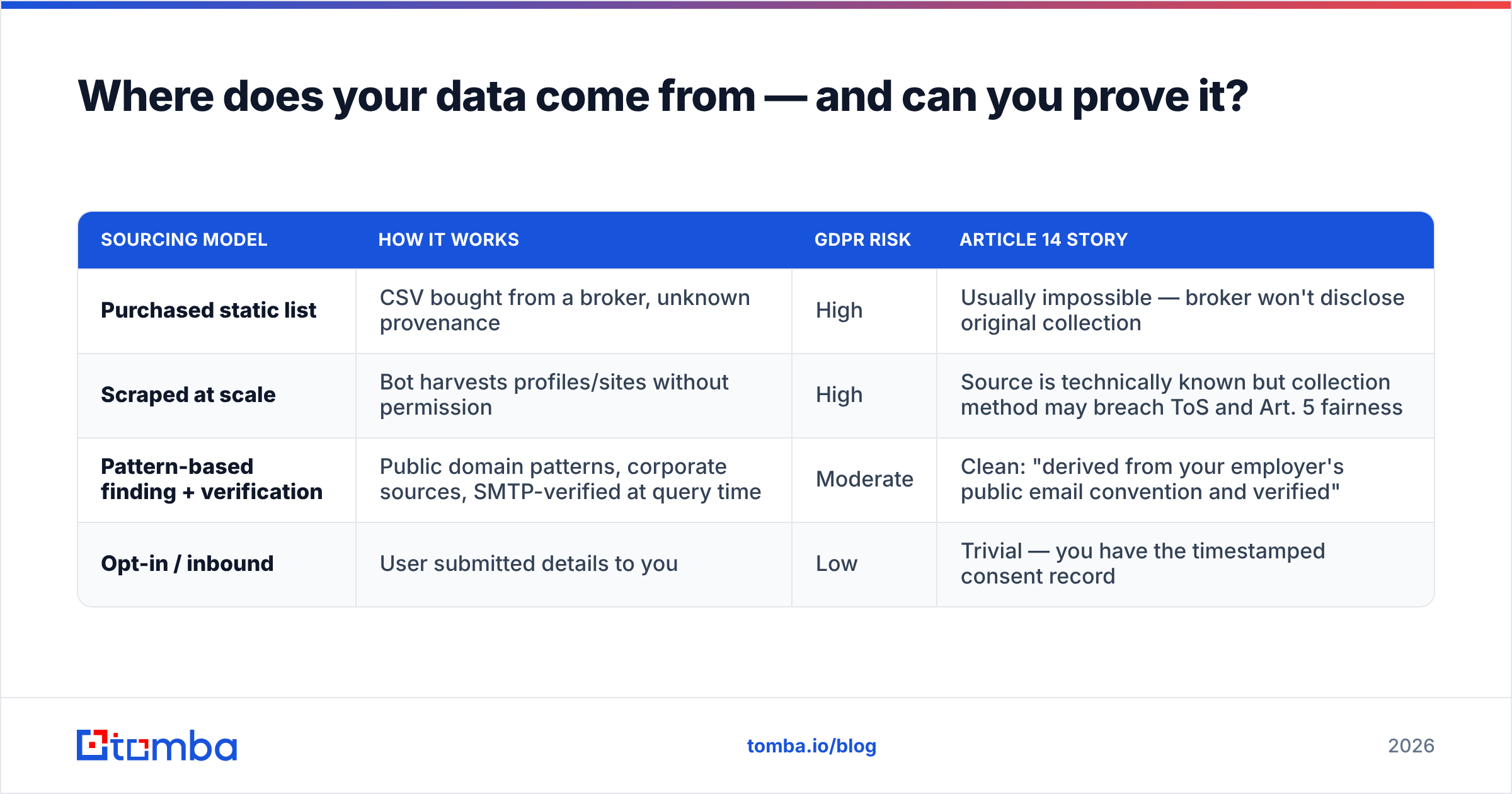
Article 14 says you must disclose the source of data you didn't collect directly. So your CRM needs a source field filled in automatically, not a sales rep's memory. Three sourcing models exist, and the risk gap between them is wide:
| Sourcing model | How it works | GDPR risk | Article 14 story |
|---|---|---|---|
| Purchased static list | CSV bought from a broker, unknown provenance | High | Usually impossible — broker won't disclose original collection |
| Scraped at scale | Bot harvests profiles/sites without permission | High | Source is technically known but collection method may breach ToS and Art. 5 fairness |
| Pattern-based finding + verification | Public domain patterns, corporate sources, SMTP-verified at query time | Moderate | Clean: "derived from your employer's public email convention and verified" |
| Opt-in / inbound | User submitted details to you | Low | Trivial — you have the timestamped consent record |
Pattern-based email finding is the model most modern tools use. It is also the easiest to defend. Say a tool works out that acme.com uses first.last@, and your target is Jane Doe at Acme. The address it returns is derived from a public business convention, then verified. That is not a covert grab from someone's private inbox. It is a story you can put in an Article 14 notice without embarrassment.
What to demand from any vendor before it touches your pipeline:
- A published data-sources page. If a vendor won't say where the data comes from, you inherit a source you can't explain. Tomba documents its data sources publicly. Expect that from every provider.
- A signed DPA with SCCs for any transfer outside the EEA. After Schrems II, US-hosted vendors need EU-US Data Privacy Framework certification or standard contractual clauses.
- Deletion propagation. When you erase a contact, does the vendor's cache still hold it? Ask directly.
- Sub-processor list. Your enrichment vendor probably calls three other APIs. Those are your sub-processors too.
Verification matters beyond deliverability. A dead or wrong address means you are processing inaccurate personal data. That is an Article 5(1)(d) accuracy problem, not just a bounce-rate problem. Running an email verifier before send is a compliance control dressed up as a hygiene step.
How do the main outbound tool categories compare on compliance?#
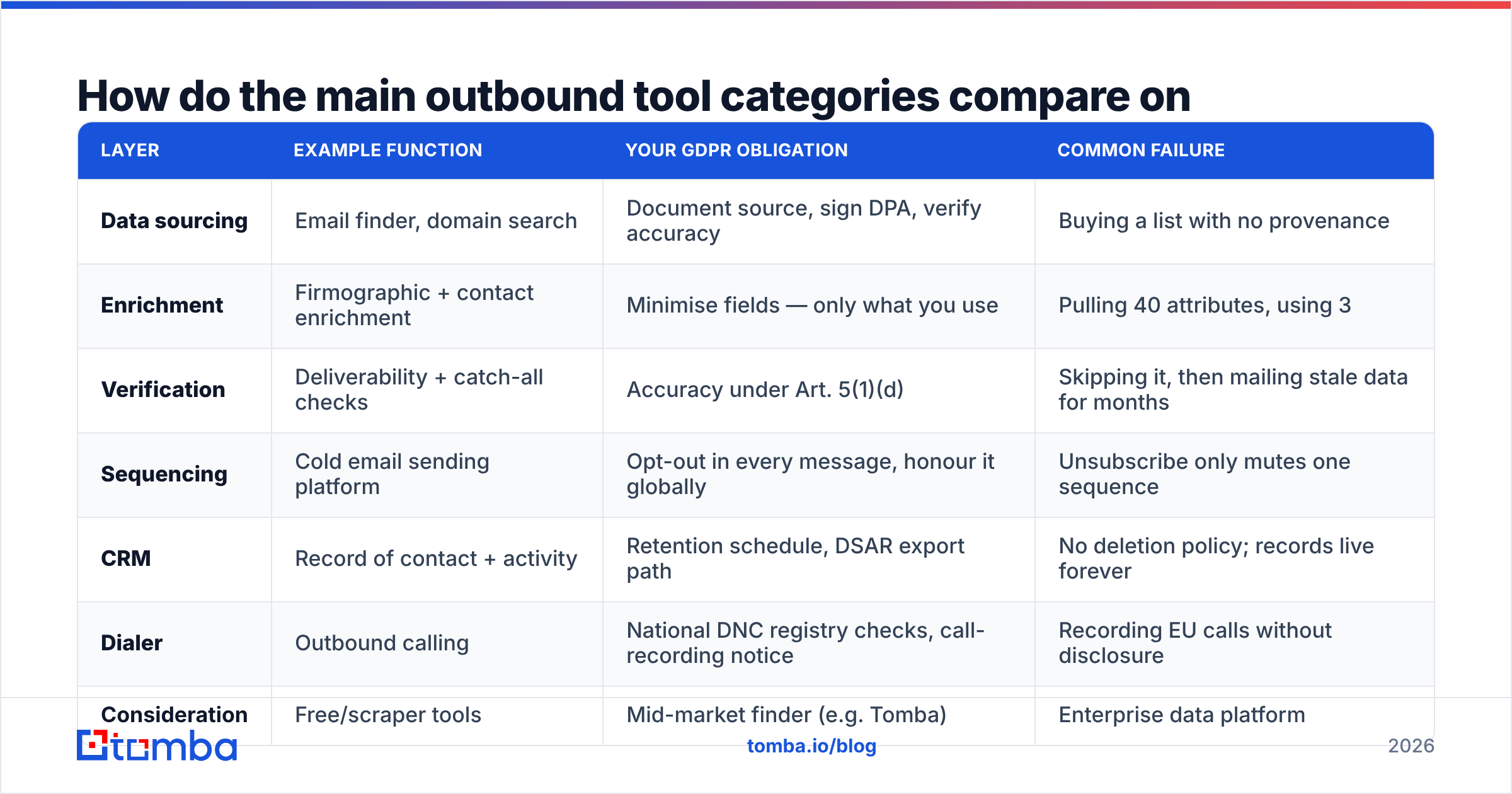
Different layers of a GDPR sales automation stack carry different duties. Here is how they line up:
| Layer | Example function | Your GDPR obligation | Common failure |
|---|---|---|---|
| Data sourcing | Email finder, domain search | Document source, sign DPA, verify accuracy | Buying a list with no provenance |
| Enrichment | Firmographic + contact enrichment | Minimise fields — only what you use | Pulling 40 attributes, using 3 |
| Verification | Deliverability + catch-all checks | Accuracy under Art. 5(1)(d) | Skipping it, then mailing stale data for months |
| Sequencing | Cold email sending platform | Opt-out in every message, honour it globally | Unsubscribe only mutes one sequence |
| CRM | Record of contact + activity | Retention schedule, DSAR export path | No deletion policy; records live forever |
| Dialer | Outbound calling | National DNC registry checks, call-recording notice | Recording EU calls without disclosure |
The sequencing layer is where the most visible breaches happen. Opt-out handling is usually scoped too narrowly. A prospect unsubscribes from Campaign A. Next quarter a rep enrolls them in Campaign B. You have just breached an absolute right. Your suppression list must live above the sequencer — in the CRM, or in a table every sending tool checks.
Put pricing next to compliance capability, because a cheap tool with no DPA is a false economy:
| Consideration | Free/scraper tools | Mid-market finder (e.g. Tomba) | Enterprise data platform |
|---|---|---|---|
| Entry price | $0 | Free tier: 25 searches/mo; Starter $49/mo | $15k–$50k/yr typical |
| DPA available | Rarely | Yes | Yes |
| Documented sourcing | No | Yes | Yes |
| Bulk deletion / cache purge | No | Yes | Yes |
| API for automated suppression | No | Yes | Yes |
| Realistic audit outcome | Indefensible | Defensible | Defensible |
Peer tools sit in the same tier and deserve the same questions. BookYourData, for example, publishes its data practices and sells pay-as-you-go. That suits teams that buy in bursts rather than on subscription. The point is not which logo you pick. It is whether the vendor answers sourcing and deletion questions in writing.
What does a compliant automated pipeline actually look like?#
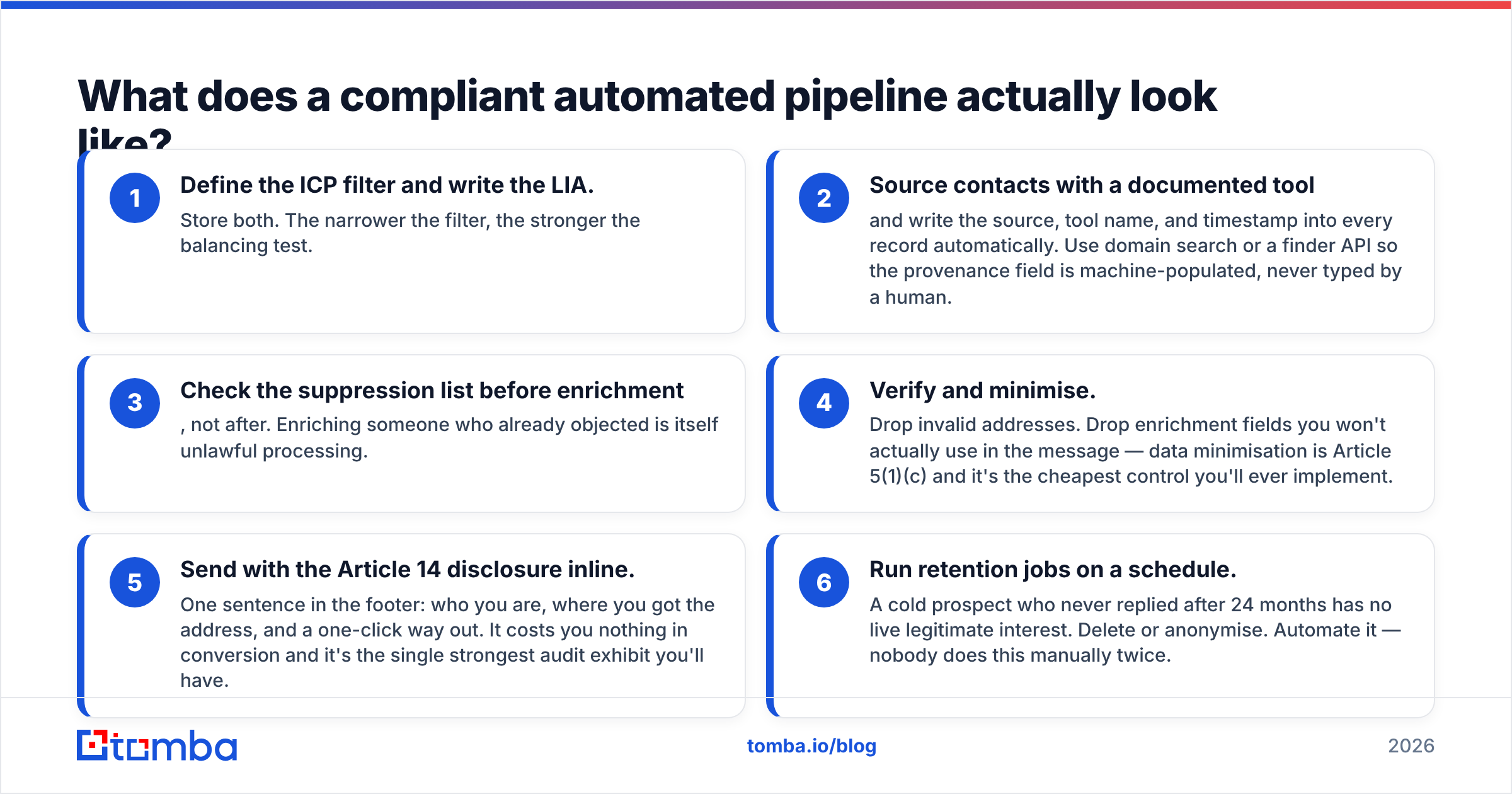
A compliant GDPR sales automation pipeline builds the controls into the flow. Six steps, each with a compliance artefact attached. The first three cover sourcing:
- Define the ICP filter and write the LIA. Store both. The narrower the filter, the stronger the balancing test.
- Source contacts with a documented tool. Write the source, tool name, and timestamp into every record automatically. Use domain search or a finder API so the field is machine-filled, never typed by a human.
- Check the suppression list before enrichment, not after. Enriching someone who already objected is itself unlawful processing.
The last three cover what happens once the record is in your CRM:
- Verify and minimise. Drop invalid addresses. Drop enrichment fields you won't use in the message. Data minimisation is Article 5(1)(c), and it is the cheapest control you will ever add.
- Send with the Article 14 disclosure inline. One sentence in the footer: who you are, where you got the address, and a one-click way out. It costs nothing in conversion. It is also the strongest audit exhibit you will have.
- Run retention jobs on a schedule. A cold prospect who never replied in 24 months has no live legitimate interest. Delete or anonymise them. Automate it — nobody does this by hand twice.
A workable footer looks like this: "You're receiving this because your role at [Company] matches who we build for. We found your work address via publicly available company email conventions. Reply 'stop' and you'll never hear from us again." It is honest. It covers Article 14's core disclosure. It also reads better than a block of legalese.
On retention windows, common industry practice — not a legal mandate — sits around:
- No engagement, ever: 12–24 months, then purge.
- Engaged but no opportunity: 24–36 months from last interaction.
- Objected / unsubscribed: keep only the minimum identifier needed to enforce the suppression, forever. This is explicitly permitted. Deleting a suppression record so you can mail someone again is the opposite of compliance.
Set the number. Write it in your retention policy. Enforce it with a job. Regulators care far more that you have a documented, enforced schedule than whether you picked 18 or 24 months.
What are the biggest GDPR sales automation mistakes?#
Ranked by how often they show up in enforcement actions and how easy they are to avoid:
- Unsubscribe that only mutes one sequence. Objection is global. Fix it by holding suppression above the tool layer.
- No source field. A DSAR arrives and you cannot say where the address came from. Everything downstream is then indefensible. Fix it by making the field non-nullable at ingest.
- Personal data in spreadsheets on laptops. Exports are the shadow database nobody deletes. Fix it with export logging and a policy that CSVs expire.
Three more show up just as often:
- Enriching everything because the credits are there. Every unused field is processing you can't justify. Map each attribute to a use in the message or the qualification logic.
- Treating US-hosted tools as an afterthought. Transfers need a legal mechanism. Check DPF certification or SCCs at procurement, not at audit.
- Recording EU sales calls silently. Call recording needs a clear notice. Several member states also want explicit consent from both parties. Script the disclosure into the opening line.
The ICO's direct marketing guidance is the most readable regulator resource on this. It also maps closely to how other EU authorities think, even post-Brexit. For a wider framing, Gartner's privacy research covers how RevOps teams govern data across GTM tooling.
One point gets missed: in GDPR sales automation, compliance and performance pull in the same direction. Tight ICP filters, verified addresses, minimal enrichment, and fast opt-out handling all lift reply rates. They also protect sender reputation. Teams with the cleanest legal posture usually have the best deliverability. Both come from not mailing people who don't want to hear from you.
How do you audit an existing stack quickly?#
Run this GDPR sales automation audit in an afternoon:
- Pull 20 random contacts from your CRM. For each, can you name the source and the date? If fewer than 18 pass, your ingest is broken.
- Take an address that unsubscribed six months ago. Try to enroll it in a new sequence. If the tool lets you, your suppression is scoped wrong.
- List every tool that touched contact data in the last 90 days. Check you hold a signed DPA for each. Count the gaps.
- Ask for a DSAR export as if you were a prospect. Time it. GDPR gives you one month. If it takes a week of manual work, it won't survive volume.
- Query your oldest contact record. If it predates your retention window, your retention job isn't running — or doesn't exist.
Each failure has a fix that costs hours, not months, if you catch it now. The expensive version is finding all five during a regulator's inquiry.
Where should you start?#
Start at ingest, because everything downstream inherits its problems. Contacts should enter your CRM with a documented source and get validated on the way in. Do that, and the rest of your compliance work is bookkeeping rather than archaeology.
That is the argument for a documented provider over a scraper or a bought list. Tomba's Email Finder works from public company email conventions. It verifies each result before it returns one. So every record lands in your CRM with a source you can put in an Article 14 notice. The free tier gives you 25 searches a month to test the workflow. The Starter plan at $49/mo covers most single-rep pipelines. Both come with a DPA and documented sourcing.
Build the paper trail while the data is moving. Reconstructing it later is the part nobody budgets for.
Related guides#
Ready to find emails that actually work?
Join 150,000+ professionals who stopped guessing and started sending. Free credits on signup — no credit card required.
Get the Tomba newsletter
Practical outbound tactics and product updates — once every two weeks.
About the author