How to Generate Demand in B2B: The 2026 Playbook That Works
Most teams call lead capture demand generation and wonder why pipeline stalls. Here's how to actually generate demand in 2026 — channels, budgets, and the metrics that prove it.
TL;DR
- To generate demand you have to create the buying intent, not just harvest the intent that already exists. Most "demand gen" teams only do the harvesting part and then wonder why the pipeline is flat.
- Split your budget into three buckets: demand creation (education, no gate), demand capture (search, review sites, retargeting), and demand conversion (outbound, sales-assisted). A common working split is 40/40/20.
- Gating every asset behind a form suppresses reach. Ungate the education, gate the tools, and use enrichment to identify who consumed what.
- Measure pipeline sourced and self-reported attribution ("How did you hear about us?"), not MQL volume. MQL count is the metric that lies most often.
- Outbound still works — but only when it's pointed at accounts already showing consumption signals. Cold lists into a cold market is the most expensive way to learn this.
What does it actually mean to generate demand?#
Generating demand means making a buyer want a solution they weren't shopping for yesterday. Capturing demand means being the option they find once they've already decided to shop.
Think of it like a restaurant. Demand creation is the smell of bread drifting into the street — nobody walked out planning to eat, and now they're hungry. Demand capture is your listing on the map app when someone searches "lunch near me." Both put people in seats. Only one of them grows the total number of hungry people.
The technical distinction matters because they need different budgets, different content, and completely different measurement. Demand creation is measured in reach, recall, and eventual branded search volume. Demand capture is measured in cost per opportunity and win rate. If you judge a creation program on last-click cost-per-lead, you will kill it in month two — right before it starts working.
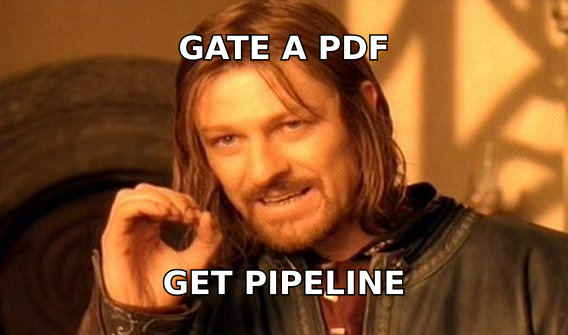
Here's the trap most B2B teams fall into: they rebrand their lead-gen team "demand generation," keep gating the same three ebooks, and change nothing else. Form fills go up. Pipeline doesn't. That's because a form fill is evidence that someone wanted your PDF, not evidence that they want your product.
(Replace with the actual meme render.)

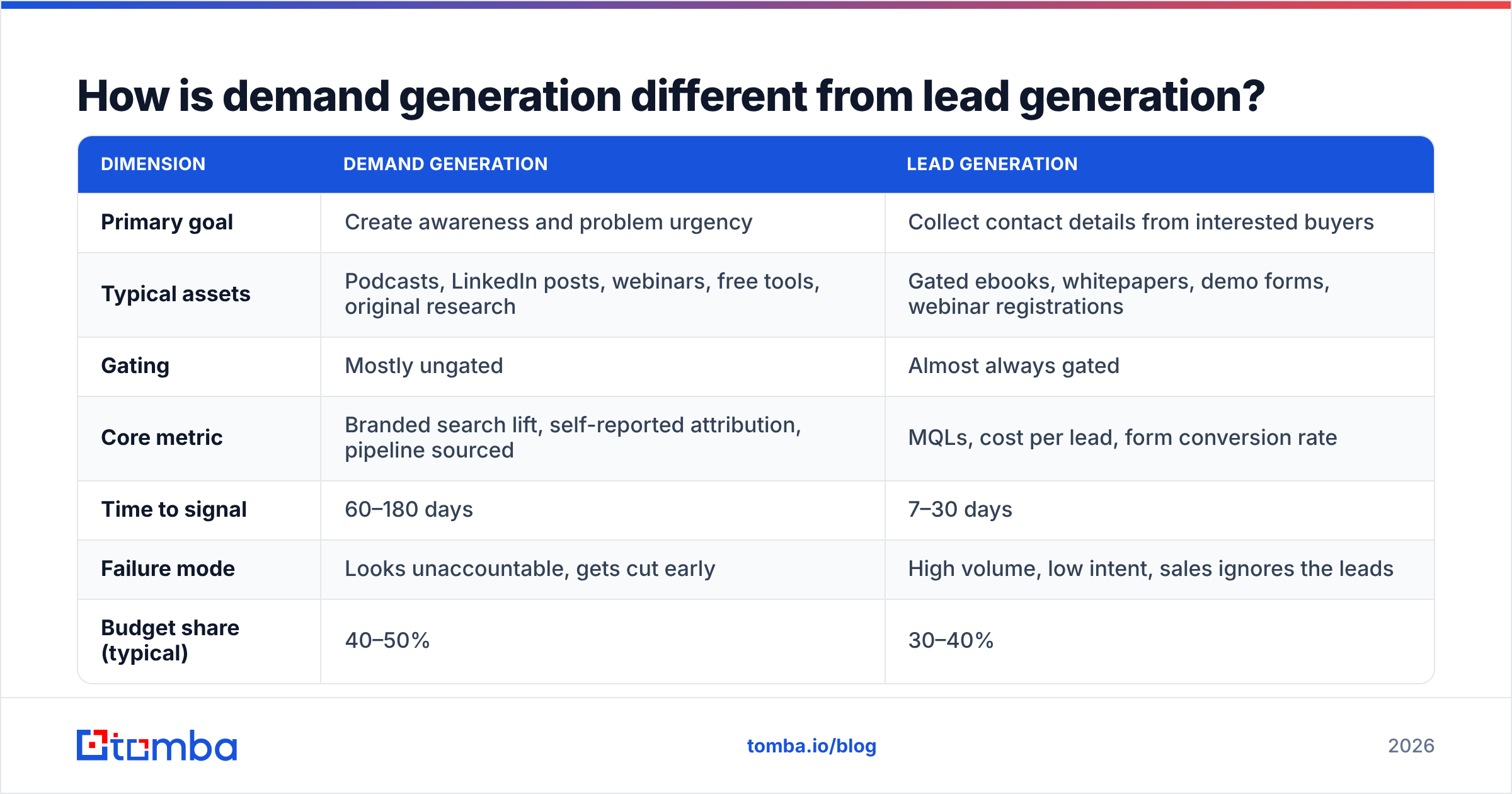
How is demand generation different from lead generation?#
They sit at different points in the same funnel, and they fail in different ways.
| Dimension | Demand generation | Lead generation |
|---|---|---|
| Primary goal | Create awareness and problem urgency | Collect contact details from interested buyers |
| Typical assets | Podcasts, LinkedIn posts, webinars, free tools, original research | Gated ebooks, whitepapers, demo forms, webinar registrations |
| Gating | Mostly ungated | Almost always gated |
| Core metric | Branded search lift, self-reported attribution, pipeline sourced | MQLs, cost per lead, form conversion rate |
| Time to signal | 60–180 days | 7–30 days |
| Failure mode | Looks unaccountable, gets cut early | High volume, low intent, sales ignores the leads |
| Budget share (typical) | 40–50% | 30–40% |
Both are necessary. The mistake is running only the right-hand column and calling the resulting pipeline stagnation a "messaging problem."
What are the core channels that actually generate demand in 2026?#
Channels shift, but the underlying job doesn't: get in front of people who have the problem before they name it. Here's the working set, ranked by how consistently teams report results.
- Founder and executive LinkedIn content. Personal profiles out-reach company pages by a wide margin. The format that works is a specific claim, a number, and a mechanism — not a carousel of platitudes. Two to four posts a week from a real operator beats a daily company-page feed.
- Original research and benchmarks. Data nobody else has is the only content that reliably earns links, quotes, and podcast invites. Survey your own customer base, publish the raw numbers, and let the industry argue about them.
- Free tools. A calculator, a checker, a generator — anything that solves a two-minute problem for free. Tools compound: they rank, they get bookmarked, and they identify high-intent users without a hard gate. Our own free email checker and email permutator exist for exactly this reason.
- Podcast and community presence. Being the guest, not the host, is usually the faster route. One 45-minute appearance in front of the right 3,000 listeners outperforms a month of paid impressions to a vague ICP.
- Paid social for reach, not conversion. Run video and thought-leadership ads optimized for cost-per-completed-view or cost-per-1000-reached to your ICP list. Judge it on brand lift and branded search, not on the seven leads the pixel claims.
- Search and review-site presence. This is the capture layer, but it's where created demand lands. If you generate interest and then don't own your category page on G2, you're funding a competitor's quarter.
The image direction for this section, if you're building an internal deck: screenshot your LinkedIn analytics "impressions from non-followers" panel and your Google Search Console branded-query graph side by side. Those two lines rising together is what a working demand program looks like.
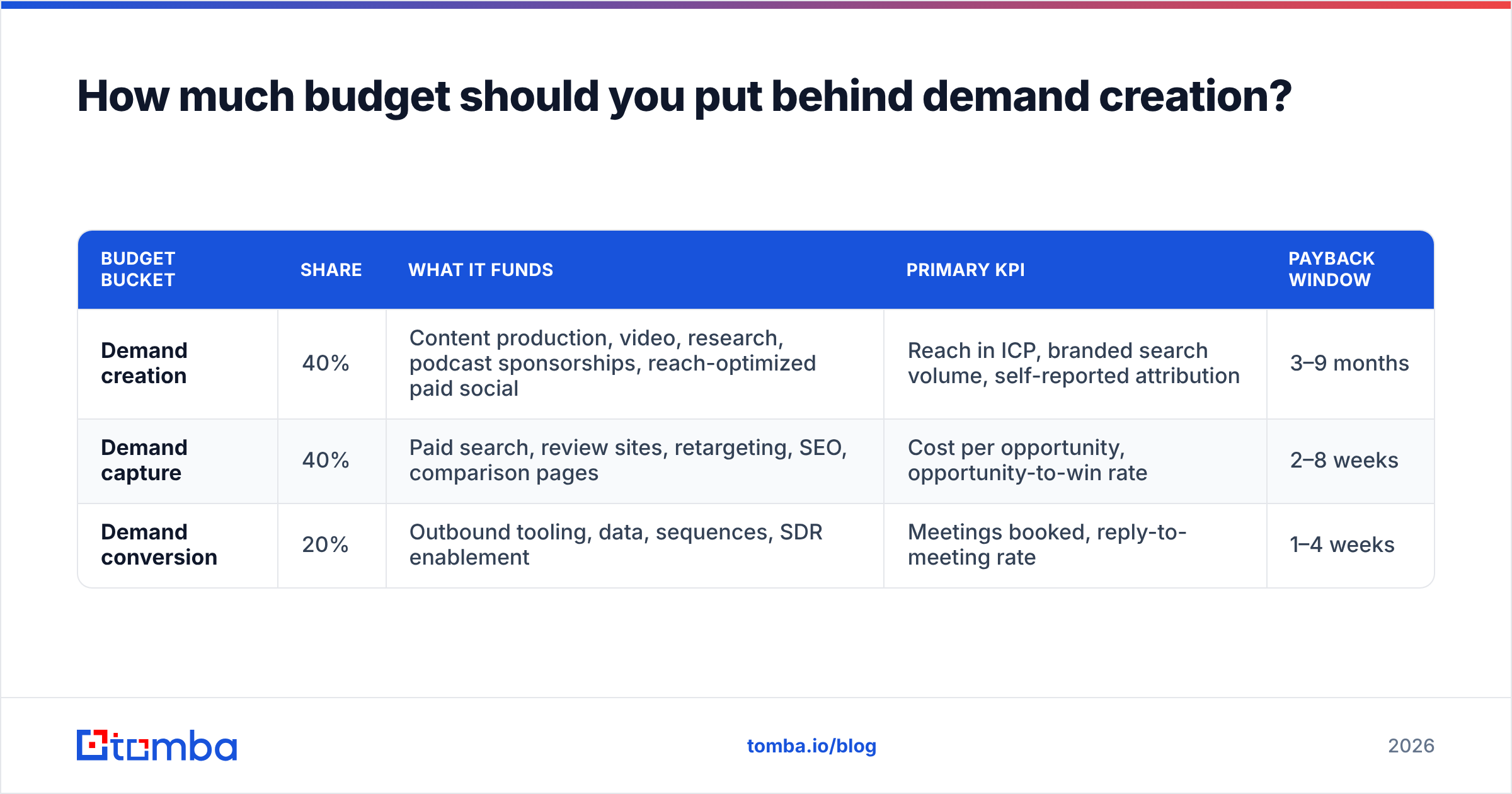
How much budget should you put behind demand creation?#
The honest answer is that it depends on how known your category is. But there's a defensible starting split, and it holds up across most mid-market B2B teams.
| Budget bucket | Share | What it funds | Primary KPI | Payback window |
|---|---|---|---|---|
| Demand creation | 40% | Content production, video, research, podcast sponsorships, reach-optimized paid social | Reach in ICP, branded search volume, self-reported attribution | 3–9 months |
| Demand capture | 40% | Paid search, review sites, retargeting, SEO, comparison pages | Cost per opportunity, opportunity-to-win rate | 2–8 weeks |
| Demand conversion | 20% | Outbound tooling, data, sequences, SDR enablement | Meetings booked, reply-to-meeting rate | 1–4 weeks |
Two rules make this split work:
- Never fund creation out of the capture budget's leftovers. Capture always looks better on a last-click dashboard, so it will eat everything if you let the same report decide both.
- Cap capture spend at demand. If you're bidding on category keywords nobody searches yet, you don't have a capture problem — you have a creation problem, and more ad spend won't fix it.
For teams under $2M ARR, shift toward 30/30/40. You need meetings now, and founder-led outbound is the cheapest way to buy learning about your ICP. Just don't confuse that phase with a scalable demand engine.
Why does gating everything kill your demand engine?#
Because a form is a tax on reach, and reach is the raw material of demand creation.
Run the arithmetic. An ungated report gets 10,000 reads. Gate it and you might get 12,000 landing-page visits and 900 form fills. You traded 9,100 people who would have learned your point of view for 900 email addresses, most of which are personal Gmails from people gathering competitive research.
The fix isn't "ungate everything." It's a tiered model:
- Ungate the education. Reports, benchmarks, teardowns, opinion pieces. These exist to change how someone thinks. A form defeats the purpose.
- Gate the utility. Templates you'll customize, calculators that save a result, tools that need an account to store work. People trade an email for something that does work for them, not for something that informs them.
- Gate nothing on the comparison pages. When a buyer is on your "X vs Y" page, they are 80% through their decision. A form there is friction at exactly the wrong moment.
Then close the identification gap on the back end instead of the front end. Website visitor identification tells you which companies are consuming ungated content, and data enrichment turns a company signal into named contacts with roles you can actually route. You get the reach of ungated content and most of the intel of a gated one.
How do you turn demand signals into pipeline?#
Created demand decays fast. Someone who read your research on Tuesday is a warm account on Wednesday and a cold one by the following month. The handoff has to be fast and specific.
A workable sequence:
- Detect the signal. Repeat visits to pricing or comparison pages, tool usage, webinar attendance, a G2 category view, or three people from the same domain reading the same post in a week.
- Resolve the account to people. Company-level intent is not actionable on its own. You need the two or three humans who own the problem — usually a director-level operator and their VP.
- Find contact data. This is where an email finder earns its cost. Pull verified addresses by domain and role rather than buying a static list that decays 25–30% a year. If you're working from a company list rather than named people, domain search is the faster route.
- Verify before you send. Bounces on a warm-intent list are self-inflicted damage. Run addresses through an email verifier first; protecting email deliverability matters more when the list is small and high-value.
- Reference the signal, don't reveal the surveillance. "Saw you downloaded X" is creepy. "Most teams reading our benchmark are trying to fix Y — is that where you are?" is useful.
- Route by signal strength, not by score. A rigid lead scoring model that adds five points for a webinar and ten for a demo request will bury the account that read three comparison pages in one night.
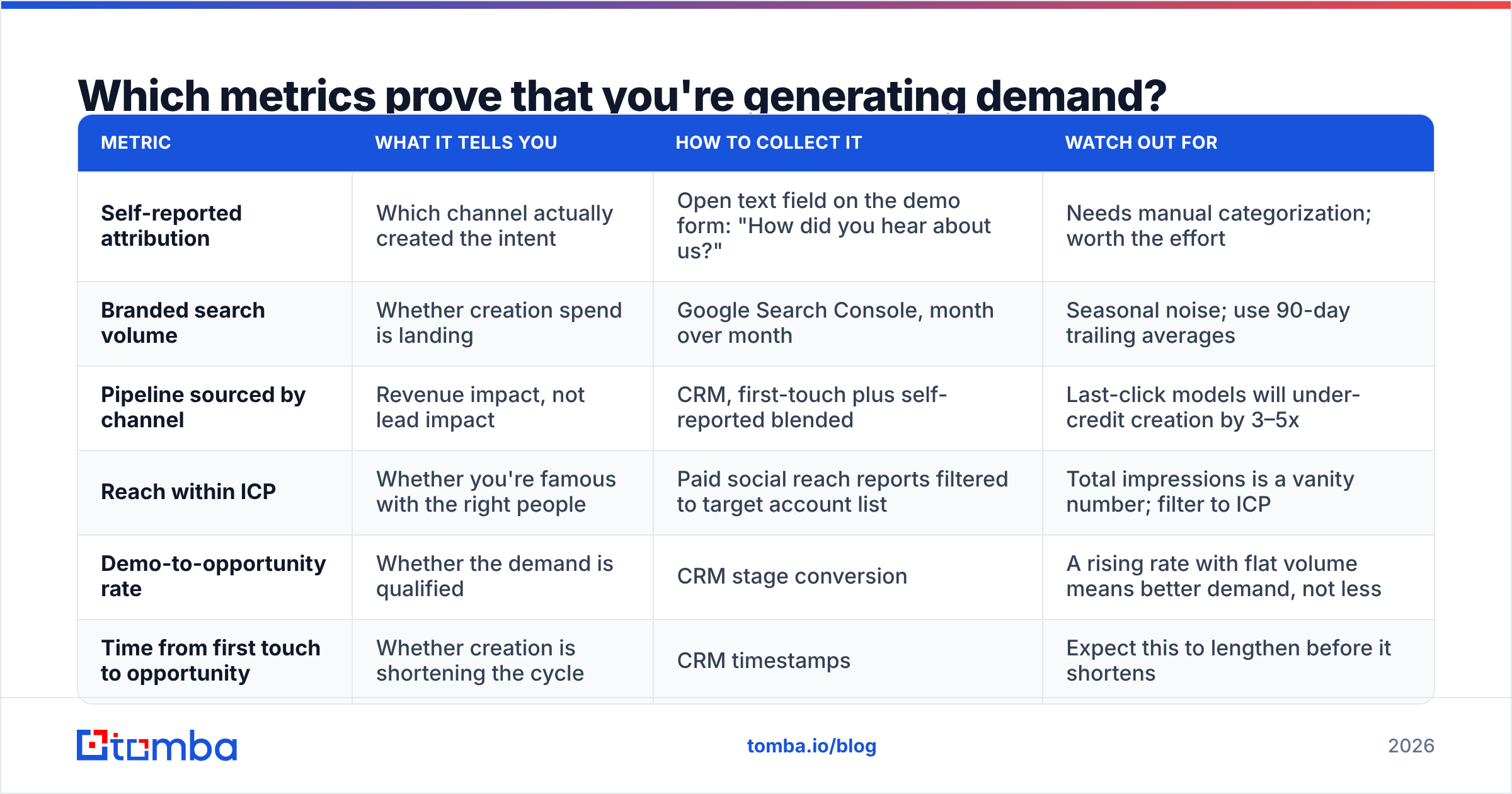
Which metrics prove that you're generating demand?#
Stop reporting MQLs as the headline. Report these instead.
| Metric | What it tells you | How to collect it | Watch out for |
|---|---|---|---|
| Self-reported attribution | Which channel actually created the intent | Open text field on the demo form: "How did you hear about us?" | Needs manual categorization; worth the effort |
| Branded search volume | Whether creation spend is landing | Google Search Console, month over month | Seasonal noise; use 90-day trailing averages |
| Pipeline sourced by channel | Revenue impact, not lead impact | CRM, first-touch plus self-reported blended | Last-click models will under-credit creation by 3–5x |
| Reach within ICP | Whether you're famous with the right people | Paid social reach reports filtered to target account list | Total impressions is a vanity number; filter to ICP |
| Demo-to-opportunity rate | Whether the demand is qualified | CRM stage conversion | A rising rate with flat volume means better demand, not less |
| Time from first touch to opportunity | Whether creation is shortening the cycle | CRM timestamps | Expect this to lengthen before it shortens |
The single highest-leverage change most teams can make is adding a free-text "how did you hear about us" field and actually reading the answers weekly. It will contradict your attribution dashboard, and it will usually be right. Forrester and Gartner have both spent years documenting how much of the B2B buying journey happens off-platform and unattributed — the dark-social problem is real, and self-reported data is the cheapest instrument you have for it.
What does a 90-day plan to generate demand look like?#
If you're starting from a gated-ebook program and want to move, here's the sequence that avoids blowing up your current numbers.
Days 1–30: instrument and unbundle. Add self-reported attribution. Ungate your two best-performing assets and track what happens to reach versus form fills — expect fills to drop and reach to multiply. Pick one executive who will post publicly and give them a writer.
Days 31–60: build the reach layer. Ship one piece of original research. Book three podcast appearances. Launch reach-optimized paid social against a matched ICP account list, capped at 15% of your total budget so a bad month doesn't create a political crisis.
Days 61–90: close the loop. Wire visitor identification to your CRM. Build the enrichment-to-outreach motion described above, with verified contact data and a strict cap on sequence volume. Review self-reported attribution against your dashboard and adjust the budget split.
Two cautions. First, don't cut capture spend to fund creation in the same quarter — you'll starve the pipeline that's currently paying salaries. Fund creation from new budget or from the worst-performing 20% of capture. Second, tell your board the payback window before you start. A creation program judged on 30-day cost-per-lead has a life expectancy of about six weeks.
Where does contact data fit into all of this?#
At the conversion layer, and it's the step teams most often under-invest in. You can build perfect awareness, identify every warm account, and still lose the quarter because your emails bounced or landed on someone who left the company eight months ago.
Buying a static list is the wrong shape for this work. Demand generation produces a moving target — the accounts you want to reach change weekly based on who's consuming what. What you need is on-demand lookup: give it a domain and a role, get back a verified address, and do that a few hundred times a month rather than once a year in a 50,000-row CSV.
That's the gap Tomba's Email Finder is built for. Feed it a company domain and a name, get a verified professional address back, and route it straight into your sequence or CRM through the integrations you already run. The free tier gives you 25 searches a month to test it against accounts you can already verify by hand, and paid plans start at $49/mo on Starter, $99/mo on Growth, and $249/mo on Pro — see full Tomba pricing for credit allocations and API limits. If you'd rather look before you commit, run a handful of domains through the tool and check the results against LinkedIn yourself. That's the honest test, and it takes ten minutes.
Generate the demand first. Then make sure you can actually reach the people it produced.
Related guides#
Ready to find emails that actually work?
Join 150,000+ professionals who stopped guessing and started sending. Free credits on signup — no credit card required.
Get the Tomba newsletter
Practical outbound tactics and product updates — once every two weeks.
About the author