How to Generate Quality Leads in 2026: A Practical Guide
Most teams do not have a lead volume problem — they have a lead quality problem. Here is the filter, data, and scoring stack that separates leads worth calling from rows in a spreadsheet.
TL;DR
- A quality lead is not "someone who downloaded a PDF." It is a contact who matches a defined ICP, sits in or near the buying committee, has a verified reachable email, and shows a timing signal. Miss any one of the four and you have a row, not a lead.
- Volume-first lead generation collapses because bad data compounds: 20–30% of B2B contact data decays each year, and every bounce damages the sending domain you need for the good leads.
- The highest-quality sources are narrow: website visitor identification, product signups, and hand-built ICP lists. The lowest-quality are broad content downloads and bought bulk lists that nobody verified.
- Scoring does not need machine learning. A 4-factor manual model (fit, role, signal, reachability) beats an unmaintained "AI score" in most sub-$50M organizations.
- Verify before you send, not after. Verification is the cheapest step in the funnel and the only one that protects everything downstream.
What actually counts as a quality lead?#
A quality lead is a contact who can buy, would plausibly want to buy, can be reached, and has a reason to talk to you now. Four conditions, all required.
Most teams only enforce one — usually "filled out a form" — and then wonder why the sales team ignores 70% of the handoff. Gartner's research on the B2B buying journey puts the average buying group at six to ten stakeholders, each arriving with independently sourced information. A single form fill from one junior researcher inside that group is a weak signal, not a qualified opportunity.
Here is the working definition to enforce:
- Firmographic fit — the account matches your ICP on industry, size, geography, and tech stack. Not "kind of B2B SaaS." Specific.
- Role relevance — the person either holds budget, uses the product daily, or is a documented influencer in the buying committee. Everyone else is noise you'll pay for later.
- Reachability — you have a deliverable email address, and ideally a phone number, that has been verified within the last 30 days.
- Timing signal — hiring, funding, a new tool in the stack, a competitor churn event, a repeat website visit, or an inbound trigger. Something that answers "why this week?"
Miss fit and you burn rep time. Miss role and you get polite forwards that go nowhere. Miss reachability and you never make contact at all. Miss timing and you get a "check back next year."
Why do most lead generation programs produce junk?#
Because they optimize the metric that is easiest to move. Lead count goes up when you loosen the filter. Nobody gets fired in Q1 for hitting an MQL target with weak leads — the damage shows up in Q3 pipeline, by which point the attribution trail is cold.
Three specific failure modes cause most of it:
Failure 1: The volume quota flows backwards into the filter. Marketing owes 2,000 MQLs. The clean ICP list only produces 600. So the gate widens — students, competitors, job seekers, and companies with eight employees all count now. The MQL definition becomes a fiction both teams quietly agree to ignore.
Failure 2: Nobody owns data decay. People change jobs. Companies rebrand, get acquired, migrate email domains. A list that was 95% accurate in January is materially worse by December. If your CRM has no re-verification cadence, your "quality" leads rot in place while the dashboard still shows them as active.
Failure 3: Deliverability damage is invisible until it is catastrophic. Every hard bounce is a vote against your sending domain. Push a 12% bounce rate through a sequence for three weeks and your genuinely good prospects stop seeing your emails at all — not because your copy is bad, but because Google and Microsoft quietly routed you to spam. The bad leads poison the good ones.
That third one is the argument that ends most "but more volume can't hurt" debates. It can. It does.
Where do the highest-quality leads actually come from?#
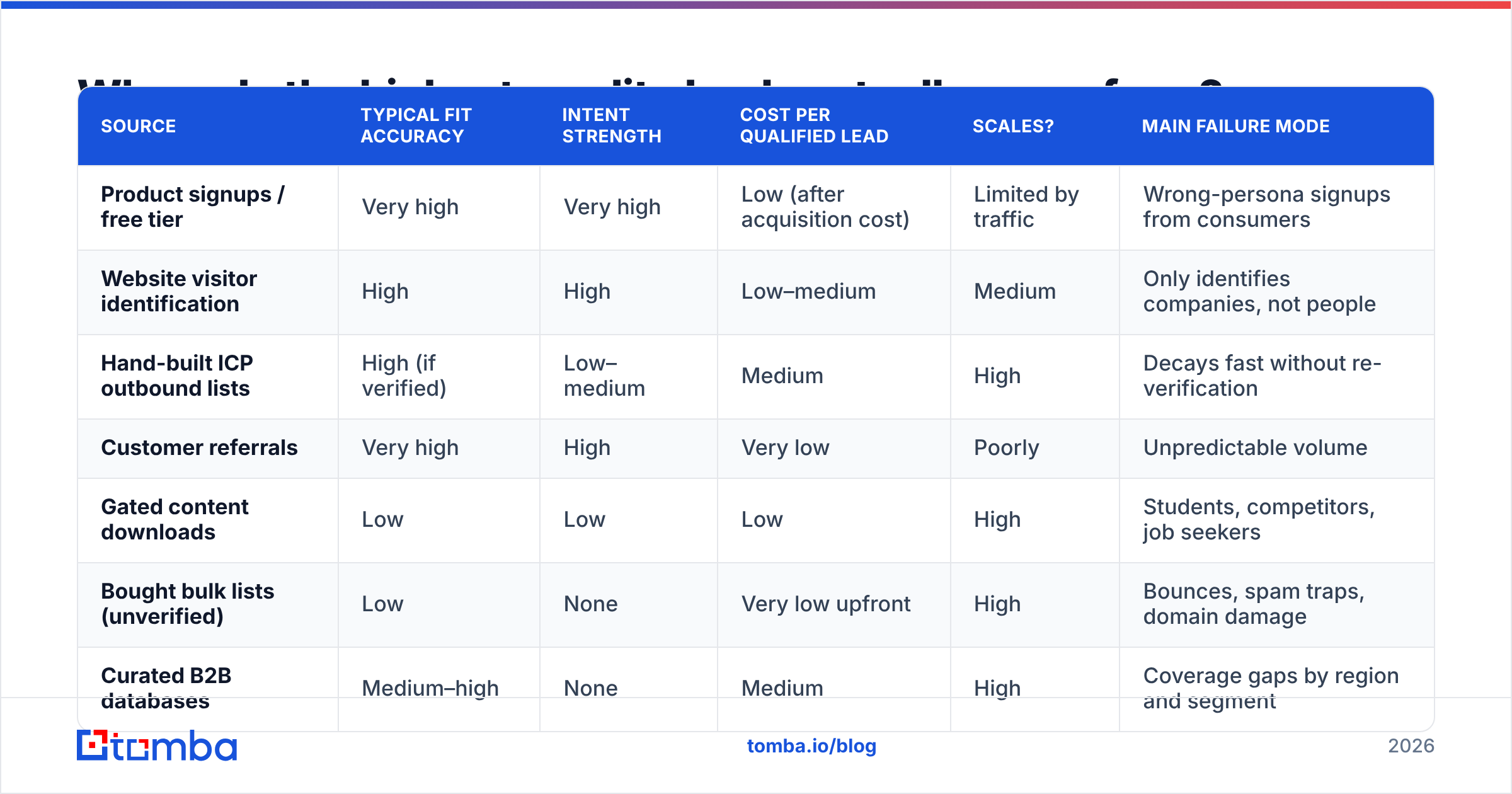
Source quality varies more than most teams assume. Here is how the common channels compare on the dimensions that matter operationally:
| Source | Typical fit accuracy | Intent strength | Cost per qualified lead | Scales? | Main failure mode |
|---|---|---|---|---|---|
| Product signups / free tier | Very high | Very high | Low (after acquisition cost) | Limited by traffic | Wrong-persona signups from consumers |
| Website visitor identification | High | High | Low–medium | Medium | Only identifies companies, not people |
| Hand-built ICP outbound lists | High (if verified) | Low–medium | Medium | High | Decays fast without re-verification |
| Customer referrals | Very high | High | Very low | Poorly | Unpredictable volume |
| Gated content downloads | Low | Low | Low | High | Students, competitors, job seekers |
| Bought bulk lists (unverified) | Low | None | Very low upfront | High | Bounces, spam traps, domain damage |
| Curated B2B databases | Medium–high | None | Medium | High | Coverage gaps by region and segment |
| Conference badge scans | Medium | Low | High | No | Everyone scans everyone |
Two rows deserve comment.
Curated databases are not the same as bought lists. A maintained, permission-aware database with documented refresh cycles — providers like BookYourData occupy this tier, and it's a legitimate one — is a different product from a CSV of 500,000 addresses sold on a forum. The distinction is whether anyone is accountable for the accuracy rate. Treat curated data as a starting point that still gets verified before it enters a sequence, and it performs.
Website visitor identification is the most underused high-quality source. Someone reading your pricing page three times this week has a timing signal you cannot manufacture. The catch is that reveal tools return a company, not a person. You still need to find the right contact at that company — which is where domain search closes the loop between "Acme visited" and "here is the VP of Ops at Acme with a verified address."
How do you build an ICP filter that actually excludes people?#
A useful ICP is defined by what it rejects. If your ICP does not disqualify at least half the market, it is a positioning statement, not a filter.
Build it in four passes:
- Start from closed-won, not from aspiration. Pull your last 30 won deals. Find the attributes that repeat: employee band, revenue band, industry, tech stack, the specific job title of the person who first replied. Aspiration-based ICPs ("enterprise!") describe the deals you wish you had.
- Add explicit disqualifiers. Write down what makes an account unwinnable — under 10 employees, no in-house sales team, regulated industries you can't service, regions where you have no data coverage. Encode these as hard filters, not soft warnings.
- Define the buying committee, not the buyer. For most B2B products there are three roles: the economic buyer, the daily user, and the technical gatekeeper. Name the exact titles for each. Then decide which one you actually open with — usually the daily user, because they answer.
- Set a coverage target per account. Two to four verified contacts per target account beats one contact at four times as many accounts. Multi-threading is what survives a champion changing jobs.
- Attach a refresh rule. Every contact record gets a "verified on" date. Anything older than 90 days goes back through verification before it is used again.
- Write it down where reps can see it. An ICP that lives in one person's head is not a filter, it's a preference.
That last point is not filler. HubSpot's ongoing state of marketing research consistently finds sales–marketing alignment on lead definitions to be one of the sharpest predictors of pipeline efficiency, and alignment requires a written artifact both teams reference.
Does data quality really matter more than volume?#
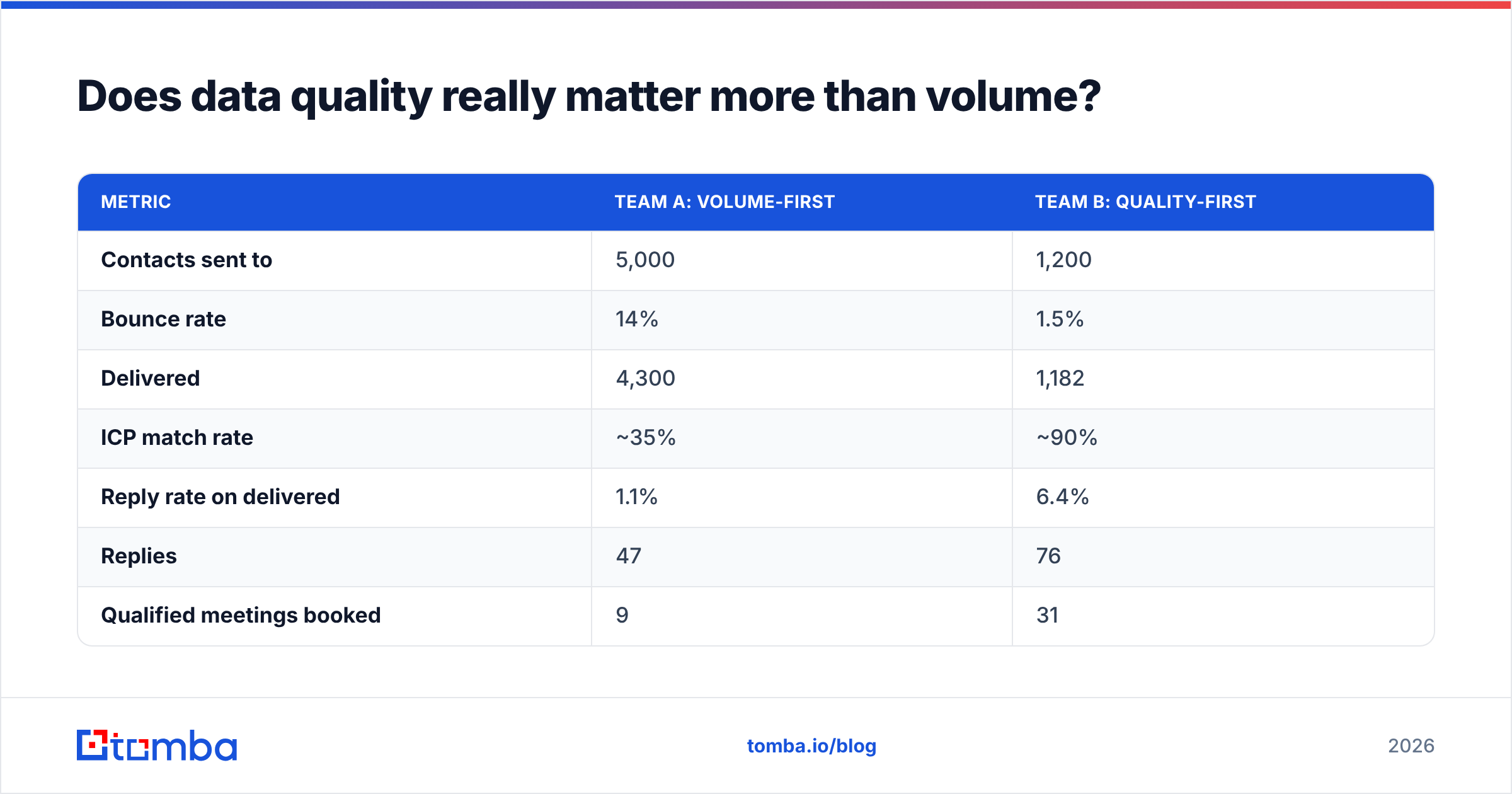
Yes, and it is straightforward to demonstrate with arithmetic rather than opinion.
Take two teams sending 5,000 emails a month.
| Metric | Team A: volume-first | Team B: quality-first |
|---|---|---|
| Contacts sent to | 5,000 | 1,200 |
| Bounce rate | 14% | 1.5% |
| Delivered | 4,300 | 1,182 |
| ICP match rate | ~35% | ~90% |
| Reply rate on delivered | 1.1% | 6.4% |
| Replies | 47 | 76 |
| Qualified meetings booked | 9 | 31 |
| Domain health after 90 days | Degraded, warmup needed | Stable |
Team B sends a quarter of the volume and books more than three times the meetings. The mechanism is not magic copy — it is that every one of Team B's emails goes to a real person who plausibly has the problem, from a domain that inboxes reliably.
The compounding effect is the part teams miss. Team A's damaged domain reputation makes next quarter worse too. Quality is not a nice-to-have applied at the end; it is an input that determines whether the channel works at all six months from now.
This is why email verification is the highest-ROI single step in the entire funnel. It costs fractions of a cent per record and it protects the asset — your sending domain — that everything else depends on. Verify at import, verify again before any sequence launch, and treat catch-all domains as a separate handling path rather than assuming they're valid.

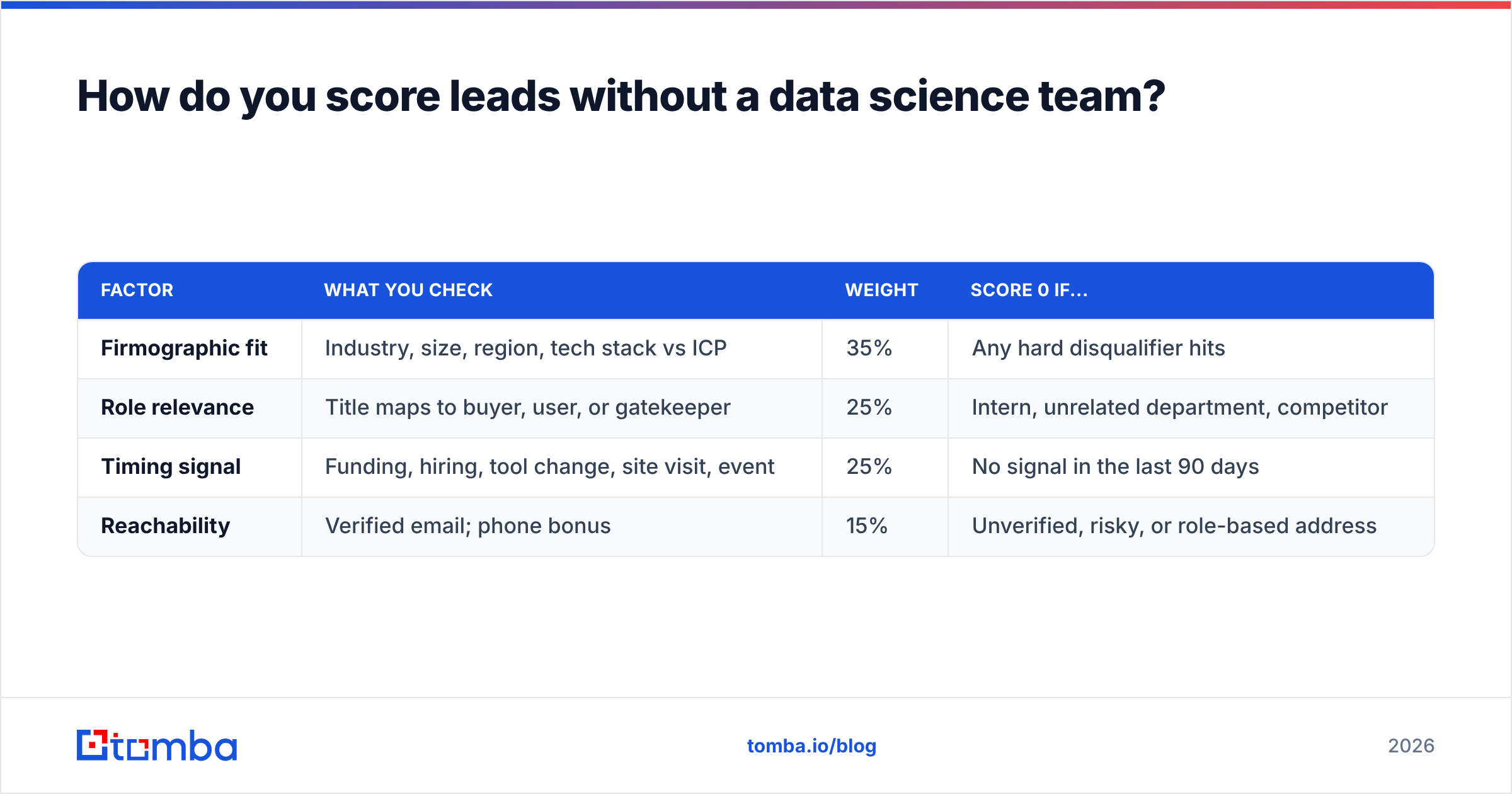
How do you score leads without a data science team?#
You do not need a model. You need four factors, weighted, and enforced consistently.
| Factor | What you check | Weight | Score 0 if... |
|---|---|---|---|
| Firmographic fit | Industry, size, region, tech stack vs ICP | 35% | Any hard disqualifier hits |
| Role relevance | Title maps to buyer, user, or gatekeeper | 25% | Intern, unrelated department, competitor |
| Timing signal | Funding, hiring, tool change, site visit, event | 25% | No signal in the last 90 days |
| Reachability | Verified email; phone bonus | 15% | Unverified, risky, or role-based address |
Score each factor 0–10, apply the weights, and set two thresholds: above 70 goes straight to a rep, 40–70 goes into nurture, below 40 gets suppressed entirely. Suppression is a feature — an unscored list has no ceiling on how much rep time it wastes.
Three implementation notes that decide whether this survives contact with reality:
- Recompute timing signals monthly. Fit and role are stable. Timing is not. A lead that scored 82 in March is a different lead in July.
- Enrich before you score, not after. You cannot score fit on a record that contains only an email address and a first name. Run data enrichment first so the scoring model has company size, industry, and role to work with.
- Let reps override, but log it. When a rep pushes a 55 through to outreach and it closes, that is training data for the next revision of the weights.
What does a working quality-lead workflow look like end to end?#
Here is the sequence, in order, with the failure each step prevents:
Step 1 — Define and version the ICP. Written, dated, with explicit disqualifiers. Prevents: quota-driven filter creep.
Step 2 — Build the account list before the contact list. Target accounts first, using firmographic filters and intent sources. Prevents: collecting contacts at companies you cannot serve.
Step 3 — Find 2–4 contacts per account. Use domain-level discovery to map the buying committee rather than searching name-by-name. Prevents: single-threaded deals that die when your champion leaves.
Step 4 — Verify every address before it enters a sequence. Separate valid, invalid, and catch-all into three buckets with three different handling rules. Prevents: bounce-driven domain damage.
Step 5 — Enrich, then score. Attach firmographics and role data, then apply the four-factor model. Prevents: reps spending their best hours on 40-point leads.
Step 6 — Route by score, not by arrival time. High scores to reps within the hour. Mid scores to nurture. Low scores suppressed. Prevents: first-in-first-out queues where good leads sit behind junk.
Step 7 — Re-verify on a 90-day cadence. Anything sitting in nurture gets rechecked before reuse. Prevents: data decay silently degrading your list.
Step 8 — Feed closed-won and closed-lost back into the ICP. Quarterly. Prevents: an ICP that describes the market you had two years ago.
For teams running this at any scale, the mechanical steps — find, verify, enrich — should be automated at the API layer rather than done by hand in a spreadsheet. That's what the Tomba API and bulk workflows exist for, and it's the difference between a process that runs weekly and one that runs when someone remembers.
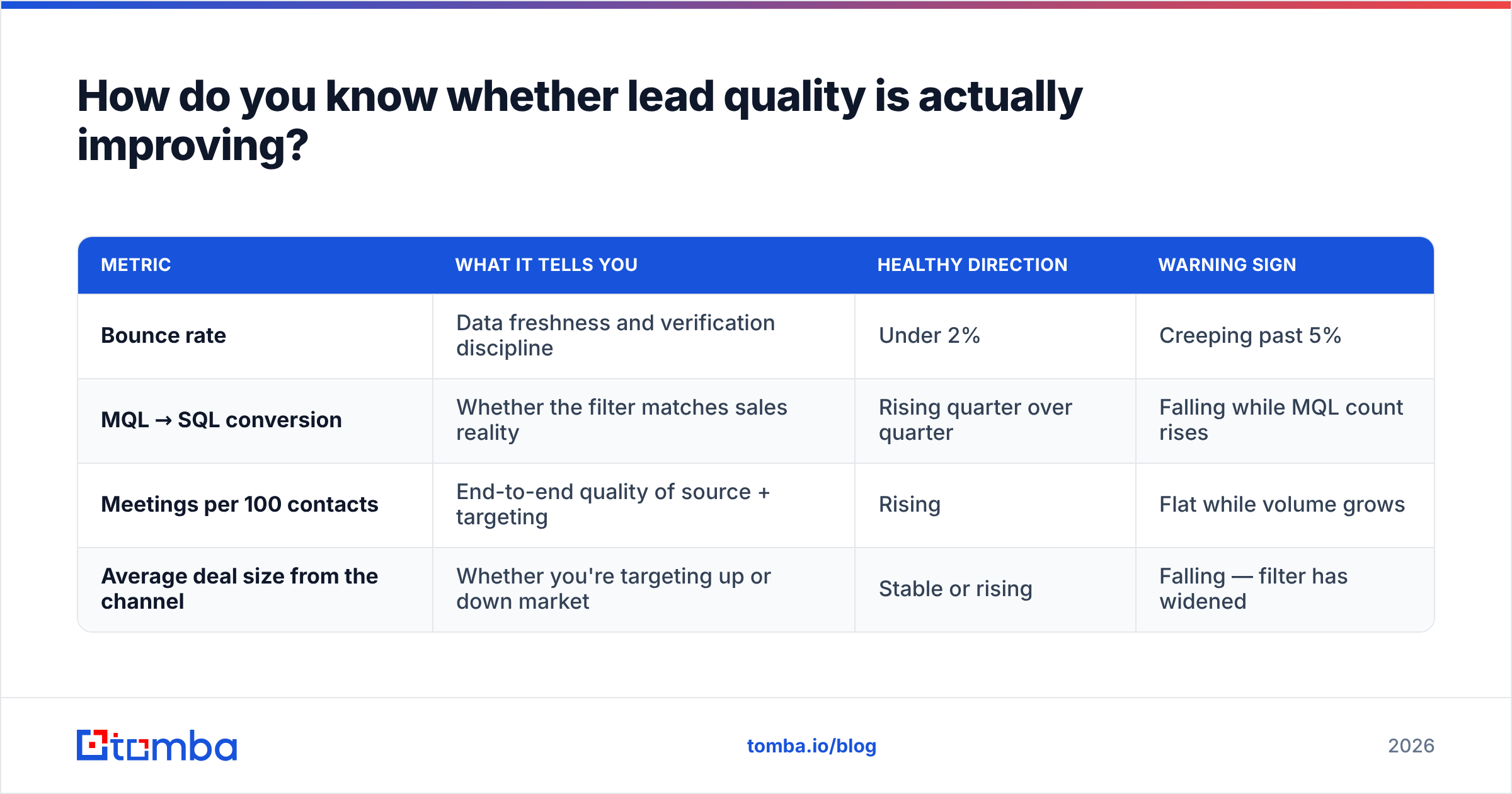
How do you know whether lead quality is actually improving?#
Track four metrics, not fourteen. Vanity dashboards hide regressions.
| Metric | What it tells you | Healthy direction | Warning sign |
|---|---|---|---|
| Bounce rate | Data freshness and verification discipline | Under 2% | Creeping past 5% |
| MQL → SQL conversion | Whether the filter matches sales reality | Rising quarter over quarter | Falling while MQL count rises |
| Meetings per 100 contacts | End-to-end quality of source + targeting | Rising | Flat while volume grows |
| Average deal size from the channel | Whether you're targeting up or down market | Stable or rising | Falling — filter has widened |
The pattern to watch for is the diagnostic one: MQL volume up, MQL→SQL conversion down. That combination means the filter widened, not that demand grew. It is the single most common signature of a lead generation program quietly getting worse while the dashboard looks green.
If you want an outside read on tooling before you commit budget, category reviews on G2 are useful for spotting where a vendor's coverage is thin — particularly by region, which is where most email and contact databases differ most.
What should you do first?#
Pick the smallest change with the largest compounding effect: verify your existing list.
Before you buy another data source, redesign your forms, or rewrite your sequences, run what you already have through verification and see how much of it is real. Most teams discover between 15% and 30% of their "leads" cannot receive email at all. That single pass tells you whether your problem is targeting, messaging, or data — and until you know which, every other fix is a guess.
Then build one clean ICP list of 200 accounts with 2–4 verified contacts each, run it properly, and compare the meeting rate against your existing channel. Small, honest test. The results usually settle the volume-versus-quality argument permanently.
Ready to build a list worth calling?#
Start with contacts you can actually reach. The Tomba Email Finder locates professional email addresses by domain, name, or company, with verification built into the same workflow — so the list you hand your reps is filtered before it costs anyone an hour. The free tier includes 25 searches a month to test coverage against your own ICP, and paid plans start at $49/mo; full details are on the Tomba pricing page. Build the 200-account list, verify it, and let the meeting rate make the argument for you.
Related guides#
Ready to find emails that actually work?
Join 150,000+ professionals who stopped guessing and started sending. Free credits on signup — no credit card required.
Get the Tomba newsletter
Practical outbound tactics and product updates — once every two weeks.
About the author