Generating Leads in 2026: Channels, Costs, and Playbooks
Most lead gen advice is a channel list with no math behind it. Here is what generating leads actually costs per booked meeting in 2026, which channels still convert, and the data workflow underneath all of them.
TL;DR
- Generating leads is not a channel problem in 2026 — it is a data problem. The teams that win run fewer channels on cleaner contact data.
- Cost per booked meeting ranges from roughly $60 (referral and warm inbound) to $900+ (paid search in crowded B2B categories). Pick channels by that number, not by how modern they feel.
- Outbound still works, but only above ~95% deliverable contact data. Below that, mailbox reputation collapses and the whole program looks broken.
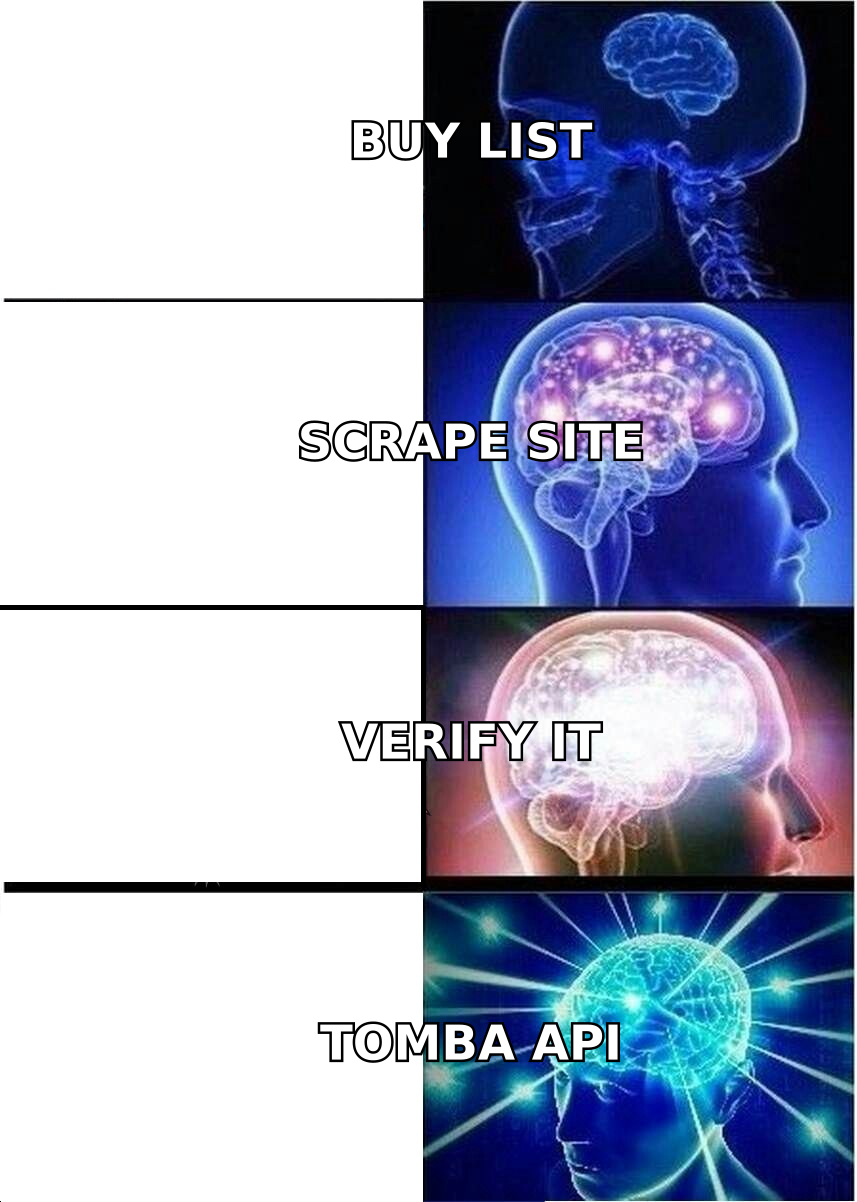
- Buying a static list is the most expensive cheap thing you can do — B2B contact data decays 25-30% per year.
- The repeatable stack: define ICP → build the account list → find and verify contacts → multi-thread across email, phone, and LinkedIn → measure by meetings, not MQLs.
What does "generating leads" actually mean in 2026?#
A lead is a person who has both a plausible reason to buy and a reachable contact record. Drop either half and you do not have a lead — you have a row in a spreadsheet.
That distinction matters more than it used to. Ten years ago, "generating leads" mostly meant filling the top of a funnel and letting volume sort itself out. In 2026 that model breaks on three fronts: mailbox providers punish low-quality sending, buying committees have grown to 6-10 people, and the average B2B buyer completes most of their research before ever talking to a rep. Volume without accuracy no longer converts into anything — it just burns domains.
So the working definition for this guide: generating leads is the repeatable process of identifying accounts that match your ICP, resolving the right humans inside them to verified contact points, and creating a conversation. Everything below serves that sentence.
Which lead generation channels are worth the money?#
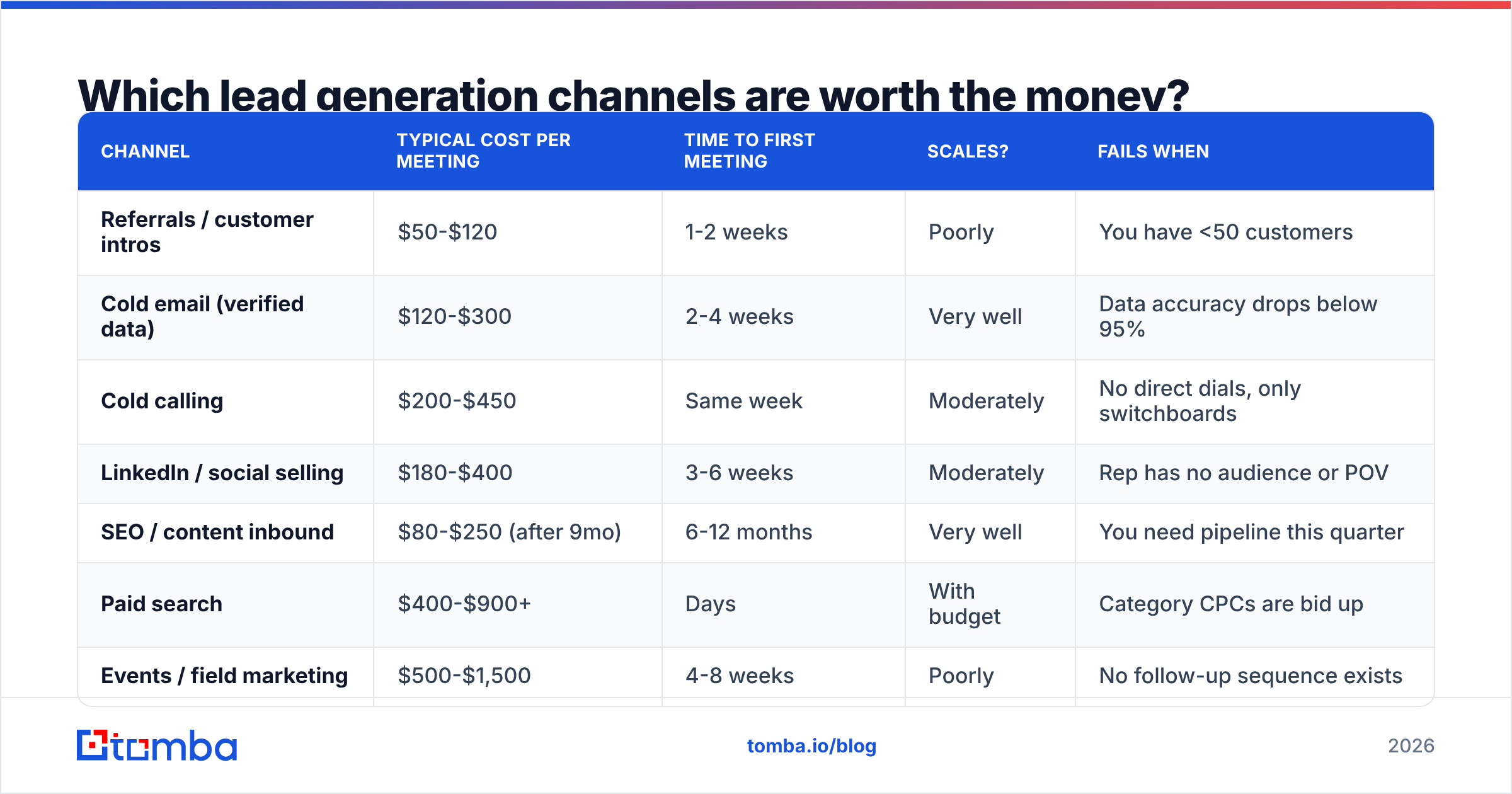
Here is the honest comparison. Numbers below are directional mid-market B2B SaaS benchmarks (ACV $10k-$60k) — your category will shift them, but the relative ordering holds across most teams I have seen audited.
| Channel | Typical cost per meeting | Time to first meeting | Scales? | Fails when |
|---|---|---|---|---|
| Referrals / customer intros | $50-$120 | 1-2 weeks | Poorly | You have <50 customers |
| Cold email (verified data) | $120-$300 | 2-4 weeks | Very well | Data accuracy drops below 95% |
| Cold calling | $200-$450 | Same week | Moderately | No direct dials, only switchboards |
| LinkedIn / social selling | $180-$400 | 3-6 weeks | Moderately | Rep has no audience or POV |
| SEO / content inbound | $80-$250 (after 9mo) | 6-12 months | Very well | You need pipeline this quarter |
| Paid search | $400-$900+ | Days | With budget | Category CPCs are bid up |
| Events / field marketing | $500-$1,500 | 4-8 weeks | Poorly | No follow-up sequence exists |
| Website visitor identification | $90-$220 | 1-2 weeks | Well | Traffic is under ~5k/mo |
Two takeaways most teams get wrong.
First, cheap-per-meeting channels are usually slow, and fast channels are usually expensive. Referrals and SEO are the two lowest costs on the list and also the two you cannot switch on this month. Cold calling is fast and expensive. The mature answer is to run one fast channel to pay this quarter's bills and one slow channel to lower next year's blended cost — not to chase whichever channel had a good LinkedIn post written about it.
Second, cold email's cost per meeting is almost entirely a function of data quality, which is why the range is so tight compared to paid search. The sending is nearly free. What you are actually paying for is accurate contact resolution.
Why does contact data quality decide everything?#
Because deliverability is now a gate, not a dial.
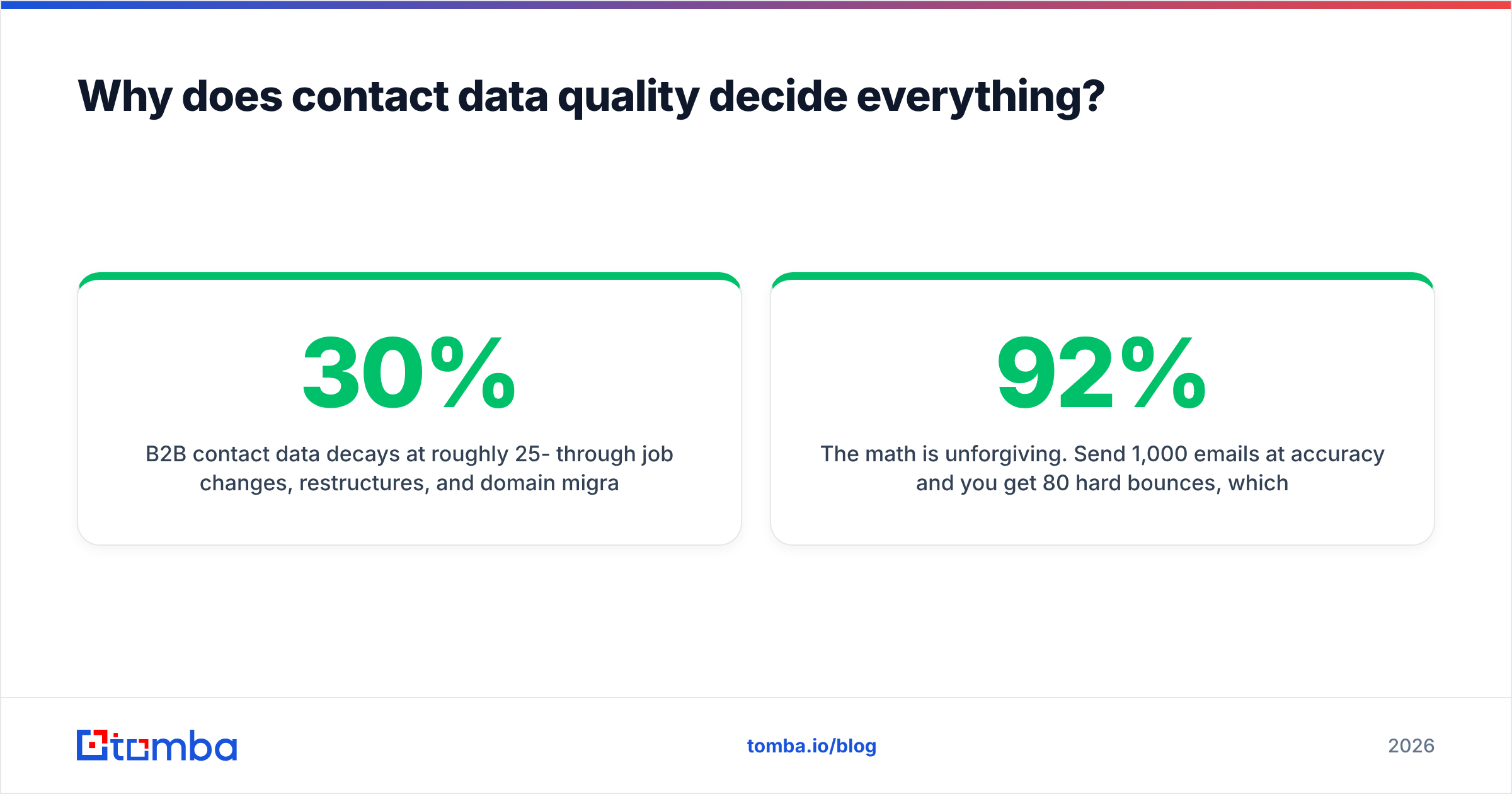
B2B contact data decays at roughly 25-30% per year through job changes, restructures, and domain migrations. A list you bought in January is meaningfully wrong by December. When you send to that decayed list, bounces spike, and mailbox providers read bounce rate as a spam signal. Gmail and Yahoo's bulk sender requirements formalized what was already true: cross a spam-complaint threshold and your mail stops landing — including mail to the good addresses on the same list.
The math is unforgiving. Send 1,000 emails at 92% accuracy and you get 80 hard bounces, which is enough to damage sender reputation on a new domain. Send the same 1,000 at 98% and you get 20 — well inside safe territory. The difference between those two lists is not 6 percentage points of waste. It is the difference between a channel that works and a channel that silently stops delivering while your dashboard still shows "sent."
This is why the sequence matters: find, then verify, then send. A good email finder resolves the address from public and pattern-based sources; an email verifier confirms the mailbox actually accepts mail before it enters a sequence. Skipping the second step is the single most common reason a technically well-run outbound program produces nothing.
Catch-all domains complicate this further. A catch-all accepts every address at the domain, so standard SMTP verification returns "unknown" rather than valid or invalid. Roughly a fifth of B2B domains are configured this way. Treating every catch-all as valid inflates your bounce rate; treating them all as invalid throws away a fifth of your enterprise TAM. A dedicated catch-all verifier that scores these separately is the difference between the two failure modes.
How do you actually build a lead list that converts?#
Six steps. Run them in order — skipping ahead is where most programs break.
- Define the ICP by evidence, not aspiration. Pull your last 30 closed-won deals. Find the shared attributes: employee count band, tech stack, funding stage, geography, and the trigger event that started the conversation. That intersection is your ICP. Anything wider is hope.
- Build the account list before the contact list. Aim for 300-800 named accounts per rep per quarter. Sources: your CRM's closed-lost pile, competitor customer pages, industry association directories, funding announcements, job postings signaling the pain you solve.
- Resolve the buying committee, not one hero contact. For each account, target 3-5 people: the economic buyer, the day-to-day owner, and one adjacent stakeholder. Multi-threaded deals close at meaningfully higher rates because your champion changing jobs stops being a fatal event. A domain search pulls the full mapped roster at a company in one pass instead of one-off lookups.
- Verify everything before it touches a sequence. Set a hard gate: nothing enters your sending tool below a "valid" or high-confidence catch-all status. This gate is not negotiable and should be enforced by tooling, not by discipline.
- Enrich for personalization hooks, not for vanity fields. You need one specific, true, non-obvious detail per contact — a recent role change, a stack addition, a published article, a hiring signal. Twelve firmographic columns nobody reads are dead weight.
- Instrument the funnel to booked meetings. Track reply rate, positive reply rate, and meetings held. Do not optimize open rate — with privacy proxies inflating opens, it is close to a random number generator in 2026.
Steps 3 and 4 are where a dedicated data layer pays for itself. Doing them manually costs a rep roughly 8-12 hours per 500-contact list. Running the same list through a bulk email finder takes minutes and produces a consistent confidence score you can actually gate on.
Is outbound or inbound better for generating leads?#
Wrong question. The right one: which channel matches your current constraint?
If your constraint is time — you need meetings in 30 days — outbound wins by default. Inbound cannot be accelerated past its content indexing cycle no matter how much you spend.
If your constraint is cost — you have runway pressure and no budget for SDRs — inbound and referrals win, and you should accept a two-to-three quarter delay.
If your constraint is TAM size — you sell to 400 companies worldwide — outbound is the only rational choice. Content marketing to an audience of 400 is a rounding error.
If your constraint is category education — buyers do not know your category exists — inbound is mandatory, because outbound to people with no vocabulary for their problem converts terribly.
Most teams above ~$2M ARR should run both, but with a clear primary. Splitting resources evenly across two channels usually produces two mediocre channels rather than one good one. HubSpot's annual marketing research consistently shows the same pattern: focus beats breadth until you have the headcount to staff a channel properly.

Should you buy a lead list or build one?#
Build, with one narrow exception.
Bought static lists fail for structural reasons, not because the vendors are bad. A list sold to you was sold to others; by the time it lands, its contacts have been sequenced repeatedly and the decay clock has been running since the file was compiled. You cannot verify the sourcing, which matters for GDPR and CCPA compliance, and you inherit whatever bounce rate the file carries.
The exception: curated, compliance-vetted databases with refresh guarantees. Providers like BookYourData built their model around verified, replacement-guaranteed records rather than volume dumps, which is a genuinely different product from the $99-for-2-million-rows files circulating on marketplaces. If you need a specific vertical slice fast and the vendor stands behind accuracy, that is a defensible buy.
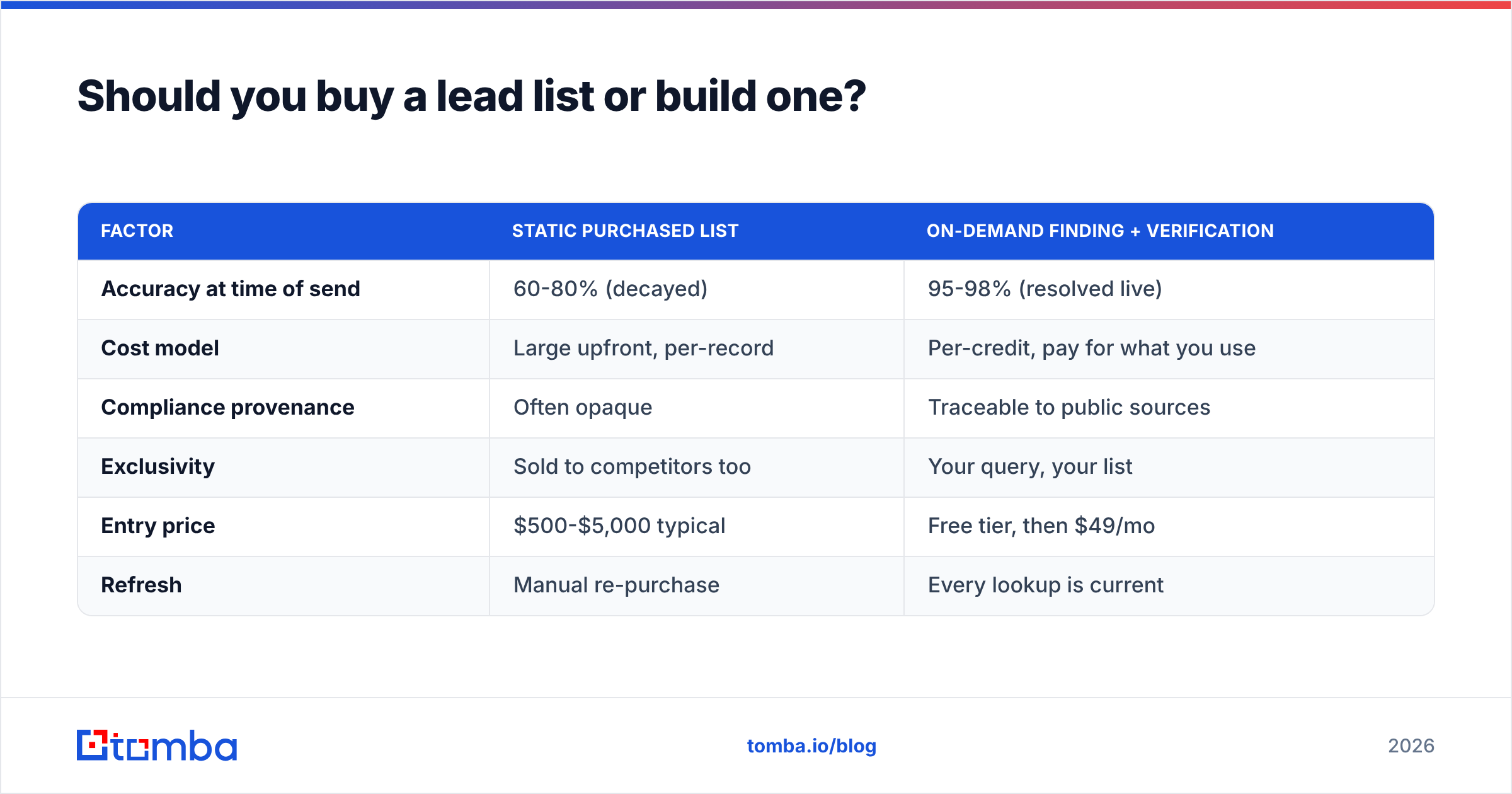
For everything else, an on-demand API model is cheaper and fresher, because you resolve contacts at the moment you need them rather than storing a decaying snapshot. Here is the comparison that usually settles the argument:
| Factor | Static purchased list | On-demand finding + verification |
|---|---|---|
| Accuracy at time of send | 60-80% (decayed) | 95-98% (resolved live) |
| Cost model | Large upfront, per-record | Per-credit, pay for what you use |
| Compliance provenance | Often opaque | Traceable to public sources |
| Exclusivity | Sold to competitors too | Your query, your list |
| Entry price | $500-$5,000 typical | Free tier, then $49/mo |
| Refresh | Manual re-purchase | Every lookup is current |
On the pricing line specifically: Tomba runs a free tier at 25 searches/month, then Starter at $49/mo, Growth at $99/mo, and Pro at $249/mo, with Enterprise custom — full Tomba pricing is public, which is worth checking against vendors that hide numbers behind a demo gate. Cross-referencing category pricing on G2 before committing is a five-minute exercise that regularly saves four figures a year.
What does a working 2026 lead generation stack look like?#
Four layers. Keep it boring.
Layer 1 — Account intelligence. Where your target accounts come from: CRM history, intent signals, funding data, job boards, website visitor identification. Output: a named account list with a reason-to-reach-out attached to each row.
Layer 2 — Contact resolution. Turning accounts into people with verified emails and direct dials. This is the layer teams underfund and then blame the sequencer for. Output: verified contacts with confidence scores.
Layer 3 — Engagement. The sequencer, the dialer, the LinkedIn tooling. Output: conversations. Critically, this layer should consume verified data, never source it.
Layer 4 — Measurement. Meetings booked, meetings held, pipeline created, and cost per each. If your dashboard's headline metric is MQLs, you are measuring the thing that is easiest to inflate.
Most stack failures come from asking one tool to do all four layers. All-in-one platforms are convenient and consistently weakest at layer 2, because contact resolution is a data-infrastructure problem, not a UI problem. Pairing a strong engagement platform with a dedicated data source usually beats a single-vendor suite on both accuracy and cost.
How do you measure whether lead generation is working?#
Four numbers, reviewed weekly:
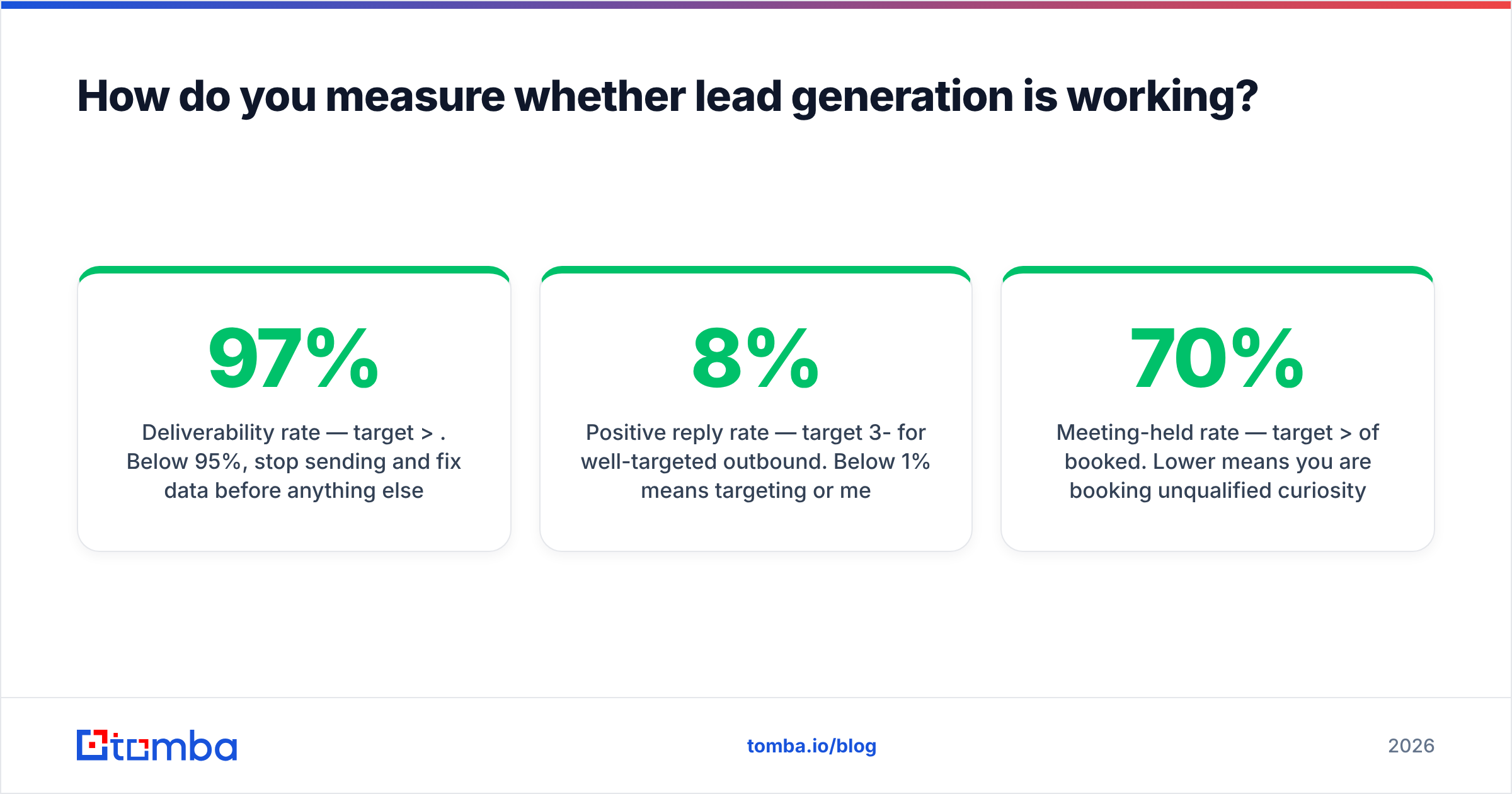
- Deliverability rate — target >97%. Below 95%, stop sending and fix data before anything else.
- Positive reply rate — target 3-8% for well-targeted outbound. Below 1% means targeting or message, not volume.
- Meeting-held rate — target >70% of booked. Lower means you are booking unqualified curiosity.
- Cost per meeting held — your one comparable number across every channel in the table above.
Notice what is absent: open rate, impressions, and total leads. Gartner's sales research has been making this point for years — pipeline quality metrics predict revenue far better than activity volume, and activity dashboards actively encourage the behaviors that destroy deliverability.
Run this review weekly, not monthly. Data quality problems compound; a domain reputation issue caught in week one is a two-day fix, and the same issue caught in week six is a six-week warmup.
Where should you start this week?#
If you are starting from zero: pick 200 accounts that look like your best three customers, resolve 3 contacts each, verify every address, and send a 4-step sequence with one genuinely specific opening line. That is 600 contacts — enough signal to know within three weeks whether your ICP thesis is right, and small enough that you can read every reply yourself.
If you already have a program that is underperforming: run your existing list through verification before changing a single word of copy. In most audits, the copy was fine and a third of the list was undeliverable.
Either way, the bottleneck is the same, and it is not creativity. Start with the Tomba Email Finder to resolve verified contacts for your target accounts — free tier gives you 25 searches a month to test the accuracy on companies you already know, before you commit a dollar. Get layer 2 right and every channel above it gets cheaper.
Related guides#
Ready to find emails that actually work?
Join 150,000+ professionals who stopped guessing and started sending. Free credits on signup — no credit card required.
Get the Tomba newsletter
Practical outbound tactics and product updates — once every two weeks.
About the author