Generative AI in Sales and Marketing: 2026 Field Guide
Most generative AI pilots in revenue teams stall because the data underneath them is wrong. Here is what actually works in 2026, what to skip, and how to measure it.

TL;DR
- Generative AI in sales and marketing works best on three jobs: first-draft creation, research summarization, and structured data extraction. It works worst on prospect discovery, forecasting, and anything requiring ground-truth contact data.
- The 2026 failure pattern is consistent: teams bolt an LLM onto a stale CRM and get fluent, confident, wrong output at scale.
- Content velocity is no longer a moat. Everyone has it. The moat is verified data plus distribution.
- Budget roughly 60% of your AI spend on data quality and 40% on the models. Most teams invert this and wonder why reply rates dropped.
- Measure AI initiatives on pipeline created and reply rate, not on "assets produced" or "hours saved."
What Is Generative AI in Sales and Marketing, Really?#
Generative AI in sales and marketing is the use of large language models and adjacent generative systems to produce, personalize, summarize, or classify revenue-facing work — emails, ad copy, call summaries, lead scores, landing pages, and research briefs.
Think of it like hiring a very fast, very literate intern who has read the entire internet but has never met your customers, does not know your pricing, and will never say "I don't know." That framing explains almost every failure mode you will encounter. The output quality is bounded not by the model, but by what you feed it.
By 2026 the technology stack has settled into four layers:
- Foundation models — the general reasoning engines (Claude, GPT, Gemini, Llama derivatives) that most tools resell under their own UI.
- Application layer — sequencers, CRMs, and content platforms that wrap those models with revenue-specific prompts and workflows.
- Grounding data — your CRM records, product docs, call transcripts, and third-party contact data. This is the layer that decides whether output is useful or hallucinated.
- Human review — the approval gate. Teams that removed it in 2024 mostly added it back by 2025.
Most vendor marketing focuses on layer one. Most of your results come from layer three.
Where Does Generative AI Actually Beat a Human in 2026?#
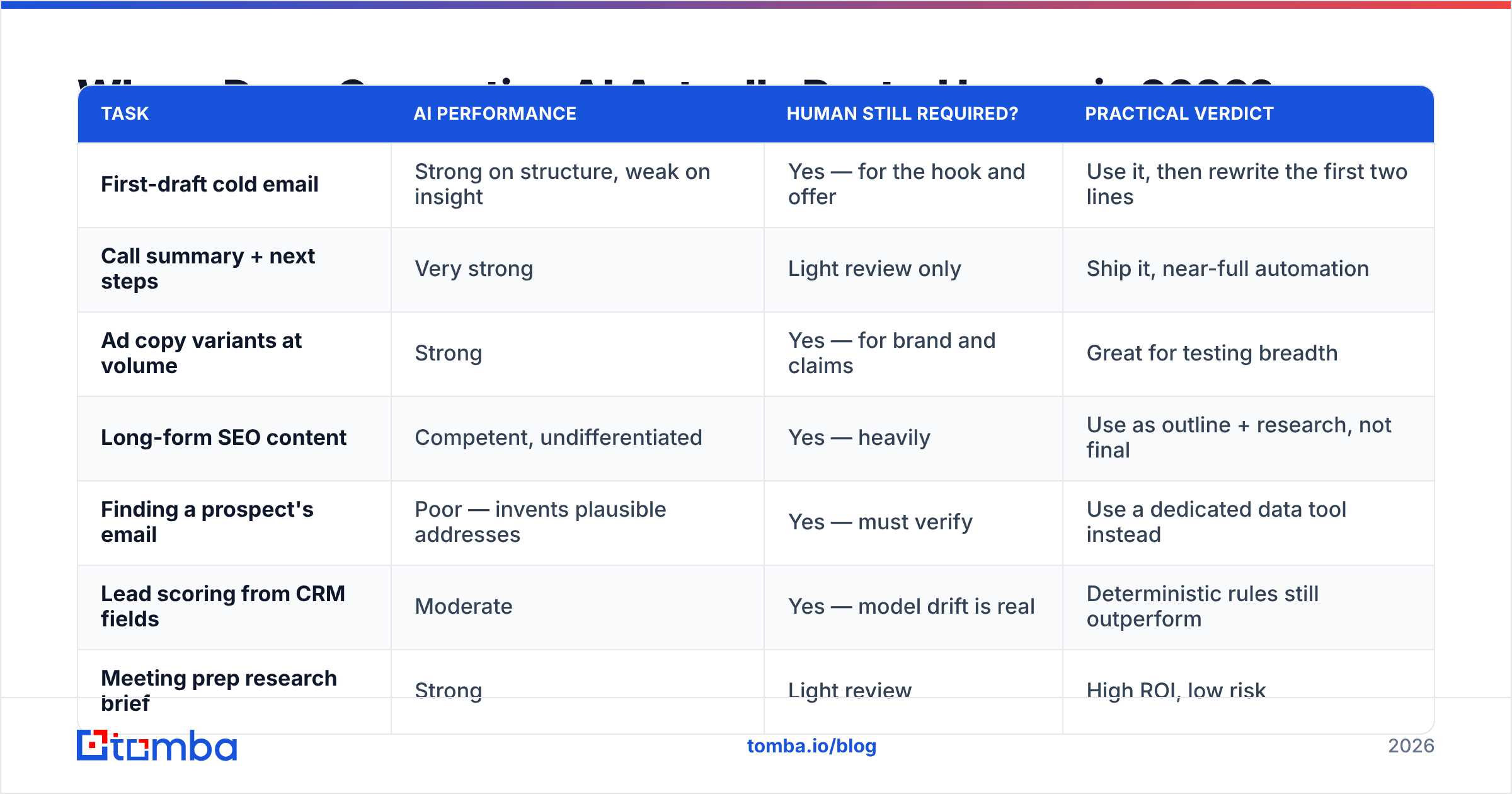
Be specific about the job, not the category. Here is the honest split based on how revenue teams are deploying it now.
| Task | AI performance | Human still required? | Practical verdict |
|---|---|---|---|
| First-draft cold email | Strong on structure, weak on insight | Yes — for the hook and offer | Use it, then rewrite the first two lines |
| Call summary + next steps | Very strong | Light review only | Ship it, near-full automation |
| Ad copy variants at volume | Strong | Yes — for brand and claims | Great for testing breadth |
| Long-form SEO content | Competent, undifferentiated | Yes — heavily | Use as outline + research, not final |
| Finding a prospect's email | Poor — invents plausible addresses | Yes — must verify | Use a dedicated data tool instead |
| Lead scoring from CRM fields | Moderate | Yes — model drift is real | Deterministic rules still outperform |
| Meeting prep research brief | Strong | Light review | High ROI, low risk |
| Forecasting from pipeline data | Weak | Yes | Do not delegate this |
The pattern: generative AI is excellent at transforming information you already have and terrible at retrieving information you do not have. Ask it to summarize a 40-minute discovery call and it will beat most reps. Ask it what the VP of Engineering at a mid-market manufacturer's email address is, and it will confidently produce firstname.lastname@company.com with no verification whatsoever — a guess dressed as an answer.

Why Do Most Generative AI Pilots Stall?#
Six recurring reasons, in rough order of how often they kill a project:
- Garbage grounding data. The model inherits every stale title, wrong domain, and dead email in your CRM. Fluency makes the errors harder to spot, not easier.
- No owner. AI initiatives get sponsored by a VP and executed by nobody. Assign a single accountable operator, ideally from revenue operations.
- Wrong success metric. "We generated 400 emails this week" is an activity metric. Pipeline created is the metric.
- Personalization theater. Inserting
{{company}}into a template three times is not personalization, and 2026 buyers pattern-match it instantly. - Deliverability collapse. Volume goes up, list hygiene does not, bounce rate spikes, and the domain burns. This is the most expensive failure on the list.
- No human gate on claims. One hallucinated compliance claim in a marketing email costs more than the entire year's AI budget.
Reason five deserves emphasis. Generative AI makes it trivially cheap to send more email, which means the constraint moved from writing to sending safely. Google and Yahoo's bulk sender requirements — spam complaint rates under 0.3%, authenticated domains, one-click unsubscribe — turned list quality into a hard gate. You can read the current requirements straight from Google's Postmaster documentation. If your bounce rate climbs past 3%, the volume advantage AI gave you becomes a liability within two weeks.
How Should You Split Budget Between Models and Data?#
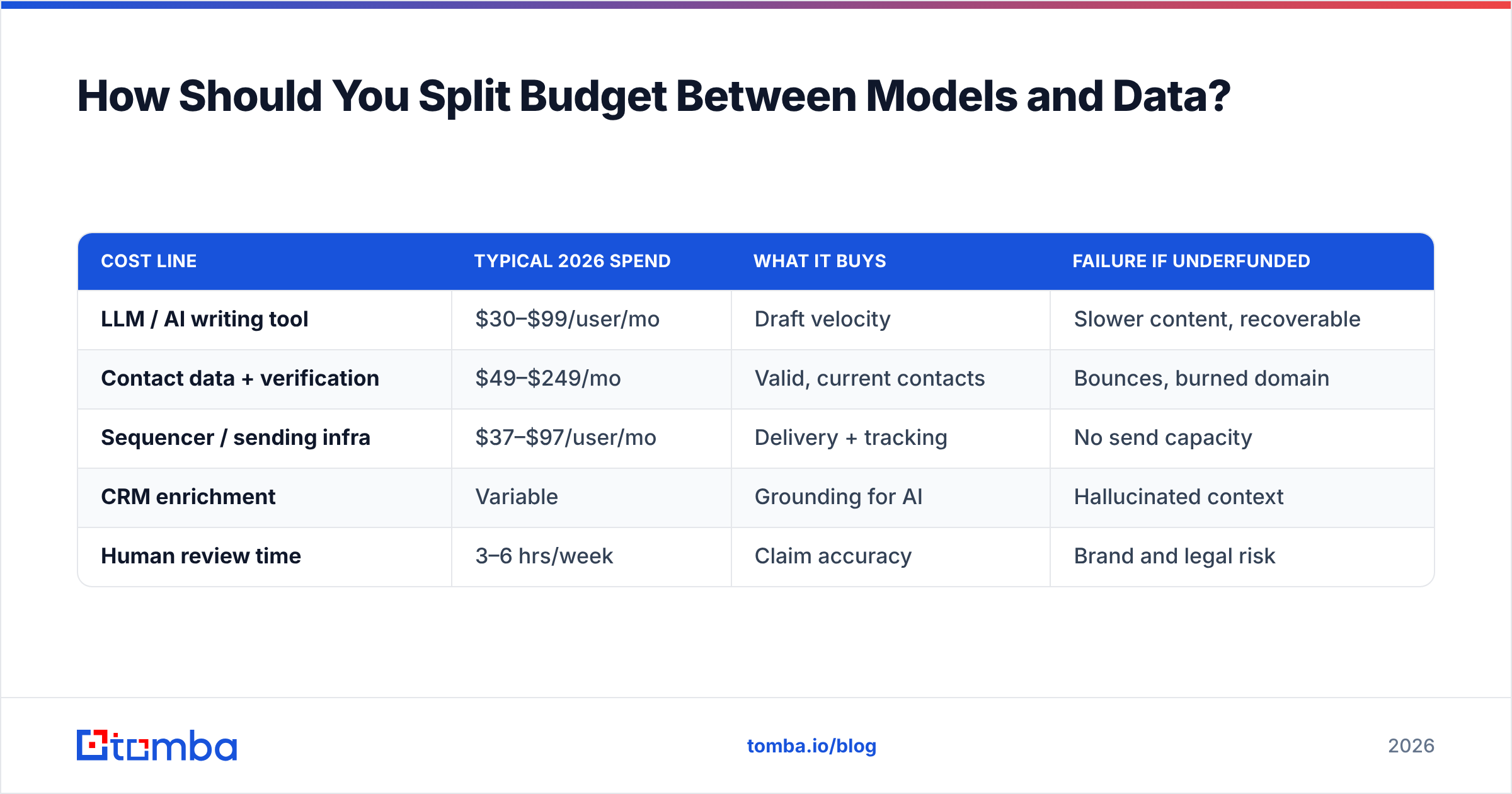
Roughly 60/40 in favor of data. Here is why, in concrete terms.
An LLM API call to draft a personalized email costs fractions of a cent. Sending that email to an address that does not exist costs you a bounce, a reputation ding, and a wasted slot in a finite daily send limit. Multiply across 5,000 sends and the arithmetic stops being close.
| Cost line | Typical 2026 spend | What it buys | Failure if underfunded |
|---|---|---|---|
| LLM / AI writing tool | $30–$99/user/mo | Draft velocity | Slower content, recoverable |
| Contact data + verification | $49–$249/mo | Valid, current contacts | Bounces, burned domain |
| Sequencer / sending infra | $37–$97/user/mo | Delivery + tracking | No send capacity |
| CRM enrichment | Variable | Grounding for AI | Hallucinated context |
| Human review time | 3–6 hrs/week | Claim accuracy | Brand and legal risk |
For the data line, the market splits into general-purpose databases and precision finders. Tomba pricing starts at a free tier with 25 searches/mo, then $49/mo Starter, $99/mo Growth, and $249/mo Pro — priced for teams that need accuracy per lookup rather than a bulk dump. Peers like BookYourData take a pay-as-you-go database approach, which suits teams buying large static lists rather than enriching a live pipeline. Both models are legitimate; pick based on whether your motion is list-buying or continuous enrichment.
Whatever you pick, run every AI-generated send list through an email verifier before it touches your sequencer. That single step is the highest-leverage thing on this page.
What Does a Working AI Sales Workflow Look Like?#
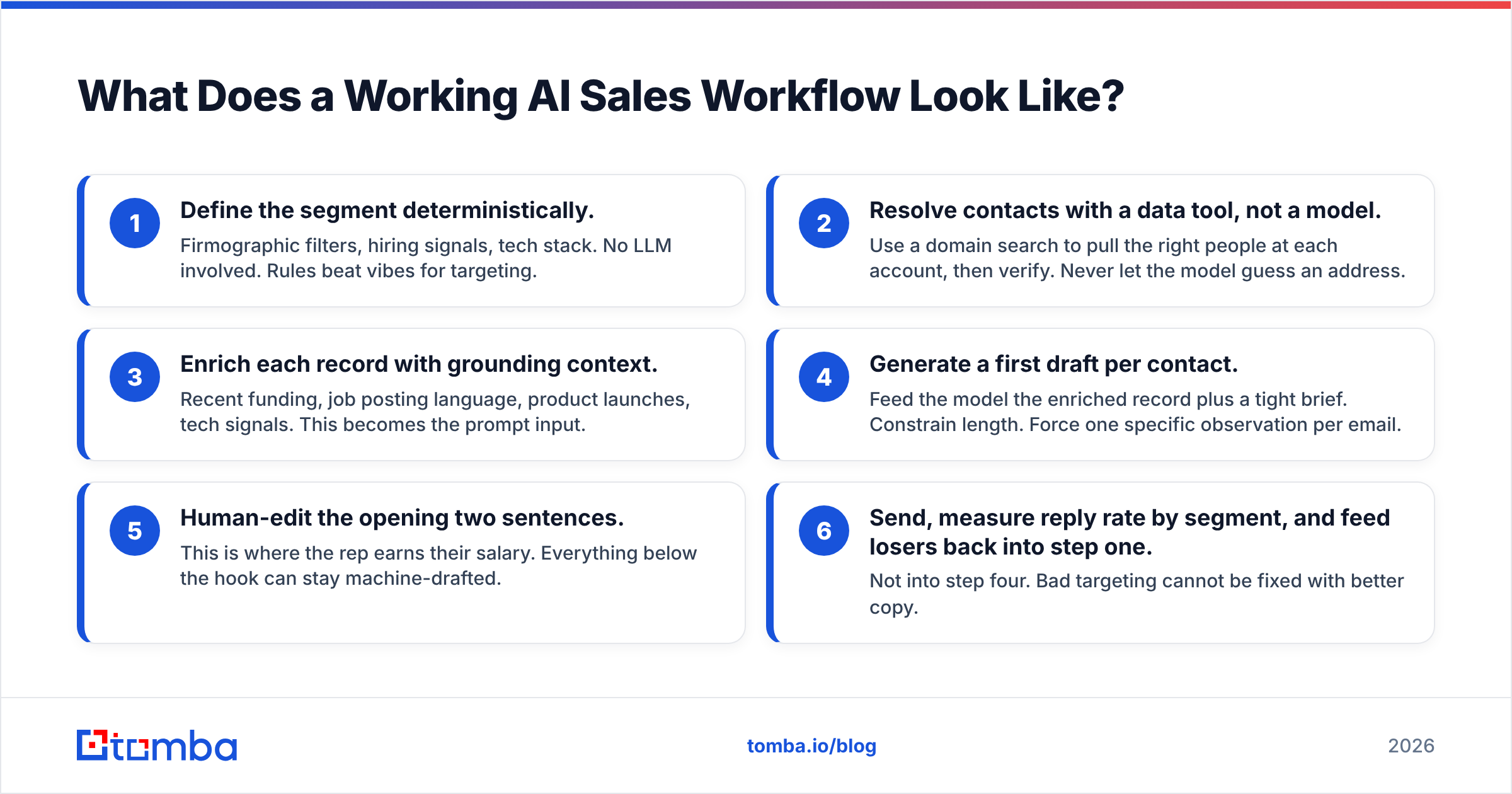
Here is a concrete, six-step motion that teams are actually running in 2026 — not a diagram from a vendor deck.
- Define the segment deterministically. Firmographic filters, hiring signals, tech stack. No LLM involved. Rules beat vibes for targeting.
- Resolve contacts with a data tool, not a model. Use a domain search to pull the right people at each account, then verify. Never let the model guess an address.
- Enrich each record with grounding context. Recent funding, job posting language, product launches, tech signals. This becomes the prompt input.
- Generate a first draft per contact. Feed the model the enriched record plus a tight brief. Constrain length. Force one specific observation per email.
- Human-edit the opening two sentences. This is where the rep earns their salary. Everything below the hook can stay machine-drafted.
- Send, measure reply rate by segment, and feed losers back into step one. Not into step four. Bad targeting cannot be fixed with better copy.
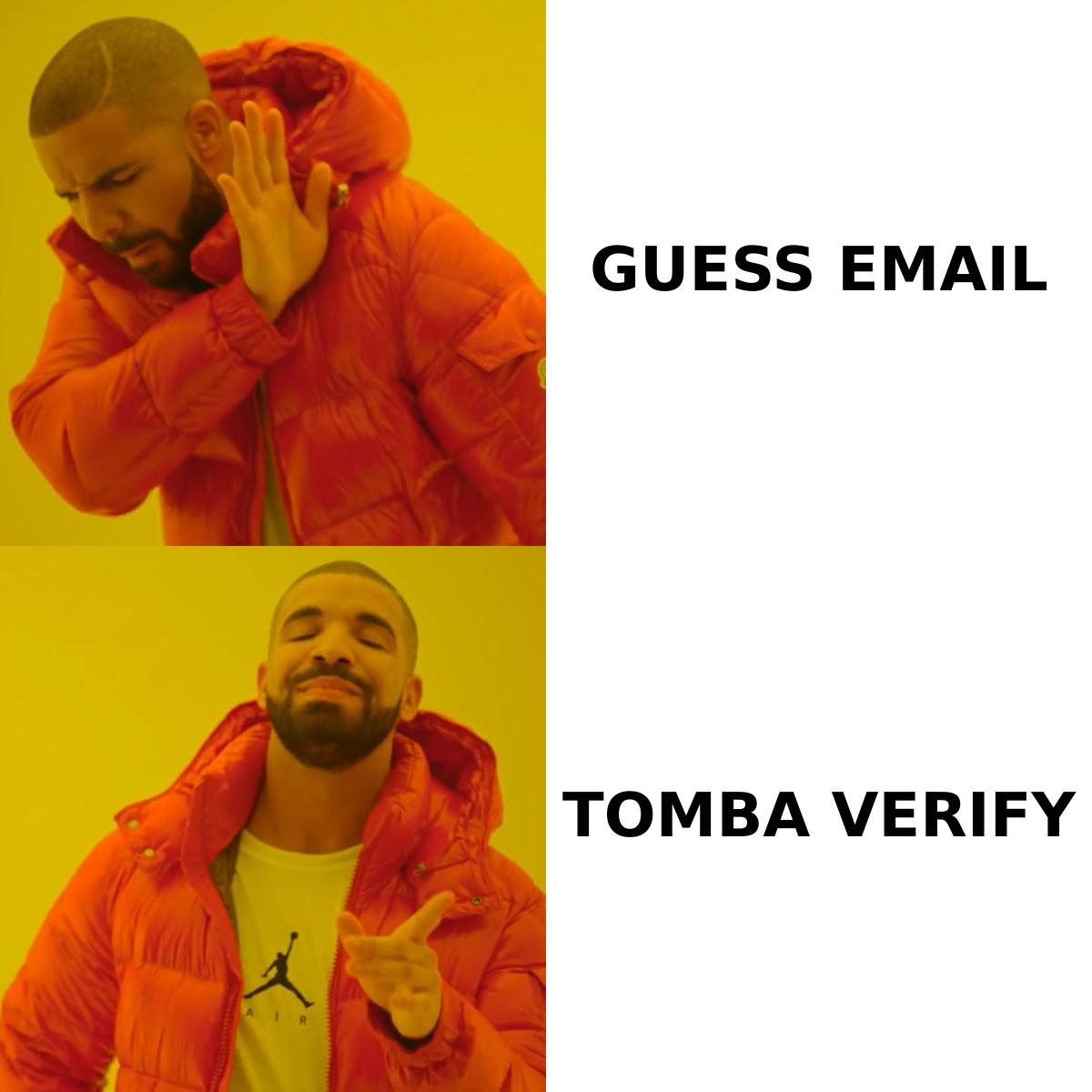
Step two is where most workflows quietly break. If you skip it and let the model produce contact data, you inherit an invented list. Tools like the Tomba Email Finder exist precisely because pattern-guessing and verification are different problems — one is a heuristic, the other is a network check against the receiving mail server.
Is AI-Generated Content Still Worth Publishing?#
Yes, with a shifted purpose. The economics changed.
In 2023, publishing AI-assisted content was an arbitrage — you got volume at a cost your competitors could not match. In 2026, everyone has that volume, search engines have adapted, and undifferentiated content ranks nowhere. Google's own helpful content guidance is explicit that automation is not penalized per se; low-value content is. That distinction is the whole game.
What still works:
- Original data. Survey your customers, publish the numbers. A model cannot generate a proprietary benchmark.
- First-hand product testing. Screenshots, real pricing, real limits, real failure cases. Verifiable specifics.
- Expert commentary on machine-assembled research. Let AI do the literature review; you supply the judgment.
- Structural comparison. Tables, decision trees, honest trade-offs. AI drafts fast, you fact-check.
What no longer works: definitional listicles, "10 tips" posts with no examples, and rewrites of the top-ranking page. Those had thin margins in 2023 and negative margins now.
For teams producing outbound copy at volume rather than blog content, tools like the subject line generator and a spam checker run in sequence do more for reply rate than upgrading to a marginally better foundation model.
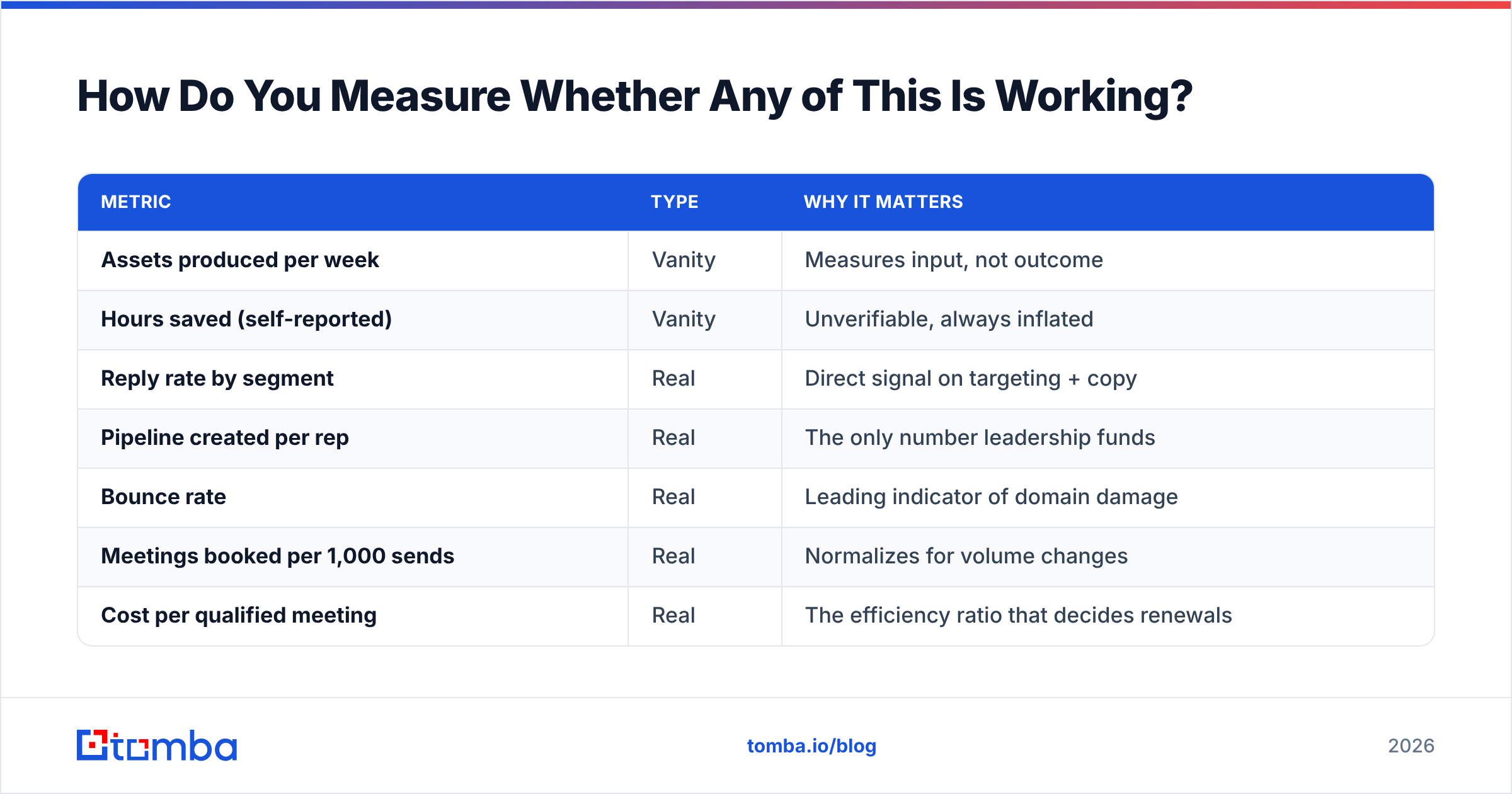
How Do You Measure Whether Any of This Is Working?#
Pick metrics that survive scrutiny from a CFO. Here is the split between vanity and real.
| Metric | Type | Why it matters |
|---|---|---|
| Assets produced per week | Vanity | Measures input, not outcome |
| Hours saved (self-reported) | Vanity | Unverifiable, always inflated |
| Reply rate by segment | Real | Direct signal on targeting + copy |
| Pipeline created per rep | Real | The only number leadership funds |
| Bounce rate | Real | Leading indicator of domain damage |
| Meetings booked per 1,000 sends | Real | Normalizes for volume changes |
| Cost per qualified meeting | Real | The efficiency ratio that decides renewals |
| Model token spend | Diagnostic | Useful only against outcome metrics |
Run a genuine holdout. Take one segment, work it without AI assistance, and compare reply rate and win rate after a full sales cycle. Most teams skip this and end up defending an investment with anecdotes. Analyst coverage from firms like Gartner consistently finds that the gap between AI-reported productivity gains and measured revenue gains is wide — the holdout is how you find out which side of that gap you are on.
One warning on attribution: if you deploy AI copy, better data, and a new sequencer in the same quarter, you will never know which one moved the number. Stage the changes.
What Should You Do in the Next 30 Days?#
A practical sequence, ordered by return on effort:
- Audit list hygiene first. Pull your last 5,000 sends and check bounce rate. If it is above 3%, stop everything else and fix data quality.
- Add AI to call summaries. Lowest risk, highest immediate acceptance from reps. It removes admin work nobody wants.
- Instrument reply rate by segment. You cannot optimize what you do not split.
- Run one holdout experiment. One segment, no AI, full cycle. Get a real baseline.
- Only then scale generation volume. Volume amplifies whatever your baseline is — including a bad one.
Notice that three of the five steps have nothing to do with AI. That is the point. Generative AI in sales and marketing is a multiplier on an existing system, and multipliers work in both directions.
The Bottom Line#
Generative AI earned a permanent place in the revenue stack — for drafting, summarizing, and transforming. It did not earn a place in prospect discovery or data resolution, and teams that pretended otherwise spent 2024 and 2025 burning sending domains and rebuilding lists.
The winning setup in 2026 is boring: deterministic targeting, verified contact data, AI-assisted drafting, human-edited hooks, and honest measurement. No single layer of that is exotic. The discipline of running all five is what separates teams booking meetings from teams producing assets.
If the data layer is your weak link — and for most teams reading this, it is — start there. The Tomba Email Finder resolves contacts by domain, name, or company and verifies them before they enter your sequencer, so your AI-drafted messages land in inboxes that actually exist. The free tier gives you 25 searches a month to test against your own known-good list before you commit to anything.
Related guides#
Ready to find emails that actually work?
Join 150,000+ professionals who stopped guessing and started sending. Free credits on signup — no credit card required.
Get the Tomba newsletter
Practical outbound tactics and product updates — once every two weeks.
About the author