Generative AI Lead Generation: How It Actually Works in 2026
Generative AI can write 10,000 cold emails an hour. That is exactly why most AI lead gen programs fail. Here is what actually moves pipeline in 2026 — and what to stop paying for.
TL;DR
- Generative AI lead generation works when it compresses research and personalization time. It fails when it is used to increase send volume against unverified data.
- The bottleneck in 2026 is not copy. It is data quality and inbox placement. An AI-written email to a guessed address still bounces.
- The realistic stack is four layers: source data, verify, enrich with AI signals, then generate copy — in that order.
- Expect 30-60% research time savings and a 1.3-2x reply lift from AI personalization. Do not expect 10x. Vendors claiming 10x are counting sends, not meetings.
- Budget roughly $150-$400/month per SDR for a working AI-assisted stack, most of which is data, not the LLM.
What is generative AI lead generation?#
Generative AI lead generation is the use of large language models to produce the artifacts of a prospecting motion: account research summaries, ICP-fit scores, personalized email openers, call scripts, LinkedIn messages, and follow-up sequences.
Think of it like a sous chef. It preps ingredients faster than any human — chopping research, drafting openers, sorting accounts. It does not decide what dish you serve, and it does not source the ingredients. If you hand it rotten produce, you get a fast, beautifully plated bad meal.
That distinction matters because most teams buying "AI lead generation" in 2026 are buying the chef and skipping the market run. The LLM is now the cheapest, most commoditized part of the stack. GPT-class and Claude-class models cost fractions of a cent per prospect research summary. Contact data that is actually deliverable still costs real money, because it requires infrastructure — crawling, pattern inference, SMTP validation, catch-all handling — that no model can hallucinate its way around.
Here is what each layer actually does:
- Sourcing — Identify companies and people matching your ICP. Firmographic filters, intent signals, job-change triggers, website visitor identification.
- Contact discovery — Turn "Sarah Chen, VP Marketing at Acme" into a working email address and phone number. This is pattern inference plus verification, not generation.
- Verification — Confirm the mailbox exists and accepts mail before you send. Catch-all domains need separate handling.
- Enrichment — Attach the context that makes personalization non-generic: funding rounds, tech stack, hiring signals, recent content.
- Generation — The LLM writes the message using the enriched context.
- Delivery and measurement — Sending infrastructure, warmup, reply routing, and attribution back to meetings booked.
Generative AI touches layers 4, 5, and increasingly 1. It does not touch 2 and 3, no matter what the demo shows you.
Why do most generative AI lead gen programs fail?#
They optimize the wrong constraint. Before LLMs, writing 200 personalized emails took a week. Now it takes twenty minutes. Teams then do the obvious thing: send 2,000 instead of 200.
That breaks three things simultaneously.
Deliverability collapses. Google and Microsoft tightened bulk-sender enforcement significantly through 2024-2025, and the bulk sender requirements now enforce authentication, one-click unsubscribe, and a spam-complaint threshold under 0.3%. Ten times the volume against a list with a 12% bounce rate is a fast route to a burned domain. Understanding email deliverability is now a prerequisite for any AI-scaled outbound, not an afterthought.
Personalization becomes detectable. Buyers have now read thousands of LLM-written cold emails. The tells are well-known: "I noticed your recent post about," "I was impressed by your work in," an opener that restates the company's homepage headline back at them. Generic AI personalization performs worse than no personalization because it signals automation without providing value.
Attribution gets muddy. When volume goes up 10x and replies go up 1.4x, the dashboard shows "more replies from AI." Reply rate per contact dropped 86%. Nobody notices until the domain reputation drops.

The fix is not to abandon generative AI. It is to hold volume constant and spend the freed-up time on depth — better accounts, better signals, better first lines, and a verified list underneath all of it.
What does the 2026 generative AI lead gen stack look like?#
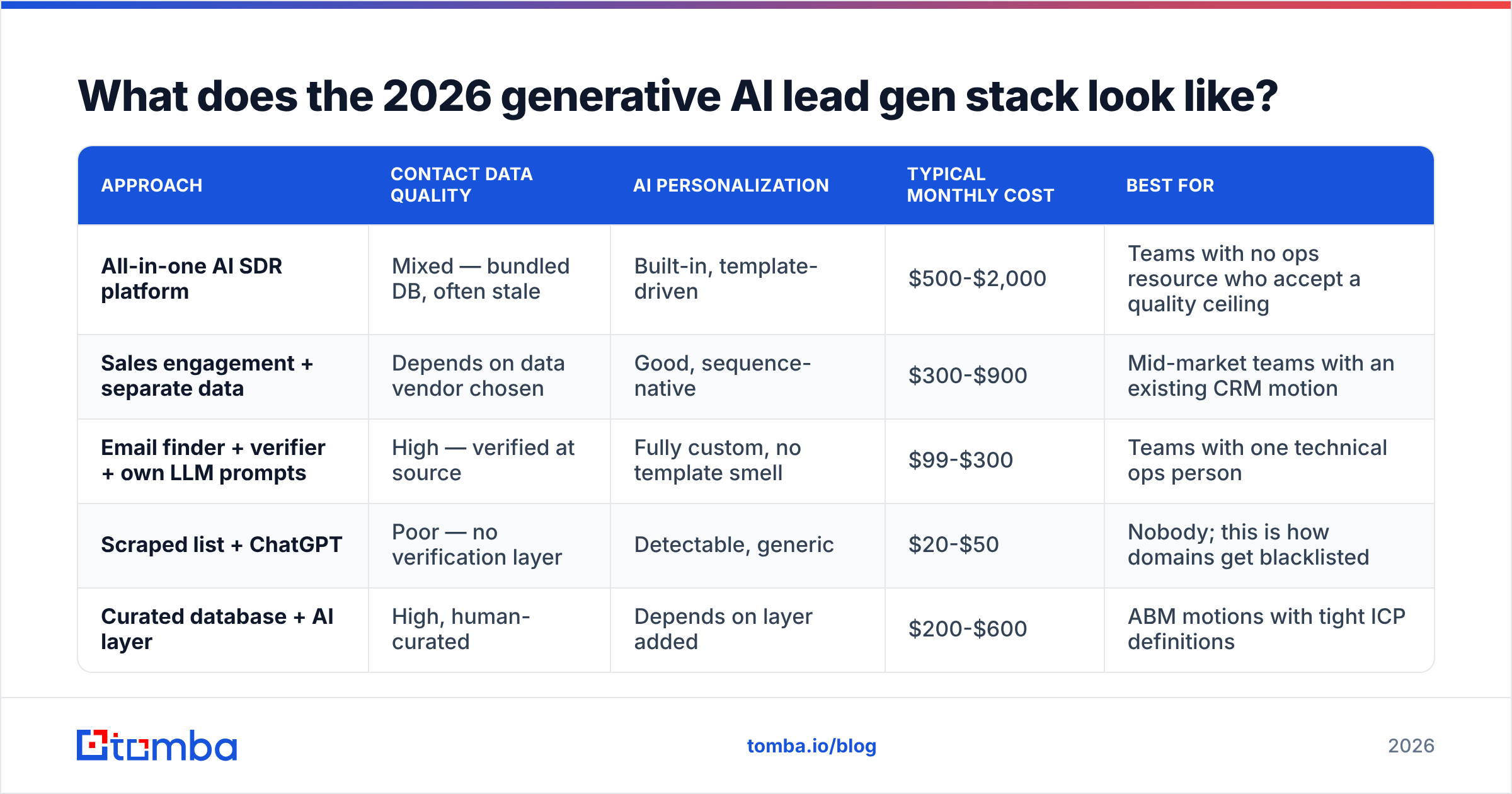
Most functional stacks now separate data from generation rather than buying an all-in-one that does both mediocrely. Here is how the common approaches compare on the dimensions that decide outcomes.
| Approach | Contact data quality | AI personalization | Typical monthly cost | Best for |
|---|---|---|---|---|
| All-in-one AI SDR platform | Mixed — bundled DB, often stale | Built-in, template-driven | $500-$2,000 | Teams with no ops resource who accept a quality ceiling |
| Sales engagement + separate data | Depends on data vendor chosen | Good, sequence-native | $300-$900 | Mid-market teams with an existing CRM motion |
| Email finder + verifier + own LLM prompts | High — verified at source | Fully custom, no template smell | $99-$300 | Teams with one technical ops person |
| Scraped list + ChatGPT | Poor — no verification layer | Detectable, generic | $20-$50 | Nobody; this is how domains get blacklisted |
| Curated database + AI layer | High, human-curated | Depends on layer added | $200-$600 | ABM motions with tight ICP definitions |
The third row is where most efficient teams landed. You pay for accuracy at the data layer, where accuracy is expensive to produce, and you pay near-nothing for generation, where it is cheap. A bulk email finder run against your target account list, followed by verification, costs less than a single seat of an AI SDR platform and produces a cleaner list.
Vendors like BookYourData take a different but valid route — pre-verified, human-curated lists sold by the record, which suits teams that want to buy a finished list rather than build one. It is a reasonable trade if your ICP is stable and your volume is predictable. Build-your-own via an email finder makes more sense when your ICP shifts, when you are prospecting against accounts surfaced by intent data, or when you need API access to enrich records continuously.
What should you actually automate with AI?#
Not everything benefits equally. Ranked by return:
- Account research summaries — Highest return. Feed the LLM a company's 10-K excerpt, recent press, and job postings; get a 100-word "why now" brief. Saves 15-20 minutes per account.
- ICP fit scoring — High return. Ask the model to score accounts against a written ICP rubric. More consistent than junior SDR judgment, and auditable.
- First-line personalization from real signals — Good return, but only when grounded in enrichment data. Ungrounded, it produces the detectable filler above.
- Follow-up variation — Moderate return. Rewriting follow-ups 3-7 to avoid repetition is genuinely useful and low-risk.
- Subject lines — Low return. Short, direct subject lines still beat clever AI ones. Test with a subject line tester rather than trusting model output.
- Full email generation, unsupervised — Negative return at scale. Use it for a first draft a human edits, not for send-ready output.
How do you keep AI-generated outreach out of spam?#
Sequence matters. Verification before generation, always.
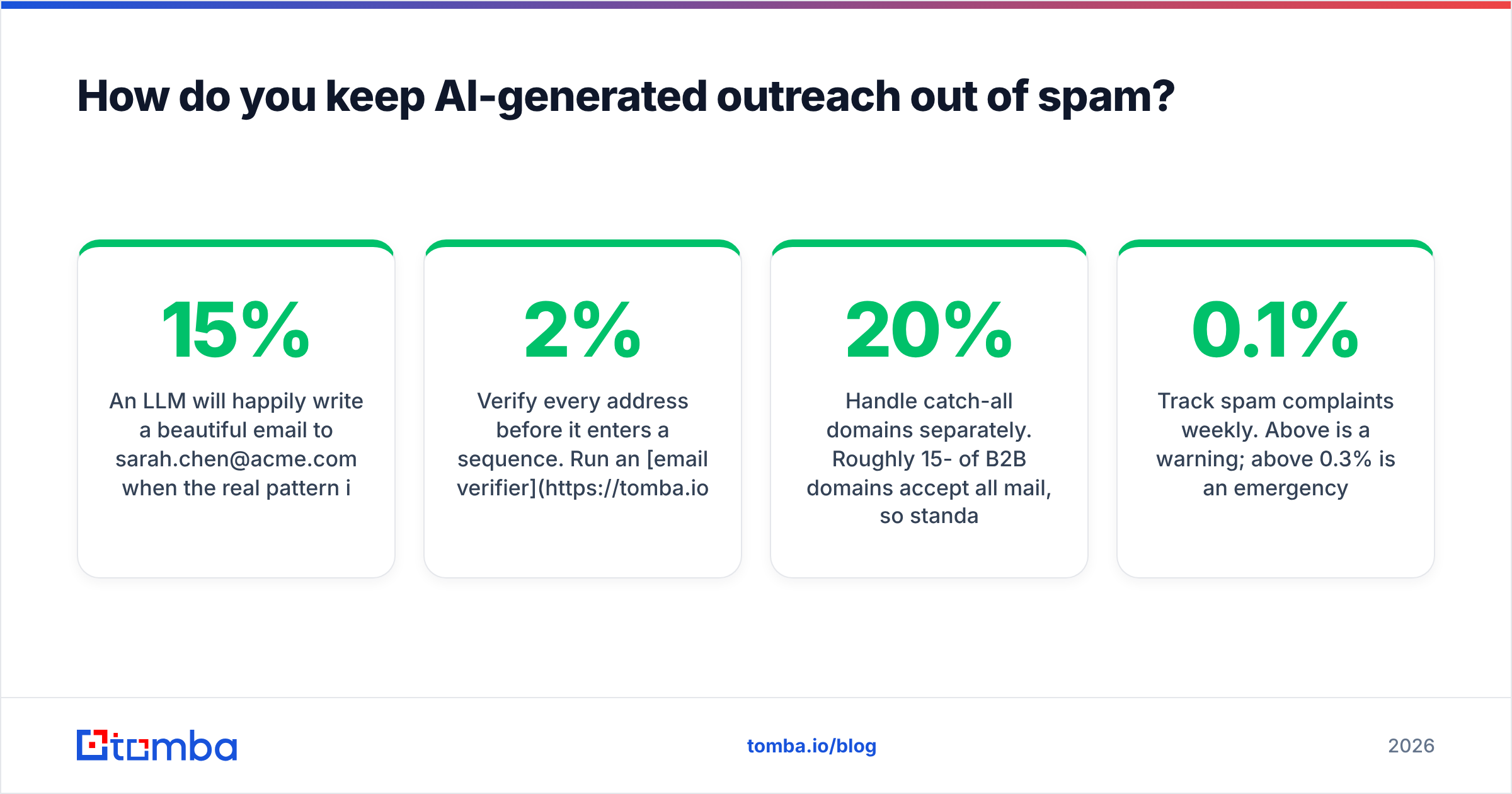
An LLM will happily write a beautiful email to sarah.chen@acme.com when the real pattern is s.chen@acme.com. The model has no way to know. It will not flag uncertainty because generating a plausible address is exactly what it is built to do. This is the single most common failure mode in AI lead gen: teams use the model to guess addresses, then wonder why bounce rates sit at 15%.

The operational checklist:
- Verify every address before it enters a sequence. Run an email verifier pass and drop anything that does not return a valid, deliverable result. Target under 2% bounce rate.
- Handle catch-all domains separately. Roughly 15-20% of B2B domains accept all mail, so standard SMTP checks return "valid" for addresses that do not exist. A catch-all verifier applies pattern-confidence scoring instead of blind acceptance. Send to these on a separate, lower-volume domain.
- Authenticate properly. SPF, DKIM, and DMARC on every sending domain. Check your SPF record before your first send, not after the first bounce spike.
- Cap per-mailbox volume. 30-50 sends per mailbox per day, regardless of how fast AI writes them. Scale with more mailboxes, not more sends per mailbox.
- Warm every new domain for 3-4 weeks. No exceptions, no matter how urgent the quarter.
- Track spam complaints weekly. Above 0.1% is a warning; above 0.3% is an emergency.
None of this is new advice. It just becomes ten times more consequential when the copy bottleneck disappears and volume can suddenly scale without friction.
Does AI personalization actually improve reply rates?#
Yes, with a much smaller effect size than the marketing claims — and only when the personalization is grounded in real data.
Across the outbound teams publishing honest numbers, the pattern is consistent: AI-personalized first lines grounded in verifiable signals (a funding round, a named tech-stack tool, a specific job posting, a real published article) lift reply rates roughly 1.3-2x over a generic template. AI-personalized lines grounded in nothing but the company's website copy perform at or slightly below the generic template.
The difference is information content, not eloquence. "I saw you're hiring three backend engineers in Lisbon while running on Segment — usually means the data pipeline is about to get painful" contains information the prospect recognizes as specific. "I was impressed by Acme's commitment to innovation in the fintech space" contains zero.
This is why enrichment is the layer that matters most for generation quality. Feed the model facts and it writes specifics. Feed it nothing and it writes flattery. Contact enrichment that attaches role, seniority, company size, tech signals, and social profiles to each record is what turns a generative model from a filler machine into a research assistant.
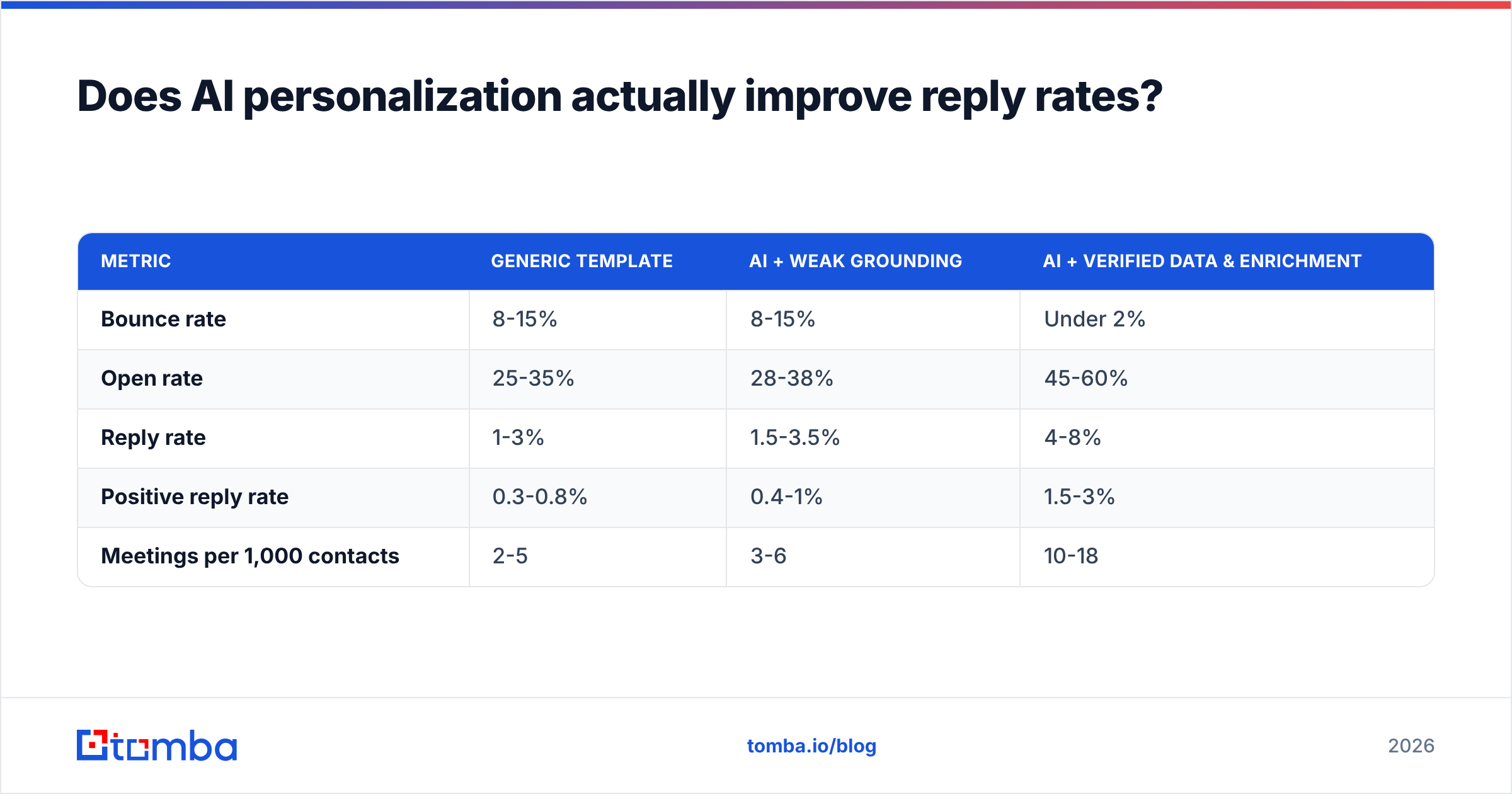
A practical benchmark for a well-run 2026 AI-assisted outbound program:
| Metric | Generic template | AI + weak grounding | AI + verified data & enrichment |
|---|---|---|---|
| Bounce rate | 8-15% | 8-15% | Under 2% |
| Open rate | 25-35% | 28-38% | 45-60% |
| Reply rate | 1-3% | 1.5-3.5% | 4-8% |
| Positive reply rate | 0.3-0.8% | 0.4-1% | 1.5-3% |
| Meetings per 1,000 contacts | 2-5 | 3-6 | 10-18 |
Note where the gain comes from. Between column two and column three, the copy quality changed modestly; the data quality changed completely. Most of the lift traces back to verification and enrichment, not to a better prompt.
What does a working AI lead gen workflow look like end to end?#
A concrete weekly loop for a two-person SDR team:
Monday — build the list. Pull 300 target accounts from your ICP filters plus any intent or job-change triggers. Run domain search against each to surface decision-maker contacts, then bulk-verify the output. Expect to keep roughly 70-80% after verification. Do not skip this step to save an hour.
Tuesday — enrich and score. Attach firmographics, tech stack, funding, and hiring signals. Run the enriched records through an LLM with a written ICP rubric and get a 1-5 fit score plus a one-line "why now." Manually spot-check 20 scores. If the model disagrees with you more than three times in twenty, your rubric is wrong, not the model.
Wednesday — generate and edit. Give the model the enriched record and a strict prompt: one opener, maximum 25 words, must reference a specific fact from the record, no adjectives about the company. Then edit. Budget 30-45 seconds per email of human review. If you cannot afford that, your volume is too high.
Thursday-Friday — send and route. Sequences go out at capped daily volume. Replies route to a human within one business hour. Never let an AI agent handle a positive reply unsupervised in 2026 — the failure mode is embarrassing and irreversible.
Ongoing — measure per contact, not per send. Track meetings booked per 1,000 verified contacts. That single metric prevents the volume trap better than any policy.
Teams running this loop typically process 300-500 accounts a week with two people, which is roughly triple the pre-LLM throughput at the same or better reply rate. That is the honest gain. It is substantial. It is not 10x.
What should you budget?#
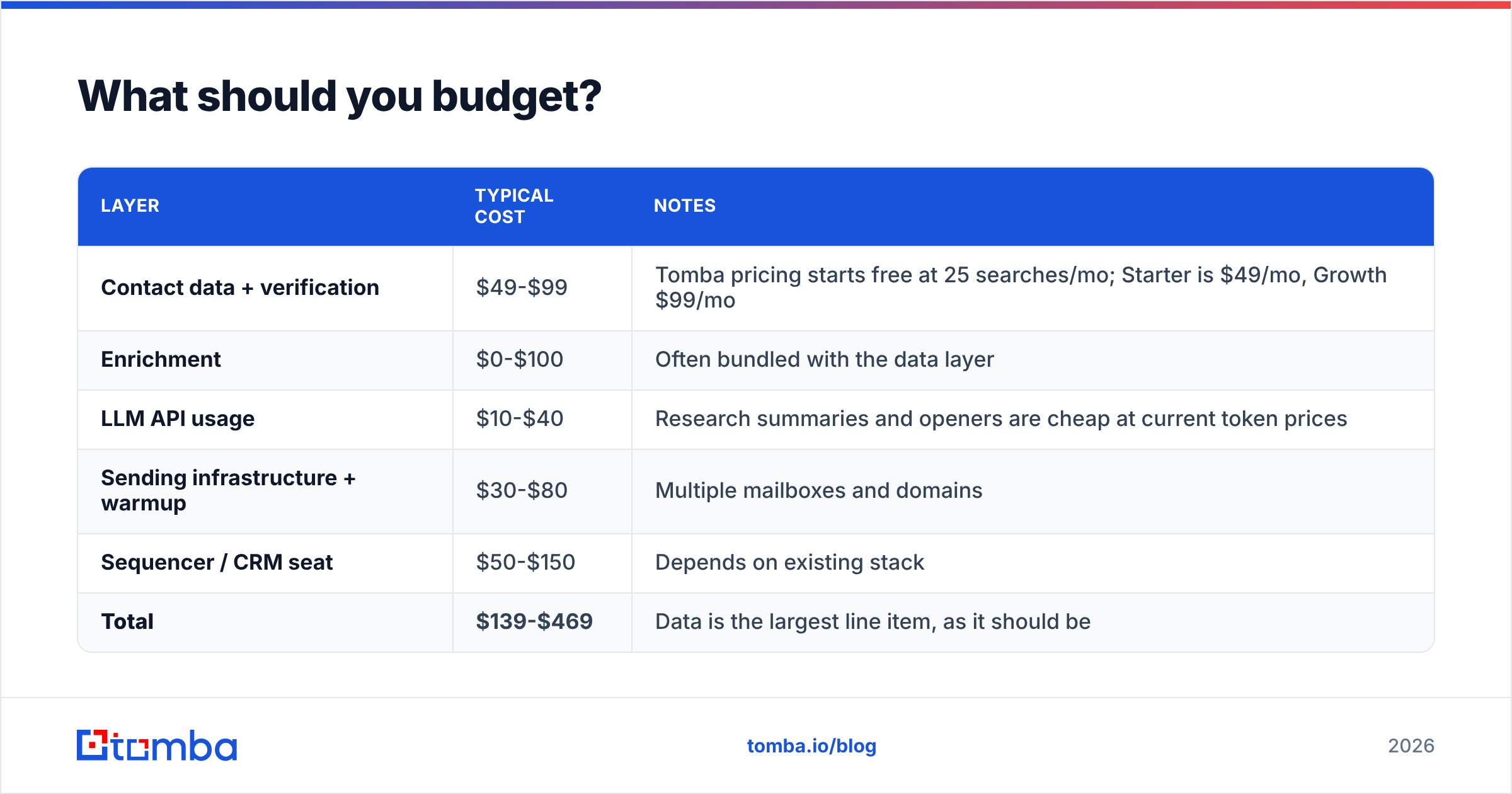
Per SDR, per month, for a stack that actually works:
| Layer | Typical cost | Notes |
|---|---|---|
| Contact data + verification | $49-$99 | Tomba pricing starts free at 25 searches/mo; Starter is $49/mo, Growth $99/mo |
| Enrichment | $0-$100 | Often bundled with the data layer |
| LLM API usage | $10-$40 | Research summaries and openers are cheap at current token prices |
| Sending infrastructure + warmup | $30-$80 | Multiple mailboxes and domains |
| Sequencer / CRM seat | $50-$150 | Depends on existing stack |
| Total | $139-$469 | Data is the largest line item, as it should be |
Compare that to a single all-in-one AI SDR seat at $500-$2,000/month, where you are paying a premium for a bundled contact database you cannot audit and cannot swap out. If your bounce rate is above 5% on a bundled platform, you are paying a premium for the privilege of burning your domain. Independent reviews on G2 tend to surface exactly this complaint pattern in the one- and two-star reviews of bundled AI SDR tools — read those before the five-star ones.
Where is this going in 2027?#
Three shifts worth planning for.
Generation becomes free; distribution gets harder. As mailbox providers keep tightening, the scarce resource shifts from "can you write it" to "will it land." Investment should follow — into verified data, domain hygiene, and channel diversification into phone and LinkedIn. A phone finder layer is becoming a hedge against email saturation rather than a nice-to-have.
Agentic research replaces static enrichment. Instead of pulling fixed fields, agents will run live research per account at prospecting time. This is already viable via API and MCP-style integrations — the Tomba API and MCP server exist to let an agent look up and verify a contact mid-workflow rather than pre-loading a static list.
Buyers deploy AI filters. Inbound AI triage on the buyer side is growing. Emails that read as machine-generated get filtered before a human sees them. The defense is specificity and brevity — which, again, comes from data, not from a better model.
The through-line across all three: generative AI keeps getting cheaper and better at the writing, which means writing stops being a differentiator. What remains scarce is knowing who to write to and being able to reach them.
Start with the layer that actually breaks#
If your AI outbound is underperforming, the prompt is almost never the problem. Pull your last 1,000 sends, check the bounce rate and the catch-all share, and you will usually find the real answer in under ten minutes.
Fix the data first. Tomba Email Finder gives you verified professional emails by domain, name, or company, with a free tier of 25 searches per month to test against your own list before committing. Run your current list through it, compare the verification results to what your existing tool returned, and let the bounce-rate delta make the decision for you. Everything downstream — the enrichment, the prompts, the sequences — only performs as well as the addresses underneath it.
Related guides#
Ready to find emails that actually work?
Join 150,000+ professionals who stopped guessing and started sending. Free credits on signup — no credit card required.
Get the Tomba newsletter
Practical outbound tactics and product updates — once every two weeks.
About the author