Generative AI Sales Tools in 2026: What Actually Works
Most generative AI sales tools promise pipeline and deliver drafts nobody sends. Here is where the category actually earns its keep in 2026, what it costs, and the data layer that decides whether any of it works.
TL;DR
- Generative AI sales tools split into four jobs: writing, research/summarization, conversation intelligence, and workflow orchestration. Most vendors claim all four and are genuinely good at one.
- The bottleneck is almost never the model. It's the data you feed it — a perfectly written email to a bounced address is still a bounce.
- Budget realistically: $30–$150 per seat per month for AI layers on top of your existing CRM and sequencer, plus data costs on top of that.
- AI-written cold email works when the AI is summarizing verified facts about the account, and fails when it's inventing personalization from a LinkedIn headline.
- The highest-ROI use in 2026 isn't writing at all. It's research compression: turning 20 minutes of account prep into 90 seconds.
What are generative AI sales tools?#
Generative AI sales tools are software that uses large language models to produce sales artifacts — emails, call summaries, account research, proposal drafts, CRM notes, forecast narratives — instead of just retrieving or storing them.
The useful mental model: a traditional sales tool is a filing cabinet. It stores what you put in and hands it back on request. A generative tool is a junior analyst with a photographic memory and zero judgment. It reads everything, produces something new, and will confidently hand you a fabricated fact with the same tone it uses for a real one.
That distinction drives every buying decision below. You are not buying intelligence. You are buying speed on top of whatever inputs you supply — and speed applied to bad inputs just gets you to the wrong answer faster.
The category breaks into four functional buckets:
- Writing and messaging — cold email drafts, sequence variants, LinkedIn messages, follow-ups, subject lines. Lowest technical barrier, highest vendor density, most commoditized.
- Research and enrichment summarization — reading 10-Ks, job postings, funding news, tech-stack signals, and news mentions, then compressing them into a two-line "why now" for a specific account.
- Conversation intelligence — call transcription, deal-risk scoring, objection tagging, coaching summaries. Gong and Chorus popularized this before "generative AI" was a marketing term; the LLM layer made the summaries readable.
- Workflow orchestration and agents — tools that chain steps: detect a signal, find the contact, verify the address, write the message, log it in the CRM, book the meeting. This is where most of the 2026 vendor roadmaps point, and where most of the demos quietly break.
Which generative AI sales tools are worth comparing in 2026?#
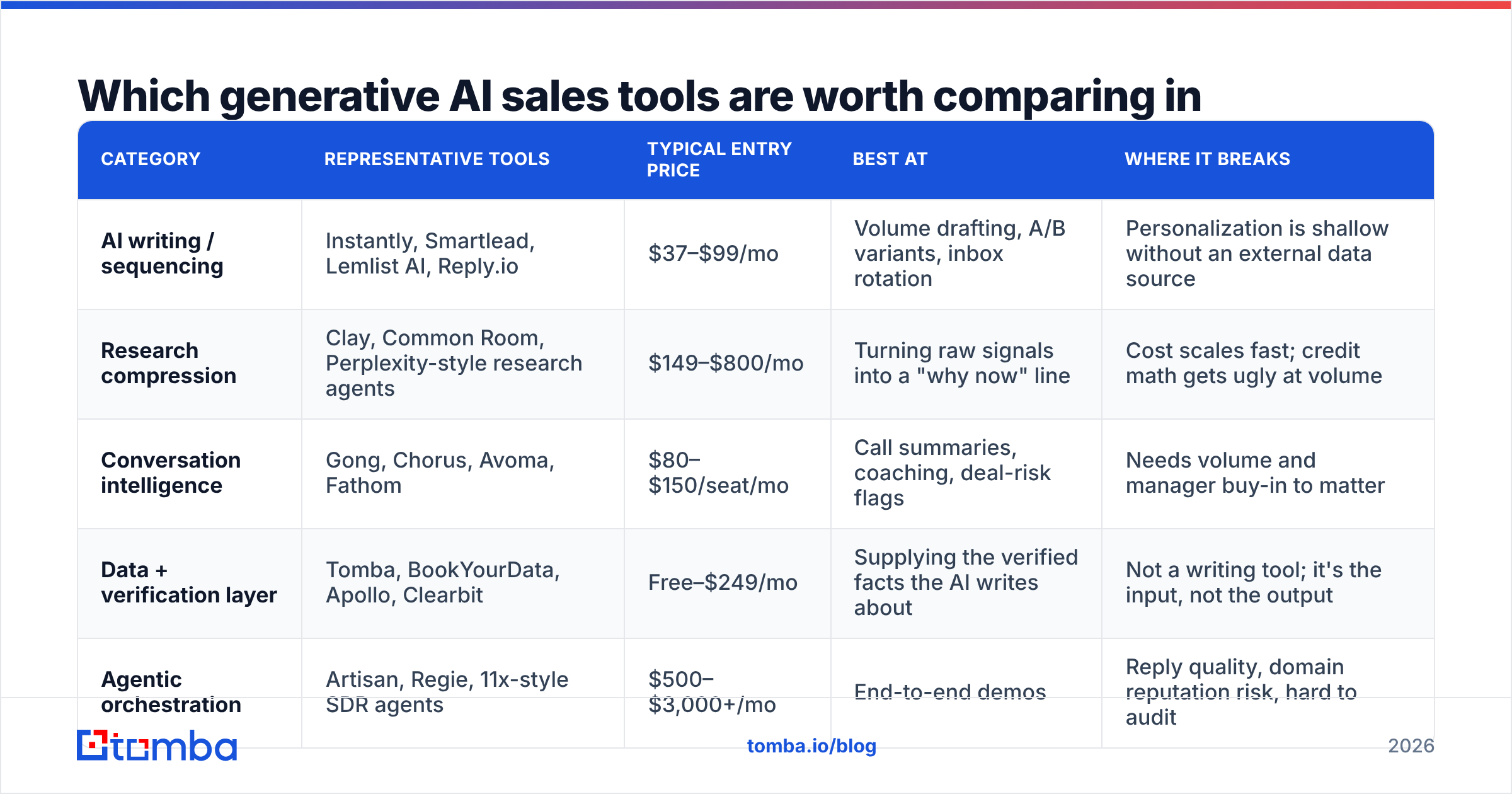
Rather than rank 40 tools, compare the archetypes. Every vendor you'll evaluate is a variation on one of these, and the pricing bands are more stable than the feature lists.
| Category | Representative tools | Typical entry price | Best at | Where it breaks |
|---|---|---|---|---|
| AI writing / sequencing | Instantly, Smartlead, Lemlist AI, Reply.io | $37–$99/mo | Volume drafting, A/B variants, inbox rotation | Personalization is shallow without an external data source |
| Research compression | Clay, Common Room, Perplexity-style research agents | $149–$800/mo | Turning raw signals into a "why now" line | Cost scales fast; credit math gets ugly at volume |
| Conversation intelligence | Gong, Chorus, Avoma, Fathom | $80–$150/seat/mo | Call summaries, coaching, deal-risk flags | Needs volume and manager buy-in to matter |
| Data + verification layer | Tomba, BookYourData, Apollo, Clearbit | Free–$249/mo | Supplying the verified facts the AI writes about | Not a writing tool; it's the input, not the output |
| Agentic orchestration | Artisan, Regie, 11x-style SDR agents | $500–$3,000+/mo | End-to-end demos | Reply quality, domain reputation risk, hard to audit |
Two things stand out when you lay it out this way.
First, the price spread is enormous, and it does not correlate with impact. A $99/mo sequencer paired with clean, verified data beats a $2,000/mo autonomous agent working off scraped guesses. The agent will send more emails. It will also burn your domain faster.
Second, the data layer is the only row that every other row depends on. Writing tools need contacts to write to. Research tools need entities to research. Agents need addresses that resolve. This is why teams that buy the AI layer first and the data layer second usually end up re-buying both.

Does AI-written cold email actually work?#
Yes — under one specific condition: the AI is summarizing verified facts, not inventing relevance.
Here's the failure mode you've already received in your own inbox. A model reads a prospect's LinkedIn headline — "VP of Revenue Operations at Acme" — and produces: "I noticed you're passionate about driving revenue efficiency at Acme." That's not personalization. It's a restatement of the job title with an adjective bolted on. Every recipient in that ICP got the same sentence with a different company name, and they know it.
Now the version that works. The model reads three verified inputs: Acme posted two RevOps analyst roles last month, their careers page lists Salesforce and Outreach in the stack, and their VP of Sales said on a podcast in March that reporting takes four days to close. The output: "Two RevOps analyst reqs open and a four-day close cycle on reporting — usually that combination means someone's rebuilding attribution by hand."
Same model. Same prompt engineering. Completely different result, because the inputs were real and specific.
The practical implication for tooling: your spend should be weighted toward whatever supplies verifiable inputs. That means a reliable email finder for contact discovery, data enrichment for firmographic and technographic context, and an email verifier pass before anything gets sent. The writing model is the cheap part of that chain — and increasingly, the interchangeable part.
One more constraint people underestimate: email deliverability. Generative tools make it trivial to 10x send volume. Google and Yahoo's bulk-sender requirements, in force since 2024 and tightened since, mean a spam complaint rate above 0.3% gets your domain throttled regardless of how good the copy is. Read Google's own sender guidelines before you let any AI tool touch your sending volume. Faster generation with a fixed reputation budget is not an obvious win.
How do you evaluate a generative AI sales tool before buying?#
Run every vendor through the same six checks. Most demos are designed to skip four of them.
- Bring your own worst account. Not the demo account. Pick a real prospect in a boring vertical with a thin web presence. Ask the tool to research and draft. Weak tools shine on Stripe and collapse on a 40-person industrial distributor.
- Ask where the facts come from. Every generated claim should trace to a source you can click. If the vendor can't show provenance, you're buying a plausible-sentence generator with a CRM logo on it.
- Check the credit math at your real volume. Vendors quote seat prices and hide consumption pricing. Model 5,000 contacts a month, not 100. Ask what happens when you exceed the bundle mid-month.
- Test the export path. Can you get your data, your prompts, and your outputs out? Lock-in in this category is usually structural, not contractual.
- Measure reply rate, not send rate. Every AI sequencer improves send volume by definition. Only some improve replies. Insist on a 30-day pilot with reply rate as the single metric.
- Audit for hallucination liability. If a generated email states a false fact about a prospect's funding, headcount, or compliance posture, that's a brand problem and occasionally a legal one. Find out who reviews before send.
Independent review data helps here too. G2's sales AI category shows a consistent pattern in the review text: the complaints are almost never about output quality and almost always about data accuracy, credit burn, and integration friction. That tells you where to focus diligence.
What does the stack actually look like when it works?#
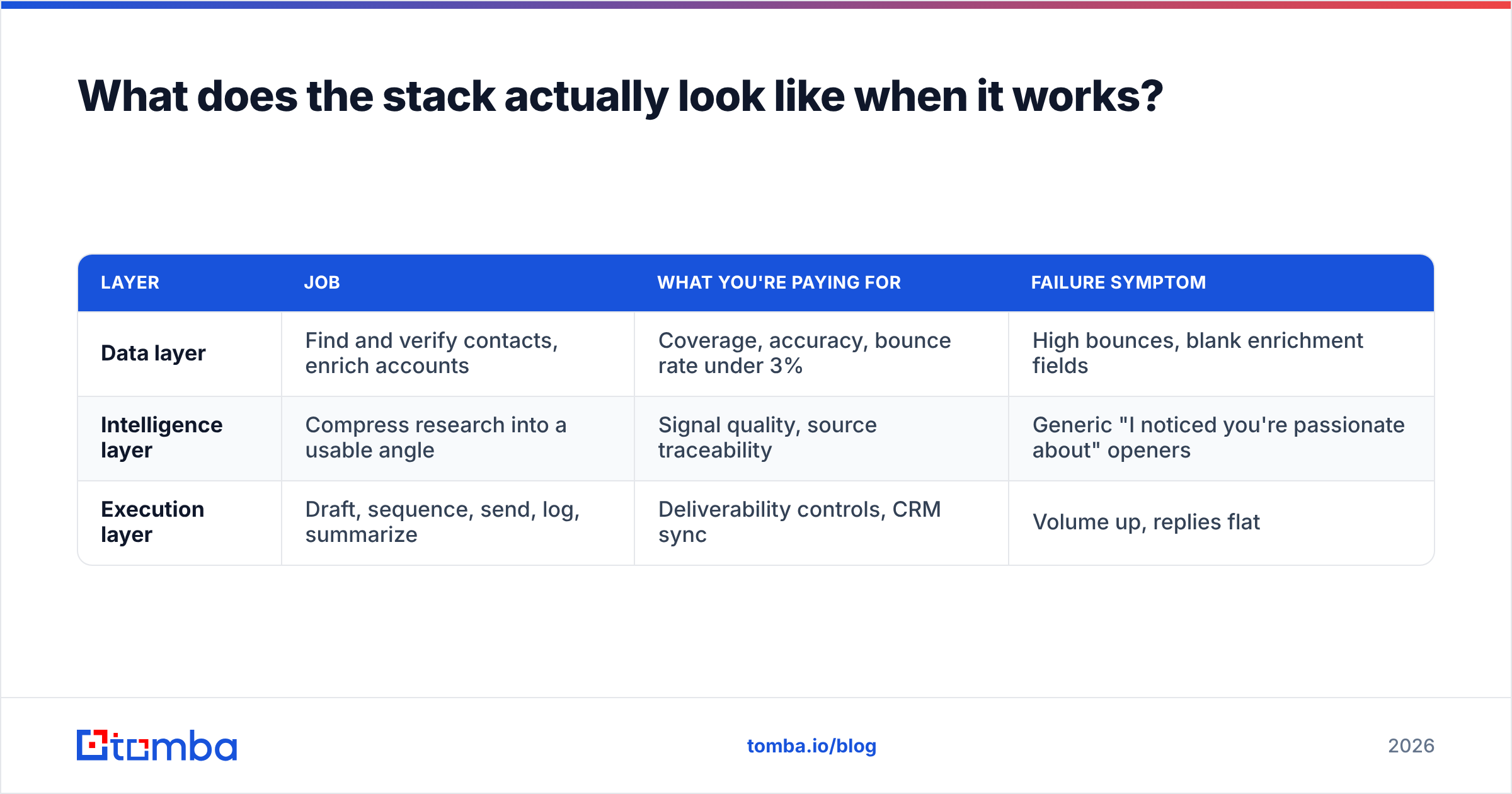
The teams getting real leverage from generative AI sales tools in 2026 tend to converge on the same three-layer shape, regardless of which vendors they picked.
| Layer | Job | What you're paying for | Failure symptom |
|---|---|---|---|
| Data layer | Find and verify contacts, enrich accounts | Coverage, accuracy, bounce rate under 3% | High bounces, blank enrichment fields |
| Intelligence layer | Compress research into a usable angle | Signal quality, source traceability | Generic "I noticed you're passionate about" openers |
| Execution layer | Draft, sequence, send, log, summarize | Deliverability controls, CRM sync | Volume up, replies flat |
Notice that the execution layer — the part everyone shops for first — is last in dependency order. That inversion explains most disappointing AI sales tool rollouts. A team buys a $2,000/mo AI SDR, plugs it into a contact list with a 22% bounce rate, and concludes AI doesn't work. The AI worked fine. It was writing letters to addresses that don't exist.
Practical sequencing if you're building this from scratch:
- Fix the data first. Run your existing list through verification before you buy anything generative. If bounce rate is above 5%, that's your project for the month. A bulk email finder plus a verification pass costs less than a single seat of most AI SDR products.
- Add research compression second. This is the highest-ROI generative use case and the least discussed. Twenty minutes of account prep down to ninety seconds, at 30 accounts a week, is roughly a full day back per rep.
- Add writing assistance third, with a human approval gate. Draft-and-review beats send-and-hope on every metric that matters except volume.
- Consider orchestration last, and only once the first three layers have measured baselines. Otherwise you can't tell what the agent improved.

Is a general-purpose LLM good enough instead?#
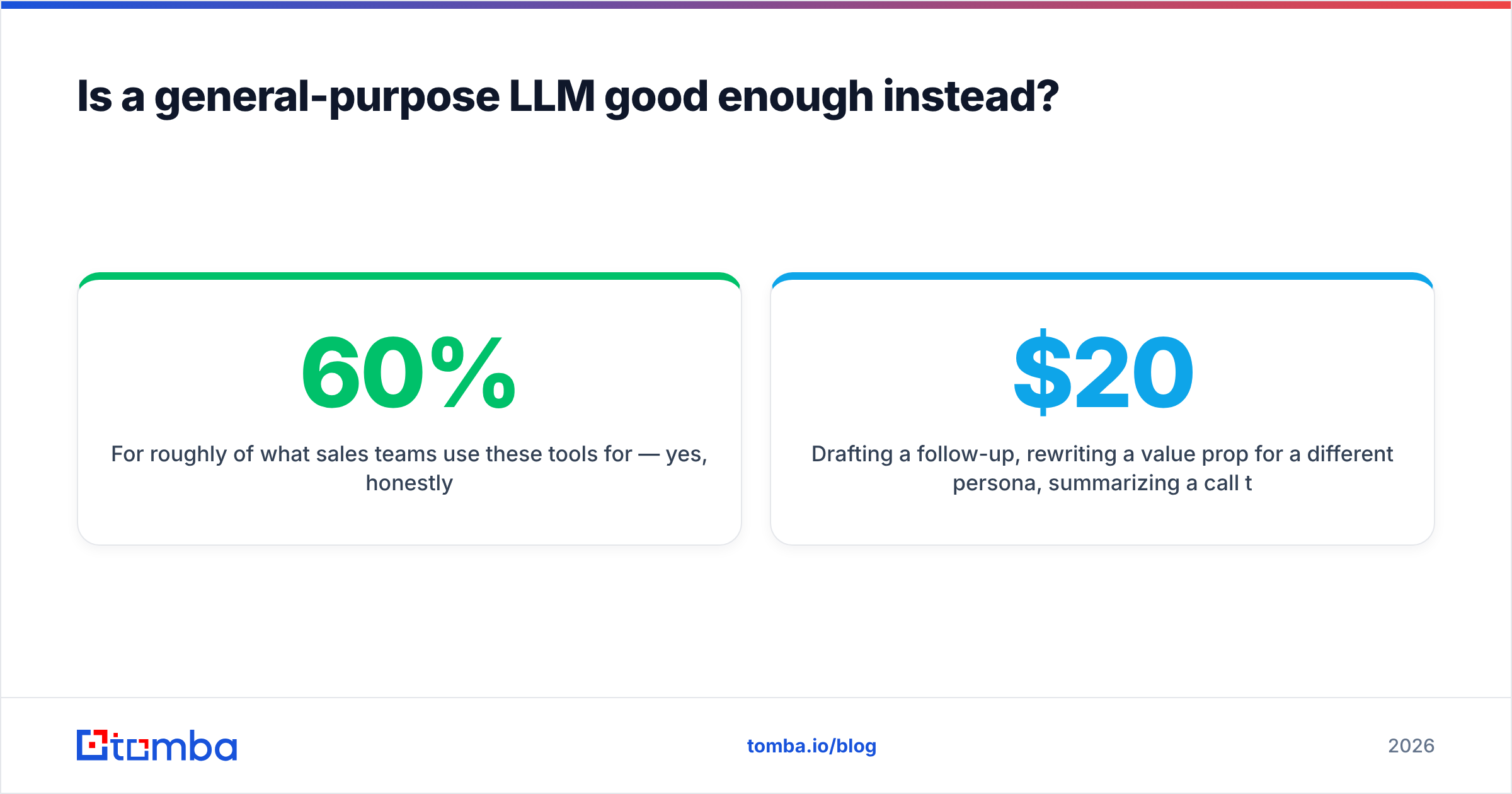
For roughly 60% of what sales teams use these tools for — yes, honestly.
Drafting a follow-up, rewriting a value prop for a different persona, summarizing a call transcript you paste in, generating 10 subject-line variants: a general-purpose model with a well-built prompt does all of that at $20–$30 per seat per month. The specialized vendors know this, which is why their marketing has shifted from "we write better emails" to "we're connected to your systems."
That connection is the real product. What you can't replicate with a raw model:
- Automatic CRM writeback — logging activity, updating fields, attaching summaries without copy-paste.
- Live data access — a chat model doesn't know which of your prospects changed jobs last week or which email address currently resolves.
- Deliverability infrastructure — inbox rotation, warmup, send throttling, bounce handling.
- Auditability — who sent what, to whom, with which claims, and who approved it.
If you don't need those four things, you're paying a large premium for a prompt wrapper. If you do need them, the premium is defensible. Be honest about which camp you're in before the annual contract.
A useful middle path: keep the LLM generic and cheap, and spend the budget on the data and delivery layers instead. Pipe verified contact data into your own prompts through an API — Tomba's email finder API and comparable endpoints from other vendors make this a weekend build rather than a quarter-long project — and you get most of the specialized-vendor value at a fraction of the seat cost. This is exactly how a lot of RevOps teams are quietly building in 2026, and it's why the revenue operations function keeps absorbing tooling decisions that used to sit with sales leadership.
What are the real costs and risks?#
Three costs that don't show up on the pricing page:
Reputation cost. Generative tools remove the natural throttle on outbound volume. Historically, writing 200 personalized emails took a week, which capped how fast a rep could damage a domain. That cap is gone. Set your own: per-domain daily sends, hard bounce thresholds that pause sequences automatically, and separate sending domains from your primary. Check your setup with an SPF checker and monitor sender reputation weekly, not quarterly.
Review cost. Every generated artifact that reaches a customer needs a human pass, at least until you've measured error rates. Budget 30–60 seconds per email in month one. Teams that skip this discover the problem via a prospect's screenshot on LinkedIn.
Switching cost. Prompt libraries, custom fields, and trained-on-your-data claims all create friction on exit. Ask specifically what "your data" means in the contract and whether your outputs are portable.
And one risk that's genuinely new: provenance collapse. When an AI summarizes an AI-written source about an AI-generated company profile, the confidence stays high and the accuracy drops with each hop. The defense is boring and effective — anchor every generated claim to a primary, verifiable source. A verified email address, a company's own careers page, a filed document. Anything else is a guess wearing a suit.
Which tool should you actually start with?#
Start with whichever layer is currently broken, and be honest about which one that is.
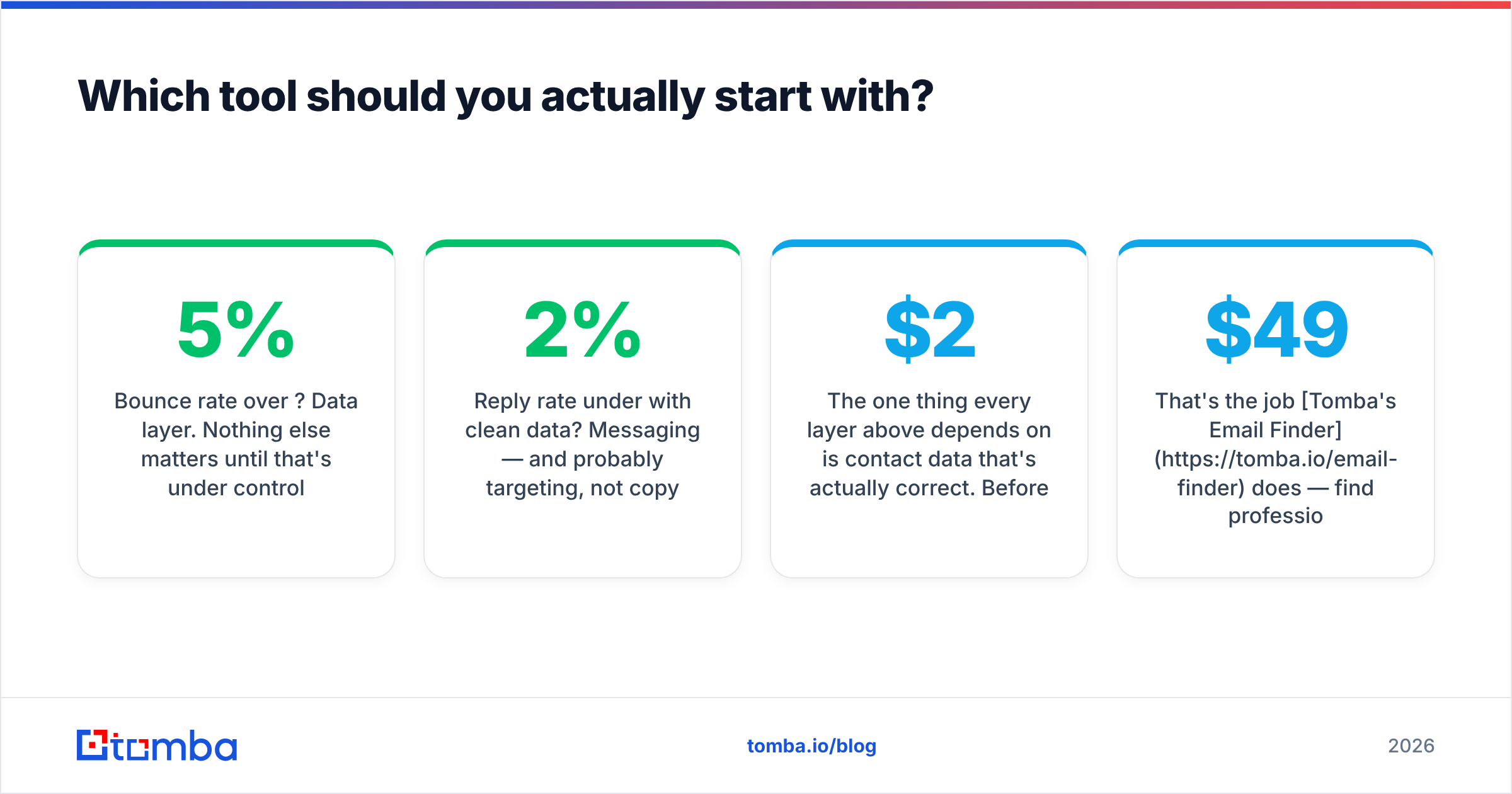
- Bounce rate over 5%? Data layer. Nothing else matters until that's under control.
- Reps spending 20+ minutes per account on prep? Research compression. Fastest measurable win.
- Reply rate under 2% with clean data? Messaging — and probably targeting, not copy.
- Managers can't tell why deals slip? Conversation intelligence.
- All four are fine and you want more volume? Now orchestration makes sense.
The one thing every layer above depends on is contact data that's actually correct. Before you spend $2,000 a month on an AI SDR that writes beautiful emails to addresses that don't exist, spend a fraction of that making sure the addresses exist.
That's the job Tomba's Email Finder does — find professional email addresses by domain, name, or company, verified before they hit your sequencer. The free tier gives you 25 searches a month to test coverage on your own ICP, and Tomba pricing starts at $49/mo for Starter, $99/mo for Growth, and $249/mo for Pro when you're ready to scale. Run your current list through it, compare the bounce rate to what you're getting now, and you'll know in an afternoon whether your AI problem was ever an AI problem.
Related guides#
Ready to find emails that actually work?
Join 150,000+ professionals who stopped guessing and started sending. Free credits on signup — no credit card required.
Get the Tomba newsletter
Practical outbound tactics and product updates — once every two weeks.
About the author