Generect Pricing in 2026: Real Costs, Limits, and Alternatives
Generect sells LinkedIn-sourced lead data by volume, not by seat — which makes the sticker price hard to compare. Here's how the credit math actually works in 2026, where the hidden costs sit, and when a cheaper email-first stack wins.
TL;DR
- Generect prices by data volume and endpoint access, not by user seat — so two teams paying the same amount can get wildly different value.
- The number that matters is cost per usable (verified, deliverable) lead, not cost per credit. Raw LinkedIn-sourced records without verification inflate that number fast.
- Expect quote-driven packages rather than a one-click checkout for most API use. Budget for a verification layer on top unless it's explicitly bundled.
- If your actual job is "find and verify work emails for a known list of companies," a dedicated email finder like Tomba ($49/mo Starter, free tier at 25 searches) usually costs less per deliverable contact.
- Generect earns its price when you need LinkedIn-shaped firmographic and profile data at scale via API — not when you need a spreadsheet of 500 emails this week.
What is Generect, and who actually buys it?#
Generect is a B2B data provider that sells LinkedIn-sourced lead, company, and contact data primarily through APIs rather than through a point-and-click prospecting UI. Think of it less like a search engine you use and more like a wholesale supplier you plug into.
The analogy: most prospecting tools are the grocery store — you walk in, grab what you need, pay at the till. Generect is the distributor behind the grocery store. You buy in volume, you integrate it into your own system, and the price depends on how much you move.
That shapes who it fits:
- Data teams building an internal GTM system — you have engineers, you want records in your warehouse, and you don't want to pay per seat for a UI nobody logs into.
- Agencies and lead-gen shops reselling enriched lists, where per-record cost directly hits margin.
- SaaS products embedding B2B data into their own feature set (a CRM auto-enriching accounts, for example).
- Recruiters and sourcing teams who need profile-level and headcount-level signals that most email finders don't carry.
- Anyone who's hit a hard export cap on a seat-based platform and needs raw volume instead.
If you're a two-person sales team that just needs emails for 300 target accounts, you are not the buyer. That matters for the pricing conversation more than any feature grid does.
You can confirm current product scope on Generect's own site, and cross-check buyer sentiment on G2 before you talk to sales.
How does Generect pricing actually work?#
Generect's model has four moving parts. Understand these and the quote you get back stops feeling arbitrary.
- Volume tiers, not seats. Pricing scales with how many records or API calls you consume per month. Adding teammates doesn't multiply your bill the way it does on seat-priced platforms like Apollo or Salesloft.
- Endpoint access. Leads, companies, and contact-enrichment endpoints aren't always one bundle. What you can call is part of what you pay for — ask explicitly which endpoints your quote covers.
- Commitment length. Monthly is the most expensive way to buy. Annual commitments and larger prepaid volumes are where the effective per-record price drops.
- Custom/enterprise quoting. Above a certain volume, you're negotiating, not shopping. That's normal for data suppliers — but it means the public pricing page is a starting point, not a price list.
The practical consequence: you cannot compare Generect to a $49/mo email finder by looking at the monthly number. You have to normalize both to cost per usable record. Most teams skip that step and then wonder why the "cheap" option ran out of budget in week three.

What should you budget for Generect in 2026?#
Here's the honest framing: Generect publishes packages, but real pricing is volume- and contract-dependent, so treat any number you read on a blog (including this one) as a shape, not a quote. Verify on the vendor's pricing page before you build a budget.
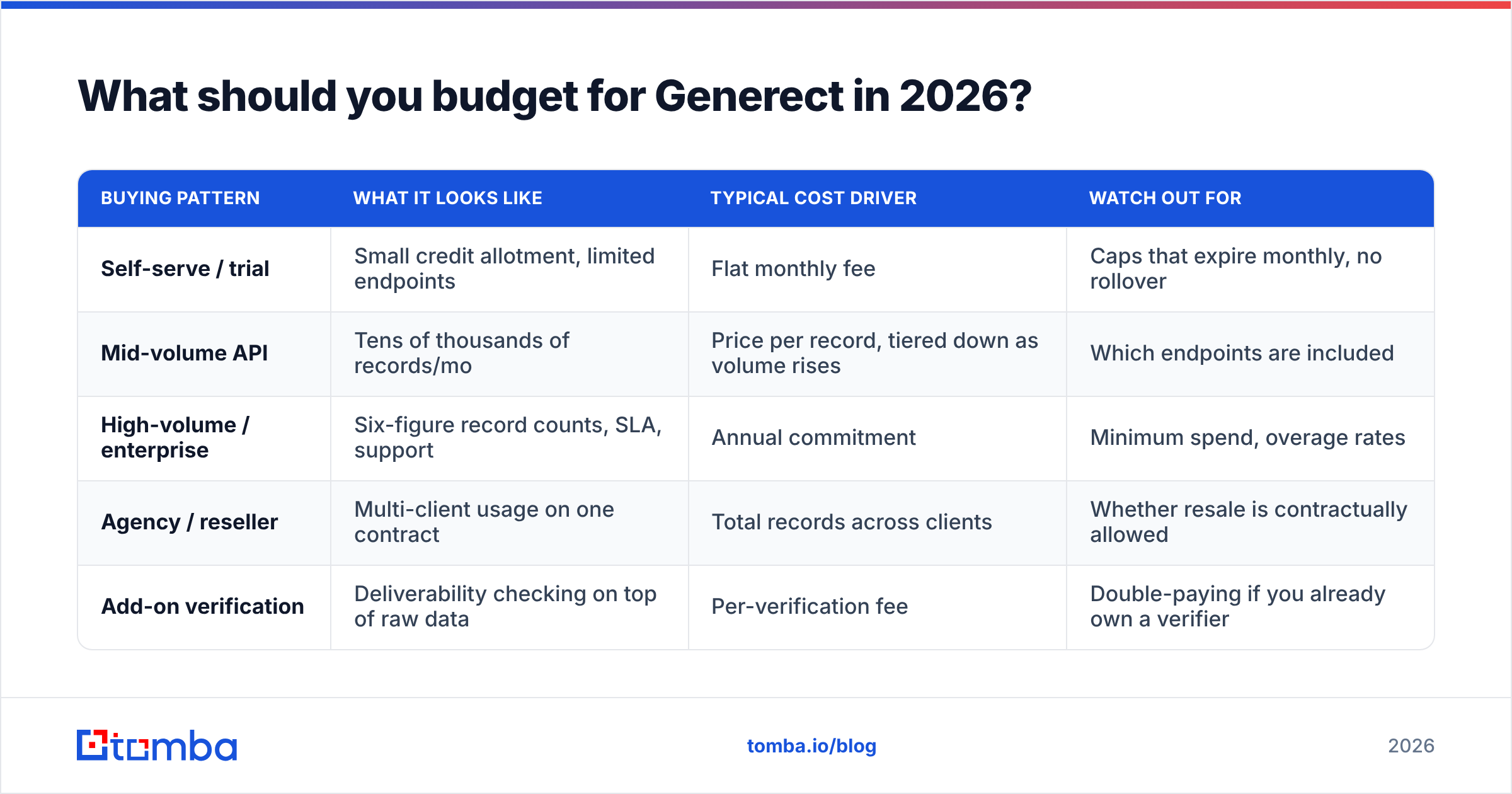
| Buying pattern | What it looks like | Typical cost driver | Watch out for |
|---|---|---|---|
| Self-serve / trial | Small credit allotment, limited endpoints | Flat monthly fee | Caps that expire monthly, no rollover |
| Mid-volume API | Tens of thousands of records/mo | Price per record, tiered down as volume rises | Which endpoints are included |
| High-volume / enterprise | Six-figure record counts, SLA, support | Annual commitment | Minimum spend, overage rates |
| Agency / reseller | Multi-client usage on one contract | Total records across clients | Whether resale is contractually allowed |
| Add-on verification | Deliverability checking on top of raw data | Per-verification fee | Double-paying if you already own a verifier |
Three questions to ask on the sales call, in this order:
- What is my effective cost per delivered record at my expected monthly volume? Not per credit. Per record I can actually use.
- What happens to unused volume? Rollover, forfeiture, or credit-back changes the real annual cost by 20-30% for spiky teams.
- Are emails verified at the point of delivery, or do I verify them myself? This single answer moves your true cost more than the headline price.
What does a lead really cost once you factor in accuracy?#
Cost per credit is marketing. Cost per deliverable contact is finance.
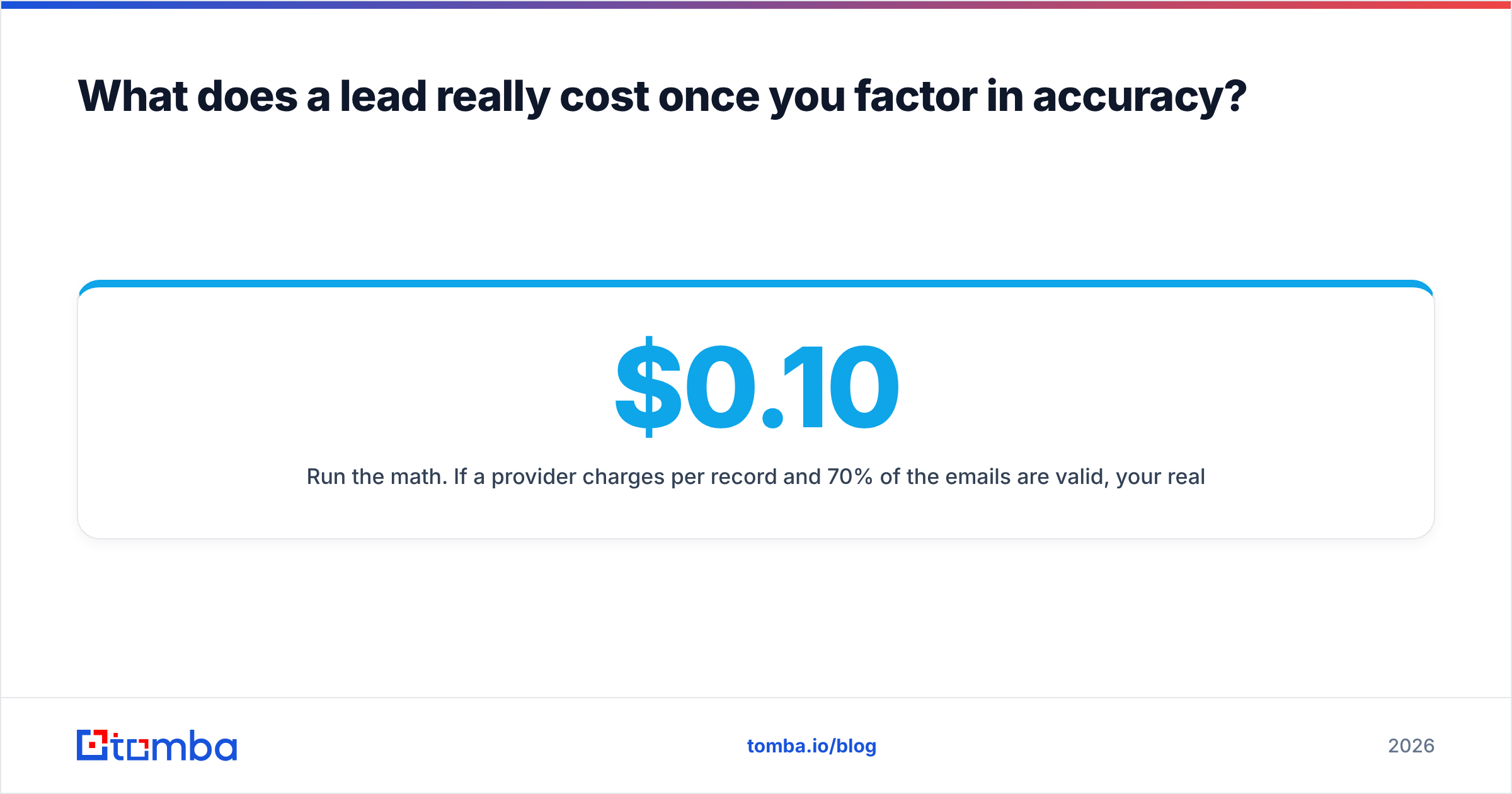
Run the math. If a provider charges $0.10 per record and 70% of the emails are valid, your real cost per usable email is $0.14 — plus whatever your verification step costs, plus the cost of the bounces that slipped through and dented your sender reputation. If a provider charges $0.15 per record at 95% valid, your real cost is $0.158 and your inbox placement stays intact. The "expensive" option is now roughly the same price and dramatically less risky.

This is where LinkedIn-sourced data needs a caveat. Profile data from LinkedIn is excellent for firmographics, titles, and headcount signals. It is not, by itself, an email source — work emails are inferred or matched from other datasets, then (hopefully) verified. Any vendor in this category is doing the same thing; the difference is how aggressively they verify before handing the record to you. Also worth reading: LinkedIn's own User Agreement governs automated collection, and your legal team will ask about it eventually.
Practical rule: whatever provider you pick, run the output through an independent email verifier before it touches a sending tool. Catch-all domains especially — those need a dedicated catch-all verifier, because a standard SMTP check returns "accept-all" and tells you nothing.
How does Generect pricing compare to the alternatives?#
Different tools solve different halves of the problem. Here's the honest split.
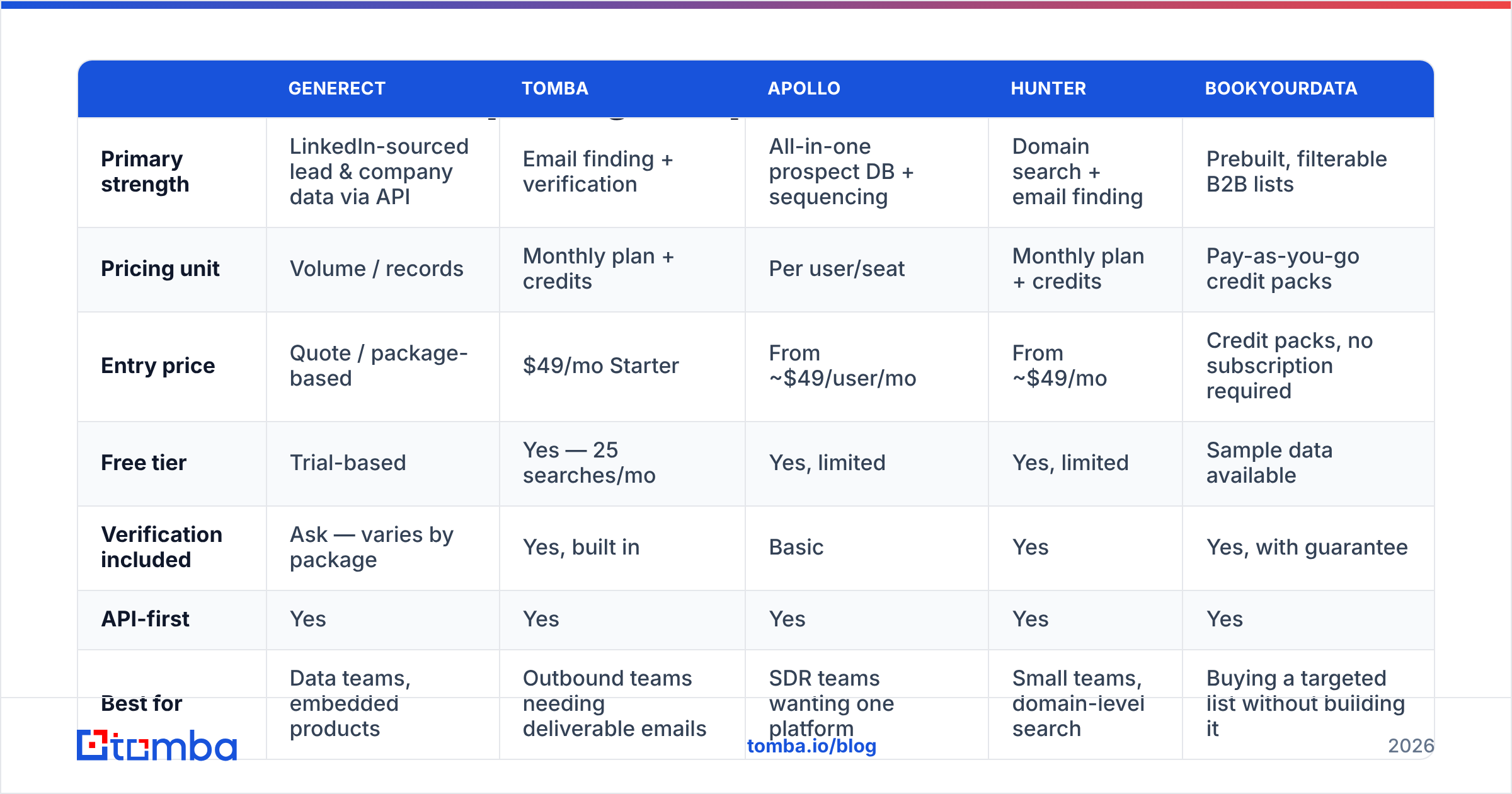
| Generect | Tomba | Apollo | Hunter | BookYourData | |
|---|---|---|---|---|---|
| Primary strength | LinkedIn-sourced lead & company data via API | Email finding + verification | All-in-one prospect DB + sequencing | Domain search + email finding | Prebuilt, filterable B2B lists |
| Pricing unit | Volume / records | Monthly plan + credits | Per user/seat | Monthly plan + credits | Pay-as-you-go credit packs |
| Entry price | Quote / package-based | $49/mo Starter | From ~$49/user/mo | From ~$49/mo | Credit packs, no subscription required |
| Free tier | Trial-based | Yes — 25 searches/mo | Yes, limited | Yes, limited | Sample data available |
| Verification included | Ask — varies by package | Yes, built in | Basic | Yes | Yes, with guarantee |
| API-first | Yes | Yes | Yes | Yes | Yes |
| Best for | Data teams, embedded products | Outbound teams needing deliverable emails | SDR teams wanting one platform | Small teams, domain-level search | Buying a targeted list without building it |

A few reads on that table:
Generect vs Tomba isn't really a fight — it's a division of labor. Generect is strongest when you want structured company and profile data flowing into your own system. Tomba is strongest when the deliverable is a verified work email you can send to tomorrow. Plenty of teams use a data provider for the account layer and an email finder for the contact layer.
Generect vs Apollo is the clearest pricing contrast. Apollo charges per seat with export caps; Generect charges per volume with no seat tax. If you have eight SDRs, Apollo's model gets expensive. If you have one ops person pulling data for eight SDRs, Generect's model is friendlier — though you lose the sequencing layer.
Generect vs BookYourData comes down to build versus buy. BookYourData is a solid choice when you want a targeted, verified list delivered now without wiring up an API — it's pay-as-you-go, which suits campaign-shaped budgets. Generect suits continuous, programmatic data needs.

What are the hidden costs in Generect pricing?#
Every data contract has line items that don't appear in the quote. These are the ones that bite:
- Verification you pay for twice. If your package includes verified emails and you also run a standalone verifier, you're paying two vendors for one outcome. Pick one source of truth.
- Unused volume. Outbound is seasonal. If January burns 40k records and July burns 4k, a flat annual commitment with no rollover quietly doubles your effective rate in the slow months.
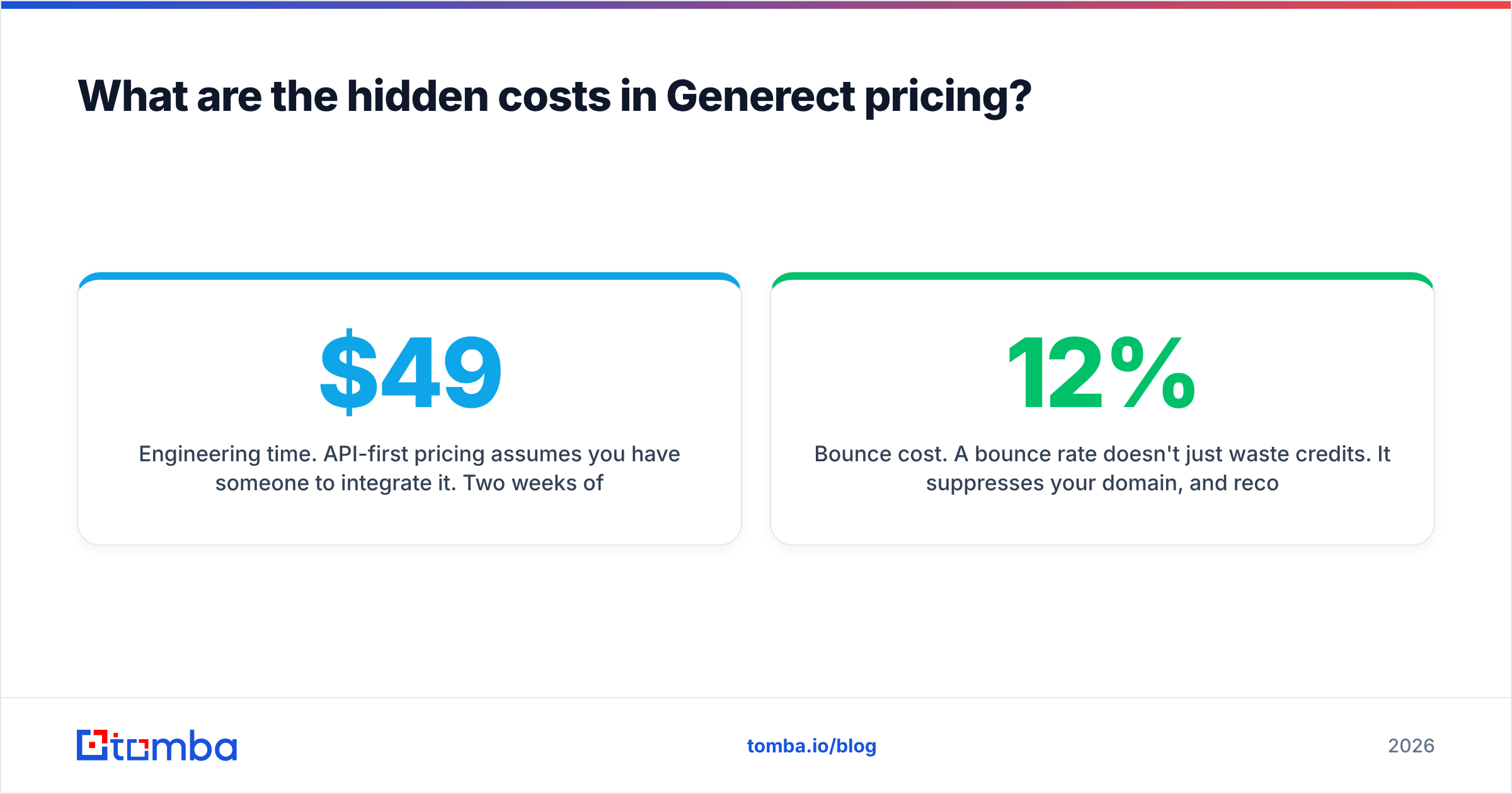
- Engineering time. API-first pricing assumes you have someone to integrate it. Two weeks of a developer's time is a real cost that a $49/mo point-and-click tool doesn't incur. If nobody on your team writes code, factor in an integration partner or pick a tool with a Google Sheets add-on and a Chrome extension instead.
- Overage rates. Ask what happens on record 100,001. Overage pricing is often 2-3x the tiered rate.
- Deduplication. If you're pulling from multiple providers, you'll pay for the same contact more than once unless you dedupe on ingest. A remove-duplicates step before enrichment is free and saves real money.
- Bounce cost. A 12% bounce rate doesn't just waste credits. It suppresses your domain, and recovering email deliverability takes weeks. That's the most expensive hidden line item of all.
Is Generect worth it for your team?#
Yes, if three things are true: you need LinkedIn-shaped data at volume, you have engineering capacity to consume an API, and your monthly record count is high enough that per-seat tools become absurd. In that scenario, volume pricing is the right model and Generect is a legitimate option worth quoting.
No, if you're a small outbound team whose actual bottleneck is "I have a list of 400 companies and I need the right person's verified email." That job is cheaper and faster with a dedicated finder. You don't need a wholesale contract to buy a week's groceries.
The middle case — most teams, honestly — is a hybrid. Use a data provider for account-level intelligence and firmographic filtering, then use an email finder with built-in verification for the contact layer. Run both through one enrichment pipeline so your CRM gets a single clean record.
If you go that route, the integration matters more than either vendor's price sheet. A Tomba API call slotted into the same pipeline that ingests your data provider's records keeps the whole thing to one workflow, and bulk processing handles the batch jobs without a per-row script.
How should you run the evaluation?#
Don't take anyone's word for accuracy, including this post. Run the same test against every vendor on your shortlist:
- Build a 200-row control set. Real target accounts, mixed company sizes, mixed geographies, including a few catch-all domains.
- Pull the same rows from each vendor. Record match rate — how many rows came back with a contact at all.
- Verify every result with a neutral third-party verifier. Not the vendor's own verifier. Record the valid rate.
- Calculate cost per verified contact. (Total spend ÷ verified contacts). This is your only real number.
- Send a small, warmed campaign and record the actual bounce rate. Vendors' "valid" and your ESP's "delivered" don't always agree.
- Score integration effort in hours. A 3% better match rate isn't worth 40 hours of engineering if you're a five-person team.
Most teams discover the ranking flips between step 2 and step 4. High match rate with mediocre verification loses to a lower match rate with clean data almost every time, because bounces cost more than misses.
The bottom line on Generect pricing#
Generect's volume-based model is genuinely better than seat pricing for data-heavy, engineering-capable teams — and genuinely worse for small teams who just want emails. The pricing page won't tell you which one you are. Your cost-per-verified-contact math will.
If your bottleneck is finding and verifying work emails rather than building a data pipeline, start with the Tomba Email Finder. The free tier gives you 25 searches a month to run your own accuracy test before spending anything, Starter is $49/mo, Growth is $99/mo, and verification is built in rather than billed separately — so the number on the invoice is close to your real cost per deliverable contact. Compare the tiers on Tomba pricing, run your 200-row control set, and let the bounce rate pick the winner.
Related guides#
Ready to find emails that actually work?
Join 150,000+ professionals who stopped guessing and started sending. Free credits on signup — no credit card required.
Get the Tomba newsletter
Practical outbound tactics and product updates — once every two weeks.
About the author